
MACGDI: Low Power MAC Based Filter Bank
Using GDI Logic for Hearing Aid Applications
N. Subbulakshmi
Sri Ramakrishna Engineering College, Coimbatore, India Email: [email protected]
R. Manimegalai
Park College of Technology, Coimbatore, India Email: [email protected]
Abstract—An electronic hearing aid is a small device which is located in and around the human ear to enhance the hearing ability. It is used to compensate the hearing loss and enhance the quality of sound for hearing impaired people. Hearing aid device in signal processing is an important field of research for the last three decades. Recently, power aware hearing aid device designs with smaller footprint, gain considerable importance. The hearing aid device has been designed for portable communication equipment with digital filtering, speech processing, sub-band coding and speech enhancement. With the technological advancements in the Digital Signal Processing (DSP) algorithms, design of hearing aid devices has been improved continuously. It is expected that more innovations in hearing aid device technology will be released in future, with new developments in signal processing algorithms and filter bank designs. Finite Impulse Response (FIR) filter design is very important and crucial for signal processing algorithms. The focus of the designer is on minimization of power on the domain of digital circuit for battery operated devices. In this paper, Gated Diffusion Input (GDI) logic is used in the proposed Filter Bank design in order to minimize power. The Multiply-Accumulate (MAC) unit of the proposed filter bank is designed by GDI logic and modified GDI logic. GDI logic has three terminals which are Common Gate (G), PMOS (P), NMOS (N) and output terminal. The number of transistors is reduced in GDI when compared to Complementary Metal Oxide Semiconductor (CMOS) logic due to reduced switching activity. This paper briefly describes the basic functions of power and delay of GDI logic and modified GDI logic. The proposed modified GDI logic provides better results in area and power when compared to CMOS logic.
Index Terms—filter bank, digital hearing aid, DSP algorithms, multiply accumulate unit
I. INTRODUCTION
With the advanced technology and an increasing trend towards portable computing and wireless communication, low power designs have gained importance. Finite Impulse Response (FIR) filtering is one of the most commonly used DSP functions. It is achieved by
Manuscript received February 16, 2017; revised June 28, 2017.
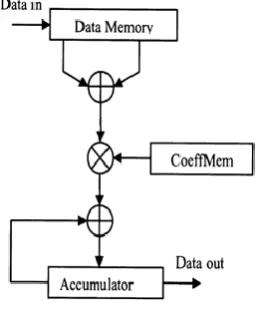
convolving the input data samples with the desired unit impulse response of the filter. The front end of a typical hearing aid device consists of two microphones for noise suppression. First microphone contains speech and noise. The other is for producing reference signal which is passed through a filter. Then, it is subtracted from the delayed version of the input signal. Fig. 1 shows the block diagram of a MAC based filter which includes Data memory, Coefficient memory, MAC unit, output register and a control unit [1]. Data memory provides data samples to the filter bank. The co-efficient memory has fixed values.
Modified Gate Diffusion Input logic is much more power-efficient than Gate Diffusion Input (GDI) logic and CMOS logic design. DC and Transient analysis are performed on modified GDI logic circuit designs and a wider range of different logic cells. The use of practical circuit realizations reveal modified GDI is advantageous over GDI and CMOS in majority of the cases with respect to speed, area and power dissipation.
Rest of the paper is organized as follows: Section II presents the Folded Direct Form (FDF) structure. Section III presents details of CMOS, GDI and Modified GDI logic styles. Section IV focuses on the proposed MAC based Filter bank using GDI for hearing aid devices. Section V presents the experimental results obtained using the proposed MAC based filter bank design by employing GDI logic. Finally, Section VI concludes the paper.
II. FDFFILTER STRUCTURE
Access Memory (RAM). A dual-port memory and an additional adder would be required to access two data samples at a time and to add them prior to the multiplication stage. The arithmetic block performs fixed-point computation on numbers which represent in 2’s complement form.
The proposed filter structure includes a multiplier and an adder / subtractor connected to the accumulator so as to be proficiently perform the Multiply-Accumulate (MAC) operation. After adding two data samples the resultant is converted into Sign Magnitude representation. Then, the output is multiplied with the corresponding co-efficient. After that the multiplied value is again transformed to 2’s complement form for further processing. The output is added with the accumulator value and then it is taken as final output i.e. data output. After every computation a new data sample is read and stored in the output memory. In order to get the new data sample, the existing data samples need to be shifted by one position for every output. This operation is done by MAC unit.
III. LOGIC STYLES:CMOS,GDI AND MODIFIED GDI LOGIC
Many logic styles have been introduced in the DSP algorithms such as (i) Complementary Metal Oxide Semiconductor (CMOS) (ii) Transmission Gates (iii) Complementary Pass Transistor logic (iv) Double Pass
Transistor logic (v) Swing Restored Pass Transistor (vi) Power saved Pass Transistor. Transmission Gates are used to realize complex functions with minimum number of complementary transistors. Pass Transistor Logic (PTL) is a method to achieve minimum number of transistors in the design. But PTL has the disadvantage of having low speed in smaller circuits. In this section, CMOS, GDI and modified GDI logic styles are presented and compared with many functions.
A. CMOS
Complementary Metal Oxide Semiconductor (CMOS) is a logic style for designing integrated circuits. CMOS is constructed by combining a PMOS transistor which has strong 1 and an NMOS transistor which has strong 0. The PMOS transistors are getting input from the voltage source (VDD). Similarly, the NMOS transistors are getting an input from the ground (GND). A PMOS transistor contains low resistance between its source and drain contacts when a low gate voltage is given and high resistance when a high gate voltage is applied. However, an NMOS transistor produces high resistance between source and drain when a low gate voltage is applied and low resistance when a high gate voltage is applied.
A logic AND gate is a category of digital logic gate. In CMOS logic, AND gate is designed using six transistors which include three PMOS transistors and three NMOS transistors. The Boolean function for an AND gate is set as (A.B = D). The above expression has two inputs A and B and the output is D. If inputs A and B are low, the output D will be low. If A input is low and B input is high, the output D will be low. If input A is high and input B is low, the output D will be low. If both A and B inputs are high, the output D will be high. CMOS XOR gate comprises of two inverters and two transmission gates. The inverter produces reverse value of the input i.e. 0 to 1 and vice versa. The transmission gate produces the output depends on the input applied. For XOR gate the Boolean function is D= A'B+AB', consider two inputs A and B in the design of CMOS logic: if both the inputs A and B are low, the output D will be low. If both the inputs A and B are high, the output D will be low. If one of the inputs is high and other input is low, the output D will be high.
Multiplexer (MUX) is designed with the help of a control signal which is also called as a select signal. It selects one of the input signals and that input signal is forwarded into a output line. A multiplexer is a ratio of 2n:n, where 2n represents the number of inputs and n represents the number of outputs. MUX consists of 12 transistors in the CMOS logic. It has six PMOS and six NMOS transistors. MUX output depends on the selection signals. Consider 2×1 Multiplexer which has 2 inputs and 1 output and it has 1 selection line. Consider, if selection line is high, it selects input A and if selection line is low it selects input B.
B. GDI
Gated Diffusion Input (GDI) logic is a basic cell [2], [3] with four terminals as shown in Fig. 3. Table I shows that the basic logic functions using GDI logic. The GDI logic
Figure 1. Block diagram of MAC based filter structure
cell has some important differences when compared to CMOS logic inverter.
Gated Diffusion Input (GDI) includes three terminals as inputs: (i) Gate (G) which is common for both PMOS and NMOS (ii) the input of PMOS for source / drain (iii) the input of NMOS for source and drain.
Sources of both PMOS and NMOS are not connected to supply voltage (VDD) and ground (GND) respectively.
Bulk of PMOS in a GDI cell is connected with P and Bulk of NMOS is connected with N.
Figure 3. Basic GDI cell [3]
TABLE I. BASIC LOGIC FUNCTIONS USING GDI
PMOS P
NMOS N
GATE
G OUTPUT D
FUNCTIONS
1 0 A A' Inverter B 0 A A'B Function1 1 B A A'+B Function2 B 1 A A+B OR 0 B A AB AND
B C A A'B+AC MULTIPLEXER B B' A A'B+AC' XOR
B' B A A'B'+AC XNOR
Table II presents number of transistors.
TABLE II. NUMBER OF TRANSISTORS
Function CMOS GDI Inverter 2 2 Function1 6 2 Function2 6 2
OR 6 2
AND 6 2
MUX 12 2 XOR 16 4 XNOR 16 4 NAND 4 4
NOR 4 4
C. Modified GDI
In Modified GDI technique, PMOS substrate terminal (Psub) is connected to the supply voltage and NMOS substrate terminal (Nsub) is connected to the ground. Modified GDI cell can be configured with all current
CMOS technologies. Table III shows various logic functions that can be implemented using modified GDI. Fig. 4 shows the basic cell structure of modified GDI logic [3].
Figure 4. Basic modified GDI cell [3]
TABLE III. FUNCTIONS OF MODIFIED GDI N Nsub P Psub G Output
D
Functions 0 0 1 1 A A' Inverter A A 0 A B AB AND
1 0 A D B A+B OR A' 0 A 1 B A'B+AB' XOR A 0 A' 1 B AB+A'B' XNOR
Table IV represents the switching delay and average power of various logic functions such as AND, OR, NAND, NOR and XOR using GDI, modified GDI and CMOS logic styles. Observing the table values, the modified GDI logic achieves comparatively less power and minimum switching delay than GDI and CMOS logic. Low power optimization techniques have been discussed in many papers [4], [5], [6] and [7]. The full swing GDI technique is discussed in [8]-[11].
TABLE IV. COMPARISONS BASED ON DELAY AND POWER
Functions
GDI Modified GDI CMOS
Delay (ps)
Power (μW)
Delay (ps)
Power (μW)
Delay (ps)
Power (μW)
AND 0.2 1.286 0.18 0.986 0.24 1.698 OR 0.28 1.3 0.18 1.2 0.27 1.550 NAND 0.52 0.657 0.242 0.54 0.28 0.604 NOR 0.54 0.68 0.28 0.654 0.3 0.756 XOR 0.545 1.48 0.362 1.23 0.567 1.5
IV. PROPOSED MAC BASED FILTER BANK FOR
DIGITAL HEARING AIDS
Figure 5. Block diagram of MAC unit
The multiplication and accumulation arithmetic determines the execution speed and performance of the entire calculation. Multiplication-and-accumulate operations are typical design for digital filters. Therefore, the functionality of MAC unit enables high speed filtering and other processing applications. Since the MAC unit operates completely independent of the Computer Processing Unit (CPU), it can process data separately and thereby decreases the CPU load. The MAC unit consists of a multiplier followed by an adder and an accumulator register which stores the result. The multiply accumulate unit computes the product of two numbers and adds that product to an accumulator as shown in Fig. 5.
V. RESULTS AND DISCUSSIONS
GDI and modified GDI logic is implemented on the proposed MAC based filter bank for hearing aid. Fig. 6 shows the simulation of MAC unit using modified GDI logic. The selection input is initially applied as 0 and the MUX selects the inputs A0, B0, A1, B1, Q and QQ. Then the input is applied as 1 for A0, 0 for B0, 1 for A1, 1 for B1, 0 for Q input and 1 for QQ input. Half adder performs the addition operation and produces sum and carry. The Sum (S0) output appeared in the simulation is high and the Carry (C0) output obtained in the simulation is low for the given inputs A0 and B0. For the inputs A1 and B1, sum S1 is obtained as high and C1 is obtained as low. For the inputs Q and QQ, sum (Sout) is obtained as high and Carry (Cout) is obtained as low. The parameters such as area and power dissipation are being compared and the results are tabulated. Table V shows that the modified GDI logic consumes minimum power and area when compared to the CMOS logic and GDI logic. The GDI logic consumes 67% of area than CMOS logic. The modified GDI logic has 35% area reduction than GDI logic. GDI logic consumes the power of 91% than CMOS logic.
TABLE V. FILTER IMPLEMENTATION RESULTS
PARAMETERS CMOS LOGIC GDI LOGIC MODIFIED GDI LOGIC
AREA 129 transistors 45 transistors 29 transistors POWER
DISSIPATION
31.065 (μW)
2.660 (μW)
1.3883 (nW)
Figure 6. Simulation results of modified GDI logic
VI.CONCLUSIONS
Filter bank consumes more power and occupies large area in the hearing aid device. To address this issue Gated Diffusion Input (GDI) logic is used in the proposed Filter Bank. The MAC unit of the proposed filter bank is designed by GDI logic and modified GDI logic. GDI logic has three terminals which are Common Gate (G), PMOS (P) / NMOS (N) and output terminal. The number of transistors is reduced when compared to Complementary Metal Oxide Semiconductor (CMOS) logic. Hence, it reduces the number of switching and power dissipation. In this paper, the GDI logic is found to be an efficient implementation than CMOS logic by various comparisons. This paper briefly describes the basic functions of power and delay of GDI logic and modified GDI logic. The layout of the MAC unit is presented in this paper. In the future work, the MAC unit design can be suggested using other logics such as pass transistor logic and transmission gate logic.
REFERENCES
N Subbulakshmi is an Assistant Professor in the Department of Electronics and Communication Engineering at Sri Ramakrishna Engineering College, Coimbatore. She has teaching experience of 6 years. She has completed her post graduate in VLSI Design from Francis Xavier Engineering College, Anna University in the year 2010 and completed her under graduate degree in Electronics and Communication Engineering from Infant Jesus college of Engineering, Anna University in the year 2006. Currently she is Pursuing Ph.D. in the domain of Low power VLSI Design in Anna University of Technology, Coimbatore. She had published papers in 03 National Conferences, 2 International Conferences and 2 International Journals. She has guided PG and UG students Projects in Low Power VLSI, Wireless Communication and Embedded Systems. Her areas of interest include VLSI Design and VLSI Signal Processing.
Dr. R Manimegalai has done PhD in the Department of Computer Science and Engineering, IIT Madras. She is also an alumnus of PSG College of Technology and College of Engineering Guindy, Anna University where she has done her UG and PG respectively.
She has more than twenty years of industry and teaching experience. Currently she is working as Professor and Research Director with Park College of Engineering and Technology, Kaniyur, Coimbatore. She holds life membership in several professional societies such as Computer Society of India, Institution of Engineers (India) and Indian Society for Technical Education. She also holds memberships in IEEE, ACM and VLSI society of India. Her areas of interest include Reconfigurable Computing, VLSI / FPGA Algorithms and Distributed Systems. She has widely published in journals and conferences and is guiding several PhD research scholars through Anna University, Chennai.
[2] R. Uma and P. Dhavachelvan, “Modified gate diffusion input technique: A new technique for enhancing performance in full adder circuits,” in Proc. 2nd International Conference on Communication, Computing & Security, 2012.
[3] A. Morgenshtein, A. Fish, and I. A. Wagner, “Gate-Diffusion Input (GDI): A power-efficient method for digital combinatorial circuits,” IEEE Transactions on Very Large Scale Integration (VLSI) Systems, vol. 10, no. 5, October 2002.
[4] Kunal and N. Kedia, “A power efficient method for digital circuits,” vol. 1, no. 3, 2012.
[5] F. Carbognani, F. Buergin, N. Felber, H. Kaeslin, and W. Fichtner, “42% power saving through glitch reducing clocking strategy in a hearing aid application,” inProc. IEEE International Symposium on Circuits and Systems, vol. 4, pp. 2941-2944, May 2006.
[6] M. Mehendale, S. D. Sherlekar, and G. Venkatesh, “Low power realization of FIR filters on programmable DSPs,” IEEE Transactions on VLSI Systems, vol. 6, no. 4, pp. 546-553, December 1998.
[7] A. P. Chandrasekaran and R. W. Broderson, “Minimizing power consumption in digital CMOS circuits,”Proceedings of IEEE, vol. 83, no. 4, pp. 498-523, April 1995.
[8] A. Morgenshtein, V. Yuzhaninov, A. Kovshilovsky, and A. Fish, “Full-Swing gate diffusion input logic—Case-study of low-power CLA adder design,” in Proc. INTEGRATION, 2013, pp. 62-70. [9] S. Chen, B. Mulgrew, and P. M. Grant, “A clustering technique
for digital communications channel equalization using radial basis function networks,” IEEE Trans. on Neural Networks, vol. 4, pp. 570-578, July 1993.
[10] J. U. Duncombe, “Infrared navigation—Part I: An assessment of feasibility,” IEEE Trans. Electron Devices, vol. ED-11, pp. 34-39, Jan. 1959.
[11] C. Y. Lin, M. Wu, J. A. Bloom, I. J. Cox, and M. Miller, “Rotation, scale, and translation resilient public watermarking for images,”
![Fig. 4 shows the basic cell structure of modified GDI logic [3].](https://thumb-us.123doks.com/thumbv2/123dok_us/9944727.1982091/3.595.343.500.133.263/fig-shows-basic-cell-structure-modified-gdi-logic.webp)

