Research Article Open Access
Efforts to Reach More Children with Effective Vaccines Through Routine
Immunization in The WHO African Region: 2013-2015
Blanche Anya*, Joseph Okeibunor, Richard Mihigo, Alain Poy, Felicitas Zawaira WHO Regional Office for Africa, Brazzaville, Congo
Article Info Article Notes Published: August 02, 2018 *Correspondence:
Dr. Blanche Anya, WHO Regional Office for Africa, Brazzaville, Congo; Telephone no: +242 06 887 1950; Email: [email protected]
© 2018 Blanche A. This article is distributed under the terms of the Creative Commons Attribution 4.0 International License. Keywords:
Routine Immunization Vaccines
African Region
ABSTRACT
Background: Some progress has been made in expanding immunization in the African Region over the last four decades. However, an estimated 22%
of the eligible children in the African Region, located in four countries of the
African Region (Democratic Republic of the Congo, Ethiopia, Nigeria and South Africa), continue to miss vaccination services for various reasons. This paper documents the status of routine immunization in the African Region.
Methods: Programme records, reports and statistics were reviewed for
this paper.
Results: Challenges remain in reaching an estimated 20–30% of children across the Region. In addition to the traditional vaccines (DTP, measles, polio
and tuberculosis) newer ones, such as for Pneumococcal conjugate vaccine
(PCV) and rotavirus, are being rolled out in the Region but uptake and coverage
are slow and patchy both within and between countries.
Conclusion: The new regional strategic plan for immunization 2014–2020 is intended to provide policy and programmatic guidance to Member States, in line with the 2011–2020 Global Vaccine Action Plan (GVAP), in order to optimize immunization services and assist countries to further strengthen their immunization programmes.
Introduction
Vaccination remains one of the greatest public health accomplishments in protecting lives. It has been credited with
significant reduction incidence of most vaccine-preventable
diseases, therefore contributing to the reduction of morbidity and mortality due to vaccine preventable diseases1-6. Smallpox, a human and disease and rinderpest, which affect livestock, were eliminated through broad immunization with effective vaccines7. In the African
Region, immunization programmes have recorded remarkable successes in delivering effective vaccines and ensuring equitable vaccination of the populations irrespective of social location, class, ethnicity or religion. Immunization coverage rates have shown upward trends over the years and access has increased remarkably even in previously hard to reach populations. Following global, regional and national efforts in the promotion of immunization, DTP3 coverage, the acknowledged indicator of the performance of
immunization programmes, rose from 5% in 1980 to 76% in 2015
in the African Region8-10.
There has also been significant progress in the introduction of new and under-utilized vaccines in Africa10. Currently, many more
Blanche A, Okeibunor JC, Mihigo R, Poy A, Zawaira F. Efforts to Reach More Children with Effective Vaccines Through Routine Immunization in The WHO African Region:
2013-2015. J Immunol Sci (2018); S (008): 55-62 Journal of Immunological Sciences
associated with childhood and adolescence, such as pneumonia, diarrhoea, yellow fever, measles and human
papillomavirus (HPV). By 2012, 81% (27/33) of the
countries at the risk for yellow fever had introduced the vaccination into their Expanded Programme on Immunization (EPI) schedules11, compared to 27% (9/33) in 20009.
Pneumococcal conjugate vaccine (PCV) and rotavirus
vaccines had been introduced in 37 and 29 of the 47 Member States as of the end of 2015, respectively. Meningitis A vaccine has been introduced since 2010 in campaigns in 16 countries of the meningitis belt in the African Region, with nearly 260,000,000 persons
vaccinated since its introduction (WHO AFRO database
2015). Surveillance for diseases targeted by these new
vaccines has been strengthened in all countries as part of monitoring disease trends and vaccine impact.
The strengthened disease surveillance has shown a
decrease in the burden of vaccine-preventable diseases
(VPD) as illustrated by the decline in the incidence of meningitis due to Neisseria meningitidis serotype A. As of
December 2015 there has been no laboratory confirmed
case of meningococcal A meningitis among vaccinated persons. Therefore, the Region is on course towards achieving the goal of eliminating meningococcal meningitis A outbreaks as a major public health problem.
Associated with immunization also is the eradication, elimination and control of VPDs in the Region. A clear case is the successful interruption of wild polioviruses (WPV) transmission in the Region12. With the use of effective vaccines, the last reported cases of the WPV
types 2 and 3 were made in 1998 and 2012, respectively. Between 2000 and 2014, the number of African countries endemic with the WPV1 decreased from 12 to one. New WPV cases reported in 2012 decreased by 63%, with 128 cases in four countries (Nigeria, Cameroon, Guinea and Ethiopia) compared to 350 cases in 12 countries in 201113. By July 2014, Nigeria, the only country endemic with the
transmission of WPV in the Region, recorded its last WPV case and was removed from the list of endemic countries
in 2015.
Similar successes have been recorded against other VPDs. This is the case for measles and maternal and
neonatal tetanus elimination. As of December 2015, a total of 36/47 countries in the region had eliminated maternal
and neonatal tetanus.
There has been 78% decline in measles case reports
since 2000, from a reported number of 520,102 in the year 2000 to 113,938 in 2015. (African Regional Measles Elimination Status Report, August 2016, IVD, AFRO).
However, there was a sharp increase in reported cases
between the years 2010 – 2011, owing to the various
outbreaks reported across the Region, especially in southern African countries. These outbreaks were mainly driven by a shift of epidemiological susceptibility to older
age groups. The increase in the case reports noted in 2012 and 2013 represents large outbreaks documented in DR Congo and Nigeria, which contributed 88,381 and 52,852 cases respectively in 2013, amounting to 83% of the total
171,178 cases reported in that particular year. Between
2000 and 2014, the estimated reduction in measles deaths has been 86% for the African region, from an estimated 342,000 deaths in 2000 (95% confidence interval between 225,400 – 574,200) to an estimated 48,000 deaths in 2014 (95% confidence interval between 41,600 – 165,000).
This paper documents progress made in the delivery of a wide range of vaccines in the Region using strategies
enshrined in the Global Vaccine Action Plan (GVAP) as well as the Regional Immunization Strategic Plan (RISP): 2014-2020.
Methods
We conducted detailed review of country WHO and
UNICEF estimates of immunization coverage data released in July 2015, as the major data source for this paper. We
also reviewed programmes reports and records over the period. The analysis employed mainly descriptive statistics to show trends in coverage with the different vaccine
antigens in the Region. Tables and figures were also used to illustrate some of the findings in the review.
Coverage during the period 2013-2015
The 2015 World Health Organization (WHO) and United Nations Children’s Fund (UNICEF) Estimates of National Immunization Coverage (WUENIC) revealed that
Regional coverage for DTP3 containing vaccine increased
from 76% to 77% between 2014 and 2015. An estimated 24.96 million children were vaccinated with DTP3 in 2015 compared to 23.98 million in 2014. A total of 16 countries reached ≥90% coverage compared to 18 in 2014, and
coverage increased in 17 countries including in four of the six priority countries (Chad, Ethiopia, the Democratic
Republic of Congo [DRC], and Nigeria). Similarly, two of
the countries, Liberia and Sierra Leone, which experienced recent disruption of their public health systems due to Ebola virus outbreak increased their coverage. Other
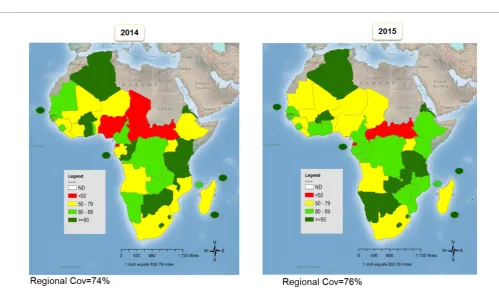
countries are (Benin, Cote d’Ivoire, Eritrea, Ethiopia, Gabon, Gambia, Mozambique, Namibia, Nigeria, Sao Tome, Togo, Tanzania and Zambia (Figure 1 and 2). However, a decrease in the coverage was recorded in 16 countries, including the
countries with disruption of their health systems due to
persistent internal conflict like South Sudan. Others, such
Source: WHO/UNICEF estimates for 2015, July 2016 release
http://apps.who.int/immunization_monitoring/globalsummary/timeseries/tswucoveragedtp3.html
Figure 1: Regional coverage of 3rd dose of Diphtheria Tetanus Pertussis Containing vaccine 2014 and 2015
Blanche A, Okeibunor JC, Mihigo R, Poy A, Zawaira F. Efforts to Reach More Children with Effective Vaccines Through Routine Immunization in The WHO African Region:
2013-2015. J Immunol Sci (2018); S (008): 55-62 Journal of Immunological Sciences
(CAR), Equatorial Guinea and South Sudan remained below
50% for both years.
A comparative analysis of the 2015 DTP3 coverage,
using administrative data from Countries Joint Reported
Form (JRF) and WHO-UNICEF Estimates of National Immunization Coverage (WUENIC), revealed similar coverage in 27 countries. The WUENIC for Botswana,
Kenya and Lesotho was higher than the administrative data highlighting possible underreporting from the national administrative system. A comparison of the two datasets in 17 countries revealed gaps between these two sources of data with administrative data reporting higher coverage
than what was seen in WUENIC. The highest gap (≥20 points) was observed in Chad, Niger, South Africa, and Mali. Moderate gap (>10 and <20) was observed in South Sudan, Nigeria, Madagascar, DRC, Liberia, Ethiopia, Guinea Bissau and Uganda. Minor gap (≥3 and <10) was observed in Guinea, Zimbabwe, Cote d’Ivoire.
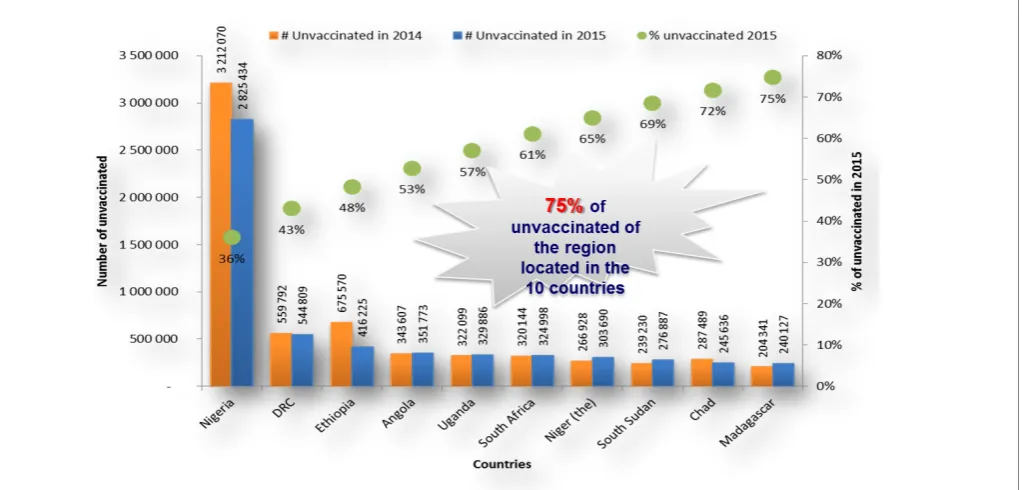
Furthermore, the data revealed that an estimated 7.84
million children were not reached with DTP3 in 2015 compared to 8.2 million in 2014, translating into about 4.3
percentage point reduction in the number of unreached children between the two periods. Approximately 75% of these children are located in 10 countries, with 57% in 5
countries - Nigeria, DRC, Ethiopia, Angola and Uganda as
shown in Figure 3. Five of the ten countries with a high number of unreached children are among the priority countries in the African Region, which are being supported in the development and implementation of national
immunization coverage improvement plans with specific
strategies to reach the unreached children. These are collaborative efforts with other immunization partners.
Similar to the increase in DTP3 coverage, coverage with 1st dose of Measles-Containing Vaccine (MCV1) and 3rd dose
of oral polio (OPV3) vaccines have been on a steady rise since 1980 (Figure 4). On immunization against measles,
the Region achieved a significant increase in the first dose measles vaccination (MCV1) coverage between 2001 (54% MCV1 coverage WUENIC) and 2009 (73% MCV1 coverage WUENIC). However, Regional MCV1 coverage levels stagnated around 71 – 74% between the years 2009– 2015. This trend is also reflected in the number of countries
achieving 90% or more coverage, which increased from only
4 in 2000 to 17 in 2010. In 2015 only 12 countries achieved or maintained MCV1 coverage of 90% or more. Only 12 countries in the Region reached 90% coverage for the first
dose of MCV1 while 11 countries sustained 90% coverage
during the 2 years. These include Algeria, Botswana,
Burundi, Cape Verde, Gambia, Lesotho, Mauritius, Rwanda,
Sao Tome et Principe, Seychelles, Tanzania, and Zambia. In
16 countries, MCV1 coverage decreased between 2014 and 2015 with a significant decrease (>5 points) in 7 countries. Three of these countries (CAR, Equatorial Guinea, and
South Sudan) reported coverage below 50% for both years. Moreover, few of the countries with large populations,
as well as the countries with challenging infrastructure/ programme gaps like Ethiopia, DR Congo, Nigeria, Chad,
Madagascar, South Africa, have not been able to improve MCV1 coverage levels in the past 5 years substantially. The
MCV1 coverage levels for the years 2011 – 2015 (WUENIC)
in the six countries that make up half (53%) of the Region’s
population shows that only Tanzania has managed to attain and maintain high coverage.
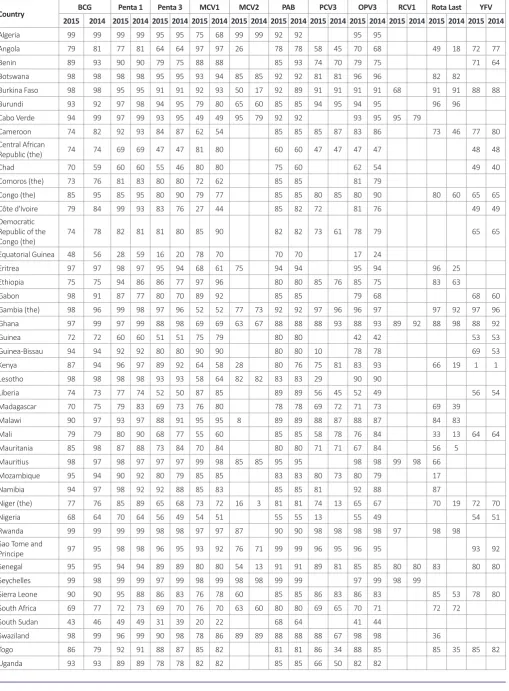
An analysis of coverage data on all antigens in the Region is shown in Table 1. The Region is seen to be attaining
below 90% coverage on all nine antigens reported for 2015.
However, unlike in the past, some countries in the Region, such as Algeria and Rwanda have achieved the objective
of ≥90% on all antigens delivered in the country. Other countries, such as Burundi, Gambia, Ghana, Mauritius and
Sao Tome and Principe, have achieved the objectives of
≥90% national coverage on all but one antigen.
Failure to meet the vaccination objectives is attributed in
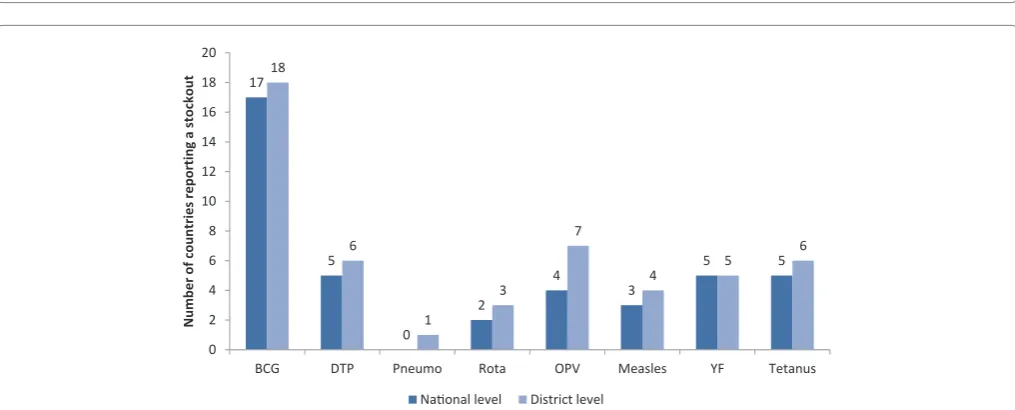
part to vaccine stock-outs. Figure 5 shows that in the 2015 JRF, two-fifths of the countries (19/47) in the Region reported at least one episode of stock-out for a duration of at least one week. BCG vaccine has been the most affected antigen for stock-out (19 countries), followed by OPV and DTP-containing vaccine and Tetanus toxoid (6 countries). Most of the
stock-outs at district level were due to unavailability of vaccines
at the national level. Stock-outs at the district level have
probably contributed to the interruption of vaccination at
peripheral levels and consequently to the non-achievements
of the set objectives in many countries.
Figure 4: Regional coverage with 1st and 3rd dose of Diphtheria, Tetanus Pertussis containing vaccine (DTP3), 3rd dose of Oral Polio
Vaccine ()OPV3, 1st dose of Measles Containing Vaccine, (MCV1) and 1980 - 2015
17
5
0
2
4
3
5 5
18
6
1
3
7
4 5
6
0 2 4 6 8 10 12 14 16 18 20
BCG DTP Pneumo Rota OPV Measles YF Tetanus
tu
okc
ots
a g
nitr
op
er s
eirt
nu
oc f
o r
eb
mu
N
Na�onal level District level
Blanche A, Okeibunor JC, Mihigo R, Poy A, Zawaira F. Efforts to Reach More Children with Effective Vaccines Through Routine Immunization in The WHO African Region:
2013-2015. J Immunol Sci (2018); S (008): 55-62 Journal of Immunological Sciences
Country BCG Penta 1 Penta 3 MCV1 MCV2 PAB PCV3 OPV3 RCV1 Rota Last YFV
2015 2014 2015 2014 2015 2014 2015 2014 2015 2014 2015 2014 2015 2014 2015 2014 2015 2014 2015 2014 2015 2014
Algeria 99 99 99 99 95 95 75 68 99 99 92 92 95 95
Angola 79 81 77 81 64 64 97 97 26 78 78 58 45 70 68 49 18 72 77
Benin 89 93 90 90 79 75 88 88 85 93 74 70 79 75 71 64
Botswana 98 98 98 98 95 95 93 94 85 85 92 92 81 81 96 96 82 82
Burkina Faso 98 98 95 95 91 91 92 93 50 17 92 89 91 91 91 91 68 91 91 88 88
Burundi 93 92 97 98 94 95 79 80 65 60 85 85 94 95 94 95 96 96
Cabo Verde 94 99 97 99 93 95 49 49 95 79 92 92 93 95 95 79
Cameroon 74 82 92 93 84 87 62 54 85 85 85 87 83 86 73 46 77 80
Central African
Republic (the) 74 74 69 69 47 47 81 80 60 60 47 47 47 47 48 48
Chad 70 59 60 60 55 46 80 80 75 60 62 54 49 40
Comoros (the) 73 76 81 83 80 80 72 62 85 85 81 79
Congo (the) 85 95 85 95 80 90 79 77 85 85 80 85 80 90 80 60 65 65
Côte d'Ivoire 79 84 99 93 83 76 27 44 85 82 72 81 76 49 49
Democratic Republic of the
Congo (the) 74 78 82 81 81 80 85 90 82 82 73 61 78 79 65 65
Equatorial Guinea 48 56 28 59 16 20 78 70 70 70 17 24
Eritrea 97 97 98 97 95 94 68 61 75 94 94 95 94 96 25
Ethiopia 75 75 94 86 86 77 97 96 80 80 85 76 85 75 83 63
Gabon 98 91 87 77 80 70 89 92 85 85 79 68 68 60
Gambia (the) 98 96 99 98 97 96 52 52 77 73 92 92 97 96 96 97 97 92 97 96
Ghana 97 99 97 99 88 98 69 69 63 67 88 88 88 93 88 93 89 92 88 98 88 92
Guinea 72 72 60 60 51 51 75 79 80 80 42 42 53 53
Guinea-Bissau 94 94 92 92 80 80 90 90 80 80 10 78 78 69 53
Kenya 87 94 96 97 89 92 64 58 28 80 76 75 81 83 93 66 19 1 1
Lesotho 98 98 98 98 93 93 58 64 82 82 83 83 29 90 90
Liberia 74 73 77 74 52 50 87 85 89 89 56 45 52 49 56 54
Madagascar 70 75 79 83 69 73 76 80 78 78 69 72 71 73 69 39
Malawi 90 97 93 97 88 91 95 95 8 89 89 88 87 88 87 84 83
Mali 79 79 80 90 68 77 55 60 85 85 58 78 76 84 33 13 64 64
Mauritania 85 98 87 88 73 84 70 84 80 80 71 71 67 84 56 5
Mauritius 98 97 98 97 97 97 99 98 85 85 95 95 98 98 99 98 66
Mozambique 95 94 90 92 80 79 85 85 83 83 80 73 80 79 17
Namibia 94 97 98 92 92 88 85 83 85 85 81 92 88 87
Niger (the) 77 76 85 89 65 68 73 72 16 3 81 81 74 13 65 67 70 19 72 70
Nigeria 68 64 70 64 56 49 54 51 55 55 13 55 49 54 51
Rwanda 99 99 99 99 98 98 97 97 87 90 90 98 98 98 98 97 98 98
Sao Tome and
Principe 97 95 98 98 96 95 93 92 76 71 99 99 96 95 96 95 93 92
Senegal 95 95 94 94 89 89 80 80 54 13 91 91 89 81 85 85 80 80 83 80 80
Seychelles 99 98 99 99 97 99 98 99 98 98 99 99 97 99 98 99
Sierra Leone 90 90 95 88 86 83 76 78 60 85 85 86 83 86 83 85 53 78 80
South Africa 69 77 72 73 69 70 76 70 63 60 80 80 69 65 70 71 72 72
South Sudan 43 46 49 49 31 39 20 22 68 64 41 44
Swaziland 98 99 96 99 90 98 78 86 89 89 88 88 88 67 98 98 36
Togo 86 79 92 91 88 87 85 82 81 81 86 34 88 85 85 35 85 82
Uganda 93 93 89 89 78 78 82 82 85 85 66 50 82 82
Analysis of 2015 JRF data indicates that 43 countries in the region confirmed having a budget line for vaccine
procurement. Seven countries reported having funded >90% of their vaccine costs. Thirty countries are funding <50% of the vaccine cost by their national governments.
The situation is completely different for the total funding of routine immunization activities funded by national
Governments. Only five countries have funded 100% of their routine immunization costs and 28 countries funded
<50%. Eight countries did not provide this information in
their 2015 JRF.
Discussion
The GVAP plans recommend countries to achieve a national coverage ≥ 90% for the third dose of DTP3. The analysis of the 2015 WUENIC data shows that only 13 out of 47 countries (27.6%) have been able to meet the
targeted DPT3 coverage for three consecutive years, while
16 out of 47 reached the target in 2015. The surviving infants living in those 13 countries represent only 12%
of the total regional target population. The majority of
surviving infants in the region still live in countries (34/47) which did not reach the GVAP/RISP recommended target of ≥90% coverage at the national level, which indicates
persistent inequities between countries. Five years of the
implementation of GVAP 2011-2020 call on more efforts
to meet and sustain the momentum towards meeting the
set goals. Some countries have however met the GVAP
objective on the relevant antigens or were on track for
2015 (see Table 1). Overall, the Region appears to be off
track and needs remedial and urgent actions to reach all children with effective vaccine and ensure equity in the coverage.
Challenges for reaching every child
The challenges facing countries are better appreciated under the different immunization components. For instance, for programme management, monitoring, and accountability, it is observed that there is fragmentation in planning and lack of clear leadership. These factors
create gaps in micro-planning and denominator figures
(target population issues); gaps in health information and monitoring systems as well as constraints in data quality management, archiving and analysis. There are challenges of ineffective use and interpretation of data to redirect the programme.
Improvements in immunization spending in most African countries have predominantly been due to donor funds. However, of the countries that established line items in their national budgets for routine vaccines, over a third of them did not fund the programmes, and those that had
drawn financial plans did not utilize them to the degree
expected.
Another challenge is the quality of immunization data in many countries in the Region. Various external evaluations
have identified many inconsistencies in reported data
suggesting that immunization data monitoring remains weak in most African countries9.
Service delivery also suffers a range of shortcomings
in the form of insufficient supply and access to quality
services, limited service delivery points, and outreach sites. The shortcoming in service delivery is closely related
to the inadequate use of the Gavi Alliance health system
strengthening funds to strengthen routine immunization activities and is exacerbated with security constraints in some countries of the region6.
Another set of challenges has to do with logistic and
cold chain issues. Insufficient storage capacity at central
and intermediate levels (high proportion of equipment failure or inappropriate) constituted a challenge to the ready availability of vaccines. There also inadequate supply and logistics systems resulting in recurrent shortages or overstock of vaccines and essential commodities as well as lack of funding for vaccine distribution at the most
peripheral levels. Cold chain management in resource-poor settings, where electricity is non-existent or erratic,
coupled with a lack of adequate trained staff to administer vaccines present major challenges in most African countries. Furthermore, of those children who do receive the vaccines, some receive them late or at inappropriate
timing, and likely receive sub-optimal disease protection.
Furthermore, weak communication strategies at all
levels; insufficient demand creation, weak links with
communities and their leaders and low community
awareness and participation have all been identified as impediments to attaining the GVAP objectives. The GVAP
recognized these and highlighted the need to promote community participation to engender demand for immunization services. In one of its targets, it was stated that individuals and communities should understand the values of vaccines and demand same as right and recognize
Country BCG Penta 1 Penta 3 MCV1 MCV2 PAB PCV3 OPV3 RCV1 Rota Last YFV
2015 2014 2015 2014 2015 2014 2015 2014 2015 2014 2015 2014 2015 2014 2015 2014 2015 2014 2015 2014 2015 2014 United Republic of
Tanzania 99 99 99 99 98 97 99 99 57 29 90 88 95 93 96 97 99 99 98 97
Zambia 99 99 97 96 90 86 90 85 47 33 85 85 86 77 90 78 82 73
Blanche A, Okeibunor JC, Mihigo R, Poy A, Zawaira F. Efforts to Reach More Children with Effective Vaccines Through Routine Immunization in The WHO African Region:
2013-2015. J Immunol Sci (2018); S (008): 55-62 Journal of Immunological Sciences
their responsibilities too. Unfortunately, this seems to be lacking. The principle of country ownership also needs to be promoted. The analysis here reveals that very few countries provide funding for immunization.
Recommendations
As we pursue the targets of the Sustainable Development
Goals (SDGs), the Region is cognizant of the various
constraints and challenges to reaching every child. Since
assuming office as the Regional Director, Dr. Moeti, has
taken steps to ensure that these challenges are addressed and that the goal of equity in access to health is achieved in the Region. The Ministerial Conference held in February
2016 in Addis Ababa provided an opportunity to assess
immunization programmes in Africa and the role of the government critically, take ownership of the Regional and
country-specific problems, and develop precise strategies to overcome the challenges identified. The underlying
theme for this ministerial event was to foster country
ownership for sustainable funding to achieve the GVAP
goals and targets while advocating for greater engagement with communities, civil society organizations and other partners for sustainable demand for immunization.
One of the key gaps recognized at the conference is the need to commit government resources for sustainable high and equitable immunization coverage. Thus the conference culminated in the signing of the Addis Declaration on Immunization (ADI) by ministers across Africa, committing
them to 10 specific goals to achieve universal access to
immunization in Africa. There is a need for increased immunization systems strengthening, as many are plagued by weak infrastructure and shortage of skilled human resources. More affordable and adapted vaccines need to be made available. Other key actions include strengthening the integration with other child survival and high impact
interventions and extend the benefits of immunization to
adolescents and adults.
The new Regional Strategic Plan for Immunization
2014-2020 which is intended to provide policy and
programmatic guidance to Member States to optimize
immunization services, in line with the GVAP, will be used
to strengthen their immunization programmes further. Key approaches in the Regional Strategic Plan include integrating immunization into national health policy and plan and during emergencies, strengthening immunization
financing, enhancing partnerships, building national
capacity, improving monitoring and data quality, improving vaccine management, safety and regulation and promoting implementation, research, and innovations.
In conclusion, while commending countries in the African Region for giant steps made in EPI performance
over the past four decades, there exist wide inter- and intra-country differences, with a significant number of children remaining unreached, un/under-vaccinated, and still dying from VPDs. Immunization systems’ strengthening
is essential in the framework of the overall health system
strengthening, as most health facilities are under-staffed with inadequate resources to function efficiently. Issues of vaccine supply, financing, and sustainability require urgent attention. Increased political and financial
commitment from governments as well as coordinated
national evidence-informed efforts by all immunization
stakeholders are needed to both maintain current achievements and make additional progress for EPI in the African Region. African leaders must be held accountable for meeting agreed country targets and honouring international commitments they have signed on to.
References
1. Larson HJ, Cooper LZ, Eskola J, et al. Addressing the vaccine confidence
gap. Lancet. 2011; 378: 526-35.
2. Healy CM, Pickering LK. How to communicate with vaccine-hesitant parents. Pediatrics. 2011; 127: S127–S133.
3. Centers for Disease Control and Prevention Vaccine preventable
deaths and the Global Immunization Strategy, 2006–2015. MMWR Morb Mortal Wkly Rep. 2006; 55: 511–515.
4. Bloom D. The value of vaccination. Adv Exp Med Biol. 2011; 697: 1–8.
5. Mavimbe JCT, Muquingue HN, Braa J, et al. Immunization coverage in
Mozambique: From concepts to decision-making. Health Policy 2006; 79: 92–100.
6. Batt K, Fox-Rushby JA, Castillo-Riquelme M. The costs, effects and cost-effectiveness of strategies to increase coverage of routine immunizations in low- and middle-income countries: systematic
review of the grey literature. Bulletin of the World Health Organization.
2004; 82(9): 689–96.
7. Moeti M. Immunization in the African Region. African Health Monitor.
2015; (19): 1.
8. Machingaidze S, Wiysonge CS, Hussey GD. Strengthening the Expanded
Programme on Immunization in Africa: Looking beyond 2015. PLoS Med. 2013; 10(3): e1001405. doi:10.1371/journal.pmed.1001405
9. World Health Organization. WHO Vaccine Preventable Diseases
Monitoring System http://apps.who.int/immunization_monitoring/ en/globalsummary/countryprofileselect.cfm. Accessed 31 March 2013. (Data as of July 2011.)
10. Wiysonge CS, Waggie Z, Rhoda L, et al. Vaccines for Africa (VACFA)
website – an innovative immunisation advocacy tool. SAMJ. 2009; 99(5): 275.
11. Okeibunor JC, Ota MC, Akanmori BD, et al. Polio eradication in the African Region on course despite public health emergencies. Vaccine.
2015. http://dx.doi.org/10.1016/j.vaccine.2015.08.024
12. Arevshatian L, Clements CJ, Lwanga SK, et al. An evaluation of infant immunization in Africa: Is a transformation in progress. Bull World
Health Organ. 2007; 85: 449–457. doi: 10.2471/BLT.06.031526.
13. Global Polio Eradication Initiative (GPEI). Infected countries.