214
Agriculture and Biosciences
www.ijagbio.com P-ISSN: 2305-6622 E-ISSN: 2306-3599 [email protected]RESEARCH ARTICLE
Effects of Single or Combined Dietary Supplementation of Boric Acid and Ascorbic Acid on
Growth Performance, Bone Mineralization and Cholesterolemia in Broilers
Ozge Sızmaz* and Gultekin Yıldız
Department of Animal Nutrition and Nutritional Diseases, Faculty of Veterinary Medicine, Ankara University, 06110, Dıskapi Ankara, Turkey
A R T I C L E I N F O A B S T R A C T
Received: Revised: Accepted:
September 01, 2014 September 28, 2014 October 20, 2014
This study was conducted to investigate the effects of boric acid and/or ascorbic acid on body weight (BW), BW gain, feed intake, feed conversion ratio, carcass yield, serum cholesterol concentration and crude ash, calcium and phosphorus contents of tibia in broilers. A total of 240 day-of-hatch male sex ROSS 308 broilers were used in a 6-week experiment and randomly allotted to one of the following dietary treatments: C, basal diet; AB, basal diet + 120 mg/kg of boric acid + 200 mg/kg of ascorbic acid; A, basal diet + 200 mg/kg ascorbic acid; B, basal diet + 120 mg/kg boric acid. During weeks 5-6, group A broilers had higher and AB broilers lower feed intake (FI) than group C (P<0.05). The feed conversion ratio (FCR) was improved with AB. Serum cholesterol concentration decreased (P<0.001) with A, B and AB, whereas cholesterolemia was not affected by AB. Broilers given B and AB diets had higher tibia and liver boron values at the end of the trial. In conclusion, the results suggest that the inclusion of 200 mg/kg ascorbic acid and 120 mg/kg boric acid, either individually or combined, can improve growth performance and benefit serum cholesterolemia in broiler chickens.
Key words:
Organic acids Poultry Carcass Cholesterol Tibia
*Corresponding Address:
Ozge Sızmaz
Cite This Article as: Sızmaz O and G Yıldız, 2014. Effects of single or combined dietary supplementation of boric
acid and ascorbic acid on growth performance, bone mineralization and cholesterolemia in broilers. Inter J Agri Biosci, 3(5): 214-218. www.ijagbio.com
INTRODUCTION
Despite the fact that boron, which is found in many types of foods and which is a trace element, is known to be an element necessary for the growth of vascular plants since 1923, it is reported to be a potentially essential element for humans by WHO (1998). In several studies carried out boron is shown to affect the usage and metabolism of many compounds (macrominerals including calcium, phosphorus, magnesium, energy substrates including glucose and triglycerides, nitrogen-containing compounds including amino acids, proteins, hormones including estrogen), brain functions, bone growth, immune functions and insulin excretion (Doganve Bahtiyarca, 2008). It is known that boron is essential for animals. However, its biochemical mechanism is less known in animals. Even though, it is suggested that boron could react with biosubstrates including sugars, polysaccharides, adenosine-5 phosphate, pyridoxin, riboflavin, ascorbic acid, dehydroascorbic acid and puridin and affect the functions and stability of cell wall, signals of hormone receptors and transmembranes (Fassani et al, 2004; Kurtoglu et al. 2007). Rossi et al.
(1993) supplemented 0, 5, 10 and 20 ppm boron to the broiler diets and boron increased bone ash level. When boron levels increased in diets, body weight, tibia strength, liver and muscle boron concentration also increased.
The chemical name of Vitamin C, a water-soluble vitamin, is ascorbic acid and it plays an important role in capillary fragility, loosened teeth and joint diseases. According to the fact that some metal ions play a very important role in degrading ascorbic acid, it appears that substances that form a chelate, that is to say block metal ions, have a stabilizing effect on ascorbic acid (Cemeroglu, 2004). According to Sahin et al. (2003a) 250
mg L-ascorbic acid increased body weight gain, feed intake, feed efficiency, hot and cold carcass weight, decreased serum cholesterol levels in broilers.
Boric acid complexes which are with vitamins (ascorbic acid, pyridoxine, ryboflavine) are found in body structure. So, boron was used with ascorbic acid in current study and it was aimed to constitude an organoboron.
The objective of this research was to evaluate the effects of boric acid and/or ascorbic acid supplementation on performance, carcass qualities, serum cholesterol and bone mineralization in broilers.
MATERIALS AND METHODS Animals, experimental design and diets
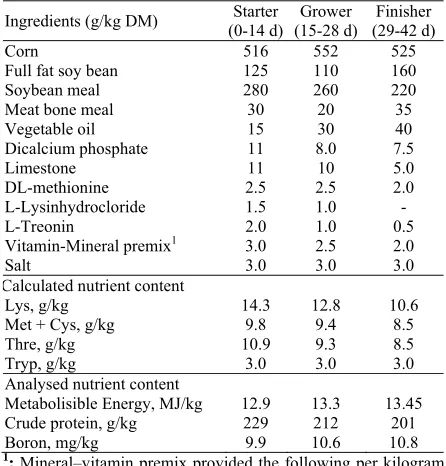
A total of 240 day-of-hatch male sex ROSS 308 broiler chicks (BeyPilic A.Ş.) with initial BW of 43 ± 0.2 g were randomly placed in battery brooders with 4 replicate pens of 15 birds/pen for each treatment. There were 4 treatments in this trial: (1) C, basal diet (Table 1); (2) AB, basal diet + 120 mg/kg of boric acid + 200 mg/kg of ascorbic acid; (3) A, basal diet + 200 mg/kg ascorbic acid; (4) B, basal diet + 120 mg/kg boric acid. Boric acid includes 17.5% Boron, therefore the present study diets contain 21 ppm boron. Birds were given ad libitum access
to water and a maize-soybean meal based feed. Chicks were kept under daylight (electric) lamp lighting on light regime consisting of 24 h light. The temperature of the room was maintained at 32˚C for the first 5 days and was then gradually reduced according to normal management practices, until a temperature of 22˚C. The diets were provided during the experiment in 3 phases consisting of starter phase from days 1-14, a growing phase from days 15-28 and a finishing phase from days 29-42. Nutrient levels of the diets were based on the AOAC (1990) recommended nutrient requirements of broiler chickens (Table 1). The metabolisable energy level of the diets was calculated according to TSE (1991). This trial has been approved by the Ankara University Animal Experiments Local Ethics Committee.
Growth performance parameters
Birds in each pen were weighed as a group weekly with birds. Mean body weight (BW) for each treatment was calculated from the pen replicates for each weighing day. Body weight gain (BWG) was calculated individually for each period and cumulatively based on pen weights for the same period, FI of each pen as a group was recorded and feed conversion ratio (FCR) was calculated as kg feed per kg body weight gain. Animals were followed up daily to determine mortality.
Sampling and measurements
On day 42 of the experiment, animals were individually weighed and three broilers per treatmend were randomly selected and blood samples were collected from the wing vein using a sterile syringe. Each of these birds was deprived of feed for 12 h and individually weighed just prior to slaughter. Inert organs, head and foot were removed manually after defeathering. Hot carcass weights were recorded and carcass yield was calculated. Absolute and proportional weights of liver, heart, gizzard, spleen, bursa fabricius and kidney were determined.
At the end of the trial 12 animals from each group were randomly selected and blood samples were collected. To determine serum parameters blood samples were centrifugated at 3000 g for 10 min. Serum cholesterol levels were analyzed by using spektrofometer with the commercial kits (Teco Diagnostic, California, USA).
Table 1: Ingredients and nutrient composition (g/kg DM) of the basal diets
Ingredients (g/kg DM) (0-14 d) Starter (15-28 d) Grower (29-42 d)Finisher
Corn 516 552 525
Full fat soy bean 125 110 160 Soybean meal 280 260 220 Meat bone meal 30 20 35 Vegetable oil 15 30 40 Dicalcium phosphate 11 8.0 7.5
Limestone 11 10 5.0 DL-methionine 2.5 2.5 2.0 L-Lysinhydrocloride 1.5 1.0 -
L-Treonin 2.0 1.0 0.5 Vitamin-Mineral premix1 3.0 2.5 2.0
Salt 3.0 3.0 3.0
Calculated nutrient content
Lys, g/kg 14.3 12.8 10.6 Met + Cys, g/kg 9.8 9.4 8.5 Thre, g/kg 10.9 9.3 8.5 Tryp, g/kg 3.0 3.0 3.0 Analysed nutrient content
Metabolisible Energy, MJ/kg 12.9 13.3 13.45 Crude protein, g/kg 229 212 201 Boron, mg/kg 9.9 10.6 10.8
1: Mineral–vitamin premix provided the following per kilogram
DM of feed: retinol 405 mg, cholecalciferol 75 mg, α tocapherol 50.000 mg, menadione 5.000 mg, thiamin 3.000 mg, riboflavine 6.000 mg, pyridoxine 4.000 mg, cobalamine 30 mg, panthotenic acid 10.000 mg, folic acid 1.000 mg, niasin 40.000 mg, biotin 50 mg, BHT 10.000 mg, manganese 80.000 mg, iron 60.000 mg, zinc 60.000 mg, copper 5.000 mg, iodine 1.000 mg, cobalt 200 mg, selenium 200 mg.
Left tibias were collected from 2 broilers randomly choosen from each group, respectively at the end of the experiment and their crude ash was determined by combustion in ash oven at 610˚C. Calcium and phosphorus contents were determined spectrophoto-metrically after combustion. The concentrations of free boron in serum, liver and tibia were determined by
Inductively Coupled Plasma Mass Spectrometry
(ICP-MS) after burned in microwave (MWS2-Berghof, Harretstrasse, Germany).
Statistical analysis
Descriptive statistics including the test of the normality of the distribution of all parameters were obtained by the SPSS software (SPSS Inc., Chicago, IL, USA). All data were statistically analyzed by one-way ANOVA to examine differences among groups. The significance of mean differences between groups was tested by Duncan´s Test with a 5% level of probability.
RESULTS Growth performance
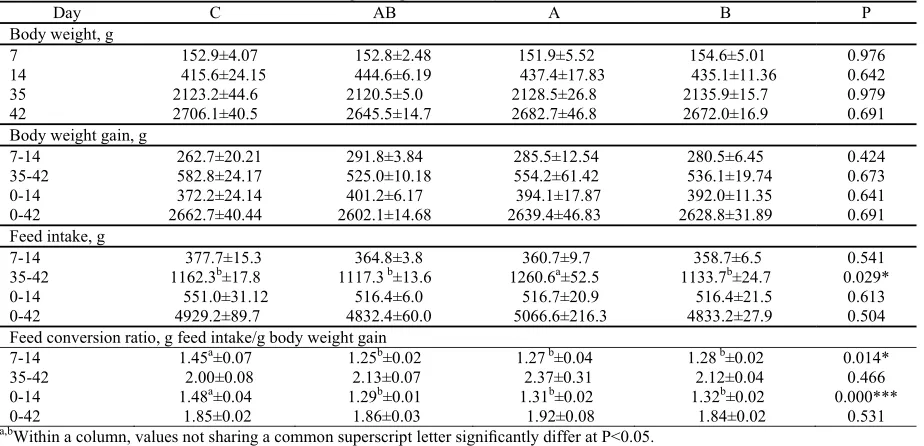
Table 2: Effects of boric acid and ascorbic acid on growth performance (x ± Sx)
Day C AB A B P
Body weight, g
7 152.9±4.07 152.8±2.48 151.9±5.52 154.6±5.01 0.976 14 415.6±24.15 444.6±6.19 437.4±17.83 435.1±11.36 0.642 35 2123.2±44.6 2120.5±5.0 2128.5±26.8 2135.9±15.7 0.979 42 2706.1±40.5 2645.5±14.7 2682.7±46.8 2672.0±16.9 0.691 Body weight gain, g
7-14 262.7±20.21 291.8±3.84 285.5±12.54 280.5±6.45 0.424 35-42 582.8±24.17 525.0±10.18 554.2±61.42 536.1±19.74 0.673 0-14 372.2±24.14 401.2±6.17 394.1±17.87 392.0±11.35 0.641 0-42 2662.7±40.44 2602.1±14.68 2639.4±46.83 2628.8±31.89 0.691 Feed intake, g
7-14 377.7±15.3 364.8±3.8 360.7±9.7 358.7±6.5 0.541
35-42 1162.3b±17.8 1117.3b±13.6 1260.6a±52.5 1133.7b±24.7 0.029*
0-14 551.0±31.12 516.4±6.0 516.7±20.9 516.4±21.5 0.613 0-42 4929.2±89.7 4832.4±60.0 5066.6±216.3 4833.2±27.9 0.504 Feed conversion ratio, g feed intake/g body weight gain
7-14 1.45a±0.07 1.25b±0.02 1.27b±0.04 1.28 b±0.02 0.014*
35-42 2.00±0.08 2.13±0.07 2.37±0.31 2.12±0.04 0.466
0-14 1.48a±0.04 1.29b±0.01 1.31b±0.02 1.32b±0.02 0.000***
0-42 1.85±0.02 1.86±0.03 1.92±0.08 1.84±0.02 0.531
a,bWithin a column, values not sharing a common superscript letter significantly differ at P<0.05.
Table 3: Effects of boric acid and ascorbic acid on carcass weight (g), hot carcass yields (%) and (x ± Sx)
C AB A B P
Slaughter weight 2476.8±33.92 2486.3±42.51 2535.0±31.33 2495.0±35.12 0.682 Hot carcass weight 1862.2±23.90 1864.5±36.34 1865.5±37.19 1869.2±31.35 0.999 Hot carcass yield 75.26±0.17 74.96±0.33 73.57±0.99 74.89±0.38 0.179 Differences between treatment groups are not statistically significant (P>0.05)
(P<0.001) respectively, compared with the non supplemented group. At 2 wks of age, ascorbic acid and boric acid supplementation did not affect BW gain and FI but significantly decreased FCR by 12.4% (P<0.05) and by 11.7% (P<0.05) compared to the control treatment, respectively. AB supplementation significantly affected broiler performance; inclusion of 200 mg/kg ascorbic acid + 120 mg/kg boric acid showing a 13.79 % increment about FCR (P<0.05).
Carcass, relative organ weights and bone mineralization
The effects of ascorbic acid and boric acid on carcass qualities, internal organ weights, bone characteristics and liver boron contents of broilers are shown in Tables 3, 4, 6 and 7, respectively. Carcass weights and yields, internal organ weights and yields and tibia ash, calcium and phosphorus were not significantly affected by dietary treatments over the 6 weeks period (P>0.05). However, the highest boron concentration of tibia and liver were obtained in response to the inclusion of 120 mg/kg boric acid showing a 36.4% (P<0.01) and 46.7% (P<0.05) increase compared with the control group, respectively. There was no interaction effect between ascorbic acid and boric acid in any measured carcass and bone characteristics.
Serum cholesterolemia
In the case of serum cholesterol, significant decreases (P<0.001) among all groups were found (Table 5). The lower concentration of cholestorelemia with B was 20.7% lower than with C. Moreover A and AB significantly decreased serum cholesterol by 20.7% and 16.6%, respectively (P<0.001).
DISCUSSION
To our best knowledge, this is the first time that 120 mg/kg of boric acid and 200 mg/kg of ascorbic acid were together in broiler feeds for their effects on growth performance, serum cholesterol, carcass traits and bone mineralization. Other studies reported boric acid as promising source of Ca for bone mobilization in animals (Nielsen, 1997) and ascorbic acid can constitude a chelat with metal ions (Cemeroglu, 2004), and therefore they were chosen as test substances together to investigate their effects on performance, carcass quality and bone mineralization of broilers.
Growth performance parameters and carcass traits
For the entire experimental period, the findings acquired show that single or combined dietary supplementation of ascorbic acid and/or boric acid did not affect BW, BW gain, FI (except for days 35-42), carcass weights and yields, internal organ weights and yields of broilers over the 6 weeks period (P>0.05). Feed efficiency was improved (P<0.001) with supplemental ascorbic acid and boric acid at 0-14 days period. In agreement with the present study several studies (Bozkurt et al., 2007; Yildiz
et al., 2011, 2013a, 2013b) reported that BW, BW gain,
feed intake, carcass traits, internal organs weights and yields were not significantly affected but feed efficiency was significantly improved by 30, 60 or 90 ppm boron. In other studies (Celik and Ozturkan, 2003; Seven et al.,
2009) indicated that performance parameters were not negatively affected by ascorbic acid supplementation. However, Sahin et al. (2003) found that ascorbic acid
Table 4: Effects of boric acid and ascorbic acid on internal organs (liver, heart, spleen and bursa Fabricius) weight (g) and ratio per 100g body weight (x ± Sx)
C AB A B P
Liver weight 52.80±2.35 50.47±1.90 48.93±1.36# 51.41±2.12 0.556
Liver yield 2.15±0.10# 2.03±0.07 2.05±0.14# 2.06±0.09 0.841
Heart weight 16.81±0.88 16.14±0.65# 14.50±0.50# 14.87±0.60 0.071
Heart yield 0.69±0.03 0.65±0.03# 0.61±0.05# 0.60±0.03 0.158
Spleen weight 3.97±0.43 3.48±0.29 3.90±0.16# 3.09±0.27 0.174
Spleen yield 0.16±0.02 0.14±0.01 0.15±0.01# 0.12±0.01 0.137
bursa Fabricius weight 4.28±0.36 4.23±0.34 4.78±0.40# 5.07±0.42 0.351
bursa Fabriciusyield 0.17±0.02# 0.17±0.02 0.20±0.02# 0.20±0.02 0.327
Differences between treatment groups are not statistically significant (P>0.05); # n=11
Table 5: Effects of boric acid and ascorbic acid on serum cholesterol (mg/dl) concentration (x ± Sx)
C AB A B P
Cholesterol 152.42±6.05a 147.42±6.64a 127.08±5.61b 120.83±5.46b 0.001** a,bWithin a column, values not sharing a common superscript letter are significantly different (least significant difference tests, P<0.05).
Table 6: Effects of boric acid and ascorbic acid on tibia crude ash, Ca, P (g/kg), Ca/P and boron (µg/kg) contents in dry matter(x ± Sx)
C AB A B P Crude ash 604.9±0.43 6161±0.55 605.1±0.30 614.7±0.20 0.378
Ca 356.3±1.02 360.9±1.72 371.1±0.10 373.0±0.40 0.607 P 178.4±0.05 186.6±0.63 178.0±0.05 177.8±0.09 0.175 Ca/P 2.01±0.06 1.96±0.10 2.07±0.01 2.09±0.02 0.416
B 43.91±1.97 b 45.14±3.31b 45.83±2.47b 59.91±3.76a 0.002** a,bWithin a column, values not sharing a common superscript letter are significantly different (least significant difference tests, P<0.05).
Table 7: Effects of boric acid and ascorbic acid on liver (µg/kg) boron contents (x ± Sx)
C AB A B P
Liver 13.05±1.07 b 14.30±1.33b 11.28±1.18b 19.14±2.48 a 0.013* a,bWithin a column, values not sharing a common superscript letter are significantly different (least significant difference tests, P<0.05).
in most places of the world (Khajavi et al., 2003).
Because of removing the negative effects of heat stress in broilers, antioxidants like an ascorbic acid are used to the diets (Mahmoud et al., 2004). This relationship could
explain the results in the current study since the environmental (stress) factors and the addition of ascorbic acid and chromium together.
Bone mineralization
In the current study, tibia ash, Ca and P contents were not significantly affected by supplementation of either boric acid or ascorbic acid supplementation in broilers. However, Ca concentration increased numerically in all treatment groups, compared with the non-supplemented group. This result is in positive correlation with the study of Konca et al. (2008) that had shown that ascorbic acid
supplementation did not change bone ash, Ca and P contents in turkeys. Results that agree with earlier study (Kurtoglu et al., 2001) which evaluated addition of B (60,
120, 180, 240 and 300 ppm) to broiler diets.
Naghii and Samman (1993) substituted that many experiments in animals have considered the interference between boron and other nutrients. The balance of demonstration suggests that boron impulse the Ca homeostasis variables by different mechanism. This could be explained by the effect of boron on cell membranes and also on steroid hormones. These hormones are also effective on lipid metabolism, particularly serum cholesterol concentration.
Serum cholesterolemia
After dose escalation of boric acid and ascorbic acid the blood serum cholesterol of broilers significantly decreased compared to C. In agreement with other studies
(Kurtoglu et al., 2005; Eren et al., 2006; Eren and Uyanik,
2007) supplementation of boron reduced serum cholesterol concentrations. However, Eklin et al. (1993),
comparing stearylboronic acid (SBA) with an inhibitor of acylcoenzyme A of cholesterol in laying hen diets, observed no effect in the serum cholesterol when the hens were given SBA compared to coenzyme A inhibitor.
According to Hall et al. (1989), boron decreases the
serum cholesterol concentration in rats for modelling to other animals and also humans. Samman et al. (1998)
explained that the boron stimulate the hydroxylation related processes of the cholesterol nucleus (Samman et al., 1998).
Conclusion
The ascorbic acid (200 mg/kg) and boric acid (120 mg/kg) were minor, as no significant effects on growth performance and carcass traits. Nevertheless, there is a chance that both additives can improve FCR, especially in the group fed with ascorbic acid and boric acid together. Moreover, supplementation of boric acid tended to decrease serum cholesterol concentration and bone Ca content, which are important for healthy poultry husbandry. Therefore, ascorbic acid and boric acid can be used in the diet formulations for broiler chicken. If the utility of trace element boron establish in animal diets, it will provide economical contribution to countries, especially, where have boron mineral reserves.
REFERENCES
Bozkurt M, K Kucukyilmaz, AU Katli, M Cinar, E Bintas, M Cabuk, C Mizrak, E Yenice, 2007. Farklı Düzeylerde Kalsiyumve Fos for İçeren Yemlere Borİlavesinin Etlik Piliçlerin Büyüme Performansı Üzerine Etkileri, IV. Ulusal Hayvan Besleme Kongresi, Tam Metinler Kitabı, Sözlüve Poster Tebliğler, 160-164.
Celik L and O Ozturkcan, 2003. Effects of Dietary Supplemental L-carnitine and Ascorbic Acid on Performance, Carcass Composition and Plasma L-carnitine Consantration of Broiler chicks Reared Under Different Temperature, Arch Anim Nutr, 57: 27-38.
Cemeroglu B, 2004. Meyve ve Sesbze İşleme Teknolojisi (in Turkish). 1. Cilt, 2. Baskı, Gıda Tekn Dern Yayınl, 35: 55-60.
Dogan V and Y Bahtiyarca, 2008. Japon Bıldırcınlarında
İnorganik Bor Kaynaklarının Nispi Biyolojik Kullanılabilirliği Konusunda Bir Araştırma. 2. National Boron Symposium Proceeding, Ankara, 619-625.
Eren M, F Uyanik, 2007. Influence of dietary boron supplementation on some serum metabolites and egg-yolk cholesterol in laying hens. Acta Vet Hung, 55: 29-39.
Eren M, B Kocaoglu Guclu, F Uyanik and N Karabulut, 2006. The Effects of Dietary Boron Supplementation on Performance, Carcass Composition and Serum Lipids in Japanese Quails. J Anim Vet Adv, 5: 1105-1108.
Eklin RG, M Freed, BA Watkins, M Srebnik and KA Kieft, RS Newton, 1993. Evaluation of two novel bio-chemicals on plasma and egg yolk lipid composition and laying hen performance. Poult Sci, 72: 513-520.
Fassani EJ, AG Bertechini, JAG Brito, RK Kato, ET Fialho and A Geraldo, 2004. Boron Supplementation in Broiler Diets, Braz J Poult Sci, v.6/n.6/213-217. Khajavi M, S Rahimi, ZM Hassan, MA Kamali and T
Mousavi, 2003. Effect of feed restriction early in life on humoral and cellular immunity of two commercial broiler strains under heat stres conditions. Brit Poult Sci, 44: 490-497.
Konca Y, F Kirkpinar, E Yaylak and S Mert, 2008. Effect of dietary ascorbic acid on performance, carcass composition and bone characteristics of turkeys during high summer temperature. Amer J App Sci, 21: (Abstr.).
Kurtoglu V, F Kurtoglu and B Coskun, 2001. Effects of boron supplementation of adequate and inadequate vitamin D3-containing diet on performance and serum biochemical characters of broiler chickens. Res Vet Sci, 71: 183-187.
Kurtoglu F, V Kurtoglu, I Celik, T Kececi, M Nizamlioglu, 2005. Effects of Dietary Boron Supplementation on Some Biochemical Parameters, Peripheral Blood Lymphocyte, Splenic Plasma Cell Counts and Bone Characteristics of Broiler Chicks
Fed with Adequate or Inadequate Vitamin D3 Containing Diet Brit Poult Sci, 46: 87-96.
Kurtoglu V, F Kurtoglu, E Sur, Z Bulut and F Onder, 2007. Effects of Boron Supplementation to the Diet on Tibia Mineral Concentrations, Peripheral Blood Leucocytes Percentages and Some Selected Variables of Layers, Arch. Geflügelkd, 71: 13-18.
Mahmoud Z, FW Edens, EJ Eisen and GB Havenstein, 2004. Ascorbic acid decreases heat shock protein 70 and plasma corticosterone response in broilers (Gallus gallus domesticus) subjected to cyclic heat stres. Comparative Biochemistry and Physiology Part B: Biochem Mol Biol, 137: 35-42.
Naghii S and S Samman, 1993. The role of boron in nutrition and metabolism, Progress. Food Nutr Sci, 17: 331-349.
Nielsen FH, 1997. Boron in Human and Animal Nutrition, Plant and Soil, 193: 199-208.
Rossi AF, RD Miles, BL Damron and LK Flunker, 1993. Effects of dietary boron supplementation on broilers. Poult Sci, 72: 2124-2130.
Sahin K, N Sahin and O Kucuk, 2003. Effects of chromium, and ascorbic acid supplementation on growth, carcass traits, serum metabolites, and antioxidant status of broiler chickens reared at a high ambient temperature (32°C). Nutr Res, 23: 225-238. Samman S, MR Naghii, PM Lyons Wall and AP Verus,
1998. The nutritional and metabolic effects of boron in humans and animals. Biol Trace Elem Res, 66: 227-239
Seven İ, T Aksu, P Tatli Seven, 2009. Oksidatif Strese Maruz Etçi Piliçlerde Antioksidan Etkili Vitamin C ve Propolis Katkılı Yemlerin Performans Üzerine Etkileri, V. Ulusal Hayvan Besleme Kongresi, Tam Metinler Kitabı Sözlüve Poster Tebliğler, 323-328. Sumbuloglu K and V Sumbuloglu, 1995. Biyoistatistik.
Özdemir Yayıncılık, 6: Baskı, Ankara.
Türk Standartları Enstitüsü, 1991. Hayvanyemleri-Metabolik (çevrilebilir) enerjitayini (kimyasalmetod) (in Turkish). TSE No: 9610. Türk Standartları Enstitüsü, Ankara.
WHO, 1998. International Programme on Chemical Safety, Environmental Health Criteria 204, Boron, Ohio, USA, 1-201.
Yildiz G, BH Koksal, O Sizmaz, 2011. Rasyonlara İlave Edilen Maya ve Borik Asitin Broylerde Performans ve KarkasÜzerineEtkisi, Kafkas Univ Vet Fak Derg, 17: 429-434.
Yildiz G, BH Koksal and O Sizmaz, 2013a. Effects of dietary boric acid addition on growth performance, cholesterolemia, some carcass and tibia characteristics in different rearing periods in broiler chickens. Revue de Med Vet, 164: 219-224.