Doctoral School in Cognitive and Brain Sciences
PhD Thesis
MUSICAL EXPERTISE AND RHYTHM PROCESSING
Francesca Perna
Advisor: Prof. Veronica Mazza
Co-advisor: Prof. Francesco Pavani
4
Acknowledgments
First and foremost I wish to express my sincere gratitude to my advisor, Prof. Veronica Mazza, for her
distinguished continuous support, guidance and motivation through the rough road of the PhD, giving me
the moral support and the freedom I needed to move on. My sincere gratitude for each moment spent on
this project, for believing in this amazing experience, for allowing me to grow as a person and as a research
scientist during these years. I would like to thank her for the brilliant comments and suggestions, but also for
the hard questions which incented me to widen my research from various perspectives.
Profound gratitude also goes to my co-advisor, Prof. Francesco Pavani, who has been a truly dedicated
mentor. I wish to thank Francesco for his precious support, insightful suggestions, and for having nurtured
my enthusiasm for the research conducted during this PhD.
Also I wish to thank Prof. Massimiliano Zampini for being part of my Oversight committee during these years
and for his professional support even at hardship.
A special acknowledgement goes to my extraordinary coach supporting me during the most difficult days.
Without him I would not have able to survive! Thank you very much for believing in my research ambitions,
thank you for all inspiring conversations that raised in me the motivation to pursue working every time I was
5 I am particularly thankful to my family for never stopping motivating me, to infuse great optimism and energy
even in the darkest days.
I am infinitely thankful to my determination, courage and ambition. For the endless dedication and love for
7
Contents
Abstract . ... 14
Chapter 1. Introduction………... 18
1.1 Rhythm and Meter as Structures in Time... 18
1.2 Theories of Temporal Structures... 19
1.3 Electrophysiological Correlates of Regularity Violation... 22
1.3.1 Mismatch Negativity (MMN)... 22
1.3.2 Middle Latency Responses (MLR)... 24
1.4 Long-term Musical Training: Musicians as a Model to Study Rhythm and Meter Perception... 26
1.4.1 Rhythm/Meter Processing and Musical Expertise... 26
1.5 Cueing Effects on Orienting Attention in Time... 29
1.6 The present research: aims and hypotheses... 31
Chapter 2. Behavioral Dynamics of Rhythm and Meter Perception: The Effect of Musical Expertise in Deviance Detection………... 36
2.1 Introduction... 36
2.2 Experiment 1... 40
2.3 Materials and Methods ... 40
2.3.1 Participants ... 40
2.3.2 Stimuli... 41
2.3.3 Procedure... 43
2.4. Results………... 44
2.4.1 Reaction Times... 44
8
2.4.3 Response Criterion (c)... 46
2.5 Discussion... 47
2.6 Experiment 2... 48
2.7 Material and Methods... 48
2.7.1 Participants... 48
2.7.2 Stimuli... 48
2.7.3 Procedure... 50
2.8 Results... 50
2.8.1 Reaction Times... 50
2.8.2 Sensitivity (d’)... 50
2.8.3 Response Criterion (c)... 51
2.9 Discussion... 51
3. General Discussion... 52
Chapter 3. The time course of auditory deviance processing: the effect of long-term musical training .………... 59
3.1 Introduction... 59
3.2 Materials and Methods... 66
3.2.1 Participants ... 66
3.2.2 Stimuli... 66
3.2.3 Procedure... 69
3.3 EEG data collection and pre-processing... 69
3.3.1 MMN... 70
3.3.2 MLR... 71
3.4. Results………... 71
9
3.4.1.1 Reaction Times... 72
3.4.1.2 Sensitivity (d’)... 73
3.4.1.3 Response Criterion (c)... 74
3.4.1.4 Musicality Tests... 75
3.4.2 EEG results... 75
3.4.3 Mismatch Negativity (MMN)... 75
3.4.3.1 MMN amplitude... 76
3.4.3.2 MMN latency... 76
3.4.4 Analyses on deviant and standard stimuli responses (100-300 ms interval)……… 77
3.4.4.1 Mean amplitude... 77
3.4.4.2 Mean latency... 81
3.4.5 Middle Latency Responses... 81
3.4.5.1 Na amplitude... 81
3.4.5.2 P0 amplitude... 83
3.4.5.3 Control Analysis... 83
3.5 Discussion... 83
3.5.1 Behavioral results... 84
3.5.2 Electrophysiological results... 84
3.6 Conclusion... 87
Chapter 4. Orienting Attention in Time: The Effect of Cue Modality and Musical Expertise ………... 89
4.1 Introduction... 89
4.2 Materials and Methods... 95
4.2.1 Participants... 95
10
4.2.3 Procedure... 97
4.3 EEG Data Collection and Pre-processing... 98
4.3.1 CNV... 99
4.3.2 MMN... 99
4.3.3 P300... 99
4.3.4 Steady-State Evoked Potentials (SS-EPs) ... 100
4.4. Results………... 101
4.4.1 Behavioral Results... 101
4.4.1.2 Inverse Efficiency score (IES)... 102
4.4.1.3 Response frequency around target stimulus onset)... 103
4.4.2 EEG results... 106
4.4.2.1 Contingent Negative Variation (CNV)... 106
4.4.2.2 CNV over centro-frontal and posterior-occipital Regions of Interest (ROI).... 108
4.4.2.3 MMN………... 109
4.4.2.4 P300………..……... 110
4.4.2.5 SS-EPs………..……... 111
4.5 Discussion………... 113
4.5.1 Behavioral results………... 114
4.5.2 EEG results ………... 116
4.5.2.1 Pre-target stimulus response ………... 116
4.5.2.2 Post-target stimulus response………..……... 117
4.5.2.3 SS-EPs………..……... 118
4.6 Conclusion………. 119
Chapter 5. Conclusions ………... 121
References ... 133
11
List of Figures
Introduction
Figure 1.1 Example of Mismatch Negativity Component……….…. 24
Figure 1.2 Example of Middle Latency Responses…..……… 26
Experiment 1
Figure 2.1 Stimulus Material Experiment 1. Example of Rhythmic module ... 42Figure 2.2 Stimulus Material Experiment 1. Example of Non-rhythmic module ... 43
Figure 2.3 Results of Experiment 1………... 47
Experiment 2
Figure 3.1 Stimulus Material Experiment 2. Example of Rhythmic module ... 49Figure 3.2 Results of Experiment 2………... 51
Experiment 3
Figure 4.1 Stimulus Material Experiment 3. Example of Rhythmic module... 67Figure 4.2 Stimulus Material Experiment 3. Example of Non-rhythmic module ... 68
Figure 4.3 Behavioral Results of Experiment 3………... 75
Figure 4.4.1. EEG results of Experiment 3. Mismatch Negativity component………... 77
Figure 4.4.2. EEG results of Experiment 3. Neural response to deviants and standards….…………... 80
12
Experiment 4
Figure 5.1 Stimulus Material of Experiment 4... 97
Figure 5.2.1. Behavioral results of Experiment 4. Reaction Times and Correct Detections... 102
Figure 5.2.2. Behavioral results of Experiment 4. Inverse Efficiency Scores... 103
Figure 5.2.3. Behavioral results of Experiment 4. Target Anticipations... 106
Figure 5.3.1 EEG results of Experiment 4. Contingent Negative Variation component... 108
Figure 5.3.2. EEG results of Experiment 4. Mismatch Negativity and P300 component... 111
14
Abstract
For decades, researchers have been trying to understand how the human mind/brain processes rhythm and
time in general. Within this framework, many studies have explored the influence of long-term musical
training on the neural and behavioral correlates of rhythm processing. Some pieces of evidence point to
enhanced rhythm processing in musicians as one of the consequences of the structural and functional
changes in many brain areas involved in auditory processing, motor synchronization and cognitive control.
Yet there is still more controversy than consensus on this field. Indeed, several behavioral and neural studies
report opposite results and describe contrasting effects associated to rhythm perception in musicians and
non-musicians.
The aim of the project described in this thesis was to shed new light on the effects of long-term musical
training on the behavioral and neural correlates of rhythm processing. First, I addressed whether musical
expertise influences rhythm processing when this is not task-relevant. Next, I expanded the investigation to
the ability of musicians to orient efficiently attention in time. I explored these questions by looking at
behavioral and electroencephalographic (EEG) correlates associated to the detection of auditory deviant
stimuli.
Chapter 1 is a general introduction to the current knowledge on rhythm processing. After a description of
the most influential theories of temporal elaboration, it introduces some of the electrophysiological
correlates associated to regularity violation. Then, it provides a detailed description of the neural and
behavioral changes triggered by a long-term musical training, focusing on rhythm processing. At the end of
this introduction, the aims and hypotheses of each experiment are presented in detail.
In Chapter 2, I describe two behavioral experiments that explored how the processing of different temporal
15 addressed the role of a refined metrical representation in musicians and non-musicians (Experiment 2). The
results revealed an overall superior performance of musicians in all experimental conditions, thus pointing
to an enhanced auditory perception as consequence of their musical training. The results also highlight a
large-scale processing of rhythm, independent of musical expertise. Furthermore, the results on response
speed indicate a refined metrical processing only in musicians. Thus, the first part of the thesis demonstrates
that long-term musical training boosts meter processing, whereas (some form of) rhythm processing appears
to be overall present in all individuals.
In Chapter 3, I report an EEG experiment which was aimed at exploring the effects of long-term musical
training on the neural correlates of auditory deviance violation (Mismatch Negativity – MMN and Middle
Latency Responses - MLRs), by inserting deviant stimuli in rhythmical (at strong and weak metrical positions)
and non-rhythmical structures. Deviant stimuli within rhythmical structures elicited larger MMN compared
to non-rhythmical ones in all participants. Moreover, the MMN was also modulated by meter as showed by
the smaller amplitude for deviants at strong than weak positions. Interestingly, a deeper investigation of the
neural modulations associated to the strong positions revealed a stronger response in musicians than
non-musicians. This demonstrates the prevailing effect of stimulus salience (strong metrical positions and
frequency deviant at these positions) over the effect of prediction for musicians. Finally, effect of long-term
musical training modulated the MLRs for deviants within rhythmical structures. Taken together, these results
indicate an effect of musical expertise at early and late stages of deviance perception, as evidenced by
modulations of the MLR and MMN responses.
Chapter 4 reports the results of a cross-modal cueing experiment aimed at investigating the influence of
long-term musical training on the ability to orient attention in time using external cues. Besides behavioral and
ERP responses, here I examined a particular neural response associated to entrainment: the steady state
evoked potential (SS-EP). The results showed that auditory cues greatly facilitate attention orienting in time.
Furthermore, targets preceded by short intervals were highly expected and this was visible both at the
behavioral (high efficiency and more anticipations) and neural (larger CNV and reduced P300 amplitude)
16 trained sensory modality (audition). Finally, musicians were less synchronized to the rhythm than
non-musicians (reduced SS-EPs). In sum, these results indicate that the auditory modality better guide temporal
orienting than the visual one, and that this effect is magnified for musicians. Finally, weaker synchronization
to rhythm in musicians may mirror the ease with which they process rhythm.
18
Chapter 1
Introduction
1.1 Rhythm and Meter as Structures in Time
Rhythm dictates most of our daily activities. Consider for instance the way in which we walk: our motor acts
are rhythmically organized with each movement following the other cyclically. Even at a more basic level, our
heartbeats follow a rhythmic pattern. Thus, rhythm can be conceived as a regular distribution of events into
coherent patterns in time (Berlyne, 1971). There are also more specific definitions of rhythm, depending on
the domain considered. In music, rhythm is defined as a set of temporally organized events encompassing
two fundamental levels: (1) the beat and (2) the meter. Previous theories on the processing of rhythm have
drawn a distinction between the mechanisms involved in the processing of beat and meter (Large, 2008;
Large & Snyder, 2009). According to these theories, beat represents a sequence of regularly recurring events
processed sequentially (Cooper & Meyer, 1960; Large, 2008): here, the auditory system elaborates each
sound individually and sequentially one after the other. For example, when listening to a piece of music, the
beats are those points to which listeners would synchronize their feet. The processing of meter instead
involves the association of different strengths (i.e., accents) to the various beats. The presence of accents
gives rise to the perception of stronger and weaker beats, and promotes the creation of groups, for example
of two (e.g., as in a march) or three (e.g., as in a waltz) elements, which depicts different hierarchical levels
of the metrical structure (Martin, 1972; Lerdahl & Jackendoff, 1983). For instance, in the waltz, the sequence
of each single sound is part of the first level (beat level or sequential level) of rhythm; at the same time, each
first sound of three is perceived as more prominent than the others. This promotes the creation of auditory
19 leads to the perception of a tension between strong and weak beats (i.e., in waltz: strong, weak, weak) which
favors the emergence of the metrical structure (Lerdahl and Jackendoff, 1983; London, 2012; Fitch, 2013).
For decades, researchers have been trying to understand how the human mind/brain processes rhythmical
structures by means of several methodological approaches. In the following sections, I provide some
examples of theories exploring the behavioral and neural underpinnings supporting the perception and
organization of time and, more specifically, of rhythm. Next, I describe the electrophysiological correlates of
deviance detection by focusing on two neural responses associated to regularity violation: the mismatch
negativity component (MMN) and the middle latency response (MLR). Most of the descriptions of the two
sections will revolve around the comparison between musicians and non-musicians, as musicians represent
the ideal model to study rhythm and meter processing. Finally, I examine the effect of endogenous cueing in
time orienting of musicians and non-musicians. Here, I will try to bridge two lines of research. The first is
related to cueing paradigms. Studies on this topic (Coull & Nobre, 1998; see Niemi & Naatanen, 1981, for a
review) have shown that, just as in the case of space, attention can be efficiently oriented in time by means
of symbolic cues. The second line of research focuses on the exceptional ability of musicians to encode
rhythm, which may act as an additional cue to orient attention to points in time.
1.2 Theories of Temporal Structures
Several theoretical approaches have tried to explain how we perceive and organize temporal structures. The
first models describing time processing were the so-called “pacemaker-accumulator” models, introduced in
the early 1960s by Creelman (Creelman, 1962) and Treisman (Treisman, 1963). In Creelman’s model
(Creelman, 1962), pulses with a fixed frequency (the pacemaker) were considered as an accumulator used to
estimate time. Yet, this fixed and not flexible structure failed in discriminating intervals differing slightly in
their duration. One year later, Treisman (Treisman, 1963) proposed a more detailed model of time
perception. Using the same basic mechanism of Creelman’s model, this model postulated the use of an
oscillator as pacemaker, and suggested different processing levels to store and compare time intervals with
20 processed. In fact, differing from the fixed structure of Creiman’s model, Treisman’s model paved the way to
more advanced models of time processing and in particular of rhythm, which is often built of different
intervals lengths.
Years after the pacemaker-accumulator models, Large and Jones (Large and Jones, 1999) proposed an
innovative model of temporal processing outlined in the “Dynamic Attending Theory” (DAT). DAT proposes
a dynamic estimation of time; in fact, rather than considering a fixed counting mechanism, as it was
previously done, temporal information is encoded by means of a set of oscillators whose frequency can be
adapted to multiple intervals’ lengths.
DAT is one of the most influential theories used for the analysis of rhythm and meter processing in humans
(Jones and Boltz, 1989). It posits that external rhythms capture listeners’ attention, resulting in a dynamic
fluctuation of attention synchronized to the perceived regularities (entrainment hypothesis). These
fluctuations of attentional energy adapt their phase and period based on the metrical structure extracted
from a sequence of sounds. This generates specific expectancies and predictions (anticipations) toward each
sound of the sequence. In this direction, DAT proposes that attention is maximally oriented toward sounds
at strong positions of the metrical structure relative to weak ones. Accordingly, stimuli coinciding at strong
positions are highly expected and more effectively processed (Jones, 2009). Further empirical support to DAT
comes from behavioral studies observing a facilitation effect prompted by the regularity of an isochronous
sequence of sounds on comparative pitches judgments (standard, comparison). Indeed, Jones et al. (2002)
demonstrated that listeners were more accurate in judging pitch differences of expected tones within regular
sequences compared to pitches embedded in irregular rhythms. These results were interpreted as evidence
of a dynamic allocation of attention in time by which tones coinciding with points of maximal attentional
energy were best detected.
The Predictive Coding Theory (PC) is another theoretical proposal that explains the effect of predictability
(proper of rhythmical sequences) on stimulus perception. In particular, the regularity of the rhythmic
21 each sound/beat, is used to create specific expectations towards future events (Vuust & Witek, 2014). As
such, sequence regularity should promote better performance for the highly expected/predicted events
compared to those less expected/predicted (e.g., Elliott et al., 2014, but see Bouwer & Honing, 2015 for
opposite results). PC theory interprets the expectancy driven by rhythm processing in terms of predictive
modeling. It postulates that perception follows a Bayesian process by which the brain predicts the causal
relationship between sensory percepts in a continuous comparison with previous knowledge (Friston, 2005).
In this process, the brain constantly tries to minimize the error between the perceived sensory input and the
predicted stimulus based on short- and long- term knowledge accumulated through experience (Vuust &
Witek, 2014). Short-term knowledge is built on a moment-to-moment basis, like for example the one that a
brief exposure to a rhythmical sequence may provide to a listener. Beside the short-term experience with
the experimental manipulations, long-term experiences (such as long-term music training, as in the present
thesis) can also influence the ability to make predictions. To maximize the match between prediction and
sensory input, a dual mechanism is hypothesized to occur: a backward projection, where the perceived
sensory input is compared to previous knowledge, and a forward projection where we use previous
knowledge, experience or contextual cues to anticipate and predict sensory inputs (Vuust & Witek, 2014). If
there is a mismatch between predicted and perceived sensory input, a residual error signal (i.e., the
prediction error) is sent to higher layers via feedforward pathways (Nazimek et al., 2013). Here, considering
the dynamics behind rhythm processing, PC suggests two types of mechanisms: a top-down
(expectancy-driven) and a bottom-up (stimulus-(expectancy-driven) mechanism (Rao & Ballard, 1999).
Prediction errors have been investigated mainly with oddball paradigms, where rare deviant stimuli are
randomly inserted within series of frequent standard stimuli. In terms of electrophysiological correlates,
when the predicted stimulus (related to the more frequent, standard stimulus) does not match the actual
sensory information (deviant stimuli), the related prediction error gives rise to specific neural responses (i.e.,
the Mismatch Negativity component (MMN)) (Friston, 2005). Specifically, PC theory postulates that the MMN
22 predictability of a stimulus corresponds to a smaller prediction error and to a smaller MMN amplitude
(Lecaignard et al., 2015). In the next section, I describe this response more in detail.
1.3 Electrophysiological Correlates of Regularity Violation
One of the effects of temporal expectation is the optimization of behavior for events presented at the
expected (regular) moment. When the expected stimulus does not correspond to the actual perception, this
regularity violation is reflected at the EEG level in a series of event-related potentials (ERPs). Here, I focus on
two ERPs traditionally associated with the perception of deviants in oddball paradigms.
1.3.1 Mismatch Negativity (MMN)
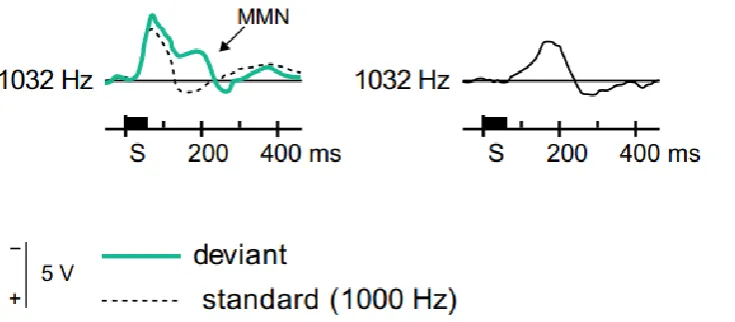
An example of ERP response associated with regularity violation is the Mismatch Negativity (MMN)
component, an index of deviance extraction from a sequence of regular and predictable stimuli (Naatanen
et al., 2007). Naatanen and colleagues (Naatanen et al., 1978) described the MMN for the first time as a
negative component of the auditory ERPs - originating in the auditory and frontal cortices (van Zuijen et al.,
2005), which usually peaks at 200-250 ms after the occurrence of a deviant stimulus. This response has a
maximal amplitude over frontal and central scalp locations (Naatanen, 1992). The MMN results from an
automatic discriminative process that detects small changes in the acoustic environment and compares them
with traces created by the repetitive presentation of sensory stimulation (Naatanen et al., 2010). Thus, the
MMN is elicited when an incoming sound is different from the memory traces of a previous input (van Zuijen
et al., 2004). This requires that the auditory system has formed a strong representation of the regular and
predictable aspect of the (standard) stimuli.
Crucially, the MMN is not simply the result of different states of refractoriness of neurons responding to
specific acoustic features of the standard or deviant stimuli (Naatanen, Jacobsen, & Winkler, 2005). This was
demonstrated in controlled oddball paradigms, where the auditory stimuli used as deviants in the oddball
sequence were inserted, with the same probability, within series of different randomly presented
23 controlled the refractoriness effects using different conditions: MMNs were obtained in oddball blocks with
standard and deviant (p = .10) sounds of respectively 700 and 750 Hz; and in control blocks, sounds’
frequency was 700, 750, 800, 900, 950, 1000, 1050, 1100, or 1200 Hz (p = .10 each). The deviant - control
comparison displayed a clear MMN in both oddball and control blocks which could not be explained in terms
of differential states of refractoriness (Schroger, 1996).
Earlier studies demonstrated that the MMN is influenced by at least three factors: (1) the deviance
magnitude, (2) the variability of the acoustic context (made of standard stimuli), and (3) the type of sequence
predictability (Lecaignard et al., 2015). The first factor is related to the fact that a larger MMN amplitude is
observed for larger differences between standard and deviant stimuli (Winkler et al., 2009).
Previous studies investigating the effect of the variability of the acoustic context on the MMN (factor 2),
manipulated the acoustic properties of standard stimuli (Daikhin & Ahissar, 2012). For example, Daikhin and
Ahissar, 2012 used an oddball paradigm in which standard stimuli had variable sound’s frequency. Comparing
the MMN amplitude elicited by deviants inserted in sequences of standards with different frequencies to the
MMN of a standard oddball (all standards with the same frequency), the authors noted that in the first case
the MMN amplitude was diminished. This suggested that a varying acoustic context does not allow for a clear
standard – deviant differentiation as reflected in a reduction of the MMN amplitude.
The type of sequence predictability (factor 3) could be derived from a set of rules that delineate the statistical
dependencies of each sound within a sequence (Lecaignard et al., 2015). It is possible to define local and
global rules, the first belonging to short time-scale dependencies (relationship between subsequent sounds)
whereas the latter generating large time-scale regularities. For example, consider a sequence of five tones,
in which the first four tones are the same and the last can be either the same or a different tone. The short
time-scale dependency rule is based on the repetition of the four tones. Hence, the repetition of the four
tones predicts the acoustic properties of the fifth tone, which will be equal to the previous ones if the rule is
met. Contrariwise, the global rule describes the probability of standard and deviant sequences (xxxxx or
xxxxy) within blocks. When the standard sequence (xxxxx) is more probable, the global rule predicts the next
24 probable, the global rule predicts the next sequences to end also in y (and in contrast with the local rules
predictions). Stimulus and sequence predictability affects the amplitude of the MMN response in such a way
that there is a decrease of the amplitude with an increase in the stimulus/sequence predictability (Lecaignard
et al., 2015).
Figure 1.1. The left side of the Figure shows an example of long-latency component of the ERPs elicited by standard (dotted line) and deviant (green line) stimuli. The right side displays an example of Mismatch Negativity component obtained by subtracting the standard stimulus ERP from that of the deviant stimulus. Adapted from Naatanen et al., 2007.
1.3.2 Middle Latency Responses (MLR)
Challenging the view that the middle-latency portion of the ERP components is responsible for the perception
of stimuli physical properties only, a series of studies showed effects of auditory deviants perception also at
these early stages of stimulus elaboration (roughly from 12 to 50 ms post-stimulus onset). Therefore, beside
the MMN component, modulations of the Middle Latency Responses (MLRs) reflect also a change-detection
process (Grimm et al., 2011) that result from a mismatch between the memory trace of a preceding standard
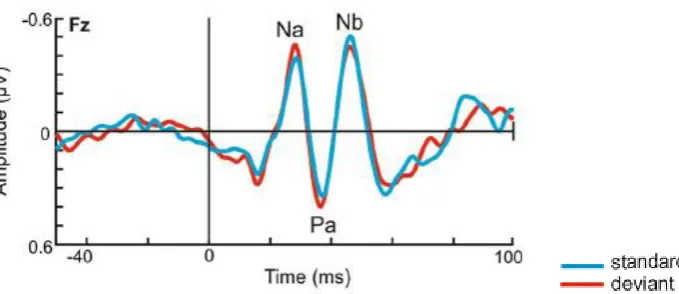
sound and an incoming deviant ones (Alho et al., 2012). The MLRs are a set of positive ("P" waves) and
negative ("N" waves) waves occurring between 12-80 ms after sound onset (Grimm et al., 2011; Alho et al.,
2012); these responses originate from the inferior colliculus, medial geniculate body, and the
25 P0 (subcortical origins), followed by Na, Pa and Nb (primary and secondary auditory cortices) (Grimm et al.,
2011).
There is not yet a clear understanding of the effects that different stimulus characteristics have on the single
waves of the MLR. Some work suggested that each positive-negative wave has its own ‘’specificity’’. For
instance, modulation of the Na-Pa components are mainly observed following intensity and location changes
in the auditory stimulus, while differences in the Nb (and sometimes Pa, Escera et al., 2014) waves are
ascribed to frequency changes (Escera and Malmierca, 2014). However, while some studies observed that
changes in stimulus frequency, intensity, duration and location influence the latency and amplitude of the
MLRs (Borgmann et al., 2001; Escera et al., 2014) others did not confirm these results (Grimm et al., 2011).
For example, Grimm and colleagues (Grimm et al., 2011) employed a traditional oddball paradigm where rare
and deviant sounds (low and high frequency sounds) were embedded within a train of standard sounds. The
authors observed that the Nb wave of the MLRs had a larger amplitude following the detection of rare and
unexpected sounds. Yet, the frequency of the deviant sound (low or high) did not have any influence on these
components. Importantly, their results were considered a clear hallmark of deviance processing per sè since,
irrespective of the stimulus frequency (low or high), modulation of the Nb amplitude triggered by deviants’
perception reflected a mismatch between the memory trace formed by the frequent standard stimuli and
the actual deviant perception (Grimm et al., 2011).
Moreover, as already noted for the mismatch negativity, deviant predictability affects these earlier
components too. Indeed, Lecaignard and colleagues found that predictable deviants resulted in smaller MLRs
amplitude compared to unpredictable ones (Lecaignard et al., 2015). This challenged the long-held view by
which the MLRs were considered only as the neural correlates of sound physical properties perception (i.e.,
stimulus frequency) and rather corroborates this response as new electrophysiological markers of auditory
deviance detection (Grimm et al., 2011).
Finally, in contrast to what I will describe for the MMN (for which there are numerous studies showing the
effects of musical expertise), it is important to note that the effect of rhythm and long-term music training
26 Figure 1.2. Example of Middle Latency Responses elicited by standard (blue line) and deviant (red line) stimuli. Adapted
from Escera et al., 2014.
1.4 Long-term Musical Training: Musicians as a Model to Study Rhythm and Meter Perception
The research described in this thesis attempts to investigate the effects of long-term musical training on
rhythm/meter processing by looking at behavioral and neural differences between musicians and
non-musicians in auditory deviant detection. To this aim, I tested non-musicians as the ideal model to highlight the
mechanisms behind rhythm and meter organization.
In the next sections, I illustrate some of the extant studies describing behavioral and neural differences in
rhythm and meter processing between musicians and non-musicians.
1.4.1 Rhythm/Meter Processing and Musical Expertise
In this section I describe some studies investigating differences between musicians and non-musicians in
rhythm/meter processing. The method used was to observe changes in specific neural components typically
associated with the perception of deviant stimuli inserted within rhythmic sequences of standard sounds.
For example, Geiser and colleagues (Geiser et al., 2010) conducted an EEG study on musicians and
non-musicians to investigate the effects of long-term musical training on the perception and representation of
meter. Participants listened to meter-congruent sequences where deviant events (i.e. intensity accents) were
inserted at metrically strong positions and to meter-incongruent sequences where deviants produced a large
meter-27 congruent (strong and expected position) and meter-incongruent sequences differed by a greater amount in
musicians than in non-musicians. Musicians showed larger MMN for accents inserted in meter-incongruent
compared to meter-congruent sequences with accents on strong and highly expected positions. This result
led to the conclusion that musical training prompts a refined perception of meter as visible from different
modulations of the MMN to meter congruent and incongruent deviants. However, the present conclusions
have to be considered with caution since the larger MMN amplitude registered for the meter-incongruent
sequence might simply echo the processing of a larger acoustic and temporal change present in this
condition. In fact, here, a sound was removed from the sequence thus changing the amount of acoustic
information delivered; and in addition, this produced a temporal change (shift of accent) within the
sequence. Thus, rather than being related to a refined meter processing, the larger difference observed in
musicians between meter congruent-incongruent conditions may be simply ascribed to their enhanced
perceptual processing per se. In addition, it should be noted that a previous study by the same authors failed
to observe neural differences between musicians and non-musicians on rhythm and meter processing (Geiser
et al., 2009).
As mention before, it is important to consider that many studies exploring rhythm/meter processing in
musicians and non-musicians used sequences of sounds that were either too complex or too simple (Potter
et al., 2009; Tierney & Kraus, 2013). Indeed, because musicians are more familiar with complex rhythmical
series compared to non-musicians, differences between groups could reflect familiarity with the material
used rather than a genuine difference in rhythm and metric perception determined by extensive musical
training.
Furthermore, behavioral and neural results reported by previous experiments using isochronous series of
sounds (Brochard et al., 2003; Potter et al., 2009, Bouwer and Honing, 2015) are doubtful because listeners
might segment the same sequence of equidistant sounds differently (i.e., segments with a different number
of sounds). For example, Bouwer and Honing (2015) used an isochronous rhythm to investigate the influence
of temporal attending and temporal prediction involved during metrical rhythm processing. Although in their
28 a specific sequence segmentation, listeners might have still perceived and group subsequent sounds within
the sequence differently.
Another line of research tested differences between musicians and non-musicians by means of direct
judgments on auditory stimuli. For example, in the study of Jongsma et al. (2004; see also Jongsma et al.,
2003) musicians and non-musicians listened to two bars marking a duple or triple meter. After a silent bar, a
test bar with a probe beat was delivered. Participants were asked to pay attention to the metrical structure
of the auditory stimulation, and to judge to what extent the timing of the probe beat fitted the experienced
metrical structure (duple or triple). The researchers hypothesized that musicians would provide higher
ratings for those probe beats that matched the previously heard metrical context, compared to
non-musicians. In addition, musicians should show enhanced evoked neural responses (as measured by EEG) to
those probe beats whose timing matched the metrical context (Jongsma et al., 2003, 2004). The results were
in agreement with the predictions, and suggested that musicians hold in memory more precise metrical
representations compared to non-musicians (Jongsma et al., 2003, 2004). However, the observed effects
have to be considered with caution since differences between musicians and non-musicians might simply
highlight a superior ability of musicians when tested on judgements of subtle differences in meter perception
which pinpoints to musical training/ knowledge effects.
Therefore, overall, the literature on the behavioral and neural effects of long-term musical training on rhythm
and meter processing do not describe a uniform and clear picture. In fact, it is not clear if differences between
musicians and non-musicians may be generalized to tasks that involve auditory sequences (with a
rhythmic/metrical structure) beyond musical competences and/or musical material. Moreover, a potentially
problematic aspect of previous studies (e.g., Geiser et al., 2009; Geiser et al., 2010; Vuust et al., 2009) is
related to the fact that the deviant stimulus often coincided with a rhythm/meter change. Consequently, this
might have conferred relevance to the rhythm/metric aspect itself, and made its processing easier for
musically experts.
Thereby, a possibility to explore rhythm/meter processing in musicians and non-musicians is to use simple
29 and non-rhythm) from the deviant stimulus, and to look at behavioral and neural changes associated to
deviants’ detection as consequence of a different temporal processing.
1.5 Cueing Effects on Attention Orienting in Time
An aspect that seems to play a crucial role in the orienting of attention in time is the expectation of future
events. This may derive from the ability to efficiently perceive the temporal relationship between events of
a rhythmic sequence (rhythm perception), or from the use of symbolic cues indicating the occurrence of a
specific events (like for example a green traffic light that cues a pedestrian about when crossing the street).
As for rhythm perception, we could consider the intervals of time between sounds of a rhythmical sequence
as a special set of cues that provide information on the occurrence of each subsequent sound. These cues
boost expectancy and perceptual levels favoring the processing of target sounds coinciding with the cued
moment in time. In support to this aspect, it has been demonstrated that perceptual judgements (i.e.,
pitches, interval lengths) are enhanced for stimuli occurring within regular rhythm and at the expected points
in time (Jones et al., 2002; Large & Jones, 1999), compared to stimuli presented before or after these points.
As suggested already by the Dynamic Attending Theory, temporal expectations derives from oscillations of
attention in synchrony with an external rhythm (Large and Jones, 1999). Thus, stimuli coinciding with
maximal picks of attention (larger oscillations amplitude) will be better processed.
From a slightly different perspective, the Predictive Coding Theory underlies the importance of a correct
estimation of the intervals of time before each event, which allows an effective prediction of future events.
Therefore, the expectancy toward a future stimulus resulting either from a dynamic allocation of attentional
resources or from predictive abilities, improves stimulus detection.
On the other hand, an example of controlled temporal expectation is given by experimental paradigms in
which symbolic cues are used to manipulate participants’ expectancy. For example, knowing the exact
location where a stimulus will occur enhances its encoding (Coulle and Nobre, 1998). Likewise, it has been
demonstrated that knowing the moment in which an event will most likely occur generates a voluntary
30 attended moment in time (Coull & Nobre, 1998). This suggests that temporal information is used to guide
selectively attention to specific points in time. This results not only in behavioral advantages as visible from
faster and/or more accurate responses to target stimuli presented at the expected time, but also in changes
of specific neural responses associated with temporal orienting and stimulus processing (see Nobre &
Rohenkohl, 2014 for a review).
A method that has been used to investigate the human ability to orient attention in time consists in
manipulating the time interval between a warning signal and a target stimulus (i.e., foreperiod, FP)
(Weinbach and Henik, 2012). In 1914, Woodrow observed that the length of the FP had a strong influence on
the participants’ reaction times (Woodrow, 1914). In particular, a short FP (e.g., 800 ms) triggered faster RTs
to a target stimulus compared to long FPs (e.g., 2000 ms, Klemmer, 1956; Naatanen et al., 1974), due to the
fact that the temporal resolution over short interval of time is higher compared to long ones (Allan & Gibbon,
1991; Wearden & Lejeune, 2008). Additionally, it has been showed that holding constant and predictable the
FPs from trial to trial prime a more precise temporal expectation (faster RTs) about the occurrence of the
target stimulus compared to conditions in which FPs are variable and unpredictable (Woodrow, 1914).
Besides the behavioral advantages, orienting attention selectively to points in time modulates also a series
of electrophysiological responses. For example, in their pioneering work, Walter and colleagues (1964)
reported the presence of a physiological response known as the Contingent Negative Variation (CNV), a slow
negative component originating in the motor areas of the brain and visible whenever subjects were
presented with two stimuli: a warning signal followed by a target stimulus. They observed that a large
negative response appeared just after the warning signal and reached maximal amplitude at the anticipated
time of the target stimulus (Walter et al., 1964). It has been suggested that the CNV mirrors the ability of the
nervous system to anticipate and prepare motor responses to temporally predictable stimuli. As such, it
reflects temporal expectations and predictions of a future event (Tecce, 1972; Mento, 2013).
However, the effect of symbolic cues is not only captured in those neural correlates reflecting temporal
prediction and anticipation of future events (i.e., pre-target activity). Some EEG studies have focused on the
31 Friedman et al., 2001; Lange, 2009; Correa and Nobre, 2008; Griffin et al., 2002; Miniussi et al., 1999). For
example, these studies described modulations of the fronto-central P3 component, which usually reaches its
maximal positive peaks at about 300 ms from the onset of the target stimulus (Friedman et al., 2001; Lange,
2009; Correa and Nobre, 2008; Griffin et al., 2002; Miniussi et al., 1999). I provide a detailed description of
all the aspects concerned with these neural responses in Chapter 4.
1.6 The present research: aims and hypotheses.
Music processing involves many cognitive and sensory functions, which are shared with other domains. For
example, attention, working-memory skills and the integration of single elements within a coherent percept
based on specific rules are similarly involved in both music and language.
The effects that a long-term musical training has on brain structures and functions have been widely
documented (Munte et al., 2002; see Herholz and Zatorre, 2012 for a review); nonetheless, we are still far
from a clear understanding of whether these effects are visible also when using auditory stimuli and tasks
that do not pinpoint to music expertise. For example, while there are studies showing enhanced evoked
potentials and auditory brain stem responses in musicians to pitch changes involved in both language and
music (Musacchia et al., 2007), and pointing to an overall superior ability of musicians in timing processing
(i.e., rhythm), other studies do not report differences due to musical expertise (Lee and Noppeney, 2011).
For instance, Lee and Noppeney (2011) found differences between musicians and non-musicians in
audio-visual asynchrony detection task only when using musical stimuli and not for speech (Lee and Noppeney,
2011). In addition, other studies reported advantages in attentional abilities when auditory but not visual
stimuli were used (Strait et al., 2010).
The first aim of the research presented in this thesis was to examine whether a long-term training in music
could influence auditory processing when the task does not imply music knowledge. Specifically, I tested
whether music expertise could improve auditory processing in contexts where rhythm/meter is not
task-relevant. To test this aspect, I used a detection task of auditory deviant stimuli inserted within simple auditory
32 use of an integrated approach consisting of behavioral and EEG measures, allowed for a more detailed picture
of the temporal dynamics of the effect of music expertise in rhythm processing. On the one hand, the use of
Signal Detection Theory (SDT) measures entailed the possibility to dissociate whether music expertise
influences sensitivity (as measured by d’ values) or response bias (as measured by the criterion). On the other
hand, the analysis of two ERP responses associated with deviance detection (MMN and MLR) provided a
precise evaluation of the specific (if any) level of stimulus analysis that is modified by long-term musical
training.
A secondary aim of the experiments described in the first part of the present thesis (Chapter 2 and 3) was to
try to ponder two main theoretical approaches often used to account for rhythm perception and music
expertise (DAT: Jones and Boltz, 1989; PC: Friston, 2005): the Dynamic Attending Theory (DAT) and the
Predictive Coding (PC) theory. As mentioned in Section 1.2, DAT explains rhythm processing and its
facilitation effects as a consequence of a dynamic fluctuation of attention synchronized to the perceived
regularities.
In contrast, PC focuses more on the precise prediction of upcoming events for an efficient rhythm processing.
While the experiments presented in Chapter 2 and 3 of thesis were not specifically designed to pit the two
theories against each other, throughout the experiments presented I tried to evaluate whether the results
could be accounted for by a single theory, or if they could be better accounted for by considering the interplay
between attentional and predictive mechanisms.
To achieve this aim and to highlight the role of DAT and PC in rhythm processing, two experiments were
conducted and are reported in Chapter 2 and Chapter 3, respectively. In Chapter 2, I describe two
experiments that explored the behavioral effects of long-term musical training on rhythm and meter
processing. I compared musicians and non-musicians looking at differences in the detection of deviants
embedded within rhythmical and non-rhythmical auditory sequences (Experiment 1), and at different
metrical positions (strong vs. weak metrical positions, Experiment 2) of the rhythm. Therefore, in Experiment
1, I examined the influence of bottom-up structuring of the auditory sequences by assessing the effect of
33 sequences. In Experiment 2, I focused on metric perception by evaluating the role of expectancy to deviant
sounds at either the strong (i.e., more salient) or weak (i.e., less salient) metrical positions of rhythm. If
long-term musical training enhances rhythm and meter elaboration, I expect to observe faster response times and
enhanced accuracy for deviants within rhythmic sequences in musicians compared to non-musicians in both
experiments. However, if the role of musical expertise is particularly related to metric processing, differences
between groups should become more visible in Experiment 2 (in which expectancy for deviants rely on the
processing of both rhythm and meter), compared to Experiment 1 (in which expectancy is primarily driven
by rhythm).
Chapter 3 focuses on the neural correlates of the effects described in Chapter 2. By measuring two specific
EEG measures (MMN and MLR) associated to deviant detection, I aimed to investigate at which stage of
deviant analysis an influence of long-term musical training, as function of a different rhythm/meter
elaboration would have been visible. In line with previous findings showing enhanced auditory processing in
musicians at late (MMN) and earliest (brainstem) stages of stimulus analysis (Koelsch, 1999; Musacchia et al.,
2007), pointing also to musicians’ augmented rhythm encoding and production (Rammsayer & Altenmüller,
2006; Chen et al., 2008; see Zatorre, Chen and Penhune, 2007 for a review), I expected that an effect of
long-term musical training could be captured even before the MMN component (at the level of the MLR) when
considering deviants inserted within rhythmical structures.
The second aim of the thesis project was to investigate the role of endogenous cueing in orienting attention
in time, as well as its interaction with music expertise. As mentioned in Section 1.5, research in the last
decades has shown that humans can orient attention in time just as well as they can do for space (Coull &
Nobre, 1998; see Nobre & Rohenkohl, 2014 for a review). However, a crucial aspect that has remained largely
unexplored is whether musicians orient more efficiently attention to specific points in time compared to
non-musicians. In fact, although several studies (Koelsch et al., 1999; Grahn & Rowe, 2009; Zuk et al., 2014; Habibi
et al., 2014 see Hannon & Trainor, 2007 for a review) underlined the advantages of musicians in many
perceptual tasks, less emphasis has been put in understanding if musicians extract information from
34 whether the superior perceptual abilities shown by musicians relative to non-musicians are strictly related
to the auditory modality (which is strongly trained in musicians), or if they could generalize to vision as well.
To investigate both aspects, I conducted an experiment (described in Chapter 4), in which I used a
cross-modal temporal cueing paradigm and I measured the behavioral and neural modulations derived from the
perception of auditory deviant targets. Participants listened to a continuous auditory rhythmic sequence
where auditory or visual cues informed them about the occurrence of a target stimulus (auditory omission)
presented after short, long or mixed (either short or long) intervals of time. On the basis of the findings from
studies on the Foreperiod effect (see Section 1.5), I expected both musicians and non-musicians to show
changes at the behavioral and neural level for target stimuli preceded by short compared to long/mixed
intervals of time, because of the higher temporal resolution over short intervals. Moreover, I hypothesized
that compared to non-musicians, musicians would show a superior ability to estimate the cue-target time
interval specifically when auditory cues were presented, since this is the mostly trained sensory modality for
36
Chapter 2
Behavioral Dynamics of Rhythm and Meter Perception: The Effect of
Musical Expertise in Deviance Detection
2.1 Introduction
The impulse to move feet in time while listening to a rhythmical musical piece is a common experience. This
act reveals the cognitive ability to identify and synchronize to ‘pulses’ or ‘beats’ within auditory series. More
generally, it speaks to our capacity to structure auditory series into perceptual units broader than the single
sound (Fitch, 2013). Previous studies addressing the cognitive mechanisms of beat perception supported the
notion that this cognitive ability has a phylogenetic basis shared among some animal species (e.g., Cook et
al., 2013; Patel et al., 2009; Parncutt 1994), and world cultures (Wallin & Merker, 2001). Moreover, recent
data suggest that the ability to detect and synchronize with regular pulses is present in newborn infants,
suggesting innate aspects of rhythm perception (Honing, 2012; Winkler et al., 2009). It is more controversial
whether rhythm and meter perception are modulated by ontogenetic influences, such as musical expertise.
For instance, it has been proposed that long-term musical training modulates meter perception more than
rhythmic perception (Geiser et al., 2009; Geiser et al., 2010).
Although rhythm and meter are inter-related concepts, they contribute separately to the perception of
auditory series. Rhythm can be described as the regular alternation of different durations in an auditory series
(Bouwer & Honing, 2015; Jongsma et al., 2004), whereas meter involves the attribution of different levels of
perceptual prominence to each of the individual auditory event (Fitch, 2013). In addition to being induced by
physical auditory cues (accents), the perceptual prominence of each auditory event can be subjectively
37 is the repeated presentation of three successive isochronous sounds. Listeners tend to impose a subjective
accent on the first sound compared to the last two. This introduces a characteristic auditory grouping that
assigns strong and weak beats to the series (i.e., strong, weak, weak) and favors the emergence of a metrical
structure within an otherwise isochronous series (Fitch, 2013; Lerdahl & Jackendoff, 1983; London, 2012).
Hence, the sound on the first accented beat is on a metrically strong position, while sounds on the second
and third beats are on metrically weak positions. Accordingly, previous theories on the processing of regular
auditory series have drawn a distinction between sequential versus hierarchical perception of regular series
(Martin, 1972). The first and commonly perceived level corresponds to beats processed as recurring events
in time. The more complex level encompasses the hierarchical organization of beats in equal subdivisions of
two (e.g., as in a march) or three (e.g., as in a waltz) elements. Therefore, in regular auditory series both the
beat level (sequential subdivision) and the metrical structure (higher subdivision) can be perceived. From a
cognitive point of view, meter perception provides listeners with different expectations as a function of the
metrical position of the tone (Large & Snyder, 2009), and influences the ability to anticipate the underlying
structure of an auditory series (Vuust et al., 2009). Accordingly, meter is considered as a high-level cognitive
phenomenon that is influenced by top-down processes, such as long-term musical training, more than
rhythm processing.
Many studies in the literature investigated the processing of rhythm and meter in musicians and
non-musicians (Besson & Requin, 1994; Grahn & Rowe, 2009; Geiser et al., 2009; Geiser et al., 2010; Jongsma et
al., 2003; Vuust et al., 2005; 2009; Thaut et al., 2014; see Rohrmeier & Koelsch, 2012 for a review).
For example, in the study of Jongsma et al. (2004; see also Jongsma et al., 2003) musicians and non-musicians
listened to two bars marking a duple or triple meter. After a silent bar, a test bar with a probe beat was
delivered. Participants were asked to pay attention to the metrical structure of the auditory stimulation, and
to judge to what extent the timing of the probe beat fitted the experienced metrical structure (duple or
triple). The researchers hypothesized that musicians would provide higher ratings for those probe beats that
38 show enhanced evoked neural responses (as measured by EEG) to those probe beats whose timing matched
the metrical context (Jongsma et al., 2003, 2004). The results confirmed the predictions, and suggested that
musicians hold in memory more precise metrical representations compared to non-musicians (Jongsma et
al., 2003, 2004).
A crucial question considered by previous studies is related to whether the influence of rhythm and meter
would be present also when there is no explicit requirement to process rhythm/meter. For instance, Geiser
et al. (2009) tried to separate an explicit from an implicit processing of different types of deviants inserted
within auditory series. In this study, musicians and non-musicians were presented with metrically regular
auditory series in which a metric or rhythmic infrequent deviant was introduced. Participants were tested in
two conditions. In the attended condition, participants were asked to detect and categorize the type of
deviants by reporting whether the deviance perceived was rhythmic or metric. In the unattended condition,
they were asked to detect and categorize among different pitches balanced over rhythmic/metric deviants.
Behavioral findings showed that musicians performed better in the detection task than non-musicians,
particularly for metric deviants.
An MEG study by Vuust et al., (2009) tried to explore even more directly the implicit processing of
rhythm/meter. The study investigated the effect of musical expertise on the perception of deviants (rhythmic
incongruities). Here deviants were inserted within auditory series of increasing rhythmic incongruence, and
their occurrence disrupted the metric expectancy of the auditory series. To direct attention away from the
rhythmic incongruities, participants were required to detect a variation of the intensity of a sound (one sound
tuned either up or down) inserted at the end of the auditory series. The authors observed quantitative and
qualitative differences in the neural responses of expert musicians compared to non-musicians, following the
perception of deviant stimuli. Specifically, musicians showed larger amplitude and earlier latency of the
39 of deviant stimuli. The difference was interpreted as an effect of long-term musical training, which allowed
musicians to build a more precise rhythmic prediction and thus resulted in an enhanced processing of
incongruities within rhythmic sequences (Vuust et al., 2009).
Geiser et al. (2010) also explored the sensitivity of musicians and non-musicians to perceptual accents that
were meter-congruent or meter-incongruent, while participants were not explicitly asked to perform such a
discrimination (i.e., they were only asked to watch a silent movie, while the EEG signal was recorded).
Nevertheless, a manipulation of the temporal structure was present in the auditory stream, resulting from
the insertion of metrical deviants. The results indicated a larger difference in the MMN evoked by the
meter-incongruent versus meter-congruent condition in musicians compared to non-musicians. This result was
interpreted as enhanced, implicit processing of meter in musicians.
A potentially problematic aspect of previous studies (e.g., Geiser et al., 2009; Geiser et al., 2010; Vuust et al.,
2009) investigating rhythm/meter effects and music expertise in implicit paradigms is that a change in the
rhythm/meter was present in the auditory stream, even when such a change was not explicitly relevant (i.e.,
it was not the target; see Vuust et al., 2009), or when no task was required (e.g., participants were watching
a movie; see Geiser et al., 2010). Thus, the presence of a rhythm/meter change in the auditory stream could
have drawn the participant’s attention to this feature. Additionally, in addressing potential differences
between musicians and non-musicians, it cannot be excluded that musicians are more sensitive to such
changes in the auditory stimulation.
For instance, Vuust et al. (2009) (see also Geiser et al., 2009, 2010) tested musicians and non-musicians by
means of rhythmic and metric changes inserted within the auditory series. Thus, although the authors tried
to test participants in an unattended condition by directing their attention away from the rhythm/meter
changes, it cannot be excluded that rhythm/meter was not processed explicitly. This could occur more likely
40 In the present experiments, I tested rhythm/meter processing in musicians and non-musicians with a
different approach, namely by dissociating the temporal aspects (rhythm/meter and non-rhythm) of the
auditory series from the changing event itself (for the case of frequency deviance). In two experiments, I
explored potential effects of long-term musical training using a task in which auditory temporal structures
were not relevant to the task.
2.2 Experiment 1
Experiment 1 tested whether the difference between musicians and non-musicians found previously would
arise also when using simple auditory series, and in tasks that do not require an explicit processing of
rhythmicality (rhythm/ meter vs. non-rhythmic). Deviants were inserted in both rhythmic (with a clear metric
structure) and non-rhythmic auditory series. If long-term musical training enhances the way in which auditory
rhythm is processed and organized, I expect to find differences between musicians and non-musicians in
deviance detection, in particular when the rhythmic versus non-rhythmic conditions were considered.
Finally, to investigate if the effect of long-term musical training could be generalized to various types of
deviant stimuli, I used frequency and temporal deviant stimuli. Frequency deviant stimuli were 1030 Hz tones
that incremented the frequency of the standard sounds of the auditory series. Temporal deviant stimuli were
triplets of tones equally spaced by silent intervals, which constituted a clearly distinct group of three tones
both in rhythmic and non-rhythmic blocks. As opposed to frequency deviance, temporal deviance detection
entailed an explicit processing of rhythm.
2.3 Material and Methods 2.3.1 Participants
Twenty-eight healthy volunteers took part in the experiment. I tested 14 non-musicians (mean age = 21.6
years; std = 2.1) and 14 musicians (mean age = 26.3 years; std = 3.4; 6 pianists, 4 guitarists and 4 violinists,
41 of six years of formal musical training. All musicians reported playing their instrument on average 5 hours per
day at the time of the experiments. Non-musicians did not have any formal musical or dance education. All
participants provided their written informed consent before starting the experiment. None of the
participants reported hearing, neurological or psychiatric disorder, and none was taking any drug at the time
of the experiment. The Human Research Ethics Committee of the University of Trento approved the
experiments (protocol number 2015-011).
2.3.2 Stimuli
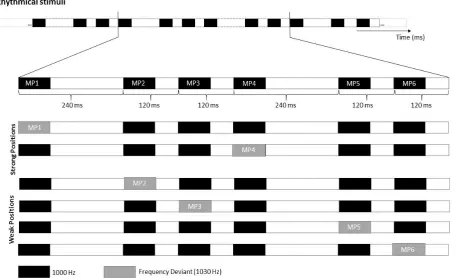
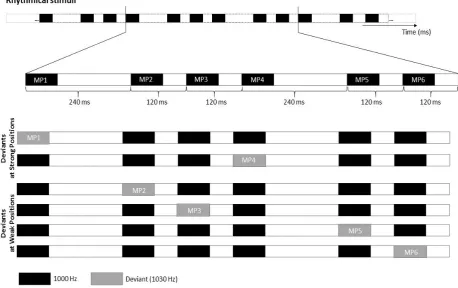
The stimuli comprised rhythmic and non-rhythmic experimental blocks (see Procedure below), built as
continuous 240 repetitions of a module comprising 6 sounds. Each sound was a 1000 Hz pure tone, lasting
70 milliseconds (ramped with 5 ms of rise time at the onset and 5 ms fall time at the offset to avoid clicks),
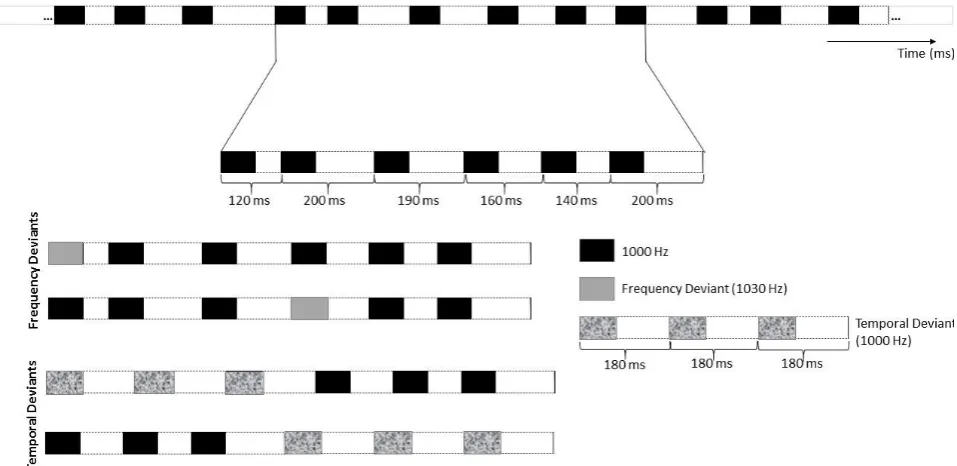
and followed by a variable silent interval. In non-rhythmic blocks, each module was created by assembling in
random order sounds with different inter-onset intervals (IOIs): 120, 140, 160, 190, 200 and 230 milliseconds
(note that these IOIs had non-integer ratio lengths, thus preventing any perception of regularity). In rhythmic
blocks, each module was created by assembling in fixed order sounds with the following IOIs: 240, 120, 120,
240, 120, 120 milliseconds. The basic modules of rhythmic and non-rhythmic blocks are shown in the top row
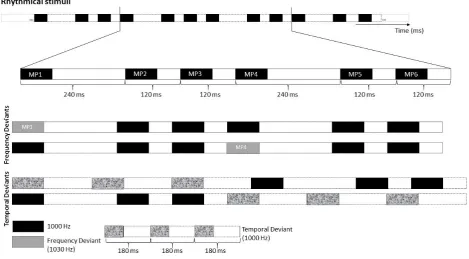
42 Figure 2.1. Stimulus material. Example of the rhythmic module. The top row illustrates an extract of the standard
rhythmical module. The middle rows represent an example of rhythmical module with a frequency deviant on the first or forth strong metrical position (MP1 and MP4). The bottom rows (last 2 rows) illustrate an example of rhythmical module with a temporal deviant replacing the first three or last three tones.
The rhythmic module (i.e., 240-120-120-240-120-120) evoked a clear binary meter based on the perception
of tones’ onsets. The first and the fourth sound in the module (labelled in Figure 2.1 as MP1 and MP4
-metrical positions 1 and 4, respectively) gained beat saliency due to their long IOIs. From now on, I will refer
to sounds with long IOI as metrically ‘strong’. By contrast, I will refer to the remaining sounds in the module
(i.e., MP2, MP3, MP5 and MP6 in Figure 2.1) as metrically ‘weak’.
In each rhythmic and non-rhythmic block, 20% of the modules (i.e., 48 modules out of 240) included a deviant
stimulus. Across blocks, the deviant was either a frequency or a temporal change. Frequency deviants were
1030 Hz tones (i.e., 30 Hz higher than the standard tones). Temporal deviants were triplets of tones equally
spaced by silent intervals of 110 ms, and constituted a clearly perceivable group both in rhythmic and
non-rhythmic blocks. Modules with deviants were inserted in the block in pseudo-random order, with the
constraint of a minimum of three and a maximum of seven modules without deviants (i.e., ‘standard’
43 either the first or the fourth strong metrical position in the module (see Figure 2.1). Temporal deviants
replaced with equal probability the first or last three tones in each module (see Figure 2.1).
Auditory stimuli were generated using the PsychToolbox extensions (Version 3.0.12.; October 2014) running
under Matlab R2014b (The MathWork, USA). All stimuli had the same acoustic energy and I did not use any
musical accent to avoid any potential influence of acoustic sound features per se. Stimuli were presented via
loudspeakers placed on a table, at a distance of 60 cm from the participant, at approximately 60 dB SPL. I
used a computer keyboard to record participants’ responses.
Figure 2.2. Stimulus material. Example of the non-rhythmic module. The top row illustrates an extract of the standard
non-rhythmical module. The middle rows represent an example of non-rhythmical module with a frequency deviant replacing the first or forth tone. The bottom rows (last 2 rows) illustrate an example of non-rhythmical module with a temporal deviant replacing the first three or last three tones.
2.3.3 Procedure
Participants were instructed to fixate a central cross presented on a computer screen in front of them, and
to listen carefully to the continuous auditory stream. They pressed a key as quickly as possible, when they