4337 A CASE STUDY ON AUTOIMMUNE HEPATITIS WITH HAEMOLYTIC ANEMIA
B. Bindu Priyanka*, B. Aswani, D. Guru Prasanna, J. Salma Sulthana
Department of Pharmacy Practice, Santhiram College of Pharmacy, Nandyal, Kurnool, Andhra Pradesh, India, Pincode-518501.
*Corresponding author E-mail: [email protected]
ARTICLE INFO ABSTRACT
Key Words
Autoimmune Hepatitis , Fatigue ,
Abdominal pain , Haemolytic anaemia,
Inflammation
Autoimmune hepatitis is also called as lupoid hepatitis. It is a chronic autoimmune disease of the liver where the liver cells to be inflamed due to our own body immune system. These are mainly classified into two types based on the action of antibodies on the liver they are type-I and type-II. Among these two types type-I is more common than type-II. The prevalence of autoimmune hepatitis in india is rare and unclear. Only five cases are reported for autoimmune hepatitis. It occurs in both males and females but it is more common in females when compared to males. The common symptoms of the autoimmune hepatitis include fatigue, mucle aches, abdominal discomfort and abdominal distension, fever, jaundice, enlarged liver, loss of apetite, nausea and vomiting. If the autoimmune hepatitis is untreated leads to scaring of liver tissues, this condition is commonly called as cirrhosis, but this condition leads to severe complications includes esophageal varices, Ascities, liver failure, liver cancer. The laboratory procedures followed for the diagnosis of autoimmune hepatitis includes blood test, liver function test and ultrasound of liver and liver biopsy. The treatment guidelines follow to treat autoimmune hepatitis by corticosteroid administration along with or without azathioprine. In our present case study a female patient of age 36years admitted in general medicine department of AMC ward in Santhiram general and medical hospital with a duration of four days with cheif complaints of abdominal discomfort, abdominal distension since 2 months which was gradually progressive in nature associated with shortness of breath on lying down position, fever since 2months associated with chills and riggor, pain in the left upper quadrant of abdomen since 7 days, decreased appetite. Based on the laboratory and clinical investigations of the patient the physician diagnose as autoimmune hepatitis with haemolytic anemia. The therapy follows for the patient includes corticosteroid drug dexamethasone to reduce the inflammation and suppress the immune system and other drugs are used for the symptomatic relief of the patient. The response of the treatment by the patient is good hence the patient is discharged with supportive therapy by corticosteroid drug dexamethasone.
INTRODUCTION:
Hepatitis is an inflammation of the liver which is commonly caused by the 5 different types of hepatitis viruses A, B, C, D and E. Autoimmune hepatitis (AIH) is also called as lupoid hepatitis which is a
chronic autoimmune disease of the liver. In autoimmune hepatitis our owns immune system attacks liver cells causing the liver to be inflamed. This autoimmune hepatitis is classified into two types which include type-An Elsevier Indexed Journal ISSN-2230-7346
4338 I and type-II(1). Type-I autoimmune hepatitis
is known as classic autoimmune hepatitis characterized by circulating antinuclear antibodies and/or anti-smooth muscle antibodies and it is common in adults and adolescents. Type-II autoimmune hepatitis is caused by the presence of the antibodies to liver/kidney microsomes (ALMN-1) and/or to a liver cytosol antigen (ALC-1) and it is common in girls and young woman. The Prevalence of autoimmune hepatitis in India is less and unclear(2). The annual incidence of the AIH is 0.34-0.42 per 1 lakh population and only five cases were reported in India (3,4). The common symptoms include
initially fever, hepatic tenderness and jaundice, later the fatigue, upper abdominal discomfort, loss of appetite, autoimmune hemolytic anemia, thrombocytopenia purpura. The common diagnostic procedures includes liver function tests, rule out of viral hepatitis, determine the type of AIH (5,6).
Treatment Guidelines followed for the autoimmune hepatitis is immunosuppressive therapy with either glucocorticoids or azathioprine for symptomatic relief.
CASE REPORT:
A 36 years old female patient was admitted in general medicine department of AMC ward in Santhiram General Hospital with chief complaints of fever since two months which was on and off with intermittent chills and rigor, abdominal pain since 2 months. The present illness was abdominal distension which was gradually progressed in association with shortness of breath on lying down position, pain in the left upper quadrant of abdomen since 7 days along with abdominal discomfort . Based on the history of previous illness patient has no similar complaints and not known case of hypertension, diabetes mellitus. On examination of personal history the patient had normal sleep and bowel, bladder profiles and appetite was decreased. On general examination of the patient the pulse rate was 82beats/min, blood pressure was 100/70 mm of Hg, temperature was 98of, SPO2 was 96%
with room air, pallor is present, icterus is present, bilateral pitting edema is present. On local examination of abdomen based on
4339 SOS, INJ. Furosemide 2cc slow IV is given
before blood transfusion.
DISCUSSION
Autoimmune hepatitis is a chronic inflammatory disease of liver that occurs when the immune system attacks the liver cells. Autoimmune hepatitis was first described in 1951 as a chronic hepatitis of
young woman with hyper
gammaglobulinemia in the absence of cirrhosis which response well to adrencorticotropic therapy. Autoimmune hepatitis is also called as lupoid hepatitis. Individuals with Autoimmune Hepatitis often have no initial symptoms and the disease is detected by abnormal liver function tests. Anomalous presentation of human leucocyte antigen(HLA) class-II on the surface of liver cells possibly due to genetic predisposition of acute liver infection causes a cell mediated immune response against the body’s own liver resulting in Autoimmune Hepatitis(7,8). This
abnormal immune response results in the inflammation of liver which can leads to further symptoms and complications such as fatigue and cirrhosis. The disease may occur at any age but it most often diagnosed in patients between the age of 40 and 50 years. The common initial symptoms include fatigue, muscle aches. Signs of acute inflammation including fever, jaundice and right upper quadrant abdominal pain. In our present study the patient was admitted with abdominal pain since 2 months and abdominal distension which was gradually progressive. Generally in Autoimmune Hepatitis upper quadrant abdominal pain with fever and jaundice was observed but in our present case there is a presence of pain in the left upper quadrant of abdomen along with abdominal discomfort, jaundice and fever. The diagnosis of autoimmune hepatitis is best achieved with a combination of clinical, laboratory and histological findings (9,10). A number of specific antibodies in the blood indicate the increased immunoglobulin G levels. However the diagnosis of the autoimmune hepatitis always require a liver biopsy but in our case the diagnosis was confirmed by clinical and
4340
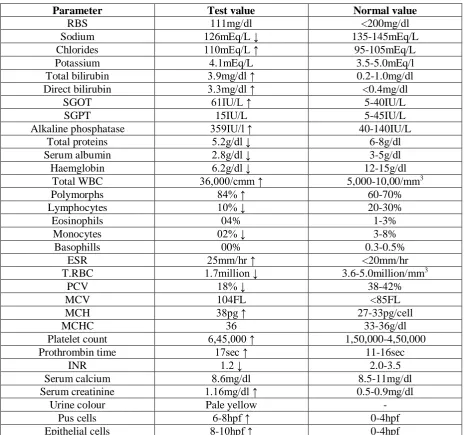
Table. No. 1. Laboratory Examinations
Parameter Test value Normal value
RBS 111mg/dl <200mg/dl
Sodium 126mEq/L ↓ 135-145mEq/L
Chlorides 110mEq/L ↑ 95-105mEq/L
Potassium 4.1mEq/L 3.5-5.0mEq/l
Total bilirubin 3.9mg/dl ↑ 0.2-1.0mg/dl Direct bilirubin 3.3mg/dl ↑ <0.4mg/dl
SGOT 61IU/L ↑ 5-40IU/L
SGPT 15IU/L 5-45IU/L
Alkaline phosphatase 359IU/l ↑ 40-140IU/L
Total proteins 5.2g/dl ↓ 6-8g/dl
Serum albumin 2.8g/dl ↓ 3-5g/dl
Haemglobin 6.2g/dl ↓ 12-15g/dl
Total WBC 36,000/cmm ↑ 5,000-10,00/mm3
Polymorphs 84% ↑ 60-70%
Lymphocytes 10% ↓ 20-30%
Eosinophils 04% 1-3%
Monocytes 02% ↓ 3-8%
Basophills 00% 0.3-0.5%
ESR 25mm/hr ↑ <20mm/hr
T.RBC 1.7million ↓ 3.6-5.0million/mm3
PCV 18% ↓ 38-42%
MCV 104FL <85FL
MCH 38pg ↑ 27-33pg/cell
MCHC 36 33-36g/dl
Platelet count 6,45,000 ↑ 1,50,000-4,50,000
Prothrombin time 17sec ↑ 11-16sec
INR 1.2 ↓ 2.0-3.5
Serum calcium 8.6mg/dl 8.5-11mg/dl
Serum creatinine 1.16mg/dl ↑ 0.5-0.9mg/dl
Urine colour Pale yellow -
Pus cells 6-8hpf ↑ 0-4hpf
Epithelial cells 8-10hpf ↑ 0-4hpf
Furosemide is used to prevent the blood transfusion complications by preventing the water retention. Packed Red Blood cell transfusion is used to treat anemia by improving the hemoglobin levels. Tramadol is an opoid analgesic used to treat pain. In our present case the patient condition was maintained according to the treatment guidelines. Glucocorticoids may cause some severe side effects like diabetes, weight gain, anxiety and confusion. In our present study we didn’t observe any side effects of the treatment. Medications that suppress the immune system may leads to various forms of cancer, in our present case the patient was discharged with maintenance therapy of
glucocorticoids. It requires close monitoring for the side effects but due to lack of follow-up of the patient we are unable to monitor the side effects.
CONCLUSION
4341
REFERENCES
1. Krawitt EL. Autoimmune Hepatitis. N Engl J Med 2006; 354-66.
2. Lohse AW, Mieli-vergani G. Autoimmune hepatitis. J Hepatol 2011;55: 171-182.
3. Zachou K, Muratori P, Koukoulis GK, Granito A, Gastselis N, Fabbri A, et al. Review article: autoimmune hepatitis- Current Management and challenges Alinment Pharmacol Ther 2013;38:887-913. 171-182.
4. Schramm C, Kanzler S, zum Buschenfelde KH, Galle PR, Lohse AW. Autoimmune hepatitis in the Gastroenterol 2001;96: 1587-1591. 5. Macky IR, Weiden S, Hasker J.
Autoimmune hepatitis. Ann N Y Acad Sci 1965; 124: 767-780. 6. Johnson PJ, McFarlane IG. Meeting
report: International Autoimmune hepatitis Group. Hepatomegaly 1993; 18:998-1005.
7. Alvarez F, Berg PA, Bianchi FB, Bianchi L, Burroughs AK, cancado EL, et al. International Autoimmune hepatitis. J Hepatol 1993; 31: 929-938
8. Muratori P, Granito A, Quarneti C, ferri S, Meinchella R, cassani F et al. Autoimmune hepatitis in Italy: the Bologna experience, J hepatol 2009;50:1210-1218.
9. Czaja AJ. Autoimmune hepatitis in diverse ethnic populations and geographical regions. Expert Rev Gastrointestinal Hepatol 2013;7:365-385.
10.Verslype C, George C, Buchel E, Nevens F, van Steenbergen W, Fevery J. Diagnosis and treatment of autoimmune hepatitis at age 65 and older. Aliment Pharmacol Ther 2005;21;695-699.