Information Paper No. 61
October 2019
UNESCO
The constitution of the United Nations Educational, Scientific and Cultural Organization (UNESCO) was adopted by 20 countries at the London Conference in November 1945 and entered into effect on 4 November 1946. The Organization currently has 195 Member States and 11 Associate Members.
The main objective of UNESCO is to contribute to peace and security in the world by promoting collaboration among nations through education, science, culture and communication in order to foster universal respect for justice, the rule of law, and the human rights and fundamental freedoms that are affirmed for the peoples of the world, without distinction of race, sex, language or religion, by the Charter of the United Nations.
To fulfil its mandate, UNESCO performs five principal functions: 1) prospective studies on education, science, culture and communication for tomorrow's world; 2) the advancement, transfer and sharing of knowledge through research, training and teaching activities; 3) standard-setting actions for the preparation and adoption of internal instruments and statutory recommendations; 4) expertise through technical cooperation to Member States for their development policies and projects; and 5) the exchange of specialized information.
UNESCO Institute for Statistics
The UNESCO Institute for Statistics (UIS) is the statistical office of UNESCO and is the UN depository for global statistics in the fields of education, science, technology and innovation, culture and communication.
The UIS is the official source of internationally comparable data used to monitor progress towards the Sustainable Development Goal on education and key targets related to science, culture, communication and gender equality.
Published in 2019 by:
UNESCO Institute for Statistics P.O. Box 6128, Succursale Centre-Ville Montreal, Quebec H3C 3J7
Canada
Tel: +1 514-343-6880
Email: [email protected] http://www.uis.unesco.org
Ref: UIS/2019/ED/IP/61 © UNESCO-UIS 2019
This publication is available in Open Access under the Attribution-ShareAlike 3.0 IGO (CC-BY-SA 3.0 IGO) license
(http://creativecommons.org/licenses/by-sa/3.0/igo/). By using the content of this publication, the users accept to be bound by the terms of use of the UNESCO Open Access Repository (http://www.unesco.org/open-access/terms-use-ccbysa-en).
The designations employed and the presentation of material throughout this publication do not imply the expression of any opinion whatsoever on the part of UNESCO concerning the legal status of any country, territory, city or area or of its authorities or concerning the delimitation of its frontiers or boundaries.
Background
The UNESCO Institute for Statistics (UIS) is the custodian agency for data for the Sustainable Development Goal on education (SDG 4) and responsible for developing the methodologies, standards and indicators needed to monitor progress across countries and time. This paper evaluates a methodology to combine access, completion and learning indicators that results in an adjustment of the SDG Indicator 4.1.1 in order to provide a more accurate view of the education situation facing children and adolescents, especially in regions with the greatest challenges.
SDG Target 4.1 aims to“ensure that all girls and boys complete free, equitable and quality primary and secondary education leading to relevant and effective learning outcomes” by 2030.
SDG Indicator 4.1.1 is used to measure progress towards this target. It is defined as“proportion of children and young people (a) in Grade 2 or 3; (b) at the end of primary education; and (c) at the end of lower secondary education achieving at least a minimum proficiency level in (i) reading and (ii) mathematics, by sex.”
Participation in primary and lower secondary (basic) education has increased substantially since the World Declaration of Education for All in 1990 and the decision by countries to make universal primary education a Millennium Development Goal in 2000. Despite this progress, learning outcomes tend to be low,
especially in low- and middle-income countries. This suggests that while a growing number of children are in school, they are not necessarily learning. As a result, SDG Target 4.1 highlights the need for effective learning outcomes while ensuring universal primary and secondary education.
Progress towards target 4.1 is currently measured by indicator 4.1.1, which calculates the percentage of children in school achieving a minimum learning proficiency level. A common benchmark for defining and measuring minimum proficiency in mathematics and reading does not currently exist; however, the Global Alliance to Monitor Learning (GAML) is developing a framework for a common benchmark that links existing learning assessment studies.1 Currently, indicator 4.1.1 relies on definitions of minimum
proficiency used at different points of measurement of the school trajectories (i.e. Grade 2/3 of primary education, end of primary education and end of lower secondary education) by the existing international learning assessments.
The need for better measurement of SDG Target 4.1
Target 4.1 reflects three major dimensions: access to education, completion and learning outcomes. To achieve the target, all children must complete primary and secondary education and achieve sufficient learning outcomes. While the current definition of indicator 4.1.1 provides a clear measure of progress towards the learning outcomes dimension of the target, it omits the access and completion dimensions,
4 UIS Information Paper Nº 61| 2019
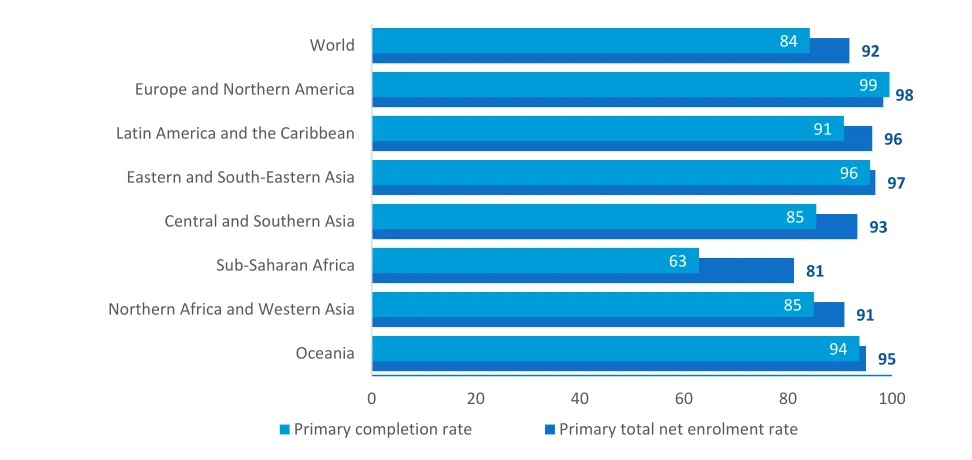
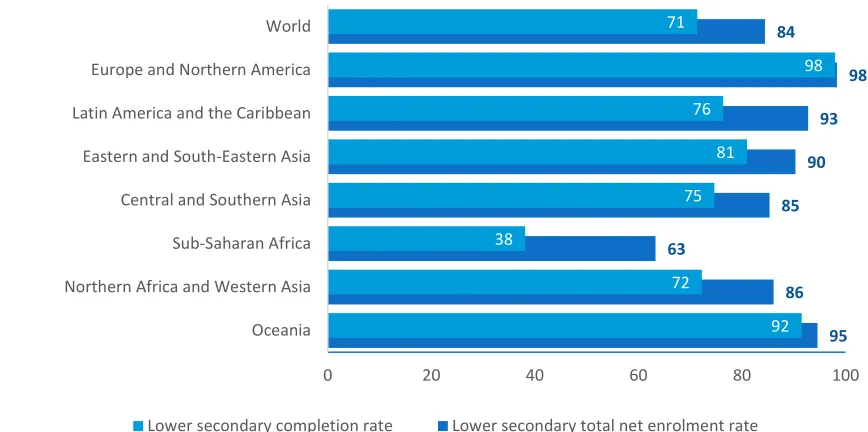
which are critical priorities for several regions. As shown in Figures 1 and 2, 81% of children are in school in sub-Saharan Africa and just 63% complete primary education. The rates fall even further for lower secondary education, with just 63% of adolescents between the ages of about 12 to 14 years old enrolled in school and only 38% completing this level.
To achieve target 4.1, significant improvements are needed to expand access to education while also improving the quality of education needed to strengthen learning outcomes. The ideal solution would involve measuring the learning outcomes of children who are in and out of school to show the extent to which a country’s education system educates its entire school-age population to a particular standard of learning. However, this is generally not feasible because it would require a significant investment in household surveys, which can be expensive. A more practical approach involves the use of school-based measures of learning because the data are already available. This approach also makes it possible to track the access dimension of target 4.1 and the extent to which children complete primary and lower-secondary school as part of the wider goal of achieving universal primary and secondary education.
Large proportions of children and adolescents are not in school or completing primary and secondary education
Source: UIS database. Regional averages for completion rates calculated by the UIS for this paper.
Source: UIS database. Regional averages for completion rates calculated by the UIS for this paper.
95 91 81
93 97 96
98 92
94 85 63
85 96 91
99 84
0 20 40 60 80 100
Oceania Northern Africa and Western Asia Sub-Saharan Africa Central and Southern Asia Eastern and South-Eastern Asia Latin America and the Caribbean Europe and Northern America World
Primary completion rate Primary total net enrolment rate
Figure 2.
Source: UIS database. Regional averages for completion rates calculated by the UIS for this paper.
A narrow focus on the learning outcomes of students can actually hide progress towards target 4.1. For example, in Indonesia, between 2006 and 2012, the proportion of 15-year-old students achieving minimum proficiency in science, according to the OECD PISA definition, fell from 38% to 33%. Yet, it would be wrong to conclude that Indonesia lost ground in providing children with quality education—enrollment of 15-year-olds increased substantially from 74% to 86% over the same period, resulting in a slight increase in the total rate of 15-year-olds in school and achieving the minimum proficiency in science (see Figure 3).
95 86 63
85 90
93 98 84
92 72
38
75 81 76
98 71
0 20 40 60 80 100
Oceania Northern Africa and Western Asia Sub-Saharan Africa Central and Southern Asia Eastern and South-Eastern Asia Latin America and the Caribbean Europe and Northern America World
Lower secondary completion rate Lower secondary total net enrolment rate
6 UIS Information Paper Nº 61| 2019
Real progress in learning can be hidden by enrolment and a narrow focus on students achieving a minimum proficiency level
Source: OECD PISA, http://www.oecd.org/pisa/, and UIS database.
In fact, as education systems expand access, learning outcomes can be expected to decline, especially as they approach universal participation. This is because education systems must reach more excluded and inherently disadvantaged populations who may be more difficult to educate—at least at first. Excluded populations may be poorer or marginalized, and these characteristics are, unfortunately, important determinants of learning outcomes in many education systems. It may take time for systems to adjust and provide quality education to more disadvantaged students. Consequently, the values for indicator 4.1.1, as currently defined, could decline despite progress towards target 4.1. with increased education participation of the world’s most disadvantaged children.
38
33
74
86
0 25 50 75 100
2006 2012 2006 2012
Percentage achieving minimum proficiency in PISA science Percentage of 15 year-olds enrolled in secondary schools
Figure 3. Percent of 15 year-old students achieving minimum science proficiency in PISA and
percentage enrolled in 2006 and 2012, Indonesia
Between 2006 and 2012, the proportion of 15-year-old students
achieving minimum science proficiency declined by 5 percentage
points...
...but at the same time, the rate of 15-year-olds enrolled increased by 12 percentage points, resulting in a small increase in the proportion of the population in school and achieving minimum
How to improve the indicator
To offer a more accurate view of the situation, the UIS has explored a simple methodology, combining enrollment and completion indicators with SDG Indicator 4.1.1, to produce a quality-adjusted enrollment and completion rate defined as follows:
Indicator 4.1.1 adjusted by enrollment and completion rates:Proportion of children (a) enrolled in primary, (b) completing primary and (c) completing lower secondary and achieving minimum proficiency in (i) mathematics and (ii) reading, measured at the 2nd or 3rd grade level, approximate end of primary, and
approximate end of lower-secondary, respectively, by sex.
This adjusted indicator effectively measures enrollment and completion but only counts students as learning if they attain minimum proficiency. For example, if 80% of children complete primary school but only 60% of children in school attain minimum reading proficiency, then the proportion of children completing primary school and achieving minimum learning proficiency is 48% (the product of the two numbers).
Another important point to consider is what a value of 100% means according to the two indicators. For the original indicator, 100% means that only children in school are achieving minimum proficiency levels. If the adjusted indicator reaches 100%, all children would be both in school and learning at a sufficient level, which is the objective of target 4.1.
Comparison of the original and adjusted indicators
The greatest differences between the two indicators are found in regions or countries with lower
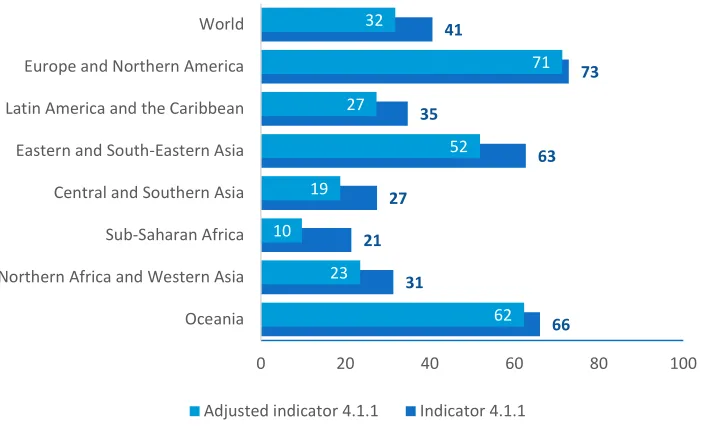
completion and enrollment rates because the adjusted indicator is based on a quality-adjusted completion rate. This also explains why the largest differences occur at the lower-secondary level. Globally, 41% of lower-secondary students achieve minimum proficiency in mathematics according to the original indicator but the value for the adjusted indicator would fall to 32% of adolescents completing lower secondary and achieving minimum proficiency in mathematics.
8 UIS Information Paper Nº 61| 2019
Combining completion rates with learning outcomes improves our understanding of progress towards target 4.1.
Figure 4. Comparison of results for 4.1.1 adjusted and original indicators; lower secondary, mathematics
Label at bottom should read: Adjusted 4.1.1 indicator Original 4.1.1 indicator
Source: UIS database. Regional averages for completion rates calculated by the UIS for this paper.
66 31 21 27 63 35 73 41 62 23 10 19 52 27 71 32
0 20 40 60 80 100
Oceania Northern Africa and Western Asia Sub-Saharan Africa Central and Southern Asia Eastern and South-Eastern Asia Latin America and the Caribbean Europe and Northern America World
Adjusted indicator 4.1.1 Indicator 4.1.1
Figure 4. Comparison of results for adjusted and original 4.1.1. indicators; lower
secondary, mathematics
74 50 35 30 69 51 79 49 69 38 15 21 56 40 77 370 20 40 60 80 100
Oceania Northern Africa and Western Asia Sub-Saharan Africa Central and Southern Asia Eastern and South-Eastern Asia Latin America and the Caribbean Europe and Northern America World
Adjusted indicator 4.1.1 Indicator 4.1.1
Source: UIS database. Regional averages for completion rates calculated by the UIS for this paper.
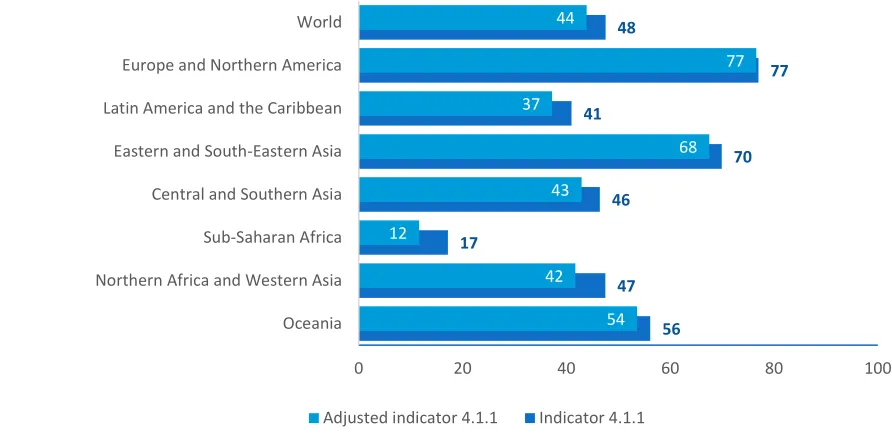
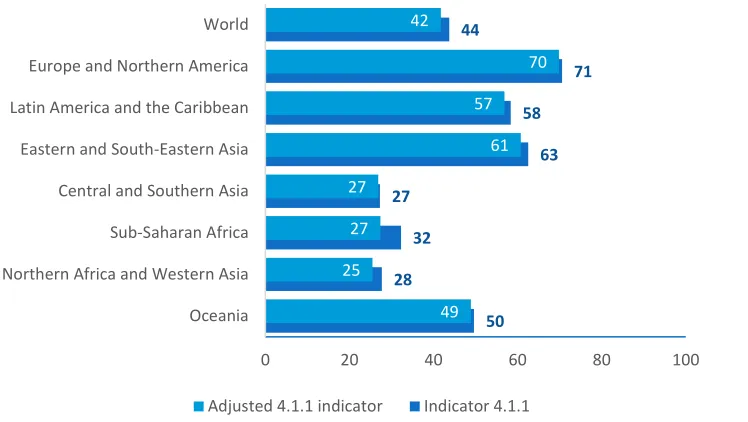
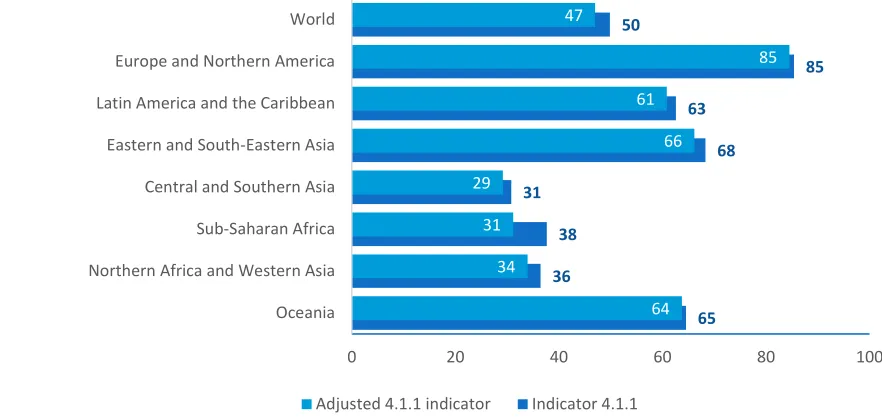
As shown in Figures 6 to 9, the differences between the original and adjusted indicators become less pronounced at the primary school level, where enrollment and completion rates are closer to 100%. Globally, 48% of primary students nearing completion achieve minimum proficiency levels in mathematics according to indicator 4.1.1, while 44% of children are completing primary education and achieving
minimum proficiency levels in mathematics according to the adjusted indicator. The largest differences emerge, again, in regions with lower levels of education participation. For example, the original and proposed adjusted indicators would be 17% and 12%, respectively, in sub-Saharan Africa.
These comparisons reveal how the original and adjusted indicators differ in their measurement of
progress towards target 4.1. Clearly, when completion or enrollment is near 100%, there is little difference between the results of the two indicators. However, when access to education remains a significant barrier, the adjusted indicator provides a better understanding of how far we are from achieving target 4.1. The greatest differences between the two indicators are found in the most poverty-stricken regions of the world, where having the clearest picture of progress—or lack thereof—is most vital.
The challenges facing sub-Saharan Africa are even greater when completion rates are considered
Source: UIS database. Regional averages for completion rates calculated by the UIS for this paper.
56 47 17
46
70 41
77 48
54 42 12
43
68 37
77 44
0 20 40 60 80 100
Oceania Northern Africa and Western Asia Sub-Saharan Africa Central and Southern Asia Eastern and South-Eastern Asia Latin America and the Caribbean Europe and Northern America World
Adjusted indicator 4.1.1 Indicator 4.1.1
10 UIS Information Paper Nº 61| 2019
Source: UIS database. Regional averages for completion rates calculated by the UIS for this paper.
At the 2nd/3rd grade level, the adjusted indicator suggests less progress towards SDG Target 4.1 especially in sub-Saharan Africa
Source: UIS database. Regional averages for completion rates calculated by the UIS for this paper.
75 56 37 45 73 43 83 54 72 49 26 41 70 40 83 49
0 20 40 60 80 100
Oceania Northern Africa and Western Asia Sub-Saharan Africa Central and Southern Asia Eastern and South-Eastern Asia Latin America and the Caribbean Europe and Northern America World
Adjusted indicator 4.1.1 Indicator 4.1.1
Figure 7. Comparison of results for 4.1.1 adjusted and original indicators, primary,
reading
50 28 32 27 63 58 71 44 49 25 27 27 61 57 70 420 20 40 60 80 100
Oceania Northern Africa and Western Asia Sub-Saharan Africa Central and Southern Asia Eastern and South-Eastern Asia Latin America and the Caribbean Europe and Northern America World
Adjusted 4.1.1 indicator Indicator 4.1.1
Insert Figure 9
Source: UIS database. Regional averages for completion rates calculated by the UIS for this paper.
65 36
38 31
68 63
85 50
64 34
31 29
66 61
85 47
0 20 40 60 80 100
Oceania Northern Africa and Western Asia Sub-Saharan Africa Central and Southern Asia Eastern and South-Eastern Asia Latin America and the Caribbean Europe and Northern America World
Adjusted 4.1.1 indicator Indicator 4.1.1