BIOTERRORISM
P.GAJALAKSHMI
Head, Department of Microbiology, Dhanalakshmi srinivasan college of arts and science for women, Perambalur, Tamilnadu
ABSTRACT
Bioterrorism is a criminal act against unsuspecting civilians using pathogenic biological agents, such as biological warfare agents. Bioterror and Biological Warfare agents are most often colorless, by-and-large odorless microorganisms (bacteria, viruses, fungi) or toxins (usually protein toxins) derived from microorganisms that can be spread in air as aerosols or in food or drink to infect as many people as possible. They are easily concealed, and thus difficult to detect before an attack. Their main advantages to terrorists are allowing easy escape and causing panic and chaos within a civilian population. Their aim is to overwhelm emergency medical departments at local hospitals and clinics. However, there are ways to help protect yourself against bioterror agents and by extrapolation biological warfare agents and to help identify an attack when it occurs.
Keywords: bioterrorism, Biological Warfare, combat bioterrorism
INTRODUCTION
Despite their current notoriety, biological weapons are not new. In 1346, plague broke out in the Tartar army during its siege of Kaffa in the Crimea. The attackers hurled the corpses of those who died over the city walls; the plague epidemic that followed forced the defenders to surrender, and some infected people who left Kaffa may have started the Black Death pandemic that spread throughout Europe, killing one-third of the population[1].
Bioterrorism does not have to cause large numbers of immediate deaths to be effective. Most biological agents do not cause widespread immediate fatalities, or even large numbers of deaths within days of exposure, and most exposed patients might not even have a life-threatening disease. Example for the agents that do not cause harm to humans but disrupt the economy is foot-and-mouth disease (FMD) virus, which is capable of causing widespread economic damage and public concern.
L - 160
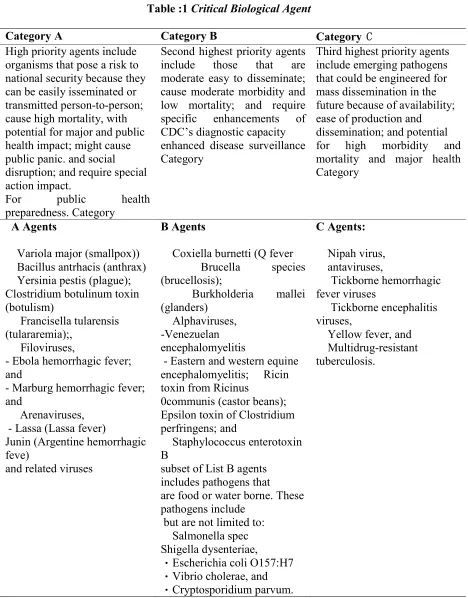
Table :1 Critical Biological Agent
Category A Category B Category C
High priority agents include organisms that pose a risk to national security because they can be easily isseminated or transmitted person-to-person; cause high mortality, with potential for major and public health impact; might cause public panic. and social disruption; and require special action impact.
For public health
preparedness. Category
Second highest priority agents include those that are moderate easy to disseminate; cause moderate morbidity and low mortality; and require specific enhancements of CDC’s diagnostic capacity enhanced disease surveillance Category
Third highest priority agents include emerging pathogens that could be engineered for mass dissemination in the future because of availability; ease of production and dissemination; and potential for high morbidity and mortality and major health Category
A Agents
Variola major (smallpox)) Bacillus antrhacis (anthrax) Yersinia pestis (plague); Clostridium botulinum toxin (botulism)
Francisella tularensis (tulararemia);,
Filoviruses,
- Ebola hemorrhagic fever; and
- Marburg hemorrhagic fever; and
Arenaviruses, - Lassa (Lassa fever)
Junin (Argentine hemorrhagic feve)
and related viruses
B Agents
Coxiella burnetti (Q fever
Brucella species (brucellosis);
Burkholderia mallei (glanders)
Alphaviruses, -Venezuelan encephalomyelitis
- Eastern and western equine encephalomyelitis; Ricin toxin from Ricinus
0communis (castor beans); Epsilon toxin of Clostridium perfringens; and
Staphylococcus enterotoxin B
subset of List B agents includes pathogens that are food or water borne. These pathogens include
but are not limited to: Salmonella spec Shigella dysenteriae,
� Escherichia coli O157:H7
� Vibrio cholerae, and
� Cryptosporidium parvum.
C Agents:
Nipah virus, antaviruses,
Tickborne hemorrhagic fever viruses
Tickborne encephalitis viruses,
Yellow fever, and
THE SIGNS AND SYMPTOMS OF SOME BIOLOGICAL AGENTS
Anthrax.
The most dangerous biological agent is probably the spore form of Bacillus anthracis. Victims of an inhalation anthrax attack will present initially with a flu-like illness with malaise, dry cough and mild fever. This phase of the disease usually takes a few days, followed by severe respiratory distress. If anthrax spores enter the skin, cutaneous anthrax infection can occur, resulting in a black scab over the contaminated area. At this point the infection remains treatable with antibiotics, but if left untreated approximately 20% of cases result in death. Persons with cutaneous anthrax can also have headaches, muscle aches, fever, nausea and vomiting, indicating a systemic form of the infection. Gastrointestinal anthrax can produce intestinal bleeding and similar signs and symptoms to systemic forms of the disease. Person-to-person transmission of Bacillus anthracis is poor, and this type of infection is not considered contagious[3]. Botulism.
Botulism is caused by toxins released from the bacillus bacterium Clostridium botulinum. This can occur naturally by ingestion of infected foods, but a terrorist attack may utilize an aerosol of the bacterium or the purified toxins. The botulism toxins are neurotoxins and cause characteristic neurological signs and symptoms within 1-5 days, such as dry mouth, double vision, excessive pupil dilatation, local paralysis, and difficulty in swallowing. The neurotoxins usually do not cause a fever, and patients are alert and oriented. Most patients die of respiratory failure, so respiratory support is essential and may have to be continued for several weeks to months.[4]
Plague.
Plague is caused by the bacterium Yersinia pestis, which is usually spread from rodents to man through the bites of infected fleas or other insects. In a bioterror attack the bacterium could be spread by inhalation of droplets containing Y. pestis or terrorists could simply disseminate infected fleas or other biting insects. If left untreated, inhalation of Y.
pestis is nearly always fatal within 2-3 days.
Patients usually suffer severe pneumonia with
malaise, high fever, cough, spitting up blood and labored breathing. Eventually patients go into septic shock and die because of respiratory failure and circulatory collapse[5].
Smallpox.
Smallpox is caused by the naturally occurring Variola Virus. After exposure, the incubation period for smallpox is approximately 7-17 days, average 12 days, during which nonspecific signs and symptoms, such as fever, malaise and aches occur within a few days. Characteristic rashes develop, starting as papules that progress to vesicles and then pustules that can form scabs in 1-2 weeks [6]
Brucellosis.
Brucellosis is caused by bacteria of the genus
Brucella. Historically brocellosis was caused by
contact with infected livestock or after ingestion of infected milk. Aerosols of Brucella are considered very effective at infection. The disease develops slowly over several months as a flu-like infection with nonspecific signs and symptoms, including intermittent fever, chills, night sweats, malaise, muscle pain and soreness, cough and eventually joint pain and soreness, gastrointestinal complaints, nausea, vomiting, diarrhea and constipation.
Q Fever
Q Fever is caused by the bacterium Coxiella
burnetii. This can occur naturally from contact with
goats, cheep and cattle. The disease develops slowly over a month or more, with fevers, malaise, headache, muscle pain and soreness and other signs and symptoms. About one-half of patients will have a pneumonia with cough and chest pain. In some patients the disease can progress to hepatitis
L - 162 prevented from infecting others .Yet most hospital
infection plans are capable of managing only a handful of infectious patients[9]
Antibiotics.
Long-term use of antibiotics can have their own problems. Some people cannot take ciprofloxacin because of allergic reactions (hypersensitivity or anaphylactic reactions). For example, ciprofloxacin therapy may result in drug crystals in the urine in rare cases, and patients should be well hydrated to prevent concentration of urine. Adverse antibiotic responses resulted in discontinuing ciprofloxacin in ~3.5% of patients, and such reactions included nausea (5%), diarrhea (2%), vomiting (2%) abdominal pain (1.7%), headache (1.2%) and rash (1.1%). Doxycycline has lower adverse responses and is just as effective against almost all anthrax strains. However, in a few patients doxycycline causes gastrointestinal irritation, anorexia, vomiting, nausea, diarrhea, rashes, mouth dryness, hoarseness and in rare cases hypersensitivity reactions, hemolytic anemia, skin hyper-sensitivity and reduced white blood cell counts. Doxycycline can be used at low dose in children aged 7 and above. Azithromycin is the antibiotic of choice for pediatric cases, but its cost generally prevents widespread use. Penicillin has been recommended for some types of bioterror agents, such as anthrax. Antivirals.
Use of antivirals against viral agents should only be done under the direct care of a physician, and their use is only recommended after a confirmed
infection. Certain nutraceutical treatments can be used such as Genistein (in soy/red clover) to inhibit viral kinase, rosemary/lemon balm to reduce complement activation, selenite to inhibit viral replication, barley grass and lauric acid to inhibit lipid metabolism of viruses and Phyllanthus
amarus/niruri to inhibit viral reverse transcriptase.
Vaccines.
Specific vaccines can potentially protect against bacterial and viral bioterror agents. Most of these vaccines would have to be administered over a relatively long time period to be effective. For example, the current anthrax vaccine must be administered in multiple doses over an 18-month period to be effective, and it is not even known conclusively that the vaccine is effective against inhalation anthrax. Other vaccines, such as the smallpox virus vaccine, have been in general civilian use for some time and are relatively safe[10].
CONCLUSIONS
Biological weapons are unique in their invisibility and their delayed effects. These factors allow those who use them to inculcate fear and cause confusion among their victims and to escape undetected. A biowarfare attack would not only cause sickness and death in a large number of victims but would also aim to create fear, panic, and paralyzing uncertainty.
REFERENCES
[1]. Christopher GW, Cieslak TJ, Pavlin JA, et al: Biological warfare. A historical perspective JAMA 1997;278(5):412-7
[2]. Osterholm MT, Schwartz J. Living Terrors: What America Needs to Know toSurvive the Coming Bioterrorist Catastrophe. New York: Delacorte Press, 2000
[3]. Anthrax as a Biological Weapon,
http://www.jama.ama-assn.org/issues/v281n18/ffull/jst80027
[4]. Botulinum Toxin as a Biological Weapon,
http://www.jama.ama-assn.org/issues/v285n8/rfull/jst00017
[5]. Plague as a Biological Weapon,
http://www.jama.ama-assn.org/issues/v283n17/rfull/jst90013
[6]. Smallpox as a Biological Weapon,
http://www.jama.ama-assn.org/issues/v281n22/rfull/jst90000
MD: US ArmyMedical Research Institute for Infectious Diseases, July 1998
[8]. Franz DR, Jahrling PB, Friedlander AM, et al: Clinical recognitionn and management of patients exposed to biological warfare agents. JAMA1997;278(5):399-411
[9] . CDC/APIC: Bioterrorism Readiness Plan: A Template for Healthcare Facilities(Centers for
Disease Control and Prevention/Association for Professionals in Infection Control and Epidemiology) (1999)
[10]. Vaccines in Civilian Defense Against Bioterrorism, by P.K. Russell, Emerg. Infect.
Dis. 1999; 5:531-533.