INTERNATIONAL JOURNAL OF PHARMACEUTICAL, CHEMICAL AND BIOLOGICAL SCIENCES
Available online atwww.ijpcbs.com
FORMULATION AND EVALUATION OF TINIDAZOLE
MODIFIED RELEASE DOSAGE FORMS
Gujjula Praveen
*, NagadesiManjusha,Naga Ravi, Chandrashekar and T. Kishore
Department of Pharmaceutical Technology, KGRL College of pharmacy, Bhimavaram-534202,Andhra Pradesh, India.
INTRODUCTION
The aim of the present study was to design drug-cyclodextrin complex to improve dissolution for improvement in bioavailability, to reduce the dosing frequency and to improve patient compliance. The objectives of the research work undertaken are 1) To prepare different modified release dosage form of Tinidazole for the treatment of anaerobic bacterial infections. 2) To study the Preformulation factors such as melting point, angle of repose, carr’s index. 3) To characterize manufactured tablets for hardness, thickness, content uniformity, weight uniformity, dimensions, etc. 4) To study in vitro drug release study comparison of different dosage form like tablet.In the present investigation, efforts were made to develop modified release tablets Tinidazole for the treatment of anaerobic bacterial infections. An attempt has been made to develop Tinidazole-carrier complex to improve the dissolution. Solid dispersion of Tinidazole was prepared by solvent method using carrier like cyclodextrin.
Tinidazole is a synthetic antibacterial and antiprotozoal agent that belongs to the nitroimidazole class. Tinidazole is effective therapy against protozoa such as Trichomonasvaginalis, amoebiasis, and giardiasis. In addition, Tinidazole is one of the most effective drugs available against anaerobic bacterial infections. Tinidazole is also useful in treating Crohn's disease, antibiotic-associated diarrhoea, and rosacea. It initially was approved by the FDA in 1963 and is available in oral, Parenteral, and topical formulations. Tinidazole is amebicidal, bactericidal, and trichomonicidal. Unionized Tinidazole is readily taken up by anaerobic organisms and cells. It acts selectively against anaerobic bacteria’s as only these bacteria are capable to reduce it to its active form intracellularly. Reduced it then disrupts DNA's helical structure, thereby inhibiting bacterial nucleic acid synthesis. This eventually results in bacterial cell death.
Tinidazole is cytotoxic to facultative anaerobic bacteria such as Helicobacter pylori and Gardnerellavaginalis, but the mechanism of
Research Article
ABSTRACT
An attempt was done to prepare the modified release tablets of tinidazole mainly to target the drug release to regions of stomach and large intestine during the treatment of bacterial infections. The formulations were tested for weight variation, hardness, friability, content uniformity, and the drug release rate. Beta cyclodextrin used as a complexing agent for alerting the release pattern, HPMC K15 M and sodium CMC was added as a matrix former. From the overall study the formulation-5 (drug: HPMC complex in 1:2) showing drug release of 68% in 60 mines. It is selected as an optimized formulation.
thisaction is not well understood3. However, its
activity against obligate anaerobes occurs through a four-step process:
Dissolution profile of Tinidazole was improved by using hydrophilic polymers by solvent method. This complex with the ratio of 1:2 (drug: HPMC complex) may contribute for better drug release profile than ratios of other formulations.
CDs have mainly been used as complexing agents to increase the aqueous solubility of poorly water-soluble drugs and to increase their bioavailability and stability. In addition, CDs have been used to reduce or prevent gastrointestinal or ocular irritation, reduce or eliminate unpleasant smells or tastes, prevent drug-drug or drug-additive interactions, or even to convert oils and liquid drugs into microcrystalline or amorphous powders1-3.
Advantages of Cyclodextrins
1. Enhancement of solubility: CDs
increase the aqueous solubility of many poorly soluble drugs by forming inclusion complexes with their polar molecules or functional groups. The resulting complex hides most of the hydrophobic functionality in the interior cavity of the CD while the hydrophilic hydroxyl groups o-n the external surface remain exposed to the environment. The net effect is that a water-soluble CD drug complex is formed.4
2. Enhancement of bioavailability:
When poor bioavailability is due to low solubility, CDs are of extreme value. Preconditions for the absorption of an orally administered drug are its release from the formulation in dissolved form. When drug is complexed with CD, dissolution rate and, consequently, absorption are enhanced. Reducing the hydrophobicity of drugs by CD complexation also improves their Percutaneous or rectal absorption. In addition to improving solubility, CDs also prevent crystallization of active ingredients by complexing individual drug molecules so that they can no longer self-assemble into a crystal lattice.5
3. Improvement of stability: CD
complexation is of immense application in improving the chemical, physical and thermal stability of drugs. For an active molecule to degrade upon exposure to oxygen, water, radiation or heat, chemical
reactions must take place. When a molecule is entrapped within the CD cavity, it is difficult for the reactants to diffuse into the cavity and react with the protected guest.6
4. Reduction of irritation: Drug
substances that irritate the stomach, skin or eye can be encapsulated within a CD cavity to reduce their irritancy. Inclusion complexation with CDs reduces the local concentration of the free drug, below the irritancy threshold. As the complex gradually dissociates and the free drug is released, it gets absorbed into the body and its local free concentration always remains below the levels that might be irritating to the mucosa.
5. Prevention of incompatibility: Drugs
are often incompatible with each other or with other inactive ingredients present in a formulation. Encapsulating o-one of the incompatible ingredients within a CD molecule stabilizes the formulation by physically separating the components in order to prevent drugdrug or drugadditive interaction.7
6. Odor and taste masking: Unpleasant
odor and bitter taste of drugs can be masked by complexation with CDs. Molecules or functional groups that cause unpleasant tastes or odors can be hidden from the sensory receptors by encapsulating them within the CD cavity. The resulting complexes have no or little taste or odor and are much more acceptable to the patient.
7. Material handling benefits:
Substances that are oils/liquids at room temperature can be difficult to handle and formulate into stable solid dosage forms. Complexation with CDs may convert such substances into microcrystalline or amorphous powders which can be conveniently handled and formulated into solid dosage forms by conventional production processes and equipment.8
MATERIALS AND METHODS Tinidazole (Cipla, Goa), HPMC K15M, sodium
Methods of Preparation of Solid Dispersions Fusion method12
The fusion method, first proposed by Sekiguchi and Obi involves the preparation of physical mixture of a drug and a water-soluble carrier and heating it directly until it melted. The melted mixture is then solidified rapidly in an ice-bath under vigorous stirring. The final solid mass is crushed, pulverized and sieved. Appropriately this has undergone many modifications in pouring the homogenous melt in the form of a thin layer onto a ferrite plate or a stainless steel plate and cooled by flowing air or water on the opposite side of the plate. In addition, a super-saturation of a solute or drug in a system can often be obtained by quenching the melt rapidly from a high temperature. Under such conditions, the solute molecule is arrested in the solvent matrix by the instantaneous solidification process. The quenching technique gives a much finer dispersion of crystallites when used for simple eutectic mixtures.
Solvent method13
In this method, the physical mixture of the drug and carrier is dissolved in a common solvent, which is evaporated until a clear, solvent free film is left. The film is further dried to constant weight. The main advantage of the solvent method is thermal decomposition of drugs or carriers can be prevented because of the relatively low temperatures required for the evaporation of organic solvents.
Melting solvent method (melt evaporation)12
It involves preparation of solid dispersions by dissolving the drug in a suitable liquid solvent and then incorporating the solution directly into the melt of polyethylene glycol, which is then evaporated until a clear, solvent free film is left. The film is further dried to constant weight. The 5 –10% (w/w) of liquid compounds can be incorporated into polyethylene glycol6000 without significant loss of its solid property. It is possible that the selected solvent or dissolved drug may not be miscible with the melt of the polyethylene glycol. Also the liquid solvent used may affect the polymorphic form of the drug, which precipitates as the solid dispersion. This technique possesses unique advantages of both the fusion and solvent evaporation methods. From a practical standpoint, it is only limited to drugs with a low therapeutic dose e.g. below 50 mg.
Melt extrusion method14, 15, 16
The drug/carrier mix is typically processed with a twin-screw extruder. The drug/carrier mix is simultaneously melted, homogenized and then extruded and shaped as tablets, granules, pellets, sheets, sticks or powder. The intermediates can then be further processed into conventional tablets. An important advantage of the hot melt extrusion method is that the drug/carrier mix is only subjected to an elevated temperature for about 1 min, which enables drugs that are somewhat thermo labile to be processed.
Solid dispersion by this method is composed of active ingredient and carrier, and prepare by hot-stage extrusion using a co-rotating twin-screw extruder. The concentration of drug in the dispersions is always 40% (w/w). The screw-configuration consist of two mixing zones and three transport zones distribute over the entire barrel length, the feeding rate is fix at 1 kg/h and the screw rate is set at 300 rpm. The five temperature zones are set at 100, 130, 170, 180, and 185C from feeder to die. The extrudates are collect after cooling at ambient temperature on a conveyer belt. Samples are milled for 1 min with a laboratory-cutting mill and sieve to exclude particles >355µm.
Preparation of drug and cyclodextrin complex17-24
Solvent method Formulation 1
In china dish accurate weight of Tinidazole was taken to this add few ml alcohol. From this
Specified amount of Tinidazole is taken for dissolution study.
Formulation 2
In china dish the drug Tinidazole and complexing agent beta cyclodextrin are taken in the proportion of 1:1.To this few ml of alcohol is added then drug is dispersed in solvent. Due to open evaporation a fine solid complex is formed.
Formulation 3
In china dish the drug Tinidazole and complexing agent beta cyclodextrin are taken in the proportion of 1:2.To this few ml of alcohol is added then drug is dispersed in solvent. Due to open evaporation a fine solid complex is formed.
Formulation 4
Due to open evaporation a fine solid complex is formed.
Formulation 5
In china dish the drug Tinidazole and HPMC are taken in the proportion of 1:2.To this few ml of alcohol is added then drug is dispersed in solvent. Due to open evaporation a fine solid complex is formed.
Formulation 6
In china dish the drug Tinidazole and Sodium CMC are taken in the proportion of 1:1.To this few ml of alcohol is added then drug is dispersed in solvent. Due to open evaporation a fine solid complex is formed.
Formulation 7
In china dish the drug Tinidazole and Sodium CMC are taken in the proportion of 1:2.To this few ml of alcohol is added then drug is dispersed in solvent. Due to open evaporation a fine solid complex is formed.
Construction of Calibration curve of Tinidazole Accurately weighed 100 mg of Tinidazole and transferred into 100 ml of volumetric flask and dissolved in small quantity of methanol and diluted with 7.4 phosphate buffer up to the mark to give stock solution 1 mg/ml. 1 ml was taken from stock solution in another volumetric flask and diluted up to 100 ml to give a stock solution 10 µg/ml. Further dilutions were made from 2-40 µg/ml with 7.4 phosphate buffer and absorbance was measured at 369 nm.
EVALUATION OF TINIDAZOLE TABLETS
The tablets were evaluated for weight variation, hardness, friability and drug content uniformity. The hardness was determined using the Monsanto hardness tester and the friability test was performed by using the Roche friabilator. The weight variation test and the test for content uniformity wasconducted as per the specifications of the indianpharmacopoeia (2010).
INVITRO DISSOLUTION STUDIES OF TABLETS Dissolution studies were carried out for all the formulations combinations in triplicate, employing USP XXVII basket method and 900ml of pH 7.4 phosphate buffers as the dissolution medium. The medium was allowed to equilibrate to temp of 37°c + 0.5°c. Solid dispersion was placed in the vessel and the vessel was covered the apparatus was operated for 1 hrs in pH 7.4
phosphate buffer at 50 rpm. At definite time intervals of 5 ml of the aliquot of sample was withdrawn periodically and the volume replaced with equivalent amount of the fresh dissolution
medium. The samples were
analyzedspectrophotometrically at 235 nm using uv-spectrophotometer.
Release Kinetics
The analysis of drug release mechanism from a pharmaceutical dosage form is an important but complicated process and is practically evident in the case of matrix systems. As a model-dependent approach, the dissolution data was fitted to five popular release models such as zero-order150,
first-order151, diffusion152 and exponential153,154
equations, which have been described in the literature. The order of drug release from matrix systems was described by using zero order kinetics or first orders kinetics. The mechanism of drug release from matrix systems was studied by using Higuchi equation, erosion equation and Peppas-Korsemeyer equation.
RESULTS AND DISCUSSION
The main aim of the work is to investigate the effect of cyclodextrin complex with poorly soluble drug like Tinidazole. In this study we prepared various inclusion complexes by using solvent method. The prepared solid dispersions were evaluated for drug content and in-vitro dissolution. From the Pre-formulation studies the flow property of Tinidazole was poor flow. The drug dissolution mainly depends on its solubility. Here Tinidazole is a poorly soluble drug, so to improve the bioavailability and dissolution we prepared the drug HPMC complexes. The hydrophobic drug Solubility is increased by using hydrophilic polymers like HPMC and Sodium Carboxy methyl cellulose, so we can increase the solubility of the drug.
From the results its clearly indicating that
compare to pure drug alone
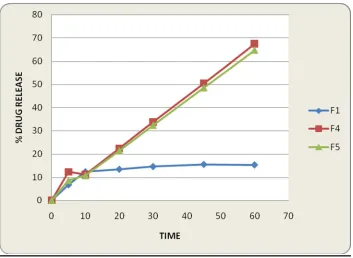
(Tinidazole) the drug complexes showing better dissolution values. The pure drug (formulation-1) alone showing 15% drug release in 60 mines. Formulation-4 showing 68% drug release and formulation-5 showing 65% drug release in 60 mins.
in the complex was increased, the dissolution was also found to be increased.
From the above results it’s concluded that the drug release from the formulation-5 and formulation-6 is used for immediate release and formulation-2 and formulation-3 used for delayed released mainly for targeting the large intestine tract infections.
CONCLUSION
Dissolution profile of Tinidazole was improved by using hydrophilic polymers by solvent method. This complex with the ratio of 1:2 (drug: HPMC complex) may contribute for better drug release
profile than ratios of other formulations. In vitro release of Tinidazole was enhanced by using both HPMC and sodium CMC complex. The prepared complexes are suitable for increase dissolution. F1 is pure drug it shows normal dissolution F2 shows slight increase in dissolution F3shows better dissolution than F2. F4 and F5shows greater dissolution rates by using HPMC by using solvent method.
From the overall study the formulation-5 (drug: HPMC complex in 1:2) showing drug release of 68% in 60 mines. It is selected as an optimized formulation.
Table 1: Composition of drug and carrier complex
Formulation Drug Carrier composition Solvent (ethanol)
F1 100 mg -- --- ---
F2 1000 mg Cyclodextrin 1:1 5-10 ml
F3 1000 mg Cyclodextrin 1:2 5-10 ml
F4 1000 mg HPMC 1:1 5-10 ml
F5 1000 mg HPMC 1:2 5-10 ml
F6 1000 mg Sodium CMC 1:1 5-10 ml
F7 1000 mg Sodium CMC 1:2 5-10 ml
Table2: Dissolution data of F1, F2, F3,F4,F5,F6 and F7 formulations
TIME
(MIN) F1 F2 F3 F4 F5 F6 F7
5 6.78 19 13.82 12.37 8.64 15.04 6.46
10 12.4 17 15.33 11.25 10.8 27.72 17.8
20 13.5 18.64 12.74 22.5 21.6 50.29 22.4
30 14.68 15.98 14.68 33.75 32.4 53.85 31.6
45 15.6 19.22 15.12 50.62 48.6 45.54 42.6
60 15.4 21.16 14.58 64.8 67.5 47.52 58.7
Fig. 2: Dissolution profile for F1,F4,F5 formulations
REFERENCES
1. Goodman &Gilmans: The pharmacological basis of Therapeutics. 2001;10:716. 2. Bekerso J, Ujtendaal, E V, Beijnen J, Bult a:
Cyclodextrins in pharmaceutical field, Drug Develop Ind. Pharm. 1991;17:1503-49.
3. Brahmanker DM, Sunil: Biopharmaceutics and Pharmacokinetics a treatise. Delhi.302. 1995.
4. Challa R, Abuja A,:Cyclodextrin in drug delivery. AAPS Pharm Sci Tech. 2005; 6(2): Article 43.
5. ThosteninLoftsson, mason: Cyclodextrins in topical drug formulations: Theory and Pratice. Inter J Pharm. 2001;225:15-30. 6. Martin A, Swarbick J, Physical p:
Mumbai.Varghese publishing house; 3:257-60; 1991.
7. Larry LB and Roger LW: The official compendia of standards; 2003.
8. Thorstenin H: Pharmaceutical applications of β-cyclodextrin. 1999:40-50.
9. RG Alfonso:RemingtonsThe science and practice of pharmacy.20 edition: 648:2000.
10. Skoog DA, Holler FJ, Timothy AN. Principles of Instrumental analysis,5:801:1998.
11. Archontaki HA, Vertzoni MV andAthanassiou MH.Journal of Pharm Biomed .2002;15:761.
12. Pose-Vilamovo B, Perodomo-Lopez I, Echezarreta-Lopez M, Schroth-Pardo P and Estrada E.Eur Journal of Pharm Sciences.2001;13:325.
13. Doliwa A, Santoyo S and Ygartua P.Skin PharmacolAppl Skin Physiol.2001;14:97. 14. Arias MJ, Moyano JR, Munoz P, Gines JM
and Justo A.Drug Ind Pharm.2000;26:253. 15. Manostroi J, Apriyani MG, FOC K
andManosroi A.Int J Pharm.2005;293:235. 16. Wong JW and Yuen KH.Drug DevInd
Pharm.2003;29:1035.
17. Bodor N, Drustrup J and Wu W.Pharmazie.2000;55:206.
18. Mora PC, Cirri M, Alloclio B, Carli F and
Mura P.Journal of Pharm
Sciences.2003;92:2177.
19. Giband S, Zirar SB, Mutzenhardt P, Fries I andAstier A.Int J Pharm.2005;306:107. 20. Kopecky F, Kopecka B and Kaclik
P.Ceskaslov Farm. 2003;52:33.
21. USP 21 United states convention inc. Rockville MO USA p.1800, 1985.
22. Guirguis Michael.J Pharm Pharmaceut Sci.2001;4:77.
23. M.D. Rockville, United
Pharmacopoeia/National Formulary, USP
23/NF 18, United States
Pharmacopoeilconvention, Inc., , USA, p.1235, 1995.