International Journal of Science Technology
Management and Research
Available online at: www.ijstmr.com
IJSTMR
©
2018 | All Rights Reserved 26Educational Campus Management
Sweeti Yadav
Department of computer Engineering Sapkal college of engineering
Nashik, India
.
Ruchita Kankariya
Department of computer Engineering Sapkal college of engineering Nashik, India
Yugandhara Shewale
Department of computer Engineering Sapkal college of engineering
Nashik, India
Shrutika Jain
Department of computer Engineering Sapkal college of engineering
Nashik, India
Abstract-: Training and Placement Management system is an android application which is helpful for students as well as the
colleges. Here we will focus on TPO section. Here we will have registration for all the final year students. After their registration we will provide them username and password so that ones they got this they can directly view all the articles, events and videos. All the students have only permission to give the feedback/request if they want. The main handling of all the application is done only by Admin. Admin has the permission to do all the required modifications like he can update/delete/modify /insert the records. If there is some company is coming for the placement of the final year he will just set the range of percentage required by that company in the HSC, SSC, Diploma, Degree also their cocubes marks and the students fall under that category will automatically receive a offline text message over the cell phones also they will get a notification that can be viewed only when student will login.
Keywords: Android, Results, Notification, Articles, Events
I. INTRODUCTION
The main objective of the existing system is to provide an interface which is user-friendly. In the previous papers the main focus was on to manage the attendance of the students along with the other details, they were not focusing on the other departments which are managing other complicated tasks. In our project we are focusing on one of the important department in every colleges that is “The Training and Placement Section”. Here we will have registration for all the final year students. After their registration we will provide them username and password so that ones they got this they can directly view all the articles, events and videos. All the students have only permission to give the feedback/request if they want. The main handling of all the application is done only by Admin. Admin has the permission to do all the required modifications like he can update/delete/modify /insert the records. If there is some company is coming for the placement of the final year he will just set the range of percentage required by that company in the HSC, SSC, Diploma, Degree also their cocubes marks and the students fall under that category will automatically receive a offline text message over the cell phones also they will get a notification that can be viewed only when student will login. It will also include a module where all the placed students short details like his name, company name where he is placed, his package, etc will be viewed. We will also represent the placement ratio of the college statically. Also the students can see which company is going to arrive on which date for what post and package that they are providing. Along with all the students can also know the events, seminars arranged by TPO section also the articles of the college in one application. To provide all the required data on mobile of the student in the form of offline message along with an online notification.
II.LITERATURE SURVEY
IJSTMR
©
2018 | All Rights Reserved 27 great number of relations between data and processes. Several strategies are used in manufacturing companies to minimize the negative impact of change requests. Some companies choose, for example, to spend more time checking products before approving them so as to avoid change requests. Some others limit the possibility of making changes to only the early stages of the design [3], [4].These strategies are unfortunately of little help in multidisciplinary environments handling relatively big projects. Thus, some efforts have been put in developing specialized tools that can help better manage ECs. The allied concurrent engineering (ACE) is a process in which different companies or disciplines can work together to design a product. The ACE combines the two concepts of virtual collaboration [5] and concurrent engineering. The ACE approach effectively shares data and 1094-6977/$26.00 © 2010 IEEE. IEEE TRANSACTIONS ON SYSTEMS, MAN, AND CYBERNETICS—PART C: APPLICATIONS AND REVIEWS, VOL. 41, NO. 3, MAY 2011 345 processes of a product throughout its development cycle.The project is divided into two phases. The first phase develops the methodology of change management. The second phase develops the management change system. Chen et al. [6] studied the model of reference for the EC before developing their own model. The ACE’s main objective is to effectively integrate all the resources of a company. In other words, the changes are propagated to other business systems. The success of the integration process depends on the integration of the different information systems of the organization. The implementation of ACE is an integration solution for the company rather than a module in an already existing system [7]. Integrating all the systems of a company is not an easy task. Developing a module that extracts information from different system so as to verify consistency could be easier. Tang et al. [8] explain in their paper how to use the design structure matrix (DSM) for change-propagation management in single and multiple domains. Multiple dependencies are possible between two items in a domain. Identifying these dependencies is very important to predict the impact of a change. The purpose of this kind of change propagation analysis is to assist decision makers in their decision regarding ECs. Inter domain change propagation consists of tracing the impact of the change starting from product to processes. The inter domain DSM could be browsed in two ways, from product to processes or from processes to product. Authors propose an implemented prototype that gives a good idea on all the dependencies of a system and the impact of an EC. Their system takes as input all the items interacting in the system, the DSM representation, direct dependency capture, and indirect dependency capture. As an output, the system gives all the affected items when an instigated item is specified (EC is triggered by this kind of item) and all the possible propagation paths. Even if DSM identifies possible impacts and propagations of a change, it does not provide assistance to expert to agree on a change or propose alternative solutions when change requests are not agreed upon. Web-based ECM [9] is a web-based architecture for implementing the ECM process. Instead of using documents to generate change requests, designers fill request forms on the internet. This approach offers a lot of advantages. First, quantity of documents generated is considerably reduced; Second, the treatment time of a change request is reduced; and finally, the data generated is automatically shared and transmitted to the disciplines involved. However, the tool does not offer any intelligence or decision making assistance.
III.PROPOSED SYSTEM
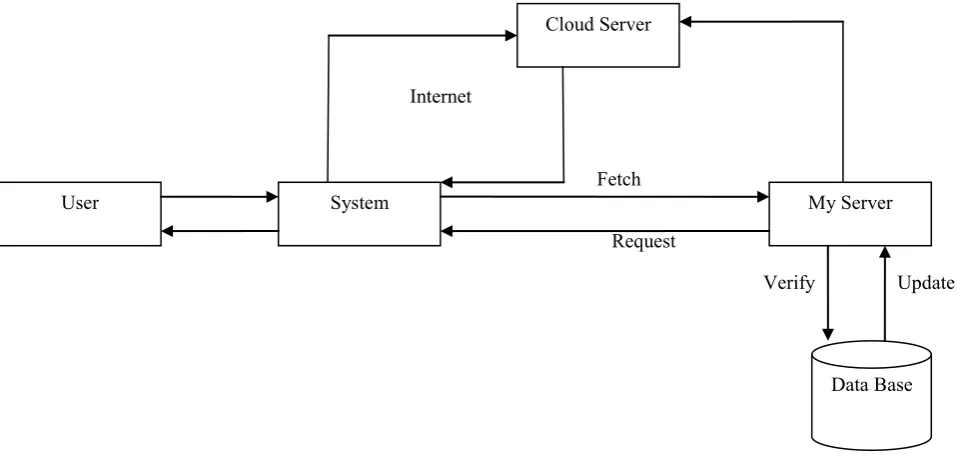
The System Architecture includes System, which contains two things first is the "Smart Phone" with android Os and second thing is the "Web Server", My Server , GCM Server and Database. The Web Server and Smart Phone will work synchronously with each other. The Web Server and the Android Smart Phone will be used for registration and Login the whole data will be managed by the admin using desktop system. The admin will insert/update/delete/modify all the data. The Admin will set the criteria for the company and according to that those who fit in that criteria will received an online notification along with an offline text message. For receiving the online notification 3G/4G or Wi-fi connectivity is required also we can use. 2G but the disadvantage of 2G is time lagging. All the data will be stored in the database through the My Server.
Internet
Fetch
Request
Verify Update
Fig 1: System Architecture
System My Server
Cloud Server
User
IJSTMR
©
2018 | All Rights Reserved 28IV.
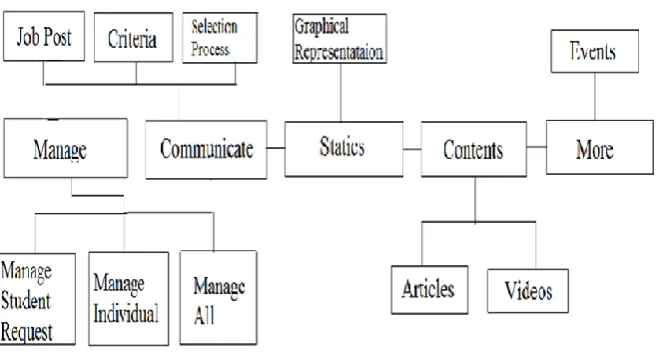
FRAMEWORK FOR SYSTEMThe proposed system will be like the figure shown below in fig2.Proposed system.
Fig 2: Proposed System
1. Job Posts:-
Here we will display,all the company details in short which is going to visit for campus drive in the collage .It will contain the name of the company,its address the job post for which they are hiring the candidates ,the date they are going to visit,package,etc.It will contain a view button to view more details of the company. This will be updated by adminand the student can only view that.
2. Manage:-
The Manage module is the most important module in our project.The manage will contain all the data that are required for the company.It includes student cell no, his/her name,10th,12th,diploma,BE marks along with cocubes marks.It include three sub modules in it.
2.1 Student Request:
Here if any student gets anything new that he wants to update hecan send a request message to admin to update his data. This will be done till the admin will not do it manually.
2.2 Individual:
If we want to search an individual then we can search then directly.for searching following data is needed : batch,sort by(name,rno,cocubes id),any other details & click directly on search then the whole student details will be viewed directly to the admin.
2.3 ALL:
Here will have search filter which have degree in a drop down list, Branch, percentage range, batch, sort by,eligible,10,12,diploma,BE,backlog history then after that we have to click select.
3. Communication:
This module will come in existence when we want to communicate with the students.It again has 2 main sub-modules in it. That will work in synchronization with manage moduke.
3.1 SMS:
This will send an offtline text to an(individual student when the student is fit in the criteria. This will be displayed an the cell phone only).
3.2 Notification:
This will send an online notification to an (individual student when the student is fit in the criteria. This will be displayed an the cell phone only).
4. Statistics:(Graph)
It will display the graphical view of last few campus arrieved in the college.Their rationwill be displayed here directly.
5. More:
All the further more details will be shown here that will include:
5.1 Events:
IJSTMR
©
2018 | All Rights Reserved 29 5.2 Alumni:The record of all the placed students that are place in the past few years will be displayed here.
6. Contents:
It will include the other details like:
6.1 Articles:
Articles of the college will be displayed here along with the photos of the articles will be displayed.
6.2 Videos:
Any important video link will be given there where the student has to click then he will redirected to the video directly where he can view the video.
V. ADVANTAGES
• Managing all events of the college. • Managing all the seminars.
• Managing all the students records according to the requirements along with there resume. • Automatic sending of SMS and notification to all the eligible candidates.
• Automatic generation of excel-sheet when requested.
• Linking of all the companies’ details with their criteria for the students.
VI.
E
XPERIMENTALR
ESULTThis application will take admin data from the web based system and when admin update that new data according to that the nonfiction will be send to the student in the case of job post updates. Here whole modification can be done by admin only students have the rights to send feedback or request. Only read operation is allowed in the case of students. The database will maintain all the record of students and thus modification is updated when request is send. Here the student will receive the online notification through registered mail id and offline text message on the registered phone number. Also student resume is stored at the database for future use. Students can view the detailed information in the case of job post available. The job alert will be send to those students only who are fit in the criteria of the company.
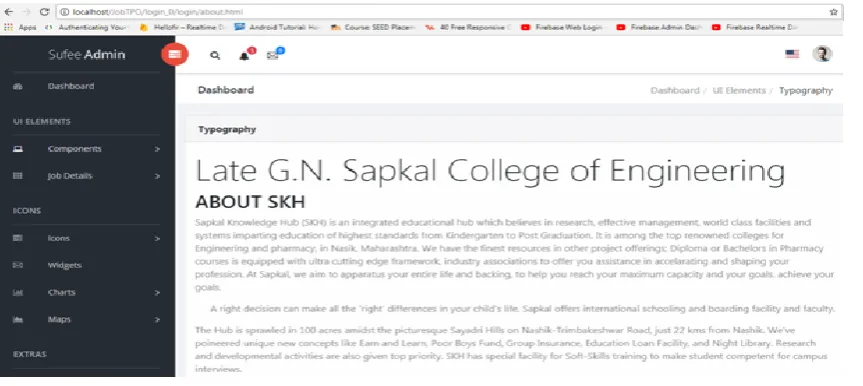
The home page will be as shown below
Fig 3: Home Page.
IJSTMR
©
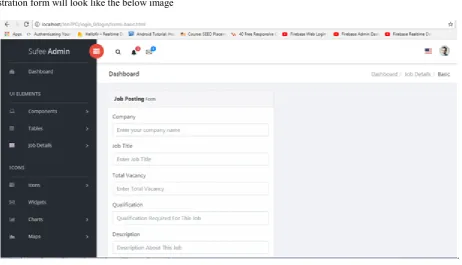
2018 | All Rights Reserved 30 Fig 4.: Admin PanelThe registration form will look like the below image
. Fig5: Job posting
CONCLUSION
In this system, we will simply all the workload of TPO department via this application by auto generation of SMS and notification for eligible candidates.
REFERENCE
1. K. G. Mcintosh, Engineering DATA Management: A Guide to Successful Implementation. McGraw-Hill, 1995, 279 pages. 2.
3. G. Harhalakis, ―Engineering changes for made-to-order products: How an MRP II system should handle them,‖ Eng. Manage. Int., vol. 4, pp. 19–36,1986. 4. C. Terwiesch and C. H. Losh, Managing the process of engineering change orders: The case of the climate control system in automobile development,‖ J.
Prod. Innov. Manage., vol. 16, pp. 160–172, 1999.
5. G. Q. Huang and K. L. Mak, ―Current practices of engineering change management in UK manufacturing industries,‖ Int. J. Oper. Prod. Manage., vol. 19, pp. 21–37, 1999.
6. J. Shah, J. Sadowsky, N. Macia, M. Woodfill, and F. Wilson, ―The virtual corporation: Simulating real world collaboration in a university setting,‖ in Proc. ASME Design Theory Methodol. Conf., 1995, p. 20.
7. Y. M. Chen, W. S. Shir, and C. Y.Shen, ―Distributed engineering change management for allied concurrent engineering,‖ J. Comput. Integr. Manuf., vol. 15, pp. 127–151, 2002.
8. M. Gruninger and M. S. Fox, ―The logic of enterprise modelling, in Modelling and Methodologies for Enterprise Integration, P. Bernus and L. Nemes, Eds. Cornwall, Great Britain: Chapman and Hall, 1996, pp. 83–98.
IJSTMR
©
2018 | All Rights Reserved 31 10. D. Tang, R. Xu, J. Tang, and R. He,Design structure matrix-based engineering change management for product development,‖ Int. J. Internet Manuf. Serv., vol.1, no. 3, pp. 231–245, 2008.
11. G. Q. Huang, W. Y. Yee, and K. L.Mak, ―Development of a web-based system for engineering change management,‖ Robot. Comput. Integr. Manuf., vol. 17, pp. 255–267, 2001.
12. K. Rouibeh and K. R. Caskey,Change management in concurrent engineering from a parameter perspective, Comput. Ind., vol. 50, pp. 15–34, 2003. 13. P. J. Clarkson, C. Simons, and C.Eckert, ―Predicting change propagation in complex design,‖ J. Mech. Des.-ASME Trans., vol. 126, pp. 788–798, 2004. 14. C. Eckert, P. J. Clarkson, and W. Zanker, ―Change and customisation in complex engineering domains,‖ Res. Eng. Des., vol. 15, no. 1, pp. 1–21, 2004. 15. J. Eustache, R. Maranzana, Y. Lanuel, and Y. Gardan, ―Managing complexity in a CAD environment,‖ in Proc. Change Manage. New Ind. Revolution, New
York, Oct. 7–9, 2001, pp. 104–109.
16. W. Fang, M. X. Tang, and H. J. Frazer,―Supporting collaborative product design in an agent based environment,Lecture Notes Comput. Sci., vol. 2718, pp. 293–298, 2003.
17. M. Rosenman and F. Wang, Autom. Constr., vol. 10, no. 4, pp. 383–397, 2001.
18. A. Mokhtar, C. Bedard, and P. Fazio, ―Information model for managing design changes in a collaborative environment,‖ J. Comput. Civil Eng., vol. 12, no. 2, pp. 82–92, Apr. 1998.
19. F. T. S. Chan, J. Zhang, and P. Li, Modelling of integrated, distributed, and cooperative process planning system using an agent-based approach,in Proc. Inst. Mech. Eng., Part B: J. Eng. Manuf., 2001, pp. 1437–1451.
20. S. Kornienko, O. Kornienko, and P.Levi, ―Flexible manufacturing process planning based on the multi-agent technology,‖ presented at the 21st IASTED, Int. Conf. Applied Informatics, Innsbruck, Austria, Feb. 2003.
21. W. Shen, L. Wang, and Q. Hao, ―Agent-based distributed manufacturing process planning and scheduling: A state-of-the-art survey,‖ IEEE Trans. Syst., Man, Cybern.C Appl. Rev., vol. 36, no. 4, pp. 563–577, Jul. 2006.