Available Online at www.ijpret.com
992
INTERNATIONAL JOURNAL OF PURE AND
APPLIED RESEARCH IN ENGINEERING AND
TECHNOLOGY
A PATH FOR HORIZING YOUR INNOVATIVE WORK
PATTERN MATCHING ALGORITHM FOR ASL SIGN GESTURE RECOGNITION
USING NEURAL NETWORK
MS. KALYANI P. SABLE1, DR. H. R. DESHMUKH2, PROF. N. S. BAND3, PROF. R. N. GADBAIL3
1.M. E. First Year, Department of Computer Science & Engineering, IBSS College of Engineering, Amravati. 2.Prof and HOD, Department of Computer Science & Engineering, IBSS College of Engineering, Amravati. 3.Asst. Prof, Department of Computer Science & Engineering, IBSS College of Engineering, Amravati.
Accepted Date: 27/02/2014 ; Published Date: 01/05/2014
\
Abstract: The human can interface with machine in more natural way using Gesture recognition. A widely used and accepted standard for communication and interface is Sign language. There are various types of systems and methods available for sign languages recognition. Our approach is robust and efficient for static symbol recognition. The main objective of this paper is to propose a method which is able to recognize hand gestures of 26 American Sign Language (ASL) for letter A- Z successfully and also it is able to perform the classification on static images correctly. We proposed a novel method of pattern recognition to recognize symbols of the ASL alphabet (A-Z) that have static gestures using Neural Network.
Keywords: Gesture recognition, ASL, Point Pattern matching Algorithm, Neural Network
Corresponding Author: MS. KALYANI P. SABLE
Access Online On:
www.ijpret.com
How to Cite This Article:
Kalyani Sable, IJPRET, 2014; Volume 2 (9): 992-1001
Available Online at www.ijpret.com
993 INTRODUCTION
Gestures are expressive, meaningful body motions. Gesture recognition is the process by which gestures made by the user are made known to the system [1]. Gesture recognition is also important for developing alternative human-computer interaction modalities [2]. It enables human to interface with machine in a more natural way.
Gesture recognition techniques to make computers ‘see’ and interpret intelligently are becoming increasingly popular. Our claim is that just as human beings interpret gestures made in any frame of reference by automatically setting the coordinate system in the brain, so should machines. This would enable the machine to better understand and interpret gestures, somewhat like the human brain does [3].
The most structured sets of gestures belong to sign language. In sign language, each gesture has an assigned meaning (or meanings). We will focus on American Sign Language (ASL). ASL is the language of choice for most deaf people. The main purpose of invented ASL is to allow deaf people communicate with normal people. ASL consists of approximately 6000 gestures of common words with finger spelling which are use to communicate proper nouns. Finger spelling can be performs by one hand and 26 gestures to communicate the 26 letters of the alphabets.
There are various types of systems and methods available for sign languages recognition. Our approach is robust and efficient for static symbol recognition and translation of ASL. We used pattern recognition system to recognize hand gesture for ASL, because it is fast and simple algorithms. Pattern recognition is the assignment of some sort of output value to a given input value, according to some specific algorithm. Proposed Point pattern matching algorithm finds the matching points between test and target images. By using this approach we can recognize gestures having open as well as closed fingers more effectively.
Related Work
Available Online at www.ijpret.com
994
recognize the gesture. Hand gestures are represented in terms of hierarchies of multi scale color images. In some systems more than one feature extraction methods and neural networks are implemented to recognize the gestures made by hand.
Proposed Method
Human beings can easily recognize things or objects based on past learning experiences. But what do computers do for recognition? This may be the motivation and purpose of the research of pattern recognition. Pattern recognition is a process that taking in raw data and making an action based on the category of the pattern. After analyzing the raw data based on a certain purpose and method, we can do actions such as classification.
Here, Pattern recognition system is used to recognize hand gesture for ASL signs, because it is fast and simple approach. Pattern recognition is the assignment of some sort of output value to a given input value, according to some specific algorithm. An example of pattern recognition is classification, which attempts to assign each input value to one of a given set of classes. It looks for exact matches in the input with pre-existing patterns. Figure 1 shows how the pattern recognition system works.
Figure1. Pattern Recognition System
As shown in figure 1, first we have to take an image from webcam or from database. These images will go through a transformation approach called Transformation. This transformation will convert an image into a feature vector, which will be then compared with other feature vectors of a training set of hand gestures. For comparison we use Point Pattern Matching Algorithm.
Our proposed system is developed by using neural network with point pattern matching algorithm to perform hand gesture recognition of all 26 ASL signs.
Multilayer Perception Learning Network
Available Online at www.ijpret.com
995
flexible in a changing environment. Neural Network pattern recognition is a powerful and robust approach for harnessing the information in the data. Neural Network learns to recognize patterns from the data set that presented to it.
The Multilayer Perceptron is an example of an artificial neural network that is used extensively for the solution of a number of different problems, including pattern recognition.
We used Multilayer perceptron (MLP) classification algorithm for proposed work. Perceptron is one of the Neural Network to ‘learns’ concept. The learning process consists of finding the correct values for the weights between the input and output layer. Multilayer Perceptron is used to train the network to perform pattern recognition. [12]
The basic MLP learning algorithm is outlined below:
1. Initialize the network, with all weights set to random numbers between -1 and +1.
2. Present the first training pattern, and obtain the output.
3. Compare the network output with the target output.
4. Propagate the error backwards.
5. Calculate the error, by taking the average difference between the target and the output vector.
6. Repeat from 2 for each pattern in the training set to complete one epoch.
7. Shuffle the training set randomly. This is important so as to prevent the network being influenced by the order of the data.
8. Repeat from step 2 for a set number of epochs, or until the error ceases to change.
The steps of Multilayer perceptron learning network for our proposed system are as follows:
1. Read the image file from Database.
2. Get the target Image from Database
3. Define the number of neurons of the Neural Network. The Perceptron neurons are set to ‘26’ because this value is optimal enough to perform the classification.
Available Online at www.ijpret.com
996
5. Initialize Learning Layer. At this layer, the pre-processed data will be ready to feed into the learning network called Perceptron. This learning layer will train the network to perform the recognition.
6. Train Perceptron (Training Network). At this stage, the pre-processed data are feed into Perceptron layer. This layer contains the number of neurons where we define during 3rd step. The feature vectors value are feed into network then multiplied with the neurons (weight) and then summed up the total with the bias. After that, the summed values will feed into function (hard-limiter). After go through the function, this will produce an output. For this, point pattern matching algorithm is runs.
7. Plot Result. The output will compare with the Target vector and displays the result.
Point Pattern Matching Algorithm
Pattern recognition systems often require matching two sets of points in space. This is because the analysed images are raster graphics or the extracted features are pixels subset of the original image. For this point pattern matching algorithm is the best solution. Point pattern matching algorithm provides a navel approach to achieve a matching of adequate quality in a efficient and robust manner.
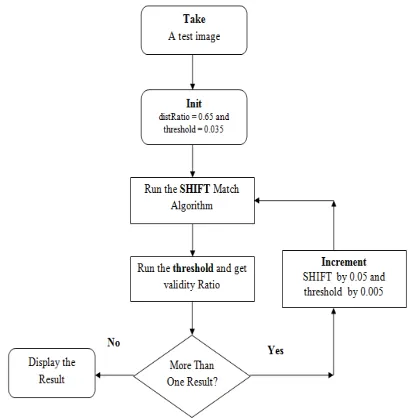
For hand gesture recognition of ASL sign, we used point pattern matching with SHIFT match algorithm. The flowchart of proposed algorithm is as shown in following figure 2.
Available Online at www.ijpret.com
997
The working of point pattern matching algorithm is as follows:
1. Take a test image
2. Initialize the distRatio = 0.65 and threshold= 0.035
3. Run the SHIFT match algorithm
4. Key point matching starts its execution by running the threshold. It gets the key point matched between test and all 26 trained images. We get the validity ratio.
5. Check that we got more than one result or not.
6. If we get more than1 result then increment the SHIFT by 0.05 and threshold by 0.005 and repeat the steps from 3 to 5.
7. If we get only one result then display the result.
Implementation Of Proposed Method
Testing Implementation for Neural Network
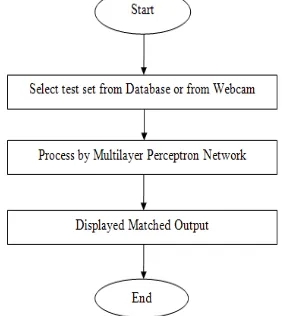
For implementing the neural network, we used supervised learning because this work is about classification and pattern recognition. Supervised learning able to compare these hand gestures with the correct/real target and ‘learns’ by the system itself.
Figure 3. Flowchart for Testing Implementation of Neural Network
Available Online at www.ijpret.com
998
Implementation of Point Pattern Matching Algorithm
During the test implementation of neural network, perceptron network processes the point pattern matching algorithm. First we have to take an input query image from database or from webcam. Then point pattern matching algorithm start its execution to find the matching between test and train images. After executing this algorithm it recognizes ASL input (query) images by comparing it with the database images and outputs the equivalent ASCII representation of it.
1) SHIFT Match Algorithm
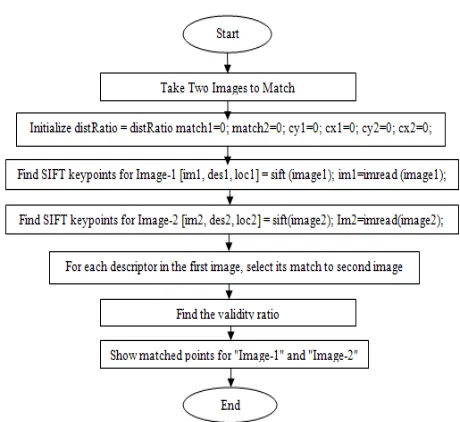
During the test implementation, the point pattern matching algorithm is executed. In point pattern matching algorithm, SHIFT match algorithm is executed for finding the matched keypoints between two images.
In SHIFT match algorithm, image1 and image2 are taken as a two images to match. For our case the first image is one of the database images and image2 is the input (query) image. distRatio is the parameter of SHIFT algorithm. In the original implementation, this parameter is set as a constant. For our algorithm's recursivity we made it a variable parameter and threshold is the threshold value for the MK-RoD algorithm.
Here, for finding the shift keypoints of an image the function shift is called which finds the keypoints with the combination of image, description and location of given image. These terms are:
Image(im): the image array in double format
Descriptors (des): a K-by-128 matrix, where each row gives an invariant descriptor for one of the K keypoints. The descriptor is a vector of 128 values normalized to unit length.
Locs (loc): K-by-4 matrix, in which each row has the 4 values for a keypoint location (row, column, scale, orientation). The orientation is in the range [-PI, PI] radians.
Available Online at www.ijpret.com
999
Figure 4. SHIFT Match Algorithm Flow Chart
2) MK-RoD Algorithm
For finding the validity ratio MK-RoD algorithm is used. For example, figure 5 shows the two images for finding the validity ratio.
(a) (b)
Figure 5. Representation of (a) Trained Database Image (b) Test Input Image with Key points
C - Denotes the center points
D - Denotes the distance mask
T - Denotes the No. of test image to match
M -Denotes the No. of Matched Points 1, 2, 3 are the key points.
Available Online at www.ijpret.com
1000
1. dT1 = ∑ di1
2. dT2 = ∑ di2
3. Ratios 1= [d11/dT1 d21/dT1 d31/dT1]
4. Ratios 2= [d12/dT2 d22/dT2 d32/dT2]
5. Distance Mask= abs[Ratios 1- Ratios 2] < (Threshold Value)
6. Valid Points = sum(Distance Mask)
7. Validity Ratio= (No. of Valid Points) / (No. of Matched Points)
Once we got the validity ratio, mask the distances by taking the absolute which are below the algorithm's threshold. This operation is done in order to determine the similar pattern of 'the matched keypoints from the center of the matched keypoints'. The absolute of the difference of the points which are below the given threshold are treated as valid matched keypoint.
CONCLUSION
Gesture is one of the most natural and expressive ways of communications between human and computer in a real system. We naturally use various gestures to express our own intentions in everyday life. At present, artificial neural networks are emerging as the technology of choice for many applications, such as pattern recognition, gesture recognition, prediction, system identification, and control.
Our method recognizes all the static symbols of American Sign Language successfully by using neural network with point pattern matching algorithm. Point pattern matching algorithm based on neural network provides the emerging approach for hand gesture recognition. This algorithm can recognize gestures having open as well as closed fingers more effectively. So it provides the simple and novel way to recognize the ASL signs.
REFERENCES
1. Cadoz, C. “Les realites virtuelles”, Dominos, Flammarion. 1994.
2. Daniel ThalmNN, “Gesture Recognition Motion Capture, Motion Retargeting, and Action Recognition”, EPFL – VRlab.
M
i=1
Available Online at www.ijpret.com
1001
3. Aditya Ramamoorthy et al. “Recognition of dynamic hand gestures “, Department of Electrical Engineering IIT New Delhi-110016 India. October 2002, pp 1-13.
4. Ravikiran.J, Kavi Mahesh, Suhas Manishi, Dheeraj.R, Sudheendar.S, Nithin.V.Pujari, “On finger detection for sign language recognition”, Hong Kong, March 18, 2009.
5. Sylvie Gibet and Pierre Francois Marteau, “On Approximation of curvature and velocity for gesture segmentation and synthesis”, Universite de Brertagne France, 2009.
6. David Rybach, Prof Dr. J. Brochers, Prof Dr.H. Ney, Appearance based features for automatic continuous sign language recognition”.