A study of Iranian EFL teachers’ perceptions and practices
regarding learner autonomy
Nasri, Najmeh
University of Isfahan, Iran ([email protected])
Eslami Rasekh, Abbas
University of Isfahan, Iran ([email protected])
Vahid Dastjerdy, Hossein
University of Isfahan, Iran ([email protected])
Amirian, Zahra
University of Isfahan, Iran ([email protected])
Received: 18 November 2014 Revised: 28 December 2014 Accepted: 3 January 2015 Available Online: 18 January 2015 DOI: 10.5861/ijrse.2015.998
ISSN: 2243-7703 Online ISSN: 2243-7711
OPEN ACCESS
Abstract
The present study attempts to investigate Iranian EFL high school teachers’ perceptions about
the importance of autonomy promoting strategies. The study also purports to investigate the
actual practice of the participant teachers for promoting their learners’ autonomy. For this
purpose, a questionnaire adopted from Chang (2007) was distributed among 97 Iranian EFL
high school teachers. Among the participants, 88 answered the questionnaires completely and
constituted the sample size of the study. Wilcoxon Ranks Test revealed a significant difference
between the teachers’ perception and their practice. Additionally, interview data were
explored to delve into the problems which cause the gap. The interviewees referred to lack of
time, university entrance exam, as well as insufficient teacher training as the major causes of
the problem. The findings provide implications for language teachers and those in charge of
teacher education programs.
A study of Iranian EFL teachers’ perceptions and practices regarding learner autonomy
1. Introduction
Over the last three decades the concept of learner autonomy (LA) has become a popular topic in second or foreign language learning in view of the fact that it can increase learners’ motivation and lead to more effective learning (Little, 2002). Although there has been different attempts to define the concept (e.g. Holec, 1981; Little, 1991; Benson, 2001), there seems to exist a general agreement in the literature that learner autonomy indicates learners’ taking responsibility of their own learning. A great amount of studies have been conducted on what autonomy means and what its rationale is. However, teachers’ voices have been largely absent in recent research. Considering the fact that teachers’ perceptions are likely to influence their practice, the present study intends to investigate Iranian EFL teachers’ perceptions with regards to learner autonomy. Moreover, the study aims to inquire into the teachers’ practices with regards to learner autonomy and address the possible gap between teachers’ perceptions and practices. Finally, a focus group interview will reveal the problems which prevent the teachers from practicing autonomy in their classrooms.
2. Literature Review
2.1 The EFL teacher and learner autonomy
Research has shed light on the role of EFL teacher in promoting learner autonomy. Deci, Vallerand, Pelletier and Ryan (1991) claimed that autonomy supportive teachers instigate more intrinsic motivation, competence, and self-esteem in their learners than controlling teachers. Deci et al. further claimed that there seems to exist a mutual relationship between learner and teacher autonomy. Voller (1997) investigated the role of language teacher in the development of learner autonomy. He proposed three basic assumptions which, as he claimed, lead to learner autonomy. The first assumption considers language learning as an interpretive process during which control is transferred from teacher to the learner. The second one is to ensure that the teaching process is based on negotiation with language learners. The third assumption is related to self-monitoring ones’ teaching by constantly reflecting on the nature of interactions as well as teaching strategies.
Learner autonomy does not imply absence of the teacher and denying the control of teacher over what happens in the process of language learning. Dornyei (2001) believes that if a teacher wants to promote his learners’ autonomy, he should change his role into a facilitator. Similarly, Joshi (2011) believes that teachers can help language learners to take more responsibility of their learning by becoming a facilitator and resource person who encourages the learners and provides them with feedback. Therefore, the teacher is a guide who creates learning atmosphere.
Little (2006) argued that to support learner autonomy, the language teacher should do the followings:
Use the target language as the medium of classroom communication,
Involve the learners in a non-stop quest for good learning activities,
Help the learners to set their own learning targets and choose their own learning activities,
Require the learners to identify individual goals,
Engage the learners in regular evaluation of their progress (p. 19).
autonomy by:
Integrating language content and learning process through learner strategy training,
Incorporating reflective lessons into teaching,
Drawing up learner contracts,
Learner diaries (Nunan 1997, p. 201).
According to Candy (1991), in order to foster learner autonomy, the teacher and learner should work towards autonomy in an atmosphere which has characteristics such as “low threat, unconditional positive reward, honest and open feedback, respect for the ideas and opinions of each other, approval of self-improvement as a goal, and collaboration rather than competition” (p. 337).
2.2 Teachers’ perceptions about learner autonomy
Although the importance of investigations on teachers’ beliefs about learner autonomy is obvious, there does not exist a large number of research on this area. Here, we present some examples of the research on teachers’ perceptions with regards to LA. Camilleri (1999) distributed a 13-item questionnaire among 328 EFL teachers in six European areas. The questionnaire asked about teachers’ opinions about LA. The findings revealed that the teachers were positively disposed towards involving language learners in a number of activities such as assessing themselves and working out language procedures. However, teachers did not express a positive view about involving students in text book selection and deciding the time and place of learning. This was due to the fact that most of the teachers worked in state schools where there is not a choice about text book, time, and place of learning.
With a group of 48 student teachers and practicing teachers, Camileri Grima (2007) sought into the perceptions of language teachers in Malta. Comparing the results of her study with those of Camillerie (1999), she found much similarity between the two study groups. The 48 teachers, however, were found to be more positive towards particular aspects such as learners’ short-term goal setting, their choice in material selection, and self-assessment. Balcikani (2010) implemented the same questionnaire to investigate the views of 112 student English teachers in Turkey. Moreover, interviews were conducted with 20 teachers. The results indicated the teachers’ positive stance about LA. They expressed their positive ideas towards involving students in making decisions about a range of classroom activities. However, similar to Camileri Grima’s study, the teachers did not agree with involving students in decision about the place of learning.
Alshaqsi (2009) was another study on teachers’ beliefs about LA. The study was conducted with 120 English teachers of Oman who were teaching in state schools. The researcher designed a questionnaire for collecting data related to teachers’ beliefs about the characteristics of autonomous learners as well as the ability of their learners to carry out a number of tasks which were indicators of learner autonomy. Finally, the questionnaire asked the teachers about how LA might be promoted. The teachers identified three characteristics for autonomous learners: They can use computers to find the required information, use a dictionary, and ask the teachers for more explanation when they do not understand. Finally, the teachers offered a number of suggestions for promoting LA including the use of different types of quizzes and challenging tasks, increasing the time learners’ talk, and devoting reward to the learners who perform well.
theoretical dispositions to learner autonomy and their pessimistic views about feasibility of promoting it in classrooms.
Learner autonomy is considered as an important concept in the field of foreign language learning. However, despite the large number of research on LA, limited attention has been awarded to foreign language teachers’ beliefs about this concept. Moreover, most of the studies have failed to consider the teachers’ actual practices in this regard. Therefore, the present study intends to address the existing gap by investigating the beliefs of Iranian EFL teachers in Iran. Moreover, as the studies mentioned above were mainly conducted in universities, studies in high school contexts are worth investigating. The following research questions will be addressed in the present study:
What are the perceptions of Iranian EFL high school teachers with regard to learner autonomy?
What strategies do Iranian EFL high school teachers implement for promoting their learners’ autonomy?
Is there any significant difference between the teachers' perceptions and their practice with regards to learner autonomy?
What problems cause the gap between Iranian EFL high school teachers’ perceptions about LA and their actual practice?
3. Method
3.1 Participants
The questionnaire participants - The questionnaires were first distributed among 97 English high school teachers in Iran. The sampling process was based on the convenience since the participants had been asked to fill out the questionnaires voluntarily. In order to have access to as many teachers as possible, a ‘snowball’ sampling strategy, in which a number of informers were recognized and asked to introduce their colleagues or other possible participants, was implemented (Nakata, 2011). The questionnaires were either emailed or handed in directly to the teachers. However, some teachers did not answer the questions at all and some did not answer them completely. This left 88 as the final sample. The participant teachers were both males and females with various teaching experiences and educational degrees. The detailed information about the participants is provided in table 1 below.
Table 1
Distribution of the questionnaire participants
Sex n Teaching experience n Educational degree n
Males 40 Less than 10 years 18 BA 36
Females 44 More than 10 years 70 MA 52
Total 88
Table 2
Distribution of interview participants
Sex n Teaching experience n Educational degree n
Males 4 Less than 10 years 3 BA 3
Females 4 More than 10 years 5 MA 5
Total 8
3.2 Instruments
The questionnaires - In order to collect data, Chang’s (2007) questionnaires were adopted. As Nakata (2011) claimed, Chang’s questionnaires investigate the characteristics of learner autonomy in simple and understandable terms. The two questionnaires included exactly the same items. However, one of them asked the teachers’ perceptions about the items while the other one required the teachers to rate the frequency of implementation of the items in their classrooms. The first section of the questionnaires asked demographic questions related to the participants’ gender, age, educational degree, and teaching experience. The second part contained 10 items which were arranged in the format of a 4-point likert scale ranging from completely disagree to completely agree for the perceptions and from very often to rarely for the practices (see appendix). In order to avoid central tendency bias (i.e. the participants’ tendency to select the central category), the likert did not include a neutral point. Before implementing the questionnaire in the study, it was piloted with 30 English teachers (other than the participants) and the reliability was measured. Cronbach α estimated a reliability of 0.88 for the questionnaire.
3.3 Procedure
To achieve the research purposes, a mixed method design was adopted in order to combine a quantitative survey and an interview study. The results of the questionnaires were considered as the essence of discussion for the focus group interview. The questionnaires were distributed, either in person or by email, among the participant teachers. The first questionnaire asked for the perception of the participants about learner autonomy while the second one dealt with their actual practice about it. After collecting the data and removing the incomplete questionnaires, the data were submitted to SPSS to be analyzed.
For the purpose of investigating the third question of the study, Wilcoxon Signed Ranks Test was conducted to see whether there existed a significant difference between the participants’ perceptions and their practice (table 4). The interviews were conducted in Persian in order to allow the participants discuss the issues freely without being anxious about their possible oral proficiency problems. This way, the interviewer could provide a relaxing environment in which there was no threat of the possible gap between the oral proficiency of the interviewer and that of the interviewee. The interview transcripts were further translated into English. Before the interview, the participants signed the Ethics Protocol Sheet which indicates the voluntary participation of the interviewees, confidentiality of the data, and the participants’ right to avoid answering any questions they deemed inappropriate. Each interview lasted 20-30 minutes. Upon completion of the interviews and transcribing the data, a copy of the transcript was sent to each participant for further comments. Consequently, a few minor points were added to the data.
4. Results and discussion
4.1 The questionnaire survey
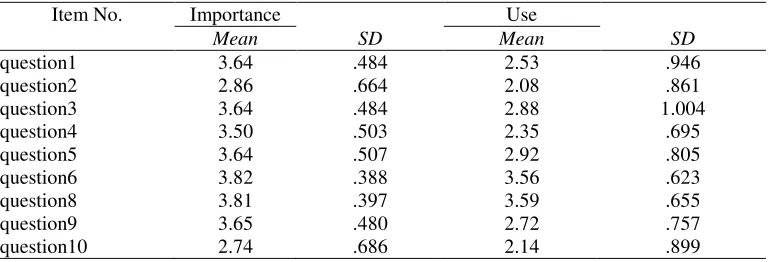
Table 3
Descriptive statistics
Item No. Importance Use
Mean SD Mean SD
question1 3.64 .484 2.53 .946
question2 2.86 .664 2.08 .861
question3 3.64 .484 2.88 1.004
question4 3.50 .503 2.35 .695
question5 3.64 .507 2.92 .805
question6 3.82 .388 3.56 .623
question8 3.81 .397 3.59 .655
question9 3.65 .480 2.72 .757
question10 2.74 .686 2.14 .899
As the table indicates, the frequencies related to the use of all the strategies were lower than those of their perceived importance. This means that the teachers did not utilize the strategies as much as they perceive them important. As the figures in table 3 reveal, among the 10 strategies, the 6th strategy “Help learners to learn from peers, not just from the teachers” was considered the most important strategy. However, item 10 “Give learners’ chances to offer opinions on what to learn in the classroom” was found to have the lowest level of importance among the teachers. This may be due to the fact that in the Iranian EFL classroom context the teachers have to cover a predetermined syllabus in a fixed number of sessions and as the exams are very important to both teachers and students, the main focus of teaching is on instructing the school books, and, if there remains any extra time, the exam related points which the teacher considers important. In such a context, the exam content, which is limited to the school books, as well as the teacher determine what the students should learn in the class.
As a result, the teachers, as the table shows, do not see any necessity in asking their students what they want to learn in the classroom. Moreover, in that context, where the most important goal for the students is getting good exam results, the teachers do not consider item 2 “Help learners to set up their own learning goal” important, either. In such a context, the main goal of most students is to pass the exams with good results and those students who want to learn English for other purposes, e.g. communication, academic studies, and many others, usually take English classes in language institutes. According to Pishghadam and NajiMeidani (2011) the educational system in Iran “turns students into the mere listener, viewer, and observant” (cited in Ahmadi & Mahdavi-Zafarghandi, 2013, p. 2).
Regarding the use of autonomy promoting strategies, the results showed that the participant teachers most frequently utilize the 8th strategy “Give learners’ chances to offer opinions in their learning”. As it was mentioned in the above paragraph, in Iranian EFL classroom context, the material, the goal, and the exams are mostly determined by the educational system and the language teacher. Therefore, the practicality of such strategies as 2 and 10, which had the lowest mean, may be under question. However, the teachers can provide the students with opportunities to offer opinions in their learning. As an illustration, they can ask the students whether they need more exercise on the grammar, or whether they like the vocabulary to be taught by data show or through other methods. It seems that the teachers are not able to employ many strategies in spite of their willingness, perhaps due to the inherent constraints in the context.
Table 4
Wilcoxon Signed Ranks Test
Item numbers 1&11 2&12 3&13 4&14 5&15 6&16 7&17 8&18 9&19 10&20 z -6.744 -6.192 -5.352 -7.015 -5.421 -3.683 -4.480 -2.631 -6.565 -5.538 Asymp.Sig (2-tailed) .000 .000 .000 .000 .000 .000 .000 .000 .000 .000 Note. *Items 1-10 refer to the importance of the 10 strategies and items 11-20 refer to their use
4.2 The focus group interview
The results obtained from the focus group interview helped us to delve deeper into some aspects which were not clear in the questionnaire survey. After transcribing all the interviews and investigating the transcripts, it was found that the teachers’ ideas were mainly about three important reasons which, in their view, contributed to the gap between the teachers’ ideals and their actual practice about learner autonomy. The first reason obtained from the interview results was lack of time. The teachers believed that employing many strategies such as 9 “Help learners to discover knowledge in English on their own rather than waiting for knowledge from the teacher and 10 “Give learners chances to offer opinions on what to learn in the classroom” are not practical in the limited time available. Teacher A’s comment refers to time restriction:
In my opinion, everything is related to lack of time. I don’t want to use clichés. Every teacher can relate her problems to lack of time and find it as a good excuse for justifying her deficiencies. But one should be in a high school teacher’ shoes and judge what she means by time restriction. When you have to cover a syllabus in limited number of sessions, there remains no time for doing things you like such as asking for the students’ opinions, teaching the students’ favorite subjects, etc……..
This comment suggests that the predetermined syllabus and the insufficient number of sessions prevent the teachers from teaching in their desired way. This finding resonates with Borg and Al-Busaidi (2012) who found time restriction as a constraint to promoting LA. The second important reason mentioned by the interviewed teachers was university entrance exam. The following excerpt from teacher B illustrates that the entrance exam has a leading role on the educational system in Iran:
Unfortunately, there is a very big problem in our educational system, something that can be called a disaster, umm… I mean the university entrance exam. Unfortunately, the exam is so important that it governs everything. Everything is the victim of this problem. When the only important thing is the percentage of correct responses your students have in the exam, there will remain no motivation for improving the quality of teaching. The school, the students, and their parents all judge you with one criterion, i.e. the entrance exam.
It is the reality that in Iranian context, when the students enter the high school level, their main concern is the entrance exam and passing the exam with good results is considered as the only way for continuing education in their favorite major. Therefore, their future career is mostly dependent on the exam. This seems to be a good justification for the importance of this exam and why the teachers are usually judged by how successful the students are in the exam. Criticizing the effect of university entrance exam, another teacher expressed the dominance of the exam by saying:
From the above comment, one can conclude that the teachers are mainly judged by their students’ exam results. This resonates with Nakata (2011) who stated that the success of a teacher in Japanese high schools is usually assessed by the students’ grades in university entrance exam. The last reason which, in the teachers’ opinion, contributed to the discrepancy between the ideal and reality in promoting LA was lack of sufficient training for EFL teachers on the concept of LA, its importance, and how it can be improved in the classroom context. As the teachers stated, they have never been taught about LA and the ways of promoting it in the classroom. Teacher C criticizes this deficiency:
As far as I remember, we have never discussed LA in teacher training programs. Even in university, we..umm.., as far as I remember, didn’t study any books, chapters, or articles on this issue. So, you see, there is a big gap here. If they make the teachers aware of the importance of LA and provide them with guidelines, more teachers will employ autonomy promoting strategies in their classrooms. So, the blame is not on the teachers alone…
Having heard the above claim, the interviewer asked other interviewees about their familiarity with LA and all teachers admitted teacher C’s claim. Their comments reflected their willingness for being trained on the concept:
I think autonomy has been greatly ignored in our teacher training programs. I really like to get more information about it but, unfortunately, we have never been informed about the ways of improving it. Workshops can be very useful and can motivate the teachers to pay more attention to this issue.
An important factor in filling the gap between the teachers’ perceptions about LA and their subsequent practice is to familiarize language teachers with the concept, its value, and the ways of promoting it. The first step in taking action for LA may be raising the teachers’ awareness about the issue and equipping them with enough techniques.
5. Conclusion
The present study investigated the perceived importance as well as the employment of autonomy promoting strategies, as identified by Chang (2007), among Iranian EFL high school teachers. Moreover, the possible gap between the importance and actual use of the strategies was investigated. Later, the focus group interview delved into the reasons behind the gap between the teachers’ perception and practice and revealed three factors as the most salient contributions. Considering the limitations of the study, any general conclusion from the findings is considered tentative. The sample size of the study limits the findings. Moreover, there exists the possibility of “social desirability bias” (Huang, Liao, & Chang, 1989, stated in Nakata, 2011, p. 908), which refers to the respondents’ desire to report their practice as better than reality. This may have affected the way the teachers answered the items related to their use of the strategies. This is an inherent problem related to any questionnaire which requires the participants to self-report and therefore, cannot be avoided. However, supplementing the data with focus group interviews can reduce the severity of the problem and support the data. To put it in a nutshell, we can conclude from the findings of the study that while Iranian EFL teachers agree that promoting LA is very important, they do not implement many of the required strategies in their actual practice. The reason may, as revealed by the interviewed participants, lie in the educational context. As Nakata (2007) stated, in order to pursuit the goal of promoting LA, we need a context-sensitive approach which moves towards autonomy step by step. Imperative in achieving this goal is providing enough support for the teachers and familiarizing them with suitable pathways of achieving their desired outcome.
5.1 Implications
autonomy. Moreover, considering the teachers’ complains about lack of insufficient training, those in charge of teacher-training programs should provide the teachers with some workshops in which the teachers can share their ideas and increase their knowledge about autonomy.
5.2 Suggestions for further research
In the present study, the data were collected from high school teachers; further studies can investigate university teachers or elementary teachers’ perceptions and practices about learner autonomy. Moreover, comparisons can be made between the perceptions and practices of teachers at different levels. Finally, other researchers can compare the results of the present study with those obtained from other educational contexts.
6. References
Ahmadi, R., & Mahdavi-Zafarghandi, A. (2013). Autonomous language learning in Iranian context: To what extent do students take responsibility for their learning? International Journal of Research Studies in Language Learning, 2,1-9. http://dx.doi.org/10.5861/ijrsll.2013.242
Al-Shaqsi, T. S. (2009). Teachers’ beliefs about learner autonomy. In S. Borg (Ed.), Researching English language teaching and teacher development in Oman (pp. 157-165). Muscat: Ministry of Education, Oman.
Balçıkanlı, C. (2010). Learner autonomy in language learning: Student teachers’ beliefs. Australian Journal of Teacher Education, 35(1), 90-103. http://dx.doi.org/10.14221/ajte.2010v35n1.8
Benson, P. (2001). Teaching and researching autonomy in language learning. Harlow: Longman.
Borg, S., & Al-Busaidi, S. (2012). Teachers’ beliefs and practices regarding learner autonomy. ELT Journal, 66(3), 283-292. http://dx.doi.org/10.1093/elt/ccr065
Camilleri, G. (Ed.). (1999). Learner autonomy: The teachers' views. Strassbourg: Council of Europe Publishing. Camilleri, G. A. (2007). Pedagogy for autonomy, teachers’ attitudes and institutional change: A case study. In M.
J. Raya & L. Sercu (Eds.), Challenges in teacher development: Learner autonomy and intercultural competence (pp. 81-102). Frankurt: Peter Lang.
Chang, L. Y. H. (2007). The influence of group processes on learners’ autonomous beliefs and behaviours.
System, 35(3), 322-337. http://dx.doi.org/10.1016/j.system.2007.03.001
Dörnyei, Z. (2001). Motivation strategies in the language classroom. Ernst Klett Sprachen. http://dx.doi.org/10.1017/CBO9780511667343
Holec, H. (1981). Autonomy and foreign language learning. Oxford: Pergamon.
Huang, C. Y., Liao, H. Y., & Chang, S. H. (1989). Social desirability and the clinical self-report inventory: methodological reconsideration. Journal of Clinical Psychology, 54, 517-528.
http://dx.doi.org/10.1002/(SICI)1097-4679(199806)54:4<517::AID-JCLP13>3.0.CO;2-I Little, D. (1991). Learner autonomy: Definitions, issues and problems. Dublin: Authentik.
Martinez, H. (2008). Learner autonomy: A qualitative study with future teachers of Romance languages [Lernerautonomie und Sprachenlernverstädnis. Eine qualitative Untersuchung bei zukünftigen Lehrerinnen und Lehrern romanischer Sprachen]. Tübingen: Narr.
Nakata, Y. (2011). Teachers’ readiness for promoting learner autonomy: A study of Japanese EFL high school teachers. Teaching and Teacher Education, 27(5), 900-910. http://dx.doi.org/10.1016/j.tate.2011.03.001 Nunan, D. (1997). Designing and adapting materials to encourage learner autonomy. In P. Benson & P. Voller
(Eds.), Autonomy and independence in language learning (pp. 192-203). London: Longman. Pishghadam, R., & Naj Meidani, E. (2011). Culture and education: Bringing to light the views of Iranian
students of English, French, and Arabic majors towards learning and teaching. International Journal of Innovative Interdisciplinary Research,1, 21-35.
Voller, P. (1997). Does the teacher have a role in autonomous language learning. In P. Benson & P. Voller (Eds.),
Appendix
Please rate the following questions based on your idea:
1. completely disagree 2. Disagree 3, agree 4. Completely agree
A language teacher should ……..
1. Help learners to identify their strengths and weakness themselves 2. Help learners to set up their own learning goals
3. Help learners to decide what to learn outside the classroom 4. Help learners to evaluate their own learning and progress 5. Help learners to stimulate their own interest in learning English 6. Help learners to learn from peers, not just from the teachers 7. Help learners to become more self-directed in their learning 8. Give learners chances to offer opinions in their learning
9. Help learners to discover knowledge in English on their own rather than waiting for knowledge from the teacher