University of New Orleans University of New Orleans
ScholarWorks@UNO
ScholarWorks@UNO
University of New Orleans Theses and
Dissertations Dissertations and Theses
12-19-2008
Securely Consume Web Services Using PHP
Securely Consume Web Services Using PHP
Sonny Tran-Hai Vo University of New Orleans
Follow this and additional works at: https://scholarworks.uno.edu/td
Recommended Citation Recommended Citation
Vo, Sonny Tran-Hai, "Securely Consume Web Services Using PHP" (2008). University of New Orleans Theses and Dissertations. 902.
https://scholarworks.uno.edu/td/902
This Thesis is protected by copyright and/or related rights. It has been brought to you by ScholarWorks@UNO with permission from the rights-holder(s). You are free to use this Thesis in any way that is permitted by the copyright and related rights legislation that applies to your use. For other uses you need to obtain permission from the rights-holder(s) directly, unless additional rights are indicated by a Creative Commons license in the record and/or on the work itself.
Securely Consume Web Services Using PHP
A Thesis
Submitted to the Graduate Faculty of the University of New Orleans
in partial fulfillment of the requirements for the degree of
Master of Science in
Computer Science
by
Sonny Tran-Hai Vo
B.S. in Computer Science University of New Orleans, 2000
ii
iii
Acknowledgments
I would like to express my deeply gratitude toward everyone who has helped me during
my graduate study at the University of New Orleans. Especially, I am truly grateful for my
advisor, Dr. Shengru Tu, for his constant guidance and continuous supports that go far above
and beyond the call of duty.
I would also like to thank Dr. Vassil Roussev and Dr. Adlai DePano for their directions
throughout the years.
Finally, I wish to thank my parents for sacrificing so much for me to have a better life.
Most importantly, I wish to thank my wife and my children for their patience, their
iv
Table of Contents
List of Figures ... v
Abstract ... vii
Chapter 1 Introduction... 1
1.1 Main Goals ... 3
1.2 Objectives ... 3
Chapter 2 Background and Related Works ... 5
2.1 XML ... 7
2.2 XPath ... 7
2.3 SOAP ... 8
2.4 WSDL ... 8
2.5 UDDI ... 11
2.6 SOA ... 12
2.7 WS-Addressing ... 12
2.8 WS-Security ... 13
Chapter 3 Design for PHP Web Service Consumer Components ... 15
3.1 System Architecture ... 15
3.2 Technology Overview ... 20
3.3 System Design ... 21
Chapter 4 System Implementation ... 27
4.1 The Soap Client ... 27
4.2 Using the Enhanced Soap Client ... 39
Chapter 5 Applications and Extensions ... 48
5.1 Main Problems and Solution Details ... 48
5.2 Using the Amazon Consumer System ... 48
5.3 Potential for further development ... 53
Chapter 6 Conclusion ... 55
References ... 56
v
List of Figures
Figure 1: Netcraft.com’s October 2008 Web Server Survey ... 2
Figure 2: Consumer request WSDL from UDDI and send request to Provider ... 6
Figure 3: In real life, URI is usually known ... 6
Figure 4: XML sample ... 7
Figure 5: SOAP Envelop ... 8
Figure 6: WSDL Structure ... 9
Figure 7: Example of a Complex Type... 9
Figure 8: WSDL's message element ... 10
Figure 9: A Web Service operation ... 10
Figure 10: WSDL's binding element ... 11
Figure 11: WSDL's service element ... 11
Figure 12: WS-Addressing Headers ... 12
Figure 13: WS-Addressing ... 13
Figure 14: WS-Security Username Token Profile Headers... 14
Figure 15: Web application overview ... 15
Figure 16: System overview ... 16
Figure 17: PHP's SoapClient ... 18
Figure 18: Code fragment to create Soap headers ... 19
Figure 19: Soap headers created with generic PHP classes ... 20
Figure 20: System Details... 22
Figure 21: Sequence Diagram ... 23
Figure 22: Class Diagram ... 25
Figure 23: PHP native SoapClient class methods ... 27
Figure 24: Sample of return of __getFunctions method ... 30
vi
Figure 26: Override SoapClient's __doRequest() ... 34
Figure 27: WS-Addressing and WS-Security support ... 35
Figure 28: Mapping Complex types to PHP classes ... 36
Figure 29: SoapClientEnhanced constructor ... 37
Figure 30: Using complex types from Web Service ... 38
Figure 31: AmazonS3 class ... 40
Figure 32: create S3 message... 41
Figure 33: Item Search WSDL fragment... 42
Figure 34: Create SOAP message for Amazon’s ItemSearch operation ... 43
Figure 35: Using EC2 method ... 44
Figure 36: Signed WS-Addressing headers ... 45
Figure 37: X.509 Security Token ... 45
Figure 38: SignedInfo and Digest... 46
Figure 39: Signature and Key Info and other Security Headers ... 47
Figure 40: A signed payload ... 47
Figure 41: Create the phpinclude directory ... 49
Figure 42: uploading hander and templates ... 49
Figure 43: the content of ws directory ... 50
Figure 44: HTML templates ... 50
Figure 45: index.php ... 51
Figure 46: StockCamera.com ... 52
Figure 47: TimeclockSolution.com ... 52
vii
Abstract
The PHP: Hypertext Preprocessor language (PHP) has evolved to a sophisticated
mainstream programming language for rapid development of significant Web applications at
major sites including Facebook.com, Wikipedia.org and Yahoo.com. Leading software vendors
such as Oracle and IBM are rushing in providing tools that bridge their products to PHP.
However, we have observed a gap in facilitating PHP to utilize Web services efficiently.
This thesis reports our efforts in design and implementation of PHP applications that
consume Web services. In doing so, I have proposed a framework facilitating PHP programs to
utilize Web services with high performance capability. In addition, a number of Web service
standards including WS-Addressing and those in WS-Security are integrated into my PHP
implementation. Examples of using various Amazon Web Services are provided with details.
Keywords: PHP, SOA, SOAP, Web Services, XML, XPath, WSDL, UDDI, WS-Addressing,
1
Chapter 1 Introduction
With the popularity of Service-Oriented Architecture (SOA), the internet has opened
many business opportunities. Companies no longer require large investment in infrastructures
since many services could easily delegate to the Service providers. For example, instead of
acquiring equipment and man-power to run and maintain one’s own servers, one could easily
purchase the space and computing power from Web service providers at minimal fee
comparing to the cost of new equipments and maintaining them. There are a vast numbers of
Web services available from weather forecasting, stock quoting to selling merchandises. For
instance, Amazon’s Simple Storage Service (S3) and Elastic Computer Cloud (EC2) directly
provide users with storage space and computational power. In addition, Amazon.com has a
comprehensive set of Web services that allows users to list and sell items on their websites to
get commissions.
On the other hand, the Internet has created a large number of domain investors, whose
business is buying, selling, monetizing and developing internet domain names. Generally, these
investors acquire and hold large number of domain name portfolios, which are often not being
developed. In the past several years, many of these investors have turned to domain parking
companies to monetize these undeveloped domains since it is much faster and easier than to
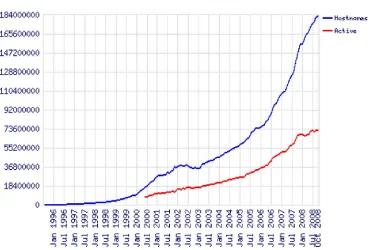
develop large number of domains. According to the Web Server report from Netcraft.com, a
company whose business is to “research data and analysis on many aspects of the Internet”
[Netcraft], there are more than 182 millions websites worldwide as of October 2008 (Figure 1).
Many of these websites might not be fully active since it is a common practice of domains
2
undeveloped domains according to Netcraft.com. There is a strong desire of a system that could flexibly build contents for large number of web sites with very minimal human
intervention.
Figure 1: Netcraft.com’s October 2008 Web Server Survey
For light-weight Web site development, the PHP: Hypertext Preprocessor (PHP) has
become one of the most popular languages [PHP]. It is one of the components of LAMP (a term
referring to a set of set of software components used to run web servers: Linux as the operating
system, Apache as the web server, MySQL as the backend database, and PHP as the
programming language). Evidently, it is used in many web sites including Wikipedia.org,
WorldPress.org, Friendster.com, Facebook.com, and Yahoo! Inc. As of Oct of 2008, PHP is the
in the top 10 most popular programming languages (behind Java, C, C++, and Visual Basic)
3
With the explosion of Web services in recent years, many PHP applications are now
consuming Web services published by external or internal providers. Unfortunately, PHP’s
built-in SOAP extension (PHP SOAP), which is written in C for speed, has somewhat fallen short
in many aspects, especially when it comes to consuming complex types and supporting various
Web service standards (often referred as WS-* standards). To aid PHP in its newly found role of
the SOA world, there have been several frameworks and libraries to help PHP consuming Web
services such as PEAR:Soap and NuSOAP, which were popular before PHP’s built-in SOAP
capabilities came to life. The most notable effort is WSO2’s WSF/PHP framework, which can be
used to provide and consume Web service. It can also support WS-Addressing and WS-Security
specifications, requires installation and server configuration.
1.1 Main Goals
If PHP’s SOAP extension could efficiently and easily consume Web services, it would be a
much better solution than using external extensions or libraries. Consequently, the main goal
of my thesis project is to investigate and implement a method for PHP application to efficiently
and securely consume Web services that have complex types and require WS-Addressing and
WS-Security specification using PHP’s native SOAP extension. An additional constraint of this
method is that the Web applications are to be deployed at an external Web hosting site in
which available administration capabilities are minimal. For example, the Web servers are not
accessible for retooling and re-compilation.
1.2 Objectives
To achieve the stated goals, I will build a set of Web application using PHP’s built-in SOAP
4
chosen a mainstream service provider, Amazon’s Web services. They provides a wide range of
Web services, some of which only require simple SOAP messages while others require the SOAP
messages to be signed using the Public Key Infrastructure (PKI) framework.
The objective of this thesis is to develop a fully functional Web application that will be
used to display different contents on different web sites using Amazon’s Web service. Other
functionalities will be also implemented so the application could easily be expanded to
consume other Web services provided by Amazon, such as Amazon Simple Storage Service (S3),
Amazon Simple DB, and Amazon Elastic Compute Cloud (EC2).
In addition, the system should be easily extended by adding a SOAP server to serve
other websites that are not resided in the same web server. Also, the domain name could be
translated into keywords (each keyword is associated with a list of settings) automatically to
5
Chapter 2 Background and Related Works
Web Services is an important new technology, which has enjoyed widespread supports
from leading industry players such as IBM, Microsoft, HP, Oracle, Novell and Sun.
According to IBM’s definition of Web Services, “Web Services are self-contained,
modular applications that can be described, published, located, and invoked over a network”.
In another word, Web Services are usually services that are offered via the Web. However, the
word “Web” in “Web Services” is actually a little bit misleading since it might hint that Web
Service sends XML-based messages over HTTP. On the contrary, Web Service does not require
HTTP as the transport layer; it could easily be migrated to other transport protocols.
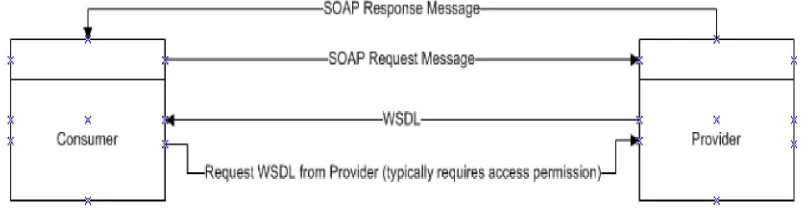
In a web service transaction, a Web application sends a request message using SOAP to
a service at some URI over communication protocols such as HTTP, SMTP, FTP, etc. The service
provider then processes the request and returns a response. The URI of the service could be
discovered using the UDDI (Fig. 2); however, in real life, URI is often known (Fig. 3). Even if
some services are free, the service consumers are typically required to acquire access
permissions from the service providers. On the other side of the equation, a web service is a
published software application that communicates with other applications using XML-based
messages using the above communication protocols. It is available to be integrated into other
6
Figure 2: Consumer request WSDL from UDDI and send request to Provider
Figure 3: In real life, URI is usually known
Since Web Services are loosely-coupled and not tied to any particular implementation,
they allow application programmers to share codes that are well-tested and could be used
across platforms and programming languages. For instance, SOAP clients written in PHP, Java
or Python should still be able to consume the same Web service without any problem.
Ultimately, new features could be seamlessly integrated into websites with minimal costs.
As the popularity of Web Services rises, many associated standards have emerged so
businesses could easily and securely publish and consume Web Services, some of which are
7
roles in Web Services. We will further discuss the role of Web Services in Service-Oriented
Architecture.
2.1 XML
eXtensible Markup Language (XML) is a specification, defined by the W3C [W3C], which
provides syntax to structurally represent data using markup. XML, however, usually refers to
the entire family of related-technologies. The W3C recommends not abbreviating XML
elements and attribute names. For example, the following listing shows how a student record
might be marked up using XML (Fig. 4):
A well-formed XML must also adhere to certain requirements such as the start tag and
end tag must be the same, no overlapping tags, and element and attribute names must be
surrounded by quotes.
In another word, XML documents have a structure format which allows data to send
across network in an interoperable manner. Naturally, XML has widespread support to become
the messaging standard.
2.2 XPath
XML Path Language (XPath) is another XML-related specification used to address certain
part of a XML document [XPath]. For example, “/StudentRecord/PostalCode/” will return
<StudentRecord>
<StudentId>123456</StudentId>
<StudentName>John Doe</StudentName> <Address>123 College Dr</Address> <City>New Orleans</City>
<State>LA</State>
<PostalCode>70130</PostalCode> </StudentRecord>
8
“70130” using XPath. Since XPath easily pinpoint to attributes and elements of a XML
document, it is often used in Web Service security.
2.3 SOAP
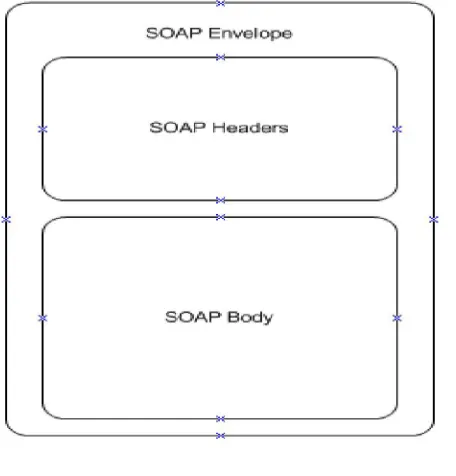
Simple Object Access Protocol (SOAP) defines a structure of XML-based messages that
are being sent between Web services applications [SOAP]. It essentially provides a functionality
to enclose messages insides envelopes. The figure below illustrates a SOAP envelope (Fig. 5):
Figure 5: SOAP Envelop
Even if SOAP is often used to send messages from one application to another, SOAP can
be used for both messaging (Documented-Based SOAP) and Remote Procedure Calls (RPC
SOAP).
2.4 WSDL
Web Service Definition Language (WSDL) is an XML format to describe the service
9
provider. It acts as the contract between the service provider and the service consumer
[WSDL].
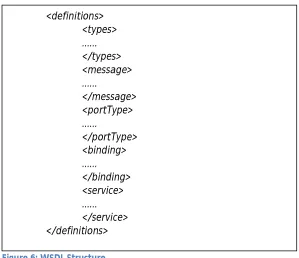
A WSDL has well defined basic structure, which includes the following main elements
(Fig. 6):
Any complex and array data types should be declared in the types element. For
example, the following figure defines a DescribeImageType (Fig. 7):
<definitions> <types> …… </types> <message> …… </message> <portType> …… </portType> <binding> …… </binding> <service> …… </service> </definitions> <xs:complexType name="DescribeImagesType"> <xs:sequence> <xs:element name="executableBySet" type="tns:DescribeImagesExecutableBySetType" minOccurs="0"/> <xs:element name="imagesSet" type="tns:DescribeImagesInfoType"/> <xs:element name="ownersSet" type="tns:DescribeImagesOwnersType" minOccurs="0"/>
</xs:sequence> </xs:complexType>
Figure 6: WSDL Structure
10
The message element is used to assign data types as parameters of the Web service’s
operations in the portType block. The following listing illustrates the message (Fig. 8):
The portType element lists the Web service’s operations. For example, the following
fragment illustrates a “Request-Response” (or In/Out) operation (Fig. 9).
We clearly see that the operation “DescribeImages” will take a
“DescribeImagesRequestMsg” as an input and will response to the client with a
“DescribeImagesResponseMsg”.
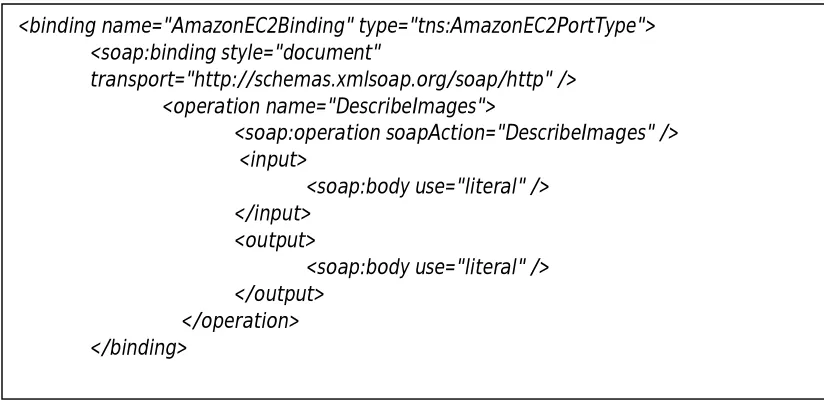
The binding element is where the declared portType are tied into actual SOAP actions.
For example, the following listing (Fig. 10) shows how the operation “DescribeImages” listed
above is tied into the SOAP action:
<operation name="DescribeImages">
<input message="tns:DescribeImagesRequestMsg" /> <output message="tns:DescribeImagesResponseMsg" /> </operation>
<message name="DescribeImagesRequestMsg">
<part name="DescribeImagesRequestMsgReq" element="tns:DescribeImages" />
</message>
Figure 8: WSDL's message element
11
The style attribute specifies the Binding type, which is either RPC or Document; whereas
the transport attribute specifies the transport protocol.
The last element is the service element, which specifies the actual location for each
port. For example, the following service element indicates that the listed operations for
“AmazonEC2Port” are located at “https://ec2.amazonaws.com/” (Fig. 11).
2.5 UDDI
Universal Description, Discovery and Integration (UDDI) is a XML-based registry for
businesses worldwide who have web services to register and also allow searching for specific
<binding name="AmazonEC2Binding" type="tns:AmazonEC2PortType"> <soap:binding style="document"
transport="http://schemas.xmlsoap.org/soap/http" /> <operation name="DescribeImages">
<soap:operation soapAction="DescribeImages" /> <input>
<soap:body use="literal" /> </input>
<output>
<soap:body use="literal" /> </output>
</operation> </binding>
<service name="AmazonEC2">
<port name="AmazonEC2Port" binding="tns:AmazonEC2Binding"> <soap:address location="https://ec2.amazonaws.com/" /> </port>
</service>
Figure 10: WSDL's binding element
12
web services[UDDI]. In another word, like a Yellow Pages phone book, the goal of UDDI is to
assist business to list and find suitable services.
2.6 SOA
Service-Oriented Architecture (SOA) provides methods to facilitate deployment of
interoperable services; to some extends, SOAP decouple the services with the underlying
programming languages, platforms, etc. In a SOA, the Web service is published on a network
where it can be discovered (ability to find the service) and bound (binding: the ability to
connect to the service). In another word, these three activities are corresponding to Web
Service Provider, Web Service Requestor and Web Service Broker in Web Service Architecture
[O’Neill].
2.7 WS-Addressing
According to the W3C, “WS-Addressing specification defines XML elements to identify
Web service end points and to secure end-to-end end point identification in message”
[WS-Addressing]. Basically, to comply with WS-Addressing specification, a SOAP message will have
the following headers (Fig. 12):
<wsa:MessageID>...</wsa:MessageID> <wsa:ReplyTo>
<wsa:Address>...</wsa:Address> </wsa:ReplyTo>
<wsa:FaultTo>
<wsa:Address>...</wsa:Address> </wsa:FaultTo>
<wsa:To>...</wsa:To> <wsa:Action>.../wsa:Action>
13
The following figure (Fig. 13) depicts how WS-Addressing might be used:
Figure 13: WS-Addressing
Ultimately, we should take precaution to prevent End Point References from being
tempered, which lead us to another specification, which is WS-Security.
2.7 WS-Security
WS-Security specification provides encryption, integrity and authentication support for
securing SOAP messages [WS-Security]. In another word, WS-Security aims to deliver the
following:
- A message from the Web Service consumer to the Web Service provider should not
be viewed by third party while it travels in the network.
- The provider should be able to ensure that the message from the consumer has not
been tempered with.
- The provider should be able to determine from whom the message was from and be
14
To achieve the above goals, WS-Security defines three token types:
- UsernameToken Profile
- X.509 Certificate Token Profile
- SAML (Security Assertion Markup Language Token Profile) [SAML]
The listing below shows SOAP headers for WS-Security UsernameToken profile (Fig. 14):
Web Service has become a very important distributed computing technology, and it will
become even more important since it has widely support from many industry leading
companies.
<S11:Envelope xmlns:S11="..." xmlns:wsse="..." xmlns:wsu="..." xmlns:ds="..."> <S11:Header>
<wsse:Security xmlns:wsse="...">
<wsse:UsernameToken wsu:Id="Example"> <wsse:Username> ... </wsse:Username>
<wsse:Password Type="..."> ... </wsse:Password> <wsse:Nonce EncodingType="..."> ... </wsse:Nonce> <wsu:Created> ... </wsu:Created>
</wsse:UsernameToken> </wsse:Security>
</S11:Header>
15
Chapter 3 Design for PHP Web Service Consumer Components
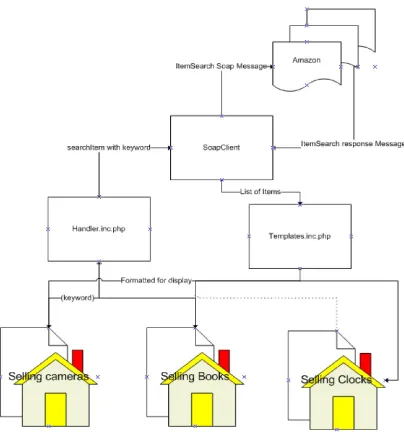
The Web application will be shared among a large number of web sites to automatically
create their contents with very minimal human intervention. Each web site will be assigned
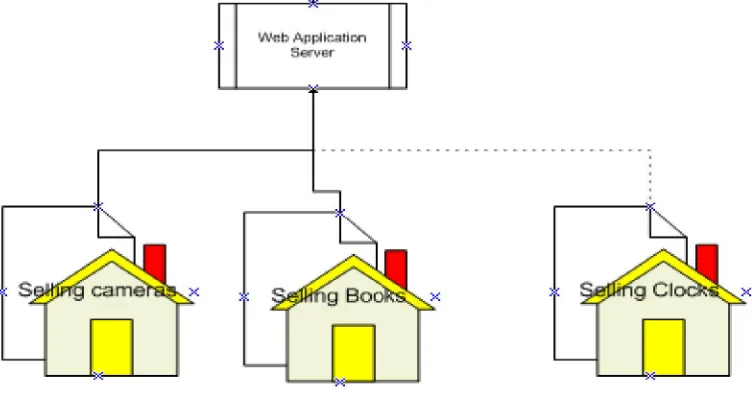
with a keyword; the contents will be created based on that given keyword (Fig. 15). This
application will be implemented using PHP as the programming language and should be able to
consume Amazon Web Associates service and facilitate the consumption of other Amazon Web
services as well.
Figure 15: Web application overview
3.1 System Architecture
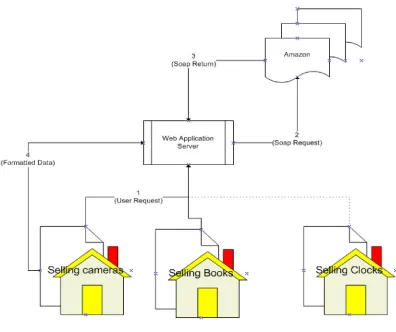
When users access one of the websites, it will send a request to the Web application
server with parameters such as the keyword, the search index, and the Browser Node Id, the
Web application server will then make a SOAP request to Amazon’s Web service with the given
information. Once the data is returned from Amazon, it will be formatted and displayed to the
16
Figure 16: System overview
There are numerous choices to consume a Web service using pure PHP. Four of them
are described in the following because I evaluated the pro and con of using each of them.
1. Pear:SOAP, a package of PEAR (PHP Extension and Application Repository), is a
framework to build many applications in PHP, normally requires Pear download
manager to be installed [Pear:SOAP].
2. NuSOAP is a library used to covert PHP data types to proper XML Schema types, had
enjoyed huge attention in the previous PHP version (version 4) since there was not
much option when it came to consume web service. However, even its latest
17
3. WSO2’s WSF/PHP is an external extension of PHP that could be used to provide and
consume Web services [WSF/PHP]. This extension could be used in providing and
consuming Web Services in PHP. WSO2 WSF/PHP is a complete solution for building
and deploying Web services and is the only PHP extension with most extensive
implementations for the widest range of WS-* specification. Its key features
include, secure services and clients with WS-Security support, binary attachments
with MTOM, automatic WSDL generation (code first model), WSDL mode for both
services and clients (contract first model) and interoperability with .NET and J2EE
(WSO2.org). However, this external extension will not meet the business
requirement for this project because it is not feasible to compile or reconfigure a
Web server in an external shared hosting environment.
4. PHP’s native SOAP extension (PHP SOAP), which is only available if the SOAP option is turned on if the PHP installation is configured with “ --enable-soap” (for example,
./configure --with-xml --with-mysqli --enable-soap), is written in C and could be used to
write SOAP server and client. Fortunately, most shared hosting environments that
support PHP5 usually have this SOAP feature enabled. However, this built-in
extension is short in many aspects.
The SoapClient class, which enables PHP to consume Web services, is not
well-documented. For example, as of today, the function __setSoapHeaders() is not even
18
Figure 17: PHP's SoapClient
Using generic classes provided by the PHP SOAP extension, a Soap Header could be
created with complex SOAP types to accommodate WS-Security’s UsernameToken.
The code segments shown below (Fig. 18) illustrate how to create a SOAP header in
19
20
Even though PHP’s SoapClient class could add the required Header information to
accommodate WS-Security’s UsernameToken, there is no easy way to add attributes
to the SOAP’s body, which would be required if the SOAP message needs to be
signed. Thus, to accomplish our stated goals, we will need to find a better solution.
Fortunately, the SoapClient class could be extended and has its methods overridden
to conform to one’s specifications. For example, we override the __doRequest()
method in order to support WS-Addressing and WS-Security features.
3.2 Technology Overview
As mentioned in the previous section, PHP SOAP could support complex SOAP types;
however, in order to support wider range of WS-Security standards, there will be more than
just wrap complex types inside the SoapVar class. We will override the __doRequest() method
in SoapClient and modify the request message before sending it off to the Web service
provider. We will use the PHP classes written by Robert Richards to support WS-Addressing
and WS-Security [Richards].
<SOAP-ENV:Envelope xmlns:SOAP-ENV="http://schemas.xmlsoap.org/soap/envelope/" xmlns:ns1="http://webservices.amazon.com/AWSECommerceService/2008-10-06" xmlns:xsi="http://www.w3.org/2001/XMLSchema-instance" xmlns:ns2="http://docs.oasis-open.org/wss/2004/01/oasis-200401-wss-wssecurity-secext-1.0.xsd">
<SOAP-ENV:Header><ns2:Security SOAP-ENV:mustUnderstand="1"> <UsernameToken><Username>Blahal</Username>
<Password xsi:type="http://docs.oasis-open.org/wss/2004/01/oasis-200401-wss-username-token-profile-1.0#PasswordDigest">
Y2ExMmEwOTFhN2IxNGFjNTcyNDNjMGRkMTU3NWM4MjYzZmNhYzM0MQ==</Password> <Nonce>TVdRMk9XUTFOamhsTW1ObE1EWTFabVUwTURnek1EQmlPREJsT1RkbE1EST0=</Nonce> </UsernameToken></ns2:Security></SOAP-ENV:Header>
21
Moreover, the SoapClient class has additional useful features in consuming Web service
in WSDL mode with the options array of flags:
1. cache_wsdl option: allow for the Soap client to disable caching the WSDL file
(WSDL_CACHE_NONE), to cache the WSDL file in memory
(WSDL_CACHE_MEMORY), to cache the WSDL file on disk (WSDL_CACHE_DISK) or to
do both memory and disk caching (WSDL_CACHE_BOTH).
2. classmap option: allow mapping Schema Elements to PHP Classes as an associative
array (Schema Elements => name of PHP Classes). Mapping Schema Elements to
PHP classes will ease the implementation process since additional functionalities
could be added directly to the classes.
3.3 System Design
Amazon’s Associates Web service is very flexible; it allows applications to retrieve a list
of sale items for displaying Web pages. When a website visitor clicks on a listed item, there are
two options:
a. The visitor will be redirected to Amazon website with the associate’s referral tag.
When the visitor purchases that item, the associate will receive commission for that
purchase.
b. Another option is to use the Remote Shopping Cart, which allow the visitor to stay
on the website instead of being redirected back to Amazon. The Remote Shopping
Carts are hosted at Amazon servers.
Whichever method is chosen, the associate will get paid the same using the following
22
thesis project, the first option is selected, which means the links on the websites will redirect
visitors back to Amazon website. Consequently, the overall system will look like the following
figure (Fig.20):
23
The Sequence Diagram for a visitor’s request is included in Fig. 21:
24
In addition, Amazon provides many more other services such as Amazon Simple Storage
Service (S3) [S3], Amazon Elastic Compute Cloud (EC2) [EC2] and Amazon Simple DB [SimpleDB],
which could greatly enhance this application; this application will need to be able to consume
those other services as well. Consequently, the Class Diagram (Fig. 22) will include classes
required to consume other Services. In addition, we will illustrate how PHP Soap client
25
26
There are five more components that are not listed in the Class Diagram:
a. index.php: takes the request and pass the request to the Controller (handler.inc.php
file).
b. handler.inc.php: the controller of the application. It processes requests from the
index.php file, invoke appropriate classes to retrieve data from Amazon Web
services, and pass the data to the View (Templates.inc.php) for displaying.
c. templates.inc.php: embed the data into HTML for displaying
d. Amazon_Item.class.php: a custom PHP class will be mapped to Amazon Item object
with additional methods to display data.Amazon_BrowseNode.class.php: a custom
PHP class will be mapped to Amazon BrowseNode object with additional method to
27
Chapter 4 System Implementation
In the implementation of this project, we emphasized on reusing existing libraries and
frameworks. For example, instead of implement functionalities supporting WS-Addressing and
WS-Security standards, we used a PHP library written by Robert Richards and is released with
Open Source license [Richards] and codes example written by Adam Delves [Delves].
4.1 The Soap Client
In the heart of this application is the SoapClientEnhanced class, which extends PHP
native SoapClient class. As mentioned before, the native SoapClient class has very limited
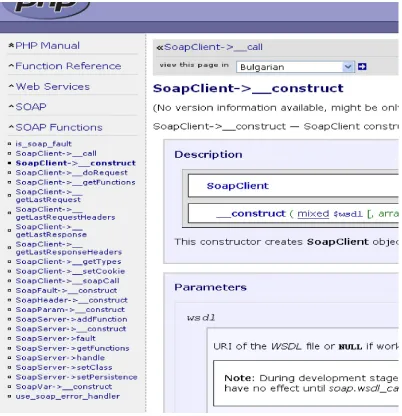
functionalities; its methods are listed in Fig. 23. Another method that was not document is
__setSoapHeaders().
Figure 23: PHP native SoapClient class methods
We will now closely exam the SoapClient class and its methods to further understand its
capabilities.
28
- The __construct($wsdl [, array $options]) method is the constructor. It takes in the
URI or the WSDL file itself as the first parameter; however, it could be set to NULL in
Non-WSDL mode. The second parameter, the optional $options array, is an
associative array of options and is optional in the WSDL mode. It is required in
Non-WSDL mode with the location and uri options, where location is the URL to request
and uri is the target namespace of the SOAP service. Since our main focus is on the
WSDL mode, we will only concentrate on options that pertain to WSDL mode.
o The soap_version could be set to specify if to use SOAP 1.1 or 1.2.
o The login and password options could be set for HTTP authentication.
o The proxy_host, proxy_port, proxy_login and proxy_password could be
used to make HTTP connection via a proxy server.
o The local_cert and passphrase are used to support HTTPS client certificate
authentication.
o The compression option is used to use compression of SOAP requests and
responses.
o The encoding option defines internal character encoding.
o The classmap option can be used to map WSDL types to PHP classes. This
option must be an array with WSDL types as keys and names of PHP classes
as values.
o The trace option enables use the use of the methods __getLastRequest(),
__getLastRequestHeaders(), __getLastResponse()
29
o The exceptions option defining whether or not exceptions of type SoapFault
are thrown when SOAP error occurs.
o The connection_timeout option specifies a timeout in seconds for the
connection to the SOAP service.
o The typemap option is an array of type mappings. Type mapping is an array
with keys type_name, type_ns (namespace URI), from_xml (callback
accepting one string parameter) and to_xml (callback accepting one object
parameter).
o The cache_wsdl option is one of WSDL_CACHE_NONE (no WSDL cache),
WSDL_CACHE_DISK (cache WSDL on Disk), WSDL_CACHE_MEMORY (cache
WSDL in Memory) or WSDL_CACHE_BOTH (cache WSDL both in Memory and
on Disk).
o The user_agent option specifies string to use in User-Agent header.
o The stream_context option is a resource for context.
o The features option is a bitmask of SOAP_SINGLE_ELEMENT_ARRAYS,
SOAP_USE_XSI_ARRAY_TYPE, SOAP_WAIT_ONE_WAY_CALLS.
- The __doRequest( string $request, string $location, string $action, int $version [, int
$one_way ] ), which could be overridden by subclass to add additional XML
processing, returns a string. The $request is the XML SOAP request; the $location is
30
- The __getFunctions(), which works only in WSDL mode, returns an array of SOAP
functions. For example, this method returns all functions of Amazon S3 as shown in
the following listing:
Supported Functions: Array
(
[0] => CreateBucketResponse CreateBucket(CreateBucket $parameters) [1] => DeleteBucketResponse DeleteBucket(DeleteBucket $parameters)
[2] => GetObjectAccessControlPolicyResponse
GetObjectAccessControlPolicy(GetObjectAccessControlPolicy $parameters) [3] => GetBucketAccessControlPolicyResponse
GetBucketAccessControlPolicy(GetBucketAccessControlPolicy $parameters) [4] => SetObjectAccessControlPolicyResponse
SetObjectAccessControlPolicy(SetObjectAccessControlPolicy $parameters) [5] => SetBucketAccessControlPolicyResponse
SetBucketAccessControlPolicy(SetBucketAccessControlPolicy $parameters) [6] => GetObjectResponse GetObject(GetObject $parameters)
[7] => GetObjectExtendedResponse GetObjectExtended(GetObjectExtended $parameters)
[8] => PutObjectResponse PutObject(PutObject $parameters)
[9] => PutObjectInlineResponse PutObjectInline(PutObjectInline $parameters) [10] => DeleteObjectResponse DeleteObject(DeleteObject $parameters) [11] => ListBucketResponse ListBucket(ListBucket $parameters)
[12] => ListAllMyBucketsResponse ListAllMyBuckets(ListAllMyBuckets $parameters) [13] => SetBucketLoggingStatusResponse
SetBucketLoggingStatus(SetBucketLoggingStatus $parameters) [14] => GetBucketLoggingStatusResponse
GetBucketLoggingStatus(GetBucketLoggingStatus $parameters) [15] => CopyObjectResponse CopyObject(CopyObject $parameters) )
31
- The __getLastRequest() and __getLastRequestHeaders(), which only work if the
trace option is on, will return the request and the headers of the last SOAP request
respectively.
- The __getLastResponse() and __getLastResponseHeaders(), which also only work if
the trace option is on, will return the response and the headers from the last SOAP
response respectively.
The __getTypes() method, which only works in WSDL mode, will return the list of
SOAP types. For example, the following listing is a sample of types returned by
32
[6] => struct DeleteKeyPairType { string keyName;
}
[7] => struct DeleteKeyPairResponseType { string requestId;
boolean return; }
[8] => struct DescribeKeyPairsType { DescribeKeyPairsInfoType keySet; }
[9] => struct DescribeKeyPairsInfoType { DescribeKeyPairsItemType item; }
[10] => struct DescribeKeyPairsItemType { string keyName;
}
[11] => struct DescribeKeyPairsResponseType { string requestId;
DescribeKeyPairsResponseInfoType keySet; }
[12] => struct DescribeKeyPairsResponseInfoType { DescribeKeyPairsResponseItemType item; }
[13] => struct DescribeKeyPairsResponseItemType { string keyName;
string keyFingerprint; }
[14] => struct RunInstancesType { string imageId; int minCount; int maxCount; string keyName; GroupSetType groupSet; string additionalInfo; UserDataType userData; string addressingType; string instanceType; PlacementRequestType placement; string kernelId; string ramdiskId; BlockDeviceMappingType blockDeviceMapping; }
[15] => struct GroupSetType { GroupItemType item; }
33
- The __setCookie (string $cookieName [, string $cookieValue ] ), which will affect all
subsequent call to the SoapClient’s methods, will send a cookie along with the SOAP
request.
- The __soapCall (string $function_name , array $arguments [, array $options [,
mixed $input_headers [, array &$output_headers ]]] ) method is a low level API
function that make a SOAP call. It will return simple type if the SOAP function return
only one value; otherwise, an associative array will be returned.
Thus, we will extend the SoapClient class with a subclass named SoapClientEnhanced to
add additional functionalities.
First, we override the parent class __doRequest() method to intercept the SOAP request
to inject the necessary SOAP headers to support WS-Addressing and WS-Security standards.
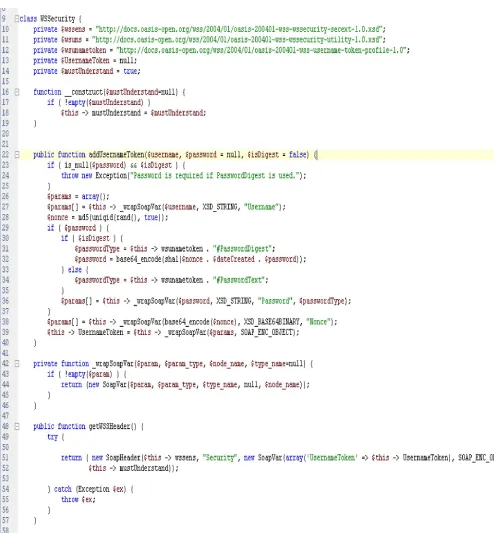
The listing below shows the codes fragment of how the __doRquest() method was overridden
34
function __doRequest($request, $location, $action, $version) { try {
if ( $this -> useWSA || $this -> useWSSE ) { $dom = new DOMDocument(); $dom->loadXML($request); if ( $this -> useWSA ) {
$objWSA = new WSASoap($dom); $objWSA->addAction($action); if ( empty($this -> to )) {
$objWSA->addTo($location); } else {
$objWSA->addTo($this -> to); }
$objWSA->addMessageID($this -> messageId); $objWSA->addReplyTo($this -> replyTo); $objWSA->addFaultTo($this -> faultTo); $dom = $objWSA->getDoc();
}
if ( $this -> useWSSE ) {
$objWSSE = new WSSESoap($dom);
$objWSSE->addTimestamp($this -> secondToExpires); if ( $this -> addUsernameToken ) {
$objWSSE->addUserToken($this -> tokenUsername, $this -> tokenPassword, $this -> tokenDigest);
}
if ( $this -> signSoapDoc ) {
$objWSSE->signAllHeaders = $this -> signAllHeader;
$objKey = new XMLSecurityKey(XMLSecurityKey::RSA_SHA1, array('type'=>'private'));
$objKey->loadKey($this -> pathToPrivateKey, true); $objWSSE->signSoapDoc($objKey);
}
if ( $this -> addCertificate ) {
$token = $objWSSE->addBinaryToken(file_get_contents($this -> pathToCert));
$objWSSE->attachTokentoSig($token); }
$request = $objWSSE->saveXML(); } else {
$request = $objWSA->saveXML(); }
$this -> modifiedRequest = $request; }
return parent::__doRequest($request, $location, $action, $version); } catch (Exception $e) {
throw new Exception("Unable to perform __doRequest: " . $e -> getMessage() . " : " . $e->getFile() . " [Line:" . $e->getLine() . "]");} }
35
As a result, the SoapClientEnhanced class now has additional methods that support WS-Addressing and WS-Security specifications (Fig. 27).
Figure 27: WS-Addressing and WS-Security support
Secondly, using the __getTypes() function, we retrieve the complex types from the
WSDL file provided by the Service provider and then map them to the corresponding PHP
classes [Delves]. In our case, we prefix the PHP classes with “Amazon_”. At the same time, we
use the __getFunctions() function to retrieve the Response types to avoid mapping those types
36 private function _createClassmap() {
$type = null; $name = null; $classname = null;
if ( is_array($funcArray = ($this -> __getFunctions())) ) { foreach (new ArrayObject($funcArray) as $func ) {
preg_match("/([a-z0-9_]+)\s+([a-z0-9_]+(\[\])?)(.*)?/si", $func, $fMatches);
if ( !is_null($fMatches[1]) ) {
$this -> returnedObjects[] = trim($fMatches[1]); }
} }
if ( is_array($typesArray = ($this -> __getTypes()) ) ) {
foreach (new ArrayObject($typesArray) as $i => $type ){
preg_match("/([a-z0-9_]+)\s+([a-z0-9_]+(\[\])?)(.*)?/si", $type, $matches);
$type = $matches[1]; $name = trim($matches[2]); switch (strtolower($type)) {
case 'struct':
$this -> _createClass($name); break;
} }
} }
private function _createClass($name) { try {
if ( !is_null($name) && !in_array($name, $this -> returnedObjects)){
$name = trim(strip_tags($name));/* Remove any potential executable codes */
$classname = $this -> classname_prefix . $name;
$this -> types[$name] = trim($classname);/*Schema Element => PHP Class name */
/* check the class does not exsits before creating it */ if(!(class_exists($classname) && in_array($classname, get_declared_classes()))) {
eval("class $classname {}"); }
}
} catch (Exception $ex) {
throw new SoapFault('Server Error', "Unable to create class $classname: " . $ex -> getMessage() . " [" . $ex ->getTraceAsString() . "]");}}
37
After the classmap array is created, we will need to initiate the SOAP client one more
time with the array of options. At a first glance, this is not a very good solution since the SOAP
client will suffer in performance due to the fact that it will have to parse the WDSL file again.
However, PHP native SOAP client has another very useful feature: it could be set to cache the
WSDL in Memory, on Disk or Both. For our project, we set it to cache the WSDL file for both in
Memory and on Disk. The resulting constructor is listed below (Fig. 29):
As the result of the above actions, now we could easily create an Amazon_Item class,
which will have all properties of the original Amazon’s Item complex type, but with additional
functionalities. The sample code is listed below (Fig. 30):
function __construct($wsdl, $classname_prefix='', $debug=false) { try {
$this -> wsdl = trim($wsdl);
$this -> classname_prefix = trim($classname_prefix); $this -> debug = $debug;
parent::__construct($wsdl); $this -> _createClassmap();
$this -> options['trace'] = ($debug) ? 1 : 0;
$this -> options['cache_wsdl'] = WSDL_CACHE_BOTH;/*Cache the WSDL in memory and on disk */
$this -> options['classmap'] = $this -> types; parent::__construct($wsdl, $this -> options); } catch (SoapFault $ex) {
throw $ex; }
}
38
<?php /**
* @name Amazon_Item.class * Wrap Amazon's Item */
class Amazon_Item {
/**
* Wrap a URL from Amazon in A tag to display on the site *
* @return string */
public function getDetailPageURL() {
$url = "<a href=\"" . (string)$this -> DetailPageURL . "\"><b>Click for more Detail</b></a>";
return $url; }
/**
* Display item in detail
* Brand and Features information could be null, * so we need to make sure to handle cases in which * information is empty
*
* @return string */
public function getDisplayURL() {
$tpl_vars['PRODUCT_URL'] = $this -> DetailPageURL; $tpl_vars['IMG_SRC'] = $this -> SmallImage -> URL; $tpl_vars['DESCRIPTION'] = $this -> ItemAttributes -> Title;
$tpl_vars['LIST_PRICE'] = !is_null($this -> OfferSummary -> LowestNewPrice -> FormattedPrice)
? $this -> OfferSummary -> LowestNewPrice -> FormattedPrice : $this -> ItemAttributes -> ListPrice -> FormattedPrice;
$tpl_vars['BRAND'] = !is_null($this -> ItemAttributes -> Brand) ? $this -> ItemAttributes -> Brand : "<i>n/a</i>";
$features = $this -> ItemAttributes -> Feature; if ( is_array($features) )
{
$features = implode('<br>', $features); }
$tpl_vars['FEATURES'] = !(is_null($features)) ? $features : "<i>n/a</i>"; return ( template('/index.php/product.tpl', $tpl_vars, 1));
}
}//end of Amazon_Item ?>
39
4.2 Using the Enhanced Soap Client
Once the SoapClientEnhanced has been completed, to actually consume a Web service,
we just need to extend it and provide it with the location to the WSDL file (or the WSDL file
itself), the optional class prefix used to name the PHP classes for the classmap option and the
debug option (to turn the trace option on). For instance, to consume Amazon S3, we just
simply extend the SoapClientEnhanced and add additional functionalities required for Amazon
40 <?php
/**
* @name AmazonS3.class
*/
require_once('SoapClientEnhanced.class.php');
class AmazonS3 extends SoapClientEnhanced {
private $prefix = 'Amazon_';
private $debug = true;
private $wsdl = 'http://s3.amazonaws.com/doc/2006-03-01/AmazonS3.wsdl';
const _AMAZON_WS_KEY_ = 'WS Access Key Id';//Amazon Web Service Key
const _AMAZON_SEC_KEY_ = 'Secret Key’;//Amazon Secret
const _AMAZON_S3_PREFIX_ = 'AmazonS3';
function __construct() {
parent::__construct($this->wsdl, $this->prefix, $this->debug);
}
/**Amazon S3 requires the signature, which is a HASH_HMAC of the combination
* of ("AmazonS3" + OPERATION + Gmdate timestamp)
*/
public function createSignature($timestamp, $operation) {
return ( base64_encode(hash_hmac('sha1', AmazonS3::_AMAZON_S3_PREFIX_ . trim($operation) . $timestamp, AmazonS3::_AMAZON_SEC_KEY_, true)));
}
public function createTimestamp() {
return (gmdate("Y-m-d\TH:i:s.B", time()) .'Z');
}
}
?>
41
The following codes fragment (Fig. 32) illustrates how to initiate a request using the
AmazonS3 class:
/**
* List all buckets in AmazonS3 that are associated with the given key *
*/
public function listBuckets() { try {
$request = new Amazon_ListAllMyBuckets();
$request -> AWSAccessKeyId = AmazonS3::_AMAZON_WS_KEY_; $timestamp = $this -> s3 -> createTimestamp();
$request -> Timestamp = $timestamp;
$request -> Signature = $this -> s3 -> createSignature('ListAllMyBuckets', $timestamp);
$result = $this -> s3 -> ListAllMyBuckets($request); $this -> buckets = $result -> Buckets;
} catch (SoapFault $ex) {
throw new Exception("Unable to retrieve all buckets: " . $ex->faultstring); }
}
42
The following is the WSDL fragment for Amazon Associates Web service’s ItemSearch
(Fig. 33).
43
The sample code below illustrates how to send a SOAP message according to the above
WSDL fragment (Fig. 34).
/**
* Search for the list of Items from Amazon Web service with the given search index, * search keyword, responsegroup, page number and optional node id.
* The page number and totalPages number are used in the paginating system (to display * the next and previous link when applicable.
* */
public function search() { try {
$itemSearch = new Amazon_ItemSearch();/* the same as using ItemSearch->AWSAccessKeyId = $accessKey */
$itemSearch -> AWSAccessKeyId = Amazon::_AMAZON_WS_KEY_; $itemSearch -> AssociateTag = Amazon::_AMAZON_ASSOCIATE_TAG_; //Associate Tag to get paid
$request = new Amazon_ItemSearchRequest(); $request -> SearchIndex = $this -> searchIndex; $request -> Keywords = $this -> searchKeyword; $request -> ResponseGroup = $this -> responseGroup; $request -> ItemPage = $this -> pageNumber;
if ( $this -> nodeId > 0 )
$request -> BrowseNode = $this -> nodeId; $itemSearch -> Request = $request;
$response = $this -> amazon -> ItemSearch($itemSearch); $itemsArray = $response -> Items;
$this -> totalPages = $itemsArray -> TotalPages; $this -> totalResults = $itemsArray -> TotalResults; $this -> items = $itemsArray -> Item;
} catch (SoapFault $e) { throw $e; }
}
44
However, not all methods are straight forward. For example, Amazon EC2 requires
extra information in order to support WS-Security specification (Fig. 35). The paths to the
Private Key and the X.509 Certificates are required.
In addition, the resulting SOAP message (list below) is much more involved, which include the following parts: the WS-Addressing header if it is being used (Fig. 36), the
BinarySecurity Token (Fig. 37), the SignedInfo and Digest (digest is usually supplied to speed up the processing time) (Fig. 38), the Signature and Key info (Fig. 39) and the Payload itself (Fig. 40). The SOAP body in this example is signed.
try {
$client = new AmazonEC2();
$client -> addWSAFaultTo("http://stockcamera.com/replyto");
$client -> signMessage("/hsphere/local/home/sonny/phpinclude/ws/pkey.pem", true);
$client -> addCertificate("/hsphere/local/home/sonny/phpinclude/ws/cert.pem"); $request = new Amazon_DescribeImagesType();
$request -> imagesSet -> item -> imageId = 'ami-be3cd8d7'; $test = $client -> DescribeImages($request);
} catch (SoapFault $ex) {
echo "SOAPFAULT: " . $ex->faultstring; }
45 <wsse:Security xmlns:wsse="http://docs.oasis-open.org/wss/2004/01/oasis-200401-wss-wssecurity-secext-1.0.xsd" SOAP-ENV:mustUnderstand="1"> <wsse:BinarySecurityToken xmlns:wsu="http://docs.oasis-open.org/wss/2004/01/oasis-200401-wss-wssecurity-utility-1.0.xsd" EncodingType="http://docs.oasis-open.org/wss/2004/01/oasis-200401-wss-soap-message-security-1.0#Base64Binary" wsu:Id="pfx726e08ed-8626-3c53-368e-bd08b23c2306" ValueType="http://docs.oasis-open.org/wss/2004/01/oasis-200401-wss-x509-token-profile-1.0#X509v3">MIICdjCCAd+gAwIBAgIFHwiWRC8wDQYJKoZIhvcNAQEFBQAwUzELMAkGA1UEBhMCVVMx EzARBgNVBAoTCkFtYXpvbi5jb20xDDAKBgNVBAsTA0FXUzEhMB8GA1UEAxMYQVdTIExpbWl0ZWQtQXNz dXJhbmNlIENBMB4XDTA4MTEwNTA2MTQxM1oXDTA5MTEwNTA2MTQxM1owUjELMAkGA1UEBhMCVV MxEzARBgNVBAoTCkFtYXpvbi5jb20xFzAVBgNVBAsTDkFXUy1EZXZlbG9wZXJzMRUwEwYDVQQDEwxsZ20 0ZGJwbXJ1cXcwgZ8wDQYJKoZIhvcNAQEBBQADgY0AMIGJAoGBAN/ldgOrW54/gQ5/5qIAL4IVmjX4I2xN9 HsKBx75GwAqSMfVNjlE9MVpj4vaZgd3bqU8/49g6UuGlD7yid40VHF171PS5Z82HbJjea+crEBLQZOhTe0s2 de7+tD6Pzogy9OAnNEo9xfaBMpLXO9hhU1oz2VWwwwSNDYk01RhzHwNAgMBAAGjVzBVMA4GA1UdD wEB/wQEAwIFoDAWBgNVHSUBAf8EDDAKBggrBgEFBQcDAjAMBgNVHRMBAf8EAjAAMB0GA1UdDgQW BBQ5eYPukh3uUDOjX0MxUFiYzov81TANBgkqhkiG9w0BAQUFAAOBgQB+MyEcBJNGpMzAQG8L+dFQkQ9 jb5Whzh6sW+v3POWrLyq8tnmcCGlk0YbME2PFiz3LhWR1Q6B/YrMho8OBVxJaiX5a8IOWquA4Twaz+bYH AC1CiQ+CAL4k3KvRx1umzzMpWOtGw7vhr8xSb4ZVmvxQzU0Lb4G1qkSOEPIWjkC/fQ==</wsse:BinarySec urityToken>
<?xml version="1.0" encoding="UTF-8"?>
<SOAP-ENV:Envelope xmlns:SOAP-ENV="http://schemas.xmlsoap.org/soap/envelope/" xmlns:ns1="http://ec2.amazonaws.com/doc/2008-08-08/" xmlns:wsa="http://schemas.xmlsoap.org/ws/2004/08/addressing"> <SOAP-ENV:Header> <wsa:Action xmlns:wsu="http://docs.oasis-open.org/wss/2004/01/oasis-200401-wss-wssecurity-utility-1.0.xsd" wsu:Id="pfx1746d739-af39-4174-9af3-c4441c0a3eb3">DescribeImages</wsa:Action> <wsa:To xmlns:wsu="http://docs.oasis-open.org/wss/2004/01/oasis-200401-wss-wssecurity-utility-1.0.xsd"
wsu:Id="pfxe71915ed-81cf-6b77-5d98-b983790eb1ba">https://ec2.amazonaws.com/</wsa:To>
<wsa:MessageID xmlns:wsu="http://docs.oasis-open.org/wss/2004/01/oasis-200401-wss-wssecurity-utility-1.0.xsd" wsu:Id="pfx1c734562-6756-9dad-bf7e-36e9e8b8c4f4">uuid:8a15ebb0-9bea-4183-ce0c-148905ecb180</wsa:MessageID> <wsa:ReplyTo xmlns:wsu="http://docs.oasis-open.org/wss/2004/01/oasis-200401-wss-wssecurity-utility-1.0.xsd" wsu:Id="pfxc5760bb4-4bc9-e40d-4576-f72321410aa6"> <wsa:Address>http://schemas.xmlsoap.org/ws/2004/08/addressing/role/anonymous </wsa:Address></wsa:ReplyTo> <wsa:FaultTo xmlns:wsu="http://docs.oasis-open.org/wss/2004/01/oasis-200401-wss-wssecurity-utility-1.0.xsd" wsu:Id="pfx2e6b22bb-db89-cbbe-991b-8197f99d3e67"> <wsa:Address>http://stockcamera.com/replyto</wsa:Address></wsa:FaultTo>
Figure 36: Signed WS-Addressing headers
46 <ds:SignedInfo><ds:CanonicalizationMethod Algorithm="http://www.w3.org/2001/10/xml-exc-c14n#"/> <ds:SignatureMethod Algorithm="http://www.w3.org/2000/09/xmldsig#rsa-sha1"/> <ds:Reference URI="#pfxb0abffb7-608e-b790-563c-6f08a4eac005"> <ds:Transforms><ds:Transform Algorithm="http://www.w3.org/2001/10/xml-exc-c14n#"/></ds:Transforms><ds:DigestMethod Algorithm="http://www.w3.org/2000/09/xmldsig#sha1"/> <ds:DigestValue>EIEEDlDAmiEexx+pmkN21Bcwi14=</ds:DigestValue></ds:Reference><ds:Reference URI="#pfx1746d739-af39-4174-9af3-c4441c0a3eb3"> <ds:Transforms><ds:Transform Algorithm="http://www.w3.org/2001/10/xml-exc-c14n#"/></ds:Transforms> <ds:DigestMethod Algorithm="http://www.w3.org/2000/09/xmldsig#sha1"/> <ds:DigestValue>zxQ5Z/91I5ErBULVQnJ72GWBG2Y=</ds:DigestValue></ds:Reference><ds:Reference URI="#pfxe71915ed-81cf-6b77-5d98-b983790eb1ba"> <ds:Transforms><ds:Transform Algorithm="http://www.w3.org/2001/10/xml-exc-c14n#"/></ds:Transforms> <ds:DigestMethod Algorithm="http://www.w3.org/2000/09/xmldsig#sha1"/><ds:DigestValue>syP/7EtX/RG4OLIK3fEF2lsa A+E=</ds:DigestValue></ds:Reference> <ds:Reference URI="#pfx1c734562-6756-9dad-bf7e-36e9e8b8c4f4"><ds:Transforms><ds:Transform Algorithm="http://www.w3.org/2001/10/xml-exc-c14n#"/></ds:Transforms> <ds:DigestMethod Algorithm="http://www.w3.org/2000/09/xmldsig#sha1"/><ds:DigestValue>SGOeSpE9n81wP0RY6dnQj 1D0SRo=</ds:DigestValue></ds:Reference><ds:Reference URI="#pfxc5760bb4-4bc9-e40d-4576-f72321410aa6"><ds:Transforms><ds:Transform Algorithm="http://www.w3.org/2001/10/xml-exc-c14n#"/></ds:Transforms><ds:DigestMethod Algorithm="http://www.w3.org/2000/09/xmldsig#sha1"/><ds:DigestValue>9IOlqEpeko4jYxtWiW7TAri 8gq4=</ds:DigestValue></ds:Reference><ds:Reference URI="#pfx2e6b22bb-db89-cbbe-991b-8197f99d3e67"><ds:Transforms><ds:Transform Algorithm="http://www.w3.org/2001/10/xml-exc-c14n#"/></ds:Transforms><ds:DigestMethod Algorithm="http://www.w3.org/2000/09/xmldsig#sha1"/><ds:DigestValue>2AtG966Pl0wwPJaqY3zfq mTCMo8=</ds:DigestValue></ds:Reference><ds:Reference URI="#pfxab5cb5c1-c345-662f-dd00-b928fd45dbfb"><ds:Transforms><ds:Transform Algorithm="http://www.w3.org/2001/10/xml-exc-c14n#"/></ds:Transforms><ds:DigestMethod Algorithm="http://www.w3.org/2000/09/xmldsig#sha1"/><ds:DigestValue>wk0HqGO9Lf1jN/W7k1l8SJ 9PCR4=</ds:DigestValue></ds:Reference></ds:SignedInfo>
47
<ds:SignatureValue>vTcCLkxk27ifyLQfm79ZhZjmdiNZHY31p0QJr2a5jHZisDXmDJUnr9xCA+3N6kxw5 ObZbah784RWA1iEeNCjvuHVw3PywnmVjI96q9ZEXnm3hfef+h5zwn9/IYqwSyF/apiKXPKspuNC+qken Mwuu+giApSFCW3ZzoWJcuaelJs=</ds:SignatureValue>
<ds:KeyInfo><wsse:SecurityTokenReference><wsse:Reference URI="#pfx726e08ed-8626-3c53-368e-bd08b23c2306"/></wsse:SecurityTokenReference></ds:KeyInfo></ds:Signature><wsu:Timestamp xmlns:wsu="http://docs.oasis-open.org/wss/2004/01/oasis-200401-wss-wssecurity-utility-1.0.xsd"
wsu:Id="pfxb0abffb7-608e-b790-563c-6f08a4eac005"><wsu:Created>2008-11-
10T02:46:44Z</wsu:Created><wsu:Expires>2008-11-10T03:46:44Z</wsu:Expires></wsu:Timestamp></wsse:Security>
<SOAP-ENV:Body xmlns:wsu="http://docs.oasis-open.org/wss/2004/01/oasis-200401-wss-wssecurity-utility-1.0.xsd"
wsu:Id="pfxab5cb5c1-c345-662f-dd00- b928fd45dbfb"><ns1:DescribeImages><ns1:imagesSet><ns1:item><ns1:imageId>ami-be3cd8d7</ns1:imageId></ns1:item></ns1:imagesSet></ns1:DescribeImages> </SOAP-ENV:Body>
Figure 39: Signature and Key Info and other Security Headers
48
Chapter 5 Applications and Extensions
5.1 Main problems and Solution Details
The main problems of this thesis were that how well PHP SOAP, a weak-typed language,
would consume Web services with complex types, and if PHP SOAP could easily support WS-*
specifications. As we have described and illustrated by implementing the Amazon Web Service
Consumer system using a combination of existing methods and libraries [Richards, Delves], PHP
SOAP could be easily extended to support WS-* specifications and to consume complex types
from various Web services.
5.2 Using the Amazon Web Service Consumer System
In order to use Amazon Web service, a free Web service Id (AWS Access Key) is required.
That key will allow user to access to Amazon Associates Web service where users could perform
a wide range of functionalities, from searching for Items listed in Amazon, getting detail on
certain item, or even using the Remote Shopping Cart. However, in order to earn commissions
for the referrals, user will need to sign up with Amazon Affiliates Central (
https://affiliate-program.amazon.com) to get the Associate Tag Id, which end in “-20” for North America
customers. This Associate Tag must be included in order to earn commissions.
In addition, while creating the AWS Access Key, it is recommended to create the Private
Key and the X.509 certificate. They will be needed in order to use Amazon EC2 and Amazon
SimpleDB service.
In the shared hosting account, create the “phpinclude” folder in the Root directory, not
49
Figure 41: Create the phpinclude directory
Next, create the “ws” and the “templates” folders and upload the handler.inc.php and
templates.inc.php file to the “phpinclude” directory (Fig. 42).
Figure 42: uploading hander and templates
50
Figure 43: the content of ws directory
I create a directory called “index.php” inside the “templates” directory and upload the
HTML templates for this project (Fig. 44). In addition, make sure to upload any required image
for these HTML templates to the appropriate directory.
Figure 44: HTML templates
Then, I made sure to set the AWS Access Key and Associate Tag in the Amazon.class.php
class. Go to the one of the domain folder and edit the index.php file to use the new Web
51
The handler.inc.php’s handler function requires the default search, search index, the
response group, the node id, the domain title and the optional special banner as its arguments.
By repeating the same process, I could use other websites as well. To display different
type of items, the only required changes are the default search, default search index and the
node id. The optional special banner is a link created within the Amazon’s Affiliates Central
dashboard.
The Items from Amazon are listed on the websites (Fig. 46 and Fig. 47).
<?php /** * $Id: $
* @name index.php * Handler request *
*/
require_once('/hsphere/local/home/sonny/phpinclude/handler.inc.php'); $defaultSearch = 'Digital Cameras';
$defaultSearchIndex = 'Photo'; $defaultResponseGroup = 'Medium';
$defaultNodeId = 51547011;//This is for the nav bar and should not be changed $domainTitle = 'Stock Cameras';
$specialBanner = "<iframe src='http://rcm.amazon.com/e/cm?t=stockcacom-20&o=1&p=8&l=as1&asins=B000FI73MA&fc1=000000&IS2=1<1=_blank&m=amaz on&lc1=0000FF&bc1=000000&bg1=FFFFFF&f=ifr' style='width:120px;height:240px;' scrolling='no' marginwidth='0' marginheight='0' frameborder='0'></iframe>";
handler($defaultSearch, $defaultSearchIndex, $defaultResponseGroup, $defaultNodeId, $domainTitle, $specialBanner);
?>
52
Figure 46: StockCamera.com
53
These sites have the same look since they use the same HTML templates, images and
style sheets. However, they could be easily changed since they are independent from the Web
application. On the contrary, the contents of each site are not the same since each site has
different search keyword and different search index.
5.3 Potential for further development
This Web application could be potentially expended to a fully functional domains
contents generation system by adding extra functionalities such as automatically associate a
domain name to a keyword and the corresponding search index. Moreover, by simply adding a
SOAP server component to it, the same application could potentially serve domains hosted
elsewhere as well. For example, a domain hosted elsewhere could request the generated
54
Figure 48: Serving Remote Websites
Furthermore, instead of redirecting visitors back to Amazon website, the application
could be extended to utilize Amazon’s Remote Shopping Cart feature. Moreover, since the
Web application is ready to consume other Amazon web services as well, it could be
implemented so that it could backup itself nightly and upload its backup images to Amazon S3.
In another word, an application could go a long way in the SOA world as long as it could