RESEARCH ARTICLE
Effect of peripheral vestibular pathologies on reading ability
and auditory-verbal memory
Mohsen Ahadi1,2*, Nima Rezazadeh3, Elahe Mosharaf Dehkordi4
1- Department of Audiology, School of Rehabilitation Sciences, Iran University of Medical Sciences, Tehran, Iran 2
- Rehabilitation Research Center, School of Rehabilitation Sciences, Iran University of Medical Sciences, Tehran, Iran 3- Department of Audiology, Amir Alam Hospital, Tehran University of Medical Sciences, Tehran, Iran
4
- Department of Audiology, School of Rehabilitation, Shahid Beheshti University of Medical Sciences, Tehran, Iran
Received: 14 Oct 2018, Revised: 10 Dec 2018, Accepted: 18 Dec 2018, Published: 15 Apr 2019
Abstract
Background and Aim: Auditory-verbal mem-ory and reading problems are frequently obser-ved in patients with vestibular disorders, but rarely considered as a cognitive consequence of vestibular disease. Many clinicians do not rec-ognize or ignore the psychological symptoms of vestibular disease. This approach could under-estimate the cognitive problems of the patients, or even led to misdiagnosis of a combined ves-tibular-cognitive condition. The current study aimed to assess the cognitive impact of acute vestibular disorders.
Methods: A total of 71 patients with unilateral vestibular neuritis, Meniere’s disease, and ben-ign paroxysmal positional vertigo underwent a through audiologic evaluation, including otos-copy, pure tone audiometry, tympanometry, vestibular evoked myogenic potentials, video-nystagmography plus caloric testing, and video head impulse testing in the plane of horizontal semicircular canals. After determination of the disease, the Persian version of the dizziness handicap inventory, the Persian reading test, and Rey auditory-verbal learning test were admi-nistered.
Results: There were no significant difference between the patient groups with regard to their inabilities like reading and learning problems according to their auditory verbal memory score induced by acute vertigo. However, acute ver-tigo can reduce the reading ability and capacity of auditory-verbal memory of the patients com-pared with normal subjects.
Conclusion: Unilateral vestibular disorders in which patients suffer from acute rotatory vertigo could lead to reading difficulties and learning because of auditory-verbal memory impairment. The exact mechanism of vestibular impairment is not a determinant factor for these cognitive problems.
Keywords: Vertigo; reading; auditory-verbal memory
Citation: Ahadi M, Rezazadeh N, Mosharaf
Dehkordi E. Effect of peripheral vestibular pathologies on reading ability and auditory-verbal memory. Aud Vestib Res. 2019;28(2):93-99.
Introduction
The main function of the mammals’ vestibular system is providing information for the central nervous system about general body orientation in relation to gravity, balance in movement and body status, readjustment of autonomic
*
Corresponding author: Department of Audiology,
functions after body orientation and gaze sta-bility [1]. Several main systems, including vis-ion, vestibular, proprioceptive; and some other accessory systems such as auditory system pro-vide the brain with relevant information. It has been shown that the vestibular system not only affects body circadian rhythm but also has con-nections with cognitive performances [1,2]. During head movement, the vestibular system maintains body and gaze stability through det-ecting head movement and sending appropriate information to extra-ocular, cervical, and torso muscles. The most overt effects of acute uni-lateral vestibular impairment are acute true rot-atory vertigo, nystagmus, body instability, and gate disturbance [3]. In addition, increasing evi-dence has supported that vestibular inputs have a key role in higher-order cognitive functions such as spatial memory and orientation, multi-sensory motion perception, and spatial orien-tation [4,5]. Several behavioral studies in rod-ents [6,7] and humans [8] have indicated that visual-spatial memory and cognition are related to vestibular function. They have shown that although two different ascending pathways con-tribute to the spatial cognition convey vestibular information from vestibular nuclei to the brain cortex via thalamus, they do this through diff-erent nuclei. The first pathway transmits inf-ormation through anterior thalamic nuclei and contributes to place perception (in hippocampus cells) and orientation (in the limbic system). On the other hand, the second pathway cont-ributes to the self-motion information which is used for motion planning and sensory repre-sentation of spatial relations of the objects in the outside world. Self-motion information integra-tes with other sensory inputs related to objects’ movements to detect the origin of the move-ment. For example, head movement results in the movement of the objects’ images on the retina even when the objects have no actual movements. Vestibular inputs enable us to dis-criminate the real movement of the objects from head movement [9]. Furthermore, some patients with the vestibular disorder complain of mem-ory loss and attention deficit as well [10-12]. Some cognitive studies by using the Wechsler
memory scale in patients with vestibular invol-vement reported that memory and attention, in general, are not affected [8], but some other stu-dies show cognitive impairment such as math disorder, slower reaction time, or visual short-term memory loss in patients with vestibular involvement [13,14].
It should be noted that cognitive function dis-order is not necessarily a secondary effect of attention allocation dysfunction in multi-tasks, but it can be related to the direct dependence of some cognitive performances on vestibular information [9]. One of the important cognitive functions in humans is auditory-verbal memory. It is short-term memory and refers to the ability to receive, process, store, and finally, recall the verbal stimuli. This type of memory is very important as it contributes to some skill deve-lopments such as word learning and recalling, language perception and usage, expressive and written language. So the disorder might have direct and indirect (through affecting speech perception ability) effects on individual and social quality of life [15-17]. In addition, rea-ding as a complex task needs simultaneous side-to-side head and saccadic eye movements. For reading a text word by word, vestibule-ocular reflex (VOR) must fixate gaze on target words. Studies have shown that peripheral vestibular disorder can reduce VOR gain and therefore can lead to compensatory strategies, including cess-ation of head movement during reading. In these patients, saccadic eye movement is the only eff-ective strategy during reading [10].
Cognition interactions with acute vertigo syn-drome (combination of severe true vertigo with acute onset, nystagmus, imbalance, and nausea), especially the relation between acute vertigo and auditory-verbal memory deficit in reading com-prehension are overlooked and to the best of our knowledge, there is no significant article in this field. Therefore, the present study aimed to inv-estigate the effects of acute vertigo in patients with a unilateral vestibular deficit on reading comprehension, auditory-verbal memory, and learning.
After approval of (the Ethical Code: 1395.95- 03-32-29387) the Deputy of Research, Iran University of Medical Sciences, 71 patients with chief complaint of acute vertigo referred to Audiology Clinic of Amir Alam Hospital (50 women and 21 men) (mean ± SD age: 48.28 ± 12.22 years; age range: 18–79 years) were selected and evaluated during 2016‒2017. After explaining the participants the research pro-cedure, aims, its benefits, entity, and duration of the tests, the written consent was taken from all the study patients in accordance with the ins-tructions and ethical guidelines of Deputy of Research Review Board, Iran University of Medical Sciences. Then, the samples’ perso-nal/background information was collected to ensure the eligibility to enter the study acc-ording to the study inclusion criteria. All pat-ients underwent otoscopy, pure tone audio-metry, tympanoaudio-metry, vestibular evoked myo-genic potentials (VEMP), videonystagmography (VNG) with caloric testing, and video head impulse testing (vHIT) (All instruments made by Interacoustics Co., Denmark) at the plane of horizontal semicircular canals. The following criteria were used to identify acute vertigo syndrome:
Diagnosis of unilateral Meniere’s disease (MD) was based on the guidelines published by the American Academy of Otolaryngology, Head,
and Neck Surgery (AAO-HNS) [18]. Diagnostic
criteria for unilateral vestibular neuritis (VN) were based on episodes of rotatory vertigo attack(s) lasting for several hours to several days, unilateral weakness of 25% or more at caloric testing, abnormal vHIT at the plane of horizontal canals, and no cochlear signs or other neurological signs. For detecting benign paro-xysmal positional vertigo (BPPV), the occu-rrence of short living positional vertigo, with torsional geotropic nystagmus in Hallpike posi-tion were used.
For vHIT testing, 256 Hz video-oculography goggle with the inertial sensor was fitted on the patient’s head and asked to fixate on a point at a 1.5-m distance. At first, eye movement calib-ration was done, and then, at least 10 unpre-dictable impulses at each side in the plane of the
normative age-specific values are reported in the original paper, and the currently acquired data are compared to those normative values [24]. The Persian version of RAVLT, like its English version, has 3 lists, a named list of Persian words (a), list of interruptive words (b), and recognition list. The examiner reads aloud (a) list words at the rate of one word per second. The participant is then asked to repeat all words from the list that he/she can remember. When-ever the patient announced that he/she could not remember any other word, the same list repeated again and the patient’s response was recorded. For evaluating the effects of stimulus repetition and learning, the (a) list repeated 5 times (A1 to A5). Scores of these five repeti-tions were averaged and calculated as the final score. List (b) words were also presented like list (a) and responses were recorded (B). Again, the patients were asked to recall the (a) list, one time exactly after presenting the (b) list (A6), and one time after a 20-minute delay (A7) (rec-ognition). In next step, the participant read a list of 50 words (30 words from [a] and [b] list, and 20 new words) and asked to indicate which word belonged to the first list (recognition). Whenever aged norms were available (such as RAVLT), the obtained data were compared with them, and if no aged norms were available, the data were compared with the average value of the final scores (such as DHI).
One-way ANOVA was used to compare the mean difference between DHI score, reading, and auditory verbal memory among 3 patient groups. The Pearson correlation coefficient was used to determine the correlation between vari-ables. All statistical tests were considered signi-ficant at p ≤ 0.05. Statistical analyses were per-formed in SPSS 16.0 (SPSS Inc., Chicago, USA).
Results
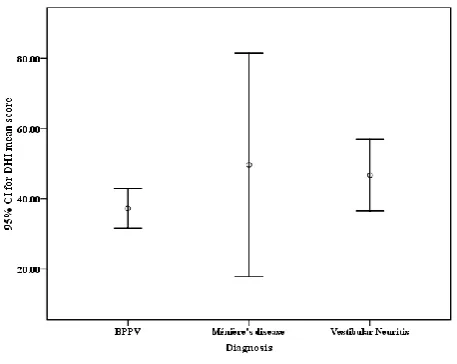
Seventy-one subjects with acute vertigo syn-drome (50 women and 21 men) in the age range of 18-79 years (mean ± SD age: 48.28 ± 12.22 years) were evaluated. There were three groups of participants, including unilateral MD (6 sub-jects; one male and 5 females), unilateral VN (25 subjects; 8 males and 17 females) and BPPV (40 subjects; 12 males and 28 females). The participants’ ages in each group were as follows: In the BPPV group, the age range was 25 to 79 years mean ± SD age: 48.25 ±12.14 years); in the MD group, the age range was 36 to 65 years (mean ± SD age: 49.33 ± 11.12 years); in the VN group, the age range was 18 to 75 years (mean ± SD age: 48.08 ± 13.02 years). Regardless of the study group, all patients had acute vertigo complaint. Therefore, the results were analyzed once regardless of the study group and once based on the group that they were assigned to. DHI score in each individual group is shown in Table 1. The DHI score was compared among the groups by one way ANOVA test and no significant difference was observed among three groups (F(2,68) = 1.947, p = 0.151). Fig. 1 shows a 95% confidence int-erval of the mean DHI score in the study groups.
Mean, standard deviation, minimum and maxi-mum of the reading score in all participants reg-ardless of the study group as well as in each group are presented in Table 2. Reading score was compared among three groups by one-way ANOVA and no significant difference was observed (F(2,68) = 0.577, p = 0.565). Fig. 2 shows a 95% confidence interval of the mean reading score in the study groups.
Rey auditory-verbal learning scores were
Table 1. Mean, standard deviation, min, and max values of dizziness handicap inventory score in all participants, and separately in each vestibular disorder
DHI score
Group N Mean (SD) Min Max
MD 6 49.66 (30.28) 4.00 96.00
VN 25 46.72 (24.69) 2.00 94.00
BPPV 40 37.25 (17.71) 6.00 76.00
compared among three groups by using one-way ANOVA test and no significant difference was observed too (p ≥ 0.05). Fig. 3 summarizes the comparison of the mean score of the list A1-5; the score for the repeating list A; mean score of the list B; immediate recall list; delay recall list; and Rey recognition list in three groups. In order to investigate the relationship between the inability secondary to acute vertigo (DHI mean score) and the reading skill, the Pearson correlation test was used. This test showed no significant correlation between the handicap degree and the reading ability in these subjects (r = - 0.133, n = 71, p = 0.26). In addition, in order to investigate the relationship between vertigo-related handicap (DHI mean score) and mean score of list A (1-5) and mean score of repeating list A (sum), list B score, immediate recall (A6), delayed recall list (A7), and rec-ognition list, the Pearson correlation test was used that showed no significant correlation bet-ween vertigo-related handicap and Rey subtests.
Discussion
In the present study, three groups of patients with peripheral vestibular involvement and acute vertigo complaint, including subjects with MD, BPPV, and VN were investigated with reg-ard to their handicap degree, reading skills,
and Rey auditory-verbal memory status. Com-paring DHI scores with normative data showed a significant handicap in the study participants. Jafarzadeh et al. reported that 10 would be the best cut-off value for separating normal subjects from patients and this cut-off point has 90% sensitivity and 98% specificity [20]. Further-more, the mean ± SD value of DHI in normal Iranian subjects is 6.3 ± 1.4 but this score in pat-ients suffering from acute vertigo was 8.21 ± 6.41. Therefore, there is a significant difference between normal and the involved groups. On the other hand, there was not any significant dif-ference among three groups regarding DHI score which is indicative of similar effects of acute peripheral vestibular involvements on individual physical, emotional, and functional aspects.
Performing reading subtest of the Persian Apha-sia test battery showed a significant difference between the mean ± SD score of the participants (59.6 ± 1.2) and normal values. There was not any significant difference among the three study groups with regard to reading score. It shows that regardless of the underlying cause, acute vertigo affects reading skill.
Rey auditory verbal test showed that in general the scores of the participants were lower than normal Iranian adults but there was not any significant difference among three study groups. Thus, the type of vestibular disorder can be
Fig. 1. 95% confidence intervals (CI) for dizziness handicap inventory mean scores in
three patient groups with acute vertigo.
Table 2. Mean, standard deviation,
minimum, and maximum values of reading score in all participants, and separately in each vestibular disorder
Reading score
Group N Mean Min Max
MD 6 6.00 (1.09) 5.00 7.00
VN 25 6.40 (1.87) 3.00 10.00
BPPV 40 6.80 (2.20) 2.00 10.00
attributed to a random factor which has a gene-rally negative effect on auditory verbal learning capacity and memory due to acute vertigo. The results of the study showed that one of the effects of acute vertigo on mental and cognitive functions is difficulty in learning verbal infor-mation and its faster forgetting. In the present study, similar to the past studies, it was shown that repeating the test in trial 1 through 5 made scores better which is known as “learning eff-ect”. In addition, after presenting distractor list (b), the score of the list (a) reduced from trial 5 to 6 which in agreement with Sinnett and Holen [25] and also Jafari et al. [24] results. Recogni-tion test can show the learning ability of the patients with acute vertigo regardless of imme-diate recall ability. The comparison of recogni-tion and delayed recall trial scores is a kind of immediate recall measurement. This method can help us determine information recall problem. In the three groups, the recognition score was higher than trial 7 which is indicative of good learning but weak retaining of the new infor-mation.
In summary, the patients with acute unilateral vestibular disorder who suffers from acute true rotatory vertigo have more difficulty in reading comprehension and learning through auditory-verbal memory. The type of vestibular
involvement is not an effective factor on cog-nitive involvements and acute vertigo per se, as a disturbing physical status, can lead to reading and auditory verbal memory disorder.
Conclusion
In general, although the degree of acute vertigo-related handicap in the three involved groups had no significant difference, acute vertigo red-uces reading score and auditory verbal capacity compared to the normal subjects.
Acknowledgements
This research is supported by grant No. 95-03-32-29387 from Iran University of Medical Sciences. We would like to thank all partici-pant’s cooperation in this study.
Conflict of interest
The authors declared no conflicts of interest.
References
1. Wuyts FL, Boudewyns A. Physiology of equilibrium. In: Gleeson MJ, Clarke RW, editors. Scott-Brown's otorhinolaryngology: head and neck surgery, vol 3. 7th ed. Boca Raton, FL: CRC Press; 2008. p. 3027-244. 2. Hanes DA, McCollum G. Cognitive-vestibular
intera-ctions: a review of patient difficulties and possible mechanisms. J Vestib Res. 2006;16(3):75-91.
Fig. 2. 95% confidence intervals (CI) for reading mean scores in three patient groups
with acute vertigo.
Fig. 3. Comparison of mean A1 to A5 scores, mean score of repeating a list (Sum), mean score of B list, immediate recall (A6), delayed
3. Popp P, Wulff M, Finke K, Rühl M, Brandt T, Dieterich M. Cognitive deficits in patients with a chronic vestibular failure. J Neurol. 2017;264(3):554-63. doi:
10.1007/s00415-016-8386-7
4. Besnard S, Lopez C, Brandt T, Denise P, Smith PF. Editorial: the vestibular system in cognitive and memory processes in mammalians. Front Integr Neurosci. 2015;9:55. doi: 10.3389/fnint.2015.00055
5. Smith PF, Zheng Y. From ear to uncertainty: vestibular contributions to cognitive function. Front Integr Neurosci. 2013;7:84. doi: 10.3389/fnint.2013.00084
6. Baek JH, Zheng Y, Darlington CL, Smith PF. Evidence that spatial memory deficits following bilateral ves-tibular deafferentation in rats are probably permanent. Neurobiol Learn Mem. 2010;94(3):402-13. doi:
10.1016/j.nlm.2010.08.007
7. Besnard S, Machado ML, Vignaux G, Boulouard M, Coquerel A, Bouet V, et al. Influence of vestibular input on spatial and nonspatial memory and on hippocampal NMDA receptors. Hippocampus. 2012;22(4):814-26. doi: 10.1002/hipo.20942
8. Brandt T, Schautzer F, Hamilton DA, Brüning R, Markowitsch HJ, Kalla R, et al. Vestibular loss causes hippocampal atrophy and impaired spatial memory in humans. Brain. 2005;128(Pt 11):2732-41. doi:
10.1093/brain/awh617
9. Shinder ME, Taube JS. Differentiating ascending vestibular pathways to the cortex involved in spatial cognition. J Vestib Res. 2010;20(1):3-23. doi:
10.3233/VES-2010-0344
10. Bigelow RT, Agrawal Y. Vestibular involvement in cognition: Visuospatial ability, attention, executive function, and memory. J Vestib Res. 2015;25(2):73-89. doi:10.3233/VES-150544
11. Black FO, Pesznecker S, Stallings V. Permanent gen-tamicin vestibulotoxicity. Otol Neurotol. 2004;25(4): 559-69.
12. Yardley L, Burgneay J, Nazareth I, Luxon L. Neuro-otological and psychiatric abnormalities in a community sample of people with dizziness: a blind, controlled investigation. J Neurol Neurosurg Psychiatry. 1998; 65(5):679-84. doi: 10.1136/jnnp.65.5.679
13. Redfern MS, Talkowski ME, Jennings JR, Furman JM. Cognitive influences in postural control of patients with unilateral vestibular loss. Gait Posture. 2004;19(2):105-14. doi: 10.1016/S0966-6362(03)00032-8
14. Risey J, Briner W. Dyscalculia in patients with vertigo. J Vestib Res. 1990-1991;1(1):31-7.
15. Aghamollaei M, Tahaei SA, Jafari Z, Toufan R, Keyhani MR. [Development and evaluation of the Persian version of the dichotic auditory-verbal memory test in 18- to 25-year old normal individuals]. Audiol. 2011;20(2):86-94. Persian.
16. Jacob RG, Furman JM. Psychiatric consequences of vestibular dysfunction. Curr Opin Neurol. 2001; 14(1):41-6.
17. Silsupadol P, Shumway-Cook A, Lugade V, van Donkelaar P, Chou LS, Mayr U, et al. Effects of single-task versus dual-single-task training on balance performance in older adults: a double-blind, randomized controlled trial. Arch Phys Med Rehabil. 2009;90(3):381-7. doi:
10.1016/j.apmr.2008.09.559
18. Committee on Hearing and Equilibrium. Committee on Hearing and Equilibrium guidelines for the diagnosis and evaluation of therapy in Menière's disease. American Academy of Otolaryngology-Head and Neck Foundation, Inc. Otolaryngol Head Neck Surg. 1995; 113(3):181-5. doi: 10.1016/S0194-5998(95)70102-8
19. Ahadi M, Rezazadeh N, Pourbakht A. Comparison of vestibulo-ocular reflex instantaneous gain and velocity regression in differentiating the peripheral vestibular disorders. Aud Vestib Res. 2017;26(4):195-201. 20. Jafarzadeh S, Bahrami E, Pourbakht A, Jalaie S, Daneshi
A. Validity and reliability of the Persian version of the dizziness handicap inventory. J Res Med Sci. 2014;19(8):769-75.
21. Masuda K, Goto F, Fujii M, Kunihiro T. [Investigation of the reliability and validity of dizziness handicap inventory (DHI) translated into Japanese]. Equilib Res. 2004;63(6):555-63. Japanese. doi: 10.3757/jser.63.555
22. Nilipour R, Pourshahbaz A, Ghoreyshi ZS. Reliability and validity of bedside version of Persian WAB (P-WAB-1). Basic Clin Neurosci. 2014;5(4):253-8. 23. Nilipour R, Pour Shahbaz A, Ghoreishi ZS, Yousefi A.
[Reliability and validity of persian aphasia battery test]. Iranian Journal of Ageing. 2016;10(4):182-91. Persian. 24. Jafari Z, Steffen Moritz P, Zandi T, Aliakbari Kamrani
A, Malyeri S. [Psychometric properties of persian version of the Rey auditory-verbal learning test (RAVLT) among the elderly]. Iranian Journal of Psy-chiatry & Clinical Psychology. 2010;16(1):56-64. Persian.