Issues
ISSN: 2146-4138
available at http: www.econjournals.com
International Journal of Economics and Financial Issues, 2015, 5(Special Issue) 313-319.
Economics and Society in the Era of Technological Changes and Globalization
Socio-Cultural Code as a Factor of Unity and Variability of
Generations
Hadia Nurgalievna Sadykova
1, Nursafa Gafurovna Khairullina
2*, Oksana Vyacheslavovna Ustinova
3,
Svetlana Vladimirovna Pelkova
4, Tatyana Michailovna Efremova
51Tyumen State Oil and Gas University, Volodarskogo Street, 38, Tyumen, 625000, Russia, 2Tyumen State Oil and Gas University,
Volodarskogo Street, 38, Tyumen, 625000, Russia, 3Tyumen State University of Architecture and Civil Engineering, Lunacharskogo Street, 2, Tyumen, 625001, Russia, 4Tyumen State Institute of Culture, Respubliki Street, 19, Tyumen, 625003, Russia, 5Tyumen State Institute of Culture, Respubliki Street, 19, Tyumen, 625003, Russia. *Email: [email protected]
ABSTRACT
This paper examines the problem of the formation of value orientations and cultural continuity between the generations in the modern conditions of Russian society on the results of a questionnaire survey conducted in 2013-2014 in Tyumen and in the south of the Tyumen 700 people aged 15 years. In the analysis it was identified generational groups such as the generation of the Soviet era (51 and older) - generation of “S” (Soviet); perestroika generation (31-50 years) - Generation “P” (Perestroika); post-perestroika generation (18-30 years) - Generation “PP”; transitive generation (15-17 years) - generation of “E” (Eve). This has allowed to characterize: The perception and assessment of the socio-economic situation; dominant values (revealing aspects of connecting or separating intergenerational interaction); the basic necessities of life (setup man to the regeneration of the system of values, as a response to external transformation); social interaction: The frequency of contact and distress inside generational group and outside it; social interaction: The frequency of contact and distress inside generational group and outside it; strategic goals (design their own future in the qualitative and quantitative parameters allows to characterize the dynamics of social processes and build a model of effective collaboration, allowing to neutralize the existing negative trends and promote the formation and functioning of the automatic controllers that support progressive social development).
Keywords: Generation, Values, Socio-Cultural Code, Social Interaction, Generational Approach, Intergenerational Cultural Transmission
JEL Classification: А13
1. INTRODUCTION
Formation of value orientations in the process of alternation of generations is one of the social development problems. In periods
of social transformation the nature of cultural transmission
is changing: There is a weakening of traditional ties between generations, which often leads to a loss of intergenerational continuity. Therefore, the current problem is the identification
of the formation mechanism of value systems and cultural
continuity between the generations in the modern conditions of Russian society. To investigate designated problem in 2013-2014 in Tyumen and in the south of the Tyumen region questionnaire
survey was conducted. The questionnaire survey involved 700 people with the minimum age of 15-years and above. For implementation a comparative analysis of generational groups the study was conducted on a stratified multi-stage sample of related parameters: Gender, age, education, socio-professional status, with the non-sampling error no more than 5%.
sociocultural code of the generation which allows you to set the factors of unity and variability generations (Dromel 1862; Feuer 1969, Hagen 1962).
2. SCIENTIFIC APPROACHES
Taking into account the different approaches in the differentiation of generations, starting from the classification of generations made by Yu. Levada, Strauss and Howe, and based on Lapin`s anthroposocietal approach generational groups were allocated not only by age. In the process of evolution of Russian society we can take into account the certain intervals of socialization of individuals, determined not only by socio-economic changes in Russia, but also ideological, that is allowed to form a definite socio-cultural code. With this approach, the distribution of the population was carried out in four basic categories with some conventional assumptions (Lorenz, 1970; Luhmann, 1982; Manheim, 1952; Merton, 1968):
• Generation of the Soviet era (51 and older) - generation “S” (Soviet). Brought up in the spirit of the ideological class struggle against the collectivist values and a very categorical declared distant objectives of social development, etc.; • Perestroika-minded generation (31-50 years) - generation “P”
(Perestroika). Active integration in the public economic cooperation took place at the beginning of the 90s of the last century, the turn of the shift vector of social and economic relations, the destruction of the existing ideological and moral dogmas, the search for alternative ways of self-development, etc.;
• The post-perestroika generation (18-30 years) generation “PP.” Perception of new social and economic systems, focused on foreign ideologies, freedom of choice of options for the development of life with the partial refusal of the state from social responsibilities and guarantees for young people, the destruction of free education, medicine, prospects of professional development, etc.;
• Transitive generation (15-17 years) - generation “E” (Eve). People of consumer orientation, saturated with world cultural values, often have a transnational and transcultural verbiage
they are actively included in the social communication by
electronic means, subject to the influence of scientific and technical progress, without the possibility of objective-reasoned analysis of the environmental situation, etc. (Khairullina, 2014; Sadykova, 2014; Khairullina and Sayfullin 2014).
Designation abovementioned generational groups allows us to focus on the analysis of the socio-cultural characteristics of the generation code, distributed on five bases (Mendel, 1969; Reich, 1970):
1. Perception and evaluation of socio-economic situation: It allows to describe the aggregate impact of the environment on the formation of individual behavior in the communications; 2. The dominant values: Identification of aspects linking or
separating intergenerational interaction, respectively - the definition of a centrally forming values, broadcasting elements of the evolutionary development of society;
3. The basic necessities of life: Setup man to the regeneration of the system of values, as a response to external transformations.
These requirements characterize the integrity of the individual, its outlook and attitude towards the principles of other people; 4. Social interaction: The frequency of contact and congestion
inside of generational group and beyond. Forms of an information exchange and effectiveness of achieving result that, in particular, indicates the intensity of intergenerational interaction;
5. Strategic objectives: Planning of their own future in the qualitative and quantitative parameters allows to characterize the dynamics of social processes and make a model of effective collaboration, allowing to neutralize the existing negative trends and promote the formation and functioning of the automatic controllers that support progressive social development.
3. METHODOLOGY
In the course of structural operationalization we identified the following indicators of social research, which are presented in Figure 1.
4. FINDINGS
Assessment of the dynamics of ongoing changes is relevant for determining the social well-being and the degree of adaptability to the generational groups of transformations in the economic and social spheres. It is clear that with age “optimism is fading” in estimates from 71.4 in young to 28% in the elderly, due to differences in the assessment mechanism, when the older generation compares the current state with the past (the Soviet period) and it is not based on economic factors as dominant. Young correlate the opportunities available to them in Russia and abroad, believing that they have more broad prospects of social and professional socialization and purely economic factor is prevailing for this age group (Reich, 1970; Rokeach, 1973; Roszak, 1971; Strauss and Howe, 1991; Ustinova and Romanova 2014).
Specification of the parameters that cause the greatest concern of the respondents is shown in Figure 2 and generally indicates a more negative external background factors, among which the respondents called (the first five descending importance): Corruption, terrorism, the problems of housing and communal services, international conflicts, poverty.
A key aspect in the value judgments are the different platforms (the presence or absence of past experience; focus on the spheres of life; the priority of motivational and behavioral, etc.) outlook, which reflects the natural law, can be seen in historical analysis.
of “inter-generational value-loops” are not able to agree on a process of continuity of spiritual and moral experience. Some loss of effectiveness of communication the perestroika-minded generation with their children (8.95%) is due, most likely, the parents’ employment, but the loss of the older generation of communication with fellow workers (10.55%) on the contrary - person’s breakaway from active employment. The latter problem, in contrast to the first, is solved very easily - by the prolonged involvement of pensioners in the real economy. It is clear that the interaction between generations should have the tensions caused by the complex internal and external contradictions that accompany the entire adult life of a man. Under these conditions, generation “E most acutely perceives the actual discrepancy,” which strongly disagrees with the fact that there is a mutual understanding of each other, and there are no serious conflicts priori (Figure 3).
5. DISCUSSION
Theanalysis allows pointing out the features that form the forces tearing intergenerational interaction and make it not possible to issue system-communicative principles:
1. The dominance of pragmatic guidelines in the outlook of man engenders individualistic life strategy, which basically suggest self-imposed isolation from the collective human cooperation; 2. Labor activity, “filling” the whole process of life is considered
in terms of success and well-being, often having egocentric installation;
3. Difficulties in the process of intergenerational transfer of experience due to the rapid development of engineering and technology, which leads to an accelerated “obsolescence” of skills cultivated by the older generations and, therefore, leads to the formation of parallel and independent (generation) practice-oriented systems;
4. The general trend in all the principles discussed above is almost equal share of respondents of each age group in the responses to the proposed alternative positions in which 25-30% are prone to isolation from the social system of life.
Satisfaction of generations with social interaction reflects the communicative installation in socio-cultural matrix code, so has been studied in two aspects: The evaluation of the degree of satisfaction with communication at various levels and spheres of
life (Table 1), and a qualitative assessment of the respondents the structure of intergenerational interaction.
The first aspect addressed through relationships with parents, with the older generation (grandparents), with children, with friends, with colleagues, and social relations as a whole in today’s society, which allowed covering almost the entire communicative network in which the individual routinely manifests itself.
As we can see, all the generations demonstrate unity in satisfaction of all communication channels, and this degree is usually excellent except for some positions. So, in a relationship with friends 42.9% of young has the problems with friends, apparently, they negatively evaluate through the prism of the whole range of social relations in modern society. Among the negative experience
of communication we must indicate the same young people, “separated” from the direct and immediate communication with grandparents (28.6%), i.e. “Latest generation,” in view of the above analysis of “inter-generational value-loops” are not able to agree on a process of continuity of spiritual and moral experience. Some loss of effectiveness of communication the perestroika-minded generation with their children (8.95%) is due, most likely, the parents’ employment, but the loss of the older generation of communication with fellow workers (10.55%) on the contrary - person’s breakaway from active employment. The latter problem, in contrast to the first, is solved very easily - by the prolonged involvement of pensioners in the real economy. It is clear that the interaction between generations should have the tensions caused by the complex internal and external contradictions that accompany the entire adult life of a man. Under these conditions, Generation “E most acutely perceives the actual discrepancy,” which strongly disagrees with the fact that there is a mutual understanding of each other, and there are no serious conflicts priori.
It is this category of young fixes basic cause of differences which, in their opinion, due to the difference of value systems. Thus, the generation of “E” notes the increasing role of the positive experience of their predecessors, allows you to generate new standards, setting targets and guidance. The authors found a decrease in the values of family, increase the distance between generations, dominance in the pragmatic goal-setting values - the equivalent of the cost-effectiveness and feasibility.
Generation “S,” remained more skeptical with regard to the international status of the country, expresses the hope of a return to the values with which this generation is carried out by public and professional socialization. A certain desire for partial loss of values is determined by its relevance to some of mythologizing the past, as a result, achieved the consolidation of the preference of social order “latest generation” - 57.1 and 54.9%, respectively, in favor of the socialist system. In a situation when there is a kind of return of the new generation to the experiences and lives of previous generations, there are requirements that should be met with the use of evidence-based approaches (algorithms) that take into account of the different perceptions and evaluations of the same events and the increase of the requirements for practical use. Prolonged effect of elder on youth, according to the generations “E,” will increase (42.9%). The conflict of generations is fixed to a small degree, but co-operation and mutual understanding are expected in the future in the hopes of every fifth respondent any generational group. This draws the attention of researchers to the absence of a mechanism and appropriate means of information transmission between generations, that is, by definition, has negative effects on the efficiency of the entire system interaction.
Intergenerational loop is indicated in the estimates of generation “E” about cultural transmission not of their fathers but grandparents (42.9%). Noted by the generation “S” the growth of extremism (42.9%) among young people is the other extreme, predestinated, in fact, the lack of a “culture of ancestors” and the danger is obvious and visible. The loss of value of the previous generations experience and the role of cultural values transmitted through the
Figure 3: Evaluation by the generations of statements that describe the
attitude between “fathers” and “children,” %
Figure 2: The problems causing the greatest concern of the
options: “In the future will not be possible to build on the tradition and experience of the older generations ‘and’ youth subcultural values will form the basis of inter-generational conflict.” All that points to a high share of pessimism in the “improvement of the situation” and improving the quality of intergenerational interaction. Socio-cultural matrix code of generation reveals the general and the particular in the intergenerational cooperation, to establish the problems of continuity between generational groups. In addition, the author of the thesis has found a number of evidence of hypothesized rejection of 15-17 years old “culture of the fathers” and the possible cultural transmission across generations, from “the culture of the grand fathers ‘to a’ culture of great-grandchildren.” With the help of typological analysis on the basis of the socio-cultural matrix code the respondent proposes to consider the social portrait of generations, starting from the base and peripheral values.
During the typological analysis the socio-cultural codes of the four generations in the Tyumen region were identified. In each of them something general and special for each generation can be identified. In each of them the basic and peripheral values are considered. The greatest degree of commonality is observed in basic values. Differentiation was made in the peripheral concerning the trends of development of culture of intergenerational relations Based on an analysis of four generations of the Tyumen region we revealed that such basic values as health, well-being and comfort, help to the to the poor and weak, peace of mind, mutual aid and support, strong family, good family relationships and personal happiness in it, a worthy continuation of a kind, legality, the continuity of generations, independence, morality, self-esteem, mutual understanding of relatives are reinforcing society and can be rightly called the sociocultural code of the population of the Tyumen region. Of particular concern is the state of the
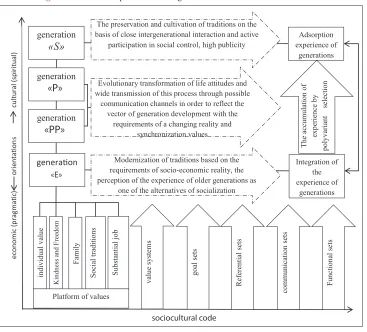
post-perestroika generation (“PP”), which today occupies a marginal position, given that it had the largest number of changes in society. This is manifested in the absence of self-identification with the country in which they live, preferred relationships with peers relationships with parents, risk-averse. And despite the fact that they enter into an active phase of socialization and start their own families. The question arises about a broadcast of their experience, or rather its quality, as well as the question of the continuity of the experience of previous generations. In the typological analysis it was confirmed the phenomenon of generational relationship of two extreme groups and broadcast of the experience is not from generation to generation, and through one generation and even through two generations, that is, from grandparents to grandchildren. The authors distinguishing four generations (“E”, “PP”, “P” and “S”), define only four specific social groups, in which the dominant values have their own, unique designation. And, despite the commonality in values, the generations “E” and “S” have the distinction of functional specialization, which is shown in Figure 4. Generation “S” specializes in the preservation of the values and their transmission through close intergenerational interaction. With regard to the generation of “PP” and “P,” then as they had during the development period the radical changes in the social structure of Russia, the main functional specialization - is the process of changing the existing values and social values transformed broadcast to the next generation. Generation “E” modernizes traditional values, basing on the current socio-economic realities, taking into account the experience of generations of «S» and taking into account the shortcomings of evolutionary transformation of generations of “P” and “PP.” Also, this generation creates new values that will continue to be adapted. With the development of the progress, the same four groups alternate, but the timeframe of their dominance is significantly reduced.
Table 1: Satisfaction of generations with social interaction, %
The subjects of social interaction Generations Quite
satisfied satisfiedRather Rather not satisfied Totally not satisfied
Relationship with parents “Е” 57.1 42.9 0 0
“РР” 74.8 18.05 4.65 0.8
“Р” 64.1 23.7 6.3 5.1
“S” 58.25 13.1 4.25 5.1
The relationship with the older generation (grandparents) “Е” 57.1 14.3 0 28.6
“РР” 60.7 30.3 5.65 0.9
“Р” 49.1 35.05 4.7 4.1
“S” 42.1 28.65 1.7 2.55
Relationships with children “Е” 71.4 28.6 0 0
“РР” 58.9 23.5 5.95 1.8
“Р” 58 28.45 8.95 0.45
“S” 52.8 38.7 3.4 0.85
Relationships with friends “Е” 28.6 28.6 42.9 0
“РР” 59.3 30.6 3.45 2.6
“Р” 47.8 33.9 9.4 0.95
“S” 40.25 35.55 4.85 1.7
Relationships with colleagues “Е” 57.1 42.9 0 0
“РР” 40.85 40.7 8.55 1.7
“Р” 43.3 41.5 6.55 2.4
“S” 41.4 38.1 10.55 2.85
Social relations as a whole in today’s society “Е” 28.6 28.6 42.9 0
“РР” 27 44.45 18.85 4.2
“Р” 24.95 44.55 21.3 2.9
6. CONCLUSIONS
Thus, translational function corresponds to the generation of “S” - the transmission to future generations of norms, values, needs, preferences, behaviors of previous generations. Generation “P” and “PP” perform the selective function - estimation of inherited values, the determination of their place and role in the development of society at this stage. Generation “E” characterized by an integrative function having an innovative nature - updating of social values and norms, taking into account borrowings from other generations.
The study allowed proposing a model of intergenerational cultural transmission in the form of a helix, which clearly illustrates not only the order of the succession of generations, but also the “compression time” transition periods between generations. Such effect of the cultural values change contributes to the effect of two opposing forces (factors), on the one hand enhancing the speed of cultural transmission, and on the other - constraints. This reflects the principle of “unity and struggle of opposites” which is characteristic for wildlife in general.
Helix also characterizes the natural process of a return to the values that for a long time have been criticized and rejected for the next two generations. This fact is easily explained by the example of fashion trends when creative ideas are formed from the past experience. However, it should take into account the nature of some differences of cultural values from the “fashion trends” in the particular aspect of that transformation of values affects all
other aspects of social interaction, whereas fashion captures only the outward forms of the appropriate common rules and standards, without major internal changes. Each spiral turn implies not literal copying and borrowing ideological meanings and priorities in the cultural and moral outlook. In this regard, the same values are complemented by content and expanding the scope of practical application in terms of outlook and widespread rationalization of human behavior. The model describes the natural processes of social change, as well as the positions of each generation group in the general historical context, illustrating the mechanics of the value of cultural transmission in relation to the new generations.
REFERENCES
Dromel, J. (1862), La loi des Révolutions: Les Générations, les Nationalités, les Dynasties, Les Religions. Paris: Didier. p580. Feuer, L. (1969), The Conflict of Generations. The Character and
Sigraficans of Student Movement. New York: Basic Books. p542. Hagen, E. (1962), On the Theory of Social Change. Homewood, II:
Dorsey Press. p360.
Khairullina, N.G. (2014), The tolerant consciousness of youth. Life Science Journal, 11(9s), 330-332.
Sadykova, K.N. (2014), Interaction between generations: A sociological approach. World Applied Sciences Journal, 31(1), 124-127. Khairullina, N.G., Sayfullin, F.F. (2014), The problem of identification in
mixed families. Life Science Journal, 11(8s), 364-367.
Lorenz, K. (1970), The enmity between generations and its probable ethological causes. The Psychoanalytiс Review, 333-337.
Luhmann, N. (1982), The Differentiation of Society. New York: Columbia University Press. p370.
Manheim, K., editors. (1952), The Problem of Generations. Essays on the Sociology of Knowledge. London: Routledge and K. Paul. p376. Mendel, G. (1969), La crise de generations. Etude Sociopsychoanalytique.
Paris: Payot. p256.
Merton, R.K. (1968), Social Theory and Social Structure. New York: Free Press. p560.
Reich, C.A. (1970), The Greening of America. N.Y.: Random House. p399. Rokeach, M. (1973), The Nature of Human Value. N.Y.: Free Press. p760.
Roszak, T.H. (1971), The Making of Counter Culture: Reflection on the Technocratic Society and its Youthful Opposition. London: Faber. p303.
Strauss, W., Howe, N. (1991), Generations: The History of America’s Future, 1584 to 2069. New York: William Morrow and Company. p544. Ustinova, O.V., Romanova, O.P. (2014), The role of communicative