www.ijper.org
Effect of integrating research skills with basic
sciences in an interdisciplinary integrated endocrine
module on students’ satisfaction and performance
Zeinab Alrefaie,1 Basem Eldeek,2,3 Nasra Ayuob2,3
1Physiology department, Faculty of Medicine, King Abdul aziz University and Cairo University, Cairo, EGYPT. 2Medical education department, Faculty of Medicine, King Abdul aziz University, Jeddah, SAUDI ARABIA. 3Faculty of Medicine, Mansoura University, Mansoura, EGYPT.
ABSTRACT
Background: A system-based integrated curriculum has been implemented at Faculty of Medicine, King Abdulaziz University since the academic year 2006/2007. There were many calls to increase the integration level and to integrate the scientific research skills into the medical curriculum. Objectives: This study aimed to document the steps taken to establish a higher level of integration of basic sciences along with the scientific research skills and to assess the effect of such changes on student satisfaction and performance.
Methods: The integration level among the endocrine basic sciences was increased from the temporal co-ordination to the interdisciplinary level. Students’ assessment methods were modified accordingly. Scientific research skills were incorporated into the module. Students’ satisfaction and performance were compared before and after implementation of these changes. Results: A significant increase in students’ satisfaction with the module organization was recorded. A significant increase in students’ self-reported motivation to study the endocrine subject matter as well as improvement of their research skills was also reported compared to that of the students studied the module before the reform. The percentage of students got grade an after modular reform was significantly higher compared to those who studied the traditional module while the overall success rate showed non-significant increase. Conclusion: This interdisciplinary integrated endocrine module provides framework and tips for module construction that would improve critical thinking skills, research skill and prepare the students to be life-long learners.
Key words: System- based, Module, Integration, Research, Satisfaction, Performance.
DOI: 10.5530/ijper.51.1.3 Correspondence:
Dr. Nasra Ayoub,
Department of Anatomy, Faculty of Medicine, King Abdulaziz University, Jeddah, Saudi Arabia Tel.: 00966530112205 Fax:009666400855 [email protected] [email protected] INTRODUCTION
Medical education is showing a trend towards inculcating critical thinking and reasoning skills and developing a positive attitude among students towards scientific research from the start of their medical career.1 Performing undergraduate research
has been shown to support students’ attitudes towards research later in their careers and increase the possibility of a career in academic medicine.2 The specific competencies that
could be enhanced through medical students’ involvement in research that include improving their long term career prospect and broad knowledge base, boosting their career profile, evolving their critical appraisal and thinking,
Submission Date: 14-04-2016; Revision Date: 31-08-2016; Accepted Date: 08-10-2016
increasing their information literacy as well as helping shape the medical students by cultivating their critical judgment.3,4 Taking
Recognizing the importance of integration in medical curriculum that became prevailing trend around the world, the FOM at KAU developed its curriculum from traditional discipline-based to integrated system-based curriculum in the academic year of 2006/2007. The developed curriculum included pre-clinical and clinical phases. During the preclinical phase, some core courses of basic sciences and system-based modules are taught while in the clinical phase the major clinical clerkships as well as sub-specialties are taught.5 The endocrine
system module is one of the system-based modules taught during the third year of the curriculum. It included the study of the structure and function of the endocrine organs including the pituitary, thyroid, parathyroid, adrenal glands and pancreas in relation to health and disease states. It was designed to be in the temporarily coordinated level of the integration ladder.6
Several teaching modalities such as lectures, problem-based learning (PBL), practical sessions, clinical presen-tations and student directed learning (SDL) were used in this module.
Despite the efforts spent to establish integration between module content, students satisfaction assessed at the end of the last two academic years showed incomplete satisfaction with the integration within the modules. In response to that, as well as the recommen-dations to integrate research skills into the curriculum, the committee responsible for the endocrine module in collaboration with the medical education department (MED) worked to increase the level of the integration of the module in order to heighten students’ under-standing of the basic science of the endocrine system as well as improve student’s critical thinking and help them to apply the scientific research skills taught to them in the previous module in the context of the endocrine health problem.
This paper aimed to document the steps taken to establish a higher level of integration of basic sciences along with the scientific research skills and to assess the effect of such changes on student satisfaction and performance. It will serve as a useful model for other medical schools aiming to improve integration levels in their curriculum.
MATERIALS AND METHODS
An ethical approval of this research article has been obtained from the biomedical research ethics committee, Faculty of Medicine, King Abdul aziz University. The module reform was done by the module committee in collaboration with the medical education department in the light of the results of the module evaluation surveys filled by both students and faculty members
during the last two years as well as the recommendation of the curriculum committee to integrate scientific research skills into the modules in order to enhance undergraduate students participation in research. Steps of module reform:
1. Extensive revision of the module intended learning outcomes, contents and assessment methods were conducted by the module committee.
2. Implementing the steps of upgrading the integra-tion level in the cardiovascular system module that was previously described by Ayuobet al.7 in order to
reach the interdisciplinary level described by Malik and Malik.8 The clinical themes set for the
endo-crine module included diabetes mellitus, pituitary disorders, Grave’s disease and Cushing’s disease. They were chosen with the consultation of the relevant clinicians and according to the commonality across the module objectives as well as the com-monality of the community.
3. Joint session between histology, physiology and clinical biochemistry instructors were conducted to explain the pathophysiological aspect of thyroid disorders and diabetes mellitus instead of discrete lectures. This was aiming to get rid of redundancy and ensure horizontal integration between these basic sciences.
4. The study guide of the students was revised and supplied with self-assessment tools like multiple choice questions (MCQs), clinical scenarios- based questions as well as research assignments.
5. When it came to students’ research skills, one of the valid students’ comments is that they have some theoretical knowledge about scientific research from their study in a previous course but they did not know how to apply this knowledge to start conducting research. So, in this module the emphasis was on how students be enabled to start thinking about the endocrine research area after have been exposed to it. They were encouraged to think about research question, test its novelty, then refine it and formulate specific research hypothesis and objec-tives. They were encouraged also to start writing a research proposal for their research ideas and have it discussed with the tutor. A protected 2 hours for research was allotted in the timetables.
6. The time allotted for the student directed learning (SDL) was increased to reach 6 hours/week. 7. Regarding the assessment of the research skills; the
8. On assessing the critical thinking of the students, case-based structure assay questions were introduced as an assessment tool in this module. A group of case scenarios with a series of questions covering different aspect of the case were written by the instructors and were revised by the relevant clini-cians. The students were trained on this type of question during the tutorials as well as the formative assessment. Some of these questions were included also in the study guide.
In order to assess the effectiveness of the changes implemented in the endocrine module students’ satisfaction was measured via a module evaluation questionnaire that was constructed by the medical education department in collaboration with the module committee members. The questionnaire was distributed to the 3rd year students in 2013-2014
who finished the reformed endocrine module as well as the 4th year students who finished the module
on 2012-2013 (before reform). Students’ response was classified according to five Likert scale; into extremely satisfied, highly satisfied, fairly satisfied, poor satisfaction, unsatisfied and cannot judge.9
The reliability of the questionnaire was calculated according to Cronbach and it was 0.83.10 The
students assessment results, in the form of success rate and the percentage of students’ grades in the module in the two consecutive years 2012/2013 and 2013/2014 was compared.
Statistical analysis was done using a statistical package of social science (SPSS) software, version 16 (2005). Kolmogrov-Smirnov test was used to check the normal distribution of data. The qualitative data were presented in the form of number and percent-age while the quantitative was expressed as mean and standard deviation. Student t-test was used to compare the students’ perception at different years.
A chi-square test, with linear trends, was used for ordinal qualitative data.
RESULTS
Regarding the changes that have been done in the instruction methods used in the endocrine module, it was observed that the percentage of the contact hours allotted to the didactic lectures was decreased (46.8 versus 37.5) while the percentage of the SDL contact hours was increased (6.3 versus 9.3) in year (2012-2013) com-pared to the year (2013-2014) (Table 1).
When comparing between the students assessment results using chi-square with linear trend in the year (2012-2013) to that of the (2013-2104), there was no statistical significance (p= 0.84) in the overall success. The percentage of students who got grade A and B in (2013/2014) was significantly higher (p=0.02 and p=0.04) compared to that of (2012-2013). About 6% of the contact hours became allotted to the joint sessions that were conducted by many instructors of different specialties (Table 2).
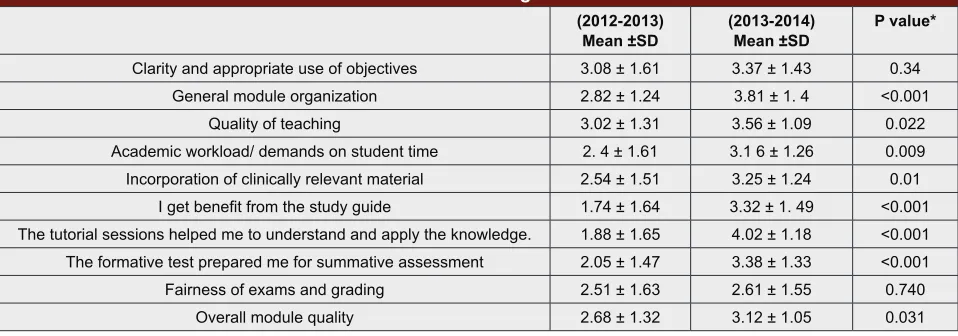
When the students satisfaction with the module was compared and it showed that students in 2013-2014 were significantly more satisfied than those in 2012-2013 regarding incorporation of clinically relevant material (p=0.01), reasonable distribution of academic workload (p=0.01), gaining benefit from the study guide (p<0.001) and effectiveness of tutorial session in application of knowledge (p<0.001). The students in 2013-2014 were significantly more satisfied with the module organiza-tion (p<0.001) and the overall quality of the module (p=0.03) (Table 3).
When asked about the critical thinking and the scientific research skills, the students in 2013-2014 reported a higher significant self-reported learning (p<0.001) in these skills compared to those in 2012-2013. They also reported a higher motivation to study the subject matter of the module (p<0.001) and they gained benefit from
Table 1: Comparison between teaching and learning modalities and contact hours of the endocrine module in the year (2012-2013) and year (2013-2014)
Method of instruction (2012-2013)
N (%) N (%)(2013-2014)
Lectures 30 46.8 24 37.5
Tutorials 7 10.9 7 11
Practical 7 10.9 7 11
SDL 4 6.3 6 9.3
Clinical Presentation 8 12.5 8 12.5
PBL 8 12.5 8 12.5
Joint sessions 0 0 4 6.3
Table 2: Comparison between the students assessment results in the years (2012-2013) and (2013-2014)
(2012-2013)
N (%) N (%)(2013-2014) P value*
Overall success rate 321 97.9 403 97.8 0.84
Grade
A 40 12.2 75 18.2 0.02
B 133 40.5 137 33.3 0.04
C 101 30.8 119 28.9 0.63
D 47 14.3 72 17.5 0.29
F 7 2.1 9 2.2 0.84
*Significant is considered at p < 0.05.
Table 3: Comparison between year (2012-2013) and year (2013-2014) regarding student satisfaction with the module design
P value* (2013-2014)
Mean ±SD (2012-2013)
Mean ±SD
0.34 3.37 ± 1.43
3.08 ± 1.61 Clarity and appropriate use of objectives
<0.001 3.81 ± 1. 4
2.82 ± 1.24 General module organization
0.022 3.56 ± 1.09
3.02 ± 1.31 Quality of teaching
0.009 3.1 6 ± 1.26
2. 4 ± 1.61 Academic workload/ demands on student time
0.01 3.25 ± 1.24
2.54 ± 1.51 Incorporation of clinically relevant material
<0.001 3.32 ± 1. 49
1.74 ± 1.64 I get benefit from the study guide
<0.001 4.02 ± 1.18
1.88 ± 1.65 The tutorial sessions helped me to understand and apply the knowledge.
<0.001 3.38 ± 1.33
2.05 ± 1.47 The formative test prepared me for summative assessment
0.740 2.61 ± 1.55
2.51 ± 1.63 Fairness of exams and grading
0.031 3.12 ± 1.05
2.68 ± 1.32 Overall module quality
*Significant is considered at p < 0.05.
Table 4: Comparison between year (2012-2013) and year (2013-2014) regarding students self-reported learning during the module
P value* (2013-2014)
Mean ±SD (2012-2013)
Mean ±SD
<0.001 2.86 ± 1.46
1.85 ± 1.43 This module improved my critical thinking
<0.001 3.41 ± 1.24
2.05 ± 1.4 This module improved my skill in internet research
<0.001 2.8 ± 1.65
1.65 ± 1.47 This module improved my scientific research skills
<0.001 3.25 ± 1.33
2.22 ± 1.37 This module motivate me to learn the subject matter
0.016 3.02 ± 1.63
2.25 ± 1.61 In this module, I received feedback about my progress in learning
0.027 3.72 ± 1.05
3.17 ± 1.65 This module prepared me for clerkships
*Significant is considered at p < 0.05.
the feedback they received (p=0.016) compared to those in in 2012-2013 (Table 4).
DISCUSSION
The ability of medical students to integrate knowledge acquired from basic sciences including biochemistry, physiology and pathology to the clinical venue lies in the core of medical practice and requisite for medical
profession has been previously raised.11 Demonstrating
tran-sition to clinical clerkships.7 The present study aimed to
explore satisfaction of medical students regarding their experience with endocrine module following its reform and compare it to those who study the traditional module. During module reform, the endocrine module commit-tee with the medical education department promoted integration through setting combined lectures and joint sessions between different disciplines to eliminate irrel-evant details that lack clinical relevance. In addition case scenarios were discussed in the lectures, tutorials and clinical sessions together with examples in the student study guide. This offered students the opportunity of a learning environment that enhance thinking and analyzing capabilities and this was evidenced by students who reported they have their critical thinking improved after study this module. The present findings agree with that of Tsinopoulos et al. who observed significant increase in 5th year medical students’ satisfaction after
implemen-tation of integrated ophthalmology course.12 Even the
mean of their final grade was significantly higher compared to those taught with the conventional system. This was also evident in the present work as the students who scored “A” and “B” grade were significantly higher following implementation of the reformed endocrine module compared with those of the preceding year. Improved student and faculty satisfaction was earlier observed as a result of change from non-integrated to integrated medical curricula in the study of Rehman
et al.13 The present results together with previous findings
point to the effectiveness of implementing integrated curricula and its acceptance and preference by students. Following module reform, students were highly signifi-cant satisfied regarding the benefit they got from the study guide and how tutorials and formative assessment helped them get prepared for the summative one. This might reflect the real improvement in module content and formative assessment even the unstructured formative assessment offered in tutorial classes.
Importance of including research skills within undergrad-uate medical curriculum has been previously addressed by Collins et al.14Students’ motivation towards scientific
research was stated as an essential element of modern undergraduate medical education curricula and the medical school graduates should be able to use research skills to develop better understanding and to affect their practice.15,16 Integrating the research further into the
curriculum was among the recommendations concluded from previous studies conducted at the FOM, KAU.17,18
In response to that, the curriculum committee at the FOM encouraged integration of research skills into the course and modules.One interesting finding in the present work is the students’ satisfaction regarding the
newly introduced module objectives related to the scientific research skills. While setting these objectives, we were inspired by research learning outcomes of GMC, but considering students’ capabilities and their academic workload.19 Student satisfaction observed in
the present work agrees with the insightful Students’ feedback that demonstrated perceived attainment of research competencies in the study of Riley et al.20
Students reported that the reformed module signifi-cantly improve their internet search as well as scientific research skills. In Charite´ University Medical Centre Berlin, Germany, Students from the problem based medical curriculum showed greater participation in research production and felt more confident in their scientific competencies than other students.21 This is
supported in this study as the PBL is one of the learning modalities in the endocrine module.
Limitations of the study: Qualitative analysis of the students learning and experience of the reformed endo-crine module through focus group was not conducted although it could add to the understanding of the increased satisfaction of the students.
In conclusion, endorsement of both horizontal and vertical integration of basic sciences and incorporation of clinically relevant topics as well as scientific research skills in the endocrine module resulted in significant improvement of the students’ satisfaction and acquisition of learning outcomes. This interdisciplinary integrated endocrine module provides framework and tips for module construction that would improve critical thinking skills, research skill and prepare the students to be life-long learners.
CONCLUSION
This interdisciplinary integrated endocrine module pro-vides framework and tips for module construction that would improve critical thinking skills, research skill and prepare the students to be life-long learners.
ACKNOWLEDGMENTS
The authors would like to thank the endocrine module committee members for their enthusiasm in improving their module and for collaboration with the ME team. Special thanks for professor Mahmod S. Alahwal, Dean of the Faculty of Medicine, King Abdulaziz University for providing help, guidance and support of the ME team.
CONFLICT OF INTEREST
REFERENCES
1. Houlden RL, Raja JB, Collier CP, Clark AF, Waugh JM. Medical students’ perceptions of an undergraduate research elective. Med Teach. 2004; 26(7):659-61. http://dx.doi.org/10.1080/01421590400019542; PMid:15763861. 2. Reinders JJ, Kropmans TJB, Cohen-Schotanus J. Extracurricular
research experience of medical students and their scientific output after
graduation. Med Educ. 2005;39(2):237. http://dx.doi.org/10.1111/j.1365-2929.2004.02078.x ; PMid:15679693
3. Frishman WH. Student research projects and theses: should they be a requirement for medical school graduation? Heart Dis. 2001;3(3):140-4. http://dx.doi.org/10.1097/00132580-200105000-00002 ; PMid:11975783 4. Metcalfe D. Involving medical students in research. J R Soc Med. 2008;
101:102-103. http://dx.doi.org/10.1258/jrsm.2008.070393; PMid:18344462 PMCid:PMC2270240.
5. Hashem E, Ayuob N, Malibary H, El-Deek B. Experience of central nervous system and special senses module establishment in the integrated medical curriculum at King Abdulaziz University. Res J Med Sc. 2013;7:65-9. 6. Harden R, Sowden S, Dunn WR. Education strategies in curriculum
development: The SPICES model. Med Educ. 1984;18(4):284-97. http:// dx.doi.org/10.1111/j.1365-2923.1984.tb01024.x.
7. Ayuob N, Eldeek B, Alshawa L, Alsabaa, A. Interdisciplinary integration of the CVS module and its effect on faculty and student satisfaction as well as student performance. BMC Med Educ. 2012;12(1):1 http://dx.doi. org/10.1186/1472-6920-12-50 ; PMid:22747781 PMCid:PMC3493313. 8. Malik AS, Malik RH. Twelve tips for developing an integrated curriculum. Med
Teach 2011;33(2):99-104. http://dx.doi.org/10.3109/0142159X.2010.507711; PMid:20874013.
9. Likert R. A technique for the Measurement of Attitudes. Arch Psychol. 1932;140:1-55.
10. Cronbach LJ. Coefficient alpha and the internal structure of tests.
Psychometrika. 1951;16(3):297-334. http://dx.doi.org/10.1007/BF02310555. 11. Van Der Veken J, Valcke M, De Maeseneer J, Derese A. Impact of the
transition from a conventional to an integrated contextual medical curriculum on students’ learning patterns: A longitudinal study. Med Teach. 2009; 31(5): 433-41. http://dx.doi.org/10.1080/01421590802141159; PMid:18825559.
12. Tsinopoulos I, Symeonidis C, Tsaousis K, Mataftsi A, Chalvatzis N, Tzamalis A, et al. Contribution of integrated teaching in the improvement of an undergraduate ophthalmology curriculum. Adva Med Educ Pract. 2014;5:433-7. PMid:25429248 PMCid:PMC4241950.
13. Rehman R, Iqbal A, Syed S, Kamran A. Evaluation of integrated learning program of undergraduate medical student. Pak J Physiol. 7:37-41 2011. 14. Collins JP, Farish S, McCalman JS, McColl GJ. A mandatory intercalated
degree program: revitalizing and enhancing academic and evidence-based medicine. Med Educ. 2010;32(12):e541-6.
15. General Medical Council. Tomorrow’s Doctors: recommendations on undergraduate medical education. London. GMC, 1993, revised 2003, revised 2009. http://www.gmc-uk.org/Tomorrow_s_Doctors_1214.pdf_48905759.pdf 16. Hren D, Lukić IK, Marusić A, Vodopivec I, Vujaklija A, Hrabak M. et al.;
Teaching research methodology in medical schools: students’ attitudes towards and knowledge about science. Med Educ. 2004;38(1):81-6. http:// dx.doi.org/10.1111/j.1365-2923.2004.01735.x
17. Alsayed N, Eldeek B, Tayeb S, Ayuob N, Al-Harbi A. Research practices and publication obstacles among interns at King Abdulaziz University Hospital, Jeddah, Saudi Arabia, 2011-2012. J Egypt Public Health Assoc. 2012; 87(3 and 4):64-70.
18. Zaki Y, Eldeek B, Ayuob N, Altayeb S, Jamjoom R. Participation of Medical Students in Health Research: Local and International Experiences. Sch J App Med Sci. 2015;3(2D):797-801.
19. General Medical Council. Tomorrow’s Doctors: Undergraduate standards and guidance our role in undergraduate medical education. http://www.gmc-uk.org/education/undergraduate/undergraduate_policy.asp
20. Riley S, Morton J, Ray D, Swann D, Davidson D. An integrated model for developing research skills in an undergraduate medical curriculum: appraisal of an approach using student selected components. Perspect Med Educ. 2013;2(4):230-247. http://dx.doi.org/10.1007/s40037-013-0079-7; PMid:24037741 PMCid:PMC3792228.
21. Pruski S, Burgwinkel P, Georg W, Keil T, Kiessling C. Medical students’ attitudes towards science and involvement in research activities: A comparative study with students from a reformed and a traditional curriculum. Med Teach. 2009;31(6):e254-9. http://dx.doi.org/10.1080/01421590802637925; PMid:19811157.
SUMMARY
• Increased level of integration as well as integrating scientific research skills resulted in a significant increase in students’ satisfaction with the endocrine module organization.
• A significant increase in students’ motivation to study the endocrine subject matter as well as improvement of their research skills was also reported after the module reorganization.
Zeinab Alrefaie: MBBSc, MD Professor, Physiology department, Faculty of Medicine, King Abdulaziz University and Cairo University. Occupying the position of Endocrine Module Director, Faculty of Medicine, King Abdulaziz University since 2011. Major research interest and publications are in endocrine and neurophysiology focusing on possible underlying Pathophysiologic mechanisms and possible protective measures.
About Authors
Basem Eldeek: Professor of Community medicine and Public health, Faculty of Medicine, Mansoura University, Egypt. He was working at the Faculty of Medicine, King Abdulaziz University, Jeddah, Saudi Arabia. He is interested in Medical education research.
Nasra Ayuob: Assistant professor of histology and cell biology, Faculty of Medicine, Mansoura University, Egypt. She was working at the Faculty of Medicine, King Abdulaziz University, Jeddah, Saudi Arabia. She is interested in medical education research.