The University of San Francisco
USF Scholarship: a digital repository @ Gleeson Library |
Geschke Center
Master's Theses
Theses, Dissertations, Capstones and Projects
3-8-1997
A Study of the Relationship Between Motivational
Factors and Incentives Among Division Board
Members of the American Heart Association,
California Affiliate, Region III
Catherine Jensen
University of San FranciscoFollow this and additional works at:
https://repository.usfca.edu/thes
This Thesis is brought to you for free and open access by the Theses, Dissertations, Capstones and Projects at USF Scholarship: a digital repository @ Gleeson Library | Geschke Center. It has been accepted for inclusion in Master's Theses by an authorized administrator of USF Scholarship: a digital repository @ Gleeson Library | Geschke Center. For more information, please [email protected].
Recommended Citation
Jensen, Catherine, "A Study of the Relationship Between Motivational Factors and Incentives Among Division Board Members of the American Heart Association, California Affiliate, Region III" (1997).Master's Theses. 1137.
The author of this thesis has agreed to make available
to the University community and the public a copy of this dissertation project.
Unauthorized reproduction of any portion of this dissertation is prohibited.
The quality of this reproduction is
contingent upon the quality of the original copy submitted
.
University of San Francisco Gleeson Library/Geschke Center
2130 Fulton Street
A Study of the Relationship Between Motivational Factors and Incentives Among Division Board Members of the
American Heart Association, California Affiliate, Region III
A THESIS SUBMITTED
by
Catherine Jens en
In Partial Fulfillment of the Requirements
for the Degree of
Master of
Nonprofit Administration
The University of San Francisco
A Study of the Relationship Between Motivational Factors
and Incentives Among Division Board Members of the
American Heart Association,
California Affiliate, Region III
This Thesis written by
I'
Catherine Jensen
This thesis written under the guidelines of the Faculty Advisory Committee. and
approved by all its members, has been accepted in partial fulfillment of the
requirements for the degree of:
Master of Nonprofit Administration
at the
The University of San Francisco
Ite.se~rch Committee:
~~
~
'( 7 e ~ c d Reader
\ .
~ ~ c l - . . ~ € ~ ~
~lil<1
G-
I
?fJ.
Program Director
Date I
1..,., ,.
i
-,
SI~~ /
j]·-0
IV,JY)' I
Abstfact
Vita Auctoris
Acknowledgements
List of Tables . . .
List of Appendices
Chapter One: Introduction
Table of Contents
Chapter Two: Review of Related Literature .
Chapter Three: Method
Chapter Four: Results
Chapter Five: Summary and Conclusions
IV
. V
vi
Vil
. Vlll
. I
12
25
33
63
References
Appendices
. . . 70
Abstract
This study measured the motivational factors influencing the decisions of volunteers to serve
the American Heart Association as division board members, and also measured actual
outcomes these board members report experiencing as a result of such service. Comparisons
were made to determine the degree to which there is a match between motives and incentives
according to four distinct categories. The four categories were normative, rational, affiliative,
and status. In addition, individual statements expressing board members' attitudes about their
service were gathered. The results of the study were intended to provide information useful
in board member recruitment and retention plans. The study revealed that, within the four
categories, there was a high degree of correlation between the reasons individuals joined their
current board and the actual incentives, or outcomes, being received. In general, board
members appear to join primarily for normative reasons, followed by affiliative, status, and
rational motives. When individual survey answers were examined, outcomes were reported at
Name:
Date of Birth:
High School:
Graduated:
Vita Auctoris
Catherine Marie Jensen
February 3, 1968
Fremont High School Sunnyvale, California
1986
Baccalaureate Degree: Bachelor of Arts Degree
College:
Graduated:
University of California at Santa Barbara Santa Barbara, California
Acknowledgments
This study would not have been possible without the support of the following
individuals from within the American Heart Association California Affiliate: Senior Vice
President Roman Bowser; Assistant to the Senior Vice President Howard Shiflett; Santa Clara
County Executive Director Maria Pappas; and the board members of the various divisions
involved in the survey. Appreciation also goes to my advisors, Donna Hamlin of Hamlin,
Harkins Ltd. and Germaine Cummings of The Board Connection. The final "thank you" is
for my husband, Tony, who has given me his complete support through this and many other
Table 1
Table 2
Table 3
Table 4
Table 5
Table 6
Table 7
Table 8
Table 9
Table lO
Table 11
Table 12
Table 13
Table 14
Table 15
Table 16
Table 17
Table 18
List of Tables
Ethnicity Demographics
General Satisfaction Common Comments
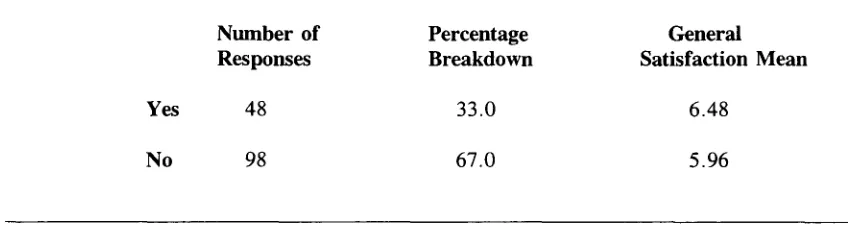
Previous AHA Volunteer Experience
Ways in Which the Volunteers Have Benefitted: Common Responses
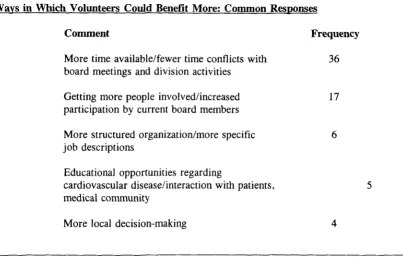
Ways in Which the Volunteers Could Benefit More: Common Responses
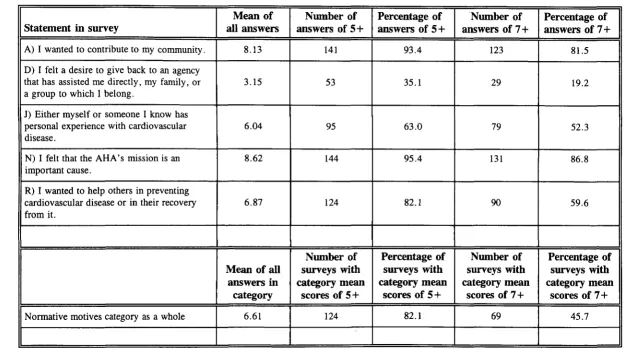
Normative Motives
Rational Motives
Affiliative Motives
Status Motives
Normative Outcomes
Rational Outcomes
Affiliative Outcomes
Status Outcomes
Percentage of Males and Females with Mean Category Rankings Above Five
Normative Motives and Outcomes: Individual Ranking Comparison
Rational Motives and Outcomes: Individual Ranking Comparison
Affiliative Motives and Outcomes: Individual Ranking Comparison
List of Appendices
Appendix A . . . Survey
Appendix B . . . .
Appendix C .
Appendix D.
First Letter Accompanying Survey
Second Letter Accompanying Survey
Answers to Survey Question: In general, how satisfied are you with your service as a board member for the AHA? Why?
Appendix E . . . Answers to Survey Question: Were you a volunteer for the AHA in another capacity prior to your current board service? If yes, please briefly describe, including approximate length of time.
Appendix F . . . Answers to Survey Question: In what ways have you benefitted from your service as a board member for the
AHA?
Chapter 1: Introduction
Background of the Issue
There are approximately 1,140,000 nonprofit organizations in the United States. Of
these, approximately 400,000 are member-serving organizations that exist primarily to serve
the needs of the membership. Approximately 740,000 are public-serving organizations, which
have been classified into ten major categories by the National Taxonomy of Exempt Entities:
Arts, Culture, and Humanities; Educational; Environmental; Health; Human Services;
International Foreign Affairs; Public and Societal Benefit; Religious; Mutual/Member benefit;
and Unclassified. The nonprofit sector is continuing rapid growth, with approximately 29,000
organizations currently receiving tax-exempt status from the Internal Revenue Service each
year (Moyers, 1994).
As a part of the U.S. economy, this "third sector" plays a major role. Over
7,000,000 Americans, or approximately 7 percent of the country's total work force, are
employed by nonprofit organizations. These organizations have operating expenditures of
over $300 billion, representing more than 6 percent of the gross national product (O'Neill,
1989; Salamon & Anheier, 1994). In addition to the paid work force in the nonprofit sector,
70,000,000 teenagers and adults are estimated to participate in volunteer work for such
organizations, with their donated time having a value equal to $110 billion, 2.4 percent of the
national income (Moyers, 1994; O'Neill, 1989).
A relationship between volunteerism and quality of life in a community has been
discussed by several authors, with each factor influencing the other. Individuals often
volunteer with the sole intention of helping some area of the community, often to fulfill an
internal need to accomplish something noble or to form bonds with other like-minded people.
of life there commands the need for volunteers to take on the roles needed to accomplish the
task (Hayes, 1994; Fiffer & Fiffer, 1994).
Increasing attention and resources are being devoted to helping nonprofit organizations
make effective use of their volunteers. Prescriptions for the proper recruitment and
orientation of volunteers are readily available. Retention of all volunteers is also viewed as an
important issue, since turnover of volunteer labor does, in fact, cost the organizations in terms
of training materials and staff time (Steinberg, 1987). Understanding the motivational factors
influencing volunteers has been suggested as key to the issue of volunteer retention (Miller,
1985), and literature suggests that many of the same factors relate to the retention of
volunteers serving in the role of board member as well.
Individuals are motivated to volunteer for a variety of reasons, and choose to do their
volunteer work in a variety of roles. Since volunteers participate for such varied reasons,
organizations might need to decide whether motives that may not be compatible with the goals
and philosophy of the organization are acceptable in their volunteers, or if mission alone
should drive the volunteer force (Houle, 1989; Puffer, 1991). The answer may be found in
an evaluation of the volunteer roles the organization needs filled and the skills which those
roles require.
One category of volunteers essential to nonprofit organizations is that of the board of
directors. Boards of directors typically govern organizations in the nonprofit sector, and are
ultimately responsible for ensuring that the organization fulfills its mission. To do so
effectively, boards must be strong entities in themselves and have qualified members serving
as trustees (Axelrod, 1994; Byrnes, 1993; Drucker, 1990; Herzlinger, 1994). Finding the
"right" members for a particular organization's board is accepted as being an important
combination of agency staff, current board members, and members of outside nominating
committees (Carver, 1990; Drucker, 1990; Houle, 1989).
Finding the "right" people to serve on a particular board involves matching the
interest, motivation, talent, and availability of individuals to an organization's mission,
programs, and current needs in terms of essential roles to be filled. The role of board
member is one of great importance to nonprofit organizations, and individual reasons for
choosing to serve in this capacity are varied. Literature suggests that organization leaders
should attempt to discover the real reasons behind their board members' participation.
Organizations are encouraged to not only examine the reasons for initial acceptance of a board
position, but also to look at the issues about their service that board members find most
attractive and unattractive (Houle, 1989)-what factors make people want to continue in this
role. Moyer (cited in Puffer, 1991) stressed the importance of an administrator for a
voluntary organization and the board itself to understand the motives of volunteers and
provide them with the appropriate incentives. For a mutually successful relationship to be
established, the organization must meet the needs of its volunteers and board members just as
the board members must meet the needs of the organization (Danoff & Kopel, 1994).
Although a significant amount of research has been conducted in recent years on the
topic of volunteer motivation (Clary & Snyder, 1993; Latting, 1990; Miller, 1985; Widmer,
1989), authors suggest that the issue needs even more investigation. In a study exploring
research needs on volunteerism, Asche and Janey (1990) asked volunteer practitioners, most
of whom were volunteer coordinators, to rank certain categories of potential research in terms
of perceived need. The highest percentage of respondents (96%) ranked "motivational issues"
as their first choice. Added to this is the thought that many researchers have examined either
motives for volunteering or incentives provided by organizations, but that few have looked at
issues affecting board members has been found, but research on this topic as it relates to
incentives provided has not been found.
An understanding of volunteer motives and incentives has potential benefits for
specific organizations and the nonprofit sector as a whole. One such organization that may
benefit from such an evaluation of volunteers is the American Heart Association.
Nationally, ranked by revenue level, the American Heart Association is listed as the
twentieth largest nonprofit organization in the country, and the fifth largest in the field of
health, with a fiscal year 1993/94 national income of over $297,000,000 ("The NPT 100,"
1995). In its audited financial statements for the fiscal year 1994/95, the California state
organization reported revenues and expenses at just over $24,000,000 (American Heart
Association California Affiliate, 1995). The size of the AHA's national and state structures
puts the organization in a prominent place among its fellow nonprofit agencies.
The American Heart Association (AHA), like so many other nonprofit organizations,
is highly dependent on volunteers, and in many capacities.
It
has been estimated that over5,800 people volunteered for the AHA in California year-round in the 1994/95 fiscal year.
Over 525,000 people volunteered on at least a one-time basis. One of the roles in which
individuals volunteer is that of board member to one of 116 local divisions of the AHA in the
state. The position of division board member does not fall into commonly accepted board
categories (The Board Connection, 1995), but is a hybrid position.
The California statewide Affiliate of the AHA has one governing board of directors
which is overseeing the majority of the governance and policy issues facing the organization
and holding legal and financial responsibilities. In addition to this one statewide governing
board, local division boards of directors exist throughout the state to support the Affiliate
governing board. Each local board has both fund raising and program implementation duties,
policy-making responsibilities, these board members oversee the activities of the AHA and carry out
its mission in their local communities. They are expected to serve as the guardians of the
AHA within their division. Current literature describes many potential functions of boards of
directors. From these, the following list was developed as a description of the primary local
duties that the AHA governing board expects these division boards to carry out:
• Monitoring the organization's programs
• Securing financial resources
• Serving as liaisons between the AHA and the division communities
• Assessing board effectiveness
• Recruiting new board members and assisting with their orientation
Statement of the Issue
Considering the number of volunteers involved as board members at the local division
level-and their importance to the AHA in both fund raising and program
implementation-little is currently known about what motivated their original involvement. It
is also unknown whether these individuals' board service is satisfying the key areas of interest
that initially prompted them to join the board. Understanding these two issues can assist the
AHA in volunteer retention at this board level.
Since the AHA has volunteers performing in many different roles, and given the
importance of role of division board member in the organization's success, this specific
category of volunteers was selected for evaluation. Studies of general volunteers motivations
and incentives have been conducted by other researchers, as have been studies on volunteers
in the role of board member. However, studies relating and comparing the motives and
incentives were not located. While gaining an understanding of all of the AHA volunteers'
responsibilities would be the most reasonable approach. Relating the motives and incentives
of this sub-set of AHA volunteers, division board members, should provide the organization
with information of most immediate relevance to its mission. Other sub-sets of volunteers can
be studied at a later date.
Definitions of Relevant Variables
Nonprofit organization. An organization that is legally prohibited from distributing
any part of its net earnings for the benefit of any individual or private shareholder. Such
organizations possess two additional characteristics: (1) they exist to provide a service or to
advance a cause, and (2) they receive some portion of their income through tax-deductible
contributions.
American Heart Association (AHA). A nationwide nonprofit organization whose
mission is that of "fighting heart disease and stroke." The organization attempts to accomplish
this mission through community education programs, professional education seminars, and
through funding scientific research.
Affiliate. A "branch" of the American Heart Association. For the purposes of this
research project, the term II
Affiliate" will refer to the California Affiliate, unless otherwise
specified.
Division. A geographic area, usually one or two cities, in which local volunteers
have been organized to implement both fund raising and education activities, and staffed by a
Division director. An AHA staff member with duties associated with specific
geographic territories, or divisions, usually working in conjunction with volunteer boards of
directors within these divisions.
Board member. In general terms-and as referred to by researchers in the current
literature-this is a volunteer serving in a specific capacity as a member of a nonprofit
organization· s governing, advisory, or administrative board. The role of board member is
assumed to differ from that of other volunteers within an agency, holding a higher degree of
responsibility. For the purposes of this study and in reference to AHA board members,
unless specified otherwise, a member of the volunteer group assisting with both fund raising
and educational program implementation activities for the AHA within a specified geographic
area, or division, who does not hold legal and financial responsibilities.
Normative motives. The desire to help the organization or others regardless of
personal benefits to be gained.
Normative incentives. The knowledge that the work being performed is for a good
cause.
Rational motives. The desire to volunteer based on some pursuit of self-interest.
Rational incentives. Material rewards or skills learned.
Affiliative incentives. Social activities and having fun.
Status motives. The desire to be visible in the community and live up to expectations
of others.
Status incentives. Recognition of work in the community or with important reference
groups.
Specification of the Research Questions
The motivational factors influencing board members' involvement with the AHA will
be investigated in this study, based on themes found in the review of current literature about
boards of directors and on key areas of interest to the American Heart Association. Within
these same themes, this study will investigate the incentives being provided to these
volunteers, from the volunteers' perspective. Finally, the degree of congruity between the
motives and incentives will be investigated. The specific research questions to be studied are:
1) What motivated individuals to join their current AHA board?
2) What incentives do these board members feel they are currently receiving?
3) To what degree is there a match between the two issues?
Board members from eighteen divisions were surveyed from the geographic area
encompassing the counties of San Mateo, Santa Clara, San Benito, Monterey, Santa Cruz, and
San Luis Obispo. These counties comprise one of the five AHA-defined regions within the
Importance of Study
While the AHA region under study will benefit the most from this study, and other
regions of the Affiliate and other complete AHA Affiliates will find useful elements, there is a
value to be gained from this study by the nonprofit community as a whole. Overall, this
study will provide the nonprofit community with an overview of motivational factors as they
relate to board members' decision to volunteer with a major nonprofit institution at this level
and with the ongoing commitment it requires. In addition, information will be gained about
the degree to which the organization is satisfying incentives identified as important to these
board members.
In describing the 1980s, Young (1993) indicated that these years were "a decade of
discovering and conceptualizing the field of nonprofit management and leadership, but it was
also a period of learning that precious little solid research was available to respond to these
questions and to help guide practice" (p. 3). The results of this study provide practical
information that can, in fact, guide future planning and practice for the AHA within the
specific region studied, the California Affiliate, and within the other AHA Affiliates.
Within the region studied, a base of knowledge will be gained about the factors that
motivate AHA board members. This will assist staff and board members in future
recruitment and retention, as individual interests can be better gauged to achieve a proper
match between the individual and the AHA. Staff will learn whether or not current board
members' interests are being satisfied through their board service, which will assist in board
development plans. Such plans can be created with the intent of increasing volunteer
retention at the division board level.
At both a statewide and national level, the study will serve two purposes. First, other
regions within California and other affiliates may choose to use the results of this study to
to the same research questions from their board members, the survey can be duplicated and
modified to include additional factors identified by the study as well as any issues of local
concern deemed appropriate.
Limitations of the Study
The study's results may be limited in their use for generalization since it is examining
a specific type of board in one region in one state. Other types of boards, especially
governing boards, and other parts of the state and country may face different issues regarding
volunteer board motivation. These might include such issues as: the local economy,
ruralness, proximity to research facilities or major medical institutions, and size of the
nonprofit community.
Since the survey is anonymous, actual prescriptive work for individual divisions will
be limited. No division directors will be able to identify weaknesses needing correction based
on his or her own board's responses, unless these weaknesses were previously known.
Two of the boards surveyed work directly with the author of this work, and, although
the survey was entirely anonymous, it is conceivable that personal biases may affect their
answers. It is also possible that social norms may dictate answers, particularly on the motive
questions.
Some of the board members surveyed have been volunteering for many years, and
some changes in board structure have taken place within the last few years. Committee
responsibilities and expectations of board members have been re-defined, and the answeres by
long-time board members may be influenced by such factors.
Finally, the survey relies on memories of board members in the section investigating
original motivational issues and provides an overview of board member views at one point in
and themes found in motivational factors and the provision of incentives might be expected to
Chapter 2: Review of Related Literature
In reviewing literature related to the topic of board member motivation and incentives,
the following three themes emerged as relevant to the research questions:
• The possible roles that different types of boards play for nonprofit organizations
• The need for organizations to understand volunteer motivations
• Categorizing motivational factors for members of nonprofit boards
The majority of the literature found looked at volunteers as a whole, with a portion
specifically focusing on volunteers in the role of board member. The current study in part
examines how the information fits within a specific group of volunteers, that of American
Heart Association division board members.
Nonprofit Boards Assume Varied Roles
Boards of directors play a variety of roles and hold various responsibilities within
nonprofit organizations. Axelrod (1994) recommends against describing all nonprofit board
characteristics as the same, since the precise role and responsibility of each board will be
determined by the particular institution's organizational and leadership variables. These
variables include the organization's age, size and scope of mission, the presence or absence of
paid staff, the leadership styles of a paid staff executive and the board chairperson, the
manner in which board members are selected, and the composition of the board itself.
Although no two boards of directors may reasonably be expected to mirror each
other, there are a number of specific responsibilities that boards can perform. Many authors
(Axelrod, 1994; Carver, 1990; Connors, 1988; Drucker, 1990; Houle, 1989; Middleton,
1987; Panas, 1991; Stoesz & Raber, 1994) have described the range of roles, and they
• To determine the organization's mission
• To select the chief executive/executive director
• To review the executive's performance
• To engage in strategic planning for the organization
• To monitor the organization's programs
• To provide financial management
• To secure financial resources
• To serve as liaisons between the organization and its community
• To assess its own effectiveness
• To establish a selection and orientation process for new board members
• To ensure that the organization meets its legal and fiscal obligations
Since no two boards can be expected to be exactly alike in the degree to which they
carry out certain responsibilities, it is important for organizations to clarify the duties of the
board to potential members, and for individuals to give thought to whether an organization's
board is involved in the activities that meet their particular interests. It is also important for
potential board members to understand the type of board on which they are being asked to
serve. There are three major types of boards among nonprofit organizations: policy-making,
advisory, and administrative (The Board Connection, 1995). To achieve an understanding of
these issues, there is general agreement that all board members need a proper interview and
orientation to the role they are expected to play for a particular organization (Axelrod, 1994;
Freyd, 1988; Houle, 1989). The literature suggests that such careful interviewing processes
rarely occur. Little is done to determine a candidate's true interest, or to give them
background information about the organization's goals, programs, finances, and the role
expected of board members in terms of fund raising, personal giving, and time demands
expectations, which does not serve the organization well, since there is the chance for
dissatisfaction and inaction among the board members, in addition to questions of board
member retention, legal compliance, and liability.
Organizations Need to Understand Volunteer Motivations
Nonprofit organizations are encouraged to think realistically about the reasons why
someone might want to serve an organization in an all-volunteer position, particularly in the
capacity of board member. The nature of the nonprofit sector, with its growth, complexity,
and competition for volunteers creates the need for more sophisticated volunteer recruitment,
training, and retention than in the past. The cost involved in volunteer turnover alone is
offered as a key reason for the importance of paying attention to this issue (Danoff & Kopel,
1994; Steinberg, 1987).
Several authors suggest that organizations should attempt to identify the motivational
factors behind a volunteer's interest in a particular role, with such information enabling staff
to make effective use of volunteers. Specific individuals or groups may be targeted for filling
future roles based on the profile revealed about current volunteers. In addition, organizations
will be better equipped to provide proper incentives and rewards for service appropriate to
individual or group interests (Danoff & Kopel, I 994; Houle, I 989). Understanding
volunteers' motivation that prompts their service, and satisfying their needs, is thought to be a
significant factor in volunteer retention (Danoff & Kopel; Miller, I 985, Widmer, 1989).
Widmer carries this thought to the recruitment function as well:
Boards should, it is clear, pay attention to incentives in their efforts to recruit
and retain board members. Potential incentives should be made explicit to
what one considers a reward another may consider meaningless. Incentives
must be matched to the individual (p. 20).
Nonprofit board members are generally considered to be the guardians of the agency
they serve, depending upon their defined duties and the type of board. Given the importance
of their role, Houle ( 1989) says that "the more realistically a selecting authority faces the
matter of motivation [of board members], the better will be the chances of finding effective
people and convincing them that they should accept membership" (p. 26). The recruitment
and orientation processes used by boards can affect whether boards recruit the "right" people
to serve, and the productivity of their service once selected. Houle stresses that these tasks
must be taken seriously by those responsible and not left to chance.
Axelrod (1994) acknowledges that there are a number of factors influencing the
success with which a board carries out it responsibilities, two of which are the quality and
commitment of those selected to serve as board members. She cautions that the quality and
potential contribution of candidates chosen to serve on a nonprofit board alone will not
necessarily create an effective board. As part of an overall board development program,
organizations are urged to allocate the needed time and resources to the processes of
recruitment, orientation, and retention of board members. She suggests that the growth of the
nonprofit sector depends on the proper execution of these activities.
Nonprofit organizations are now competing for volunteers, according to Hay (1990),
and strategies for the best use of volunteers are needed. People want their volunteer time
used efficiently and effectively by the organization, and tend to cease their work for an
organization when it is not. Such volunteer turnover mars the image of the nonprofit and
diminishes the accomplishment of the mission. Hay also says that people typically volunteer
to satisfy certain needs or to fulfill certain expectations, and urges nonprofit organizations to
Comparable literature on competition for volunteers specifically in the role of board member
was not found; however, it is assumed by this author that such competition exists at this level
of volunteerism.
Categorizing Motivational Factors for Members of Nonprofit Boards
Motivations behind the acceptance of, or interest in, a volunteer position vary by
individual. While much literature exists about general volunteer motivation (Clary & Snyder,
1993; Hay, 1990; Latting, 1990; Mackenzie, 1988; Puffer, 1991; Schindler-Rainman, 1988),
information specific to the motivation behind volunteering in the role of board member is less
abundant (McAdam & Gies, 1985; Widmer, 1989). The available information suggests that
many of the same motivational factors are present in all levels of volunteer work. The role of
governing board member, in particular, is one holding more and distinctly different
responsibility and visibility than that of other volunteers, and extra emphasis is given to
identifying factors motivating service in this role.
Perhaps the most commonly mentioned reason for service on a particular board is the
desire to serve a cause in which the individual believes. Herman and Heimovics (1991)
caution, however, that nonprofit executives must not simply assume that this is the only or
primary motivating factor for board members. They suggest that executives, as well as the
board members or committees responsible for board recruitment and development, attempt to
discover what motivates individual board members. This will help build an understanding not
only between the executive and the current board members. but will also help gather ideas
about the possible motivations of future board members.
Houle (1989) suggests that altruistic motives should not be assumed to be the only
reason for participation at the board level. He acknowledges that to obtain trustees who will
individuals who will join for reasons of self-interest. He suggests that most of these
volunteers balance their altruistic motives with a set of self-interested ones. He says that this
thinking is objected to by individuals who argue that boards should only have members
prompted by altruistic intent, but he counters that those responsible for selecting board
members should realize that such a board, however ideal, is unlikely to exist. Mixed motives
stimulate most other activities in which adults are involved, and should be expected to guide
actions in volunteer work as well.
In an effort to discover some of the key issues motivating board members, McAdam
and Gies (1985) asked a sample why they serve, and four dominant responses were received.
In ranking order, they are: to influence the practices of an organization believed to be
providing a social good; to demonstrate a commitment to the community; to influence public
policy; and to achieve a degree of personal recognition. They acknowledge that the individual
motives for voluntary service on a board of directors are numerous, and that these four
responses are merely representative.
In looking at the descriptions that one particular group of middle aged professionals
used when referring to their own voluntary board service work, Wood (cited in Hall, 1992)
found that they viewed their work not only as altruistic and civically valuable, but as offering
self-enhancement, the opportunity for character growth, character expression, maturation, and
development.
Some literature specifically encourages nonprofit board membership as a means for
business professionals to increase their visibility and elevate their professional image (Lucht,
1988; Moore, I 989). Moore suggested marketing oneself, not only to the nonprofit
organizations on whose board one would like to sit, but also by publicizing one's
accomplishments once on a board as methods by which these professionals can expand their
relationships between businesspersons and organizations, the actions Moore suggested focus
on the benefits individuals can receive, primarily through higher degrees of recognition among
their business colleagues, in addition to leadership and skills development.
Bowen ( 1994) explored some of the reasons why business executives join nonprofit
boards. Personal commitment to the mission of the organization was mentioned as an
altruistic reason for participation at the board level. Other reasons were also mentioned,
including the opportunity to escape from the pressures of business bottom lines, the idea of
joining a new club, or the chance to improve a personal or industry-related public image in
the community.
Isenberg (1993) suggests that business managers volunteering at high levels (including
service on a board) in a nonprofit organization can create a mutually beneficial relationship.
The organization can tap the business person's management skills, while the manager can be
sharpening his or her own skills, becoming a more valuable employee.
In her study of volunteer motives and incentives among business professionals, Puffer
(1991) explained that, from a career professional's perspective, volunteer work serves many
purposes. These include gaining visibility, expanding one's contacts to benefit both the
individual and their employer, building skills in strategic planning and marketing, and
providing a balance in their lives in terms of social interaction and service that is removed
from their career concerns. For the nonprofit organization, she says, these professionals often
bring a network of contacts within their field that can be used to further the organization's
mission and goals.
Some employers clearly encourage volunteerism among their employees, as a benefit
to both the community and to the employee, which then benefits the company. In his book
focusing on employee volunteerism, which he describes as the first of its kind, Forward
U.S. companies and the individual acts of volunteerism conducted by employees of these
companies. When community needs demand involvement in the form of volunteers, these
corporations and their employees are a ready source. The employees stressed that, through
their volunteer work, they "receive back far more joy and personal gratification than we give"
(p. 2). The senior executives of the companies explained that they have found the costs of
maintaining such programs are minimal in comparison to the benefit the company receives in
higher morale and in customer recognition of a good corporate citizen. These employees are
available and willing to volunteer and participate in improving their communities in great part
because their employers have adopted community service through volunteerism as part of their
mission. It is viewed as a win-win situation.
Hanson, Hero, and Koch (1994) suggest in their study of Silicon Valley corporate
community involvement that a model corporate community effort should include an employee
volunteer program as one of its components. The authors suggest that companies formalize
their volunteer programs, encourage employees to volunteer, and offer incentives for those
who do. In addition, they specifically include the recommendation that corporations
encourage service on nonprofit boards, as well as on school boards and civic boards and
commissions.
Shaskin (cited in Danoff & Kopel, 1994) created a questionnaire based on Maslow's
(1943) theory of human motivation. Maslow's theory states that human beings are motivated
by certain needs, and that once a need is satisfied, the person can work toward meeting needs
at a higher level. The hierarchy of needs has five levels: physiological, safety, love, esteem,
and self-actualization. He says also that most activity is motivated by more than one of his
theory's levels, and that behavior tends to be guided by the needs at several or all of the
levels simultaneously. Shaskin used four of Maslow' s five categories of need to categorize
individual's status within each category. Physiological needs are assumed to have been met,
and are not included. As described by Danoff and Kopel (1994), Shaskin's classification
measures the relative importance individuals place on the following categories:
1) Safety and Security: the feeling of having economic security, employment
security, a satisfactory standard of living, and a general feeling of safety;
2) Social and Belongingness: the desire for social interaction and the desire to
belong to a group;
3) Self Esteem: the feeling of self worth;
4) Self-Actualization: the feeling and search for self-development.
An incentive-barrier model of citizen involvement has been created by Widmer
(1989). Her model proposes that individuals' motivation to participate is a function of both
incentives and barriers to such participation. She defines incentives as nthose things which
incite or motivate participation through the expectation of valued outcomesn (p. 9). Four
potential incentives for participation were described:
1) Material: tangible rewards that might be employment-related through working
with an organization related to one's profession, such as skill development or
making professional contacts, as well as personal rewards that might relate to
their own ability to ensure the receipt of agency services by themselves or
some closely related group;
2) Social: intangible rewards related to meeting new people and/or working with
friends;
3) Developmental: intangible rewards related to personal growth and the
utilization of skills already possessed;
4) Ideological: intangible rewards such as satisfaction and gratification that one
directly, but that one expects to feel simply as a result of working toward
something in which they believe.
Although not distinguished as one of her defined categories, Widmer also describes a group of
"service incentives," such as a belief in community service, the repayment of a debt to the
organization or to society, the opportunity to help those less fortunate, or the belief that one's
image requires it of them. Such service leads to valuable secondary outcomes, which fall into
one of Widmer's four defined incentive categories. In her study of board members of human
service agencies, Widmer found that, as Houle (1989) suggested, many of them reported
participating for reasons from three or even four of her categories. In fact, most who
indicated that their participation was prompted by a single incentive, usually related to their
employment, actually ended their involvement when that incentive ceased to exist.
In a functional analysis of volunteer behavior, through which they sought to determine
whether different individuals will be involved in the same type of volunteer activity for very
different reasons, Clary and Snyder (1993) identified six motivational categories for volunteer
activities:
1) Knowledge function: the desire to learn, to gain a greater understanding of
people, or to practice skills and abilities already possessed;
2) Career function: the desire to enhance one's current job and future career
prospects by gaining experience and contacts;
3) Value-expressive function: the desire to act on values important to oneself
such as humanitarian values, altruistic concerns, or desires to contribute to
society;
4) Social-adjustive function: the desire to join or belong to important reference
5) Ego-defensive function: the desire to reduce feelings of guilt or to resolve or
escape from one's own personal problems;
6) Esteem enhancement function: the desire to enhance one's worth and
self-confidence or to expand one's social network.
In another study of motivational factors and incentives among career professionals,
Puffer (1991) states that her purpose was to determine whether volunteers were more satisfied
and productive when their motives and incentives were congruent or incongruent. She
acknowledges that many theorists have not only recognized that the motives and incentives in
voluntary organizations are multiple, but they have developed their own typologies with
categories to describe them. The majority of these theorists' typologies consist of three major
categories: normative, rational, and affiliative. Puffer added a fourth category: status. A
motive is described as a reason someone might have chosen to volunteer, and an incentive is
described as an outcome of such service. Puffer's categories are:
1) Normative motives: the desire to help the organization or others regardless of
personal benefits to be gained;
Normative incentives: the knowledge that the work being performed is for a
good cause;
2) Rational motives: the desire to volunteer based on some pursuit of
self-interest;
Rational incentives: material rewards or skills learned:
3) Affiliative motives: the desire for social interaction or to make business
contacts;
Affiliative incentives: social activities and having fun; and
4) Status motives: the desire to be visible in the community and live up to
Status incentives: recognition of work in the community or with important
reference groups.
The description of Puffer's study began with the assumption that professionals
volunteer for many reasons, and that administrators should understand these reasons and
provide appropriate rewards. From this arose the question of whether career professionals
should be valued and rewarded equally, depending on whether their motives for volunteering
are or are not compatible with the organization's goals and philosophy. Two possible
viewpoints were suggested as a means to address the question, both revolving around the
concept of congruence between motives and incentives and how their combination relates to
individual satisfaction and performance. Puffer explains:
The congruence view advocates that administrators in voluntary organizations
should accept volunteers' motives and provide incentives that satisfy these
motives. The incongruence view advocates that administrators should manage
volunteers' motives by using incentives to shape motives to become consistent
with the values of the voluntary organization (p. 110).
The study's conclusions suggest that the congruence theory results in satisfied volunteers,
since they are receiving the incentives that they desire, but that the incongruence theory
ensures good performance among the volunteers, since they are receiving incentives based on
how their motives fit with the organization's values.
Conclusion
Overall, the review of literature demonstrated the importance of matching the interests
and needs of board members with an organization's mission, programs, and board roles. The
review also revealed common categories of possible motivation for volunteers and board
for participation in any volunteer work were not made by the authors whose work was
studied. Most simply encourage nonprofit organizations to attempt to understand what
motives may inspire or persuade new volunteer involvement for the organization. A realistic
understanding of these factors will help the staff and current board members to engage in
Chapter 3: Method
Subjects
The American Heart Association California Affiliate is divided into five regions. All
active division board members from Region Three within the affiliate were selected to receive
the survey. Region Three covers the geographic area including the following counties:
Monterey, San Benito, San Luis Obispo, San Mateo, Santa Clara, and Santa Cruz.
Research Design
Board members from Region Three in the California Affiliate of the AHA were
surveyed to determine the answers to key questions:
1) What motivated individuals to join their current AHA board?
2) What incentives do these board members feel they are currently receiving?
3) To what degree is there a match between the two issues of expectation and
fulfillment?
The answers to these questions were compared to determine the degree to which there
is a match between the issues within four key categories. The four categories selected for use
are those suggested by Puffer (1991) and encompass normative, rational, affiliative, and status
motives and incentives for volunteer participation. The analysis will reveal whether AHA
service is currently meeting the needs of its division board members, in addition to revealing
the reasons individuals chose to volunteer as board members.
Subjects were also asked to rank the motives and incentives that they felt to be the
most important. In addition, subjects were asked to indicate whether their volunteer service
information will also reveal whether service with the AHA is meeting their needs as
volunteers.
In addition, comparisons were made among various demographic and volunteer
experience characteristics of the study subjects.
Instrumentation
An anonymous survey (Appendix A) was sent to a total of 227 board members
representing the 18 active divisions within Region Three of the California Affiliate. A
zero-to-ten-based scale was used to measure respondents' motivational factors and the degree to
which certain potential incentives are being provided. The statements to which subjects were
asked to respond were based on Puffer's four categories of motivation and incentives. The
statements in the two sections were not necessarily an exact pairing of each motive and
incentive, but rather each was associated with one of the four categories. Subjects were asked
to prioritize the five statements deemed most important to them. Finally, demographic and
volunteer experience information was requested to gain background information on the
subjects. Several open-ended questions were also asked, allowing the respondents to identify
additional motivational factors that influenced them to participate as a volunteer for the AHA,
and to express their views about the degree to which this volunteer role has benefitted them
and in what manner.
Procedures
Division board rosters were obtained from the AHA staff members working directly
with them. Surveys were numbered and mailed to all board members on the rosters with
pre-paid return envelopes. A cover letter was included with the survey, and the text of the letter
project, as well as the fact that the study was funded independently of the organization. The
fact that the author of the study was also a staff member of the AHA California Affiliate was
not included in the letter. The rationale for this decision was the desire to encourage board
members to be honest in their answers, and the concern that there may be some reluctance to
do so if it was widely known that a staff member would be reviewing individual responses.
One follow-up mailing was sent to those board members not responding within five weeks of
the first mailing, with a similar cover letter attached. The division directors were asked to
encourage their volunteers to respond to the survey.
The sample population was selected because it was believed that evaluating the
responses from volunteers within one entire region would provide the most consistency in
subject selection. Many activities within the AHA occur on a region-wide basis, including
various staff trainings for the staff members who work directly with these volunteers.
The survey instrument was pre-tested on a small group of nonprofit professionals,
who provided feedback on its content. These individuals regularly work with volunteers or
have done so in the past.
Conceptual Definitions of Relevant Variables
The motivational factors influencing division board member participation and the
presence of certain potential incentives were measured according to the following categories:
1) Normative motives: the desire to help the organization or others regardless of
personal benefits to be gained;
Normative incentives: the knowledge that the work being performed is for a
good cause;
2) Rational motives: the desire to volunteer based on some pursuit of
Rational incentives: material rewards or skills learned;
3) Affiliative motives: the desire for social interaction or to make business
contacts;
Affiliative incentives: social activities and having fun; and
4) Status motives: the desire to be visible in the community and live up to
expectations of others;
Status incentives: recognition of work in the community or with important
reference groups.
Operational Definitions of Relevant Variables
The statements in the survey used to determine the motivational factors and the
presence of certain incentives described above fell specifically into each of the four categories.
Rankings of five or higher were considered relevant, with particular attention being paid to
those statements receiving rankings of seven or higher. Survey respondents were considered
to have had the particular motive and to have received the particular outcome described in
each statement when a score of five or higher was given for the statement. A score of seven
or higher was considered particularly significant. Survey respondents were considered to
possess the category motive as a whole when the mean score from the statements within the
category was five and seven or higher. They were considered to be receiving outcomes in the
category as a whole when the mean score from the statements within the category was
similarly five and seven or higher. The full survey and cover letters sent can be found in
Appendices A, B, and C. The individual statements within each category, with the
corresponding letter used in the survey, are as follows:
Normative Motive Statements:
D) I felt a desire to give back to an agency that has assisted me directly, my
family, or a group to which I belong.
J) Either myself or someone I know has personal experience with
cardiovascular disease.
N) I felt that the AHA's mission is an important cause.
R) I wanted to help others in preventing cardiovascular disease or in their
recovery from it.
Normative Outcome Statements:
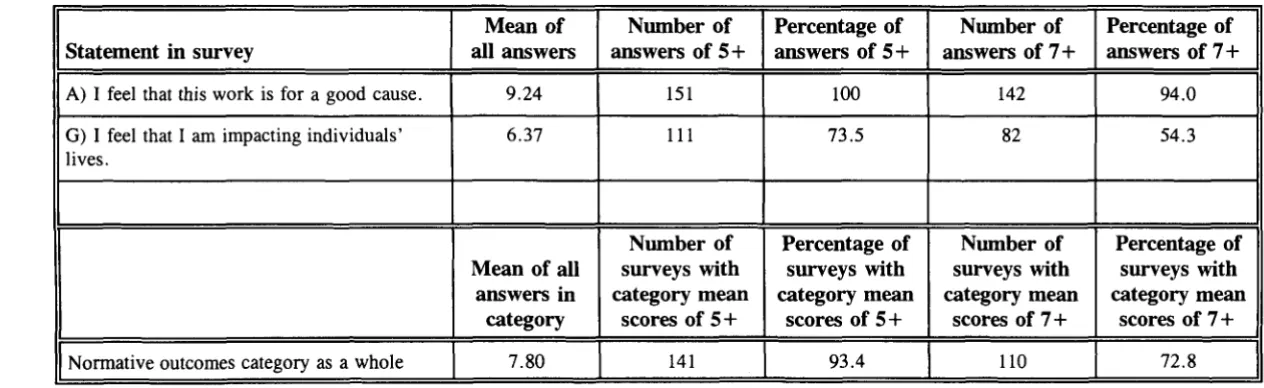
A) I feel that this work is for a good cause.
G) I feel that I am impacting individuals' lives.
Rational Motive Statements:
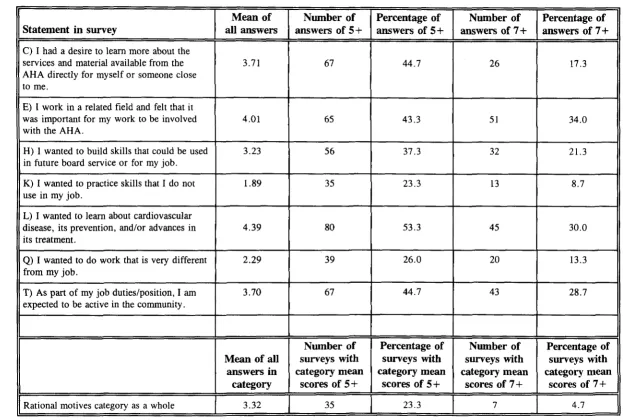
C) I had a desire to learn more about the services and material available from
the AHA directly for myself or someone close to me.
E) I work in a related field and felt that it was important for my work to be
involved with the AHA.
H) I wanted to build skills that could be used in future board service or for
my job.
K) I wanted to practice skills that I do not use in my job.
L) I wanted to learn about cardiovascular disease, its prevention, and/or
advances in its treatment.
Q) I wanted to do work that is very different from my job.
T) As part of my job duties/position, I am expected to be active in the
Rational Outcome Statements:
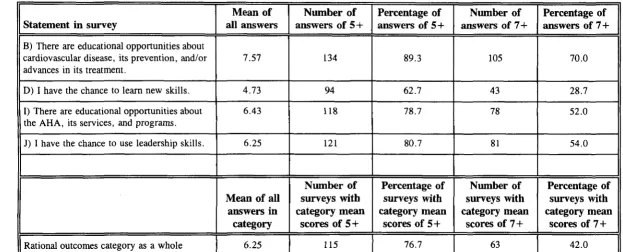
B) There are educational opportunities about cardiovascular disease, its
prevention, and/or advances in its treatment.
D) I have the chance to learn new skills.
I) There are educational opportunities about the AHA, its services, and
programs.
J) I have the chance to use leadership skills.
Affiliative Motive Statements:
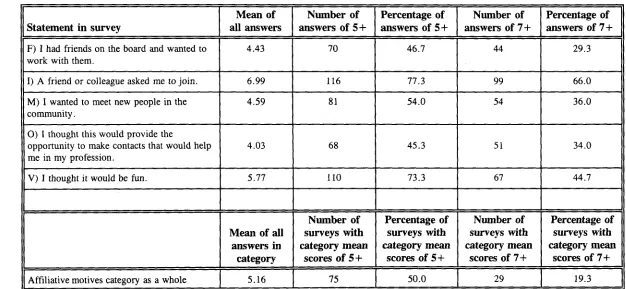
F) I had friends on the board and wanted to work with them.
I) A friend or colleague asked me to join.
M) I wanted to meet new people in the community.
0) I thought this would provide the opportunity to make contacts that would
help me in my profession.
V) I thought it would be fun.
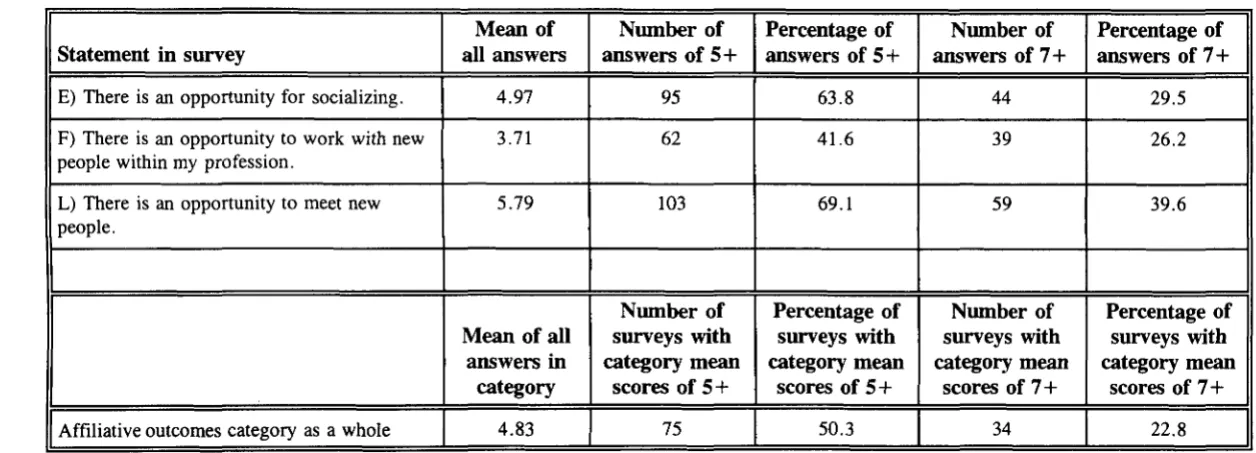
Affiliative Outcome Statements:
E) There is an opportunity for socializing.
F) There is an opportunity to work with new people within my profession.
L) There is an opportunity to meet new people.
Status Motive Statements:
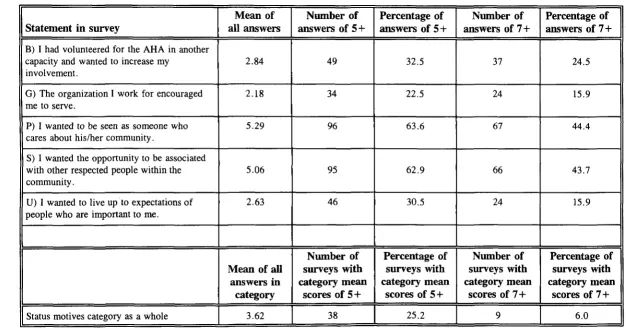
B) I had volunteered for the AHA in another capacity and wanted to increase
my involvement.
G) The organization I work for encouraged me to serve.
P) I wanted to be seen as someone who cares about his/her community.
S) I wanted the opportunity to be associated with other respected people
U) I wanted to live up to expectations of people who are important to me.
Status Outcome Statements:
C) I feel appreciated by staff and other volunteers.
H) I have positive feelings because of public recognition of the AHA's work
in the community.
K) I receive personal public recognition as a board member.
Treatment of the Data
The survey responses were analyzed according to four categories of potential
motivational factors and incentives. From each of the two sections of the survey containing
zero-to-ten-based scales, mean scores for each question were calculated, as were overall
scores for the four categories described above. The results were used to record descriptive
information about the factors that initially motivated these volunteers to participate as well as
about the degree to which certain areas considered to be potential incentives are actually being
provided by the organization.
The results of the questions about motivating factors were compared to the results of
the questions about potential incentives to determine whether there is a match between the
volunteers' motivations and the fulfillment of these potential interest areas. The results of this
comparison provided information on whether the experience of volunteering in the capacity of
board member for the AHA is meeting the needs of these board members according the areas
of interest to them.
The sections in which the subjects prioritized the five most important statements
within the areas of motivation allowed descriptive information to be gathered that would not
area of incentives allowed comparison between the items subjects selected as the most
important and whether they are being fulfilled.
The information received about the volunteers' demographics, volunteer backgrounds,
and motivating factors was included in the results as a description of current board members.
This information enabled the AHA to know more about who is volunteering for this specific
role and why. Such information can be used to evaluate current recruitment and retention
practices or to determine them for future application as deemed appropriate.
Chapter 4: Results
A total of 152 surveys were returned from the two survey mailings to 227 individuals,
amounting to a 67 percent return rate. The number of individuals answering specific
questions varied, and the results reflect this. Rather than disqualifying an entire survey that
was incomplete, the calculations that follow are based on the number of answers in each
specific category.
Demographic Information
The survey recipients were asked several questions intended to gather demographic
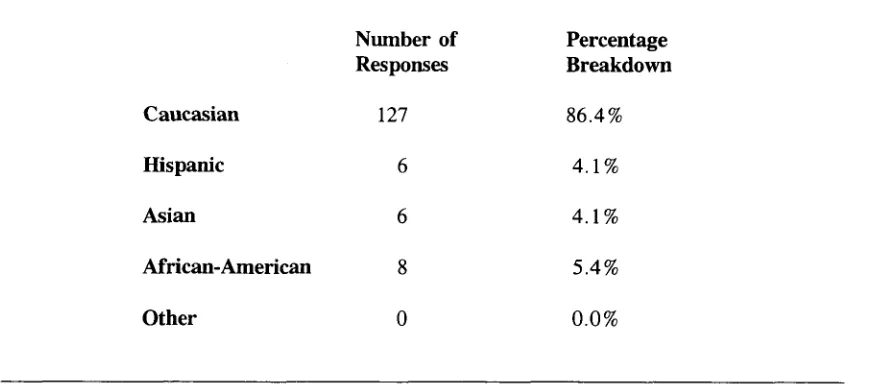
information. In general, the boards are made up of more women than men, more Caucasian
people than any other ethnicity, with a majority of individuals falling into the mid-to-upper
forties age range. Gender was indicated by 148 survey recipients. Fifty-nine of the 148
board members were male, totalling 39.9 percent, and 89 were female, totalling 60.1 percent.
Age was indicated by 146 survey recipients. The age of the board members ranged from 26
to 70, with the mean being 48.84, the median being 48.50, and the mode being 46.00.
Table 1
Ethnicity Demographics
Caucasian
Hispanic
Asian
African-American
Other
Satisfaction Levels
Number of Responses
127
6
6
8
0
Percentage Breakdown
86.4%
4.1 %
4.1 %
5.4%
0.0%
The survey recipients were asked to indicate their general satisfaction with their
service as a board member for the AHA on a zero-to-ten scale. They were also asked to
explain why, and were given room to explain why they might or might not be particularly
satisfied. General satisfaction level was indicated by 148 survey recipients. The mean
satisfaction level was 6.06, the median 6.00, and the mode 5.00.
Of the 148 respondents giving a numerical rating for their general satisfaction, 109
also wrote comments in the section that asked them to explain their rating. All responses are
included in Appendix D, organized according to the satisfaction level indicated. Some general
themes were found among the comments, although there was not necessarily consistency
between these themes and the general satisfaction ratings given. Nor were there clearly more
positive or negative comments. Comments containing similar sentiments fell across the
satisfaction level spectrum. The most commonly expressed thoughts, along with the number