DEMOGRAPHIC RESEARCH
VOLUME 33, ARTICLE 12, PAGES 327–362
PUBLISHED 25 AUGUST 2015
http://www.demographic-research.org/Volumes/Vol33/12/ DOI: 10.4054/DemRes.2015.33.12
Research Article
Commitment and the changing sequence of
cohabitation, childbearing, and marriage:
Insights from qualitative research in the UK
Ann Berrington
Brienna Perelli-Harris
Paulina Trevena
This publication is part of the Special Collection on “Focus on Partnerships: Discourses on cohabitation and marriage throughout Europe and Australia,” organized by Guest Editors Brienna Perelli-Harris and Laura Bernardi.
© 2015 Berrington, Perelli-Harris & Trevena.
This open-access work is published under the terms of the Creative Commons Attribution NonCommercial License 2.0 Germany, which permits use, reproduction & distribution in any medium for non-commercial purposes, provided the original author(s) and source are given credit.
1 Introduction 328 2 Changes in family formation and attitudes in the UK 330 3 Commitment in cohabitation and marriage 331 3.1 Conceptualizations of commitment 332
3.2 Expressions of commitment 333
4 Data and methods 334
5 Findings 336
5.1 Commitment in cohabitation and marriage 336
5.1.1 Men’s lack of commitment 340
5.2 Expressions of commitment 342
5.2.1 The wedding 342
5.2.2 Marriage and changes to social identity 343 5.2.3 Commitment and family tradition 345 5.2.4 Other expressions of commitment 346 5.3 Interplay between commitment and the new sequence of family
events
347
5.3.1 Journey of commitment 348
5.3.2 The ordering of events 349
5.3.3 Preferred sequencing of family events among high and low educated
350
6 Conclusion 352
7 Acknowledgements 357
Commitment and the changing sequence of cohabitation,
childbearing, and marriage:
Insights from qualitative research in the UK
Ann Berrington1
Brienna Perelli-Harris2
Paulina Trevena3
Abstract
BACKGROUND
In the United Kingdom, standard, traditional sequences of family events have been replaced by a de-standardized life course; marriage is postponed and no longer necessary for childbearing; unmarried cohabitation has increased. New sequencing raises questions about the meaning of cohabitation and marriage in peoples’ lives. OBJECTIVE
We ask whether, and to what extent, the new sequencing of life events implies a shift in commitment in cohabitation, potentially giving rise to new expressions of commitment and understandings of cohabitation.
METHODS
We analysed data from eight focus groups conducted in Southampton, England, by deductively following major themes outlined in the cross-national focus group guidelines, and inductively using themes raised by the respondents themselves.
RESULTS
Personal commitment is similar in cohabiting and marital relationships, although marriage is perceived to embody greater moral and structural commitment. Since marriage is no longer required as a public display of commitment, the wedding has become more important as a symbolic event. Public displays of commitment are increasingly occurring in other ways, such as childbearing and joint mortgages, demonstrating that cohabiting couples can be as committed as married couples. Although couples discussed ways in which commitment could grow over time, this progression was not necessarily talked about in relation to the timing of childbearing.
Highly educated groups seem to have a greater expectation than less educated groups that childbearing will follow marriage.
CONCLUSIONS
Commitment levels are no longer ascribed solely by union type, but rather by other life events and the couple’s own perceived level of commitment.
1. Introduction
In the UK, the standard, traditional sequence of family events has become far less dominant, to be replaced by a complex and de-standardized lifecourse (Berrington 2003; Elzinga and Liefbroer 2007; Billari and Liefbroer 2010; Perelli-Harris and Lyons-Amos 2013). Marriage is no longer necessary for childbearing, childbearing is sometimes postponed, unmarried cohabitation is becoming more prevalent before marriage and as a setting for child-rearing, and more partnerships, even those producing children, often end in dissolution (Berrington 2001; Kiernan and Smith 2003; Beaujouan and Ni Bhrolchain 2011). These complicated sequences raise questions about the meaning of cohabitation and marriage in peoples’ lives: do people consider cohabitation and marriage to be similar or are they still distinct types of relationships? It also raises questions about the role of commitment in relationships. Investigating the role of commitment is important for understanding interdependencies within relationships, joint investments in relationships, as well as long-term union stability (Brines and Joyner 1999, Burgoyne et al. 2010). Previously, marriage signalled that a couple was committed to a life-long relationship, at least on the day of the wedding. Today, however, cohabiting relationships can also entail high levels of commitment, especially because cohabitation has begun to take on many other functions of marriage – such as maintaining a home, childbearing and childrearing. Thus, as the sequencing of family events has become more complex and cohabitation has become a standard part of relationship formation, it is important to investigate how processes of union formation and childbearing decision-making are now interrelated, and the role of commitment in shaping these processes.
(Wiik et al. 2009). The quantitative research has emphasized that cohabitors are a heterogeneous group; for example one study in the Netherlands found a variety of different levels of legal and interpersonal commitment (Poortman and Mills 2012). Quantitative survey research has also revealed differences in opinion about the level of commitment in cohabitation and marriage; for example, nearly two-thirds of British respondents thought that living with a partner showed the same level of commitment as marriage (Duncan and Philips 2008). In addition, qualitative research from the UK has emphasized the role of commitment in relationships, especially in contrast to increased individualization (Lewis 2001; Carter 2012). Thus, studying commitment has been an important way to better understand the emergence and meaning of cohabitation.
Nonetheless, these studies have not explicitly engaged with changing attitudes and social norms associated with cohabitation in relation to new patterns of family formation (Heckhausen 1999). Social norms concerning the appropriate timing and sequencing of life events remain central to understanding demographic behaviour (Liefbroer and Billari 2010). Social norms relate to prescriptions or proscriptions about behaviour, and are supported through consensus (at least within a sub-group of the population). They may be enforced through social sanctions, but external enforcement may not be required if norms have been internalised via socialisation in childhood (Liefbroer and Billari 2010). For example, the ways in which men and women from different educational groups talk about marriage and cohabitation will, in part, reflect different social norms within different population subgroups. Given the rapid increase in childbearing within cohabitation (ONS 2014a) and further increases in partnership instability (Beaujouan and Ni Bhrolchain 2011), it is important to examine the development of attitudes and normative beliefs associated with cohabitation in relation to the new complexity of family formation.
In this paper, we use new evidence from a series of focus groups undertaken in Southampton, a socially diverse, medium-sized city in the South of England. This research was conducted as part of a larger international research project aimed at comparing discourses on cohabitation and marriage (see Perelli-Harris et al. 2014). Focus groups can produce a broader as well as more in-depth understanding of attitudes and norms. The group interaction can encourage memories, discussion and debate (Wilkinson 2003; Hennink 2007). In this study, focus groups are useful for eliciting information on the different ways in which people talk about cohabitation and marriage, and permit a better understanding of individuals’ beliefs and attitudes about changing family lifecourses.
potentially giving rise to new expressions of commitment and understandings of cohabitation?”
Drawing on previous conceptualizations of commitment, we investigate whether people talk about relationships as a “journey of commitment” that implies a natural progression from cohabitation to marriage. We also discuss whether participants express particular ideals for sequencing life events and the role of alternative forms of commitment, such as children and buying a home together. Finally, because our focus groups were stratified by gender and education, we can see the different ways in which men and women from different educational backgrounds talk about the timing and sequencing of cohabitation, marriage and parenthood. Taken as a whole, this study provides substantive details about new processes of union formation in the UK, but also provides general insights into how the meaning of commitment is shifting as cohabitation becomes commonplace in the life course.
2. Changes in family formation and attitudes in the UK
destandardization of the lifecourse. The UK has one of the more heterogeneous patterns of union formation in Europe (Perelli-Harris and Lyons-Amos 2013).
These behavioural changes are mirrored by large shifts in attitude. Of those born in the 1940s, 62% thought people should marry before having children, compared to 34% among those born in the 1960s, and only 28% born in the 1980s (Park and Rhead 2013). The majority of the UK population see little difference socially between being married and living together (Duncan and Philips 2008). This perception may be spurred by a “common law marriage myth,” or the perception that people who live together for a period of time have the same rights as married couples. Nearly half of the population believe this myth, despite the fact that cohabitation is not recognized by law to the same degree as marriage, especially with respect to inheritance, or to separation (Barlow 2006). Nonetheless, the acceptance of new behaviors does not necessarily suggest that individuals prefer or adopt these behaviours for themselves. In particular, educational level or social class may be important for shaping attitudes and norms. For example, individuals in professional occupations are more likely to prefer the traditional order of marriage before childbearing (Duncan and Smith 2006; Duncan and Phillips 2008), and the highly educated are more likely to have a birth within marriage than those who are less educated (Berrington 2001, 2003; Kiernan and Smith 2003; Perelli-Harris et al. 2010). Thus, while the UK population may becoming more accepting of new sequences of family life events, the practice of new sequences may not be occurring among all groups.
3. Commitment in cohabitation and marriage
This focus on the individual, however, generally negates the need for relationships that are bound by commitment. In the UK, both quantitative and qualitative research has contested the individualisation thesis (Lewis 2001; Jamieson et al. 2002; Duncan et al. 2005; Duncan and Smith 2006; Carter 2012), arguing that “commitment cannot be abandoned so quickly to individualisation” (Carter 2012, p. 138). By examining commitment in intimate relationships, UK scholars have defined and deepened the understanding of how individuals understand commitment in marriage and cohabitation, and fundamentally challenged the idea that commitment in relationships has declined (Lewis 2001; Jamieson et al. 2002; Carter 2012). Cohabiting couples can be committed to their partners, but the expressions of commitment are multi-dimensional and depend on circumstances (Jamieson et al. 2002). Here we draw on these studies to better understand how commitment has been previously conceptualized and expressed in the UK, and in order to see whether they resonate in our focus group research.
3.1 Conceptualizations of commitment
Carter (2012) summarized previous conceptualizations of commitment, which capture different dimensions of and perspectives on the concept. The discrete model of commitment, originally developed by Johnson (1991) and adopted by Lewis (2001) and Duncan et al. (2005), delineates three dimensions: personal commitment; moral commitment; and structural commitment. Personal commitment is based on how attracted a person is to the partner (expressed often in terms of romantic love), or to the social identity which is conferred by being in the partnership. Moral commitment reflects the notion that the individual should stay in the partnership, through moral obligation to the partner or the partnership. Structural commitment expresses whether individuals feel they have to stay in a partnership due to fear of the social, financial, and emotional costs of ending the relationship.
These different definitions of commitment have implications for our understanding of relationships. In general, the UK studies have emphasized heterogeneity in expressions of commitment and how it can change across the life course and over the course of relationships (Smart and Stevens 2000, Jamieson et al. 2002). Duncan et al. (2005) found that the majority of their cohabiting respondents discussed a personal dimension of commitment: they wanted the relationship to continue. However, some respondents did not express this type of commitment, especially following an unexpected pregnancy, and instead relied on the moral-normative or structural commitment types of commitment to keep their relationships intact, especially if the relationship was weak. Smart and Stevens (2000) only interviewed men and women whose previous cohabiting relationships had dissolved, but they still found examples from across the commitment continuum. Couples with mutual commitment tended to presume that the relationship would last, whereas for those contingently committed, this was only a hope. After interviewing her informants, Carter (2012) found that the concept of commitment went beyond Smart and Steven’s (2000) two-dimensional continuum scale and was closer to Smart’s (2007) view of commitment as a process that ebbs and flows. Jamieson et al (2002) also found that her in-depth interviews allowed respondents to talk about the process of commitment, and how it can grow or falter over time.
3.2 Expressions of commitment
Previous UK qualitative research found that cohabitors often express and value commitment according to different definitions. Children can be a sign of commitment, both in terms of public commitment (others may perceive of children as a sign of a close relationship) and as private commitment (children can create deep bonds between parents) (Lewis 2001). Children require an investment in the relationship and an orientation toward the future, since partners desire a relationship that will last (Carter 2012), although commitment might be more contingent in the case of unplanned pregnancy (Smart and Stevens 2000).
In addition, past research based on in-depth interviews has discussed the role of children in relationships in terms of pregnancy triggering entry into cohabitation (Smart and Stevens 2000; Lewis 2001), and decisions as to which surname to use for children within cohabiting families (Duncan et al. 2005). Nonetheless, it is less clear how these themes are expressed with respect to more general social norms about the role of cohabitation, and what types of conclusions we can draw based on differences in cohabitation and marriage generally. Hence, in this paper we use focus group discussions to better understand views and beliefs about commitment in marriage and cohabitation and how the new ordering of family events shapes these.
4. Data and methods
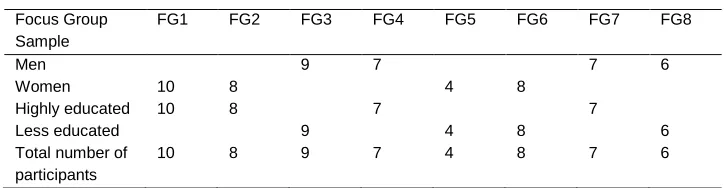
Our data collection followed the research design developed by the Focus on Partnership team, whereby a standardized focus group guideline directed the focus group discussions.4 Four all-male, and four all-female focus groups (FG) were conducted with individuals aged 25 to 40 who held British citizenship. Within each gender, we distinguished two groups of those with higher education, and two groups of those with less education (Table 1) (defined as below and above Advanced Levels, primarily with university education). Participants had a variety of relationship statuses and histories: just under half had married, four had divorced, nine were currently cohabiting, and the remainder were not currently in a co-residential partnership. Within all the partnership groups, some were parents, others were childless. Given the complexity of past relationships, we are unable to specifically use partnership status in our analysis of general focus group discourses.
The aim of the focus group research was not to go in-depth into individuals’ partnership histories, but to understand how individuals perceive and view cohabitation and marriage in modern Britain. Of course, respondent’s accounts and the dialogue with others in the group reflects their personal and vicarious experiences in these areas.
Participants often drew on their own lifecourses, but also on the experiences of other relatives and friends. Often participants contrasted their own experiences with (generally more traditional) family formation patterns of their own parents. Focus groups are very useful for eliciting discussions between individuals (Wilkinson 2003) and often we found that participants were happy to debate an issue, for example, whether cohabiting unions were harder to dissolve than marital unions, without intervention from the moderator. In focus groups it can be those with the loudest voice and strongest opinion who are heard most. We tried to counterbalance this tendency though the moderator inviting quieter participants for their thoughts.
Table 1: Focus group participants according to gender and education
Focus Group Sample
FG1 FG2 FG3 FG4 FG5 FG6 FG7 FG8
Men 9 7 7 6
Women 10 8 4 8
Highly educated 10 8 7 7
Less educated 9 4 8 6
Total number of participants
10 8 9 7 4 8 7 6
The focus groups were conducted in Southampton, a medium-sized port city on the southern coast of the UK (population around 236,000 individuals). According to 2011 Census data, almost one quarter of employees in Southampton are in public sector jobs – slightly higher than the average for England, reflecting the presence of two large universities in the city. Recruitment and fieldwork for this study were carried out in 2012 in two socio-economically diverse areas of Southampton. The first is ethnically diverse and characterised by an above-average education profile, youthful age structure and large percentage of private home renters. The second is more ethnically homogenous, predominantly white, with a higher proportion living in state-subsidized housing. The recruitment strategy included distributing leaflets, putting up posters on community noticeboards and other public places, advertisements in a local newspaper, notices on local community websites, and through social media. Focus groups were moderated by Trevena and observed by Berrington.
then agreed upon a single set of coding, initially following a deductive approach. First we coded major themes that were outlined in the focus group guidelines. Subsequently we coded themes raised by the respondents’ themselves (such as the importance of tradition and socialisation in childhood) and sub-themes relating to views and experiences that were recurrent in the data (such as the “correct” ordering of life events). This iterative method allowed us to draw out the most salient themes of the focus group discussions.
5. Findings
5.1 Commitment in cohabitation and marriage
The concept of commitment was essential to understanding perceptions of cohabitation. However, participants in our focus groups did not necessarily discuss commitment in the same way as noted in previous work. In fact, we found that the way in which participants discuss commitment indicates overlapping frameworks. For example, Jamieson et al (2002) make a distinction between private and public commitment, but in our focus groups, it is not always clear whether participants would make this distinction, especially when thinking about the personal commitment that reflects their commitment to each other. Johnson’s (1991) framework, which outlines personal, moral and structural commitment, does not explicitly focus on the expression of commitment, especially by those outside of the couple, which we found to be an important theme in our focus groups. Finally, previous UK work rarely discusses the importance of family and tradition in expressions of commitment, themes which emerged repeatedly in our focus groups. Hence, here we provide an alternative framework for our results that reflects the main themes emerging from the focus groups. First, we explore a perceived hierarchy of general commitment which tends to suggest that marriage is the ultimate commitment. We then explore different dimensions of commitment – personal, moral and structural, which may be expressed simultaneously within one statement. Finally, we look at how commitment is manifested in marriage and cohabitation and how commitment is judged by others external to the couple, particularly with respect to family and tradition.
marriage was superior to cohabitation. This hierarchy also emerged when they contrasted “being married” to “just living together.” Sue, in this quote, expressed the opinion that marriage has higher levels of commitment than cohabitation:
Well it [marriage] is a real statement. It’s a statement to everybody that we are together and we’re committing to be together, whereas you’re not doing that if you’re just living together. (Sue, highly educated)
While most participants referred to marriage as taking the next step in a relationship, cohabitation was often seen as “not such a serious step.” Natasha argued that marriage is associated with “wholly committing” oneself to someone rather than “just cohabiting.” She wondered whether some of her peers may have been put off marriage by the experience of parental separation:
I would like to get married…and to make that commitment to somebody, whereas friends who have come from broken homes themselves sort of don’t see the point and would rather have the freedom to be able to just live with somebody rather than commit wholly to them through marriage. (Natasha, highly educated)
Many focus group participants held on to a romanticized view of marriage, in which the wedding is a declaration that “this is the one.” In addition, participants referred to marriage as a “promise”, that entailed an expectation of permanency.
I think there’s a lot of hope attached to marriage, it’s like “From here on in” and there’s something quite lovely about that. (Natasha, highly educated)
Most of the way that commitment has been expressed so far can be conceptualized as “personal commitment”, or the extent to which individuals want to stay in the partnership (Johnson 1991). Personal commitment can also relate to feelings of psychological security, and some (more often female) focus group participants argued that being proposed to and getting married provides important emotional or psychological security. George likens marriage to becoming part of a team which is expected to remain intact providing mutual support:
Nonetheless, most focus group participants endorsed the view that couples can personally commit to one another in cohabitation, or “without a piece of paper.” The discussion below between Holly (a single mother) and Megan (a cohabiting mother) is typical, and reflects the general acceptance in the UK of cohabitation as a relationship that involves a high level of commitment, but may not be preferred by all. Holly supports cohabitation as a partnership form, despite indicating that she personally would prefer to marry. Holly’s response is very typical of the highly educated men and women in our focus groups – a theme to which we will return in section 5.4.
Holly: I think you can commit [in cohabitation]. I mean, personally I would like to get married but I can see the flipside that you can commit without the piece of paper.
Megan: It [marriage] doesn’t change anything.
Holly: It doesn’t change anything at all. And I can totally understand where couples are coming from that say, ‘We’re going to be together regardless…I’m proving my commitment by living my life with them and sharing everything I have with them, we don’t feel the need to get married.’ (FG2 highly educated)
Some participants even argued that cohabitation entails a larger commitment than marriage, since whether or not a couple remains together is an “expression of free choice” rather than being based on promises made within wedding vows:
If you are together and you’re not married it almost says more, doesn’t it, because you’re not together because of that bit of paper, you’re together because you’re together. (Mark, low education)
One of the ways in which the moral conceptualization of commitment emerged was with respect to promises and vows. Richard emphasises the promise made when taking wedding vows and the moral obligation to continue within a marriage. This promise is made not only to his partner, but to the wider community, and the ring is a symbol of that promise.
Maybe [you] would work harder if you’ve got a ring on your finger and, you know, there’s something, again maybe just psychological, something saying well, I’ve promised to spend the rest of my life with this person, I best really try. (Richard, highly educated)
Julie and Monica also agree that couples would work harder at a marriage, because it is a greater moral and structural commitment. In this instance Julie emphasises the moral and social obligations which arise from the expense of an elaborate wedding, for which she paid most of the costs.
Julie: I think you’re more inclined to go [if cohabiting], I have got married, so I’ve got to deal with this. That’s me anyway.
Monica: It’s more of a commitment.
Julie: I’ve bothered to get married and it cost me a lot of money, so I’m going to sort it out, whereas if you’re not married and they really do get on your nerves, you could more easily get out of it. (FG6, low education)
Structural commitment was also perceived by most focus group participants as stronger in marriage, especially the perceived difficulty of ending a marriage, as mentioned by Julie at the end of the previous quote. Many participants, both those with higher and with lower education, suggested that the financial costs of divorce are higher because of the need to involve lawyers and the courts. Natasha suggests that in comparison to separating from a cohabiting partner, divorce is more painful and expensive.
Financially if you were then living with somebody and then you realised they had a gambling habit or the fact that you just really couldn’t get on you don’t have to go through the painful and very expensive process of divorce. (Natasha, highly educated)
marriage and having to admit to having been divorced was viewed more negatively than having ended a cohabitation partnership.
In summary, while focus group participants did not consider personal commitment to be exclusive to marriage, they did perceive differences in the moral obligation cohabitors and married couples feel to their relationships. Once couples marry, they are more likely to work at their relationships in order to stay together. In addition, the structural commitment clearly differs between marriage and cohabitation, since informants perceived marriage to be harder to get out of due to the financial costs, the involvement of courts and lawyers, and the stigma, which has not completely disappeared in the UK.
Nevertheless, it is important to note that some participants still expressed a fundamental scepticism toward the institution of marriage, and argued that cohabitation was in fact a sign of greater commitment. High divorce rates contributed to this scepticism, leading some to question whether marriage is really the “ultimate commitment.” Emily’s contribution is typical:
I don’t think people have got as much faith in marriage either anymore… It’s not a forever thing anymore, is it, whereas before it was more of a commitment than nowadays. (Emily, low education)
In fact, Anthony suggests that cohabiting couples are more likely to have strong personal commitment precisely because they are not bound by the same level of moral obligation or structural commitment associated with marriage:
Cohabiting means that you know that you’re there for the right reasons and not purely because a piece of paper you signed ten years ago is requiring you to remain. (Anthony, highly educated)
Thus, despite the prevailing opinion that marriage represents a greater sense of commitment, especially with respect to moral and social commitment, these particular responses reflect a fundamental shift in how cohabitation can be perceived not only as a type of relationship which can be committed, but also as a relationship which can transcend marriage, because it is less constrained by the external moral and structural obligations that force two people to remain together.
5.1.1 Men’s lack of commitment
in the UK are often reluctant to commit themselves to marriage. This reluctance was expressed as men being scared of commitment, not seeing the point of marriage, or being less interested in the big wedding day. For example, in response to the first question of the focus group guideline “More and more couples are living together without being married… why do you think this is happening?” two participants in FG6 immediately responded:
Laura: Because men don’t want to get married. Lori: Afraid of commitment. (FG6, low education)
In response to the question of why couples might cohabit for a long time, Natasha and Susan agree that some couples may be cohabiting because the male partner did not want to marry.
Natasha: I’ve noticed with some of my friends it’s actually been the men who’ve resisted and the women of the partnership want to get married. So they will compromise to stay with that man by not marrying.
Susan: Yeah it’s much rarer to have a couple who are both genuinely happy with living together and not getting married I think. (FG1 highly educated)
Both highly and less educated men admitted that, often, men do not want to “settle down”, or commit to a single relationship. In the following discussion, Mathew discusses his friend who was happy to live with but not to marry his partner. Jonathan suggests that in modern societies, we are used to having a wide range of options, and are no longer as committed to one thing. Tim wonders whether men may be afraid of marriage, since by committing themselves to one person, they might miss an opportunity to upgrade when a better option comes along:
Mathew: I guess it’s that security of having someone and being committed to a certain level but not wanting to take the plunge. Jonathan: I think it may reflect society more broadly in that today in
society we have a lot more choice in every area of life, whether it’s work, travel, products… We’re not as committed to necessarily one thing as we are a multitude of options.
always being told to seize the moment and go for the biggest and the best. (FG7, highly educated)
Our findings suggest that in the UK the importance placed on marriage (especially the wedding event) generally differs by gender. Focus group participants described men as less willing to commit to a single partner than are women, for fear of missing out on a better option.
5.2 Expressions of commitment
The previous sections focused on personal, moral, and structural commitment, which tend to reflect how couples perceive commitment within their own relationships. However, a couple’s level of commitment is not always obvious to people outside the relationship. Therefore it is important to examine the ways in which couples express their commitment, especially now that marriage is no longer essential.
5.2.1 The wedding
Almost all focus group respondents felt that the purpose of the wedding is to make a public declaration of love and commitment. In response to the interviewer’s question on whether marriage will disappear within 50 years, Daniel notes the importance of a public promise:
Whatever it turns out to be in the future, our conception of marriage, I think there will still be something like that in the future, some public display of promise. (Daniel, highly educated)
Many of the discussions reflect Smart’s (1997, p. 69) “future oriented commitment,” which encompasses this idea of a public promise “based upon the experience of falling in love and feeling the other person to be the one.” Below, Sara reflects on why she decided to marry, despite having seen her dad cohabit happily with his new partner for 25 years following a divorce from her mother.
According to focus group participants, the wedding symbolizes the aspired-to “fairy tale ending,” which remains pervasive across society. The majority of couples who were married or who were considering marriage wanted to do it “the proper way” and have a “proper wedding”. As seen in previous research findings for the UK (Jamieson et al. 2002; Carter 2012), “proper weddings” were conceptualised as weddings which are large, ritualised events, and not small affairs at the registry office. Nonetheless, it is important to remember that the desire to marry is not all about a desire to express commitment. Focus group participants also extensively discussed the wedding itself. They mentioned how socialisation in childhood, in particular through fairy tales and Disney films, perpetuated marriage as an ideal, and the traditional wedding as something to which one aspired. As Julie notes below, she was socialized in childhood to believe that getting married is what girls do when they grow up.
Thinking back to when I was ….a little girl, you do assume you’re going to get married some day and it’s there in all the fairy stories and on the TV and everything. There was that, kind of assumption from when I was very, very small that that’s just what girls do, basically, when they grow up. (Julie, highly educated)
Hence, getting married and having a wedding are not only displays of public commitment, but also a reflection of social norms. This popularity of marriage (or a wedding) as a consumer event cautions us against viewing decisions about marriage purely in terms of individuals wanting to make a public declaration of commitment.
5.2.2 Marriage and changes to social identity
few months, remarks “I’m very aware that once we get married I will be an auntie, but at the moment I’m not.”
In the UK individuals are asked for their title, e.g., Mr., Mrs., or Miss, when undertaking many day to day tasks or filling out forms. Unlike adult men, whose title remains “Mr.” whatever their marital status, women have a title-change upon legal marriage from Miss to Mrs, and divorced women sometimes use Ms. Thus in everyday life, the legality of partnership status can have an impact on women’s social identity. Some of the less educated women agreed that being married conferred a different status and allowed them to take greater control of their household; for example, they could talk to utility companies on behalf of the whole family.
Issues surrounding the family name were raised spontaneously in all the focus groups. First, a few women discussed surnames in the context of not wanting to relinquish their personal identity upon marriage by taking their husbands’ surname. Second, a shared family surname was frequently cited as an advantage of marriage. Respondents mentioned that uncomfortable situations may arise if children have different surnames than their parents. To many, a common surname seems to strengthen the family unit, as Dawn explains:
I feel like I’m providing more security in some way, a family unit, with the same name. (Dawn, highly educated)
This importance of having the same family name is intensified by the reaction of others, especially in social situations. Some of the focus group participants whose children held different surnames from them or their partner talked about experiences with their children’s schools. Sometimes the different names caused confusion; often assumptions were made by the school that the couple was married. One cohabiting father said that he was quite happy with cohabiting rather than marrying the mother of his child, since he was able to give his child his surname. Therefore, surnames still seem to be important for social identity and in identifying the commitment-level of the family.
5.2.3 Commitment and family tradition
Focus group participants not only saw that marriage was an expression of commitment made publicly, but also an expression of commitment that linked families together, as well as providing a sense of historical continuity. In response to a direct question on whether the institution of marriage would still exist in 50 years, the majority of focus group participants thought it would, often because they saw it as an important link to tradition. Dawn argues, for example, that marriage will be around for many years to come:
It’s just embedded in so many traditions, family history and religion and… It’s in everything and I think it will take a very long time to work out of that, if it’s going to, longer than fifty years. (Dawn, highly educated)
As discussed above, the wedding, and especially a church wedding, prevails as one of the enduring images of true commitment. A number of focus group participants, particularly in the highly educated group, mentioned that they and their friends wanted to marry in a church, even though they were not religious. However, some married in church because of the family’s image of what the big day should look like, rather than the couple’s. Megan, who married in a church, recollected:
I’m not religious at all (…) I said I would never get married in a church, and it was because of the family pressure, even though none of them are religious, it was ridiculous. But there was this family pressure about, ‘Ah, well it’s the church where Mark was christened’…(Megan, highly educated)
The importance of other family members in decisions about whether and how to marry were very salient. Family traditions can put pressure on couples to perform the wedding in a certain way. Below, Kevin suggests that the parents may be the motivating force in maintaining traditions, such as the symbolic gesture of the father handing the bride to her future husband. Kevin mentions that these traditions put pressure on a couple to have a traditional church wedding, even if they are not religious at all:
Interference from other family members, especially mothers and mothers-in-law, in the planning of weddings was a common theme in discussions of how family and peers influence decisions to cohabit or marry. For a few focus group participants, the desire to avoid the big wedding and the associated fuss led them to have a wedding overseas (a popular choice in the UK). Hence, despite the overall feeling that it is important for a couple to signal their commitment by paying attention to family and tradition, clearly some are rejecting the need to display their commitment, by avoiding a big wedding altogether.
5.2.4 Other expressions of commitment
Despite the discussion surrounding public displays of commitment, such as big weddings and the role of family and tradition, focus group participants also raised other expressions of commitment that could be more important than marriage. The notion that cohabitors can be committed in a variety of ways is shown by the discussion between Lauren and Dawn.
Lauren: People feel like they commit in other ways, like, say they bought a house or something like that, that feels like a big commitment to people, so it might feel that that would be enough of a commitment maybe.
Dawn: People just feel they don’t need a piece of paper to prove their commitment if they’re showing it in other ways, I think. (FG2, highly educated)
Some participants suggested that taking on a joint mortgage can indicate a greater commitment than does marriage. Right at the start of FG4, when the highly educated men were asked why they thought more and more couples are living together without marrying, Joshua responds:
I don’t think marriage is the biggest commitment people can make these days. I think one of the biggest commitments people make is like joint financial projects and the like, mortgages particularly, because that seems harder to get out of….. like with mortgages they’re for 30 years which may in fact last a lot longer than marriages. (Joshua, highly educated)
relationship broke up. Susan responded: “Well a mortgage is the same sort of seriousness of commitment.”
In many of the focus groups, the idea that having children together was more of a commitment than marriage arose spontaneously. For example, Bob identified the enduring commitment related to having children, especially when discussing his brother, who has had two children in a long- term cohabiting union.
He’s committed to his children, he’s committed to his partner, but he doesn’t feel that he needs that piece of paper...personally I think having children with somebody is more of a commitment, because if we were to have children together and split up, there’s always that common thing is the children. (Bob, low education)
Nonetheless, some participants still maintained that, even though cohabitors may have joint investments, including children, this still does not equal the commitment associated with marriage, as the quote from Ally demonstrates:
Even though they are committed because they might have a mortgage and they’ve got a child (…), in their head probably feel that they’re not committed because they haven’t actually got married. (Ally, low education)
As these comments show, public displays of commitment are increasingly demonstrated in other ways, demonstrating that cohabiting couples can be as committed as married couples. This type of commitment is not independently personal, moral, or structural, but instead embodies several elements of each. These new displays of commitment allow the couple to demonstrate their love in different ways, without marriage and without sequencing their lives in a traditional order. In the next section, we describe focus group participants’ discussions about how the sequence of family events is becoming increasingly de-standardized, a process which occurs simultaneously with the development of new public expressions of commitment.
5.3 Interplay between commitment and the new sequence of family events
expectations for the sequencing of life course events. In particular, we observed differences in the way in which these expectations were discussed in the highly educated and less educated groups, as discussed below.
5.3.1 Journey of commitment
Throughout the focus group discussions there was a tendency to refer to “progression” in relationships, similar to the way Jamieson et al (2002) and Smart (2007) discussed commitment as a process that ebbs and flows. For many, cohabitation was perceived as the next step following dating, and leading to marriage. Sometimes cohabitation is seen as a test-relationship prior to marriage, as is the case for Phil:
It’s a case of relationship, living together, engaged, married - so people see it as a process. It [cohabitation] is almost like a trial run, how are we going to get on when we live together, can we bear each other every day of the week…when talking about progression in a relationship, I think it [cohabitation] is certainly a step up from regularly dating and seeing someone and there’s obviously a stage before committing your life together. (Phil, highly educated)
Participants often talked about marriage as “taking the next step in the relationship,” or “taking the partnership to the next level” as in the following quote from Kenneth, who had cohabited for eight years prior to marriage:
I was with my ex for eight years before we actually married, and then we married because we thought that was the next step in the relationship. (Kenneth, low education)
5.3.2 The ordering of events
Although couples discussed how commitment could grow over time, resulting in a “journey of commitment”, this progression was not necessarily talked about in relation to the timing of childbearing. All focus group participants agreed that the quality of a relationship and ‘being settled’ were more important than life-stage in making the decision to get married.
For some respondents marriage was more of a capstone event, as suggested by Cherlin (2004) and Holland (2013). Kenneth talks about being in a position to marry, having already achieved parenthood and secure accommodation:
[I]t’s not like the old days where people had to get married if the kid came along. (…) See, we got married because we thought at the time that was the next natural progression in our relationship. We already had kids, we’d got a place, so we thought next thing is we’re going to get married. (Kenneth, low education)
Some respondents felt that a hurried wedding in response to a premarital pregnancy was not likely to last:
Well I think that ... the reason people get married is because they love each other… it shouldn’t be because you’ve got kids. If people are forced into a situation, it’s less likely to work, isn’t it? (Andy, low education)
A common response, especially among the less educated focus groups, was that people should get married whenever it feels right for them, and that marriage is no longer a requirement for childbearing.
It’s the reason for getting married as opposed to the timing when they get married that’s more important, you know, it should just be for the right reason, not just because you’ve got a child. (Judith, low education)
This different ordering of life course events can make cohabitation more difficult to dissolve. Below, Gina’s assumption that cohabitation was easier to walk away from than marriage is challenged by other participants. Amy and Elizabeth qualify Gina’s original statement, highlighting the complicating role of joint investments such as mortgages and children.
Amy: Unless there’s a joint mortgage.
Gina: Yes.
Elizabeth: Or a baby. (FG2, highly educated)
Emily also argues that whether or not cohabitation is easier to end depends on the couple’s circumstances, suggesting that cohabitors can be committed in many ways, including having a pooled income and joint investments.
I think it depends on your situation. I mean, if you’ve got a joint mortgage and all your bills are joint and everything, and you’ve got two incomes coming in, then you’ve still got to go through everything bar the paperwork of the divorce, really, if you’re going to separate. But if you’re in rented, perhaps, and, you know, you haven’t got so much commitment in that respect as well, then you don’t have so much to do when you separate than if you’re committed in a lot of other ways as well. (Emily, low education)
In summary, the focus group findings suggest that the increasing diversification of family trajectories, particularly the increase in nonmarital childbearing, and of divorce, has led to expressions of commitment other than a wedding to become more important. Joint investments such as children and mortgages often require a greater level of commitment over a long period of time, irrespective of whether the partnership dissolves.
5.3.3 Preferred sequencing of family events among high and low educated
Although liberal attitudes towards non-traditional sequencing of family events arose in all focus groups, we found persistent differences in how participants with high education and those with a low level of education talked about the relationship between commitment, cohabitation and marriage. The importance of marriage as a public statement of commitment appeared to be more important in the high educated focus groups, reflecting both a greater personal desire to take the “next step,” and also greater external pressure from family, friends, and wider social circles, as described by George:
The highly educated participants repeatedly discussed expectations from family and peer groups for individuals to follow a more traditional sequencing of family events. Catherine, a cohabiting mother, perceived a judgmental attitude towards her lifestyle choice. She describes the reaction to the news that she was pregnant, contrasting her experience with the more positive reaction that married mothers-to-be receive.
I do think if you tell people that you’re pregnant and you’re not married, they’re much more surprised. So, I think there’s generally an expectation – (…) certainly when I told people I was pregnant a lot of them said, ‘Oh, was it planned?’ (…) I had that a lot from my work colleagues and random people and apparently if you’re married people say, ‘Oh, congratulations!’ And I was very surprised that there was that difference. I’ve been with my partner for ten years so it’s not, like, I only met him last week. (Catherine, highly educated)
It is noteworthy that her work colleagues, among others, questioned her as to whether the pregnancy was planned, even though she had been in a stable partnership for ten years. This suggests that there is an expectation among those with higher levels of education that childbearing should wait until formal marriage.
In contrast, discussions in the less educated focus groups suggested that cohabitation as a type of family form, and not just as a precursor to marriage was more accepted. Below, Mark comments on general partnership trends in the UK:
The meaning of marriage has gone... I mean, if you look at it twenty-thirty years ago, it was – you used to do it. Whereas these days it’s just, the general consensus is that it’s not the norm to get married… people don’t feel the need to get married these days. (Mark, low education)
What is most striking about this quote is that Mark actually says that it is not the behavioural norm to get married. This sentiment, echoed by others from the focus groups of respondents with low levels of education, reflects differences by education in the lived experiences of couples, both within our focus groups sample and in the wider population in which childbearing while cohabitating is more common among less educated groups (Berrington 2001; Kiernan and Smith 2003; Perelli-Harris et al. 2010). Jenny (aged 28) reflects on the fact that she is unusual among her peer-group to have married. Nevertheless, her cohabiting friends are demonstrating their commitment through buying a house together and through the joint rearing of children.
own properties and probably about half of them had kids… (Jenny, low education)
Often, childbearing is not planned, as discussed by Bob, who notes that the birth of children within cohabitating partnerships means that financial and family commitments can take precedence over marriage.
Accidents happen along the way, you can be cohabiting and before you know it, you’ve got children that come along. Children take priority, and then getting married tends to take a back seat. It’s maybe something that you may wish to do later on, or after probably 20 years together, and that you think, oh we’re right as we are now, so what’s the point? (Bob, low education)
The less educated participants repeatedly mention that marriage is a low priority, relative to other financial and family commitments. In particular, the high costs of housing mean that the a traditional ordering of family events is no longer attainable, especially for those with low incomes, as Kenneth explains:
Where the housing market is so extortionate that a lot of people aren’t doing that first step of getting a house first, and then going on to the next step of getting married, then having children. A lot of them are, sort of, having the children, and cohabiting, because obviously they can’t afford that first step onto the property ladder before thinking about carrying on with, sort of, the next steps of marriage and family and things like that. (Kenneth, low education)
In summary, the highly educated groups in the UK seem to maintain a greater expectation that childbearing will follow marriage, reflecting individuals’ own preferences, but also family traditions and peer group norms which favour a traditional sequencing of events. The less educated, on the other hand, may want to marry, but consider it a low priority relative to other pressing needs.
6. Conclusion
Joshua’s reflections on the future of marriage encapsulate our finding that despite the decline in marriage, increase in divorce, and the rise of nonmarital cohabitation, people still have a need to show and feel commitment within relationships. Even though individualization may be increasing, commitment in relationships is still important, and most people have the intention to find and stay with a partner for the foreseeable future. This finding, consistent with evidence from previous UK cohabitation research (e.g., Lewis 2001) raises questions about the individualisation thesis of Beck and Beck-Gernsheim (1995) and Giddens (1992). Yet our study goes beyond debates about commitment versus individualization to examine how expressions of commitment reflect the increase in cohabitation and the new sequencing of life events. Not only have the order of childbearing, partnership formation, and marriage changed, but the broader set of life transitions, such as buying a house (or at least securing long term accommodation), have become more uncertain and postponed to later ages (Berrington and Stone 2014; McKee 2012). Thus, the traditional sequence of marriage, mortgage, childbearing is no longer relevant to a large segment of the population, and it is important to understand what commitment means, as relates to cohabitation and marriage.
Before reflecting on some of the key findings, we note some limitations to the study. Readers should be cautious of generalising from our eight focus groups conducted in (albeit mixed) neighbourhoods in Southampton to the rest of the UK. While Southampton is an average city in terms of income, the UK has a variety of important regional differences that could influence union formation. Also, our sample was relatively homogenous in terms of ethnicity; most respondents were white. Secondly, in the British focus groups, participants were very polite, and it is likely that focus group participants felt constrained in regard to expressing opinions, for example, about unmarried parenthood, so as not to offend others present in the room who might be in that situation. It is difficult to know whether the very high levels of acceptance of all family forms by focus group participants is an exaggeration of what nevertheless are very tolerant attitudes within British society. Notwithstanding these limitations, the focus group methodology allows us to describe the range of ways in which people talk about commitment in marriage and cohabitation. Furthermore, the interactions between focus group participants provides unique insights into how opinions are constructed as a result of discussion with other focus group respondents (Wilkinson 1998; Morgan 2010). In this way, the focus group discussions reveal the complex relationship between the new ordering of life events and the nature of commitment.
while cohabitation referred to as “just” living together. Participants spoke about progression in relationships, with the decision to marry representing “taking the next step”, or “making a natural progression.” Men were seen as sometimes reluctant to commit and “to take the plunge” into marriage.
Differences from previous findings may relate to the type of commitment examined, whether personal, moral, or structural (Johnson 1991). We found that cohabiting and married couples were perceived to differ less in terms of personal commitment, and more in terms of the greater moral and structural commitment that marriage entails. The symbolic role of the wedding, the public promise and the wedding expense, can result in a greater moral obligation to continue in a marriage. Furthermore, participants thought that ending a marriage entailed greater emotional, financial and practical difficulty than ending a cohabiting partnership. Therefore, in the UK, it is generally perceived that marriage conveys a greater expectation of permanency than cohabitation, and has higher costs if the relationship dissolves.
Nonetheless, despite the hierarchy of commitment, our findings suggest that the relationship between commitment, cohabitation, and marriage has changed over time, so that cohabitation can now reflect a much higher level of commitment than previously. Even though there may be a “natural progression” through relationships, the traditional markers of commitment (marriage, mortgage, childbearing) have moved and become less standardized. Although marriage is referred to as “the next step” in a relationship by our respondents, this step did not have to come at a particular point in the life course. Thus, ideas regarding “natural progression”, or “taking the partnership to the next level” were generally not talked about in relation to the timing of childbearing; instead, childbearing might occur anywhere along this “commitment journey”. For example, a number of respondents talked of “the natural progression” to marriage as something which they had done after having had children, or bought a house. Thus, increasingly, cohabitors are publically expressing their commitment through rearing children and in joint financial investments such as mortgages. As a result, for some couples the moral and structural barriers to dissolving a cohabiting partnership may have actually increased.
childbearing and rearing; participants may express preferences for the sequencing of family events in their own lives, but they are reluctant to comment on others’ choices. This ambivalence appears to signal a new ambiguity of social norms and an acceptance of alternative lifestyles. In addition, the perceived relationship between commitment, cohabitation and marriage can differ by social group. The highly educated participants, while simultaneously holding liberal and accepting attitudes towards non-marital partnerships and non-marital childbearing, tended to prefer a more traditional ordering of family life events for their own (future) families. For lower educated participants, on the other hand, cohabitation and childrearing within cohabitation was often seen as customary. Many less-educated participants believed that, nowadays, “nobody cares” whether couples are married or not. Nevertheless, marriage (or at least the wedding) was still generally perceived as “an ideal”, although one which is often difficult to achieve due to the high costs of a large wedding.
Whilst commitment is no longer organized in the standard ways of the past due to the increasingly complex sequencing of the family life course, it is not the case that partnership behaviour is part of a “do-it-yourself biography”, removed from traditional precepts and external control (Beck and Beck-Gernsheim 1995). Peer groups and family members are very important in prescribing social norms relating to cohabitation and marriage. The focus group respondents described how family, friends, and even work colleagues, often made the assumption that a couple will marry, for example, questioning the couple as to when the wedding will take place. These external expectations for marriage were discussed more often in the highly educated focus groups suggesting that those from more advantaged socio-economic backgrounds may favour a traditional ordering of family life events. Differences between social groups can arise through cultural traditions and “family displays” (Smart 2007; Duncan 2011). The public expression of commitment, for example in the form of a wedding, is more important for some families, classes, and communities. Individuals differ in their own need and preferences to express commitment, e.g., whether to have a large, elaborate wedding, but this need cannot be viewed in isolation, because they are raised, socialized, and surrounded by families. The importance of peers and family members in decisions about whether and how to marry needs to be reflected in new theoretical development, as recognised for example by Duncan (2011), but also needs to be reflected in the sorts of questions being asked within quantitative surveys about partnership formation aspirations and behaviour.
paradoxically, as the aspirations for a “proper wedding” are quite high and the financial costs of a wedding have increased (Boden 2001), the “public” expression of commitment is now more difficult to achieve. At the same time, commitment is increasingly being expressed in cohabitation through childbearing and other joint investments, with less need to show commitment through marriage. This results in a feedback loop: the “private” commitment of cohabitation has become stronger because the wedding has become more difficult to achieve. Weddings can especially become a low priority for low income couples when in competition with other commitments, such as the costs of caring for a young family, or the need to save for rental or mortgage payments. Future research, based on both new quantitative and qualitative data collection, is needed to understand whether cohabitation does entail similar levels of personal, moral, and structural commitment as marriage, and to what extent shifts in commitment are resulting in a new ordering of family life events. As noted by Perelli-Harris et al. (2014 p 1069) closed questions that could be asked in a survey might include: “Is marriage a sign of higher emotional commitment (love) than living together for a long time?”; “What symbolizes a greater level of commitment: marriage, children, or buying a house together?”
The British focus group findings suggest that men and women with higher levels of education are more likely to prefer a traditional sequencing of family events for themselves. Survey questions eliciting whether this is indeed the case (e.g., “should couples who want children marry first?” would be useful, together with questions which elucidate the reasons for this preference. For example, to what extent does this preference relate to a perception of marriage as a more secure setting for family formation. Questions using a Likert scale might include: “children brought up in cohabiting couple families face an increased risk of family breakdown,” whether “marriage is a more secure setting for childbearing,” “married mothers have better legal protection than cohabiting mothers when a relationship fails.”
shifted, so too have conceptualizations of commitment. These conceptualizations of commitment are important to our understanding of the meaning of cohabitation and marriage: commitment levels are no longer ascribed solely by union type, but rather by other life events and the couple’s own perceived level of commitment. Given the level of cohabitation and heterogeneous pattern of relationship formation in the UK, these insights are especially valuable in this setting.
7. Acknowledgements
References
Barlow, A. (2006). Cohabitation Law Reform – Messages From Research. Feminist Legal Studies 14(2): 167–180. doi:10.1007/s10691-006-9026-x.
Beaujouan, E. and Ni Bhrolchain, M. (2011). Cohabitation and marriage in Britain since the 1970s. Population Trends 145: 35–59. doi:10.1057/pt.2011.16.
Beck, U. and Beck-Gernsheim, E. (1995). The Normal Chaos of Love. London: Polity Press.
Berrington, A. (2001). Entry into parenthood and the outcome of cohabiting partnerships in Britain. Journal of Marriage and Family 63(1): 80–96.
doi:10.1111/j.1741-3737.2001.00080.x.
Berrington, A. (2003). Change and continuity in family formation among young adults in Britain. Southampton, UK, Southampton Statistical Sciences Research Institute Applications and Policy Working Papers A03/04.
Berrington, A. and Stone, J. (2014). Young adults’ transitions to residential independence in Britain: the role of social and housing policy. In: Antonucci, L. and Hamilton, M. (eds.). Youth Transitions and Social Policy. Palgrave Publishers.
Billari, F.C. and Liefbroer, A.C. (2010). Towards a new pattern of transition to adulthood? Advances in Life Course Research 15 (2–3): 59–75. doi:10.1016/
j.alcr.2010.10.003.
Boden, S. (2001). ‘Superbrides’: Wedding Consumer Culture and the Construction of Bridal Identity. Sociological Research On-Line 6(1). doi:10.5153/sro.570.
Brines, J. and Joyner, K. (1999). The ties that bind: Principles of cohesion in cohabitation and marriage. American Sociological Review 64(3): 333–355.
doi:10.2307/2657490.
Brown, S. (2004). Moving from cohabitation to marriage: effects on relationship quality. Social Science Research 33: 1–19.
doi:10.1016/S0049-089X(03)00036-X.
Burgoyne, C. B., Reibstein, J., Edmunds, A.M., and Routh, D.A. (2010). Marital commitment, money and marriage preparation: What changes after the wedding? Journal of Community & Applied Social Psychology 20(5): 390–403.
doi:10.1002/casp.1045.
Carter, J. (2012). What is commitment? Women's accounts of intimate attachment. Families, Relationships and Societies 1(2): 137–153. doi:10.1332/20467431
2X645484.
Cherlin, A.J. (2004). The deinstitutionalization of American marriage. Journal of Marriage and Family 66(4): 848–861. doi:10.1111/j.0022-2445.2004.00058.x.
Duncan, S. (2011). Personal life, pragmatism and bricolage. Sociological Research Online 16(4): 13. doi:10.5153/sro.2537.
Duncan, S., Barlow, A., and James, G. (2005). Why Don't They Marry-Cohabitation, Commitment and DIY Marriage. Child and Family Law Quarterly 17: 383–398. Duncan, S. and Phillips, M. (2008). New families? Tradition and change in modern
relationships. In: Park, A., Curtice, J., Thomson, K., Phillips, M., Johnson, M.C., Clery, E. (eds.) British Social Attitudes: the 24th Report. London: Sage.
doi:10.4135/9781849208697.n1.
Duncan, S. and Smith, D. (2006). Individualisation versus the geography of ‘new’ families. Twenty-First Century Society 1(2): 167–189.
Elzinga, C. and Liefbroer, A.C. (2007). De-standardization of family-life trajectories of young adults: a cross-national comparison using sequence analysis. European Journal of Population 23: 225–250. doi:10.1007/s10680-007-9133-7.
Finch, J. (2007). Displaying families. Sociology 41(1): 65–81. doi:10.1177/003803
8507072284.
Giddens, A. (1992). The transformation of intimacy: sexuality, eroticism and love in modern societies. Cambridge: Polity Press.
Heckhausen, J. (1999). Developmental Regulation in Adulthood. Age-normative and Sociostructural Constraints as Adaptive Challenges. Cambridge: Cambridge University Press.
Hennink, M.M. (2007). International focus group research: A handbook for the health and social sciences. Cambridge: Cambridge University Press. doi:10.1017/
Holland, J.A. (2013). Love, marriage, then the baby carriage? Marriage timing and childbearing in Sweden. Demographic Research 29(11). doi:10.4054/DemRes.
2013.29.11.
Jamieson, L., Anderson, M., McCrone, D., Bechhofer, F., Stewart, R., and Li, Y. (2002). Cohabitation and commitment: Partnership plans of young men and women. The Sociological Review 50(3): 356–377. doi:10.1111/1467-954X.
00387.
Johnson, M. (1991). Commitment to personal relationships. In: W. Jones and Periman, D. (eds.). Advances in Personal Relationships vol 3. London: Jessica Kingsley: 117–143
Kiernan, K. and Smith, K. (2003). Unmarried parenthood: new insights from the Millennium Cohort Study. Population Trends 114: 26–33.
Lewis, J. (2001). The end of marriage? Individualism and intimate relations. Cheltenham: Edward Elgar.
Liefbroer, A.C. and Billari, F.C. (2010) Bringing norms back in. A theoretical and empirical discussion of their importance of understanding demographic behaviour. Population, Space and Place 16: 287–305. doi:10.1002/psp.552.
McKee, K. (2012). Young people, homeownership and future welfare. Housing Studies 27 (6): 853–862. doi:10.1080/02673037.2012.714463.
Morgan, D.H.J. (1996). Family Connections: An Introduction to Family Studies. Cambridge: Polity Press.
Morgan, D.L. (2010). Reconsidering the Role of Interaction in Analyzing and Reporting Focus groups. Qualitative Health Research 20(5): 718–722.
doi:10.1177/1049732310364627.
Office for National Statistics (2013). Trends in civil and religious marriages, 1966-2011. http://www.ons.gov.uk/ons/rel/vsob1/marriages-in-england-and-wales--provisional-/2011/sty-marriages.html
Office for National Statistics (2014a). Live Births in England and Wales by Characteristics of Mother, 2013. http://www.ons.gov.uk/ons/rel/vsob1/ characteristics-of-Mother-1--england-and-wales/2013/stb-characteristics-of-mother-1--2013.html#tab-Partnership-Status-of-Parents.