ISSN: 1942-9703 / CC BY-NC-ND
Abstract—Sleep quality is one of the main issues related to health and this research aims to assist an individual in obtaining better sleep quality by developing a smart bed that can provide comfort according to the user’s needs. The smart bed is able to identify the user and adjust its comfort settings according to the user’s needs by using a fingerprint sensor and Arduino as the input-output controller. Raspberry Pi was used to control the whole system that comes in the form of smart module that can be assembled and customized in any type of bed, old or new. The smart bed was tested by 10 users and gained an 83% satisfaction rate. As an addition to the smart bed, a battery driven auto warm bolster was assembled as part of bed accessories that can maintain its temperature at 32oC to provide a comfortable level of warmth for the user.
Keywords—smart bed, smart home, Arduino, finger print sensor, smart bolster
I. INTRODUCTION
HE need for good sleep quality is one of our basic needs [1-5], where it is believed that a good quality of sleep also enhances the ability for self-healing in most patients in hospital [6], affects health-related behavior [7-8], and influences poverty. Patel et al. observed that health indicators naturally influenced sleep quality most noticeably in poor individuals. Factors such as employment, education and health status, amongst others, undoubtedly has a greater effect on economically disadvantaged individuals [9]. There are several factors that affect the sleeping quality such as anxiety or stress, stomach discomforts due to the food consumed, medical conditions, noisy environment, light influence, and age [10-14].
Many people are willing to pay more to get the best comfort during their relaxation time. People choose different varieties of spring to be installed in the mattress to get different kind of softness and comfort to support the backbone [15-16]. The invention of the air bed also led to the exploration of sleeping comfort [17-19] as one of the alternative solutions for having appropriate level of softness according to user’s needs. Some
Manuscript received August 10, 2018. This work was supported by the Indonesia Ministry of Research, Technology under Grant No. 0422/KM/2017 on May 31st, 2017.
L. Niro, A. Hermawan, R. Wijaya, Z.S. Lie, and R. Hedwig (corresponding author) are with Computer Engineering Department, Faculty of Engineering, Bina Nusantara University, Jl. K.H. Syahdan No. 9, Jakarta 11480, Indonesia (phone: +62 21 53 69 69 30; fax: +62 21 53 00 2 44; e-mail: [email protected], [email protected], [email protected], [email protected], [email protected], respectively).
studies have shown that aromatherapy can give comfort during sleeping and promote sense of well-being [20-22]. Moreover, lightings [23-25] and background music [26-27] also play a role in enhancing sleep quality.
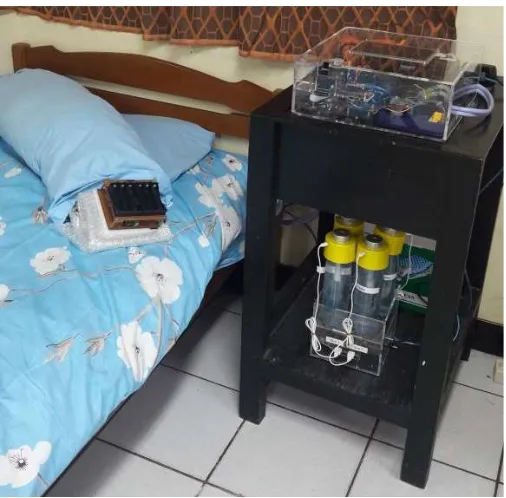
After obtaining all the required data, the smart bed was built based aimed to provide comfort according to the user needs. This bed was assembled with a smart system module, fingerprint sensor, air mattress system, aromatherapy module, light module, and music module that user can adjust Moreover, the smart bed is also equipped with battery driven auto warm bolster that can give a stable and comforting temperature for the user. The desired temperature will be determined by the user and the bolster will maintain the temperature for at least 1 hour.
When this smart bed was first launched for testing, it was used to help a 76 years old woman who had to spend most of her time in bed for weeks due to knee injury. The smart bed was not only giving the best support to the backbone according to her need, but could also give comfort by reducing her insomnia, so she can have 6 hours sleeping without interruptions. This paper will give explanation about the system design, data taken, discussion and conclusion in general.
II. SYSTEM DESIGN
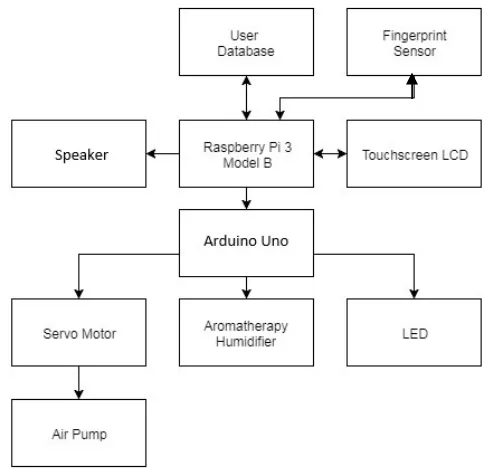
Figure 1 shows the block diagram of the system where the data inputs are processed by a single board computer, Raspberry Pi. The inputs are fingerprint sensor, user database, and touchscreen Liquid Cristal Display (LCD). Later, the data will be processed in a micro controller, namely Arduino, to control the stiffness of the air mattress, aromatherapy humidifier, and Light Emitting Diode (LED).
User identification is performed using a fingerprint sensor so that the smart bed comfort level can be adjusted according to the user’s needs. The user’s profile stored in user database consists of name, age, music selection, aromatherapy selection, mattress stiffness selection, and LED brightness selection. The LCD touchscreen is used in this design so that the user can control the output of the systems. The selection menus and the input were processed by Raspberry Pi before finally sent to the Arduino for controlling the outputs, such as air mattress, music player, aromatherapy humidifier, and LED brightness. In the first prototype of the system, Arduino was mainly used in the design but at the end, Raspberry Pi with its powerful control was used combined with the Arduino.
Smart Bed and Battery Driven Auto Warm
Bolster based on Raspberry Pi and Arduino
Lorenzo Niro, Addo Hermawan, Rico Wijaya, Zener S. Lie, and Rinda Hedwig*
However, in the future commercialized product, Raspberry Pi will be the only single board computer that will be used. Servo motors will turn on the air pump to inflate the air mattress, which control the stiffness of the mattress. According to the studies [28-30] about effects of mattress stiffness in musculoskeletal pain, it is suggested that the stiffness of the mattress should be adjusted according to the user’s backbone structure, gender and age.
Fig. 1. The block diagram of the smart bed.
A music player, which can play 20 tracks of music, will play music during the sleep period. It is believed that the music will help the user to feel easy and relax [27]. While in the same time, the selection of certain aroma such as sandalwood, eucalyptus, apple, and rose will be diffused from the aromatherapy humidifier to stimulate user’s smelling and brain sensory to relax [31].
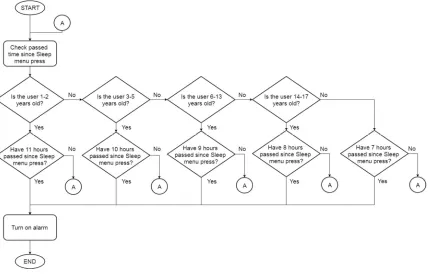
The brightness of the LED will be adjusted according to the comfort level of each identified user. Even though the study of brightness vs. sleeping disorder showed that it will lead to circadian phase [32], the system will not suggest any recommendation about the LED brightness, but it will adjust only to the user’s sleeping habit. An alarm will be automatically turned on if the sleeping period of the user is considered adequate. An alarm will be activated according to the length of sleeping hour, which is set according to the user’s age [33].
As an additional comfort to the user, a battery driven auto warm bolster is provided to give a certain warm temperature as shown in figure 2. The bolster is covered with heating elements protected by insulator tape to avoid any electric current leakage. Since the bolster is powered by batteries, it can be moved anywhere easily, and the batteries are rechargeable after running for 30 minutes. The bolster is also equipped with a sensor to maintain the temperature of 30oC
for the first 30 minutes of sleeping.
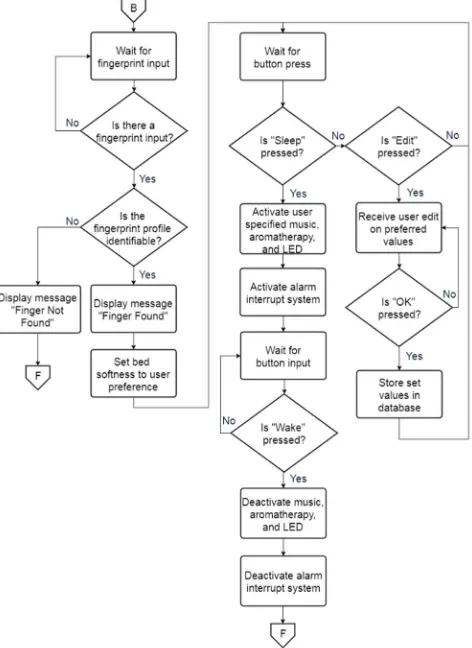
Figure 3 until 6 show the flowcharts for the overall system in detail. The main program is shown in figure 3, while
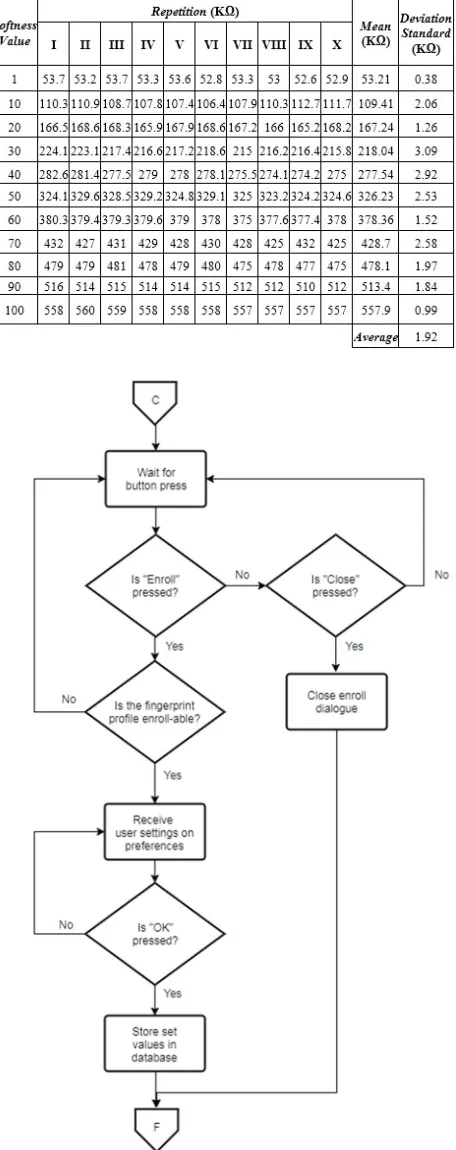
searching the database is shown in figure 4. Once the user identification is successfully done, the system will run all the controls until the “wake” selection is chosen by the user. Figure 5 shows the “enroll” system for new user so that he/she can be identified. Figure 6 is showing the “interrupt” process of the alarm system which is working according to the user’s age.
The flowchart of the bolster is shown in figure 7 where there is a temperature sensor, which will compare the surrounding temperature with the comfortable bolster’s temperature that is set at the beginning. When the temperature is lower than the set temperature, the batteries will turn on the heating elements until it reaches the desired temperature and maintain it for the next 30 minutes. It is assumed that the user will fall asleep after 30 minutes and the bolster can be turned off automatically afterwards.
Fig. 2. The block diagram of auto warm bolster.
ISSN: 1942-9703 / CC BY-NC-ND
The age selection in figure 6 was determined according to the study of K. Fukuda and K. Ishihara in concerning sleep-related lifestyle and mental health among junior high schools, high schools, universities students, and adults [34]. It is stated that children tend to sleep 8 to 10 hours a day, while adults 6 to 8 hours a day. An elderly person usually needs 6 hours or less for sleeping. Therefore, the alarm was set according to the age of the user.
The Raspberry Pi, a LINUX based small computer, was selected as the microprocessor since to be used as database processing and output control [35]. The Raspberry Pi is an open source device with low-power consumption and it can be combined with Arduino as microcontroller of the system output. Although it is slower than any general computer, this affordable single board computer can provide all the expected abilities.
III. RESULTS AND DISCUSSION
To understand the quality of smart bed and bolster, the researchers derive some data to prove its stability, accuracy, and user satisfaction index upon the products. The potentiometer in the motor servo was adjusted to measure the accuracy between the stiffness of the mattress and the potentiometer value by using deviation standard.
…(1)
S is deviation standard of sample. is the value of the sample. is the average of the sample.
The average value of 1.92 is obtained from the calculation, which means that the consistency of each value setting is similar between the potentiometer and the stiffness of the mattress. Therefore, whenever the user sets the digital value in the menu, the exact stiffness will be determined.
A similar measurement was also performed for the LED control to check its accuracy between the input value and the brightness of the LED. The result shows that the deviation standard value is 0, which means that the consistency between the input values with brightness output is 100% accurate. The 100% accuracy also happens to the music control and aromatherapy selection. The next measurement is done in order to find the successful rate of user identification. All ten users were tested and repeatedly identified by the fingerprint sensor and it was found that the successful rate is 95%, which was mainly caused by the condition of the finger such as dirt, scar tissue, or finger disorientation.
The next measurement was conducted to measure the bolster temperature after heating by comparing the reading status between temperature sensor DS18B20 and FLIR TG165 as shown in figure 8. In the beginning, the bolster is activated in order to achieve temperature of 32oC and will be steady in
1.2%. The reading takes place as long as 5 minutes with time
interval of 4 seconds. It is shown that the reading differences between two measurement tools are quite negligible or around 0.29%. Therefore, the bolster can work accurately and maintain the desired temperature constantly until the batteries finished. Nevertheless, when the room temperature goes down until 18oC it will take more time for the bolster to go to the
desired temperature. The average time to reach the desired temperature is usually less than 1 minutes but when the room temperature goes down to 18oC, it will take more than 10
minutes to warm up the bolster. A higher capacity battery and wireless charging will be used for the next development of this system.
A questionnaire was developed and delivered to 10 users in order to see how this product could satisfy the user’s need. The questions asked them about their satisfaction upon the smart bed, whether they will recommend the product to others, their loyalty to use the product, and any open inputs.
The result shows that 67% of the users feel satisfied and likely to use the product repeatably, 16% feel very satisfied and very likely to use the product repeatably, and the rest feel neutral. All of the users declared that they will recommend the product to others as well. The product itself has been tested for more than a month with the elderly woman who suffered from knee injuries and had to stay in the bed for recovery. The woman felt very satisfied because she could have more than 6 hours sleeping and felt comfortable without severing from the back injury.
TABLE 1.POTENTIOMETER VALUE ACCORDING TO MATTRESS STIFFNESS.
Fig. 5. Flowchart of the alarm “enroll” system.
Table 2 shows the successfulness of finger print sensor in identification of user. It showed that the identification of user’s identification is 95%. Once the finger print sensor failed to recognize the pattern, the whole system will not run accordingly.
The user can adjust the temperature sensor which is assembled in the bolster and it took 5 minutes of the heater to achieve the desired temperature which was set at 32oC. Once
the temperature sensor failed to read the setting temperature, the heating process did not run or stayed in the room temperature. In order to get the most effective steady state condition for auto warm bolster, the researchers set the best proportional gain as shown in table 3.
TABLE 2.SUCCESSFULNESS OF USER IDENTIFICATION.
ISSN: 1942-9703 / CC BY-NC-ND
It is shown that the proportional gain of 400 is the fastest response time for the heating elements to achieve its steady state. However, there is less than 1% overshoot which is negligible for the system to respond since the tolerable temperature changes was 1.2% of the desired temperature.
Furthermore, this product has been submitted for a simple patent to the Indonesia Directorate General of Intellectual Property with submission number of S00201901454 and has been exhibited several times, which gain interest among the industries as well. The next development of this product will be the integration of smart bed and smart wardrobe, which can be seen in figure 9.
IV. CONCLUSION
A smart bed and auto warm bolster was built in this research in order to help people with sleeping disorder to get better sleeping quality. By setting up the bedroom environment and the bed itself according to the user’s needs, it is believed that this product will improve user’s sleeping comfort. A user can adjust the stiffness of the bed, the music that will be played all night long including the aromatherapy that can stimulate relaxation of the body, the brightness of the room, and the warmest of the bolster as sleeping companion. From the questionnaire distributed to ten users and a case study of an elderly woman who suffered from knees injury, it was found that the smart bed did give them more comfort and relaxation during sleeping period. As for the elderly woman who has difficulties in having a good sleeping quality, she feels satisfied by this product.
There are some limits in this product such as the number of aromatherapy selection which was limited to only 4 scents, the
music selection was not in a playlist mode, and there is only one reference temperature value in the bolster system. However, this smart module can be applied in any kind of bedding as long as there is an adjustable size of air mattress available for the bed size.
The overall cost of this research was US$340 for developing the smart bed while the bolster is US$48. The bolster is more expensive due to the battery selection since the heat should be transferred equally to the bolster surface for hours. Nevertheless, this battery selection can be changed if the affordable battery technology is provided in the future.
REFERENCES
[1] D.J. Buysse, C.F. Reynolds, III, T.H. Monk, C.C. Hoch, A.L. Yeager, D.J. Kupfer, "Quantification of Subjective Sleep Quality in Healthy Elderly Men and Women Using the Pittsburgh Sleep Quality Index (PSQI)," Sleep, vol. 14, no. 4, p. 331–338, 1 July 1991.
[2] J.J. Pilcher, D.R. Ginter, B. Sadowsky, "Sleep quality versus sleep quantity: Relationships between sleep and measures of health, well-being and sleepiness in college students," Journal of Psychosomatic Research, vol. 42, no. 6, pp. 583-596, June 1997.
[3] F.C. Brown, W.C. Buboltz Jr., B. Soper, "Relationship of Sleep Hygiene Awareness, Sleep Hygiene Practices, and Sleep Quality in University Students," Behavioral Medicine, vol. 28, no. 1, pp. 33-38, 2002. [4] K. Kirmil-Gray, J.R. Eagleston, E. Gibson, C.E. Thoresen, "Sleep
disturbance in adolescents: Sleep quality, sleep habits, beliefs about sleep, and daytime functioning," Journal of Youth and Adolescence, vol. 13, no. 5, p. 375–384, October 1984.
[5] T. Åkerstedt, K. Hume, D. Minors, J. Waterhouse, "Good sleep — its timing and physiological sleep characteristics," Journal of Sleep Research, vol. 6, no. 4, pp. 221-229, December 1997.
[6] O. Doǧan, Ş. Ertekin, S. Doǧan, "Sleep quality in hospitalized patients," Journal of Clinical Nursing, vol. 14, no. 1, pp. 107-113, January 2005. [7] Mei-Yen Chen, E.K. Wang, Yi-Jong Jeng, "Adequate sleep among
adolescents is positively associated with health status and health-related
behaviors," BMC Public Health, vol. 6, no. 1, p. 59, 8 March 2006. [8] T. Norlander, A. Johansson, S.A. Bood, "The Affective Personality: Its
Relation to Quality of Sleep, Well-Being and Stress," Social Behavior and Personality: an international journal, vol. 33, no. 7, pp. 709-722, 2005.
[9] N.P. Patel, M.A Grandner, D. Xie, C.C. Branas, N. Gooneratne, ""Sleep disparity" in the population: poor sleep quality is strongly associated with poverty and ethnicity," BMC Public Health, vol. 10, no. 1, p. 475, 2010.
[10] L. Zhang, Q. Yuan, Q. Wu, S. Kwauk, X. Liao, C. Wang, "Sleep quality and sleep disturbing factors of inpatients in a Chinese general hospital," Journal of Clinical Nursing, vol. 18, no. 17, pp. 2521-2529, September 2009.
[11] M. Chan, "Factors associated with perceived sleep quality of nurses working on rotating shifts," Journal of Clinical Nursing, vol. 18, no. 2, pp. 285-293, January 2009.
[12] L.K.P. Suen, K.L.E. Hon, W.W.S. Tam, "Association between Sleep Behavior and Sleep‐Related Factors among University Students in Hong Kong," The Journal of Biological and Medical Rhythm Research, vol. 25, no. 5, pp. 760-775, 18 April 2008.
[13] O. Afandi, H. Hawi, L. Mohammed, F. Salim, A.K. Hameed, R.B. Shaikh, S. Al Sharbatti, F.A. Khan , "Sleep Quality Among University Students: Evaluating the Impact of Smoking, Social Media Use, and Energy Drink Consumption on Sleep Quality and Anxiety," Inquiries Journal, vol. 5, no. 6, pp. 1-3, 2013.
[14] The President and Fellows of Harvard College, "External Factors that Influence Sleep," WGBH Educational Foundation and the Harvard Medical School Division of Sleep Medicine, 2008. [Online]. Available: http://healthysleep.med.harvard.edu/healthy/science/how/external-factors. [Accessed 18 May 2018].
[15] L. Li, "Study on the Soft Bed Comfort Based on Kansei Engineering," Packaging Engineering, vol. 8, p. 12, 2010.
[16] S.E. Hänel, T. Dartman, R. Shishoo, "Measuring methods for comfort rating of seats and beds," International Journal of Industrial Ergonomics, vol. 20, no. 2, pp. 163-172, August 1997.
[17] E. D. D.C. Shafer, "Air control system for an air bed". USA Patent US5509154A, 11 November 1994.
[18] R. Walker, "Air adjustable bed". USA Patent US5170522A, 16 December 1991.
[19] E. D. D.C. Shafer, "Air control system for an air bed". USA Patent US6037723A, 1 November 1994.
[20] M. Louis, S.D. Kowalski, "Use of aromatherapy with hospice patients to decrease pain, anxiety, and depression and to promote an increased sense of well-being," American Journal of Hospice and Palliative Medicine®, vol. 19, no. 6, pp. 381-386, 2002.
[21] C. Dunn, J. Sleep, D. Collett, "Sensing an improvement: an experimental study to evaluate the use of aromatherapy, massage and periods of rest in an intensive care unit," Journal of advanced nursing, vol. 21, no. 1, pp. 34-40, January 1995.
[22] G. Cannard, "On the scent of a good night's sleep," [Online]. Available: http://www.lenus.ie/hse/bitstream/10147/251925/1/OntheScentofaoodNi ghts.pdf. [Accessed 18 May 2018].
[23] S. Hubalek, M. Brink, C. Schierz, "Office workers’ daily exposure to light and its influence on sleep quality and mood," Lighting research & technology, vol. 42, no. 1, pp. 33-50, 5 January 2010.
[24] D-J Dijk , S.N. Archer, "Light, Sleep, and Circadian Rhythms: Together Again," PLoS Biology, vol. 7, no. 6, p. e1000145, 23 June 2009. [25] D.J. Dijk, C.A. Visscher, G.M. Bloem, D.G.M. Beersma, S. Daan,
"Reduction of human sleep duration after bright light exposure in the morning," Neuroscience Letters, vol. 73, no. 2, pp. 181-186, 14 January 1987.
[26] L. Harmat, J. Takács, R. Bodizs, "Music improves sleep quality in students," Journal of advanced nursing, vol. 62, no. 3, pp. 327-335, 18 April 2008.
[27] H-L. Lai, M. Good, "Music improves sleep quality in older adults," Journal of advanced nursing, vol. 53, no. 1, pp. 134-144, 10 January 2006.
[28] B.H. Jacobson, T. Wallace, H. Gemmell, "Subjective rating of perceived back pain, stiffness and sleep quality following introduction of medium-firm bedding systems," Journal of chiropractic medicine, vol. 5, no. 4, pp. 128-134, 2006.
[29] B. Haex, Back and Bed: Ergonomic Aspects of Sleeping, Florida: Taylor & Francis, 2005.
[30] V. Ancuelle, R. Zamudio, A. Mendiola, D. Guillen, P.J. Ortiz, T. Tello, D. Vizcarra, "Effects of an adapted mattress in musculoskeletal pain and sleep quality in institutionalized elders," Sleep Science, vol. 8, no. 3, pp. 115-120, November 2015.
[31] A. Takeda, E. Watanuki, S. Koyama, "Effects of Inhalation Aromatherapy on Symptoms of Sleep Disturbance in the Elderly with Dementia," Evidence-Based Complementary and Alternative Medicine, vol. 2017, no. 1902807, pp. 1-7, 2017.
[32] K.M. Sharkey, M.A. Carskadon, M.G. Figueiro, Y. Zhu, M.S. Rea, "Effects of an advanced sleep schedule and morning short wavelength light exposure on circadian phase in young adults with late sleep schedules," Sleep Medicine, vol. 12, no. 7, pp. 685-692, 2011.
[33] M.M. Ohayon, M.A. Carskadon, C. Guilleminault, M.V. Vitiello, "Meta-Analysis of Quantitative Sleep Parameters From Childhood to Old Age in Healthy Individuals: Developing Normative Sleep Values Across the Human Lifespan," Sleep, vol. 27, no. 7, p. 1255–1273, 2004. [34] K. Fukuda, K. Ishihara, "Age-related changes of sleeping pattern during
adolescence," Psychiatry and Clinical Neurosciences, vol. 55, issue 3, p. 231-232, 2001.
[35] M. Richardson, S. Wallace, Getting Started with Raspberry Pi, Sebastopol, CA 95472, Marker Media, Inc., 1st Edition, 2012.
ISSN: 1942-9703 / CC BY-NC-ND Fig. 8. Graph of comparison of temperature measurement between DS18B20
and FLIR TG165 when the bolster already warms up.