A Monthly Double-Blind Peer Reviewed (Refereed/Juried) Open Access International e-Journal - Included in the International Serial Directories
Indexed & Listed at:
Ulrich's Periodicals Directory ©, ProQuest, U.S.A., EBSCO Publishing, U.S.A., Cabell’s Directories of Publishing Opportunities, U.S.A., Open J-Gage, India [link of the same is duly available at Inflibnet of University Grants Commission (U.G.C.)],
VOLUME NO.2(2012),ISSUE NO.11(NOVEMBER) ISSN2231-5756
INTERNATIONAL JOURNAL OF RESEARCH IN COMMERCE, IT & MANAGEMENT
CONTENTS
CONTENTS
CONTENTS
CONTENTS
Sr.No.
TITLE & NAME OF THE AUTHOR (S)
Page No.
1. SIGNIFICANCE OF COST MANAGEMENT TECHNIQUES IN DECISION MAKING: AN EMPIRICAL STUDY ON ETHIOPIAN MANUFACTURING PRIVATE LIMITED COMPANIES (PLCs)
DR. FISSEHA GIRMAY TESSEMA
1
2. TECHNICAL EFFICIENCY ANALYSIS AND INFLUENCE OF SUBSIDIES ON THE TECHNICAL EFFICIENCY OF FARMS IN THE SLOVAK REPUBLIC
DR. ING. ANDREJ JAHNÁTEK, DR. ING. JANA MIKLOVIČOVÁ & ING. SILVIA MIKLOVIČOVÁ
10 3. A COMPARISON OF DATA MINING TECHNIQUES FOR GOING CONCERN PREDICTION
FEZEH ZAHEDI FARD & MAHDI SALEHI
14 4. DETERMINANTS OF CONSTRAINTS TO LOW PROVISION OF LIVESTOCK INSURANCE IN KENYA: A CASE STUDY OF NAKURU COUNTY
THOMAS MOCHOGE MOTINDI, NEBAT GALO MUGENDA & HENRY KIMATHI MUKARIA
20 5. PERCEPTIONS OF ACCOUNTANTS ON FACTORS AFFECTING AUDITOR’S INDEPENDENCE IN NIGERIA
AKINYOMI OLADELE JOHN & TASIE, CHUKWUMERIJE
25 6. AN ASSESSMENT OF MARKET SUSTAINABILITY OF PRIVATE SECTOR HOUSING PROJECT FINANCING OPTIONS IN NIGERIA
I.S. YESUFU, O.I. BEJIDE, F.E. UWADIA & S.I. YESUFU
30 7. AN EXPLORATORY STUDY ON THE PERCEPTION OF CUSTOMERS TOWARDS THE ROLE OF MOBILE BANKING, AND ITS EFFECT ON QUALITY
OF SERVICE DELIVERY, IN THE RWANDAN BANKING INDUSTRY
MACHOGU MORONGE ABIUD, LYNET OKIKO & VICTORIA KADONDI
35
8. BUSINESS PROCESS REENGINEERING AND ORGANIZATIONAL PERFORMANCE
C. S. RAMANIGOPAL, G. PALANIAPPAN, N.HEMALATHA & M. MANICKAM
41 9. CUSTOMER PERCEPTION OF REAL ESTATE SECTOR IN INDIA: A CASE STUDY OF UNORGANISED PROPERTY ADVISORS IN PUNJAB-INDIA
DR. JASKARAN SINGH DHILLON & B. J. S. LUBANA
46 10. INNOVATIVE TECHNOLOGY AND PRIVATE SECTOR BANKS: A STUDY OF SELECTED PRIVATE SECTOR BANKS OF ANAND DISTRICT
POOJARA J.G. & CHRISTIAN S.R.
51 11. THE PROBLEMS AND PERFORMANCE OF HANDLOOM COOPERATIVE SOCIETIES WITH REFERENCE TO ANDHRA PRADESH INDIA
DR. R. EMMANIEL
54 12. IMPACT OF GENDER AND TASK CONDITIONS ON TEAMS: A STUDY OF INDIAN PROFESSIONALS
DEEPIKA TIWARI & AJEYA JHA
58 13. MOTIVATIONAL PREFERENCES OF TEACHERS WORKING IN PRIVATE ENGINEERING INSTITUTIONS IN WESTERN INDIA REGION: AN
EXPLORATORY STUDY
DD MUNDHRA & WALLACE JACOB
68
14. CHANNEL MANAGEMENT IN INSURANCE BUSINESS
DR. C BHANU KIRAN & DR. M. MUTYALU NAIDU
74 15. MANAGEMENT INFORMATION SYSTEM APPLIED TO MECHANICAL DEPARTMENT OF AN ENGINEERING COLLEGE
C.G. RAMACHANDRA & DR. T. R. SRINIVAS
78 16. A STUDY ON THE PERCEPTIONS OF EMPLOYEES ON LEADERSHIP CONCEPTS AND CONSTRUCTS IN LIC
H. HEMA LAKSHMI, P. R. SIVASANKAR & DASARI.PANDURANGARAO
83 17. TEXTURE FEATURE EXTRACTION
GANESH S. RAGHTATE & DR. S. S. SALANKAR
87 18. INDIAN BANKS: AN IMMENSE DEVELOPING SECTOR
PRASHANT VIJAYSING PATIL & DR. DEVENDRASING V. THAKOR
91 19. DEVALUATION OF INDIAN RUPEE & ITS IMPACT ON INDIAN ECONOMY
DR. NARENDRA KUMAR BATRA, DHEERAJ GANDHI & BHARAT KUMAR
95 20. SERVICE PRODUCTIVITY: CONCERNS, CHALLENGES, AND RESEARCH DIRECTIONS
DR. SUNIL C. D’SOUZA
99 21. A STUDY OF THE MANAGERIAL STYLES OF EXECUTIVES IN THE MANUFACTURING COMPANIES OF PUNJAB
DR. NAVPREET SINGH SIDHU
105 22. FINANCIAL LEVERAGE AND IT’S IMPACT ON COST OF CAPITAL AND CAPITAL STRUCTURE
SHASHANK JAIN, SHIVANGI GUPTA & HAMENDRA KUMAR PORWAL
112 23. REACH OF INTERNET BANKING
DR. A. JAYAKUMAR & G.ANBALAGAN.
118 24. THE PROPOSED GOODS AND SERVICE TAX REGIME: AN ANALYSIS OF THE DIFFERENT MODELS TO SELECT A SUITABLE MODEL FOR INDIA
ASHISH TIWARI & VINAYAK GUPTA
122 25. ESTIMATION OF STOCK OPTION PRICES USING BLACK-SCHOLES MODEL
DR. S. SARAVANAN & G. PRADEEP KUMAR
130 26. MIS AND MANAGEMENT
DR.PULI.SUBRMANYAM & S.ISMAIL BASHA
137 27. REFORMS IN INDIAN FINANCIAL SYSTEM: A CONCEPTUAL APPROACH
PRAVEEN KUMAR SINHA
147 28. NATURAL RUBBER PRODUCTION IN INDIA
DR. P. CHENNAKRISHNAN
151 29. QUALITY IMPROVEMENT IN FREE AND OPEN SOURCE SOFTWARE PROJECTS
DR. SHAIK MAHABOOB BASHA
157 30. ICT & PRODUCTIVITY AND GROWTH BUSINESS: NEW RESULTS BASED ON INTERNATIONAL MICRODATA
VAHID RANGRIZ
160
INTERNATIONAL JOURNAL OF RESEARCH IN COMMERCE, IT & MANAGEMENT
CHIEF PATRON
CHIEF PATRON
CHIEF PATRON
CHIEF PATRON
PROF. K. K. AGGARWAL
Chancellor, Lingaya’s University, Delhi
Founder Vice-Chancellor, Guru Gobind Singh Indraprastha University, Delhi
Ex. Pro Vice-Chancellor, Guru Jambheshwar University, Hisar
FOUNDER
FOUNDER
FOUNDER
FOUNDER PATRON
PATRON
PATRON
PATRON
LATE SH. RAM BHAJAN AGGARWAL
Former State Minister for Home & Tourism, Government of Haryana
Former Vice-President, Dadri Education Society, Charkhi Dadri
Former President, Chinar Syntex Ltd. (Textile Mills), Bhiwani
CO
CO
CO
CO----ORDINATOR
ORDINATOR
ORDINATOR
ORDINATOR
AMITA
Faculty, Government M. S., Mohali
ADVISORS
ADVISORS
ADVISORS
ADVISORS
DR. PRIYA RANJAN TRIVEDI
Chancellor, The Global Open University, Nagaland
PROF. M. S. SENAM RAJU
Director A. C. D., School of Management Studies, I.G.N.O.U., New Delhi
PROF. M. N. SHARMA
Chairman, M.B.A., Haryana College of Technology & Management, Kaithal
PROF. S. L. MAHANDRU
Principal (Retd.), Maharaja Agrasen College, Jagadhri
EDITOR
EDITOR
EDITOR
EDITOR
PROF. R. K. SHARMA
Professor, Bharti Vidyapeeth University Institute of Management & Research, New Delhi
CO
CO
CO
CO----EDITOR
EDITOR
EDITOR
EDITOR
DR. BHAVET
Faculty, M. M. Institute of Management, Maharishi Markandeshwar University, Mullana, Ambala, Haryana
EDITORIAL
EDITORIAL
EDITORIAL
EDITORIAL ADVISORY BOARD
ADVISORY BOARD
ADVISORY BOARD
ADVISORY BOARD
DR. RAJESH MODI
Faculty, Yanbu Industrial College, Kingdom of Saudi Arabia
PROF. SANJIV MITTAL
University School of Management Studies, Guru Gobind Singh I. P. University, Delhi
PROF. ANIL K. SAINI
Chairperson (CRC), Guru Gobind Singh I. P. University, Delhi
DR. SAMBHAVNA
Faculty, I.I.T.M., Delhi
DR. MOHENDER KUMAR GUPTA
VOLUME NO.2(2012),ISSUE NO.11(NOVEMBER) ISSN2231-5756
INTERNATIONAL JOURNAL OF RESEARCH IN COMMERCE, IT & MANAGEMENT
DR. SHIVAKUMAR DEENE
Asst. Professor, Dept. of Commerce, School of Business Studies, Central University of Karnataka, Gulbarga
DR. MOHITA
Faculty, Yamuna Institute of Engineering & Technology, Village Gadholi, P. O. Gadhola, Yamunanagar
ASSOCIATE EDITORS
ASSOCIATE EDITORS
ASSOCIATE EDITORS
ASSOCIATE EDITORS
PROF. NAWAB ALI KHAN
Department of Commerce, Aligarh Muslim University, Aligarh, U.P.
PROF. ABHAY BANSAL
Head, Department of Information Technology, Amity School of Engineering & Technology, Amity University, Noida
PROF. A. SURYANARAYANA
Department of Business Management, Osmania University, Hyderabad
DR. SAMBHAV GARG
Faculty, M. M. Institute of Management, Maharishi Markandeshwar University, Mullana, Ambala, Haryana
PROF. V. SELVAM
SSL, VIT University, Vellore
DR. PARDEEP AHLAWAT
Associate Professor, Institute of Management Studies & Research, Maharshi Dayanand University, Rohtak
DR. S. TABASSUM SULTANA
Associate Professor, Department of Business Management, Matrusri Institute of P.G. Studies, Hyderabad
SURJEET SINGH
Asst. Professor, Department of Computer Science, G. M. N. (P.G.) College, Ambala Cantt.
TECHNICAL ADVISOR
TECHNICAL ADVISOR
TECHNICAL ADVISOR
TECHNICAL ADVISOR
AMITA
Faculty, Government H. S., Mohali
DR. MOHITA
Faculty, Yamuna Institute of Engineering & Technology, Village Gadholi, P. O. Gadhola, Yamunanagar
FINANCIAL ADVISORS
FINANCIAL ADVISORS
FINANCIAL ADVISORS
FINANCIAL ADVISORS
DICKIN GOYAL
Advocate & Tax Adviser, Panchkula
NEENA
Investment Consultant, Chambaghat, Solan, Himachal Pradesh
LEGAL
LEGAL
LEGAL
LEGAL ADVISORS
ADVISORS
ADVISORS
ADVISORS
JITENDER S. CHAHAL
Advocate, Punjab & Haryana High Court, Chandigarh U.T.
CHANDER BHUSHAN SHARMA
Advocate & Consultant, District Courts, Yamunanagar at Jagadhri
SUPERINTENDENT
SUPERINTENDENT
SUPERINTENDENT
SUPERINTENDENT
SURENDER KUMAR POONIA
INTERNATIONAL JOURNAL OF RESEARCH IN COMMERCE, IT & MANAGEMENT
CALL FOR MANUSCRIPTS
CALL FOR MANUSCRIPTS
CALL FOR MANUSCRIPTS
CALL FOR MANUSCRIPTS
Weinvite unpublished novel, original, empirical and high quality research work pertaining to recent developments & practices in the area of Computer, Business, Finance, Marketing, Human Resource Management, General Management, Banking, Insurance, Corporate Governance and emerging paradigms in allied subjects like Accounting Education; Accounting Information Systems; Accounting Theory & Practice; Auditing; Behavioral Accounting; Behavioral Economics; Corporate Finance; Cost Accounting; Econometrics; Economic Development; Economic History; Financial Institutions & Markets; Financial Services; Fiscal Policy; Government & Non Profit Accounting; Industrial Organization; International Economics & Trade; International Finance; Macro Economics; Micro Economics; Monetary Policy; Portfolio & Security Analysis; Public Policy Economics; Real Estate; Regional Economics; Tax Accounting; Advertising & Promotion Management; Business Education; Management Information Systems (MIS); Business Law, Public Responsibility & Ethics; Communication; Direct Marketing; E-Commerce; Global Business; Health Care Administration; Labor Relations & Human Resource Management; Marketing Research; Marketing Theory & Applications; Non-Profit Organizations; Office Administration/Management; Operations Research/Statistics; Organizational Behavior & Theory; Organizational Development; Production/Operations; Public Administration; Purchasing/Materials Management; Retailing; Sales/Selling; Services; Small Business Entrepreneurship; Strategic Management Policy; Technology/Innovation; Tourism, Hospitality & Leisure; Transportation/Physical Distribution; Algorithms; Artificial Intelligence; Compilers & Translation; Computer Aided Design (CAD); Computer Aided Manufacturing; Computer Graphics; Computer Organization & Architecture; Database Structures & Systems; Digital Logic; Discrete Structures; Internet; Management Information Systems; Modeling & Simulation; Multimedia; Neural Systems/Neural Networks; Numerical Analysis/Scientific Computing; Object Oriented Programming; Operating Systems; Programming Languages; Robotics; Symbolic & Formal Logic and Web Design. The above mentioned tracks are only indicative, and not exhaustive.
Anybody can submit the soft copy of his/her manuscript anytime in M.S. Word format after preparing the same as per our submission guidelines duly available on our website under the heading guidelines for submission, at the email address: [email protected].
GUIDELINES FOR SUBM
GUIDELINES FOR SUBM
GUIDELINES FOR SUBM
GUIDELINES FOR SUBMISSION OF MANUSCRIPT
ISSION OF MANUSCRIPT
ISSION OF MANUSCRIPT
ISSION OF MANUSCRIPT
1. COVERING LETTER FOR SUBMISSION:
DATED: _____________
THE EDITOR
IJRCM
Subject: SUBMISSION OF MANUSCRIPT IN THE AREA OF .
(e.g. Finance/Marketing/HRM/General Management/Economics/Psychology/Law/Computer/IT/Engineering/Mathematics/other, please specify)
DEAR SIR/MADAM
Please find my submission of manuscript entitled ‘___________________________________________’ for possible publication in your journals.
I hereby affirm that the contents of this manuscript are original. Furthermore, it has neither been published elsewhere in any language fully or partly, nor is it under review for publication elsewhere.
I affirm that all the author (s) have seen and agreed to the submitted version of the manuscript and their inclusion of name (s) as co-author (s).
Also, if my/our manuscript is accepted, I/We agree to comply with the formalities as given on the website of the journal & you are free to publish our contribution in any of your journals.
NAME OF CORRESPONDING AUTHOR:
Designation:
Affiliation with full address, contact numbers & Pin Code: Residential address with Pin Code:
Mobile Number (s): Landline Number (s): E-mail Address: Alternate E-mail Address:
NOTES:
a) The whole manuscript is required to be in ONE MS WORD FILE only (pdf. version is liable to be rejected without any consideration), which will start from the covering letter, inside the manuscript.
b) The sender is required to mention the following in the SUBJECT COLUMN of the mail:
New Manuscript for Review in the area of (Finance/Marketing/HRM/General Management/Economics/Psychology/Law/Computer/IT/
Engineering/Mathematics/other, please specify)
c) There is no need to give any text in the body of mail, except the cases where the author wishes to give any specific message w.r.t. to the manuscript. d) The total size of the file containing the manuscript is required to be below 500 KB.
e) Abstract alone will not be considered for review, and the author is required to submit the complete manuscript in the first instance.
f) The journal gives acknowledgement w.r.t. the receipt of every email and in case of non-receipt of acknowledgment from the journal, w.r.t. the submission of manuscript, within two days of submission, the corresponding author is required to demand for the same by sending separate mail to the journal.
2. MANUSCRIPT TITLE: The title of the paper should be in a 12 point Calibri Font. It should be bold typed, centered and fully capitalised.
3. AUTHOR NAME (S) & AFFILIATIONS: The author (s) full name, designation, affiliation (s), address, mobile/landline numbers, and email/alternate email address should be in italic & 11-point Calibri Font. It must be centered underneath the title.
4. ABSTRACT: Abstract should be in fully italicized text, not exceeding 250 words. The abstract must be informative and explain the background, aims, methods,
VOLUME NO.2(2012),ISSUE NO.11(NOVEMBER) ISSN2231-5756
INTERNATIONAL JOURNAL OF RESEARCH IN COMMERCE, IT & MANAGEMENT
5. KEYWORDS: Abstract must be followed by a list of keywords, subject to the maximum of five. These should be arranged in alphabetic order separated bycommas and full stops at the end.
6. MANUSCRIPT: Manuscript must be in BRITISH ENGLISH prepared on a standard A4 size PORTRAIT SETTING PAPER. It must be prepared on a single space and
single column with 1” margin set for top, bottom, left and right. It should be typed in 8 point Calibri Font with page numbers at the bottom and centre of every page. It should be free from grammatical, spelling and punctuation errors and must be thoroughly edited.
7. HEADINGS: All the headings should be in a 10 point Calibri Font. These must be bold-faced, aligned left and fully capitalised. Leave a blank line before each
heading.
8. SUB-HEADINGS: All the sub-headings should be in a 8 point Calibri Font. These must be bold-faced, aligned left and fully capitalised.
9. MAIN TEXT: The main text should follow the following sequence:
INTRODUCTION
REVIEW OF LITERATURE
NEED/IMPORTANCE OF THE STUDY
STATEMENT OF THE PROBLEM
OBJECTIVES
HYPOTHESES
RESEARCH METHODOLOGY
RESULTS & DISCUSSION
FINDINGS
RECOMMENDATIONS/SUGGESTIONS
CONCLUSIONS
SCOPE FOR FURTHER RESEARCH
ACKNOWLEDGMENTS
REFERENCES
APPENDIX/ANNEXURE
It should be in a 8 point Calibri Font, single spaced and justified. The manuscript should preferably not exceed 5000 WORDS.
10. FIGURES & TABLES: These should be simple, crystal clear, centered, separately numbered & self explained, and titles must be above the table/figure. Sources of data should be mentioned below the table/figure. It should be ensured that the tables/figures are referred to from the main text.
11. EQUATIONS: These should be consecutively numbered in parentheses, horizontally centered with equation number placed at the right.
12. REFERENCES: The list of all references should be alphabetically arranged. The author (s) should mention only the actually utilised references in the preparation
of manuscript and they are supposed to follow Harvard Style of Referencing. The author (s) are supposed to follow the references as per the following:
•
All works cited in the text (including sources for tables and figures) should be listed alphabetically.•
Use (ed.) for one editor, and (ed.s) for multiple editors.•
When listing two or more works by one author, use --- (20xx), such as after Kohl (1997), use --- (2001), etc, in chronologically ascending order.•
Indicate (opening and closing) page numbers for articles in journals and for chapters in books.•
The title of books and journals should be in italics. Double quotation marks are used for titles of journal articles, book chapters, dissertations, reports, working papers, unpublished material, etc.•
For titles in a language other than English, provide an English translation in parentheses.•
The location of endnotes within the text should be indicated by superscript numbers.PLEASE USE THE FOLLOWING FOR STYLE AND PUNCTUATION IN REFERENCES: BOOKS
•
Bowersox, Donald J., Closs, David J., (1996), "Logistical Management." Tata McGraw, Hill, New Delhi.•
Hunker, H.L. and A.J. Wright (1963), "Factors of Industrial Location in Ohio" Ohio State University, Nigeria. CONTRIBUTIONS TO BOOKS•
Sharma T., Kwatra, G. (2008) Effectiveness of Social Advertising: A Study of Selected Campaigns, Corporate Social Responsibility, Edited by David Crowther & Nicholas Capaldi, Ashgate Research Companion to Corporate Social Responsibility, Chapter 15, pp 287-303.JOURNAL AND OTHER ARTICLES
•
Schemenner, R.W., Huber, J.C. and Cook, R.L. (1987), "Geographic Differences and the Location of New Manufacturing Facilities," Journal of Urban Economics, Vol. 21, No. 1, pp. 83-104.CONFERENCE PAPERS
•
Garg, Sambhav (2011): "Business Ethics" Paper presented at the Annual International Conference for the All India Management Association, New Delhi, India, 19–22 June.UNPUBLISHED DISSERTATIONS AND THESES
•
Kumar S. (2011): "Customer Value: A Comparative Study of Rural and Urban Customers," Thesis, Kurukshetra University, Kurukshetra. ONLINE RESOURCES•
Always indicate the date that the source was accessed, as online resources are frequently updated or removed. WEBSITESINTERNATIONAL JOURNAL OF RESEARCH IN COMMERCE, IT & MANAGEMENT
MIS AND MANAGEMENT
DR.PULI.SUBRMANYAM
ASST. PROFESSOR
KMM COLLEGES
TIRUPATI
S.ISMAIL BASHA
ASST. PROFESSOR
KMM INSTITUTE OF POSTGRADUATE STUDIES
TIRUPATI
ABSTRACT
In today’s business world, there are varieties of information systems such as TPS, DAS, KWS, MIS, DSS, ES,CSCWS, GDSS and ESS. Each plays a different role in organizational hierarchy and decision making process. In this article the authors have selected two main information systems, namely, MIS and DSS. After discussing the decision making process based on each concept, its characteristics, relations, connections of each concept to decision-making process have been determined. At the same time, different models and figures are presented to enrich the discussion and to highlight precisely the status of each MIS and DSS information system in organizational decision making.
KEYWORDS
Management information system, Decision support system, Managers, Decision making process.
INTRODUCTION
or the last twenty years, different kinds of information systems are developed for different purposes, depending on the need of the business. Transaction Process Systems (TPS) function in operational level to process large amount of data for routine business transactions of the organization, Office Automation Systems (OAS) support data workers and Knowledge Work Systems (KWS) support professional workers. Higher-level systems include Management Information Systems (MIS) and Decision Support Systems (DSS). Expert System (ES) applies the expertise of decision makers to solve specific, unstructured problems. At the strategic level of management, there is Executive Support Systems (ESS). Group Decision Support Systems (GDSS) and the more generally described Computer Supported Collaborative Work (CSCW) systems aid group level decision making of a semi structured or unstructured decision. In the present article the authors discuss two kinds of information systems, namely, MIS, and DSS, and then their characteristics, interrelationship and their relations with decision-making process in an organization.
ABOUT MIS
MIS is popularly known as the Management Information System. MIS is considered asone such method of generating information which is used by management of organization for decision Making, control of activities, operations etc. During the period 1940 to 1960 computers were commercially used for census and payroll work. This involved large amount of data and its processing. Since then the commercial application exceeded the scientific applications for which the computer were mainly intended for. MIS is an information System which helps in providing the management of an organization with information which is used by management for decision making.
MIS is popularly known as the Management Information System. MIS is considered as one such method of generating information which is used by management of organization for decision. Making, control of activities, operations etc.
During the period 1940 to 1960 computers were commercially used for census and payroll work. This involved large amount of data and its processing. Since then the commercial application exceeded the scientific applications for which the computer were mainly intended for.
MIS is an information System which helps in providing the management of an organization with information which is used by management for decision making.
HISTORY
Kenneth and Jane Loudon identify five eras of MIS evolution corresponding to five phases in the development of computing technology: 1) mainframe and
minicomputer computing, 2) personal computers, 3) client/server networks, 4) enterprise computing, and 5) cloud computing.
The first (mainframe and minicomputer) era was ruled by IBM and their mainframe computers; these computers would often take up whole rooms and require teams to run them - IBM supplied the hardware and the software. As technology advanced these computers were able to handle greater capacities and therefore reduce their cost. Smaller, more affordable minicomputers allowed larger businesses to run their own computing centers in-house.
The second (personal computer) era began in 1965 as microprocessors started to compete with mainframes and minicomputers and accelerated the process of decentralizing computing power from large data centers to smaller offices. In the late 1970s minicomputer technology gave way to personal computers and relatively low cost computers were becoming mass market commodities, allowing businesses to provide their employees access to computing power that ten years before would have cost tens of thousands of dollars. This proliferation of computers created a ready market for interconnecting networks and the popularization of the Internet.
As the complexity of the technology increased and the costs decreased, the need to share information within an enterprise also grew, giving rise to the third
(client/server) era in which computers on a common network were able to access shared information on a server. This allowed for large amounts of data to be accessed by thousands and even millions of people simultaneously.
The fourth (enterprise) era enabled by high speed networks, tied all aspects of the business enterprise together offering rich information access encompassing the complete management structure.
The fifth and latest (cloud computing) era of information systems employs networking technology to deliver applications as well as data storage independent of
the configuration, location or nature of the hardware. This, along with high speed cell phone and wifi networks, led to new levels of mobility in which managers
access the MIS remotely with laptops, tablet PC's, and smart phones.
TERMINOLOGY
The terms MIS, information system, ERP and, information technology management are often confused. Information systems and MIS are broader categories that
include ERP. Information technology management concerns the operation and organization of information technology resources independent of their purpose.
TYPES
Most management information systems specialize in particular commercial and industrial sectors, aspects of the enterprise, or management substructure.
•
Management information systems (MIS), per se, produce fixed, regularly scheduled reports based on data extracted and summarized from the firm’sunderlying transaction processing systems to middle and operational level managers to identify and inform structured and semi-structured decision
problems.
VOLUME NO.2(2012),ISSUE NO.11(NOVEMBER) ISSN2231-5756
INTERNATIONAL JOURNAL OF RESEARCH IN COMMERCE, IT & MANAGEMENT
•
Decision support systems (DSS) are computer program applications used by middle management to compile information from a wide range of sources tosupport problem solving and decision making.
•
Executive information systems (EIS) is a reporting tool that provides quick access to summarized reports coming from all company levels and departments such as accounting, human resources and operations.•
Marketing information systems are MIS designed specifically for managing the marketing aspects of the business.•
Office automation systems (OAS) support communication and productivity in the enterprise by automating work flow and eliminating bottlenecks. OAS may be implemented at any and all levels of management.•
School management information systems (MIS) cover school administration, and often including teaching and learning materials.ADVANTAGES
The following are some of the benefits that can be attained for different types of management information systems.
•
Companies are able to highlight their strengths and weaknesses due to the presence of revenue reports, employees' performance record etc. Theidentification of these aspects can help the company improve their business processes and operations.
•
Giving an overall picture of the company and acting as a communication and planning tool.•
The availability of the customer data and feedback can help the company to align their business processes according to the needs of the customers. Theeffective management of customer data can help the company to perform direct marketing and promotion activities.
•
Information is considered to be an important asset for any company in the modern competitive world. The consumer buying trends and behaviours can bepredicted by the analysis of sales and revenue reports from each operating region of the company.
ENTERPRISE APPLICATIONS
•
Enterprise systems, also known as enterprise resource planning (ERP) systems provide an organization with integrated software modules and a unified database which enable efficient planning, managing, and controlling of all core business processes across multiple locations. Modules of ERP systems may include finance, accounting, marketing, human resources, production, inventory management and distribution.•
Supply chain management (SCM) systems enable more efficient management of the supply chain by integrating the links in a supply chain. This may include suppliers, manufacturers, wholesalers, retailers and final customers.•
Customer relationship management (CRM) systems help businesses manage relationships with potential and current customers and business partners across marketing, sales, and service.•
Knowledge management system (KMS) helps organizations facilitate the collection, recording, organization, retrieval, and dissemination of knowledge. This may include documents, accounting records, and unrecorded procedures, practices and skills.DEVELOPING INFORMATION SYSTEMS
"The actions that are taken to create an information system that solves an organizational problem are called system development". These include system
analysis, system design, programming/implementation, testing, conversion, production and finally maintenance. These actions usually take place in that specified order but some may need to repeat or be accomplished concurrently.
Conversion is the process of changing or converting the old system into the new. This can be done in four ways:
•
Direct cutover – The new system replaces the old at an appointed time.•
Pilot study – Introducing the new system to a small portion of the operation to see how it fares. If good then the new system expands to the rest of the company.•
Phased approach – New system is introduced in stages.Definition of MIS: A Management Information System is used to transform data in to useful information as needed to support managerial decision making with structured decisions (formally called programmed decisions) which are those that are based on predictable patterns of activity.
Mis based on four major components (McLeod, 1986).
1. Data gathering: Data pertinent to the operations of the organization are gathering from both external and internal sources.
2. Data entry : The above data is inputted and stored in database at the information processing core of the system.
3. Data transformation: Data is transformed into useful information through the application of computer software programs and judgments made by technical staff and other system users.
4. Information Utilization: This method information is retrieved as needed by the management and technical personnel and applied to a wide variety of decisions related tot eh conduct of organizational operations.
(or)
A Management Information System is a network of communication channels and information processing centers collecting information from its sources of origin.
i) Storing, updating, collecting and processing it.
ii) Supplying the processed information to the various users managing the organization.
(or)
Management information systems (MIS) is an organized approach to gathering information from company operations and making a strategic management decision. Developing quality characteristics for gathering information is essential to making solid management decisions.
BASIC COMPONENTS OF MIS
Management Information System like any other Information System, use people, data, software, hardware and other communication networks
INTERNATIONAL JOURNAL OF RESEARCH IN COMMERCE, IT & MANAGEMENT
Information
System
People
Data
Software
Hardware
Communication network
OBJECTIVES OF MIS
Managers play a key role in any organization. They are responsible for taking decisions appropriate to the need of the market. Information systems have become the main tool used by managers in decision making. Managers perceive information as the driving force to achieve success in any business. Hence there is a need for MIS as: Support of its business process and operations Support of decision making by its employees and managers Support of its strategies for competitive advantage-Gaining a strategic advantage The major roles of the business applications of a Management Information System may be represented in the pyramid form as shown below:
Managers play a key role in any organization. They are responsible for taking decisions appropriate to the need of the market. Information systems have become the main tool used by managers in decision making. Managers perceive information as the driving force to achieve success in any business. Hence there is a need for MIS as:
Support of its business process and operations
Support of decision making by its employees and manager
Support of its strategies for competitive advantage-Gaining a strategic advantage
THE BASIC CHARACTERISTICS OF AN EFFECTIVE MANAGEMENT INFORMATION SYSTEM ARE AS FOLLOWS: 1. MANAGEMENT-ORIENTED
The basic objective of MIS is to provide information support to the management in the organization for decision making. So an effective MIS should start its journey from appraisal of management needs, mission and goal of the business organization. It may be individual or collective goals of an organization. The MIS is such that it serves all the levels of management in an organization i.e. top, middle and lower level.
2. MANAGEMENT DIRECTED
When MIS is management-oriented, it should be directed by the management because it is the management who tells their needs and requirements more effectively than anybody else. Manager should guide the MIS professionals not only at the stage of planning but also on development, review and implementation stages so that effective system should be the end product of the whole exercise in making an effective MIS.
3. INTEGRATED
It means a comprehensive or complete view of all the sub systems in the organization of a company. Development of information must be integrated so that all the operational and functional information sub systems should be worked together as a single entity. This integration is necessary because it leads to retrieval of more meaningful and useful information.
4. COMMON DATA FLOWS
The integration of different sub systems will lead to a common data flow which will further help in avoiding delicacy and redundancy in data collection, storage and processing. For example, the customer orders are the basis for many activities in an organization viz. billing, sales for cashing, etc. Data is collected by a system analyst from its original source only one time. Then he utilizes the data with minimum number of processing procedures and uses the information for production output documents and reports in small numbers and eliminates the undesirable data. This will lead to elimination of duplication that simplify the operations and produce an efficient information system.
5. HEAVY PLANNING-ELEMENT
The preparation of MIS is not a one or two day exercise. It usually takes 3 to 5 years and sometimes a much longer period. So the system expert has to keep 2 things in mind – one is that he has to keep future objectives as well as the firm’s information well in advance and also he has to keep in mind that his MIS will not be obsolete before it gets into action.
6. SUB SYSTEM CONCEPT
When a problem is seen in 2 sub parts, then the better solution to the problem is possible. Although MIS is viewed as a single entity but for its effective use, it should be broken down in small parts or subsystems so that more attention and insight is paid to each sub system. Priorities will be set and phase of implementation will be made easy. While making or breaking down the whole MIS into subsystems, it should be kept in mind that the subsystems should be easily manageable.
7. COMMON DATABASE
This is the basic feature of MIS to achieve the objective of using MIS in business organizations. It avoids duplication of files and storage which leads to reduction in costs. Common database means a “Super file or Master file” which consolidates and integrates data records formerly stored in many separate data files. The organization of the database allows it to be accessed by each subsystem and thus, eliminates the necessity of duplication in data storage, updating, deletion and protection.
8. COMPUTERISED
MIS can be used without a computer. But the use of computers increases the effectiveness and the efficiency of the system. The queries can be handled more quickly and efficiently with the computerized MIS. The other benefits are accuracy, storage capacity and timely information.
9. USER FRIENDLY/FLEXIBILITY
An MIS should be flexible i.e. there should be room for further modification because the MIS takes much time in preparation and our environment is dynamic in nature. MIS should be such that it should be used independently by the end user so that they do not depend on the experts.
10. INFORMATION AS A RESOURCE
Information is the major ingredient of any MIS. So, an MIS should be treated as a resource and managed properly
11. RELEVANCE
VOLUME NO.2(2012),ISSUE NO.11(NOVEMBER) ISSN2231-5756
INTERNATIONAL JOURNAL OF RESEARCH IN COMMERCE, IT & MANAGEMENT
12. ACCURATE
MIS information should be accurate and avoid any inclusions of estimates or probable costs. Making decisions based on estimates can lead to cost overruns or lower profits from future operations.
13. TIMELY
Many management decisions are based on information from a certain time period, such as quarterly or annual periods. Information outside of the requested time frame may skew information and lead to an improperly informed decision.
14. EXHAUSTIVE
MIS information gathering should resemble an upside-down triangle. The early stages of information gathering should be exhaustive, including all types of company information. As management narrows its decision-making process, the information is refined to include only the most relevant pieces.
15. COST-EFFECTIVE
The MIS needs to be a cost-effective and efficient system for gathering information. Most of these systems are developed internally, creating costs that cannot be passed to clients.
17. MIS is mainly designed to take care of the needs of the managers in the organization.
18. MIS aids in integrating the information generated by various departments of the organization.
19. MIS helps in identifying a proper mechanism of storage of data.
20. MIS also helps in establishing mechanism to eliminate redundancies in data.
21. MIS as a system can be broken down into sub systems.
22. The role and significance of MIS in business and its classification is explained. It is possible to understand the various phases of development in MIS based on
the type of system required in any organization.
23. It supports transaction handling and record keeping.
24. It is also called as integrated database Management System which supports in major functional areas.
25. It provides operational, tactical, and strategic level managers with east access to timely but, for the most, structured information.
26. It supports decision –making function which is a vital role of MIS.
27. It is flexible which is needed to adapt to the changing needs of the organization.
28. It promotes security system by providing only access to authorized users.
29. MIS not only provides statistical and data analysis but also works on the basis on MBO (management by objectives). MIS is successfully used for measuring
performance and making necessary change in the organizational plans and procedures. It helps to build relevant and measurable objectives, monitor results, and send alerts.
30. Coordination: MIS provides integrated information so that all the departments are aware of the problem and requirements of the other departments. This
helps in equal interaction of the different centers and connects decision centers of the organization.
31. Duplication of data is reduced since data is stored in the central part and same data can be used by all the related departments.
32. MIS eliminates redundant data.
34. It helps in maintaining consistency of data. It is divided into subsystems. Handlings with small systems are much easier than an entire system. This helps in
giving easy access of data, accuracy and better information production.
35. MIS assembles, process, stores, Retrieves, evaluates and disseminates the information.
IMPACT OF MIS
Electronic communication increases the overall amount of communication within the organization. You can find the following advantages obtained from MIS. a) Quicker information availability
b) Anytime anywhere access to information c) Promotes non redundancy
d) Quick decision-making e) Fast actions undertaken f) Effective productivity g) Reduced transaction rate
Information can be stored, retrieved, and communicated far more easily and effectively. There is an enormous role of information technology (IT) on operations. The following can be the examples you can list for the areas in which MIS is used. When you go to any vendor and ask for catalogues of the product then smart catalogues and databases for simpler customer/ vendor will help you and the vendor in coordination. When you are traveling or driving, the transponder-equipped vehicles can re-route you in real time. Voice-recognition systems for greater warehouse inventory accuracy, collaborative editing of graphics documents by geographically-remote individuals, and even electronic storage/retrieval of documents to reduce volume. You will see the texts and images in electronic forms are effective in communicating ideas from source to destination. When you access money through your credit cards, ATM cards, smart cards you can find that it is technology driven which revolves around wireless electronic gadgets, internet and money cards. When you use it for your identity proof it is your identity cards that detect you from the list of users.
A computerized management information system (MIS) in all registered clients, counseling sessions, and all medical visits provided to the clients with respect to hospital management system of any major hospitals. Non-computerized data from previous years only documented the number and location of counseling sessions while the new MIS provides much more specific and detailed data. The impact of computer-based information systems on manager’s work reflects decisions made by managers themselves about how the technology is used. The impact of MIS is not an individually stable and predictable. As a manager at any organization you can use non linear on-going process of change that evolves over time and situations. In an organization you can develop a system, shape it and also react it to any different way.
MIS in the field of education system also playing a very significant role where we come across usage of LCDs, Smart boards, internet etc in class rooms. In the traffic control system, an Intelligent Transportation System (ITS) disseminates real-time traffic information to travelers. It helps travelers in making their route choice decisions based on the traffic congestion information and make proper decision making in predicting the traffic congestion and choosing the right choice. In the tourism MIS has led to radical changes in booking system, tourist information system, hotel facilities, accommodation facilities, transportation modes available, images of the facilities that could be provided etc.
We cannot limit the impact of MIS to some specific areas. It has wide range of applications and has a unique impact on each system. Now, MIS has become very important fact of all the information systems that we cannot view any system without MIS.
DECISION MAKING PROCESS
INTERNATIONAL JOURNAL OF RESEARCH IN COMMERCE, IT & MANAGEMENT
a) Programmed decisions are routine and repetitive decisions, and the organization typically develops specific ways to handle them. For this kind of routine repetitive decisions, standard arrangement decisions are typically made according to established management guidelines.
b) Non-programmed decisions, in contrast, are typically one-shot decisions that are usually less structured than programmed decisions (Certo, 1997). Simon’s
model of decision-making has three steps (Figure 1). www.ccsenet.org/ijbm International Journal of Business and Management Vol. 6, No. 7; July 2011 Published
by Canadian Center of Science and Education 165
FIGURE 1: STEPS IN SIMON’S MODEL (SIMON, 1997)
After Simon, Huber (1980) expanded the model for decision making process and added two steps into Simon’s model (Figure 2).
FIGURE 2: STEPS IN HUBER’S MODEL (HUBER, 1980)
After them, Gorry and Morton (1971) classified decisions by its structure into three levels; structured decision, in which the ingredients, or variables, that
comprise a decision are known and they can be measuredquantitatively.
Unstructured decision is one that the ingredients, or variables, that comprise a decision can notbe measured quantitatively.
Semi structured decision is in between structured and unstructured decisions.Usually most business decisions are semi structured. Then Gory and Morton
continued on computer applicationsin terms of the degree of structure in the decision they are intended to make and the management level that theysupport
(Gorry, Michael, 1971). Figure 3 shows the Gory and Morton grid.
VOLUME NO.2(2012),ISSUE NO.11(NOVEMBER) ISSN2231-5756
INTERNATIONAL JOURNAL OF RESEARCH IN COMMERCE, IT & MANAGEMENT
A review of decision making literature reveals that the core process of decision making process consists of mainly six steps which are shown in Figure 4.
FIGURE 4: THE SIX-STEP DECISION MAKING PROCESS (SIMON, 1997)
The six-step decision making process increases the likelihood that a high quality, accepted decision will result (Certo, 1997).
FIGURE 5: AN MIS MODEL (RAYMOND, 1990)
MANAGEMENT INFORMATION SYSTEM (MIS)
Management information system (MIS) is one of the major computer based information systems. Its purpose is to meet the general information need of all the managers in the firm or in some organizational subunit of the firm. Subunit can be based on functional areas on management levels. There are many definitions for MIS, but one of the most appropriate definitions describes management information system (MIS) as "an organizational method of providing past, present and projected information related to internal operations and external intelligence. It supports the planning, control and operation functions of an organization by furnishing uniform information in the proper time frame to assist the decision makers" (Waston, 1987). The information in MIS describes the firm or one of its major systems in terms of what has happened in the past, what is happening now and what is likely to happen in the future. The information is made is available in form of periodic reports, special reports and output of mathematical simulations. All managers use the information output as they make decisions to solve the firm’s problems (Raymond, 1990).
AN MIS MODEL
An MIS model is illustrated in Figure 6. The database contains the data provided by accounting information system. In addition, both data and information are entered from the environment. The data based content is used by software that produces periodic and special report, as well as mathematical model that simulate various aspects of the firm operations. The software output is used by people who are responsible for solving the firm’s problems. Note that some of the decision maker might exist in the firm’s environment. The environment will involve once the firm bonds together with other organizations such as suppliers to form an Inter Organizational Information System (IOS). In such case, the MIS supplies information to the other member of the IOS (Raymond, 1990).
MIS CHARACTERISTICS
In general, management information systems have a number of characteristic, which include the following:
♣Report with fixed and standard formation. For example scheduled reports for inventory control may contain the same type of information placed in the same location on the reports.
♣Have report developed and implemented using information system personnel, including systems analysts and computer programmer. Typically analysts
and programmers are involved in developing andimplementing MIS reports. User is normally involved in the design of the reports, but they are not typically
involved in writing the computer programs to produce them.
♣Require formal request from user. Because information systems personnel typically develop and implement MIS reports, a formal request to the information systems department for report is usually required.
♣Produce scheduled and demand reports. The major type of reports produced by an MIS is scheduled; demand reports (Stair, 1992).
♣External data is not captured by the organization but is used by the MIS. (i.e., customer, supplier and competitor information).www.ccsenet.org/ijbm
International Journal of Business and Management Vol. 6, No. 7; July 201,166 ISSN 1833-3850 E-ISSN 1833-8119
THE ROLE OF MIS IN DECISION MAKING PROCESS
INTERNATIONAL JOURNAL OF RESEARCH IN COMMERCE, IT & MANAGEMENT
Transport Record (CPTR) of Durban (CPTR), the Durban Unicity Council decided to make use of a Public Transport Management Information System (PTMIS) developed by Stewart Scott. This system is for use by transport planners and managers (Louw et al, 2001). Power (2002) has stated that making decisions is an important part of working in business environment. Companies often make decisions regarding operational improvements or selecting new business opportunities for maximizing the company's profit. Companies develop a decision-making process based on individuals responsible for making decisions and the scope of the company's business operations. A useful tool for making business decisions is a management information system (MIS). Historically, the MIS was a manual process used to gather information and funnel it to individuals responsible for making decisions.
1 Organization–wide information resource:The MIS is an organization – wide effort to provide decision making process information. The system is a formal
commitment by executive to make the computer available to all managers. The MIS sets the stage foraccomplishments in the other area, which is DSS, the
virtual office and knowledge based systems.
2 Situation analysis, problem identification and understanding: The main idea behind the MIS is to keep a continuous supply of information flowing to the management. Afterward by data and information gathered from MIS system, make decisions.
DECISION SUPPORT SYSTEM (DSS)
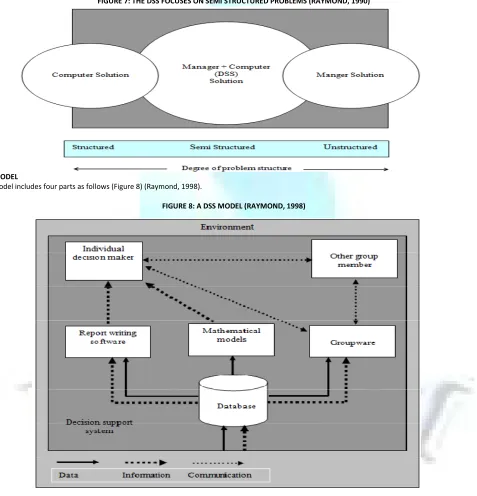
A decision support system or DSS is a computer based system intended for use by a particular manager or usually a group of managers at any organizational level in making a decision in the process of solving a semi structured decision (Figure 7). The DSS produces output in the form of periodic or special report or the results of mathematical simulations (Raymond, 1990). It is difficult to pinpoint that are completely structured or unstructured. The vast majorities are semi structured. This means that the DSS is aimed at the area where most semi structured decision is needed to be made.
FIGURE 7: THE DSS FOCUSES ON SEMI STRUCTURED PROBLEMS (RAYMOND, 1990)
A DSS MODEL
A DSS model includes four parts as follows (Figure 8) (Raymond, 1998).
FIGURE 8: A DSS MODEL (RAYMOND, 1998)
- Data base produces both internal and environmental data, which are stored in the database.
- Report writing software produces both periodic and special reports. Periodical reports are prepared according to a schedule and typically they are produced by software, which is coded in a procedural language such as COBOL or PL/I. The special report is prepared in response to unanticipated information need and takes form of database by users who use the query language of a DBMS or fourth generation language.
VOLUME NO.2(2012),ISSUE NO.11(NOVEMBER) ISSN2231-5756
INTERNATIONAL JOURNAL OF RESEARCH IN COMMERCE, IT & MANAGEMENT
- Groupware enables multiple decision makers, working together as a group, to reach solutions. In this particular situation, the term GDSS, or a group decision support system is used. Perhaps the decision makers represent a committee or a project team. The group members communicate with one another both, directly and by means of the group ware. The reports writing software and mathematical model have always been regarded as necessary DSS ingredients. As the DSS concept was broadened to provide support to two or more decision maker working together as a team or committee, the idea of special group oriented software or groupware, became a reality.
DSS CHARACTERISTICS
Decision support system has a number of characteristics, which include following:
- DSS provide support for decision maker mainly in semi structured and unstructured situations by bringing together human judgment and computerized information. Such problem can not be solved (can not be solved conveniently) by other computerized systems, such as MIS.
- DSS attempts to improve the effectiveness of decision-making (accuracy, timeliness, quality) rather than its efficiency (cost of making the decision, including
the charges for computer time) (Davis & Olson, 1985). www.ccsenet.org/ijbm International Journal of Business and Management Vol. 6, No. 7; July 2011
Published by Canadian Center of Science and Education 167
- DSS provides support to individuals as well as to groups. Many organizational problems involve group decision-making. The less structured problem frequently requires the involvement of several individuals from different departments and organizational levels.
- Advanced DSS are equipped by a knowledge component, which enables the efficient and effective solution of very difficult problems (Turban & Aronson, 1998).
- A DSS can handle large amount of data for instance advanced database management package have allowed decision makers, to search database for information. A DSS can also solve problems where a small amount of data is required.
- A DSS can be developed using a modular approach. With this approach, separate functions of the DSS are placed in separate modules - program or subroutines-allowing efficient testing and implement of systems. It also allows various modules to be used for multiple purposes in different systems.
- A DSS has a graphical orientation. It has often been said that a picture is worth a thousand words. Today’s decision support systems can help managers make attractive, informative graphical presentations on computer screens and on printed documents. Many of today’s software packages can produce line drawing, pie chart, trend line and more. This graphical orientation can help decision makers a better understanding of the true situation in a given market place. - A DSS support optimization and heuristic approach. For smaller problems, DSS has the ability to find the best (optimal) situation. For more complex problems, heuristics are used. With heuristic, the computer system can determine a very good-but not necessarily the best- solution. This approach gives the decision maker a great deal of flexibility in getting computer support for decision making activities.
- A DSS can perform “what – if" and goal – seeking analysis. “What – if “analysis is the process of making hypothetical change to problem data and observing impact of the results. In with” what – if “analysis, a manager can make changes to problem data (the number of automobiles for next month) and immediately see the impact on the requirement for subassemblies (engines, windows, etc.) (Stair, 1992).
THE ROLE OF THE DSS IN THE PROCESS OF DECISION MAKING
Previously it was mentioned that the MIS is best suited in identifying problems and helping managers understanding them to make suitable and correct decisions, but the main weakness of MIS is that it is not aimed at the specific need of the individual and group decision makers. Very often the MIS does not provide exactly the information that is needed to solve problems for individual and group decision making. DSS is tailored to the specific need of the individual and group managers. Therefore, the DSS can extend this support through the remaining steps (in objective and criteria setting, alternative search, alternative evaluation, making the decision and decision review) of the decision making. Finally DSS has more roles in decision-making and problem solving than MIS (Raymond, 1998). The other researches such as the following confirm this idea: Uma (2009) has stated that a Decision Support System is an integrated set of computer tools allowing a decision maker to interact directly with computer to retrieve information useful in making semi structured and unstructured decisions. Example of this decisions include such things as merger and acquisition decisions, plant expansion, new product decisions portfolio management and marketing decisions. Nokhbatolfoghahaayee et al (2010) have introduced a fuzzy decision support system (FDSS) with a new decision making structure, which can be applied to manage the crisis conditions in any large scale systems with many parameters. After receiving both functional variables of the system and fault signals, the FDSS makes proper decisions to make up and repair the distorted situation and the affected elements of the network according to its data base established through experience gathered from expert managers and decision models properly developed. These decisions are expressed in the form of some scenarios with different desirability degrees, which are determined by some properly developed fuzzy multi-criteria decision making methods, helping the manager choose the best one according to his discretion. Alonso et al (2010) have presented an implemented web based consensus support system that is able to help, or even replace, the moderator in a consensus process where experts are allowed to provide their preferences using one of many types (fuzzy, linguistic and multi-granular linguistic) of incomplete preference relations. These studies show the important and role of MIS during managers' decision making process.
DISCUSSION
Managers in all levels of organization hierarchy need precise and suitable data and information to make decisions that increase organizational performance. Such concept suggests an informational need of supervisory level is different from top level. At the same time the type of information also at each level is different. At lower level, supervisors need defined, clear, precise, quantifiable and internal organizational information but at the top level a manager needs undefined, future oriented, infrequent, summarized, relatively, non quantifiable and mostly external information. Such concept is illustrated in Figure 9. Quantifiable information could be gathered from external environment if suitable. Management Information Systems are placed in organizational information system such as CSCWS, GDSS and ESS. And some of organization environment elements such as www.ccsenet.org/ijbm International Journal of Business and
Management Vol. 6, No. 7; July 2011, 168 ISSN 1833-3850 E-ISSN 1833-8119 socio-cultural factors like birth rate, population rate, competitor's share of market
and so on could be quantifiable data and be considered and used it the process of top level management decision making process.
INTERNATIONAL JOURNAL OF RESEARCH IN COMMERCE, IT & MANAGEMENT
In general, different kinds of data and information are suitable for decision-making in different levels of organizational hierarchy and require different information system to be placed. Such system could have explicit effect on each step of decision process in solving problems. At the same time each information system can not fulfill complete information needs of each level, but rather different information systems if integrated in different levels could satisfy information needs of a level and at the same time fulfill part of information needs of other levels. For example TPS fulfills the lower level needs of an organization but MIS furnishes data and information for lower and middle level management needs(Note 1) On the other hand, DSS furnishes information for middle level and higher level of organizational hierarchy and ES fulfills only higher level managerial needs. Clearly by segregating each IS, its particular function could be recognized and it's overlapping distinguished. The role of different information systems is depicted in Figure 10.
FIGURE 10: ORGANIZATION AND INFORMATION SYSTEM (DAVIS & OLSON, 1985)
The perceived concepts, which are based on the role of MIS and DSS in the decision making process, especially with emphasize on MIS and DSS which provide information services for middle and higher level managers in the process of decision making are integrated in Figure 11.
FIGURE 11: TRANSFERRING DATA FROM EDP SYSTEM TO DBMS AND MANAGERS' DECISION MAKING PROCESS
In Figure 11 it could be noted that data from EDP system transfers to DBMS and helps managers to make programmed and non-programmed decisions (Note 2). The flow of data after moving from EDP system to DBMS will move from MIS level to DSS and at the same time part of processed data will be restored in EDP system.
CONCLUSION
Apart from variety of information system in business world, MIS and DSS were the main concern of present article. It was found that MIS is best suited to identify problems and help management to understand them to make suitable decisions. At the same time, MIS is not aimed to help particular and specific need of the individual and group decision making. On the other hand DSS are tailored to the specific need of individual and group managers. Therefore, it could be concluded, that DSS can extend its support to the same steps of decision making process and has more roles in decision-making and problem solving than MIS. Due to some practical limitations, may be some of steps of decision making process to be chosen and the others to be removed. It is important to consider which ones are preferred to the other ones. In future works can study on the role of other information systems for managers' decision making and comparative it to DSS and MIS.
REFERENCES
1. Alonso, S., Herrera-Viedma, E., Chiclana, F., & Herrera, F. (2010). A web based consensus support system for group decision making problems and
incomplete preferences. Information Sciences, 180(23), 1 December. 4477-4495.
2. Certo, S, C. (1997). Modern Management, diversity, quality, ethics and the global environment, 7th Ed, New Jersey, Prentice-Hall Inc.
3. Davis, G.B., & Olson, M.H. (1985). Management Information Systems, conceptual foundation, structure and development, 2nd. New York, McGraw-Hill.
4. Gordon, J.R. (1993). A diagnostic approach to organizational behavior, 4th Ed, New York, Prentice-Hall Inc,Englewood Cliffs, NJ.
5. Gorry, G. A., & Michael M.M.S. (1971). A. Framework for Management Information System. Sloan,Management Review, 13 (Fall), 55-70
6. Huber, G. P. (1980). Managerial decision making. Glenview, IL: Scott, Foresman and Co.
7. Louw, J.J., Van Zyl, N.J.W., & Meintsma, J. (2001). Development of a public transport management Information system to assist decision-making in the
VOLUME NO.2(2012),ISSUE NO.11(NOVEMBER) ISSN2231-5756
INTERNATIONAL JOURNAL OF RESEARCH IN COMMERCE, IT & MANAGEMENT
8. Nokhbatolfoghahaayee, H., Menhaj, M.B., & Shafiee, M. (2010). Fuzzy decision support system for crisis management with a new structure for decision
making. Expert Systems with Applications, 37(5), May. 3545-3552.
9. Power, D. J. (2002). Decision Support Systems: Concepts and Resources for Managers. Editor, DSSResources.COM. Quorum Books division, Greenwood
Publishing.
10. Raymond McLeod, Jr. (1998). Management Information Systems, 6th Ed. New Jersey: Prentice Hall.
11. Raymond, McLeod, Jr. (1990). Raymond, Information Systems. New York, Macmillan Publishing Company.
12. Simon, H. (1997). Administrative Behavior: A Study of Decision-Making Processes in Administrative Organizations, 4th Ed. The Free Press.
13. Stair, R.M. (1992). Principles of Information Systems: A Managerial Approach. Boston: Boyd and Fraser Publishing Company.
14. Turban, E., & Aronson, J.E. (1998). Decision Support Systems and Intelligent Systems, 5th Ed., New Yourk: Prentice-Hall.
15. Uma, V.D. (May 13, 2009). Role of Decision Support System for Decision-Making Process in Global Business Environment. From ezinearticles.com, Date
Access: 1 Feb.2011. [Online] Available http://ezinearticles.com/?Role-of-Decision-Support-System-For-Decision-Making-Process-in-Global-Business-Environment&id=2315787
INTERNATIONAL JOURNAL OF RESEARCH IN COMMERCE, IT & MANAGEMENT
REQUEST FOR FEEDBACK
Dear Readers
At the very outset, International Journal of Research in Commerce, IT and Management (IJRCM)
acknowledges & appreciates your efforts in showing interest in our present issue under your kind perusal.
I would like to request you to supply your critical comments and suggestions about the material published
in this issue as well as on the journal as a whole, on our E-mail i.e.
for further
improvements in the interest of research.
If you have any queries please feel free to contact us on our E-mail
.
I am sure that your feedback and deliberations would make future issues better – a result of our joint
effort.
Looking forward an appropriate consideration.
With sincere regards
Thanking you profoundly
Academically yours
Sd/-
VOLUME NO.2(2012),ISSUE NO.11(NOVEMBER) ISSN2231-5756