Please cite this article as: S. E. Mousavi, Effect of Moisture Content on Shear Strength of Offshore Clay Interface Steel Surface, International Journal of Engineering (IJE), TRANSACTIONS B: Applications Vol. 29, No. 2, (February 2016) 183-191
International Journal of Engineering
J o u r n a l H o m e p a g e : w w w . i j e . i rEffect of Moisture Content on Shear Strength of Offshore Clay Interface Steel
Surface
S. E. Mousavi
Civil Engineering Department, College of Engineering, Universiti Tenaga Nasional Kajang, Selangor, Malysia
P A P E R I N F O
Paper history:
Received 22 December 2015
Received in revised form 16 January 2016 Accepted 26 January 2016
Keywords: Offshore Clay Moisture Content Interface Shear Strength Surface Roughness
A B S T R A C T
This paper investigates the effect of moisture content on interface shear strength between offshore clay and steel plate. Although, sensitive and high plasticity offshore clay deposits are widely distributed in Malaysia and many other countries in the world, and steel is a vital construction material for many structures, research works on interaction between offshore clay and steel surface are relatively scarce. This study aims to evaluate interface shear strength of offshore clay with various steel surfaces, namely smooth, rough, and corroded. To achieve such aim, direct shear tests were conducted to assess the effect of moisture content and surface roughness on the interface shear strength. The normal stresses were ranged to be 50, 100, and 150 kPa. It was found that, the interface shear strength of offshore clay with rough steel significantly increased by almost 1.5 folds. It was further discovered that, addition of water content induced a progressive decrease in the interface shear strength. In summary, it has been observed that rough steel surface higher than the smooth and corroded steel surface enables a better interaction with offshore clay, enhancing the interface friction angle. The results developed in this research work can contribute a cost-effective design of structures in offshore clay.
doi: 10.5829/idosi.ije.2016.29.02b.07
1. INTRODUCTION1
Offshore clay is a natural deposited fine grained soil recovered from offshore at the seabed worldwide. It poses many challenges to geotechnical engineers due to its low strength and high compressibility [1, 2]. The physical and mechanical behaviors of marine clays are widely investigated to better understand their behavior [2-5]. According to Thian and Lee [1], offshore clay is classified as clay (CH), with clay fraction and plasticity index of 43 and 27%, respectively. Previous research works have stipulated that marine clay tends to considerably lose its strength due to disturbance. It depicts quick clay behavior, high sensitivity and serious geotechnical hazards [6]. The Malaysia high plasticity marine clays are often called offshore clay in the Malaysian geotechnical engineering literature. Therefore, offshore clays are problematic soil and they are responsible for many geotechnical problems, such as
*Corresponding Author’s Email: [email protected] (S. Mousavi)
landslides and foundation damages in the
[1], Gireesha and Muthukkumaran [9]. Since the mentioned areas are heavily industrialized and populated, the importance of offshore clay as a foundation soil, particularly for harbor and ports has led to several investigations of its geotechnical characteristics [1, 12]. Although, at the regions where the offshore clay exists, structure foundations have adopted using pile foundation as subsurface supporting structures (i.e. heavy structures such as harbor and port). The interface shear strength between pile and offshore clay has not completely investigated yet. Therefore, it is crucial to examine the interface shear strength of pile materials (steel plate) and offshore clay to have a reliable and cost-effective design of friction pile foundation structures. Hence, the interface shear strength parameters can be used in stability analysis [6-8, 10]. This study focuses on the effects of moisture content variations on the interface shear strength of three different steel surfaces, namely smooth, corroded, and rough steel surface with offshore clay. The main objective of this study is to evaluate the interface shear strength between offshore clay and steel plate under application of different water content. In summary, a notable discovery is that the offshore clay-interface rough steel surface can be sustainably applied for construction of steel structures in offshore clay without sliding. However, sufficient laboratory and field testing are required.
2. LABORATORY INVESTIGATION
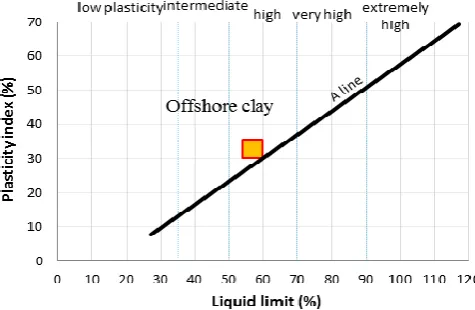
2. 1. Soil Sample The natural deposited soil sample in the form of offshore clay was obtained at the seabed depths of approximately 15-20 m in the state of Kuala Terengganu, Malaysia (Figure 1). Initial observation and its characterization further show that, offshore clay is a sensitive and high plastic soil. The soil has same behavior, from one area to another. The particle size distribution curve of the soil sample is illustrated in Figure 2. The main physico-chemical properties of the offshore clay are specified in Table 1. The soil sample was classified as CLAY of high plasticity (CH) according to the Unified Soil Classification System (USCS). The location of the offshore clay in the plasticity chart is shown in Figure 3. It should be noted that the sensitivity of the offshore clay was determined to be 6.5 (Table 1). Therefore, the offshore clay is classified as medium to high sensitive clay. This is justified by Taha and Fall [6], that for the medium to high sensitive clay, sensitivity (St) must be
ranged between 6 to 8.5.
2. 2. Steel Surfaces In this research three different types of steel plates namely, smooth, corroded, and rough surfaces were used. The steel plates have a
thickness of 5 mm, which made up the square shear box with dimension of 60 mm.
Figure 1. Map of Peninsular Malaysia
Figure 2. Particle size distribution curve of the offshore clay
TABLE 1. Physico-chemical properties of the offshore clay
Properties Average value
Natural moisture content (%) 74
Specific gravity, (Gs) 2.62
Liquid limit (%) 57
Plastic limit (%) 24
Plasticity index (%) 33
Liquidity index 1.5
Clay fraction, particles smaller than 0.002 mm (%) 48
Activity 0.69
Sensitivity 6.5
pH 8.33
Optimum moisture content (%) 22.6
Maximum dry density (kN/m3) 14.9
Coefficient of permeability (m/s) 7.3×10⁻¹⁰
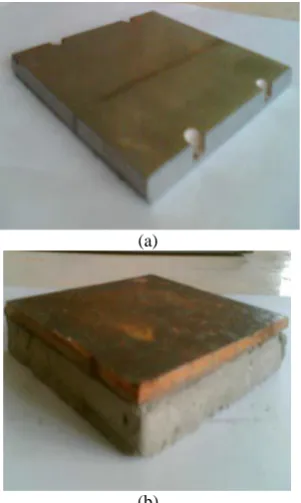
The surface roughness of each steel plate was assessed as the maximum height over a gage length of 0.2 mm in accordance with the method proposed by Taha and Fall [6]. For the smooth, rough, and corroded steel the maximum surface roughness was determined to be 1, 19, and 24 μm, respectively. It is noticeable that the surface roughness was chosen to represent typical steel piles in geotechnical practical applications. The smooth, corroded and rough steel plates are shown in Figure 4. Besides, the properties of the steel plate are tabulated in Table 2.
(a)
(b)
(c)
Figure 4. Steel plate: (a) smooth, (b) corroded and (c) rough
TABLE 2. Properties of the steel plate (from manufacturer)
Property (25°C) Value
Density (kg/m3) 7.81 × 10³
Elastic modulus (GPa) 210
Tensile strength (MPa) 384
Yield strength (MPa) 286
2. 3. Methodology The offshore clay samples were firstly oven dried and was thereafter passed through a 2 mm sieve to remove coarser particles. The oven dried soil thoroughly mixed with three different distilled water contents of 30, 50 and 70% in a soil mixer. Then, the soil admixture was sealed in plastic bags for the purpose of laboratory testing and preventing the moisture loss. In order to evaluate shear strength at the interface, the specified steel plate was placed at the bottom side of the direct shear box and then the provided soil admixture was tamped into the shear box. It should be noted that, steel plate occupied the first half of the shear box and the soil admixture was tamped above the steel plate. Meanwhile, porous platens were positioned at the bottom of the steel plate and the top of the soil admixture (Figure 5). The assembled shear box was placed in a direct shear apparatus with applied shear rate of 0.5 mm/min. To perform the direct shear test, the soil samples were sheared in a 60 mm square shear box under application of 50, 100 and 150 kPa normal effective stresses. All the tests have been carried out in accordance with ASTM standard methods.
3. RESULTS AND DISCUSSION
Figure 5. Schematic diagram of assembling of the shear box
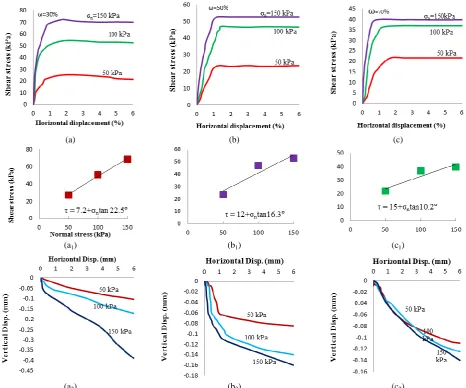
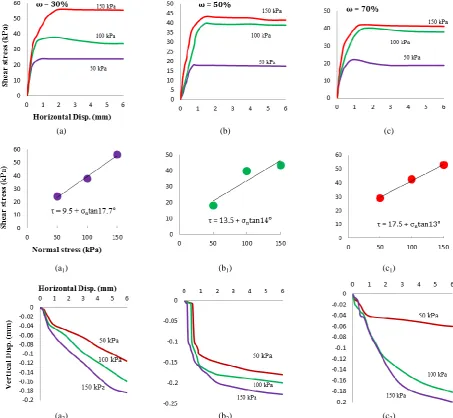
In general, each figure illustrates 3 types of graphs i.e. shear stress versus horizontal displacement, shear strength envelope line and vertical displacement versus horizontal displacement. The strength envelope line gives the interface friction angle and interface cohesion. From Figure 6 (a, b, c), it can be observed that the shear stress exhibited a rapid trend of increase with its
horizontal displacement until its critical strength was reached. After the ultimate (critical) strength, the soil volume was noticed to be almost constant as shearing continued. The soil specimen is now in the critical state and the volume is the critical volume. The highest value of critical shear stress of the offshore clay was determined to be 73 kPa under application of 150 kPa normal stress and 30% water content. The strength envelopes of the offshore clay specimens at 30, 50, and 70% water content are shown in Figure 6 (a1, b1, c1).
The maximum value of internal friction angle was determined to be 22.5° corresponding to the offshore clay with 30% water content. The vertical displacement with respect to each test specimen was plotted against horizontal displacement as indicated in Figure 6 (a2, b2,
c2). The offshore clay specimens exhibited contraction
behavior since vertical displacement increased with increasing horizontal displacement.
(a) (b) (c)
(a1) (b1) (c1)
(a2) (b2) (c2)
Figure 6. Direct shear test results on offshore clay with (a, a1, a2) 30% water content, (b, b1, b2) 50% water content, and (c, c1, c2)
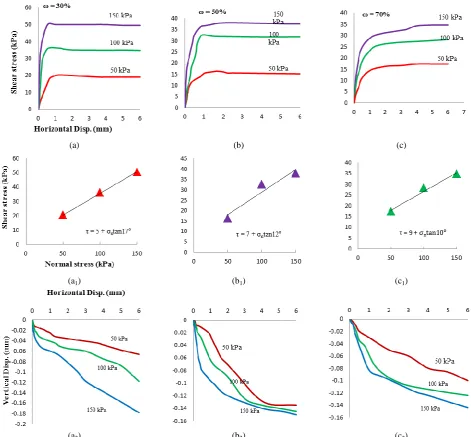
Figure 7 depicts typical shear stress-horizontal displacement, strength envelope and vertical displacement versus horizontal displacement for the interface between offshore clay and smooth steel surface with 30, 50, and 70% water content. In a similar pattern as compared to that of offshore clay, the shear stress exhibited a rapid trend of increase with its horizontal displacement until its ultimate shear strength was reached. Based on the assumption that Mohr Columb law is valid, soil specimen was expected to fail under a combination of normal and shear stresses. The highest value of interface shear strength between
offshore clay and smooth steel surface was determined to be 50 kPa corresponding to the test specimen with 30% water content. For the test specimens, here was a consistent decrease of vertical displacement with increasing horizontal displacement irrespective of the normal stress applied (Figure 7 (c, c1, c2)). Such
phenomenon was largely attributed to the contraction behavior of the soil sample due to its volume reduction. The interface friction angle and interface cohesion of offshore clay-smooth steel surface are shown on graphical plots in Figure 7 (b, b1, b2).
(a) (b) (c)
(a1) (b1) (c1)
(a2) (b2) (c2)
Figure 7. Direct shear test results on offshore clay-interface smooth steel surface with(a, a1, a2) 30% water content, (b, b1, b2) 50%
Based on the results of direct shear tests, the relevant graphical relationships were plotted in Figure 8. There was a remarkable increase in the shear stress with increasing horizontal displacement with the higher the normal stress applied, the higher was the peak shear stress in the test specimen (Figure 8 (a, a1, a2)). As
expected, the maximum shear stress of the soil specimen increased with increasing normal stress. It should be emphasized that at zero normal stress for the test specimens, no inter-particle friction occurred and thus the shear strength is equivalent to zero. Figure 8 (b, b1, b2) indicate the corresponding strength envelope
lines for interface between offshore clay and corroded steel plate. The corresponding values of cohesion and internal friction angle are indicated on the graphs of Figure 8 (b, b1, b2). As shown in Figure 8, the highest
value of vertical displacement during shearing was determined to be 0.23 mm. The consistent decline in the vertical displacement with increasing horizontal displacement confirmed the fact that all the test specimens contracted during its shearing process. Likewise, the results of direct shear tests on interface of offshore clay-corroded steel with 30, 50, and 70% water content were obtained. As evident, there is a consistent increase in the horizontal displacement of shear stress on interface in such a way that the higher the normal stress, the greater is its corresponding shear strength. As such, for the corroded steel plate the test specimens exhibited contracting behavior with increasing horizontal displacement. The highest value of interface shear strength corresponding to the 30% water content was determined to be 73 kPa.
(a) (b) (c)
(a1) (b1) (c1)
(a2) (b2) (c2)
Figure 8. Direct shear test results on offshore clay-interface corroded steel surface with(a, a1, a2) 30% water content, (b, b1, b2) 50%
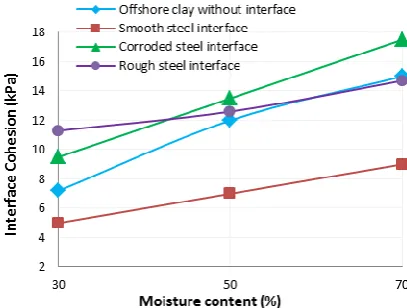
3. 2. Role of Water Content on Interface Shear Strength Effect of water content on interfacial shear behavior of the offshore clay-steel plate interface is established in Figure 9. It is evident in Figure 9 that the interface cohesion increased while the water content raised from 30 to 70%. It is justifiable to state that water had a pronounced impact on the clay fractions in a way that it absorbs the clay particles due to clay water holding capacity which led to the enhancement of soil cohesion. From Figure 9 it is observable that high water content is capable to induce high interface cohesion between offshore clay and steel plate. The highest value of interface cohesion was determined 17.5 kPa is corresponding to the interface of soil-corroded steel plate.
Figure 10 illustrates the impact of water content on the interface friction angle of the offshore clay with steel plate. From this figure, it can be observed that higher water content is associated with a lower friction angle at the interface. It is shown in the figure that when the water content increases from 30 to 70%, the internal friction angle of offshore clay drastically decreases from 22.4° to 10°. Based on the data in Figure 10, both internal and interface friction angles of offshore clay interface with steel plates decreased, while the water content increased. It is inevitable that shear strength parameters would be affected by water content. Previous practices indicate that disease of friction angle is in close relation with change of water content in the test specimens [15].
3. 3. Effect of Surface Roughness on Interface Shear Strength The surface roughness is found to have a remarkable effect on the shear strength parameters as shown in Figure 11. Based on Figure 11, the test specimen of offshore clay-interface rough steel plate had the highest interface cohesion and friction angle of 11.3 kPa and 22.4°, respectively.
Figure 9. Effect of moisture content on interface cohesion
Figure 10. Effect of moisture content on interface friction
angle
Figure 11. Effect of surface roughnesson the interface shear
strength parameters of offshore clay with 30% water content
It is observable in Figure 11 that the test specimens of offshore clay-interface smooth and corroded steel plates indicate an almost similar friction angle. Therefore, utilization of steel plate with rough surface could increase the interface shear strength by almost 1.5 folds when compared to that of smooth steel interface.
4. CONCLUSIONS
Effect of moisture content on interface shear strength between offshore clay and steel plates were investigated using laboratory direct shear test apparatus. Based on the results the following conclusions are summarized.
(1) The interface shear strength between offshore clay and smooth, rough, and corroded surface was found to be 50, 73, and 57 kPa, respectively.
structures that are in contact with offshore clay. Thus, from the roughness point of view, rough steel surface indicates higher asperity in compare to that of smooth and corroded surfaces.
(3) It was revealed that water content had a pronounced impact on the interface shear strength parameters between offshore clay and steel plates. Based on the results, high water content induced high cohesion and small friction angle.
5. ACKNOWLEDGEMENTS
The work presented in this paper was carried out at Universiti Tenaga Nasional (UNITEN). The author would like to thank all the parties involved in this study.
6. REFERENCES
1. Thian, S.Y. and Lee, C.Y., "Geotechnical characterisation of high plasticity offshore clay", Journal of Scientific Research &
Reports, Vol. 3, No. 21, (2014), 2745-2756.
2. Basack, S. and Purkayastha, R., "Engineering properties of marine clays from the eastern coast of india", Journal of
Engineering and Technology Research, Vol. 1, No. 6, (2009),
109-114.
3. Sridharan, A. and Miura, N., "Physico chemical and engineering behaviour of ariake clay and its comparison with other marine clays", in Proc. Int. Symposium, IS Yokohama. Vol. 2, (2000), 203-213.
4. Sridharan, A., Rao, P. and Miura, N., "Characterisation of ariake and other off shore clays", International Symposium on
Lowland Technology, (2004), 53-58.
5. Li, L.-L., Dan, H.-B. and Wang, L.-Z., "Undrained behavior of natural marine clay under cyclic loading", Ocean Engineering, Vol. 38, No. 16, (2011), 1792-1805.
6. Taha, A. and Fall, M., "Shear behavior of sensitive marine clay– steel interfaces", Acta Geotechnica, Vol. 9, No. 6, (2014), 969-980.
7. Tan, W., Lee, C. and Sivadass, T., "Behaviour of clay-steel interfaces", in Int Conf Construct Build Technol. Vol. 2, (2008), 11-20.
8. Al-Mhaidib, A.I., "Influence of shearing rate on interfacial friction between sand and steel", Engineering Journal of the
University of Qatar, Vol. 19, (2006).
9. Gireesha, N. and Muthukkumaran, K., "Study on soil structure interface strength property", International Journal of
Earth Sciences and Engineering, Vol. 4, No. 6, (2011), 89-93.
10. Zeevaert, L., Feld, J., Fegan, J.C., Tschebotarioff, G.P., Rutledge, P.C., Skempton, A., Schuyler, J.R., Kantey, B., Krynine, D. and Legget, R.F., "Discussion of" effect of driving piles into soft clay"", Transactions of the American Society of
Civil Engineers, Vol. 115, No. 1, (1950), 286-345.
11. Fattah, M., Shlash, K. and Al-Soud, M., "Boundary element analysis of a lined tunnel problem", International Journal of
Engineering-Transactions B: Applications, Vol. 25, No. 2,
(2012), 89-93.
12. Anuar, N., Chan, C.-M. and Kassim, A.S.M., "Interactions between the survival of escherichia coli and the physico-chemical properties in malaysia dredged marine soils", Journal
of Civil Engineering Research, Vol. 4, No. 3A, (2014), 63-65.
13. Bensallam, S., Bahi, L., Ejjaaouani, H. and Shakhirev, V., "Shrinkage curve: Experimental study and modelling",
International Journal of Engineering, Vol. 25, No. 3, (2012),
203-210.
14. Ayadat, T. and Hanna, A., "Assessement of soil collapse prediction methods", International Journal of Engineering, Vol. 25, No. 1, (2012), 19-26.
15. Bingjian, Z., Zhanhong, Q., Hao, X., Chunmu, H. and Helong, C., "Effect of water content on the shear strength parameters of municipal solid waste", Electronic Journal of Geotechnical
Effect of Moisture Content on Shear Strength of Offshore Clay Interface Steel
Surface
S. E. Mousavi
Civil Engineering Department, College of Engineering, Universiti Tenaga Nasional Kajang, Selangor, Malysia
P A P E R I N F O
Paper history:
Received 22 December 2015
Received in revised form 16 January 2016 Accepted 26 January 2016
Keywords: Offshore Clay Moisture Content Interface Shear Strength Surface Roughness
هديكچ
هس و هدنبسچ کاخ عون کی نیب کرتشم حطس رد هدش جیسب یشرب تمواقم یور تبوطر دصرد ریثات رضاح قیقحت رد
ایرد قمع زا هک ساسح سر کاخ عون نیا هچرگ .تسا هتفرگ رارق یسررب دروم توافتم حوطس اب یدلاوف هحفص عون
لاوف زینو دوش یم تفای ایند فلتخم یاه روشک رد روفو هب هدمآ تسدب امتخاس تتنص رد یدیلک ححاام زا ییی د
ددرگ یم بوسحم .
شهوژپ نیا رد .تسا هتفرگن رارق قیقحت دروم لماک روط هب روکذم کاخ و دلاوف نیب شنکردنا ونکات
( فلتخم یاه تبوطر دصرد اب کاخ هنومن نیب یشرب تواقم 03
، 03 و 03 گنز ،فاص حوطس اب دلاوف عون هس و ) دصرد
زآ ربز و هدز لاف یشرب تمواقم یور دلاوف حطس یربز زین و تبوطر دصرد ریثات یبایزرا روظنم هب .تسا هدیدرگ شیام
تمواقم هک دنهد یم اشن یهاگشیامزآ تاشیامزآ جیاتن .تسا هتفای ماجنا میقتسم شرب تاشیامزآ دلاوف و کاخ کرتشم
رادقم نیرتشیب یاراد ربز حطس یارب دلاوف و کاخ کرتشم لاف یشرب هدز گنز و فاص حوطس اب هسیاقم رد و هدوب
ادودح " 5.0 هلیسا دننام ایرد رد رقتسم یدلاوف یاه هزاس یحارط رد دناوت یم قیقحت نیا جیاتن .تسا هتفای شیازفا ربارب
.ددرگ یم هیصوت یرتشیب ییارحص و یهاگشیامزآ تاشیامزآ ماجنا هچرگ .دشاب دیفم اه