VOLUME NO. 4 (2014), ISSUE NO. 04 (APRIL) ISSN 2231-5756
A Monthly Double-Blind Peer Reviewed (Refereed/Juried) Open Access International e-Journal - Included in the International Serial Directories
VOLUME NO. 4 (2014), ISSUE NO. 04 (APRIL) ISSN 2231-5756
INTERNATIONAL JOURNAL OF RESEARCH IN COMMERCE, IT & MANAGEMENT
CONTENTS
Sr.
No.
TITLE & NAME OF THE AUTHOR (S)
Page
No.
1
.
ENCOMPASSING KANO’S MODEL TO AUGMENT CUSTOMER EXPERIENCE FOR THE
INDIAN DTH INDUSTRY
DR. SUJATA JOSHI, DR. SANJAY BHATIA, ARNAB MAJUMDAR & ARCHIT MALHOTRA
1
2
.
WOMEN AND CHILD TRAFFICKING
ARJUMAND BANO & DR. SANJAY BAIJAL
7
3
.
OBSTACLES IN GROWTH OF ENTREPRENEURSHIP
MOHAN BHAGWAT BHOSALE & DR. SARANG SHANKAR BHOLA
12
4
.
A STUDY OF CONSUMERS' ATTITUDES AND PURCHASE INTENTIONS TOWARDS
ENVIRONMENTAL: FRIENDLY PRODUCTS IN FMCG SECTOR IN INDIA
DR. NAMITA RAJPUT, RUCHIKA KAURA & AKANKSHA KHANNA
14
5
.
INDIAN COMMODITY DERIVATIVE MARKET: A STUDY OF PRICE TRENDS IN THE
INTERNATIONAL MARKET
GIRISHA H.J, VISHWANATH C.R & MARIGOWDA K.T
20
6
.
A STUDY ON INFORMATION TECHNOLOGY IN THE CURRENT BUSINESS FRAMEWORK
PRADEEP KUMAR, RUCHI SHARMA & SUNITA PRAJAPATI
22
7
.
A STUDY ON THE DEVELOPMENT OF ONLINE MICRO-LENDING COMMUNITY IN NORTH
BENGAL
DIPANJAN MOITRA & SANMOY MALLICK
26
8
.
TRANSACTIONAL ANALYSIS: THEORY OF PERSONALITY AND INTER PERSONAL
BEHAVIOUR
VAJINDER PAL SINGH & AMIT KUMAR JAIN
32
9
.
SOCIO-ECONOMIC BACKGROUND OF MANAGEMENT STUDENTS OF PUBLIC AND
PRIVATE INSTITUTIONS IN DELHI
VIJETA BANWARI
37
10
.
TAX STRUCTURE IN INDIA AND EFFECT ON CORPORATES & INDIVIDUAL CUSTOMERS
ABHISHEK JHA
43
11
.
MERGERS AND ACQUISITIONS IN INDIAN PHARMACEUTICAL INDUSTRY: A CASE STUDY
ON MATRIX LAB
DR. SURESH CHANDRA DAS, POOJA PATTANAYAK & BHAGYASHREE PATTNAIK
46
12
.
IMPACT OF ACHIEVEMENT MOTIVATION UPON ACADEMIC ACHIEVEMENT AND
SOCIO-ECONOMIC STATUS
DR. SAIMA SIDDIQI
50
13
.
EXPLORATORY ANALYSIS ON THE TRENDS AND ISSUES RELATED TO STANDARDIZING
FINANCIAL REPORTING IN ETHIOPIAN BANKING SECTOR
MATEWOS KEBEDE & ABIY GETAHUN
53
14
.
CHANGING CUSTOMER BEHAVIOR-TIME TO RETHINK BY THE INSURANCE PROVIDERS
PURTI BATRA
57
15
.
EXAMINING EMPLOYEES PERFORMANCE APPRAISAL ISSUES AND CHALLENGES IN BANKS
OF PAKISTAN: COMPARATIVE STUDY OF PRIVATE AND PUBLIC BANKS OF PUNJAB
PAKISTAN
SYEDA NUDRAT SAMEEN, SHAHID NAWAZ, MUHAMMED NAWAZ & MUHAMMAD IRFAN
SHAKOOR
60
VOLUME NO. 4 (2014), ISSUE NO. 04 (APRIL) ISSN 2231-5756
CHIEF PATRON
PROF. K. K. AGGARWAL
Chairman, Malaviya National Institute of Technology, Jaipur
(An institute of National Importance & fully funded by Ministry of Human Resource Development, Government of India)
Chancellor, K. R. Mangalam University, Gurgaon
Chancellor, Lingaya’s University, Faridabad
Founder Vice-Chancellor (1998-2008), Guru Gobind Singh Indraprastha University, Delhi
Ex. Pro Vice-Chancellor, Guru Jambheshwar University, Hisar
FOUNDER PATRON
LATE SH. RAM BHAJAN AGGARWAL
Former State Minister for Home & Tourism, Government of Haryana
Former Vice-President, Dadri Education Society, Charkhi Dadri
Former President, Chinar Syntex Ltd. (Textile Mills), Bhiwani
CO-ORDINATOR
AMITA
Faculty, Government M. S., Mohali
ADVISORS
DR. PRIYA RANJAN TRIVEDI
Chancellor, The Global Open University, Nagaland
PROF. M. S. SENAM RAJU
Director A. C. D., School of Management Studies, I.G.N.O.U., New Delhi
PROF. M. N. SHARMA
Chairman, M.B.A., Haryana College of Technology & Management, Kaithal
PROF. S. L. MAHANDRU
Principal (Retd.), Maharaja Agrasen College, Jagadhri
EDITOR
PROF. R. K. SHARMA
Professor, Bharti Vidyapeeth University Institute of Management & Research, New Delhi
CO-EDITOR
DR. BHAVET
Faculty, Shree Ram Institute of Business & Management, Urjani
EDITORIAL ADVISORY BOARD
DR. RAJESH MODI
Faculty, Yanbu Industrial College, Kingdom of Saudi Arabia
PROF. SANJIV MITTAL
University School of Management Studies, Guru Gobind Singh I. P. University, Delhi
VOLUME NO. 4 (2014), ISSUE NO. 04 (APRIL) ISSN 2231-5756
INTERNATIONAL JOURNAL OF RESEARCH IN COMMERCE, IT & MANAGEMENT
DR. SAMBHAVNA
Faculty, I.I.T.M., Delhi
DR. MOHENDER KUMAR GUPTA
Associate Professor, P. J. L. N. Government College, Faridabad
DR. SHIVAKUMAR DEENE
Asst. Professor, Dept. of Commerce, School of Business Studies, Central University of Karnataka, Gulbarga
ASSOCIATE EDITORS
PROF. NAWAB ALI KHAN
Department of Commerce, Aligarh Muslim University, Aligarh, U.P.
PROF. ABHAY BANSAL
Head, Department of Information Technology, Amity School of Engineering & Technology, Amity
University, Noida
PROF. A. SURYANARAYANA
Department of Business Management, Osmania University, Hyderabad
DR. SAMBHAV GARG
Faculty, Shree Ram Institute of Business & Management, Urjani
PROF. V. SELVAM
SSL, VIT University, Vellore
DR. PARDEEP AHLAWAT
Associate Professor, Institute of Management Studies & Research, Maharshi Dayanand University, Rohtak
DR. S. TABASSUM SULTANA
Associate Professor, Department of Business Management, Matrusri Institute of P.G. Studies, Hyderabad
SURJEET SINGH
Asst. Professor, Department of Computer Science, G. M. N. (P.G.) College, Ambala Cantt.
TECHNICAL ADVISOR
AMITA
Faculty, Government M. S., Mohali
FINANCIAL ADVISORS
DICKIN GOYAL
Advocate & Tax Adviser, Panchkula
NEENA
Investment Consultant, Chambaghat, Solan, Himachal Pradesh
LEGAL ADVISORS
JITENDER S. CHAHAL
Advocate, Punjab & Haryana High Court, Chandigarh U.T.
CHANDER BHUSHAN SHARMA
Advocate & Consultant, District Courts, Yamunanagar at Jagadhri
VOLUME NO. 4 (2014), ISSUE NO. 04 (APRIL) ISSN 2231-5756
CALL FOR MANUSCRIPTS
We invite unpublished novel, original, empirical and high quality research work pertaining to recent developments & practices in the areas of Computer Science & Applications; Commerce; Business; Finance; Marketing; Human Resource Management; General Management; Banking; Economics; Tourism Administration & Management; Education; Law; Library & Information Science; Defence & Strategic Studies; Electronic Science; Corporate Governance; Industrial Relations; and emerging paradigms in allied subjects like Accounting; Accounting Information Systems; Accounting Theory & Practice; Auditing; Behavioral Accounting; Behavioral Economics; Corporate Finance; Cost Accounting; Econometrics; Economic Development; Economic History; Financial Institutions & Markets; Financial Services; Fiscal Policy; Government & Non Profit Accounting; Industrial Organization; International Economics & Trade; International Finance; Macro Economics; Micro Economics; Rural Economics; Co-operation; Demography: Development Planning; Development Studies; Applied Economics; Development Economics; Business Economics; Monetary Policy; Public Policy Economics; Real Estate; Regional Economics; Political Science; Continuing Education; Labour Welfare; Philosophy; Psychology; Sociology; Tax Accounting; Advertising & Promotion Management; Management Information Systems (MIS); Business Law; Public Responsibility & Ethics; Communication; Direct Marketing; E-Commerce; Global Business; Health Care Administration; Labour Relations & Human Resource Management; Marketing Research; Marketing Theory & Applications; Non-Profit Organizations; Office Administration/Management; Operations Research/Statistics; Organizational Behavior & Theory; Organizational Development; Production/Operations; International Relations; Human Rights & Duties; Public Administration; Population Studies; Purchasing/Materials Management; Retailing; Sales/Selling; Services; Small Business Entrepreneurship; Strategic Management Policy; Technology/Innovation; Tourism & Hospitality; Transportation Distribution; Algorithms; Artificial Intelligence; Compilers & Translation; Computer Aided Design (CAD); Computer Aided Manufacturing; Computer Graphics; Computer Organization & Architecture; Database Structures & Systems; Discrete Structures; Internet; Management Information Systems; Modeling & Simulation; Neural Systems/Neural Networks; Numerical Analysis/Scientific Computing; Object Oriented Programming; Operating Systems; Programming Languages; Robotics; Symbolic & Formal Logic; Web Design and emerging paradigms in allied subjects.
Anybody can submit the soft copy of unpublished novel; original; empirical and high quality research work/manuscriptanytime in M.S. Word format after preparing the same as per our GUIDELINES FOR SUBMISSION; at our email address i.e. [email protected] or online by clicking the link online submission as given on our website (FOR ONLINE SUBMISSION, CLICK HERE).
GUIDELINES FOR SUBMISSION OF MANUSCRIPT
1. COVERING LETTER FOR SUBMISSION:
DATED: _____________
THE EDITOR IJRCM
Subject: SUBMISSION OF MANUSCRIPT IN THE AREA OF.
(e.g. Finance/Marketing/HRM/General Management/Economics/Psychology/Law/Computer/IT/Engineering/Mathematics/other, please specify)
DEAR SIR/MADAM
Please find my submission of manuscript entitled ‘___________________________________________’ for possible publication in your journals.
I hereby affirm that the contents of this manuscript are original. Furthermore, it has neither been published elsewhere in any language fully or partly, nor is it under review for publication elsewhere.
I affirm that all the author (s) have seen and agreed to the submitted version of the manuscript and their inclusion of name (s) as co-author (s).
Also, if my/our manuscript is accepted, I/We agree to comply with the formalities as given on the website of the journal & you are free to publish our contribution in any of your journals.
NAME OF CORRESPONDING AUTHOR: Designation:
Affiliation with full address, contact numbers & Pin Code: Residential address with Pin Code:
Mobile Number (s): Landline Number (s): E-mail Address: Alternate E-mail Address:
NOTES:
a) The whole manuscript is required to be in ONE MS WORD FILE only (pdf. version is liable to be rejected without any consideration), which will start from the covering letter, inside the manuscript.
b) The sender is required to mentionthe following in the SUBJECT COLUMN of the mail:
New Manuscript for Review in the area of (Finance/Marketing/HRM/General Management/Economics/Psychology/Law/Computer/IT/ Engineering/Mathematics/other, please specify)
c) There is no need to give any text in the body of mail, except the cases where the author wishes to give any specific message w.r.t. to the manuscript. d) The total size of the file containing the manuscript is required to be below 500 KB.
e) Abstract alone will not be considered for review, and the author is required to submit the complete manuscript in the first instance.
f) The journal gives acknowledgement w.r.t. the receipt of every email and in case of non-receipt of acknowledgment from the journal, w.r.t. the submission of manuscript, within two days of submission, the corresponding author is required to demand for the same by sending separate mail to the journal. 2. MANUSCRIPT TITLE: The title of the paper should be in a 12 point Calibri Font. It should be bold typed, centered and fully capitalised.
3. AUTHOR NAME (S) & AFFILIATIONS: The author (s) full name, designation, affiliation (s), address, mobile/landline numbers, and email/alternate email address should be in italic & 11-point Calibri Font. It must be centered underneath the title.
VOLUME NO. 4 (2014), ISSUE NO. 04 (APRIL) ISSN 2231-5756
INTERNATIONAL JOURNAL OF RESEARCH IN COMMERCE, IT & MANAGEMENT
5. KEYWORDS: Abstract must be followed by a list of keywords, subject to the maximum of five. These should be arranged in alphabetic order separated by commas and full stops at the end.
6. MANUSCRIPT: Manuscript must be in BRITISH ENGLISH prepared on a standard A4 size PORTRAIT SETTING PAPER. It must be prepared on a single space and single column with 1” margin set for top, bottom, left and right. It should be typed in 8 point Calibri Font with page numbers at the bottom and centre of every page. It should be free from grammatical, spelling and punctuation errors and must be thoroughly edited.
7. HEADINGS: All the headings should be in a 10 point Calibri Font. These must be bold-faced, aligned left and fully capitalised. Leave a blank line before each heading.
8. SUB-HEADINGS: All the sub-headings should be in a 8 point Calibri Font. These must be bold-faced, aligned left and fully capitalised. 9. MAIN TEXT: The main text should follow the following sequence:
INTRODUCTION REVIEW OF LITERATURE
NEED/IMPORTANCE OF THE STUDY STATEMENT OF THE PROBLEM OBJECTIVES
HYPOTHESES
RESEARCH METHODOLOGY RESULTS & DISCUSSION FINDINGS
RECOMMENDATIONS/SUGGESTIONS CONCLUSIONS
SCOPE FOR FURTHER RESEARCH ACKNOWLEDGMENTS REFERENCES APPENDIX/ANNEXURE
It should be in a 8 point Calibri Font, single spaced and justified. The manuscript should preferably not exceed 5000 WORDS.
10. FIGURES &TABLES: These should be simple, crystal clear, centered, separately numbered & self explained, and titles must be above the table/figure. Sources of data should be mentioned below the table/figure. It should be ensured that the tables/figures are referred to from the main text.
11. EQUATIONS:These should be consecutively numbered in parentheses, horizontally centered with equation number placed at the right.
12. REFERENCES: The list of all references should be alphabetically arranged. The author (s) should mention only the actually utilised references in the preparation of manuscript and they are supposed to follow Harvard Style of Referencing. The author (s) are supposed to follow the references as per the following:
•
All works cited in the text (including sources for tables and figures) should be listed alphabetically.•
Use (ed.) for one editor, and (ed.s) for multiple editors.•
When listing two or more works by one author, use --- (20xx), such as after Kohl (1997), use --- (2001), etc, in chronologically ascending order.•
Indicate (opening and closing) page numbers for articles in journals and for chapters in books.•
The title of books and journals should be in italics. Double quotation marks are used for titles of journal articles, book chapters, dissertations, reports, working papers, unpublished material, etc.•
For titles in a language other than English, provide an English translation in parentheses.•
The location of endnotes within the text should be indicated by superscript numbers.PLEASE USE THE FOLLOWING FOR STYLE AND PUNCTUATION IN REFERENCES: BOOKS
•
Bowersox, Donald J., Closs, David J., (1996), "Logistical Management." Tata McGraw, Hill, New Delhi.•
Hunker, H.L. and A.J. Wright (1963), "Factors of Industrial Location in Ohio" Ohio State University, Nigeria.CONTRIBUTIONS TO BOOKS
•
Sharma T., Kwatra, G. (2008) Effectiveness of Social Advertising: A Study of Selected Campaigns, Corporate Social Responsibility, Edited by David Crowther & Nicholas Capaldi, Ashgate Research Companion to Corporate Social Responsibility, Chapter 15, pp 287-303.JOURNAL AND OTHER ARTICLES
•
Schemenner, R.W., Huber, J.C. and Cook, R.L. (1987), "Geographic Differences and the Location of New Manufacturing Facilities," Journal of Urban Economics, Vol. 21, No. 1, pp. 83-104.CONFERENCE PAPERS
•
Garg, Sambhav (2011): "Business Ethics" Paper presented at the Annual International Conference for the All India Management Association, New Delhi, India, 19–22 June.UNPUBLISHED DISSERTATIONS AND THESES
•
Kumar S. (2011): "Customer Value: A Comparative Study of Rural and Urban Customers," Thesis, Kurukshetra University, Kurukshetra.ONLINE RESOURCES
•
Always indicate the date that the source was accessed, as online resources are frequently updated or removed.WEBSITES
VOLUME NO. 4 (2014), ISSUE NO. 04 (APRIL) ISSN 2231-5756
ENCOMPASSING KANO’S MODEL TO AUGMENT CUSTOMER EXPERIENCE FOR THE INDIAN DTH INDUSTRY
DR. SUJATA JOSHI
ASST. PROFESSOR
SYMBIOSIS INSTITUTE OF TELECOM MANAGEMENT
SYMBIOSIS KNOWLEDGE VILLAGE
LAVALE
DR. SANJAY BHATIA
DIRECTOR
SBG sTECH (PROGRAMME LEAD – INNOVATION & IP PROTECTION)
AMDOCS (INDIA)
CYBERCITY, MAGARPATTA, HADAPSAR, PUNE
ARNAB MAJUMDAR
STUDENT
SYMBIOSIS INSTITUTE OF TELECOM MANAGEMENT
SYMBIOSIS KNOWLEDGE VILLAGE
LAVALE
ARCHIT MALHOTRA
STUDENT
SYMBIOSIS INSTITUTE OF TELECOM MANAGEMENT
SYMBIOSIS KNOWLEDGE VILLAGE
LAVALE
ABSTRACT
The purpose of the research was to develop a solution which would help the Direct to Home service providers to enhance the levels of customer experience and help in attaining customer satisfaction. This study modifies the Kano’s model within the context of the Direct to Home industry and segregates the attributes that affect customer experience into the various quadrants as identified by Noriaki Kano as Exciters, Satisfiers, Dissatisfiers, and Indifference attributes. Data analytics and then modeling the data to provide insightful information was the core process followed. For obtaining Primary Data for the service parameters and customer information, a questionnaire was formed and an assisted survey of 440 consumers was carried out. Secondary research was carried out to build the data model. The questionnaire could quantitatively capture voice of customers on a scale of 1-7. A crosstab correlation was performed using SPSS, which promotes the fact that the considered attributes in developing the model have positive influence on enhancing the overall Customer Experience. The results show that there is a significant relationship between customer experience and the attributes defined under exciters, satisfiers and Must Be’s. A broader segment can be opted for the survey to get better results, also the move to rural areas can be considered. The study will help DTH operators to perform efficient parameter profiling & understand the customer’s mindset. The operator can then build on its Quality of Service & increase customer satisfaction and loyalty by delivering the perceived customer experience. The work has been able to express experience quantitatively. The research was based on unconventional and logical thoughts on how to analyze and model the data which could be used for strategic decision making by the service providers.
KEYWORDS
Customer Experience, Customer satisfaction, KANO’S Model, DTH industry.
1. INTRODUCTION
ndia happens to stand third in terms of subscriber base of TV market with 155 million subscriber households in 2012, with US and China being the first two contenders. In India, as of date, the TV signals are distributed in three formats, analog, digital, and terrestrial. In India, the analogue TV services are being provided by cable operators and the digital TV services are being provided by direct to Home operators. Direct to Home (DTH) refers to Direct to Home Television. DTH is can be defined as receiving satellite programs in the house using a personal dish by an individual user. DTH eliminates the local cable operator by enabling direct contact between the broadcaster and the consumer. The cable operators are able to receive satellite programs which in turn are distributed to individual homes of customers.
The Cable Television Networks (Regulation) Act was reformed by the Indian government in 2011 whereby it was decided to digitize Pay TV services in a phased manner such that the implementation would be complete by end of 2014.The main reasons driving the growth of Direct to Home services are the progress in technology, increased overall value proposition, and simplified yet enhanced consumer's television viewing experience. One more major driver for growth of DTH industry is customer service as it acts as a major differentiator for the DTH players A few challenges faced by the Direct to Home Industry are low Average Revenue per user (ARPU), high customer acquisition costs and high churn rate. DTH Service Providers consider superior service experience as the key differentiator that will help them acquire new customers and manage churn as well. Currently the rate of churn for the DTH industry is 14-16%. Thus, it is essential to develop effective methods to retain the existing which can be achieved by managing the customer experience. Customer experience is defined as the sum of all experiences that a customer has at every touch-point of the customer-company relationship. It is an intentional effort on the part of the company to develop and maintain good experience which is differentiated from the competition, consistent at every touch point and most importantly valued by the customer. The objective of the paper is to use the Kano’s model of customer satisfaction in order to enhance customer experience for DTH customers. This study modifies the Kano’s model within the context of the Direct to Home industry. The attributes which affect customer experience for DTH services have been identified in this study and are then segregated into the various quadrants as identified by Noriaki Kano as Exciters, Satisfiers, Dissatisfiers, and Indifference attributes. The segregation will help managers to focus on those attributes which will yield in creating value for the customers.
VOLUME NO. 4 (2014), ISSUE NO. 04 (APRIL) ISSN 2231-5756
INTERNATIONAL JOURNAL OF RESEARCH IN COMMERCE, IT & MANAGEMENT
2. LITERATURE REVIEW
2.1 IMPORTANCE OF CUSTOMER EXPERIENCE
Various authors have stressed on the importance of customer experience. Pine and Gilmore 1998 and 1999, Shaw and Ivens 2002, Voss 2003, Prahalad and Ramaswamy 2004, Meyer and Schwager 2007 opine that customer experience can be used as a source of competitive advantage. According to Liljander and Strandvik 1997, customer experience has an effect on customer satisfaction. As per Yu and Dean 2001, Pullman and Gross 2004, Mascarenhas et al. 2006, customer experience leads to customer loyalty. Johnson and Mathews 1997, Flanagan et al. 2005 advocate that customer experience can influence expectation of customers. Flanagan et al. 2005 feel that customer experience helps to build confidence of customer towards a brand, and Grace and O‟Cass 2004 Berry and Carbone 2007 opine that customer experience actually supports in brand building which is also supported by Pullman and Gross 2004 who opine that good experiences helps to create emotional bonding with customers.
2.2 CUSTOMER EXPERIENCE DEFINED
Pine and Gilmore (1998, 1999) were amongst some of the early writers to research on the concept of customer experience. One of their observations was on commoditization of services which they felt was the main reason why companies now had to compete on basis of better experience to customers. Research done by Pine and Gilmore, 1998; Prahalad and Ramaswamy, 2004 Johnston and Kong, 2011; clearly reflects the trend of creating a differential advantage by giving better experiences to the customer.
Experience has been increasingly discussed since the beginning of 2000 (Caru and Cova 2007), but it is rarely defined. Sundbo and Hagedorn- Rasmussens (2008) defined Customer Experience as the customer’s direct and indirect experience of the service process, the organization, the facilities and how the customer interacts with the service firm’s representatives and other customers. According to them, Customer experience is one of the major factors influencing the consumer’s process for purchase decision. Customer experience has been defined by Meyer and Schwager (2007) as the response of a customer at any direct or indirect touch point of a company, which may be internal or subjective in nature. Customer experience, as perceived by Zomerdijk and Voss (2009), is a holistic concept which is a combination of the combined aspects of a product/service offering of a company.
In the opinion of Davidson (1992) customer experience is a method of creating a competitive advantage for achieving sustenance and for establishing customer’s loyalty. Barlow and Maul (2000) have suggested that as per the experience economy philosophy, customers expect a positive, emotional and memorable experience at every touch-point or transaction with an organization. According to O’Sullivan and Spangler (1998), customer experience economy includes all those companies or individuals whose prime aim is to give customers a wonderful and different experience.
2.3 CUSTOMER EXPERIENCE AND CUSTOMER SATISFACTION
Previous studies by researchers by Bolton, 1998; Fornell, 1992 have proven that customer satisfaction leads to increase in revenue for an organization. Reichheld and Sasser, 1990 opine that customer satisfaction leads to reduction in the transactional costs. As per Anderson and Sullivan, 1993 it also decreases in rate of customer defection in cases when quality has not been delivered at times. As per Kotler 2006, customer satisfaction plays an important role as it is not affected by changes in costs or seasonal changes or other organizational practices. Hence customer satisfaction is considered by researchers as one of the best indicators of a company’s profits.
Oliver (1980) has defined customer satisfaction as a feeling of pleasure or disappointment which occurs after an individual evaluates the services delivered by an organization with his individual expectations of the same. Fornell (1992) has defined customer satisfaction from post purchase perspective as how a service is evaluated by a customer after he buys the service. Cadotte, Woodruff and Jenkins 1987 define it from experience perspective as the evaluation of a customer based on the usage experience that he gets from the service. The same perspective has been emphasized by Day 1984 wherein they define customer satisfaction as a resultant of the evaluation of a service by a customer based on actual service received versus customer’s prior expectation from that service. Churchill and Surprenant 1982 view customer satisfaction as an outcome of purchase and usage i.e customers’ expectation with respect to product attributes and evaluation of the same post usage. According to Swan, Trawick and Carroll 1980 it is a feeling of customer towards a product/service: whether the product or service performed as expected or it performed poorly. Howard and Sheth 1969 interpreted it as the cognitive response of buyer and whether buyer feels adequately rewarded for sacrifices he has undergone for purchasing the product. W. Boulding, K. Ajay, S. Richard, A.Z. Valarie (1983) divide customer satisfaction as twofold: transaction specific satisfaction or cumulative satisfaction. Transaction specific satisfaction has been described by C. Cook, B.Thompson (2000) as a customer’s individual experience with respect to a particular service encounter with an organization. Cumulative satisfaction has been described by I. M. Tahir, N. M. Abu-Bakarcon (2007) as the overall experience of a customer with an organization from the beginning till date.
According to Hongxiang (2011) experience quality is one of the exceedingly important factors for creating a satisfied customer. As per statistical information, it has been proven that approximately 82% of users either leave or move to another service provider’s network because they are not satisfied with the quality of the service provider’s offerings.
The research done by Belk et al (1989) stresses on the importance of understanding the factors affecting experience of the modern consumer. Similarly, Thompson et al. (1990) have also reiterated the fact that researchers should do a study on customer experiences. Experience, according to Michela Addis (2005), is what a customer experiences during consumption of a product or service. Katz (1968), and Van Der Wagen (1994) are of the opinion that different customers may have different perception of experiences for a given product or service because each customer is unique in his understanding and analysis given the fact that each one of them comes from a different educational, cultural background. Blythe (1997) reiterates a similar opinion by saying that consumers analyze their purchase decisions as a result of their previous positive experiences.
From the above literature review we can summarize that positive experiences are essential in order to achieve customer satisfaction. However, there is little guidance in practical terms regarding designing of experiences. Shaw and Ivens (2005) have pointed out the fact that companies are now utilizing customer experience as a way to attain sustainable competitive advantages. Pine and Gilmore (1998) feel that this may lead to customer experience becoming the next competitive for companies to battle upon. .
As per Kotler 2006, the antecedents and consequences of customer satisfaction have been discussed in several articles. But the use of Kano’s model for creating better value for customers has not been discussed especially in the context of customer experience. According to Hsiu-Yuan Hu1, Ching-Chan Cheng, Shao-I Chiu and Fu-Yuan Hong “the antecedents of this model can be replaced by different quality attributes”, which will help managers to improve levels of customer satisfaction and create value for customers.
Hence, this study uses the Kano’s model to study how overall customer experience associates with various attributes of service quality for the DTH services. The purpose of the research was to capture service attributes for the DTH service & segment them to realize the focus areas of Customer Experience in the Indian DTH consumer’s mindset.
3. MODEL NARRATIVE
3.1 KANO’s QUADRANTS
The Kano’s quadrants are a depiction of an excellent model of customer satisfaction. The quadrants emerge from the responses of the customers & define the service attributes & statements into various categories. This model can be used an insightful tool for the service providers to check out the focus areas & work upon them to provide better customer experience & build customer loyalty. The quadrants defined by Noriaki Kano are as follows:-
1. Exciters: Are services that are unexpected. For example an attendant offering one’s phone to the customer or a service call from the operator for the plan that fits customer needs. These are basically those experiences which create delight & customer wants to return to the DTH operator for another purchase. 2. Satisfiers: These are the ‘the more the better’ parameters which drive customer satisfaction. Higher the “Satisfier” higher the experience. Experience will suffer if these parameters are low. Directly proportional is the loyalty factor better experience greater are the chances of loyalty.
VOLUME NO. 4 (2014), ISSUE NO. 04 (APRIL) 4. Indifference: These do not make any impact one wa
operators& create unexpected experience enhancement & enhance loyalty & WOM.
4 RESEARCH METHODOLOGY
4.1 RESEARCH OBJECTIVE
The objective of the paper is to use the Kano’s model of customer satisfaction in order to enhance customer experience for DTH customers. This study modifies the Kano’s model within the context of the Direct to Home industry. The attributes which affect customer experience for DTH s
this study and are then segregated into the various quadrants as identified by Noriaki Kano as Exciters, Satisfiers, Dissatis segregation will help managers to focus on those attributes which wi
4.2 RESEARCH DESIGN
The purpose of the research was to capture service attributes for the DTH service & segment them to realize the focus areas o
Indian DTH consumer’s mindset. Hence for obtaining Primary Data for the service parameters and customer information, a questionnaire was formed and an assisted survey of 440 consumers was carried out. Secondary research was carried out to build the data model. The questionnai
voice of customers on a scale of 1-7. A Scale reliability test based on the responses was carried out for initial validation. These analyses were carried out to the considered hypothesis and achieve the research objective.
4.3 RESEARCH FLOW
5. CONCEPTUAL FRAMEWORK
For designing the framework, a thorough literature review was done to determine the set of 25 parameters contributing to cust
parameters were clubbed up in 4 different quadrants in accordance to the KANO’s Model. To obtain quantitative inputs, a questionnaire was pre containing questions related to these buckets. The response was measured on a scale of 1
model which would later on provide a view of customer experience. Both the primary and secondary inputs helped in carrying ou the classification of service attributes.
6. HYPOTHESIS FORMULATION
The review of literature gave deeper insights into the attributes or parameters affecting customer experience for DTH service this study researcher has considered:-
H1: There is a significant relationship between the Exciter attributes and Customer experience. H2: There is a significant relationship between the Satisfier attributes and Customer experience. H3: There is a significant relationship between the Must Be attri
7. SOLUTION PRESENTATION
7.1 CROSS TAB CORRELATION OF ATTRIBUTES TO CUSTOMER EXPERIENCE
The service attributes of the DTH service provider need to be characterized & adjudged into various segments so as to bring o experience. The loyalty of the customers further depends upon as to how proficiently & effectively these service statements a provider. Kano’s classification of parameters gives a pertinent solution to such prop
The distribution of various parameters into various segments of the grid is arrived at by creating a plot between (X Importance). The following table indicates the Stated Importance & th
tab correlation between the overall experiences of the customer with the 25 service attributes considered.
These do not make any impact one way or another. These create the secondary opportunity areas to be tapped upon by the DTH service operators& create unexpected experience enhancement & enhance loyalty & WOM.
the Kano’s model of customer satisfaction in order to enhance customer experience for DTH customers. This study modifies the Kano’s model within the context of the Direct to Home industry. The attributes which affect customer experience for DTH s
this study and are then segregated into the various quadrants as identified by Noriaki Kano as Exciters, Satisfiers, Dissatis segregation will help managers to focus on those attributes which will yield in creating value for the customers.
The purpose of the research was to capture service attributes for the DTH service & segment them to realize the focus areas o
e for obtaining Primary Data for the service parameters and customer information, a questionnaire was formed and an assisted survey of 440 consumers was carried out. Secondary research was carried out to build the data model. The questionnai
7. A Scale reliability test based on the responses was carried out for initial validation. These analyses were carried out to the considered hypothesis and achieve the research objective.
FIGURE 1: RESEARCH PROCESS
For designing the framework, a thorough literature review was done to determine the set of 25 parameters contributing to cust
clubbed up in 4 different quadrants in accordance to the KANO’s Model. To obtain quantitative inputs, a questionnaire was pre containing questions related to these buckets. The response was measured on a scale of 1-7. Secondary literature review was c
model which would later on provide a view of customer experience. Both the primary and secondary inputs helped in carrying ou FIGURE 2: HYPOTHESIS
The review of literature gave deeper insights into the attributes or parameters affecting customer experience for DTH service There is a significant relationship between the Exciter attributes and Customer experience.
There is a significant relationship between the Satisfier attributes and Customer experience. There is a significant relationship between the Must Be attributes and Customer experience.
7.1 CROSS TAB CORRELATION OF ATTRIBUTES TO CUSTOMER EXPERIENCE
The service attributes of the DTH service provider need to be characterized & adjudged into various segments so as to bring o experience. The loyalty of the customers further depends upon as to how proficiently & effectively these service statements a provider. Kano’s classification of parameters gives a pertinent solution to such proposals for the business.
The distribution of various parameters into various segments of the grid is arrived at by creating a plot between (X-axis as Stated Importance; Y
Importance). The following table indicates the Stated Importance & the Derived Importance values. The derived importance is arrived at by performing a cross tab correlation between the overall experiences of the customer with the 25 service attributes considered.
ISSN 2231-5756 y or another. These create the secondary opportunity areas to be tapped upon by the DTH service
the Kano’s model of customer satisfaction in order to enhance customer experience for DTH customers. This study modifies the Kano’s model within the context of the Direct to Home industry. The attributes which affect customer experience for DTH services have been identified in this study and are then segregated into the various quadrants as identified by Noriaki Kano as Exciters, Satisfiers, Dissatisfiers, and Indifference attributes. The
The purpose of the research was to capture service attributes for the DTH service & segment them to realize the focus areas of Customer Experience in the e for obtaining Primary Data for the service parameters and customer information, a questionnaire was formed and an assisted survey of 440 consumers was carried out. Secondary research was carried out to build the data model. The questionnaire could quantitatively capture 7. A Scale reliability test based on the responses was carried out for initial validation. These analyses were carried out to prove
For designing the framework, a thorough literature review was done to determine the set of 25 parameters contributing to customer experience. These clubbed up in 4 different quadrants in accordance to the KANO’s Model. To obtain quantitative inputs, a questionnaire was prepared 7. Secondary literature review was carried out to help build data model which would later on provide a view of customer experience. Both the primary and secondary inputs helped in carrying out the research which aimed at
The review of literature gave deeper insights into the attributes or parameters affecting customer experience for DTH services. For hypotheses formulation in
cross-VOLUME NO. 4 (2014), ISSUE NO. 04 (APRIL)
INTERNATIONAL JOURNAL OF RESEARCH IN COMMERCE
TABLE 1: SERVICE PARAMETERSParameters
Advertisements Promotions Plans & offers Pricing is value Trustworthy operator Variety of Channel Packages I feel valued customer First time installation Activation of first time services Behavior of installation staff Picture & Audio
Continued Service User Friendly equipment Experience of change in service Experience in Relocation Dealers are widely spread Experience at Outlets Interactive website
Customer Helpline easy Access Helpline staff are
Queries solved efficiently & quickly Maintenance & Repair Options Accurate (Fair) Charge Regular payment alerts Recharge Flexibility
7.2 KANO’s QUADRANTS
The Kano’s construct is a metric that classifies service parameters and their impact on creating customer delight. When imple
grid is formulated simply in Excel worksheet by making a Bubble Plot, between the stated importance and the derived importance of all the considered parameters. The stated importance is captured in the questionnaire on a scale of 1
performance of all the parameters and the overall experience. The correlation values fall between to the range of 0-1. The origin for the grid is reached at by the average of averages method the averag (0.79) & the average of derived importance (25 parameters) i.e. Y
value i.e. 0.71 was calculated from all the surveyed responses. The derived importance i.e. 0.15 was calculated from a cross tab correlation between the average performance score of the parameter and the overall experience. The same was done for all the parameters to construct the plot
FIGURE
INTERNATIONAL JOURNAL OF RESEARCH IN COMMERCE, IT
: SERVICE PARAMETERS WITH CORRESPONDING VALUES OF STATED & DERIVED IMPORTANCE
Stated Importance Derived Importance
Advertisements 0.71 0.15
0.74 0.22
0.81 0.20
0.81 0.27
Trustworthy operator 0.81 0.31 Channel Packages 0.83 0.01
valued customer 0.74 0.25
First time installation 0.79 0.12 first time services 0.82 0.20 of installation staff 0.80 0.23 Picture & Audio Quality 0.84 0.31 Continued Service in heavy rains 0.79 0.26 User Friendly equipment 0.79 0.23 change in service 0.77 0.22 Relocation of services 0.77 0.17 widely spread 0.78 0.31 Experience at Outlets 0.74 0.20 Interactive website 0.77 0.18 Helpline easy Access 0.79 0.15 Helpline staff are polite & courteous 0.81 0.26 solved efficiently & quickly 0.80 0.21 Maintenance & Repair Options 0.81 0.27 Charge deduction 0.81 0.22
payment alerts 0.78 0.27
Recharge Flexibility 0.82 0.30
The Kano’s construct is a metric that classifies service parameters and their impact on creating customer delight. When imple
by making a Bubble Plot, between the stated importance and the derived importance of all the considered parameters. The stated importance is captured in the questionnaire on a scale of 1-7. The derived importance is a cross
ormance of all the parameters and the overall experience. The correlation values fall between -1 to 1. So the stated importance values were brought down 1. The origin for the grid is reached at by the average of averages method the average of stated importance (25 parameters) i.e. the X (0.79) & the average of derived importance (25 parameters) i.e. Y-Axis (0.22). Considering the service parameter as Advertisements, the average importance
rveyed responses. The derived importance i.e. 0.15 was calculated from a cross tab correlation between the average performance score of the parameter and the overall experience. The same was done for all the parameters to construct the plot
FIGURE 3: PARAMETER DISTRIBUTION IN QUADRANTS
ISSN 2231-5756
, IT & MANAGEMENT
IMPORTANCEDerived Importance
VOLUME NO. 4 (2014), ISSUE NO. 04 (APRIL) ISSN 2231-5756
8. HYPOTHESIS TESTING
Correlation was performed using SPSS, which promotes the fact that the considered attributes in developing the model have significant relationship with the overall Customer Experience. The proof of hypothesis considered can be aptly depicted by the following tabular representation.
TABLE 2
EXCITERS (THE UNEXPECTED) Correlation with CE
Promotions 0.604
I feel valued customer 0.734 Experience of change in service 0.748 Dealers are widely spread 0.744 Regular payment alerts 0.743
The correlation values of 0.604 for Promotions, 0.748 for Experience of Change in service & others show that there is a noteworthy relationship between Exciter attributes & Customer Experience. The statistical value of Pearson’s correlation coefficient ranging between 0.7 to 0.9 on the positive side indicates a good positive association. Hence evidencing the Hypothesis H1: There is a significant relationship between the Exciter attributes and Customer experience.
TABLE 3
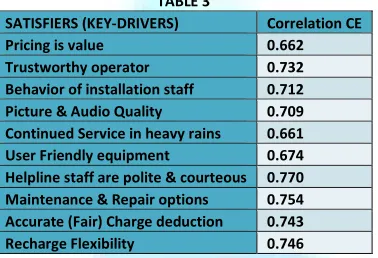
SATISFIERS (KEY-DRIVERS) Correlation CE Pricing is value 0.662 Trustworthy operator 0.732 Behavior of installation staff 0.712 Picture & Audio Quality 0.709 Continued Service in heavy rains 0.661 User Friendly equipment 0.674 Helpline staff are polite & courteous 0.770 Maintenance & Repair options 0.754 Accurate (Fair) Charge deduction 0.743 Recharge Flexibility 0.746
The Pearson’s correlation coefficient window between +0.7 to +0.9 gives an insight of a strong level of connection between Satisfier attributes & Customer Experience. The Hypothesis H2: There is a significant relationship between the Satisfier attributes and Customer experience; is proven by the values such as 0.770 for Helpline staff are polite & courteous, 0.754 for Maintenance & Repair options & others.
TABLE 4
MUST BE’s (POTENTIAL DISSATISFIERS) Correlation with CE Plans & offers 0.683
Variety of Channel Packages 0.674 Activation of first time services 0.726 Queries solved efficiently & quickly 0.754
Hypothesis H3: There is a significant relationship between the Must Be attributes and Customer experience; is substantiated by the association levels depicted by correlation values ranging from 0.60 to 0.75 in the table. The correlation values give a clear interpretation that a moderate to strong association exists between the Potential Dissatisfiers & the Customer Experience.
9. MANAGERIAL IMPLICATIONS
DTH operators can effectively focus & manage decisions based on the above classification and enhance the customer experience for TH customers.
The Performance Attributes i.e. trustworthy operator, picture & audio quality, recharge flexibility, behavior of customer care staff are important for the customer & feature as key drivers that give higher satisfaction levels & build loyalty.
Parameters like promotions; value to the customers & regular payment alerts provide additional delight to the customers & make the customers more loyal to the brand, as these showcase brand value & also bridge the gaps in services that customers perceive.
The Potential Dissatisfier Attributes, like Accurate billing, plans and offers, channel packages are the mandates for customers. They must provide a higher service experience or else would upshot the chances of churn & negative word of mouth & decreased loyalty.
Interactive website, Relocation of service, Advertisements may have an impact on decision making but do not formulate a measurable part of the customer’s black box.
Increased quality of service will give rise to better experiences. Greater level of experiences in turn enhances customer’s trust leading to customer satisfaction & increased loyalty towards the brand.
10. LIMITATIONS OF THE RESEARCH
1) Sample size -- The number of the units of analysis was relatively small. Open to more advanced & wider data collection.
2) Availability of data -- Reliable and sufficient data from the DTH service providers will give a more clear understanding of the trends in the services and experiences.
3) Limited Demographics -- The study was limited to students, professional & employees, only in Pune area. An increase in sample size and varied demographics would provide a more heterogeneous sample.
4) Rural coverage -- The rural areas have not been covered & would formulate a wider scope for future research.
11. SCOPE FOR FUTURE RESEARCH
1) The survey and analysis can be completed on a larger scale to include more customer & industry insights. 2) This tested study can further be applied to other telecom verticals such as broadband & mobile. 3) Can be used as a consulting solution for service providers.
VOLUME NO. 4 (2014), ISSUE NO. 04 (APRIL) ISSN 2231-5756
INTERNATIONAL JOURNAL OF RESEARCH IN COMMERCE, IT & MANAGEMENT
2. Barlow, J., & Maul, D. (2000). Emotional Value–Creating Strong Bonds with Your Customers. San Francisco, USA: Berrett-Koehler Publishers.3. Bate, P. and Robert, G. (2007). "Toward More user-Centric OD - Lessons From the Field of Experience-Based Design and a Case Study." The Journal of Applied Behavioral Science, 41(1): 41-66.
4. Belk, R. W., Wallendorf, M., & Sherry, J. F. (1989). The Sacred and the Profane in Consumer Behavior: Theodicy on the Odyssey. Journal of Consumer Research, 16(1), 1-37
5. Berry, L. L. and Carbone, L. P. (2007). "Build Loyalty Through Experience Management." Quality Progress 40(9): 26-32. 6. Blythe, J. (1997). The Essence of Consumer Behavior. London: Prentice-Hall.
7. Bolton RN (1998). A dynamic model of the duration of the customer’s relationship with a continuous service provider: the role of customer satisfaction. Mark. Sci., 17(1):45-65. Caru , A., Cova, B., 2007. Consuming Experience, Routledge, London
8. C. Cook, B.Thompson. Reliability and validity of SERVQUAL scores used to evaluate perceptions of library service quality. Journal of Academic Librarianship. 2000. 26(4), 248-258
9. Cadotte, Ernest R., Robert B. Woodruff, and Roger L. Jenkins. 1987. "Expectations and Norms in Models of Consumer Satisfaction." Journal of Marketing Research 24 (August): 305-314.
10. Carbone, L. P. and Haeckel, S. H. (1994). "Engineering Customer Experience." Marketing Management 3(3): 8-19.
11. Churchill, and Carol Surprenant.1982. "An Investigation into the Determinants of Customer Satisfaction." Journal of Marketing Research 19 (November): 491-504.
12. Davidson, R. (1992). Tourism in Europe. London: Pitman Publishing.
13. Day, Ralph L. 1984. "Modeling Choices Among Alternative Responses to Dissatisfaction." Advances in Consumer Research 11. Ed. William D. Perreault. Atlanta, GA: Association for Consumer Research, 496-499
14. E.W. Anderson, C. Fornell, D.R. Lehmann, Customer satisfaction, market share, and profitability: findings from Sweden, Journal of Marketing, 1994 58, July.53-66
15. Flanagan, P., Johnston, R., and Talbot, D. (2005). "Customer confidence: the development of a "pre-experience" concept." International Journal of Service Industry Management 16(4): 373-384.
16. Fornell C (1992). A national satisfaction barometer: the Swedish experience. J. Mark., 56(1):6-21.
17. Grace, D. and O'Cass, A. (2004). "Examining service experiences and post-consumption evaluations." Journal of Services Marketing 18(6): 450-461. 18. H.M Government, (2007), Service Transformation Agreement, H.M. Treasury, HMSO, Norwich
19. Hongxiang. T. (2011). Volumetric Heat Capacity Enhancement In Ultrathin Fluorocarbon Polymers For Capacitive Thermal Management. Submitted in partial fulllment of the requirements for the degree of Master of Science in Mechanical Engineering in the Graduate College of the University of Illinois at Urbana-Champaign
20. Howard, John A. and J.N. Sheth. 1969. The Theory of Buyer Behavior. New York: John Wiley and Sons.
21. Hsiu-Yuan Hu, Ching-Chan Cheng, Shao-I Chiu3 and Fu-Yuan Hong, “Study of customer satisfaction, customer loyalty and quality attributes in Taiwan’s medical service industry” African Journal of Business Management Vol. 5(1), pp. 187-195, 4 January, 2011
22. Johnston, R. and Kong, X. (2011), “The customer experience: a road-map for improvement”, Managing Service Quality, Vol. 21 No. 1, pp. 5-24.
23. Katz, E. (1968). On reopening the question of selectivity in exposure to mass communications. In Abelson, I.(Ed), Theories of Cognitive Consistency: A Source Book. Chicago, IL: Rand McNally.
24. Kotler P (2006) Marketing management. 12th Ed., NY: Prentice Hall.
25. Liljander, V. and Strandvik, T. (1997). "Emotions in Service Satisfaction." International Journal of Service Industry Management 8(2): 148-160.
26. M. Tahir, N. M. Abu-Bakar. Service Quality Gap and Customers’ Satisfactions of Commercial Banks in Malaysia. International Review of Business Research Papers. 2007. 3(4) October: 327-336
27. MARC Group report entitled "Smart Card Industry in India: SIM, Identity, Banking, Transport, Healthcare, Pay TV, Loyalty & PDS"
28. Mascarenhas, O. A., Kesavan, R., and Bernacchi, M. (2006). "Lasting customer loyalty: a total customer experience approach." Journal of Consumer Marketing 23(7): 387-405.
29. Meyer, C. and Schwager, A. (2007), “Understanding customer experience”, Harvard Business Review, Vol. 85, p. 137
30. Michela A. (2005). New technologies and cultural consumption – edutainment is born! European Journal of Marketing, 39(7/8), 729-736. 31. O’Sullivan, E., & Spangler, K. (1998). Experience Marketing – Strategies for the New Millenium. Pennsylvania: Venture Publishing, Inc. 32. Oliver.R.L A cognitive model of the antecedents and consequences of satisfaction decisions. Journal ofMarketing Research. 1980 17, 460-469. 33. Pine II, B. J. and Gilmore, J. H. (1998). "Welcome to the Experience Economy." Harvard Business Review 1998 (July-August): 97-105.
34. Pine II, B. J. and Gilmore, J. H. (1999). The Experience Economy: Work is Theatre and Every Business a Stage. Cambridge, MA., Harvard Business School Press.
35. Prahalad, C. K. and Ramaswamy, V. (2004). The Future of Competition - Co-Creating Unique Value with Customers. Boston, Harvard Business School Press. 36. Pullman, M. E. and Gross, M. A. (2004). "Ability of Experience Design Elements to Elicit Emotions and Loyalty Behaviors." Decision Science 35(3): 551-578. 37. Reichheld FF, Sasser WE (1990). Zero defections: quality comes to services. Harv. Bus. Rev., 68(5):105-111.
38. Sales and Marketing, “ Going Digital: Key DTH and IPTV Offerings in the market”, May27, 2013, p 1 39. Shaw, C. and Ivens, J. (2002). Building Great Customer Experiences. New York, Palgrave MacMillan. 40. Shaw, C. and Ivens, J. (2005), Building Great Customer Experiences, Palgrave Macmillan,Basingstoke.
41. Swan, I. Frederick Trawick, and Maxwell G. Carroll. 1982. "Satisfaction Related to Predictive, Desired Expectations: A Field Study." in New Findings on Consumer Satisfaction and Complaining. H. Keith Hunt and Ralph L. Day, eds. Bloomington, IN: Indiana University, 15-22.
42. Thompson, C., Locander, W., & Pollio, H. (1989). Putting Consumer Experience Back into Consumer Research the Philosophy and Method of Existential-phenomenology. Journal of Consumer Research, 16(2), 133-47.
43. TRAI consultation paper on, “ Bharti Airtel Response to TRAI’s draft tariff order prescribing standard tariff package(STP) for Set Top Boxes (STB’s), page 4. 44. Van Der Wagen, L. (1994). Building Quality Service with Competency Based Human Resource Management (p. 3). Butterworth-Heinemann, Port
Melbourne.
45. Voss, C. A. (2003). "Rethinking paradigms of service - service in a virtual environment." International Journal of Operations & Production Management 23(1): 88-104.
46. W. Boulding, K. Ajay, S. Richard, A.Z. Valarie. A Dynamic Model of Service Quality: From Expectations to Behavioral Intentions, Journal of Marketing Research. 1993. 30 (2): 7–27.
47. Yu, Y.-T. and Dean, A. (2001). "The contribution of emotional satisfaction to customer loyalty." International Journal of Service Industry Management 12(3): 234-251.
VOLUME NO. 4 (2014), ISSUE NO. 04 (APRIL) ISSN 2231-5756
WOMEN AND CHILD TRAFFICKING
ARJUMAND BANO
RESEARCH SCHOLAR
DEPARTMENT OF BUSINESS ADMINISTRATION
DEEN DAYAL UPADHYAY GORAKHPUR UNIVERSITY
GORAKHPUR
DR. SANJAY BAIJAL
PROFESSOR
DEPARTMENT OF COMMERCE
DEPARTMENT OF BUSINESS ADMINISTRATION
DEEN DAYAL UPADHYAY GORAKHPUR UNIVERSITY
GORAKHPUR
ABSTRACT
Human Trafficking is the most heinous crime where a person is treated as commodity and sold in the market. It is shame on humanity. Traffickers deceive women, men and children from all corners of the world and force them into exploitative situations every day. While the best-known form of human trafficking is for the purpose of sexual exploitation, hundreds of thousands of victims are trafficked for the purposes of forced labor, domestic servitude, child begging or the removal of their organs. The major victims of human trafficking are women and children. The most common form of human trafficking detected by national authorities is trafficking for the purpose of sexual exploitation. Women make up two thirds of the world's human trafficking victims. The vast majority of these female victims are young women who are lured with false promises of employment and then raped, drugged, imprisoned, beaten or threatened with violence, have debt imposed on them, have their passport confiscated and/or are blackmailed. Children are exploited for the purposes of forced begging, child pornography or sex. Children are sometimes favored as laborers. Terrorists are also using them as human shield. Poverty is a major driver of the human trafficking industry. Those trapped in poverty are keen to obtain a better life for themselves and their families, and these vulnerable people are preyed on by unscrupulous people offering jobs, training, opportunities, remuneration and better life prospects. Recently youth is showing keen interest in profession in television and movies. Glamour, money and fame attract them. Traffickers are now using the intense desire as their trap. The other reason which is responsible for trafficking is deteriorating standards of morality and ethics in the society. Now people care for money and prosperity and ignore the moral aspects of earning it. The paper shall try to explore the determinants of human trafficking and try to find out the ways of creating awareness in order to save people from it.
KEYWORDS
Human trafficking, forced labor, domestic servitude, child begging, sexual exploitation, child pornography, human trafficking industry.
1.
INTRODUCTION
uman Trafficking is the most heinous crime where a person is treated as commodity and sold in the market. It is shame on humanity. Traffickers deceive women, men and children from all corners of the world and force them into exploitative situations every day. While the best-known form of human trafficking is for the purpose of sexual exploitation, hundreds of thousands of victims are trafficked for the purposes of forced labor, domestic servitude, child begging or the removal of their organs. The major victims of human trafficking are women and children. The most common form of human trafficking detected by national authorities is trafficking for the purpose of sexual exploitation.
Women make up two thirds of the world's human trafficking victims. The vast majority of these female victims are young women who are lured with false promises of employment and then raped, drugged, imprisoned, beaten or threatened with violence, have debt imposed on them, have their passport confiscated and/or are blackmailed.
Children are exploited for the purposes of forced begging, child pornography or sex. Children are sometimes favored as laborers. Terrorists are also using them as human shield.
Poverty is a major driver of the human trafficking industry. Those trapped in poverty are keen to obtain a better life for themselves and their families, and these vulnerable people are preyed on by unscrupulous people offering jobs, training, opportunities, remuneration and better life prospects.
Recently youth is showing keen interest in profession in television and movies. Glamour, money and fame attract them. Traffickers are now using the intense desire as their trap. The other reason which is responsible for trafficking is deteriorating standards of morality and ethics in the society. Now people care for money and prosperity and ignore the moral aspects of earning it.
Gorakhpur district is a place which shares its border with Nepal and Bihar. Both the places are facing problems related to poverty, education and unemployment and that makes the places easy target for traffickers. The migration rate is high in these areas. People of such areas are less prepared and more vulnerable to deceiving schemes by traffickers. The wish for a better life puts millions of people at risk of exploitation. Trafficking when carried out from one place to another involves transit places. The major hubs of such transit are railway junctions, bus stops, ports, borders entry posts etc.
2.
CURRENT SCENARIO
After more than six decades of independence the nation is still facing the heinous crime of human trafficking. Despite of adequate legal provisions it continues to thrive. Human trafficking has been defined as the commercial trade of human beings, who are subjected to involuntary acts such as begging, prostitution or forced labor. On the one hand poverty and hunger and on the other hand fast wealth and fast fame make the society highly vulnerable to human trafficking. Article 23 under Part -3 (Fundamental Rights) of the Indian constitution prohibits trafficking of human beings in the territory of India. There are also more than 20 provisions in the Indian Penal Code, 1860 which deal with various aspects of human trafficking. But despite all this, there is an inexplicable apathy in the approach of law enforcement agencies when it comes to dealing with human trafficking. To combat human trafficking, several short-term and long-term measures are needed to be taken up at all levels. There is an urgent need to create awareness among the public about human trafficking. Institutionalized system of co-ordination between the law enforcement agencies and nongovernmental organizations (NGOs) and greater coordination between different states could be an effective measure for combating the naked truth of society.
VOLUME NO. 4 (2014), ISSUE NO. 04 (APRIL) ISSN 2231-5756
INTERNATIONAL JOURNAL OF RESEARCH IN COMMERCE, IT & MANAGEMENT
the greed of money and better life. We have a set questionnaire for them that we make them fill and our counselors try to make them aware of the truth. We call their parents and family members on the spot and hand them over. I’m happy that after a decade of struggle we are able to create some awareness but we require more awareness and more coordination and support of the police and administration. We received Star award from Star foundation, UK, for our work in the area of human trafficking.”Human Trafficking is a well organized illegal trade which has a vast network. In the name of employment and career traders lure young people. Dhirendra Mishra, victim’s brother shares, “my brother is in Saudi Arabia in a very pathetic condition. He is deprived of basic necessities. He took training from an institute at Khajanchi Chauraha in the city. After the training the institute asked him Rs. 1 lakh and 60 thousand as they were sending him to Saudi Arabia on the job of a fitter for a salary of 800 Riyal with food and lodging free but his dreams are shattered as he was forced to work without salary for nine months. 72 people are there from the same institute praying to come back to their country. I asked help from the administration and praying for his safe and secure comeback but I know these people have very strong network.”
Illiteracy, poverty, ignorance and globalization are the causes of flourishing monstrous trade in our country. Rajeshmani, social activist and director of a world renowned NGO explains, “Children, women of 15 to 25 years in age and young lads are mostly smuggled. In the era of globalization, more connected world has helped indirectly in organizing criminal groups and networks as they are better equipped with new information and communications technologies, and are becoming diversified and connected in their illicit operations. Fast money and desire of fame and glamour push young people towards unfortunate destinations. We found four boys of well-off families as victims. They were ready to move in the hope of acting in TV serial. We try to tell these kinds of people that mobility for career is good but it should be safe and secure. In 2002 when I started working in this area I was shocked that even police men were not aware of the term ‘human trafficking’. We organized various awareness workshops. I’m happy that since 2002 the case of human trafficking has reduced to 4-5 from 10-12 cases per month. But still we have a long way to eradicate noxious practice from our society. In 2009 as per Govt. of India every district should have anti-trafficking cell but we require more effective cell.”
3.
PRE-ANTI HUMAN TRAFFICKING CELL ESTABLISHMENT PERIOD
In the pre anti human trafficking cell period NGO’s were active to curb the social menace in Gorakhpur district and the places adjoining the borders including Nepal and Bihar. According to the data provided by a major NGO working in the area, Manav Seva Sansthan, from the year 2002 to 20012, total 167900 people were counseled by the NGO as they were victims of human trafficking.
TABOLE 1.0: SOUNAULI – BHAIRAWAN- 2002- AUGUST 2012
Details Male Female Total
1. Total Number of Persons Counselled
1.1 Number of person less than 16 years of age 1310 1264 2574 1.2 Numbers of person 16-18 years of age 1762 1361 3123 1.3 Number of persons above 18 years of age 2378 2460 4838 1.4 Numbers of person counselled 60000 86000 146000 2. Total Number of persons returned to Nepal
2.1 Number of persons less than 18 years of age 103 117 220 2.2 Numbers above 18 years of age 131 149 280 2.3 Numbers of persons returned to Nepal 234 266 500 3. Break-Up of the Returned persons with respect to their relationships
3.1 Number of Victims returned 65 65 3.2 Number of suspects (suspected traffickers) returned 35 35 3.3 Number of trafficking cases/ITPA 3 4 7
TABLE- 1.1: THUTIBARI – MAHESHPUR-2002- AUGUST 2012
Details Male Female Total
1. Total Number of Persons Counselled
1.1 Number of person less than 16 years of age 328 316 644 1.2 Numbers of person 16-18 years of age 441 340 781 1.3 Number of persons above 18 years of age 595 615 1210 1.4 Numbers of person counselled 15000 21500 36500 2. Total Number of persons returned to Nepal
2.1 Number of persons less than 18 years of age 26 29 55 2.2 Numbers above 18 years of age 33 37 70 2.3 Numbers of persons returned to Nepal 59 67 126 3. Break-Up of the Returned persons with respect to their relationships
3.1 Number of Victims returned 16 16 3.2 Number of suspects (suspected traffickers) returned 9 9 3.3 Number of trafficking cases/ITPA 3 0 3
TABLE- 1.2: GORAKHPUR- 2002- AUGUST 2012
Details Male Female Total
1. Total Number of Persons Counselled
1.1 Number of person less than 16 years of age 1507 1454 2961 1.2 Numbers of person 16-18 years of age 2026 1565 3591 1.3 Number of persons above 18 years of age 2735 2829 5564 1.4 Numbers of person counselled 69000 98900 167900 2. Total Number of persons returned to Nepal
2.1 Number of persons less than 18 years of age 118 135 253 2.2 Numbers above 18 years of age 151 171 322 2.3 Numbers of persons returned to Nepal 269 306 575 3. Break-Up of the Returned persons with respect to their relationships
VOLUME NO. 4 (2014), ISSUE NO. 04 (APRIL) TABLE Details
1. Total Number of Persons Counselled 1.1 Number of person less than 16 years of age 1.2 Numbers of person 16
1.3 Number of persons above 18 years of age 1.4 Numbers of person counselled 2. Total Number of persons returned to Nepal
2.1 Number of persons less than 18 years of age 2.2 Numbers above 18 years of age
2.3 Numbers of persons returned to Nepal
3. Break-Up of the Returned persons with respect to their relationships 3.1 Number of Victims returned
3.2 Number of suspects (suspected traffickers) returned 3.3 Number of trafficking cases/ITPA
4.
POST-ANTI HUMAN TRAFFICKING CELL ESTABLISH
On 9th September 2012, Anti Trafficking Cell was established in Gorakhpur district. Surprisingly only two human trafficking cases ar and the cell authorities are not able to tell about the number of cases counseled in the cell.
district. In Thoonthibari the total number of cases registered is 19 whereas in Sonauli the registered cases are 38. In Raxau
The data concerned with pre establishment period from 2002 to August 2012, attained from various NGO’s the average number of cases per year in Gorakhpur was 16790, in Thoonthibari 3650, in Birganj- Raxaul 4667 and in Sonauli 14600.
The cases per year in post establishment period are compar
number of cases is not registered in the cell. But the flip side of the picture became clear when various NGO’s were contacte trafficking cell period.
5.
DETERMINANTS OF HUMAN TRAFFICKING
After viewing the seriousness of the matter a study is conducted with empirical approach in which through exhaustive question
victims, an attempt of finding out the major causes of human trafficking. For this purpose 50 victims were interviewed from Gorakhpur district, Maharajga Birganj.
The major findings concerned with human trafficking could be understood by the table given below: ADULT AND MINOR VICTIMS
Adult and Minor Victims
TABLE-1.3: RAXAUL – BIRGANJ- 2002-AUGUST 2012
Male Female Total Total Number of Persons Counselled
1.1 Number of person less than 16 years of age 917 885 1802 1.2 Numbers of person 16-18 years of age 1233 953 2186 persons above 18 years of age 1665 1722 3387 1.4 Numbers of person counselled 146700 32000 46670 Total Number of persons returned to Nepal
2.1 Number of persons less than 18 years of age 72 82 154 2.2 Numbers above 18 years of age 92 104 196 2.3 Numbers of persons returned to Nepal 164 186 350
Up of the Returned persons with respect to their relationships
3.1 Number of Victims returned 46 46 3.2 Number of suspects (suspected traffickers) returned 25 25 trafficking cases/ITPA 10 16 26
CKING CELL ESTABLISHMENT PERIOD
September 2012, Anti Trafficking Cell was established in Gorakhpur district. Surprisingly only two human trafficking cases