Volume 7
Article 1
2018
Full Issue
Follow this and additional works at:
https://digitalcommons.northgeorgia.edu/papersandpubs
Part of the
Arts and Humanities Commons
,
Education Commons
,
Medicine and Health Sciences
Commons
,
Physical Sciences and Mathematics Commons
, and the
Social and Behavioral Sciences
Commons
This Full Issue is brought to you for free and open access by the Center for Undergraduate Research and Creative Activities (CURCA) at Nighthawks Open Institutional Repository. It has been accepted for inclusion in Papers & Publications: Interdisciplinary Journal of Undergraduate Research by an authorized editor of Nighthawks Open Institutional Repository.
Recommended Citation
ublica
tions
2018
Vol
ume 7
Cover art:
Biology and Life Sciences _____________
Enumeration of extended-spectrum- beta-lactamase-producing Enterobacteriaceae from up- and downstream water samples and samples within a wastewater treatment plant in Hall County, Georgia, USAMonica Leavell, Jeanelle Morgan, PhD; Margi Flood, MS; and Swapna Bhat, PhD
University of North Georgia
Play behavior varies by age class in wild African elephants (Loxodonta africana)
Emily Palmer
Randolph-Macon College
Criminology _______________________
Student Perceptions of Faculty, Staff, and Students Carrying Concealed Weapons on CampusJacob Russ, Summer Jones, and Chastity Blankenship, PhD Florida Southern College
Undergraduate Perceptions of Race Ideology Groups as Problematic in Society
Bailey Williams, Niyyah Bilal Hayes, Caroline Lombardo, and Chastity Blankenship, PhD
Florida Southern College
Literary Studies ____________________
Searching for Purpose: Silas House’s The Coal Tattoo Brooke E. BolingJohnson University
The World’s Eye, the World’s Heart: Frederick Douglass and the Transcendence from Slavery
Emmy Dixon
University of North Georgia
Snakeskins, Sunsets, and Seeing: Creation and Theodicy in Pilgrim at Tinker Creek
Madeline Perkins Samford University
Medical and Health Sciences __________
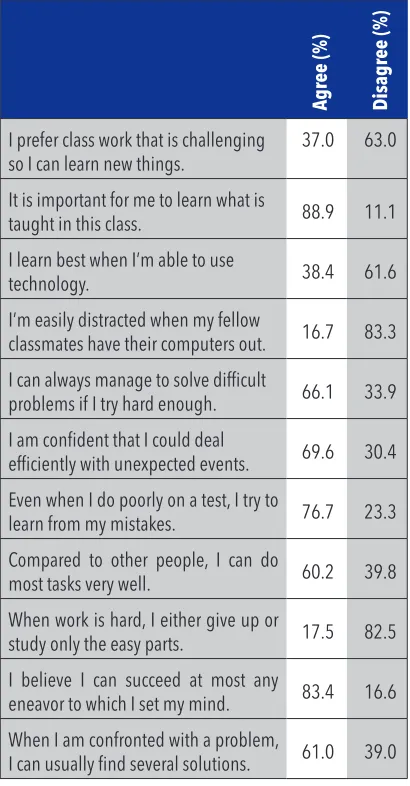
How Do Millennials Learn? An Investigation of the Learning Styles, Strategies, and Perceived Academic Success Among College-aged MillennialsLalar Hannans, Jolie Johnson, Brittany Litton, and Ivana Torres Georgia Southern University
Visual Arts ________________________
All those “one more chances” soon turned into five years of my lifeHolly Bokash
University of North Georgia
Petrolia Jada Weaver
University of North Georgia
Ruins Lauren Copelan
Copyright University of North Georgia 2018
All rights reserved. No part of this book may be reproduced in whole or in part without written permission from the publisher, except by reviewers who may quote brief ex-cerpts in connection with a review in newspaper, magazine, or electronic publications; nor may any part of this book be reproduced, stored in a retrieval system, or transmitted in any form or by any means electronic, mechanical, photocopying, recording, or other without the written permission from the publisher.
Published by:
University of North Georgia Dahlonega, Georgia Printing Support by: Interstate Graphics, Inc. Johnson City, Tennessee
Cover art: All those “one more chances” soon turned into five years of my life (Holly Bokash)
Cover Design: Leigh G. Dillard ISSN: 2325-2502
Printed in the United States of America, 2018 Anastasia Lin
Managing Editor Royce Dansby-Sparks Content Editor Susann Doyle-Portillo Content Editor Ereck J. Jarvis Content Editor Jamie Scalera Content Editor Marian Tabi Content Editor Craig Wilson Content Editor Allison Galloup
Letter from the Managing Editor 1 Anastasia Lin, PhD
Letter from the Editor-in-Chief 2
Leigh G. Dillard, PhD
Play behavior varies by age class in wild African elephants
(Loxodonta africana) 3
Emily Palmer
Randolph-Macon College
Student Perceptions of Faculty, Staff, and Students Carrying
Concealed Weapons on Campus 10
Jacob Russ, Summer Jones, and Chastity Blankenship, PhD
Florida Southern College
All those “one more chances” soon turned into five years of my life 20 Holly Bokash
University of North Georgia
Searching for Purpose: Silas House’s The Coal Tattoo 23
Brooke E. Boling Johnson University
How Do Millennials Learn? An Investigation of the Learning Styles, Strategies, and Perceived Academic Success Among College-aged
Millennials 28
Lalar Hannans, Jolie Johnson, Brittany Litton, and Ivana Torres Georgia Southern University
Petrolia 36
Jada Weaver
University of North Georgia
Enumeration of extended-spectrum- beta-lactamase-producing Enterobacteriaceae from up- and downstream water samples and samples within a wastewater treatment plant in Hall County,
Georgia, USA 39
Monica Leavell, Jeanelle Morgan, PhD; Margi Flood, MS; and Swapna Bhat, PhD University of North Georgia
The World’s Eye, the World’s Heart: Frederick Douglass and the
Transcendence from Slavery 44
Emmy Dixon
University of North Georgia
Ruins 53
Lauren Copelan
University of North Georgia
Undergraduate Perceptions of Race Ideology Groups as Problematic
in Society 55
Bailey Williams, Niyyah Bilal Hayes, Caroline Lombardo, and Chastity Blankenship, PhD
Florida Southern College
Snakeskins, Sunsets, and Seeing: Creation and Theodicy in Pilgrim at
Tinker Creek 66
I
n Dust Tracks on a Road, novelist and anthropologist Zora Neale Hurston famously writes: “Research is formalized curiosity. It is poking and prying with a purpose. It is a seeking that he who wishes may know the cosmic secrets of the world and they that dwell therein” (182).1 The essays gathered together in the seventh volume of Papers &Publications demonstrate Hurston’s core tenets of research. Throughout
this volume, students “poke” and “pry” at their subjects, attempting to unearth new knowledge or confirm theories about the world around them. As has come to be our standard mark, the articles range in discipline and focus. Inside, you will find a panoply of ideas and methodologies, from theoretical literary analyses to in-depth field research to qualitative studies. Our researchers literally tackle the small (enzymes) to the large (elephants), while also meditating on challenging social issues affecting campuses including concealed weapons, racial ideologies, and learning styles.
This year’s selections continue to reflect the assorted research interests and exceptional work of students in our region. In placing such diverse articles in conversation, we hope to elicit new conversations and lines of inquiry. We invite you to enjoy the conversation, pass it on to others, and consider contributing – or encouraging others to contribute – to our next volume.
Anastasia W. Lin, PhD Managing Editor
Assistant Vice President – Research and Engagement Associate Professor of English
1 Hurston, Zora Neale. Dust Tracks on a Road. Philadelphia, J. B. Lippincott
Letter from the Managing Editor
W
hether in the lab, the library, at home on a computer, or in the field, research demands we look beyond ourselves. Although this work might at times seem solitary, the mere act of research expands our sense of community by allowing us to interact with others. The contributors featured in this volume engage meaningfully in the cultural and political conversations of our time, presenting thoughtful analyses on issues such as gun violence, race, environmental concerns, education, and identity. They are participating in communities that foster questions, confusion, and uncertainty or are compelled to respond to an issue raised in a classroom assignment or discussion. How encouraging!Similarly, this volume is the work of many hands. I am as always indebted to the work of the very capable editorial board and proudly present this volume on their behalf.
Leigh G. Dillard, PhD Editor-in-Chief
Associate Professor of English Leigh G. Dillard, PhD
Abstract: Many environmental factors effect the behaviors of African elephants, Loxodonta africana, such as, health, drought, and dominance. The purpose of this research was to observe play behaviors within the different age classes (calf, juvenile, and adult) of wild elephants during recent drought conditions in Amboseli National Park, Ol Pejeta Conservancy, and Samburu National Reserve in Kenya. Scan sampling every 15 minutes was used to record play behavior. The results from this study indicated that there are differences in the types of play behavior among the age classes. Adults displayed the most play frequencies for environmental, alone locomotion, and tactile play. Calves exhibited the most play frequencies for object and calm play. Calves were also the only age class to display nursing attempts, with juveniles displaying zero attempts. Research was conducted at the David Sheldrick Wildlife Trust, an elephant orphanage, as a comparison to the wild data. The findings indicated similarities between wild and captive data. Similar to the results in the wild, juveniles had the highest play frequencies for environmental play. Calves also had similar behavior in the orphanage and in the wild, where the highest play frequencies were object and calm play. Observing play behavior across the different age classes can be beneficial in order to understand the impact play behavior has on social development.
ß
T
he African elephant (Loxodonta africana) is an endangered species that is experiencing declines due to poaching and habitat destruc-tion (Blanc, 2008). Many behaviors of African elephant’s mimic that of other individuals in their cohort through emotional expression; this is important when understanding the impact emotion has on play behavior (Soltis, 2013). Play behavior offers psychological and physio-logical benefits, as elephants use play behavior as a method to alleviate distress, anxiety, and grief (Lee and Moss, 2014). In the wild there are various factors that influence the different types of play behaviors, including environmental conditions such as drought, social exchanges that reflect personality types, and early maternal investment. The com-bination of these factors influences the social development of elephants.Drought conditions can influence maternal investment and play behavior, potentially altering social development. More specifical-ly, drought decreases water availability, which limits food resources and affects the amount of nutrition lactating mothers have access to. Nursing calves, therefore, experience less nourishment (Lee and Moss, 2014). Early maternal investment is critical for understanding social development later in life. Calves experience a tradeoff between nutri-tional development and social development (Lee and Moss, 2014). Time spent nursing provides more nutrients for growth and survival but is also time less spent on social development through play with other individ-uals and herds. It is the balance between development payoffs now or
Play Behavior Varies by Age Class in Wild
African Elephants (Loxodonta africana)
later in life. Males and females display different behavior with regards to nursing and social de-velopment. Males attempt to suckle more and are more successful, which provides them with a greater intake (Lee and Moss, 1986). Mothers show equal tolerances of both male and female suckling attempts (Lee and Moss, 1986). These early suckling behaviors are thought to influence social development. Males are believed to need more nutrients for future mating success, whereas females need social success to develop future maternal instincts (Lee and Moss, 1986).
Along with environmental conditions, gender, personality types, age, and hierarchy of herds all influence the types of play behavior in African elephants. As an individual becomes more dominant, it engages in less play behavior. Dominant bulls are less tolerant of play, whereas dominant females are more tolerant (Jeffery, 2017). Different personality types also influence play behavior, similar to humans (Jeffery, 2017). Sheldrick (1992) notes each elephant displays its own distinct personality and can display a range of emotions from happy or sad or envious.
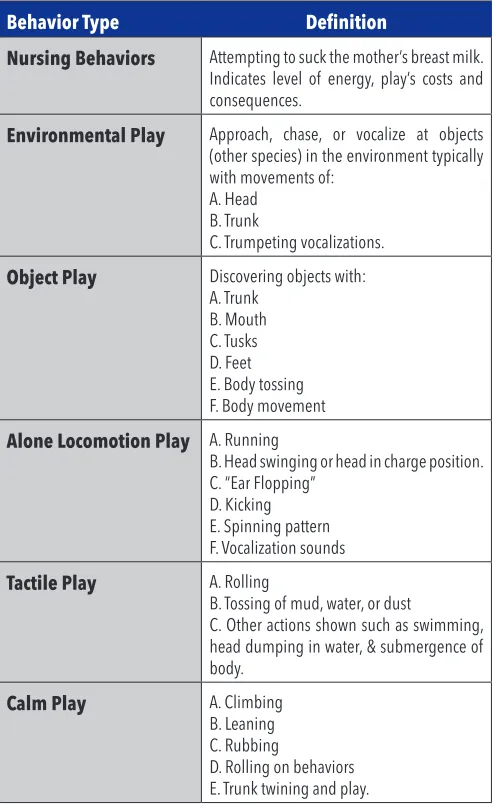
Various types of play include environmental play, tactile play, object play, alone locomotion, and calm play (Lee and Moss, 2014; Table 1). Distinct body movements reflect the type of play behavior. Poole and Granli (2011) found larger juveniles or adults displaying submission to smaller calves, which demonstrates calm play. When older individuals instigate play, calves often respond by climbing, leaning, or rubbing (Poole and Granli, 2011). Object play is when calves, juveniles, or adults use an environmen-tal or artificial object such as a stick or ball to play (Lee and Moss, 2014). Alone locomotion and tactile play consist of ear flapping, head swinging, and the tossing of water or mud on one’s self or others (Lee and Moss, 2014). Lastly, Lee (1987) defines environmental play as when the elephant uses the head or trunk in an abnormal behavior to express play, along with trumpeting vocalizations (Lee, 1987). Elephants held in captivity also demonstrate play behaviors that invoke physical activity and social compe-tency despite artificial conditions. In calf and juvenile elephants, play behaviors increase when water is present (Vicino and Marcacci, 2015),
indicating that the presence of water may predict the amount of play behaviors shown. Play is also shown in times of death or grief as elephants use play to relieve stress (Mertel et al., 2009). When nurturing calves and juveniles back to mental and physical health following abandonment or the death of their mothers, Ndume and Malaika (2017) also found similar behavioral patterns in Nairobi, Kenya. Studying play behavior in African elephants is important in order to under-stand the trade off between social development and nursing. These patterns are expressed long term under various circumstances throughout an individual’s life such as poaching, drought, etc. Therefore, looking at play behaviors across all age classes is beneficial because we expect there to be a difference between social and nutri-tional needs in African elephants.
This study aims to compare the types of play behavior in calves, juveniles, and adults, under the current drought conditions in Amboseli, Ol Pejeta, and Samburu, Kenya. We predicted a sig-nificant difference in play between age classes, with younger calves playing more frequently than older individuals, and the same expectation of calves displaying more play behavior than juveniles as found in Ndume and Malaiks (2017). Within each age class, we also expect play frequency to vary by type of play with a sig-nificant difference. With a goal of seeing 3 scans per hour, under each duration of scan sampling, we hypothesized that calves display more calm play, and juveniles display more tactile play (Lee and Moss, 2014). We predicted that in adults environmental play will predominate. Lastly, we also expect nursing frequencies between calves and juveniles to differ, with calves attempting to nurse more frequently. Documenting maternal investments can provide insight in social devel-opment, in light of the survival-social trade off. Understanding the social interactions within play behaviors in African elephants may help in times of environmental stress, poaching, or habitat destruction.
Methods
Observational Methods
observation scans took place from January 8-11, 2018. On January 13 and 14, 2018, 8 observation scans were taken in Ol Pejeta Conservancy. In Samburu National Reserve, 11 observation scans took place January 15-18, 2018. Scan sampling was used to investigate play behavior among different age classes of wild elephants. The time intervals for recorded obser-vations began every 15 minutes for 1-3-minute intervals, or until elephants left the field of view. A wrist watch was used to ensure that all times were precise, as well as a set of binoculars that kept elephants in sight for as long as possible. An ethogram was created to outline the different types of play behaviors based on Lee and Moss
(2014) (see Table 1). Play behaviors were operationalized based on the unique character-istics that each behavior displayed, such as body movements, vocalizations, and interactions with others. These play behaviors included: environ-mental play, alone locomotion play, object play, tactile play, and calm play (Table 1). The nursing frequencies of calves were determined using the same method (Table 1).
A tally system was implemented to record the frequency of each play behavior. For instance, if a juvenile depicted object play, one tally for the age class of juvenile was recorded under the object play behavior type: one tally per bout. The tally system displayed the frequencies of each
play behavior, in each age class, for sta-tistical testing. The play behaviors were observed under the set time intervals and recorded based on which age class (Calf, Juvenile, or Adult), and which type of play behavior was shown. Each age class was abbreviated as C (calf), J (juvenile), or A (adult). Having the cor-responding letter with each tally mark showed which age class was displaying what behavior.
David Sheldrick Wildlife Trust
The David Sheldrick Wildlife Trust (DSWT) in Nairobi, Kenya is an elephant orphanage designed to nurse elephants back to mental and physical health following abandonment or the death of their mothers. In this location, the play behaviors of the elephants were observed in the orphanage as a com-parison to the play behaviors of the elephants in the wild. It was expected to see calves displaying more play behavior, as it is likely they were still coping with emotional trauma. A total of 4 observa-tion scans took place at the DSWT on January 7, 2018.
Analytical Methods
SPSS version 25.0 (2017) was used to calculate summary statistics, including the average number of bouts of each play behavior in both the wild and
Table 1: Play Behavior Types.
The different types of play behaviors are defined with the distinct characteristics (Lee and Moss, 2014).
Behavior Type Definition
Nursing Behaviors Attempting to suck the mother’s breast milk. Indicates level of energy, play’s costs and consequences.
Environmental Play Approach, chase, or vocalize at objects (other species) in the environment typically with movements of:
A. Head B. Trunk
C. Trumpeting vocalizations.
Object Play Discovering objects with: A. Trunk
B. Mouth C. Tusks D. Feet E. Body tossing F. Body movement
Alone Locomotion Play A. Running
B. Head swinging or head in charge position. C. “Ear Flopping”
D. Kicking E. Spinning pattern F. Vocalization sounds
Tactile Play A. Rolling
B. Tossing of mud, water, or dust
C. Other actions shown such as swimming, head dumping in water, & submergence of body.
Calm Play A. Climbing B. Leaning C. Rubbing
captive populations. Wild observations were then pooled, and a statistical analysis was run to investigate whether play frequency varied by age class, and by play type within each age class. A chi-squared non-parametric test (α= 0.05) was implemented in SPSS. Statistical tests on the captive population were not run due to a small sample size.
Results
In the wild, adults exhibited the most play fre-quencies for environmental, alone locomotion, and tactile play. Calves generally exhibited the most play frequencies for object and calm play. Calves were also the only age class to display nursing attempts, with juveniles displaying zero attempts. In the DSWT, the results were similar regarding which type of play was expressed the most. The oldest indi-viduals at the DSWT were juveniles, who displayed the most play frequencies for environmental, similar to the results found in the wild. In addition, calves had similar behavior in the orphanage and in the wild, where the highest play frequencies were object and calm play. Nursing frequencies were not observed at the DSWT because all elephants were held in captivity without mothers; and were, therefore, bottle-fed.
Out of 40 total wild observation scan
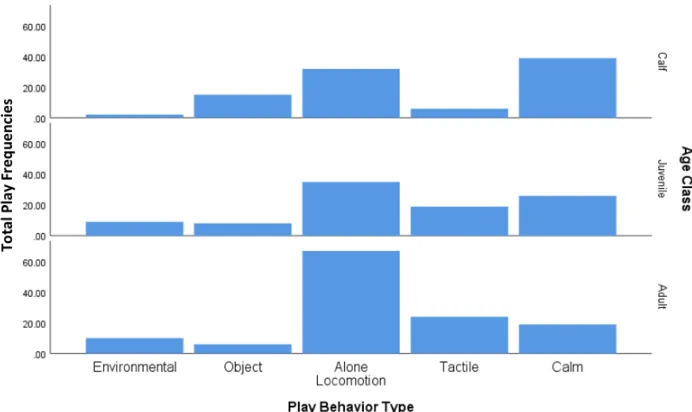
periods, there were 317 play bouts across all age classes and play behavior types. From the pooled data from all of the parks, a significant differ-ence in play frequencies was found across all age classes and play behavior types (χ2 (2) = 5.91,
p < 0.05; Figure 1). Adults displayed more play bouts in environmental, alone locomotion, and tactile play; whereas calves displayed more play bouts in object and calm play (Table 2). Also, the frequency by play type was significantly different within each age class. For calves, play frequency varied by type of play (χ2 (4) = 55.5,
p < 0.0005), and calves displayed the greatest number of bouts in calm play. For juveniles, play frequency varied by type of play (χ2 (4) = 27.1,
Table 2: The total number of play behavior occurrences, per age class and play type.
The average frequency of each type of play behavior is displayed.
Age Class Envir
onmental Alone
Locomotion Object Tactile
Calm
Calf 2 32 15 6 39
Juvenile 9 35 8 19 26
Adult 10 67 6 24 19
Average 7.00 44.66 9.66 16.33 28.00 Figure 1. The total play frequencies for each play behavior type is listed, per age class, from
p < 0.0005), and juveniles displayed the greatest number of bouts in alone locomotion play. Lastly, in adults play frequency varied by type of play (χ2 (4) = 96.7, p < 0.0005) and adults
also displayed the greatest number of bouts in alone locomotion play. Calves displayed more nursing attempts than juveniles (N = 21 for calves; N = 0 for juveniles). The greatest number of scans were taken in Amboseli National Park, with the least number of scans observed in Ol Pejeta Conservancy (Amboseli = 21; Ol Pejeta =
8; Samburu = 11).
In DSWT there were a total of 4 observa-tion scans, with 30 play bouts, and the DSWT results also showed a difference in play behaviors between calves and juveniles, with calves display-ing more total play frequencies (Table 3). Also, the same findings from the various parks were found in the DSWT results as well. Although the number of play frequencies were much less, juveniles displayed higher play frequencies in environmental play; while calves displayed higher play frequencies in object and calm play (Table 3).
Discussion
This study supports the hypothesis of calves displaying more calm play, with adults exhibit-ing more environmental play. Calves displayed the greatest nursing attempts and calm play frequencies, and adults demonstrated the most environmental play frequencies. However, juveniles did not exhibit the most play frequen-cies for tactile play, as predicted; instead, adult
elephants displayed the highest frequencies. In Asian elephants (Elephas maximus), tactile play is recognized as a form of social behavior, as well as a form of play behavior in specific cir-cumstances (Vanitha et al., 2011). The details of the behavior include trunk twining in a ‘S’ or ‘U” shape, as well as using the trunk to touch lips (Vanitha et al., 2011). These specific char-acteristics can be found at various times such as, disturbance, threatening situations, grooming practices, or for reassurance in partner relation-ships (Vanitha et al., 2011). Tactile play in Asian elephants is primarily expressed by adults, which corresponds to the findings of this study as adult African elephants displayed the most frequen-cies for tactile play. Both instances of tactile play in the Asian and African elephant poten-tially involve other individuals by touching lips, trunk twining, and the tossing of mud or water on one’s self or others. These similarities suggest that tactile play could be used less as a method of play behavior, but rather more as a method of social behavior.
In addition to using tactile play in a social context, both African and Asian elephants display similarities in communication methods. The two-different species use the same four cate-gories of communication techniques: trumpets, chirps, roars, and rumbles (Nair et al., 2009). In Asian elephants, Nair et al. (2009) found adults primarily demonstrate the use of trumpets and roars in times of play, distress, and aggression. Juveniles use trumpets, roars, and rumbles in times of play and distress as well (Nair et al., 2009). The findings from Nair et al. (2009) are similar to the findings of this study as adult and juvenile African elephants displayed the highest frequencies regarding alone locomotion and environmental play: the two play behaviors that include vocal-ization sounds and trumpeting. Notably, these play behaviors involving vocalizations are exhibited by individuals in the more mature age classes. Juveniles and adults are responsible for learning the behaviors of the matriarch with age progression and are therefore likely to vocalize their learning behaviors as a method of social communi-cation (Lee and Moss, 2014).
Table 3: The total number of play behavior occurrences for calves and juveniles with respect to each play type at the
DSWT.
The average frequency of each type of play behavior, for calves and juveniles, is displayed.
Age Class Envir
onmental Alone
Locomotion Object Tactile
Calm
Calf 1 5 7 6 7
Juvenile 3 3 1 5 2
One of the limitations of this study was that elephants often left the field of view. It became troublesome to keep a continuous scan of the same herd over time due to landscape attributes. Elephants were often covered by bushes, or other members of the herd, which inhibited the ability to observe all members equally. Scans conducted in Amboseli were more continuous because the landscape was open plains as compared to shrubland habitat present in the other parks. Another limitation of this study was the compar-ison of nursing frequencies between calves and juveniles. We expected that juveniles and calves would have an equal opportunity to nurse and would feel pressure to nurse due to the drought conditions. However, calves were the only age class to attempt nursing. Despite the limitations, the data still relate closely with other findings of nursing behaviors (Lee and Moss, 1986).
This study illustrates that observing play and nursing behavior can help illuminate the social interactions of African elephants. More specifi-cally, as poaching rates and habitat destruction continue to rise, understanding play behavior among age classes can help researchers interpret the meaning behind play behavior. Adults and juveniles used play behaviors as methods of social communication when interacting with other individuals. Calves, however, demonstrat-ed play that includdemonstrat-ed mimicking the behavior of other individuals; potentially indicating play is used as a training tool to enhance survival (Lee and Moss, 2014). Similarities in the results between the wild and orphaned elephants also suggest that the different age classes have similar interactions. From the findings of this study we suggest that play behaviors and nursing attempts may inform the future social success of the in-dividuals in both wild and captive populations.
References
Blanc, J. (2008). Loxodonta africana. The IUCN Red List of Threatened Species 2008: e.T12392A3339343. http://dx.doi. org/10.2305/IUCN.UK.2008.RLTS. T12392A3339343.en.
Soltis, J. (2013). Emotional communication in African elephants (Loxodonta africana) pg.
105-112 in Altenmüller E, Schmidt S, & Zim-mermann E. (Eds.) The evolution of emotional communication: From sounds in nonhuman mammals to speech and music in man. OUP Oxford.
Lee P., & Moss C. (2014). African elephants play, competence and social complexity. Animal
Behavior and Cognition, 1: 144-156.
Lee P., & Moss C. (1986). Early maternal invest-ment in male and female African elephant calves. Behavioral Ecology and Sociobiology, 18: 353-361.
Jeffery A. (2017). Social behavior and personality patterns of captive African elephants.
Under-graduate Research Journal, 325.
Sheldrick D. (1992). Elephant emotion. In: David Sheldrick Wildlife Trust. https://www.sheldrick-wildlifetrust.org/html/elephant_emotion.html Poole J.H., & Granli P.K. (2011). Signals, gestures,
and behaviour of African elephants. Editors: Moss C.J, Croze H., & Lee P.C. (Eds.), In: The
Amboseli elephants: A long-term perspective on a long-lived mammal (Ch. 8: 110-124). Chicago:
University of Chicago Press.
Lee P.C. (1987). Allomothering among African elephants. Animal Behaviour, 35(1): 278-91. Vicino G., & Marcacci E. (2015). Intensity of play
behavior as a potential measure of welfare: a novel method for quantifying the integrated intensity of behavior in African elephants. Zoo
Biology, 34: 492-496.
Mertel C., Gough K., & Schulte B. (2009). Inves-tigation of a fresh African elephant carcass by conspecifics. Pachyderm, 45: 124-126. Ndume & Malaika. (2017). Nairobi Nursery Unit:
The Infant Nursery Stage. In: David Sheldrick Wildlife Trust (Understanding the Elephant Orphan’s Project). http://www.sheldrickwild-lifetrust.org/html/raiseorphan.htm
IBM Corp. Released 2017. IBM SPSS Statistics for Windows, Version 25.0. Armonk, NY: IBM Corp.
Vanitha V., Thiyagesan K., & Baskaran N. (2011). Social life of captive Asian elephants (Elephas maximus) in Southern India: implications for elephant welfare. Journal of Applied Animal
Welfare Science, 14 (1): 42-58.
Asian elephants (Elephas maximus): structural classification and social context. The Journal of
the Acoustical Society of America, 126 (5):
2768-2778.
ß
Contributor Bio
Emily Palmer is intrigued in the study of animal behavior and has researched play behavior in wild African elephants (Loxodonta africana) in Kenya, Africa. She is receiving her B.S. from Randolph-Macon College with a major in Biology and minor in Psychology. After un-dergraduate education, she will attend nursing school to receive her B.S.N. Her studies and interests are focused around animal and human behavior, as she enjoys learning more about the functions of the brain and the purpose of behavior: both human and animal.
Acknowledgements
Abstract: Reactions to gun violence and potential policies regarding gun control are often reactions to fear with schools being the focal point of gun control dialogue. From elementary schools to college campuses, the concealed carry debate exists. Should we allow staff, faculty, and at the college-level, students to carry concealed guns? Students at a private college in Florida were surveyed in regards to their attitudes towards concealed carry and campus safety. We tested a number of hypotheses related to how much time students spend being exposed to media, student perceptions of safety, and their attitudes toward concealed weapons on campus. Results show low levels of support for armed campus safety and concealed weapons for faculty among our student sample. Students were even less comfortable with other students being armed on campus. In support of previous research, conservative students were more likely to believe the media spends too much time covering gun violence. While our results show mixed support of previous research on concealed weapons, our findings are particularly interesting due to our close proximity to two recent mass shootings in Florida.
ß
I
n recent years, social cognizance of gun-related controversies such as concealed carry, and school campus safety has become increas-ingly relevant (Wolfson, Teret, Azrael, & Miller, 2017). Lately it appears that mass shootings can occur anywhere, which instills a high threat of gun violence in today’s society. There have been reported mass shooting incidents at schools and college campuses, parks, government buildings, nightclubs, and other locations (Wolfson et al., 2017). Among others, certain places have become infamous and synonymous with gun violence, such as Columbine, Virginia Tech, and Sandy Hook (Nedzel, 2014). These high-profile school shootings have caused a great deal of concern and awareness for public safety. The aforementioned tragedies are greatly unwanted problems that the public has to address, and the loss of lives has prompted a debate regarding concealed carry and campus safety (Nedzel, 2014). In many cities within the United States, the news media cover any possible reports of gun violence frequently, sometimes without any new information being presented to the public (Wolfson et al., 2017). Society’s perception of gun violence and opinions regarding concealed carry rights may be influenced by the amount of news coverage dedicated to public safety concerns. Moreover, the public perception of risk in certain places, such as college campuses may be swayed significant-ly by disproportional news coverage of gun violence compared to other social issues (Callanan, 2012; Wolfson et al., 2017; Yanich, 2001).For example, more frequent television news and television crime-re-ality program consumption is significantly related to greater fear of crime (Callanan, 2012). This could be because news media spend more time covering this topic than any other social issue (Yanich, 2001). Of news
Student Perceptions of Faculty, Staff, and Students
Carrying Concealed Weapons on Campus
Jacob Russ,
Summer Jones,
reports involving crime, the most prominent were of court proceedings involving murder, which allows the news station to cover a topic without using resources to uncover new infor-mation while also providing entertainment (Yanich, 2001). Further, commentary cultures and info-tainment news that present biased perspectives have the ability to create a moral panic, which encourages society to believe that a matter requires critical, instant, and continual awareness. When a condition becomes a threat to societal interests and values (e.g. public safety), a moral panic results (Arrigo & Acheson, 2016). Moral panic incidents can either dissipate or they can have long-lasting effects of adaptations within society. New legal and social policies are examples of long-lasting effects. Another example of a long-lasting effect is in the manner society perceives or conceives itself (i.e. the fear that school campuses are extremely vulnerable to danger or mass shootings) (Arrigo & Acheson, 2016). In America, gun violence and mass shootings have provided the mass media many occasions to establish a moral panic. Public cognizance and discussion have increased con-cerning the perceived and sensationalized threat in certain contexts. In particular, campus policies on the concealed carrying of guns have become prevalent political topics (Arrigo & Acheson, 2016).
This is an enduring and heated issue that has pulled society to trigger different responses (Birnbaum, 2013). In time, relentless news headlines covering gun violence and school shootings establishes and impresses upon the public that a campus is vulnerable and danger-ously at risk. It implies that students and faculty are increasingly not safe (Birnbaum, 2013). In response, two opposing policies have been aimed to shoot down public safety concerns and reduce campus violence. One suggests that violence on campuses could be deterred by arming individu-als [e.g., campus safety officers, and other faculty] (Birnbaum, 2013). On the other hand, it has been proposed that campus violence could be prevented by a complete ban on weapons. Both of these positions raise important questions. Would students on campus feel more safe or unsafe, with the implementation of concealed
carry policies (Birnbaum, 2013)?
Overall, there is limited knowledge con-cerning the public’s viewpoints about concealed carry permissibility in places like schools and the prospect for deterring gun violence (Wolfson et al., 2017). Perceptions held by students are particularly noteworthy due to the significant manner in which they are affected by the campus policies (Arrigo & Acheson, 2016). Policies relating to campus-specific gun regulations have to be evaluated in conjunction with an idea of the relative impact it might have on students. Research on students’ perceptions regarding concealed carry laws and campus safety issues will help provide elucidation for society on this critical matter (Arrigo & Acheson, 2016).
Literature Review
the coverage will be repeatedly depicted and will extend over a long period of time, which can cause a public panic (Meindl & Ivy, 2017).
It is important to note that the duration and the frequency of coverage also influenc-es the amount of fear that is perpetuated. It can be argued that increased news coverage of school shootings results in an increase of fear for public safety. Moreover, it can be argued that less coverage and less hyped headlines will decrease overall interest in the event, which could also limit generalized imitation (Meindl & Ivy, 2017). For example, one study found a significant relationship to fear of crime and exposure to news media, yet this same study did not find a relationship between fear of crime and exposure to crime dramas (Callanan, 2012). This means viewers are likely to believe news reports are realistic representations of gun violence, which in turn influences their level of fear. However, altering the manner in which the news media covers gun violence may be difficult because the sensationalizing of a story brings in more viewers, more revenue, and higher ratings. Additionally, the emergence of social media complicates media portrayals of gun violence because it derives from an individual source and not a corporate entity. The general public needs to be made aware of the media’s role in this issue. There is a noteworthy connection between the media’s reach and society’s motivations for certain behaviors [e.g., the increase in public panic about violence on campuses] (Meindl & Ivy, 2017).
Increased cognizance of the gun violence issue has permeated the policy making in both legislation and schools (De Angelis et al., 2017). Driven by the concept that concealed guns will prevent violence and deter crime, a number of state legislatures have attempted to establish looser restrictions on concealed carry regulations for college campuses. Research by De Angelis et al., (2017) suggests that there is not much known about the relationship between the fear of crime and the support for looser concealed carry rules on colleges. However, it has been reported that the fear of crime is strongly related to the support for concealed carry (De Angelis, Benz, & Gillham, 2017).
The academic world is inundated by the issues related to gun violence and gun control, which serves as an impetus for researching this matter (Dierenfeldt, Brown, & Roles, 2017). Gun violence and control is a large problem that derives partly from cultural influences. Strategies to implement meaningful change have to be addressed, in order to abate the growing public concern (Dierenfeldt et al., 2017). Today, many colleges and campuses still prohibit concealed carry on campus. Therefore, it is a controver-sial, ongoing issue and debate (De Angelis et al., 2017). Regarding the policy that opposes loosening concealed carry regulations, it is argued that college campuses are generally safe environments and serious crime is a very rare occurrence.
Despite the great deal of media coverage on gun violence and new policies, there is still very limited knowledge about how students perceive the policies and violence. More attention and research needs to be devoted to the perceptions of students (De Angelis et al., 2017). Research by Jang, Dierenfeldt, and Lee (2014) focused on student perceptions, explored and examined their attitudes on legalizing concealed weapons on campus. Assessing student attitudes at a four-year university, they found 27.9% of partic-ipants strongly disagreed and an additional 22% disagreed with legalizing concealed weapons on campus (Jang et al., 2014). More participants either strongly disagreed or disagreed with the legalizing of concealed carry on campus than expressed positions in favor of concealed carry (Jang et al., 2014).
student participants were three times more likely to self-report that they were not at all comfort-able with the concept of concealed carry being permitted on their college campus, in contrast to being very comfortable. This finding suggests that students may regard a college campus as a unique environment that is perceived to be safer than an off-campus location (Cavanaugh et al., 2012).
Campus locations (e.g. region of the country) may also influence student opinions about this matter, and it behooves researchers to investigate and help inform policy (De Angelis et al., 2017). In the U.S., every state permits in-dividuals to carry a concealed weapon; however region of the country can influence overall support for these policies (Ghent & Grant, 2015). Research on Missouri voters by Ghent and Grant (2015) reports that individuals who support the right to carry are motivated by violent crime. Voter approval for the right to carry a concealed weapon increased by around seven-tenths of a percentage point, when an increase in the violent crime rate was reported (Ghent & Grant, 2015). In comparison to other research, perhaps region of the country in which a campus is located could influence student support for conceal-carry policies.
Beyond region of the country in which the college is located, political affiliation is likely to be correlated with a student’s support of concealed weapons on campus. Regarding voter demographics, the right to carry was supported notably more by those who were affiliated with the Republican political party, which has con-servative values and vehemently supports the right to own a gun (Ghent & Grant, 2015). Additionally, 48% of voters supported the right to carry, and of that percentage around 2% of the voters had a permit to carry (Ghent & Grant, 2015). The findings suggest that there is a belief in the idea carrying a concealed weapon deters crime. Voters may have been motivated to vote in support of the right to carry because of their belief in the connection between violent crime and carrying a concealed weapon as a deterrent to crime.
Lastly, other research has shown gender to be a significant factor with attitudes towards
concealed weapons. For example, women are less likely to support concealed weapons on campus even after a violent event (Patten, Thomas, & Viotti, 2013). Among gun owners women were less likely than men to support guns in public places (Wolfson et al., 2017). Other research has indicated men are more likely to seek a concealed handgun license and would carry a weapon on campus if legally able to do so (Bouffard, Nobles, & Wells, 2012). Bouffard et al.’s (2012) findings are particularly interesting to the researchers in the current study because our college, as a private college in the state of Florida, could change our rules and permit concealed weapons on campus. Men in another study also reported greater levels of comfort with guns in the community and on campus (Cavanaugh et al., 2012). Overall, we expect our results to echo these studies with men showing greater support and comfort with guns and concealed weapons on campus.
Hypotheses
Based on the previous literature we hypothesize:
1. The majority of students will report feeling safe on campus.
2. Students that report feeling safe on campus will have lower levels of support for concealed weapons on campus.
3. Male students will be more likely to support concealed weapons on campus.
4. Students who identify as Republican/ conservative will be more likely to support concealed weapons on campus in comparison to students of other political affiliations.
5. Students who support concealed weapons on campus will be exposed to a variety of news and social media.
Methodology
and the shooting at Marjory Stoneman Douglas High School in Parkland, Florida. This college campus provides a vital research opportunity that is relevant to today’s issues concerning gun violence and safety issues.
To obtain our sample, two students and one faculty member distributed 130 surveys in five face-to-face classes. Before students could participate they were read a research script that stated, “As part of this study you will be asked to take an approximately fifteen-minute survey containing questions, which concern informa-tion about percepinforma-tions of conceal carry laws and campus safety.” Students were also instructed to not complete the survey again if they did so in another class. Beyond asking students to not write their name on the survey we also did not track students in the course who declined to participate in these courses. Due to not tracking class attendance, student participation and those declining to participate, we are unable to report a non-response rate.
Every participant reviewed a consent form prior to deciding to partake in the study. After signing a consent form, each participant received the same survey which contained 30 questions. When the survey was completed, the researchers collected the data for analysis. While 30 items were on the survey questionnaire, in this section we focus on the variables we will discuss in the results section. All survey data was coded and analyzed using the program, Statistical Package for the Social Sciences, commonly known as SPSS.
At the beginning of the questionnaire we asked students to report some basic demo-graphic or background characteristics, such as their sex, ethnicity/race, and political affilia-tion. These variables were measured as follows: SEX (male or female); RACE (White, Black, Hispanic, Asian, and Other) and POLITICAL (Democrat, Republican, Independent, and Other). Ethnicity/race and political affiliation were later collapsed into dichotomous variables in order to meet t-test and multiple regres-sion requirements. Race became White and all other races, while political affiliation became Republican and all other political affiliations.
Another hypothesis for this research study
purports that those who are actively involved with social media or pay attention to the news on a regular basis will report stronger attitudes regarding concealed carry, and they may feel less safe. Previously cited research studies, have described the contagion effect, which is when public panic or fear is spread through news and social media. Due to social media and news exposure as a possible factor in their attitudes toward concealed weapons, students were asked to report the following information: how many hours per day they spent on social media (open-ended question), if they have noti-fications enabled on their social media accounts (yes or no), and how many hours per week they estimated they spent watching the news on tele-vision or online (open-ended question).
weapons at [school name]”.
Results
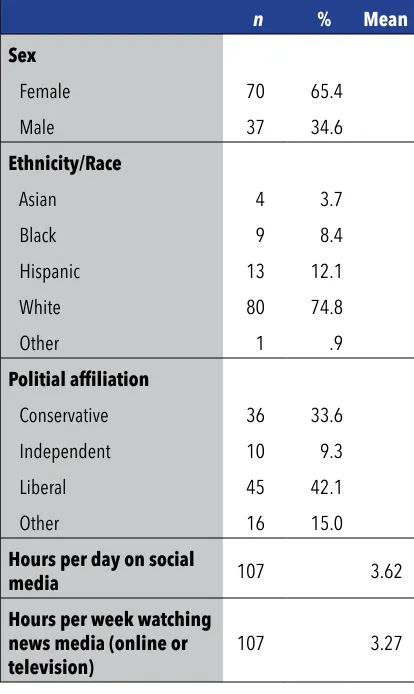
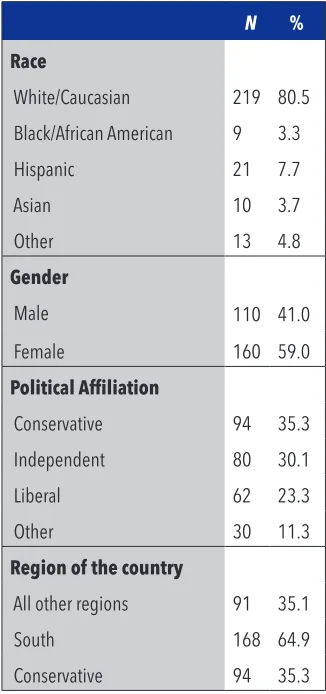
After the surveys were coded, data from all of participants were analyzed. In total, there were 107 completed surveys collected. The subse-quent information elucidates on the findings, regarding students’ opinions and attitudes towards concealed weapons and campus safety issues. Table 1 depicts the demographic and background characteristics of our sample. Regarding race and sex, a majority of partici-pants were White and female, which were both proportional to the student population of our small, private college.
In Table 2 we report student perceptions of campus as a safe place and media coverage of gun violence. As we hypothesized, a majority of students on campus reported feeling safe (85.1%). Also shown in Table 2 we were interested in
knowing how many students disagreed with the questionnaire item, “the media covers too much gun violence.” In other words, do students feel gun violence coverage is “not too much” given our world of 24-hour news coverage? Less than half (36.4%) of students disagreed with this statement. We discuss possible explanations for these findings within the discussion section of the current paper.
In order of our hypotheses, we believed students that reported feeling safe on campus would have lower levels of support for concealed weapons on campus. Overall, students’ mean score of acceptance was an 18.85 (7-35 score range, SD = 8.67). Students were most likely to support armed safety (72.9% agreed or were neutral to them carrying guns), then armed faculty (58.9% agreed or were neutral to them carrying concealed weapons), and lastly other students (32.7% agreed or were neutral to them carrying concealed weapons). In order to further test these relationships we conducted a t-test comparing two groups of students—those who reported feeling unsafe versus all other students (i.e. students who reported feeling neutral or agreeing they felt safe on campus). Our t-test was not statistically significant, t (99) = .087, p
= .244. Students who reported feeling unsafe on campus (M = 18.73, SD = 7.1) were not sig-nificantly more likely to have higher scores on our acceptance of concealed weapons on campus scale in comparison to other students (M =
18.57, SD = 6.63).
Our next hypothesis was that male students would be more likely to support concealed weapons on campus than female students. The Table 1: Student Sample Demographics and
Independent Variable Characteristics
n % Mean
Sex
Female 70 65.4
Male 37 34.6
Ethnicity/Race
Asian 4 3.7
Black 9 8.4
Hispanic 13 12.1
White 80 74.8
Other 1 .9
Politial affiliation
Conservative 36 33.6
Independent 10 9.3
Liberal 45 42.1
Other 16 15.0
Hours per day on social
media 107 3.62
Hours per week watching news media (online or
television) 107 3.27
Table 2: Student Perceptions of Campus as a Safe Place and Media Coverage of Gun Violence
n %
I feel safe on campus
Agree 86 85.1
Disagree 15 14.9
Media covers too much gun violence
Agree/Neutral 68 63.6
only significant sex difference we uncovered was related to support for concealed weapons for faculty. In a chi-square test, male students were more likely to agree or feel neutral about faculty carrying concealed weapons (disagree, n
= 10, neutral/agree, n = 27) in comparison to females who were more divided (disagree, n =
34, neutral/agree, n = 36); χ2 (1) = 4.64, p =
.031.
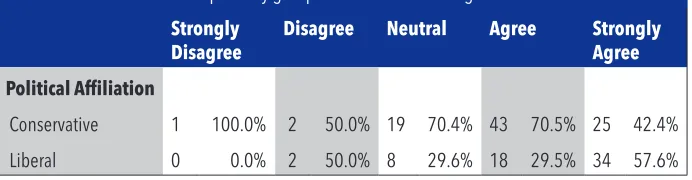
Based on previous literature we also hy-pothesized students who identify as Republican/ conservative will be more likely to support concealed weapons on campus in compari-son to students of other political affiliations. While we did not find a significant difference based on political affiliation and attitudes towards concealed weapons on campus, one’s political affiliation had an influence on their opinion about how often the media covers gun violence. More specifically, a chi-square test uncovered Republican/conservative students were more likely to be neutral or agree (n =
28) than disagree (n = 8) with this statement. Other students were more evenly divided with 31 students disagreeing that the media covers too much gun violence versus being neutral or agreeing with this statement (n= 40).
Our next hypothesis was students who support concealed weapons on campus will be exposed to a variety of news and social media,
which could support the contagion effect. Two Pearson correlation tests were conducted—first we compared social media hours to acceptance of weapons on campus followed by a second test exploring the relationship between hours per week a student spent watching the news and our acceptance of weapons scale. Both tests did not yield significant results for social media hours (r = .014, M = 3.62, SD = 2.39, DF = 105, p
= .883) or for number of hours spent watching the news (r = .129, M = 3.27, SD = 4.23, DF
=105, p = .185). This could be because students overwhelmingly felt safe on our specific campus, which may be more important than how social media may relate to fear of mass shootings or the contagion effect.
Lastly, the researchers conducted a Multiple Regression Test in order to measure favorable attitudes for concealed carry. Even though some of the variables included in the regression were not significant during bivariate analysis we thought they may have a significant effect while controlling for other variables simultaneously. A significant regression equation was found, F (4, 96) = 2.26, p = .039. Table 4 displays the regression model results. The current regres-sion model was only able to explain 6% of the variance. While controlling for a student’s race, sex, political affiliation, and perceptions of safety only a student’s beliefs that the media spends too much time on gun violence was significant. Students who felt the media spent too much time on gun violence were more likely to have positive attitudes towards guns and concealed weapons on campus (β = .23).
Discussion and Conclusions
Our sample showed mixed support for previous research on factors that influence attitudes towards concealed weapons on campus. We did find a majority of our students felt safe, however they did not significantly differ from students that did not feel safe and their accep-tance of guns and weapons on campus. Perhaps because a majority of students reporting feeling safe on campus, a majority of our sample also reported that the media spends too much time covering gun violence (63.6%). These results could indicate students feel safe so they may Table 3: Multiple Regression Results for
Measuring Favorable Attitudes for Concealed Weapons
Variable b SE β
Race 2.94 1.53 .188
Sex –2.46 1.36 –.183
Political affiliation 1.31 1.39 .095 Feels unsafe on
campus .374 1.83 .02
Media reports too
much gun violence 2.88 1.39 .23*
Constant 17.816 3.07 –––
F-value** 2.26
R² .06
believe media focus on gun violence is dis-proportionate to the likelihood of a shooting occurring. Our student population is relatively small (~2,500 enrolled) with the largest courses capped at 40 students. It could be difficult for students to imagine someone they know or see on a regular basis committing an act of violence against them. This study was conducted after the Pulse Night Club shooting in which the victims did not personally know the shooter and before the Marjory Stoneman Douglas High School shooting in Parkland when some students did know the offender.
Within our data we also found male students were more likely to support faculty having concealed weapons on campus. Female students were more mixed on their feelings towards faculty having concealed weapons on campus. Perhaps while other literature shows females to be more fearful of crime in general, our results support other research that indicates after a violent crime near campus women are more opposed to concealed guns on campus (Patten et al., 2013).
While previous research found Republicans were more likely to support concealed weapons perhaps the unique environment (i.e. college campus) and age of those who may be permitted to carry them (e.g. students) influenced our results (Ghent & Grant, 2015; Patten et al., 2013). We did find that students overall were more likely to support armed campus safety as opposed to concealed weapons among faculty or students. Perhaps if we asked if faculty and students were trained prior to being permitted to have weapons on campus we might have found significant results. We do not know if students are aware that in the state of Florida training is required for a concealed guns license.
In reference to people’s perceptions, opinions, attitudes, and behaviors, fear can be influential. While we did not see support for the contagion effect it could be because nearly 75% of our students reported feeling safe on campus even though our campus security does not currently carry guns or other weapons on campus. Society’s perception of gun violence and opinions regarding concealed carry rights may be influenced by the amount of news
coverage dedicated to public safety concerns. It could be that we surveyed students between school shootings—the Parkland mass shooting even happened about a month after data collec-tion began while we were analyzing our results. Perhaps if we resampled students after this tragedy we would have found more significant results to support the contagion effect. Some students that survived the Parkland shooting have called for stricter gun control, which shows perceptions held by students are noteworthy, due to the significant manner in which they are effected by the campus policies (Arrigo, & Acheson, 2016). Policies relating to campus-spe-cific gun regulations have to be evaluated in conjunction with an idea of the relative impact it might have on students. Research on students’ perceptions regarding concealed carry laws and campus safety issues will help provide elucida-tion for society on this critical matter (Arrigo, & Acheson, 2016).
carry policy on campus.
In the United States of America, there are college and university campuses almost every-where. There have been frequently reported incidents of gun violence across the country, and at both universities and colleges (Nedzel, 2014). These numerous incidents of gun violence and shootings have caused a great deal of concern and awareness for public safety.
The purpose of this study was to gain more knowledge about student perceptions regarding concealed carry and campus safety issues. The participants of this research study represent a constituency that has valuable opinions that could influence future gun control policies; however, more research still needs to be done, in order to gain better knowledge. Increased social cognizance of the gun violence issue and its relationship to college and universi-ty perceptions has become a relevant research opportunity. Campus community members such as students and faculty make up a society and culture that have important opinions that should be considered by state legislatures and policymakers. Regular shootings will continue to prompt action from all parties involved. The gun violence issue is not going to be resolved, without more research.
References
Arrigo, B.A., & Acheson, A. (2016). Concealed carry bans and the American college campus: a law, social sciences, and policy perspective.
Contemporary Justice Review, 19(1), 120-141.
doi:10.1080/10282580.2015.1101688 Birnbaum, R. (2013). Ready, fire, aim: The college
campus gun fight. Change, 45(5), 6-14. doi:10. 1080/00091383.2013.812462
Bouffard, J.A., Nobles, M.R., & Wells, W. (2012). Differences across majors in the desire to obtain a license to carry a concealed handgun on campus: Implications for criminal justice education. Journal of Criminal Justice Education, 23(3), 283-306.
Callanan, V.J. (2012). Media consumption, percep-tions of crime risk and fear of crime: Examining race/ethnic differences. Sociological Perspectives, 55(1), 93-115. doi:10.1525/sop.2012.55.1.93
Cavanaugh, M.R., Bouffard, J.A., Wells, W., & Nobles, M. R. (2012). Student attitudes toward concealed handguns on campus at two universities. American Journal Of Public
Health, 102(12), 2245-2247. doi:10.2105/
AJPH.2011.300473
De Angelis, J., Benz, T.A., & Gillham, P. (2017). Collective security, fear of crime, and support for concealed firearms on a university campus in the western United States. Criminal Justice
Review (CJR), 42(1), 77-94.
Dierenfeldt, R., Brown, T.C., & Roles, R.A. (2017). Re-considering the structural covariates of gun crime: An examination of direct and moderated effects. Deviant Behavior, 38(2), 208-225. doi:1 0.1080/01639625.2016.1196974
Ghent, L.S., & Grant, A.P. (2015). Concealed carry in the show-me state: Do voters in favor of right-to-carry legislation end up packing heat?.
Social Science Quarterly (Wiley-Blackwell),
96(1), 191-201. doi:10.1111/ssqu.12131 Jang, H., Dierenfeldt, R., & Lee, C. (2014). Who
wants to allow concealed weapons on the college campuses? Security Journal, 27(3), 304-319. doi:10.1057/sj.2012.31
Kyle, M., Schafer, J., Burruss, G., & Giblin, M. (2017). Perceptions of campus safety policies: Contrasting the views of students with faculty and staff. American Journal Of Criminal Justice, 42(3), 644-667. doi:10.1007/s12103-016-9379-x
Meindl, J.J., & Ivy, J.W. (2017). Mass shootings: The role of the media in promoting gener-alized imitation. American Journal Of Public
Health, 107(3), 368-370. doi: 10.2105/
AJPH.2016.303611
Nedzel, N. (2014). Concealed carry: The only way to discourage mass school shootings. Academic
Questions, 27(4), 429-435. doi:10.1007/
s12129-014-9459-7
Patten, R., Thomas, M.O., & Viotti, P. (2013). Sweating bullets: Female attitudes regarding concealed weapons and the perceptions of safety on college campuses. Race, Gender &
Class, 269-290.
Wolfson, J.A., Teret, S.P., Azrael, D., & Miller, M. (2017). US public opinion on carrying firearms in public places. American Journal Of
AJPH.2017.303712
Yanich, D. (2001). Location, location, location: Urban and suburban crime on local TV news.
Journal of Urban Affairs, 23(3-4), 221-241.
ß
Contributor Bios
Jacob Russ is originally from Brandon, Florida. He is a member of the National Society of Leadership and Success. He holds an interest in the criminal justice system. Shelly Summer Jones graduated summa cum laude, with a Bachelor of Science degree in Psychology, Criminology, and Pre-Law from Florida Southern College. She is originally from Chattanooga, Tennessee. Shelly was a recipient of the 2017 Psychology Department Service Award. Among other clubs, She is a member of the Phi Eta Sigma, and the Psi Chi honor societies. She holds interests in various areas of research related to forensic psy-chology, and the criminal justice system. In the near future, she intends to pursue a graduate degree. Moreover, She aspires to help contrib-ute to the education of social issues and hopes to make a relevant difference for the better. Dr. Blankenship is an Assistant Professor of Social Science at Florida Southern College. Her research area interests include race, class and gender portrayals within educational media. She is also interested in and writes about a variety of issues within the criminal justice system.
Acknowledgments
All those “one more chances” soon turned
into five years of my life
Cover Art Contest Winner
Holly Bokash
University of North Georgia
“I looked at everyone and wondered where they came from, and who they missed, and what they were sorry for.” — Jonathan Safran Foer.
O
ur identities have become dependent upon how other people envision us, so we’re reinventing ourselves all the time. In today’s society, we are so focused on negative stereotyping and preemp-tive judgment, with an “assume first, ask questions later” attitude, that we’ve been taught to hide our hearts and bury our true nature because we’re afraid we’ll be misunderstood. Because of this, we never really get to know the true identity of a person—what makes them who they are.All those “one more chances” soon turned into five years of my life, is a
piece from my senior show Who Says, which is made up of five digital portraits of females whose identities have been obscured.1 The purpose of
this work is to focus on the idea of getting to know someone. Not only for who they are now, but who they used to be and what experiences made them grow. While photographing my model, we spoke in the hopes of getting to the core idea of who she believed herself to be and what life events brought her to that conclusion. I asked her questions regarding her biggest influences, dreams of the future, moments of failure, who she’s forgiven, and the quiet moments that seem the loudest in her mind. “What does vulnerability mean to you?” I asked to which she replied, “being susceptible to some form of harm.” She said only one person has the ability to make her feel truly vulnerable—a past love. “All those ‘one more chances’ soon turned into five years of my life believing he had changed time after time only to find, he hadn’t. Not even a little bit.” This type of raw vulnerability she experienced helped mold a portion of her because every memory, every scar, and every day made up who she is.
Identity is fleeting and people are constantly fighting to be seen the way they see themselves, which gets lost along the way due to society’s notion of who they think you should be. But who says people’s opinions of you are the right ones? Who says regression in life won’t allow for your personal growth? Who says the path you’re walking isn’t the path you were meant to be on? Only you can say who you are and who you will become.
Contributor Bio
Holly Bokash is a portrait and landscape photographer based in Charleston, South Carolina. She received her Bachelor of Science degree in Art Marketing from the University of North Georgia in Dahlonega in 2017, concentrating in photography and graphic design. Bokash’s journey as a photographer began at a young age, always being inspired by photographs and the stories behind them. Portraiture, her main passion, allows her to connect with the subject through their personalities. Holly loves capturing moments frozen in time that tell a story and compel the viewer to ex-perience an emotional response.
Acknowledgments
Abstract: This paper examines The Coal Tattoo by Silas House and its focus on psychological self-reflection by its two main characters, Easter and Anneth Sizemore. Anneth, the younger of the sisters, is characterized as a “wild child,” chasing after men and sex in an attempt to discover her identity and fulfill a longing within her that may be too large to satisfy. The Sizemore girls’ mother, Birdie, committed suicide when Anneth was five years old. Through a Lacanian lens, Anneth’s entrance into subjectivity is a violent and incomplete one, which evolves into an incom -plete sense of her “imaginary” self and an intensified longing for her real desires while these two warring elements intensely disrupt her sense of existence and placement within the symbolic order. Anneth’s entrance into the symbolic was irreparably disrupted, and she is the picture of social rebellion: multiple marriages, going to bars, underage drinking, smoking, and becoming pregnant. The unhealthy state of her identity manifests itself in a myriad of ways, including psychic restlessness and the intensification of her desire for the Other. Anneth only feels a partial sense of wholeness when she listens to music, using music as an incomplete expression of her desire. Within a Lacanian context, due to the linguistic nature of music, she is incapable of fully articulating desire; however, because music is also non-linguistic, she is able to achieve a partial expression of desire, though she cannot articulate it herself and it cannot be articulated fully even through music.
ß
T
he Coal Tattoo by Silas House focuses almost completely onpsy-chological self-reflection by its two main characters, Easter and Anneth Sizemore. Anneth, the younger of the sisters, is charac-terized as a “wild child,” chasing after men and sex in an attempt to discover her identity and fulfill a longing within her that may be too large to satisfy. The Sizemore girls’ mother, Birdie, committed suicide when Anneth was five years old. Anneth characterizes her state of mind by saying that “sometimes I feel so full up of something that I think I’ll bust wide open. Don’t you know how that feels, to want more?” (House 8). Through a Lacanian lens, Anneth’s entrance into subjectivity is a violent and incomplete one, which evolves into an incomplete sense of her “imaginary” self and an intensified longing for her real desires while these two warring elements intensely disrupt her sense of existence and placement within the symbolic order.
A child’s entrance into subjectivity occurs, in a Lacanian sense, when “an individualized identity begins to form quite apart from the child’s parents. This discovery is of crucial importance, for at this time the child notices that he or she is different from the mother, who was the first object of the child’s desire” (Lundell 249). Lacan explains this separation through the visualization of m(Other). A child has no need to utilize language for their desires to be known by their mother, but as the child formulates its own identity separate from the mother during the mirror stage, he is separated from this prelinguistic expression of desire, forever entering into a subjectivity driven by the existence of language. This