155
AN EFFECTIVE VIRTUAL COORDINATE-BASED
BYPASSING VOID ROUTING FOR WSN USING LINK
QUALITY ALGORITHM
*Ms. R . Gandhimathi, **Dr. T. Senthil Prakash, *Ms. S. Jeevitha *II year ME (CSE), Shree Venkateshwara Hi-Tech Engg College, Gobi *Professor & HOD, Shree Venkateshwara Hi-Tech Engg College, Gobi
ABSTRACT
Over the past decades, wireless sensor networks (WSNs) have been widely applied in many different fields in which routing protocol is one of the key technologies. Since a sensor node exploits a path depending only on the location information of neighbor nodes in geographic routing, routing protocol based on geographic information is more efficient. To solve the routing void problem in geographic routing, high control overhead and transmission delay are usually taken in wireless sensor networks. Inspired by the structure composed of edge nodes around which there is no routing void, this project proposed an efficient bypassing void routing protocol based on virtual coordinates. The basic idea of the protocol is to transform a random structure composed of void edges into a regular one by mapping edge nodes coordinates to a virtual circle. By utilizing the virtual circle, the greedy forwarding can be prevented from failing, so that there is no routing void in forwarding process from source to destination and control overhead can be reduced. Furthermore, the virtual circle is beneficial to reduce average length of routing paths and decrease transmission delay. The proposed protocol has higher delivery ratio, shorter path length, less control packet overhead, and energy consumption.
1. INTRODUCTION
destination, the current node, and its immediate neighbors. Hence, it is suited for sensors’ limited memory.
On the other hand, GR requires nodes’ location information. Although a number of localization algorithms have been proposed to infer nodes’ locations with a few GPS-enabled anchors [6], accurate localization is still subject to errors leading to route failures. In addition, greedy forwarding based on local information cannot ensure global optimum and packets might never reach the desired destination.
This thesis introduces a Topology Aware Routing (TAR) algorithm that guides the GF along the near-optimal paths in terms of global metrics. The topology awareness is achieved via constructing a virtual coordinate space (VCS) where the geometric distance between two arbitrary nodes reflects the actual distance in corresponding global metric space.
The dimensionality of VCS is reduced by introducing a multidimensional scaling (MDS) approach. It embeds a WSN into a Euclidean space where the geometric distance between two arbitrary nodes is proportional to the number of expected transmissions (ETX) for a packet to be successfully delivered between the two nodes. TAR routing algorithm adopts the metric of ETX [8] instead of that of minimum hop count and achieves high performance.
Virtual coordinate systems emerge as a solution when location information is not available. The virtual coordinate of a node is calculated based on its distances, typically in hops, to a set of reference points called anchors (or landmarks). Because the coordinates are based on network connectivity rather than the physical distance, virtual coordinate systems are more tolerant to routing voids. Inspired by the fact that the position of a point on a two-dimensional plane can be uniquely described by its distances from at least three noncollinear reference pints, algorithms in and only use three anchors. Because a set of nodes within a zone have the same triplet (x,y,z) coordinate, a proactive ID-based approach is used to deliver packets to the desired destination node.
LCR shows that the delivery ratio is quite satisfactory when using four anchors with each placed at a corner of a rectangular area. The similar idea of obtaining virtual coordinates from a set of anchors is also employed by BVR but a different forwarding metric and a scoped flooding recovery scheme have been proposed. Because the distance is measured in hops, the use of integers to approximate continuous geometric distance introduces quantization noise. This has been studied in aligned VCS.
157
2. PROBLEM STATEMENT
In a WSN, it is prohibitive to implement the table-driven shortest path routing (SPR), which requires per-destination states maintained by in-dividual nodes. When the network scales to thousands of nodes, the large size routing tables containing thousands of entries may not be affordable to resource - constrained sensors. The conflict between the large size network with a random structure and the small routing table affordable to a sensor node raises fundamental challenges to point-to-point routing in WSNs.
3. SYSTEM METHODOLOGY
3.1 GF ALGORITHM AND EMBEDDING A NETWORK TOPOLOGY
In this section, first, the local minimum problem in GF algorithm is presented. Then it is shown how to achieve the shortest path routing through scalable GF instead of the table-driven method. The benefit is that there is no need to store a large -size routing table in a node. Third, the definition of embedding a network topology to a low-dimensional Euclidian space is presented, which could be used to reduce the routing state space of GF. Finally the Multidimensional Scaling method is proposed that is used to embed a network topology.
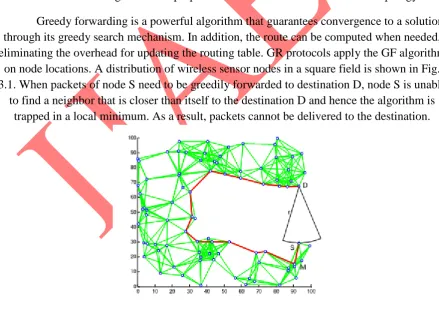
Greedy forwarding is a powerful algorithm that guarantees convergence to a solution through its greedy search mechanism. In addition, the route can be computed when needed, eliminating the overhead for updating the routing table. GR protocols apply the GF algorithm
on node locations. A distribution of wireless sensor nodes in a square field is shown in Fig. 3.1. When packets of node S need to be greedily forwarded to destination D, node S is unable
to find a neighbor that is closer than itself to the destination D and hence the algorithm is trapped in a local minimum. As a result, packets cannot be delivered to the destination.
3.2 TOPOLOGY AWARE ROUTING
In this section, the TAR algorithm is presented. TAR adopts MDS to embed a network topology to a low-dimensional Euclidean space where the hop distances between pairwise nodes are preserved. A centralized version is first presented and then how to deploy it in a distributed fashion through anchor sampling is shown.
Before, the detailed description of TAR routing protocol is proceed, the objectives of the proposed TAR is clarified below:
1. It is targeted to improve the point-to-point routing performance of a WSN comprising a large number of randomly deployed stationary nodes. This covers the main category of WSNs that have limited dynamics caused by node failures.
2. Different from prior works, it is focused on improving the routing performance of GF instead of optimizing the complementary recovery schemes that are invoked when GF fails. GF is in average more efficient than routing in recovery mode. Therefore the objective is to reduce the need of resorting to recovery schemes. In addition, it aims to provide better routing paths than that discovered by local recovery schemes.
3.3 CENTRALIZED MULTIDIMENSIONAL SCALING
The idea of using MDS is introduced to reduce dimensionality of VCS. In practice, the following steps can be used to reduce the dimensionality of the virtual coordinate space by utilizing the MDS embedding:
The base station floods a topology request packet to the entire network to collect
connectivity information between nodes. Efficient flooding algorithms such as the multipoint relaying (MPR) [25] can be adopted. They are shown to cover the entire network with a few number of broadcasts. A small set of selected multipoint relays are responsible for relaying the topology request packet and reporting two-hop neighbor information back to the base station.
When the base station obtains the global network topology, it computes hop distances
between pairwise nodes.
Based on the hop distances between pairwise nodes, the base station uses MDS to embed
the network topology into a Euclidean space where each node is assigned a virtual coordinate.
The base station then sends the virtual coordinates to corresponding multipoint relays and
let them broadcast the virtual coordinates to their one-hop neighbors.
The centralized algorithm incurs overhead for detecting the entire network topology.
3.4 PROTOCOL BVR-VCM
The existing system presents routing protocol BVR-VCM (bypassing void routing
159
processing mode. Here, greedy algorithm is adopted to select relay node in greedy mode. If greedy mode fails when a routing void is encountered, void processing mode is activated. Void processing mode is composed of three phases, according to processing in the order, respectively void detecting, virtual coordinate mapping and void region dividing. After the implement of void processing mode, the virtual coordinates of edge nodes are established. Then greedy mode is reactivated, these edge nodes that have the virtual coordinates can be selected as the relay node by greedy algorithm.
The main steps of entire process are
Void Detecting Phase:
The main function of the void detecting phase is to collect edge node information around the routing void after the void is encountered.
Virtual Coordinate Mapping Phase:
The virtual coordinate mapping phase is responsible for mapping the edge node coordinates stored in the detecting packed to a virtual circle, i.e., converting a structure composed of edge nodes to the structure without routing void.
Void Region Dividing Phase:
The main function of the void region dividing phase is to divide the surrounding area of the void into three different regions, in which different routing strategies are applied. According to the void position and the location of destination node of the packets, the surrounding area of a void is divided into approaching region, departing region and free region.
After implementing the three phases above, the edge nodes of void contain two types of location information which are geographic coordinates and virtual coordinates, and that surrounding area of routing void has been divided into three different regions according to the destination node.
DRAWBACKS
Since the source to destination path identification requires high quality links with optimal
hops, the path information is identified each time it requires a communication.
Consequently, the GF (Greedy Forwarding) fails to find the optimal path comprising
high-quality links.
Calculation overhead is more in all intermediate nodes for successive transmission.
3.5. ENHANCED ROUTING PROTOCOLS
checked periodically and so the base station communication is reduced. Like existing system, the optimal routing path between the source and the destination is achieved with fewest hops. No need of full hop information calculation for each and every transmission. The proposed system aims to find the shortest path, each individual hop usually has long transmission distance with high quality link maintenance.
ADVANTAGES OF PROPOSED SYSTEM
Nearest node location need not be retrieved from base station, since partial path
information (achieved through maintaining trusted value of the path) is maintained.
Calculation overhead is reduced since it maintains the quality details of previous
communications.
Retransmission count is reduced than the existing system.
High quality link is maintained along with fewest hop path information.
It is suitable for highly scalable and dynamic networks as it has drastically reduced the
amount of overhead.
4. CONCLUSION
The project introduces a method to improve routing performance with small routing states. It solves the local minimum problem by embedding a network topology to a low-dimensional Euclidean space where hop distances between pairwise nodes. Based on accurate hop distance comparison between neighboring nodes, the greedy forwarding can find the shortest path between two nodes. The project shows that the routing quality can be improved by embedding a network topology to a Euclidean space. Nearest node location need not be retrieved from base station, since partial path information (achieved through maintaining trusted value of the path) is maintained. Calculation overhead is reduced since it maintains the quality details of previous communications.
It is believed that almost all the system objectives that have been planned at the commencement of the software development have been net with and the implementation process of the project is completed. A trial run of the system has been made and is giving good results the procedures for processing is simple and regular order.
The application eliminates the difficulties in the existing system. It is developed in a user-friendly manner. The application is very fast and any transaction can be viewed or retaken at any level. Error messages are given at each level of input of individual stages. This software is very particular in reducing the difficulty in analyzing the router algorithms. The application works well for given tasks in network environment. Any node with .Net framework installed can execute the application.
161 [1] B. Karp and H.T. Kung, “GPSR: Greedy Perimeter Stateless Routing for Wireless Networks,” Proc. MobiCom, 2000.
[2] M. Mauve, J. Widmer, and H. Hartenstein. A Survey on Position-Based Routing in Mobile Ad-Hoc Networks. IEEE Network, 15(6), 2001.
[3] F. Kuhn, R. Wattenhofer, Y. Zhang, and A. Zollinger, “Geometric Ad-Hoc Routing: Of Theory and Practice,” Proc. Ann. Symp. Principles of Distributed Computing (PODC), 2003.
[4] H. Frey and I. Stojmenovic, “On Delivery Guarantees of Face and Combined Greedy-Face Routing in Ad Hoc and Sensor Networks,” Proc. MobiCom, pp. 390-401, 2006.
[5] Z. Zhong and T. He, “Achieving Range-Free Localization beyond Connectivity,” Proc. ACM Conf. Embedded Networked Sensor Systems (SenSys), 2009. [7] T. He, C. Huang, B.M. Blum, J.A. Stankovic, and T. Abdelzaher, “Range-Free Localization Schemes for Large Scale Sensor Net-works,” Proc. MobiCom, pp. 81-95, 2003.
[6] D.S.J.D. Couto, D. Aguayo, J. Bicket, and R. Morris, “A High-Throughput Path Metric for Multi-Hop Wireless Routing,” Proc. MobiCom, pp. 134-146, 2003.
[7] Y.-J. Kim, R. Govindan, B. Karp, and S. Shenker, “Geographic Routing Made Practical,” Proc. Conf. Symp. Networked Systems Design and Implementation (NSDI), vol. 2, pp. 217-230, 2005.
[8] B. Leong, B. Liskov, and R. Morris, “Geographic Routing without Planarization,” Proc. Conf. Networked Systems Design and Implementation (NSDI), vol. 3, pp. 339-352, 2006.
[9] T. He, C. Huang, B. M. Blum, J. A. Stankovic. Range-free Localization Schemes in Large-scale Sensor Networks. In MobiCom’03
[10] N. Bulusu, J. Heidemann, D. Estrin and T. Tran. Self-configuring localization systems: Design and Experimental Evaluation. ACM Transon Embedded Comp. Sys., 2004, 3(1).
[11] S. Basagni, I. Chlamtac, V. R. Syrotiuk, and B. A. Woodward. A distance routing effect algorithm for mobility (DREAM). In ACM/IEEE International Conference on Mobile Computing and Networking (Mobicom'98), pages 76-84, 1998.
[12] J. C. Lin. Biological aspects of mobile communication data. Wireless Networks, 3(6):439-453, 1997.
[13] ZAUMEN,W., AND GARCIA-LUNA ACEVES, J. Dynamics of distributed shortest-path routing algorithms. In Proceedings of the SIGCOMM ’91 Conference on Communications Architectures, Protocols and Applications (Sept. 1991), pp. 31–42.
Fourth Annual ACM/IEEE International Conference on Mobile Computing and Networking (MobiCom ’98) (Dallas, Texas, USA, Aug. 1998).
[15] JOHNSON,D.B., AND MALTZ, D. B. Dynamic source routing in ad hoc wireless networks. In Mobile Computing, T. Imielinski and H. Korth, Eds. Kluwer Academic Publishers, 1996, ch. 5, pp. 153–181.
[16] PERKINS, C. Ad hoc on demand distance vector (AODV) routing. Internet-Draft, draft-ietf-manet-aodv-04.txt, Oct. 1999.
[17] HAAS, Z., AND PEARLMAN, M. The performance of query control schemes for the zone routing protocol. In Proceedings of the SIGCOMM ’98 Conference on Communications Architectures, Protocols and Applications (Sept. 1998).
[22] Perkins,C., And Bhagwat, P. Highly-dynamic destination-sequenced distance-vector routing (DSDV) for mobile computers. In Proceedings of the SIGCOMM ’94 Conference on Communications, Architectures, Protocols, and Applications (London, UK, Sept. 1994), pp. 234–244.
[19] Chandrakasan,A., Amirtharajah,R., Cho,S.,Goodman,J.,Konduri,G.,Kulik,J.,Rabiner,W., And Wang, A. “Design considerations for distributed microsensor systems. In Proceedings of the IEEE 1999 Custom Integrated Circuits Conference (CICC ’99) (May 1999), pp. 279–286.
[20] SHEPARD, T. A channel access scheme for large dense packet radio networks”. In Proceedings of the SIGCOMM ’96 Conference on Communications Architectures, Protocols and Applications (Aug. 1996).
AUTHORS BIOGRAPHY
Ms. R.Gandhimathi Pursuing ME(CSE) degree in Shree Venkateshwara Hi- Tech Engineering College, Erode, India in 2014-2016 and B.E (CSE) degree from K..S.R College of Engineering, Tiruchengode ,India in 2007-2011 .She is a Member of Computer Society of India (CSI). She published 1 National Conferences, 4 Workshops. Her research interests include Networking, Cloud Computing, and DataMining.
163 India. His research interests include Data Mining, Data Bases, Artificial Intelligence, Software Engineering etc.,He has published several papers in 17 International Journals, 43 International and National Conferences.