A Reevaluation of the Work of William Beaver
in 1968
by
Zach Williams – Mercy College Leslie L. West – Hampton Universty
Abstract
This study evaluates the pivotal work of Beaver (1968) that
demonstrated the value and timeliness of financial statements. This paper discusses the original study by Beaver (1968), assesses the literature in the field since 1968, and conducts a study that fills three important gaps in the research area of information content of financial statements. The key test is an analysis of variance (ANOVA) test that compares the trading volume of a firm 30 days prior to an earnings announcement with the trading volume of that firm for 10 days after the announcement. This study concludes that between 61.81% and 64.85% of all firms report financial information that is both timely and valuable. The first research gap that this study fills is the need for ongoing testing of the information content of financial statements as the financial markets and the field of accounting are constantly evolving. This study fills a second gap in the research by explaining variance in the post-announcement drift of individual firms. This study fills a third gap in the literature by providing a percentage estimate of all firms that provide timely and valuable information content. This third contribution may prove to be useful to future research as this classification of firms could be used as a platform to define the characteristics of individual firms that do or do not report financial information that is both timely and valuable..
Introduction
The work of William Beaver in 1968 was ground-breaking in its contribution to accounting, market efficiency, and capital market research in general (Kothari, 2001). In 1968, Beaver,
contemporaneously with Ball and Brown (1968), demonstrated the value of the information content in financial statements. This study seeks to reevaluate the impact of Beaver’s work, analyze the related research that has been conducted since 1968, and test the
conclusions of Beaver’s work in the current market environment. This study will take a random selection of 30 recent company
announcements and analyze the trading period 30 days before the announcement and the trading period 10 days after the
A reevaluation of Beaver’s (1968) work is timely for a number of reasons including changes in the financial market as well as the change in the prominence of financial statements that was due in large part to the work of Beaver himself in 1968. Since Beaver (1968), there have been advancements and analysis of the proper
methodology for tests of information content including analysis of dependent variables such as price, price volatility, and trading volume. These more recent studies have answered questions, but a number of gaps remain in the research including a better
understanding of individual company characteristics that drive
valuable information content as well as the need for ongoing testing of the value of information content.
Timeliness of Reevaluation
In large part because of the significant impact of the work Beaver in 1968, financial statements have claimed a more prominent role in capital markets research (Kothari, 2001). Thus, financial statements are more important to investors today than they were in 1968. This increased importance calls for continued testing of the value of the information content in financial statements.
conducted updated research of the work of Beaver (1968), and those researchers noted that investors in 2000 have many more sources of information than they did in 1968 and that the market changed to one that was much less based on tangible assets. As a result, Landsman & Maydew (2000) questioned whether or not the field of accounting had adequately adjusted in its mission of accurately reporting company value. The same is true in 2018; the economy is constantly evolving, and the question of the value of information content remains timely.
Lastly, the question of market efficiency remains unsettled, and there have been relatively recent studies that have noted increasing levels of inefficiency (Kothari, 2001). If the level of market efficiency is changing, then the conclusions of Beaver have changed as well. Market efficiency was a necessary condition to support the validity of Beaver’s (1968) work (Kothari, 2001); therefore, if the market has become less efficient, then any market reactions to earnings
financial statements, financial markets, and company value will help investors as well as preparers of financial statements.
Choosing Dependent Variables
Since the work of Beaver (1968), there has been considerable research discussion of the best dependent variables that could be used to test the value of information content. The common dependent variables considered are price, price volatility, and trading volume. The characteristics and the sensitivity of these variables can change over time (Bamber, 1986). Also, some research indicates that the effect of these variables is modest (Lev, 1989). Therefore, imperfect methodology in Beaver’s study or studies since then could have produced dubious results that need to be revisited. The focus of this research will be on choosing the best dependent variable among the options of price, price volatility, and trading volume.
Price change.
An overall assessment of the literature indicates that the key problem with using price changes as a dependent variable is the difficulty in specifying a market model. If a company’s stock price changes after an earnings announcement, then researchers must be able to separate the market-related change from the company-related change in order to make any conclusions about the value of
biases or errors from an improperly specified model. This is similar to Eugene Fama’s joint hypothesis problem (Fama, 1970). Fama explains that a test of market efficiency must have a properly specified model, and it is sometime impossible to tell if inconclusive results are due to a poor model or actual market inefficiency.
An additional problem is that there may not even be a price reaction even if there is an earnings surprise because the earnings surprise could have already been incorporated into the security price with analyst forecasts. Research by Barron (1995) indicates that a market analyst’s forecast is a better independent variable than a company’s forecast. Thus, there may be an earnings surprise announcement from the company, if the financial analysts have already incorporated that surprise into their forecasts, then theoretically there might not be a market reaction.
Price volatility.
Price volatility is a measure of price fluctuation after an
earnings announcement. A problem with using price volatility is that differing opinions might “balance” and there theoretically could be no price volatility even there is timely and valuable information content; this point was noted both by Beaver in 1968 and by Kothari in 2001. In other words, after an earnings announcement, any trader wishing to sell immediately might find a buyer to buy at the market price, and there would be no drop in security price. Conversely, any sell orders would be immediately filled. In this theoretical situation, there would not be a change in price, nor would there be an increase in price volatility. Again, Beaver (1968) avoided this problem by using trading volume as a dependent variable.
Trading volume.
As mentioned above, using trading volume as a dependent variable avoids the problem specifying a market model, and it avoids the theoretical problem of trading orders perfectly “balancing.” But one necessary assumption is divergent investor opinions (Beaver, 1968). Divergent investor opinions simply means that traders or investors have different opinions about the true value of a security.
there could theoretically be no trading if the earnings surprise had already been incorporated into market price. In this theoretical situation, there would be no change in price and no change in price volatility, but there are other reasons mentioned above as to why those two measures could otherwise fail. But if there are diverse investor opinions, using trading volume as a dependent variable will not fail.
The literature review in this paper will support the assumption that investors have diverse opinions, and thus the selection of the dependent variable will be trading volume. The literature will show that market asymmetries and lack of pre-earnings announcements show a greater market reaction, which implies different opinions between company management and the public (Holthausen & Verrecchia, 1988). The literature goes on to demonstrate that the asymmetric information results in investors with diverse opinions for various reasons (Bamber, Barron, & Stober, 1997).
Research advances in post-announcement drift.
The research since the work of Beaver (1968) has illuminated the concepts of a post-announcement drift. This non-instantaneous market reaction can be confusing for researchers because the
testing the value of information content. However, if the post-announcement drift timeframe is overestimated, then the research risks including random noise in the test results. A key contribution of this study involves an understanding post-announcement drift and a method for adjusting for the variation in this drift. The literature since Beaver (1968) related to this concept will be reviewed. The existence of this drift is a necessary condition for the success of a study that measures the change in price volatility for periods after the earnings announcement, but the challenge is determining the timing of this drift. This study attempts to address this challenge with a
Gaps in Existing Literature
This study fills three important gaps in the research on valuable information content: the need for ongoing tests, the need for adjusting for the variability of the post-announcement drift, and the need to understand the percentage of earnings announcements that report timely, valuable information content.
The dynamic nature of the changing financial market creates an ongoing need for testing the timeliness and value of information
content. The allocation of wealth that the market creates has always been of great interest to investors (Kothari, 2001), and the accuracy with which financial statements report this allocation seems likely to be of perpetual interest to market participants. Furthermore, an understanding of how well accounting surmises value is all the more important as the field of accounting undergoes modern changes.
The findings in this study frame company reactions to earning announcements as unique characteristics of those companies, and this view of information content is relevant to both the variability of post-announcement drift and the finding of the percentage of
announcements with valuable information content. The
accounts for the differences in post-announcement drift of individual companies and the methodology in this study allows for recognition of these differences when making conclusions about timely, valuable information content.
The third gap in the literature that this study fills is estimating a percentage of all earnings reports that contain timely, valuable
information content. Previous studies have commonly identified characteristics such as the percentage of the variation explained by information content or the overall statistical significance of earnings reports. However, the literature focuses less on separating companies into groups of ones that report valuable information content and ones that do not. This study does this by calculating a sample percentage and then estimating a population percentage of earning reports with timely, valuable information content. This different perspective could alter the analysis in this field of research. The focus could shift to studies that seek to understand the different characteristics of
companies rather than studies that seek to understand overall market trends.
Literature Review
The State of Accounting Research before Beaver (1968)
Before 1968, Beaver explains that variables besides financial
statements were considered to be better indicators of company value and that investors felt that measurement errors in earnings corrupted accounting metrics (Beaver, 1968). In addition, most of the
information in accounting statements could be found in more timely and less costly sources (Beaver, 1968).
Research by Benston (1967) found no correlation between stock price and company earnings. Benston (1967) explained that users of financial statements had varying objectives, and that the preparers of financial statements had difficulty determining those objectives; as a result, the best choice of reporting method was unclear. Kothari (2001) explains that before the work of Beaver (1968) and the work of Ball and Brown (1968), there was no consensus on the singular
objective of accounting statements; therefore, there was not consensus on optimal accounting methods. As such, accounting statements were thought to be suboptimal assertions of company value that were heavily influenced by a company’s subjective choice of objectives (Kothari, 2001). Thus, according to the then conventional thinking in 1968, the effort and cost involved in company preparation of financial statements might have been pointless.
financial statements by demonstrating that company financial statements contained valuable and sometimes timely information content (Kothari, 2001).
Methodology Used in Beaver (1968)
The methodology used by Beaver (1968) involved an assessment of trading volume and price of the company stock eight weeks before an earnings announcement and eight weeks after the earnings
announcement. Beaver looked for a statistically significant change in trading volume or stock price. Beaver hypothesized that a positive price change would be caused by a positive announcement and that a negative price change would be caused by a negative announcement. Additionally, the researcher hypothesized that an increase in trading volume would mean that the announcement contained valuable
information that would change the optimal portfolio for individual investors even if the overall price did not change.
20 or more announcements to avoid noise from multiple
announcements. Beaver controlled for the overall market effects by selecting stocks with random announcement dates. After initial analysis, Beaver developed a model which allowed him to conclude that firm-specific events had a more significant effect on trading volume than did market-specific events. This conclusion allowed him to assess changes in trading volume as a result of company specific information.
Beaver acknowledged that his choice of sample firms could lead to a bias toward larger firms. Beaver noted that this is potentially very dangerous because larger firms are more heavily covered; thus, the value of information might be significantly diminished as investors have access to other sources of information. Additionally, by selecting firms that did not report on December 31st, Beaver acknowledged a possible bias towards retail firms. Beaver also notes a potential bias due to time lag between financial statement finalization and financial statement reporting; as the information could be incorporated into market price before the earnings are announced.
Related Research after 1968
and/or timeliness of information content in financial statements are critical in showing the importance of this continued research, and a few of those studies will be explained here. Studies that illuminate the nuances of the market reactions are important for the construction of the methodology in this paper; those nuances include an
understanding of price change, price volatility, trading volatility, and post-announcement earnings drift; therefore, a number of those
studies will be examined here. Thus, the literature review in this study illustrates the continued acceptance of Beaver’s (1968) principle finding that financial statements contain valuable and/or timely information content and consider ways to refine the methodology of studying this phenomenon.
Replication of Beaver (1968).
A relatively recent study by Landsman & Maydew in 2000 tested whether or not the information content of earnings had decreased from 1968 to 2000, and those researchers found that the value of information content had not decreased. Landsman & Maydew (2000) found that market investors had much more access to timely company information in 2000 compared to 1968, and they asserted that it was likely that those additional sources of information would decrease the value of earnings announcements and thus decrease the market
(2000) stated that the conventual wisdom in of market sentiment at the time of their study was consistent with the belief that the value of information content had decreased from 1968 to 2000.
Landsman & Maydew (2000) address two specific concerns that might indicate that the value of information has decreased. The first is that the economy of 2000 had shifted from one less associated with tangible assets and more associated with services, information, and intangible assets; thus, the field of accounting may not have properly accounted for those changes and therefore financial statements might be less likely to reflect accurate firm values, and that would cause a muted market reaction to announcements of accounting earnings. The second concern is that the cost of computing decreased dramatically from 1968 to 2001; thus, market investors could access more sources of analysis that could be much more powerful. However, contrary to Landsman & Maydew (2000) assessment of conventical wisdom, they find that the information value of earnings announcements had not decreased as measured by the same variables of price volatility and trading volume used by Beaver in 1968. In fact, Landsman & Maydew (2000) find that the value of information content had actually
increased.
(1999, as cited in Landsman & Maydew, 2001) find that earnings announcements contained higher information content in the early 1990s as compared to the early 1960s. Francis, Schipper, and Vincent (1999, as cited in Landsman & Maydew, 2001) find that abnormal security returns during the time periods of earnings announcements increased over the time period of 1986 to 1995. Lo and Lys (2000, as cited in Landsman & Maydew, 2000) found that abnormal return volatility around the time of earnings announcements was stable over the time period of study.
Studies refining the methodology of Beaver (1968).
Upon a review of the literature since 1968, there is no
substantial, enduring research that disputes the key finding of the valuable information content in financial statements. Other research on the nuances of the testing variables often starts with an assertion that this key finding is upheld, and then the research attempts to illuminate details of the test variables. The testing variables that will be discussed here are post-announcement drift, differing investor opinions, and price volatility and trading volume as proper dependent variables.
Post-announcement drift.
An understanding of a post-announcement drift in price is
or not an earnings announcement affects price, price volatility or trading volume. Furthermore, evidence that shows that the delayed reaction in price volatility and trading volume is related to the initial earnings announcement is a necessary condition of proving that the financial statements contain valuable information because unless the market reaction is instantaneous, the post-announcement testing period must be determined by the test methodology.
The issue of understanding the post-announcement drift is thus critical to constructing a proper methodology to test the value of information content in financial statements. The critical first issue is to understand is whether a post-announcement drift exists. If it does, then price movements after the announcement are related to the announcement. The work of Ball and Brown (1968) provided preliminary evidence that security prices exhibited a
post-announcement drift was provided with research by Foster et al. (1984) and Bernard and Thomas (1989, 1990) (Kothari, 2001). Research by Bernard and Thomas (1989) found that the post-announcement drift is consistent with a delayed market reaction to valuable information content. This was a useful finding in 1989 because the popular use of the terminology Capital Asset Pricing Model (CAPM) offered an alternative explanation for the post-announcement drift (Bernard and Thomas, 1989). Some market analysts felt that the drift was due to the fact that the CAPM was incorrectly used or incorrectly specified (Bernard and Thomas, 1989), but Bernard and Thomas (1989) found strong evidence that suggests the drift is due to a delayed reaction to valuable information content. The work by Bernard and Thomas (1989) ruled out this alternative explanation and more firmly established the existence of a post-announcement drift.
Asymmetric information.
investor opinions. The literature reviewed in this section implies that an asymmetry of information between management and investors ultimately leads to different opinions among investors and the
different investor opinions ultimately point to trading volume as the best dependent variable.
In 1988, Holthausen and Verrecchia introduce evidence that the amount of preannouncement information is negatively correlated to the market reaction after the earnings announcement. In other words, the less information that the company provides, the greater the value of the actual earnings announcement. In 1991, research by Kim and Verrecchia confirms the 1988 finding by Holthausen and Verrecchia that information asymmetries result in larger market reactions to earnings announcements. Atiase and Bamber (1994) support the findings of Kim and Verrecchia's (1991) by concluding that there is a positive relationship between the amount of information asymmetry and the increase in trading volume after the earnings announcement.
These three studies illustrate the first step in information asymmetry; the next step is understanding how investors respond differently to information asymmetry. Bamber, Barron, and Stober (1997) studied the relationship between earnings announcements and trading volume; these researchers thoroughly reviewed at three
increases in trading volume. This was an important step in
illuminating the nuances of investor disagreement. Bamber et al. (1997) found that three different causes contribute to investor disagreement. First, investors have a dispersion in prior beliefs, meaning that they have different opinions of companies before the earnings announcements are made; second, investors have changes in dispersion, which means that the earnings announcements themselves will sometimes cause the dispersion of investor’s beliefs to increase, and it will sometimes cause the dispersion of investors’ beliefs to decrease. Third, investors will exhibit belief jumping by changing their beliefs in reaction to earnings announcements.
The findings of Bamber et al. (1997) are supported by earlier work of Morse (1978). In 1978, Morse conducted extensive analysis of price changes and trading activity around earnings announcements (Morse, 1978 as cited in Morse, 1981). Morse concluded that trading increases before the announcement were due to differences in beliefs about the probability of different possible announcements; a primary reason for these differences could be the asymmetrical distribution of information. Morse also asserted that trading increases after the announcement were due to different interpretations of the
This understanding of information asymmetry and differing investor opinions leads to the question the most suitable dependent variables for determining information content. Different investor opinions will not by itself guarantee a price change or price volatility. This was explained by Beaver (1968) and by Kothari (2001). For
example, if the different opinions match perfectly, then there will be offsetting buyers and sellers with minimal price volatility and
theoretically no price change. However, in this case, there will be an increase in trading volume. The literature reviewed in this study suggests that there are diverse investor opinions for a variety of reasons, and that diversity often creates price volatility and price changes, but it will always create an increase in trading volume provided that there is valuable information content in earnings announcements. That valuable information will cause investors with diverse opinions to make different choices about the optimal portfolio and thus increase trading. Therefore, the key test that will be used in the methodology of this study is the increase in trading volume.
Unstable Variables.
Bamber (1986) studied the relationship between trading
that price reactions and trading volume reactions to earnings announcements would be expected to change over time. Bamber’s (1986) research was very important because it tests whether or not the associations observed by Beaver (1968) can be generalized to firms that report earnings at any time throughout the year. Bamber (1986) finds that the time of year in which firms report earnings is related to the market reaction, the researcher warns against results gathered in one time period being generalized to a different time period. This concern is addressed in this research by gathering data over a wide span of time.
Firm size.
Bamber (1986) also finds an inverse relationship between
trading volume and firm size. This is not a surprising finding as many researchers have asserted that larger companies are more actively followed and thus like to be more efficient; in other words, these larger firms will already have incorporated relatively more of the information in the earnings announcements. This is consistent with research by Fama and French (1993) that finds that smaller
to firm size; thus, smaller firms were expected to have a larger increase in trading volume after earnings announcements. Gaps in Literature Filled by This Research
This literature review draws attention to three important gaps in the research: the need for ongoing tests, the need for adjusting to unknown properties of the post-announcement drift, and the need to quantify numerically the percentage of firms that report valuable information content.
As far as the need for ongoing testing, Landsman & Maydew (2000) explain how the economy changed from 1968 to 2001 and how that left questions as to the value of information content. The
economy will continue to change, and experts in the field of
As discussed in the literature review above, researchers affirm the presence of a post-announcement drift. However, researchers have not reached consensus on a definitive timeframe for this post-announcement drift. This is likely because the timeframe varies based on changes in market efficiency as well as industry-specific and
company-specific factors. Thus, a one-size-fits-all timeframe
methodology for testing of information content may be inappropriate. If the timeframe is too short, it may not capture the information
content, and if the timeframe is too long, it may capture too much random noise, and the results might be obscured. Thus, a study that subjectively chooses the appropriate timeframe may add unique insight to this field of study. The methodology in this study comprises a second step that adjusts the timeframe in order to find the ideal timeframe for determining the value and timeliness of information content.
The third gap is that past research has not quantified numerically the percentage of companies that report valuable
company-specific variables are often discussed in the literature, that discussion is usually more related to the overall results. This study in this paper will produce a percentage estimate of all earnings
announcements that contain valuable information content. This finding could change the frame of research in this area, and future research could focus more on individual company characteristics of efficiency and financial reporting.
Methodology Data Source
All of the data in this analysis was collected from Yahoo
Finance. This includes the list of all firms reporting earnings in each week of analysis, the EPS forecasted by company, the actual EPS reported, the trading volume before and after the announcement, and the market capitalization of each firm.
market effect and to avoid noise from a cluster of announcements over short time period. For each week in the analysis period, the day with the fewest number of company earnings announcements was selected, and then a randomly selected firm from this list of firms that reported earnings that day was selected. Selecting the day with the fewest announcements is an attempt to control for random noise of additional market information and focus on the effect of the earnings
announcement. The random selection of the specific firm from the list allows for an approximation of a simple random sample and thus will allow for conclusions of inferences of the entire population of firms based on the sample result. Firms that did not report forecasted EPS were excluded from the sample.
Trading Volume Analysis of Variance
assesses the variance of trading before announcement, the variance of trading after the announcement, and variance between those two time periods. In this study, if the variance between the two time periods was relatively large, and the variance within each time period was relatively small, then the ANOVA will return a high F-statistic and a low p-value (p<0.05). The low p-value indicates that there is a
statistically significant difference in the trading volume between the two time periods.
After an initial test comparing trading volume 30 days before with 10 days after was conducted, firms that did not show a
significant relationship were subjectively tested based on a different number of days after the announcement. This method is not objective, and the results should be interpreted with caution. However,
Each firm’s forecasted earnings was compared to the actual reported earnings on the announcement day. The difference between those two figures is termed the earnings surprise. In this research, the absolute value of the earnings surprise as a percentage of the forecast was analyzed as an independent variable, and the percentage increase in trading after the announcement was analyzed as a
dependent variable. The absolute value was used because the important issue is whether there was a significant surprise; both a positive and a negative surprise is hypothesized to cause an increase in trading. A simple regression analysis was conducted to evaluate the relationship between these two variables. Lastly, each sample firm’s market capitalization was analyzed as an independent variable and the percentage increase in trading volume was analyzed as dependent variable. A simple regression analysis was conducted evaluate the relationship between these two variables.
Hypothesis Tests
between the market capitalization of a firm and the percentage
increase in trading volume, and the relationship between the absolute value of the earnings surprise and the percentage increase in trading volume.
In the hypothesis test comparing trading volume 30 days before with 10 days after, the null hypothesis is that there is no difference in trading volume between the two time periods. The alternative
hypothesis is that there is a difference in trading volume between the two time periods. The test comparing trading volume 30 days before with 10 days after has the same null and alternative hypotheses. For the test comparing market capitalization with increase in trading volume, the null hypothesis is that there is no relationship between a firm’s market capitalization and an increase in trading volume, and the alternative hypothesis is that there is a relationship between market capitalization and increased trading volume. For the earnings surprise test, the null hypothesis is that there is no relationship
Results
Proportion of Firms Demonstrating Significance of Earnings
Announcements
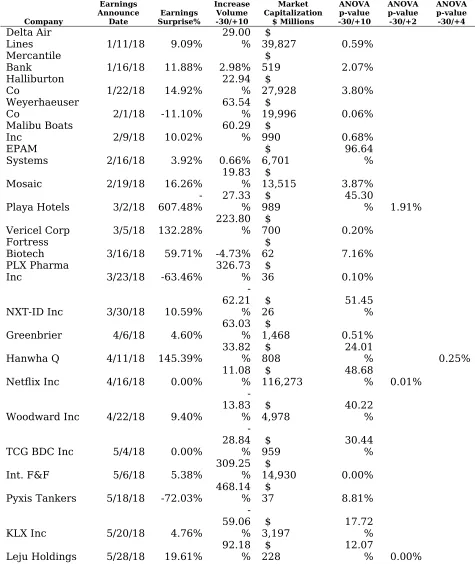
The full results are shown in Table 1 and Table 2. Table 1 indicates that of the 30 sample firms, 14 of those firms have a
statistically significant increase in trading volume in the 10 days after the earnings announcement as compared to the 30 days before the announcement. Additionally, when an ANOVA is conducted using a time period other than 10 days after the announcement, an additional five firms are shown to have a statistical difference in trading volume after the announcement. While the five additional firms are not part of the scientific approach used to prove that the first 14 firms announced valuable market information, the evidence is strong that the five
additional firms make announcements that contained timely, valuable market information. Furthermore, the five additional firms that show statistically significant results using different time frames indicate a variance in the length of time that it takes for financial information to be incorporated into market prices, likely due to variance in post-announcement drift.
conclusions based on standard inferential methods (Freed, Jones, & Bergquist, 2013). The confidence level result based on standard inferential statistical methods at the 95% confidence level (Freed at el., 2013) is that between 61.81% and 64.85% of all firms make
earnings announcements that contain information that affects trading volume; thus, between 61.81% and 64.85% of all firms report earnings information that is both valuable and timely.
Table 2 shows the results of two the additional regression analyses. The first result is that there is no statistically significant relationship between a firm’s market capitalization and a percentage increase in trading volume. The second result is that there is no
statistically significant relationship between the absolute value of the earnings surprise and the percentage increase in trading volume.
Conclusions
However, because previous studies do not seem to specify results as a percentage of firms, it is difficult to assess possible changes since Beaver’s (1968) work. Nonetheless, the high percentage of firms with valuable information seems to affirm the work of Beaver and other studies.
This study fills the second gap in the literature by
demonstrating variability in the post-announcement drift and by accounting for that variation in order to get an accurate picture of the percentage of earnings reports containing timely and valuable
information content; in other words, this study adds to the existing literature both by demonstrating the variability of the
post-announcement drift and by using this methodology to obtain an accurate percentage estimate. Had this study not taken the second step of subjectively assessing the variation in trading after the
announcement, then the result would indicate that only 14 out the 30 earnings announcements (47%) contained timely and valuable
these results are even close to the significant threshold of 5%, suggesting that these firms be counted as firms that provide timely and valuable information content.
This study fills the third gap in the literature with the actual percentage estimate of all firms that report both timely and valuable information content in financial statements. The interpretation of this percentage has been discussed above, but the mere fact that this study produces this figure is in and of itself beneficial to the current and future research in this area. The percentage finding is potentially useful in at least two important ways. One, investors now have an understanding of this metric and can use that information for financial analysis or other investment decisions. Two, this metric could be used as an important platform for future research. Because this third
contribution is so important, the next and last section will discuss the implications in more detail.
Percentage of all Firms with Timely and Valuable Information Content
for further research. This frame of analysis could help future researchers isolate and better understand the roughly 63% of earnings announcements with information content. This 63%
conclusion is based on a sample of firms that was irrespective of most firm qualities; the sample was not based on factors such as size,
earnings, earnings surprise, or industry. The only qualifications for the sample were attempts to factor out noise from a cluster of
announcements and attempts to spread the sample over time to factor out market effects. The two regressions involving firm size and the magnitude will be analyzed in the paragraphs below, but the main implication here is that future research will be needed to understand the distinguishing characteristics of the firms that fell in the 63% category and the firms that did not.
Firm size.
As future researchers attempt to understand the roughly 63% firms that report earnings that contain timely and valuable
correlation between market capitalization and the change in trading volume after the earnings announcement.
This result is contrary to the results of Bamber (1986) discussed in the above literature review section, and this issue can be resolved with future research. For this particular test, the methodology in this study was limited. The regression in Table 2 is based on the
percentage increase in trading volume over the 10-day period after the earnings announcement. This regression test is not able to uncover as many nuances as the ANOVA test that was reported in Table 1. The ANOVA test could determine a significant change even if the magnitude of total trading volume was small. However, the
regression test reported in Table 2 would not be able to detect this level of nuance. A small change in trading volume for one firm could be theoretically be significant for many firms, but if this were the case, then the regression results in Table 2 would not be significant. Thus, more research is required to affirm or refute the results of this study that find no relationship between firm size and an increase in trading volume.
Surprise earnings.
in Table 2 of this research, there is no statistically significant
relationship between the magnitude of the earnings surprise and the change in trading volume after the earnings announcement.
This could be a perfectly valid result, and the intuition might be that market investors are less concerned with the magnitude of
surprises and more concerned with whether the change is positive or negative combined with other firm-specific characteristics. However, it is again worth noting that the regression results in Table 2 are not the key findings of this research, and these regressions have
limitations. The ANOVA test was able to differentiate between trading volume changes of the same magnitude and determine which were significant and which were not. However, the regression test could show insignificant results if for example the change in trading volume was uniform among companies with different earnings surprises, even if those uniform changes in trading volume showed statistically
References
Atiase, R. K., & Bamber, L. S. (1994). Trading volume reactions to
annual accounting earnings announcements. Journal of
Accounting and Economics,17(3), 309-329. doi:10.1016/0165-4101(94)90031-0
Ball, R., & Brown, P. (1968). An Empirical Evaluation of Accounting
Income Numbers. Journal of Accounting Research,6(2), 159. doi:10.2307/2490232
Bamber, L. (1986). The Information Content of Annual Earnings
Releases: A Trading Volume Approach. Journal of Accounting Research, 24(1), 40-56. doi:10.2307/2490803
Bamber, L., Barron, O., & Stober, T. (1997). Trading Volume and
Different Aspects of Disagreement Coincident with Earnings
Announcements. The Accounting Review, 72(4), 575-597. Retrieved from http://www.jstor.org/stable/248176
Bamber, L. (1987). Unexpected Earnings, Firm Size, and Trading
Volume around Quarterly Earnings Announcements. The
Accounting Review, 62(3), 510-532. Retrieved from
http://www.jstor.org/stable/247574
Barron, O. (1995). Trading Volume and Belief Revisions That Differ
Benston, G. (1967). Published Corporate Accounting Data and Stock
Prices. Journal of Accounting Research, 5, 1-14. doi:10.2307/2489904
Bernard, V., & Thomas, J. (1989). Post-Earnings-Announcement Drift:
Delayed Price Response or Risk Premium? Journal of Accounting Research, 27, 1-36. doi:10.2307/2491062
Beaver, William H., “The informational Content of Annual Earnings
Announcements,” Journal of Accounting Research Supplement, 1968
Fama, E. (1970). Efficient Capital Markets: A Review of Theory and
Empirical Work. The Journal of Finance,25(2), 383-417. doi:10.2307/2325486
Fama, E. F., & French, K. R. (1993). Common risk factors in the
returns on stocks and bonds. Journal of Financial
Economics,33(1), 3-56. doi:10.1016/0304-405x(93)90023-5
Freed, N., Jones, S., & Bergquist, T. (2013). Understanding business statistics. Hoboken, NJ.: John Wiley & Sons.
Holthausen, R. W., & Verrecchia, R. E. (1988). The Effect of
Sequential Information Releases on the Variance of Price
Kim, O., & Verrecchia, R. E. (1991). Trading Volume and Price
Reactions to Public Announcements. Journal of Accounting Research,29(2), 302. doi:10.2307/2491051
Kothari, S. (2001). Capital markets research in accounting. Journal of Accounting and Economics,31(1-3), 105-231. doi:10.1016/s0165-4101(01)00030-1s
Lev, B. (1989). On the Usefulness of Earnings and Earnings Research:
Lessons and Directions from Two Decades of Empirical
Research. Journal of Accounting Research, 27, 153-192. doi:10.2307/2491070
Landsman, W. R., & Maydew, E. L. (2000). Beaver (1968) Revisited:
Has the Information Content of Annual Earnings
Announcements Declined in the Past Three Decades? SSRN Electronic Journal. doi:10.2139/ssrn.204068
Morse, D. (1981). Price and Trading Volume Reaction Surrounding Earnings Announcements: A Closer Examination. Journal of Accounting Research, 19(2), 374-383. doi:10.2307/2490871 Verrecchia, R. (1981). On the Relationship Between Volume Reaction
Table 1
Trading Volume Increase Post-Earnings Announcement
Company
Earnings Announce
Date Surprise%Earnings
Increase Volume -30/+10 Market Capitalization $ Millions ANOVA p-value -30/+10 ANOVA p-value -30/+2 ANOVA p-value -30/+4 Delta Air
Lines 1/11/18 9.09%
29.00 %
$
39,827 0.59% Mercantile
Bank 1/16/18 11.88% 2.98%
$
519 2.07% Halliburton
Co 1/22/18 14.92%
22.94 %
$
27,928 3.80% Weyerhaeuser
Co 2/1/18 -11.10%
63.54 %
$
19,996 0.06% Malibu Boats
Inc 2/9/18 10.02%
60.29 %
$
990 0.68% EPAM
Systems 2/16/18 3.92% 0.66%
$ 6,701
96.64 % Mosaic 2/19/18 16.26%
19.83 %
$
13,515 3.87% Playa Hotels 3/2/18
-607.48% 27.33 % $ 989 45.30 % 1.91% Vericel Corp 3/5/18 132.28% 223.80% $ 700 0.20%
Fortress
Biotech 3/16/18 59.71% -4.73% $ 62 7.16% PLX Pharma
Inc 3/23/18 -63.46% 326.73% $ 36 0.10%
NXT-ID Inc 3/30/18 10.59%
-62.21 % $ 26 51.45 % Greenbrier 4/6/18 4.60%
63.03 %
$
1,468 0.51% Hanwha Q 4/11/18 145.39%
33.82 % $ 808 24.01 % 0.25%
Netflix Inc 4/16/18 0.00%
11.08 % $ 116,273 48.68 % 0.01%
Woodward Inc 4/22/18 9.40%
-13.83
% $ 4,978 40.22%
TCG BDC Inc 5/4/18 0.00%
-28.84
% $ 959 30.44% Int. F&F 5/6/18 5.38% 309.25% $ 14,930 0.00% Pyxis Tankers 5/18/18 -72.03% 468.14% $ 37 8.81%
KLX Inc 5/20/18 4.76%
Organovo 6/8/18 0.00%
-35.18
% $ 117 16.19% Progressive 6/13/18 6.89% 30.73% $ 36,088 6.35% Carmax Inc 6/22/18 5.90% 82.38% $ 11,289 3.28% Greenbrier 6/29/18 11.32% 99.65% $ 1,468 0.00% Int. Speedway 7/5/18 2.22%
65.07 %
$
1,880 2.51% Helen of Troy 7/9/18 22.29%
176.63 %
$
3,719 0.43% Supercom 7/16/18 472.44% 8.48%
$ 20
92.65 % Amer. Camp. 7/23/18 156.25% -6.85%
$ 5,938
66.21 % Changyou.Co
m 7/29/18 12.06%
33.03 % $ 956 22.57 % 0.15% Table 2 Regression Results Independent
Variable DependentVariable P-Value Significance
Market Capitalization Increase inTrading Volume 73.16% No Absolute Value of