M E T H O D O L O G Y
Open Access
Iterative development of Stand Up Australia: a
multi-component intervention to reduce
workplace sitting
Maike Neuhaus
1*, Genevieve N Healy
1,2, Brianna S Fjeldsoe
1, Sheleigh Lawler
1, Neville Owen
1,2,3,4,
David W Dunstan
1,2,5,6, Anthony D LaMontagne
4and Elizabeth G Eakin
1,2Abstract
Background:Sitting, particularly in prolonged, unbroken bouts, is widespread within the office workplace, yet few interventions have addressed this newly-identified health risk behaviour. This paper describes the iterative development process and resulting intervention procedures for theStand Up Australiaresearch program focusing on a multi-component workplace intervention to reduce sitting time.
Methods:The development ofStand Up Australiafollowed three phases. 1) Conceptualisation:Stand Up Australia was based on social cognitive theory and social ecological model components. These were operationalised via a taxonomy of intervention strategies and designed to target multiple levels of influence including: organisational structures (e.g. via management consultation), the physical work environment (via provision of height-adjustable workstations), and individual employees (e.g. via face-to-face coaching). 2) Formative research: Intervention components were separately tested for their feasibility and acceptability. 3) Pilot studies:Stand Up Comcaretested the integrated intervention elements in a controlled pilot study examining efficacy, feasibility and acceptability. Stand Up UQexamined the additional value of the organisational- and individual-level components over height-adjustable workstations only in a three-arm controlled trial. In both pilot studies, office workers’sitting time was measured objectively using activPAL3 devices and the intervention was refined based on qualitative feedback from managers and employees.
Results:Results and feedback from participants and managers involved in the intervention development phases suggest high efficacy, acceptance, and feasibility of all intervention components. The final version of theStand Up Australiaintervention includes strategies at the organisational (senior management consultation, representatives consultation workshop, team champions, staff information and brainstorming session with information booklet, and supportive emails from managers to staff), environmental (height-adjustable workstations), and individual level (face-to-face coaching session and telephone support).Stand Up Australiais currently being evaluated in the context of a cluster-randomised controlled trial at the Department of Human Services (DHS) in Melbourne, Australia.
Conclusions:Stand Up Australiais an evidence-guided and systematically developed workplace intervention targeting reductions in office workers’sitting time.
Keywords:Intervention development, Sedentary behaviour, Sitting time, Sit-stand, Physical activity, Postural transitions, Workplace, Workplace intervention, Office workers, Height-adjustable workstations
* Correspondence:[email protected]
1
The University of Queensland, School of Population Health, Cancer Prevention Research Centre, Herston, Queensland, Australia Full list of author information is available at the end of the article
Background
Sedentary behaviour – sitting or lying down while expending little energy [1] - is a newly identified health risk behaviour that is detrimentally associated with sev-eral health outcomes, including cardiovascular disease and premature mortality [2-4]. Emerging evidence sug-gests that both total sitting time and prolonged individ-ual bouts thereof are linked to chronic diseases [5,6]. Further, sedentary behaviour is ubiquitous with adults spending more than half of their waking hours sitting down while watching television, travelling in cars, or working [7,8]. Thus, interventions aiming to reduce sit-ting time in adults have been identified as an important public health initiative [9].
An opportunistic, high-reach setting for sedentary be-haviour intervention is the office-based workplace [10]. Office workers constitute one of the largest occupational groups in industrialised countries such as the US [11], who spend approximately half of their waking hours at work [12]. Importantly, recent studies have shown that they sit for an average of six hours during an eight-hour workday, with this sitting time often accumulated through prolonged unbroken bouts of 30 minutes or more [13-16]. Emerging evidence suggests that targeting workplace sitting through strategies such as modifying the physical work environment [13,17-20], the provision of education sessions and behaviour change advice [16,21,22], or a combination of these strategies [23,24], can be effective. However, information on the develop-ment processes of these interventions, such as behaviour change models used and the operationalisation of con-structs into intervention messages is limited.
Detailed reporting of intervention development and con-tent is vital to advance intervention research and interven-tion effectiveness in public health [25]. This should include the theoretical model, targeted context, and forma-tive research and evaluation methods used [10,26-28]. While this type of work is increasingly being published across a number of disciplines including physical activity [29], nutrition [30], chronic disease management [31], and smoking cessation [32] interventions, to the best of our knowledge, no publications have described the develop-ment of an intervention to reduce workplace sitting time in adults.
The purpose of this paper is to systematically describe the evidence-based iterative development of the Stand Up Australia intervention whose primary aim is to re-duce workplace sitting time in office workers. The in-creasing number of sedentary behaviour publications in both the scientific and popular press over the past dec-ade has led to a demand from office-based workplace settings for assistance with reducing employee sitting. Such requests provided the opportunity for collaborative development of the Stand Up Australia intervention,
particularly through the formative research phases de-scribed below. In accordance with the workplace health promotion literature [33,34] and ecological models of sedentary behaviour [35], Stand Up Australia considers the multiple influences on workplace sitting and ad-dresses them via a multi-component approach including behaviour change strategies at the organisational/man-agerial, environmental, and individual level. The following intervention development description aims to provide a resource for researchers and public health practitioners with a level of detail beyond the restriction of a conven-tional intervention methods paper.
Methods
Identification of an intervention development framework
The systematic development of the Stand Up Australia
intervention was guided by an intervention development framework. A number of frameworks informed the broader intervention development principles, including the PRECEDE-PROCEED model [36] and the Interven-tion Mapping approach [37]. Given the specific (work-place) context, a workplace health promotion framework was chosen as the core approach [34], with elements of two other frameworks [38,39] used to complement this method. This included the following key elements: a phased and iterative approach in the development of the intervention [38]; the use of quantitative and qualitative evaluation methods to inform the intervention content [38]; formative research with the target group [39]; and, integration of interrelated dynamics of intra-individual, so-cial, organisational, political, and economic factors within the workplace context [34]. The development of theStand Up Australiaintervention involved three phases: 1) Con-ceptualisation (literature review and theoretical ground-ing); 2) Formative research (with the target audience); and, 3) Pilot testing of the efficacy, acceptability and feasibility of the integrated multiple components relative to a control group. More specifically, the additional value of the organ-isational and individual intervention components over an environment (height-adjustable workstations)-only inter-vention was examined in a three-arm trial. The pilot stud-ies included objective measurement of office workers’ sitting time, as well as quantitative and qualitative data collection from managers and staff.
Intervention development across 3 phases
Phase 1: conceptualisation
successfully used in physical activity intervention stud-ies [42]. The operationalisation of theoretical constructs into intervention strategies was guided by an interven-tion taxonomy [26,43].
Furthermore, Stand Up Australia was conceptualised as a multi-component approach to the workplace. Social ecological models of sedentary behaviour emphasize the importance of considering the multiple interrelated in-fluences on individual behaviour. These include the policy environment, the physical and psychosocial environment, and intrapersonal factors [35]. Similarly, best-practice workplace health promotion frameworks identify these in-fluences as key factors for behaviour change strategies in the workplace setting [34,44,45]. In accordance with these models and frameworks, this approach included strategies designed to address organisational structures and the of-fice environment, as well as individuals. By targeting these multiple levels, the aim was to not only raise awareness of sitting behaviours in the workplace, but also to facilitate habitual change via addressing the environment and the workplace culture. Furthermore, key elements in work-place health promotion as identified by the World Health Organization [44] were applied to this sedentary behav-iour intervention context as shown in Table 1.
Finally, based on evidence from successful intervention trials on workplace physical activity (the behaviour clos-est to the one of interclos-est) Stand Up Australiais ideally delivered over the course of at least three months [46].
Conceptualisation of organisational-level strategies Effective workplace health promotion interventions ad-dress organisational structures and group dynamics through a participative approach and visible management support [33,45]. A participatory approach directly involves staff from all levels (in contrast to a top-down approach) in the identification of well-suited behaviour change strategies and barrier identification. This makes the intervention context-sensitive and appropriate, and thus likely to be implemented and sustained. Within Stand Up Australia, this participative approach was implemented through its iterative design including formative research, brainstorm-ing sessions and qualitative feedback interviews. This in-volved all levels of staff including occupational health and safety (OHS) personnel, workplace safety advisors, and corporate ergonomists (depending on the size of the tar-geted workplace, this includes senior- and middle man-agers, as well as team leaders/team champions).
The implementation ofStand Up Australiabegan with initial contact with senior managers within the organisa-tion to elicit support for the study. Further strategies in-cluded a representatives consultation workshop and a sedentary behaviour information and brainstorming ses-sion for staff, with an accompanying electronic informa-tion booklet. During the representatives consultainforma-tion
workshop team champions were selected. They played a crucial part in the identification of behaviour-change op-portunities suited to their workplace and in delivering one of the organisational intervention components (sending management emails in support of the study to participat-ing staff ).
Conceptualisation of environmental-level strategies Activity-permissive workstations allow office workers to stand, walk, or pedal while working at their usual computer and desk-based job tasks. Examples of activity-permissive workstations include treadmill desks, stepping or pedal devices that are fitted underneath the desk, and height-adjustable workstations. Height-adjustable worksta-tions enable office workers to complete their desk-based and/or computer tasks while alternating between sitting and standing without significant disruption of work prac-tices. Traditionally acquired for the prevention of muscu-loskeletal problems [47,48], their potential to reduce sitting time for broader preventive-health benefits is in-creasingly being recognised [10].
Throughout all Stand Up Australia study development and implementation phases, manually height-adjustable workstations of the typeWorkFit-S(manufactured and pro-vided by Ergotron; www.ergotron.com) were used. These workstations were chosen as they enabled a ‘retro-fit’ to existing office furniture. They were also less expensive than fully height-adjustable desks. Other environmental-based strategies (e.g. centralisation of printers or in-office waste bins) could be identified in the brainstorming sessions, but the primary focus of this strategy was the use of the height-adjustable workstations.
Conceptualisation of individual-level strategies In line with evidence from successful health intervention programs [49], individual-level intervention strategies were mainly delivered through a face-to-face coaching session with follow-up support telephone calls using a motivational interviewing approach [50]. The face-to-face session followed a script which is very detailed but allowed the consultant to tailor the coaching to the needs of the individual. While there is no firm evidence for an ideal amount of telephone-delivered intervention contact, a recent review suggests that a higher number of tele-phone contacts is associated with better health behaviour outcomes [51]. In the case of Stand Up Australia, where there was an intervention period of three months, four calls were considered to provide an appropriate balance of participant support and time involvement for both partici-pants and researchers.
health impacts: Stand Up, Sit Less, Move More. Stand Up was a prompt to break-up long, unbroken bouts of sitting of 30 minutes or more. This suggestion was based on both epidemiological and laboratory-based evidence which has reported the cardio-metabolic benefits of regularly interrupting sedentary time [5,6]. Furthermore, this target is in line with the ergonomic literature [52,53], and could be practically implemented into office work routines. The message Sit Less aimed to reduce total workplace sitting time through substituting some sitting with standing (primarily at the new workstation) and/or moving, with the intent that the reductions in workplace sitting be substantial enough to reduce the health risks associated with high daily sitting time. Finally, the principle of Move More was to increase movement throughout the working day. The primary emphasis of this message was on the use of practical strategies (e.g. taking the stairs instead of the lift) to increase incidental physical activity – a key component of daily energy expenditure [54] - throughout the workday.
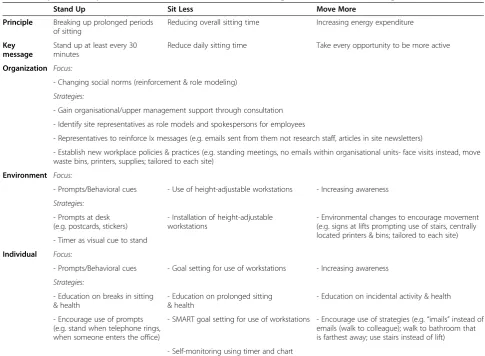
Table 2 illustrates how these conceptual elements were linked with specific behaviour change strategies related to the key intervention messages ofStand Up, Sit Less, and Move More across the three workplace levels (organisa-tional, environmental, individual). This table shows the first iteration of theStand Up Australiaintervention. This version of the intervention was used in the formative work with the target audience.
Phase 2: formative research
The second phase included pilot testing of intervention components at all intervention target levels. This oc-curred across multiple studies and settings comprising theStand Up Australiaprogram of research.
At the organisational level, a consultation session was arranged between senior study investigators and the management of a medium-sized organisation interested in workplace health promotion [24]. This consultation identified this first session as key for gaining manage-ment ‘buy-in’, as well as for the identification of
Table 1 Application of“Five Keys to Healthy Workplaces”(World Health Organization) to theStand Up Australia Intervention
Keys Application toStand Up AustraliaIntervention
1) Leadership commitment and engagement - Senior management consultation (gaining leadership commitment, necessary permissions, resources, and support);
- Representatives consultation workshop (mobilising and gaining commitment from major stakeholders including union representatives and OHS staff)
- Manager emails (demonstrating continuous management support)
2) Involve workers and their representatives - Representatives consultation workshop
- Team champions
- Staff information and brainstorming session
- Individual coaching session and telephone support calls
3) Business ethics and legality - Development of key messages, instructions, and workstation introduction in collaboration with ergonomists and OHS experts
- Senior management consultation (aligning study principles with workplace policies)
- Representatives consultation workshop (involvement of OHS staff)
4) Use a systematic, comprehensive process to ensure effectiveness and continual improvement
- Representatives consultation workshop (involving team of multidisciplinary experts)
- Staff information and brainstorming session (including elaboration of organisational priorities)
- Pre- and post-intervention assessment of workplace sedentary behaviour in line with key intervention messages
- Feedback of study results to individuals and the organisation including consultation about future strategies and policy changes
- Iterative development with continuous improvement of intervention components
5) Sustainability and integration - Representatives consultation workshop (reducing isolation of work groups, and mobilisation of team champions)
- Staff information and brainstorming session
- Assessment of intervention acceptance, feasibility and fidelity
- Assessment of sedentary behaviour change maintenance
organisational processes and structures important to study implementation (e.g. policies around workplace activity).
At the environmental level, a preliminary study was conducted testing the efficacy, acceptability, and feasibil-ity of height-adjustable workstations in office workers (Intervention, n = 18; Comparison, n = 14; 94% and 86% women in the intervention and control group, respect-ively; 20-65 years) between February and June 2011. In this study, and in all other studies forming part ofStand Up Australia, evaluation of changes in workplace sitting time was assessed by the activPAL3 activity monitor (PAL Technologies Limited, Glasgow, UK). Detailed methods and results of this preliminary study are pub-lished elsewhere [13]. In brief, relative to the comparison group, intervention participants reduced their daily workplace sitting time by an average of 143 minutes per eight-hour day at the workplace following the installa-tion of the workstainstalla-tions (95% CI = -184, -102; p < 0.001), without compromising work-performance. Acceptability of the workstations was high (94% stated that it was en-joyable and easy to use). However, generalisability of
these findings was limited due to the intervention sam-ple consisting of a group of public health researchers working in the area of sedentary behaviour research. Furthermore, these findings were limited to closed-plan office designs.
Addressing these limitations, another pilot study was conducted to test the acceptability of the height-adjustable workstations utilised inStand Up Australia in open-plan offices (ethical approval granted by The University of Queensland’s School of Population Health Research Ethics Committee on 4thAugust 2011; #MN 010811). A conveni-ence sample of five desk-based employees (three women; 20-65 years) was recruited from administrative personnel from a university in Brisbane (Australia) to trial the work-stations for two weeks. Following the trial period, all par-ticipants (‘workstation group’), as well as another seven employees (‘peer group’; six women; 20-65 years), who shared the same open-plan office and sat nearby the in-stalled workstations, underwent a brief (five-minute) feed-back interview on their experience. The interview was semi-structured, audio-recorded, and transcribed.
Table 2 Map ofStand Up, Sit Less, and Move Moreintervention strategies across intervention target levels
Stand Up Sit Less Move More
Principle Breaking up prolonged periods of sitting
Reducing overall sitting time Increasing energy expenditure
Key message
Stand up at least every 30 minutes
Reduce daily sitting time Take every opportunity to be more active
Organization Focus:
- Changing social norms (reinforcement & role modeling)
Strategies:
- Gain organisational/upper management support through consultation
- Identify site representatives as role models and spokespersons for employees
- Representatives to reinforce Ix messages (e.g. emails sent from them not research staff, articles in site newsletters)
- Establish new workplace policies & practices (e.g. standing meetings, no emails within organisational units- face visits instead, move waste bins, printers, supplies; tailored to each site)
Environment Focus:
- Prompts/Behavioral cues - Use of height-adjustable workstations - Increasing awareness
Strategies:
- Prompts at desk (e.g. postcards, stickers)
- Installation of height-adjustable workstations
- Environmental changes to encourage movement (e.g. signs at lifts prompting use of stairs, centrally located printers & bins; tailored to each site) - Timer as visual cue to stand
Individual Focus:
- Prompts/Behavioral cues - Goal setting for use of workstations - Increasing awareness
Strategies:
- Education on breaks in sitting & health
- Education on prolonged sitting & health
- Education on incidental activity & health
- Encourage use of prompts (e.g. stand when telephone rings, when someone enters the office)
- SMART goal setting for use of workstations - Encourage use of strategies (e.g.“imails”instead of emails (walk to colleague); walk to bathroom that is farthest away; use stairs instead of lift)
Workstation group feedbackOverall, all five employees were satisfied with the workstations. While suggestions were made for the improvement of the workstation design, everyone appreciated the option to sit or stand while work-ing at their computer–for example, one employee stated:
“It was nice to have the option to sit or stand. It took a lot of pressure off my lower back which usually tends to get sore after prolonged periods of sitting”. On a 5-point scale (1=’did not like it at all’to 5=’found it great’), participants rated the workstations from 3 to 5 with an average of 3.9 points. None of the participants perceived any disturbance (visual or auditory) for colleagues working in their immedi-ate environment. Four participants expressed interest in keeping their workstation.
Peer group feedback Six peer group participants did not feel disturbed in any way by others using the work-stations. One participant however experienced distrac-tion through the increased noise level and the fact that the‘workstation user’was able to look over the partition while standing up -“We have staff come and see us about
confidential/ personal information at our desks. It feels like someone is constantly staring at you”. Based on the feed-back from this participant, a discussion about the pur-chase of cubicle dividers was taken into the protocol for the management consultation (details below) at the outset of theStand Up AustraliaIntervention.
At the individual level,the feasibility of a face-to-face health coaching session was tested with two university employees (both women, 23 and 28 years) who were not otherwise involved in the Stand Up Australia program of research. Overall, the coaching session was received well by the two trial participants and the intended length of the session (30 minutes) was confirmed. Feedback on the key intervention messages led to further clarification of the distinction between Stand Up (i.e. standing up regularly to break up long bouts of sitting) andSit Less
(i.e. reducing the overall sitting time throughout the day by replacing some sitting time with standing and/or moving time).
Phase 3: pilot testing
Two pilot studies were conducted and are described below: ‘Stand Up Comcare’, a two-arm controlled trial that tested the efficacy, feasibility, and acceptability of the integrated multiple components; and,‘Stand Up UQ’, a three-arm controlled trial that evaluated the additional value of the multiple components over height-adjustable workstations only.
Stand Up Comcare methods An abridged, four-week version of theStand Up Australia intervention was ini-tially pilot tested with 43 employees (56% women; 26-62 years) in a two-arm controlled trial between July and
September 2011 in an urban open-plan office (Comcare: the government agency responsible for workplace safety, rehabilitation and compensation for Australian govern-ment workplaces) in Melbourne, Australia [24]. The main purpose of this pilot was to test the combined implemen-tation of all three intervention components. Following the pilot study, intervention group participants completed a telephone interview about their study experience and managers provided feedback in face-to-face sessions.
Stand Up Comcareresults Results from this pilot study are published elsewhere [24]. In brief, relative to the control group, participants in the intervention group re-duced their workplace sitting time by just over two hours per eight-hour workday (mean change -125, 95% CI = -161, -89 minutes) following intervention, with sit-ting primarily replaced with standing (127, 95% CI = 92, 162 minutes). Of the 21 intervention group partici-pants, 18 completed the telephone feedback interview. Overall, the height-adjustable workstations, as well as the organisational and individual intervention compo-nents (in particular the face-to-face coaching session), were evaluated very positively by both staff and man-agers (detailed below).
Intervention refinement based onStand Up Comcare
Based on the feedback from Stand Up Comcare, the
Stand Up Australia intervention was modified at all three levels. Regarding organisational-level strategies, the majority of participants indicated that the initially standardised manager emails were mostly left unread due to email overload and not enough relevance – for example, “I read one or two but don’t remember more
than that, didn’t take much notice of them”. Thus, the intervention was refined to tailor the manager email templates provided by the study to the managers’ obser-vations of their team’s experience with the intervention. This could include the observation of potential problems (e.g. sore feet from increased levels of standing) and sug-gested solutions (e.g. keeping a spare pair of orthopaedic shoes at the desk). While the primary outcome targeted through Stand Up Australia is sitting at the workplace, it was decided to add a list of useful strategies to Stand Up, Sit Less, and Move Moreoutside of the workplace to the second manager email. Further, during the manage-ment consultation, more emphasis was placed on the initiation of standing by managers/senior-level staff dur-ing staff meetdur-ings, as participants repeatedly expressed feeling ‘awkward’ to initiate standing by themselves
managers. At the environmental level, a detailed ergo-nomic introduction to the height-adjustable worksta-tions (involving internal OHS staff wherever available) was added to the intervention protocol. This introduc-tion was delivered immediately following the worksta-tion installaworksta-tion to address employee concerns about their limited experience in the correct use of these. During theindividual intervention contacts, a stronger emphasis was placed on the importance of regular pos-tural changes, and, as most participants experienced diffi-culties distinguishing the principles ofStand UpandSit Less, a clearer and more detailed explanation of these recommendations was incorporated. Further, assisting participants with the set-up of a stopwatch or computer software to monitor their sitting/standing time if re-quired was included in the protocol, as some partici-pants experienced difficulties with doing this on their own. In line with the addition of a strategy list toStand Up, Sit Less,and to give more emphasis to the target of
Move More outside of the workplace, a discussion about these strategies was added to the protocol of the third telephone call in addition to the related list of strategies added to the second manager email. Finally, the email summaries sent following the telephone calls were removed from the intervention protocol, as feed-back from employees indicated that these were gener-ally not read due to an overload of emails.
The results of this pilot study addressed the efficacy considerations of the multi-component intervention on reducing workplace sitting time. However, as the partici-pating employees were from a government agency for workplace safety, rehabilitation and compensation, the results may be limited in their generalizability. Further-more, based on the two-group design it was not possible to determine the contribution of the organisational- and individual-level elements, as distinct from the provision of height-adjustable workstations alone. Considering the resource implications of these elements, this issue has important practical and financial implications. The sec-ond pilot study (Stand Up UQ) therefore involved a test of the efficacy of this multi-component intervention to a height-adjustable workstations-only intervention in a three-arm controlled trial involving a comparatively rep-resentative sample of office workers.
Stand Up UQmethods Between January and June 2012, a group of desk-based office workers from three separate administrative units of The University of Queensland (Brisbane, Australia) participated in the‘Stand Up UQ’study (multi-component intervention, n = 16; height-adjustable workstations-only, n = 14; comparison, n = 14; 84% women; 20-65 years). The multi-component intervention comprised all the Stand Up Australia intervention elements as refined following the Stand Up Comcare pilot study
(detailed above), delivered over three months. Partici-pants in the workstations-only intervention received height-adjustable workstations only.
Stand Up UQ results Results are published elsewhere [55]. In brief, following intervention and relative to the comparison group, workplace sitting time in the multi-component group was reduced by 89 mins/8-hour work-day (95% CI = -130, -47 minutes; p < 0.001) and 33 minutes in the workstations-only group (95% CI = -74, 7 minutes, p = 0.285). Furthermore, all participants in the multi-component intervention rated all intervention compo-nents as either useful or very useful. In particular, 12/13 rated the manager emails, which were mostly left unread in theStand Up Comcarepilot and therefore tailored in the refinement, as either useful or very useful (one participant was neutral)–“Her emails brought everyone onto the same
page and encouraged [us] to try things, reinforcing support”.
Results (final intervention design)
The following section provides a detailed description of the resulting Stand Up Australia intervention protocol. The suggested timing of all intervention components is shown in Table 3.
Organisational intervention strategies
In brief, there are three key strategies targeting the organ-isational level: A senior management consultation, a repre-sentatives consultation workshop, and a staff information and brainstorming session including the provision of an in-formation booklet.
Senior management consultation (approx. 30-45 mins)
During a consultation session between senior research staff (trained in the evidence of excessive sitting and detri-mental health outcomes) and selected senior staff, details of the study timeline are presented and an explanation of the role of organisational and physical environmental fac-tors in determining occupational sitting time is given. Fur-thermore, current organisational processes and structures important to study implementation are considered, the concept of the representatives consultation workshop is introduced, and relevant staff identified (more details below). Strategies to encourage employee participation are discussed and important OHS policies and resources iden-tified (e.g. those relating to workplace activity). Finally, additional resources to support study targets are identified (e.g. headphones or higher partitions between desks).
Representatives consultation workshop (approx. 2-4 hours)
include staff from each staff level (including senior and middle managers) as well as other important stake-holders such as OHS personnel, union representatives, workplace safety advisors, and corporate ergonomists. During the workshop, research staff present details on the research background and target behaviour, and rep-resentatives identify feasible workplace changes toStand Up, Sit Less, and Move Moresuited to their organisation (e.g. standing meetings, or the relocation of printers and waste bins). Furthermore, a group of team champions is identified. Throughout the duration of theStand Up Australia intervention, the role of team champions is: 1) to actively promote standing by using their height-adjustable desks and to encourage and initiate standing in staff meetings (e.g. by hanging up signs in meeting rooms that ‘standing meetings are welcome’ or by an-nouncing in the beginning of a staff meeting that staff are welcome to stand); 2) to act as liaison between staff and the research team; and, 3) to distribute the man-agement emails (one champion; typically a manager). Standard email templates supportive of the study targets are provided to this champion by the research team. The champion is asked to walk through the offices on a regular basis to observe and chat to staff about potential problems related to the new workstations or other study compo-nents. Any observations are subsequently integrated into the email templates. Six fortnightly emails are sent to staff (blind copied to the research team) over the course of the three-month intervention.
Staff information and brainstorming session and information booklet (approx. 30-45 mins)
Research staff facilitate a staff information and brain-storming session. This session addresses the detrimental
health impacts of prolonged sitting and provides details about intervention participation, as well as feedback on the group’s workplace sitting time collected from the ac-tivity monitors at baseline. Organisational strategies to
Stand Up, Sit Less, and Move More as identified in the representatives consultation workshop are discussed, and staff are encouraged to further brainstorm strategies that may be specifically suited to their group. Following this information session, a summary email (provided by research staff ) is sent from the responsible team cham-pion to all staff. This email includes an electronicStand Up Australiainformation booklet with details about: the study rationale (i.e. evidence on sedentary behaviour and health outcomes) and purpose; general guidelines on op-timal workplace activity; specific behaviour change strat-egies related to the key intervention messages; and, general information about the study procedure and timeline.
Environmental intervention strategy
Height-adjustable workstation installation and ergonomic posture check
Each participating employee receives a height-adjustable workstation. In consultation with an OHS ergonomist, the authors adapted the manufacturer-provided worksta-tion informaworksta-tion sheet, which contains details about the correct ergonomic posture and tips on the use of the workstation, as well as the study recommendations on workplace sitting and activity. It is left on the workstation shelf for each participant to read upon the first contact with the new workstation. Following the workstation in-stallation, the organisation’s OHS staff confirm the correct ergonomic posture and address any workstation-related problems or questions. If OHS staff are unavailable, this
Table 3 Intervention elements and timing of implementation
Timing Intervention level
Organisational Environmental Individual
Intervention elements
Week 1 Senior management consultation
Week 2 Representatives consultation workshop
Week 3 Staff information & brainstorming session; Manager email 1 Workstation installation Coaching session & email summary
Week 4 Phone call 1
Week 5 Manager email 3
Week 6 Phone call 2
Week 7 Manager email 4
Week 8
Week 9 Manager email 5 Phone call 3
Week 10
Week 11 Manager email 6
Week 12
step is conducted by research staff following study-specific training.
Individual intervention strategies
In brief, the individual component consists of one face-to-face coaching session and four follow-up support tele-phone calls over the three months.
Face-to-face coaching
The workstation installation is followed by an individual 30-minute face-to-face coaching session delivered by a health coach (trained in motivational interviewing tech-niques) in a private room at the work site. First, the par-ticipant and coach review the parpar-ticipant’s individual feedback document [55]. This analytic feedback docu-ment reflects the participant’s activity and posture (as re-corded during the baseline assessment week) in relation to each of the key messages Stand Up, Sit Less, and Move More. This includes both overall proportions of sitting, standing, and moving time across the day and during work hours only, as well as a 24 hour ‘heatmap’ showing times at which these activities occurred for each day during the assessment week. Then, potential dispar-ities between the baseline and target behaviours are established, and specific goals for each key message are elaborated on using motivational interviewing methods. For example, tasks undertaken during long periods of sitting visible on the heat map are discussed and solu-tions to achieve the desired behaviour target identified. Goals are documented on a ‘Workstation Tracker’[55], which is to be attached to the workstation clearly visible to the participant (for self-monitoring purposes). Follow-ing the coachFollow-ing session, participants receive an email summary from the coach containing the key points discussed.
Support telephone calls
Each intervention group participant receives a total of four behaviour change support telephone calls following the coaching session, preferably from the same health coach. The telephone calls are delivered in staggered in-tervals (preferably at one, three, six, and ten weeks fol-lowing the coaching session), offering more intense support during the initiation period and gradually less during the maintenance period of behaviour change. They serve as a general check-in on the participants’ sat-isfaction with the study and their workstation, their goal achievement, barrier identification and problem solving, discussion of new strategies, and a potential adjustment of goals. During the second call, the health coach also discusses strategies toStand Up, Sit Less, and Move More
outside the workplace. On average, these calls should take around ten minutes.
Intervention feedback
At the end of the three-month intervention period, and again one year after baseline, the research team provides both individuals and the organisation with feedback on the sitting time reductions experienced by staff. This can be ac-companied by a consultation on strategies that were con-sidered to be most suited to the particular organisation and a discussion regarding potentially relevant future strat-egies and policy changes.
Discussion
Detailed reporting on intervention development is vital for the advancement of effective behaviour change inter-ventions. This is the first paper to provide a thorough de-scription of the development process of an intervention to reduce sitting time in office workers -Stand Up Australia. Key strengths of this development process include: a systematic three-stage process guided by currently avail-able evidence; strong theoretical grounding and transla-tion of key constructs guided by the use of an interventransla-tion taxonomy; a participative approach to both the broader workplace and its staff; the targeting of multiple levels of influence on workplace sitting (organisational/managerial, environmental, and individual); as well as the integration of qualitative and quantitative data to inform subsequent uptake into practice.
However, when considering the potential for wide-spread translation of the Stand Up Australia interven-tion, it should be noted that, despite the strong input from workplaces into intervention development and the pragmatic design of the evaluation, the participatory process was limited by research funding constraints. The findings may therefore not generalise across the wider population of office workplace settings.
Stand Up Australiais currently being evaluated in the context of a cluster-randomised controlled trial at the Department of Human Services (DHS) in Melbourne, Australia (Stand Up Victoria; ACTRN12611000742976). This study is funded by the Australian National Health and Medical Research Council and the Victorian Health Promotion Foundation, and includes objective measure-ment of activity and posture via activPAL3 monitors, clin-ical assessment of anthropometric outcomes and cardio metabolic biomarkers, evaluation of work-related outcomes (including productivity, absenteeism and presenteeism), as well as cost-effectiveness analyses [56].
Conclusions
studies demonstrate the efficacy ofStand Up Australiato significantly reduce office workers’sitting time. Results of the currently implemented cluster-randomised controlled trial will inform its (cost-) effectiveness and feasibility on a larger scale.
Consent
Written informed consent was obtained from all partici-pants for the publication of this report and any accom-panying images.
Competing interests
Height-adjustable workstations were kindly provided by Ergotron (www.ergotron.com) for theStand Up ComcareandStand Up UQpilot studies. The funding bodies had no influence on the conduct or the findings of the study.
Authors’contributions
All authors made substantial contributions to the conceptualisation and development of theStand Up Australiaintervention. All authors played a significant role in the drafting of this manuscript. All authors read and approved the final manuscript.
Acknowledgements
Neuhaus was supported by an Australian Postgraduate Award and UQ School of Population Health Top-Up Scholarship. Healy was supported by a National Health and Medical Research Council (NHMRC) [#569861] and Heart Foundation [PH 12B 7054] Fellowship. Dunstan was supported by an Australian Research Council Future Fellowship [#FT100100918], and by the Victorian Health Promotion Foundation and the Victorian Government’s Operational Infrastructure Program. Owen was supported by a NHMRC Program Grant [#569940], a Senior Principal Research Fellowship [NHMRC #1003960], and by the Victorian Government’s Operational Infrastructure Program. LaMontagne was supported by a Victorian Health Promotion Foundation Centre grant (grant #15732). Eakin was supported by a NHMRC Senior Research Fellowship [#511001].
Author details 1
The University of Queensland, School of Population Health, Cancer Prevention Research Centre, Herston, Queensland, Australia.2Baker IDI Heart and Diabetes Institute, Melbourne, Victoria, Australia.3Monash University, Medicine, Melbourne, Australia.4The McCaughey Centre, School of Population Health, University of Melbourne, Melbourne, Australia.5The University of Western Australia, School of Sports Science, Exercise and Health, Perth, Australia. 6The University of Melbourne, School of Population & Global Health, Melbourne,
Australia.
Received: 1 August 2013 Accepted: 17 February 2014 Published: 21 February 2014
References
1. Barnes J, Behrens TK, Benden ME, Biddle S, Bond D, Brassard P, Brown H, Carr L, Chaput J-P, Christian H, Sedentary Behaviour Research Network: Letter to the Editor: standardized use of the terms "sedentary" and "sedentary behaviours".Appl Physiol Nutr Me2012,37(3):540–542. 2. Wilmot EG, Edwardson CL, Achana FA, Davies MJ, Gorely T, Gray LJ, Khunti
K, Yates T, Biddle SJ:Sedentary time in adults and the association with diabetes, cardiovascular disease and death: systematic review and meta-analysis.Diabetologia2012,14:14.
3. Thorp AA, Owen N, Neuhaus M, Dunstan DW:Sedentary behaviors and subsequent health outcomes in adults A systematic review of longitudinal studies, 1996-2011.Am J Prev Med2011,41(2):207–215. 4. Matthews CE, George SM, Moore SC, Bowles HR, Blair A, Park Y, Troiano RP,
Hollenbeck A, Schatzkin A:Amount of time spent in sedentary behaviors and cause-specific mortality in US adults.Am J Clin Nutr2012, 95(2):437–445.
5. Dunstan DW, Kingwell BA, Larsen R, Healy GN, Cerin E, Hamilton MT, Shaw JE, Bertovic DA, Zimmet PZ, Salmon J, Owen N:Breaking up prolonged
sitting reduces postprandial glucose and insulin responses.Diabetes Care
2012,35(5):976–983.
6. Healy GN, Dunstan DW, Salmon J, Cerin E, Shaw JE, Zimmet PZ, Owen N: Breaks in sedentary time - beneficial associations with metabolic risk. Diabetes Care2008,31(4):661–666.
7. Matthews CE, Chen KY, Freedson PS, Buchowski MS, Beech BM, Pate RR, Troiano RP:Amount of time spent in sedentary behaviors in the United States, 2003-2004.Am J Epidemiol2008,167(7):875–881.
8. Helmerhorst H, Wijndaele K, Brage S, Wareham N, Ekelund U:Objectively measured sedentary time may predict insulin resistance independent of moderate- and vigorous-intensity physical activity.Diabetes2009, 58(8):1776–1779. Epub 2009 May 1726.
9. Owen N, Healy GN, Matthews CE, Dunstan DW:Too much sitting: the population health science of sedentary behavior.Exerc Sport Sci Rev2010, 38(3):105–113.
10. Healy GN, Lawler S, Thorp A, Neuhaus M, Robinson E, Owen N, Dunstan D: Reducing prolonged sitting in the workplace, An evidence review: full report.InCreating Healthy Workplace evidence review series.Carlton, Australia: Victorian Health Promotion Foundation (VicHealth); 2012:88. 11. Lee MA, Mather M:U.S. Labor force trends.InPopulation Bulletin, Volume
63. Edited by Lee M. Washington, DC; 2008.
12. American Time use Survey - 2012 Results.[http://www.bls.gov/news.release/ pdf/atus.pdf]
13. Alkhajah TA, Reeves MM, Eakin EG, Winkler EA, Owen N, Healy GN:Sit-stand workstations: a pilot intervention to reduce office sitting time.Am J Prev Med2012,43(3):298–303.
14. Ryan CG, Grant PM, Dall PM, Granat MH:Sitting patterns at work: objective measurement of adherence to current recommendations.Ergonomics
2011,54(6):531–538.
15. Thorp AA, Healy GN, Winkler E, Clark BK, Gardiner PA, Owen N, Dunstan DW: Prolonged sedentary time and physical activity in workplace and non-work contexts: a cross-sectional study of office, customer service and call centre employees.Int J Behav Nutr Phys Act2012,9:128.
16. Evans RE, Fawole HO, Sheriff SA, Dall PM, Grant PM, Ryan CG: Point-of-choice prompts to reduce sitting time at work: A randomized trial.Am J Prev Med2012,43(3):293–297.
17. Grunseit AC, Chau Y, Ploeg HP, Bauman A:"Thinking on your feet": a qualitative evaluation of sit-stand desks in an Australian workplace. BMC Public Health2013,13:365.
18. Ellegast R, Weber B, Mahlberg R:Method inventory for assessment of physical activity at VDU workplaces.Work Stress2012,41:2355–2359. 19. Hedge A, Ray EJ:Effects of an electronic height-adjustable worksurface
on computer worker musculoskeletal discomfort and productivity. Hum Fac Erg Soc P2004,48:1091–1095.
20. Pronk NP, Katz AS, Lowry M, Payfer JR:Reducing occupational sitting time and improving worker health: The take-a-stand project, 2011. Prev Chronic Dis2012,9:110323.
21. Kozey-Keadle S, Libertine A, Staudenmayer J, Freedson P:The feasibility of reducing and measuring sedentary time among overweight, non-exercising office workers.J Obes2012,2012:282303.
22. Galinsky TL, Swanson NG, Sauter SL, Hurrell JJ, Schleifer LM:A field study of supplementary rest breaks for data-entry operators.Ergonomics2000, 43(5):622–638.
23. Gilson ND, Suppini A, Ryde GC, Brown HE, Brown WJ:Does the use of standing 'hot' desks change sedentary work time in an open plan office? Prev Med2012,54(1):65–67.
24. Healy GN, Eakin EG, LaMontagne AD, Owen N, Winkler EAH, Wiesner G, Gunning L, Neuhaus M, Lawler S, Fjeldsoe BS, Dunstan DW:Reducing sitting time in office workers: Short-term efficacy of a multicomponent intervention.Prev Med2013,57(1):43–48.
25. Goldenhar LM, LaMontagne AD, Katz T, Heaney C, Landsbergis P: The intervention research process in occupational safety and health: an overview from the National Occupational Research Agenda Intervention Effectiveness Research Team.J Occup Environ Med / Am Coll of Occup Environ Med2001,43:616–622.
26. Michie S, Ashford S, Sniehotta FF, Dombrowski SU, Bishop A, French DP: A refined taxonomy of behaviour change techniques to help people change their physical activity and healthy eating behaviours: The CALO-RE taxonomy.Psychol Health2011,26(11):1–20.
interventions: The TREND statement.Am J Public Health2004, 94(3):361–366.
28. Schulz R, Czaja SJ, McKay JR, Ory MG, Belle SH:Intervention Taxonomy (ITAX): Describing Essential Features of Interventions.Am J Health Behav
2010,34(6):811–821.
29. Fjeldsoe BS, Miller YD, O'Brien JL, Marshall AL:Iterative development of MobileMums: a physical activity intervention for women with young children.Int J Behav Nutr Phys Act2012,9:151.
30. Nicklas TA, Johnson CC, Farris R, Rice R, Lyon L, Shi RH:Development of a school-based nutrition intervention for high school students: Gimme 5. Am J Health Promot1997,11(5):315–322.
31. Cherrington A, Martin MY, Hayes M, Halanych JH, Wright MA, Appel SJ, Andreae SJ, Safford M:Intervention Mapping as a guide for the development of a diabetes peer support intervention in Rural Alabama. Prev Chronic Dis2012,9:110053.
32. Whittaker R, Maddison R, McRobbie H, Bullen C, Denny S, Dorey E, Ellis-Pegler M, van Rooyen J, Rodgers A:A multimedia mobile phone-based youth smoking cessation intervention: findings from content development and piloting studies.J Med Internet Res2008,10(5):e49.
33. LaMontagne AD, Noblet AJ, Landsbergis PA:Intervention development and implementation: Understanding and addressing barriers to organisational-level interventions.InImproving organisational interventions for stress and well-being.Edited by Biron C, Karanika-Murray M, Cooper CL. England: Routledge; 2012.
34. Noblet AJ, LaMontagne AD:The challenges of developing, implementing, and evaluating interventions.InOrganizational Well-Being.Edited by Cartwright S, Cooper CL. Oxford: University Press; 2009.
35. Owen N, Sugiyama T, Eakin EE, Gardiner PA, Tremblay MS, Sallis JF:Adults' sedentary behavior determinants and interventions.Am J Prev Med2011, 41(2):189–196.
36. Green L, Kreuter M:Health program planning: An educational and ecological approach, Volume 4th. New York, NY: McGraw-Hill; 2005.
37. Bartholomew LK, Parcel GS, Kok G, Gottlieb NH, Fernández ME:Planning health promotion programs: An Intervention Mapping approach, Volume 3rd. San Francisco, CA: Jossey-Bass; 2011.
38. Campbell M, Fitzpatrick R, Haines A, Kinmonth AL, Sandercock P, Spiegelhalter D, Tyrer P:Framework for design and evaluation of complex interventions to improve health.Br Med J2000,321(7262):694–696. 39. Whittaker R, Merry S, Dorey E, Maddison R:A development and evaluation
process for mHealth interventions: examples from New Zealand.J Health Commun2012,17:11–21.
40. Bandura A:Health promotion by social cognitive means.Health Educ Behav2004,31(2):143–164.
41. Rhodes RE, Mark RS, Temmel CP:Adult sedentary behavior: a systematic review.Am J Prev Med2012,42(3):E3–E28.
42. Keller C, Fleury J, Gregor-Holt N, Thompson T:Predictive ability of social cognitive theory in exercise research: an integrated literature review. Online J Knowl Synth Nurs1999,6:2.
43. Abraham C, Michie S:A taxonomy of behavior change techniques used in interventions.Health Psychol2008,27(3):379–387.
44. Five keys to healthy workplaces: no business wealth without workers' health.
[http://www.who.int/occupational_health/5keys_healthy_workplaces.pdf?ua=1] 45. Essential elements of effective workplace programs and policies for improving
worker health and wellbeing.[http://www.cdc.gov/niosh/twh/essentials.html] 46. Conn VS, Hafdahl AR, Cooper PS, Brown LM, Lusk SL:Meta-analysis of
workplace physical activity interventions.Am J Prev Med2009, 37(4):330–339.
47. Nerhood HL, Thompson SW:Adjustable sit-stand workstations in the office.InProceedings of the Human Factors and Ergonomics Society 38th Annual Meeting, Volume 1. Nashville, Tennessee: The Human Factors and Ergonomics Society; 1994:668–672.
48. Winkel J, Oxenburgh M:Towards optimizing physical activity in VDT/ office work.InPromoting health and productivity in the computerized office.
Edited by Sauter S, Dainoff M, Smith M. Bristol, PA, USA: Taylor & Francis/ Hemisphere; 1991:94–117.
49. Armstrong MJ, Mottershead TA, Ronksley PE, Sigal RJ, Campbell TS, Hemmelgarn BR:Motivational interviewing to improve weight loss in overweight and/or obese patients: a systematic review and meta-analysis of randomized controlled trials.Obes Rev2011,12(9):709–723.
50. Hecht J, Borrelli B, Breger RKR, DeFrancesco C, Ernst D, Resnicow K: Motivational interviewing in community-based research: Experiences from the field.Ann Behav Med2005,29:29–34.
51. Goode AD, Reeves MM, Eakin EG:Telephone-delivered interventions for physical activity and dietary behavior change: an updated systematic review.Am J Prev Med2012,42(1):81–88.
52. Computer Workstations: Design & Adjustment.[http://www.uq.edu.au/ohs/ ERGO/ERGO-CompWS-Guideline.pdf]
53. Stand Up Comcare - Promoting health by tackling sitting as a risk factor for chronic disease.[http://www.comcare.gov.au/__data/assets/pdf_file/0010/ 107974/Stand_up_Comcare.pdf]
54. Levine JA, Lanningham-Foster LM, McCrady SK, Krizan AC, Olson LR, Kane PH, Jensen MD, Clark MM:Interindividual variation in posture allocation: Possible rote in human obesity.Science2005,307(5709):584–586. 55. Neuhaus M, Healy GN, Dunstan DW, Owen N, Eakin EG:Workplace sitting
and height-adjustable workstations: a randomized controlled trial.Am J Prev Med2014,46(1):30–40.
56. Dunstan DW, Wiesner G, Eakin EG, Neuhaus M, Owen N, LaMontagne AD, Moodie M, Winkler EA, Fjeldsoe BS, Lawler S, Healy GN:Reducing office workers' sitting time: rationale and study design for the Stand Up Victoria cluster randomized trial.BMC Public Health2013,13:1057.
doi:10.1186/1479-5868-11-21
Cite this article as:Neuhauset al.:Iterative development of Stand Up Australia: a multi-component intervention to reduce workplace sitting. International Journal of Behavioral Nutrition and Physical Activity201411:21.
Submit your next manuscript to BioMed Central and take full advantage of:
• Convenient online submission
• Thorough peer review
• No space constraints or color figure charges
• Immediate publication on acceptance
• Inclusion in PubMed, CAS, Scopus and Google Scholar
• Research which is freely available for redistribution