• No results found

Modelling and Simulation of Electric Trains in the Presence of Ultra-capacitor as Energy Storage

N/A
N/A
Protected

Academic year: 2020

Share "Modelling and Simulation of Electric Trains in the Presence of Ultra-capacitor as Energy Storage"

Copied!
11
0
0

Loading.... (view fulltext now)

Full text

(1)

*Corresponding author

Email address: [email protected]

1. Introduction

Today, energy consumption and reducing the air pollution are becoming more and more important issues in the worldwide scale as well as the transportation industry [1, 2]. In transportation industry, the hybrid vehicles that use recovered energy are proposed to deal with these important problems [3]. Nowadays, there are lots of small and large vehicles that use variety of hybrid configuration to reduce fuel consumption and environmental emissions. It seems that hybrid technology is mature enough to be used in mass transportation industry [2]. Moreover, with respect to development in technology of producing ultra-capacitors and super-capacitors, it seems that the hybrid vehicles and corresponding transportation are feasible to be discussed in more details [4]. There are clear benefits of having an energy storage device allowing start-stop operation and the re-use of energy absorbed during the braking

process. Also, in case of trams and trains primary energy demand can be reduced significantly, allowing longer, more or higher performance vehicles on an existing track [5].

One of the energy storage devices is rechargeable batteries, but in fact they have some serious limitations for this kind of application. Batteries are heavy, large in size, have a limited charging rate and potentially high maintenance costs [4]. They also can suffer degraded performance at low temperatures [6]. It is believed that rapid transients in power demand will be better handled by the use of high power density ultra-capacitors [6]. Ultra-capacitors, or double-layer capacitors, provide high charge acceptance, high-efficiency, cycle stability and excellent low-temperature performance [6]. The difference between super-capacitors and ultra-capacitors is only in their construction. Super-capacitors use porous carbon electrodes with high surface areas and do not involve an International Journal of

Railway Research

Modelling and Simulation of Electric Trains in the Presence of Ultra-capacitor as Energy Storage

Mohsen Maaleky 1*, Bijan Moaveni 2

1Electric Railway Expert

2Associate Professor of Control Engineering, Iran University of Science and Technology, Tehran, Iran

ARTICLE INFO A B S T R A C T Article history:

Received: 5.03.2015 Accepted: 18.05.2015 Published: 30.06.2015

When a vehicle brakes, energy is released. To date, considerable amount of the braking energy is lost in hot air. The challenging alternative is to store the braking energy and use it during acceleration or autonomous operation of the vehicle. As a consideration of progress in hybrid and energy storage technology in heavy transportation a simple and precise model of train equipped with ultra-capacitor modules as energy storage system is modeled and simulated in MATLAB/Simulink environment. The simulation results show that its technology is mature enough to be used in railway transportation and it has many advantages over the customary batteries.

Keywords: Hybrid Electric Train Energy saving Optimization Simulation Ultra-capacitor

ISS

N:

24

23

-3

83

8

(2)

38 International Journal of Railway Research (IJRARE) electrochemical reaction (Electrostatic), while

ultra-capacitors store their energy electrochemically in a polarized liquid layer which occurs at the interface between the electrolyte and electrode (Electrolytic) [4]. Many times, the terms super-capacitor and ultra-capacitor are used interchangeably, however it is important to note that these are two distinct technologies with somewhat different operating characteristics [4].

There are many researches about hybrid vehicles based on the different structures with the use of battery and some with ultra-capacitors in the literature [7, 8, 9]. But, there are little researches about heavy vehicles as railcars [10]. As a practical sample, “SITRAS” that is developed by Siemens to be used in several cities such as Madrid in Spain and Cologne in Germany [5]. SITRAS is an innovative energy storage system that is also designed to recover braking energy. The system is not placed on the vehicle, but it uses ultra-capacitor banks to recover braking energy and maintain the voltage, stable. It provides a peak power capacity of one megawatts. But the weakness is its radius of operation that it is just about 3 kilometers [5]. Another attractive technology is MITRAC technology by Bombardier corp. The Bombardier MITRAC energy saver works by charging storage devices with electrical energy released when braking. The system is based on high-performance double layer capacitor technology which allows frequent starting and braking. The stored energy can be used in many ways resulting in various benefits [11].

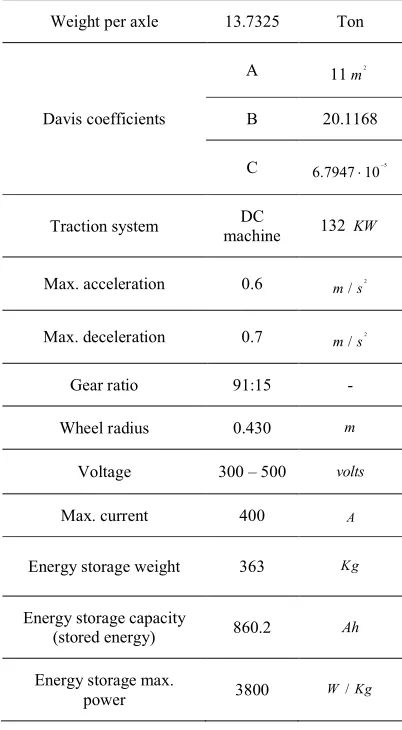
There are lots of researches and articles about modeling and simulation of small and heavy cars but not much reliable and precise models for electric hybrid train [10]. In this paper, the modeling and simulation of Tehran metro railcar equipped with a Maxwell ultra-capacitor module as energy storage is introduced. In the first step, a reliable and practical model of a hybrid train that can be used for next researches is established. In the next step, the effect of using ultra-capacitor inside train to recover the energy is studied. Table 1 presents the characteristics of the simulated system.

2. Model Based Design of Electric Train System

There are many software and toolboxes for modeling and simulation of conventional vehicles, such as Autonomie, SimDriveline, SIMPLEV, V-Elph, Saber, Simulink and Advisor [7, 12, 13, 14]. But, none of them can be used to model the hybrid electrical train [10].

Table 1. Characteristics of the simulated system

Weight per axle 13.7325 Ton

Davis coefficients

A 11 2

m

B 20.1168

C 5

6.7947 10 

Traction system DC

machine 132 KW

Max. acceleration 0.6 2

/

m s

Max. deceleration 0.7 2

/

m s

Gear ratio 91:15 -

Wheel radius 0.430 m

Voltage 300 – 500 volts

Max. current 400 A

Energy storage weight 363 Kg

Energy storage capacity

(stored energy) 860.2 Ah

Energy storage max.

power 3800 W/Kg

Here, a model based design to model a hybrid electrical train is presented. It is regarding the Advisor approach, due to its simplicity and reliability [7, 15, 16]. The concept of the approach is shown in Figure 1. In most basic form, “model based system design” is a method which uses the models of components to describe the specifications, operations and performance of the corresponding system [17]. Instead of listing specification in a text document, a model is used that implements the specifications, operation, and performance of components [17]. It is worth noting that, in this paper, simulation of the hybrid train is performed in MATLAB/Simulink environment

(3)

International Journal of Railway Research (IJRARE) 39 based on the ideas which were introduced in

Advisor. It is clear that Advisor has so many details that don’t need to be included in this simulation. As it is shown in Figure 2, and regarding the backward/ forward approach introduced in Advisor, arrows from left to right correspond to the related backward facing that illustrate forward facing connection.

2.1.Drive Cycle Modeling

The first block of the system in Figure 1, is drive cycle. It represents the desired velocity; grade and curve profiles of route at each time of the cycle. Obviously, it can be modeled by a matrix that its first column is time and the second column is the corresponding desired velocity at related time. By integration of velocity, distance is obtained. So, by using the grade and curve profiles of the route, the grade versus distance and curve versus distance lookup tables as can be provided as is shown in Figure 3.

2.2.Modeling the Longitudinal Dynamics

The main relation that governs the longitudinal dynamic of any vehicle is the Newton’s second law of motion in Equation (1):

F

m a

(1)

Wheremis total mass of the vehicle in kilograms, a is its acceleration in meter per second squared and F is required tractive force to accelerate the train in Newton. In addition to main pulling or pushing force of the train, there are three resistive forces that influence the motion of the vehicle.

Figure 3.Drive cycle block diagram

A set of resistance forces can be modeled by using the Davis formula [18]:

2

(5.78266 128.997 )

( )

D

R M n n

B M n v C A v

   

     

(2)

Where,A,B, and C are the coefficients that depend on the type of the trains. The values of these coefficients that are used in this research are illustrated in Table 1. A schematic for the grade forces on a train is presented in Figure 4.

Figure 1. Backward/ Forward approach flowchart

Figure 2. Block diagram of complete system

(4)

40 International Journal of Railway Research (IJRARE) Also, in Equation (2) v is train velocity, and RD

is the total resistance of train in Newton [19]. Another part of the resistive forces is the grade resistance which can be described as in Equation (3):

88.964 g

R   n M G (3)

Where, Rgis grade resistance in Newton and G

is percentage of the grade. It is important to note that, Rg has a positive sign in downgrades and a

negative sign in upgrades due to the backward facing approach. The last part of the resistive forces is the curve resistance (Rc) from friction of wheel flanges against rails as a train goes around a curve. Railroad curve resistance is 3.5587 Newton per Ton of car per degree of curvature. In other word, a 100 ton car on a 2 degree curve has a resistive force equal to 711.7154 Newton. So, to compute the curve resistance the Degree of Curvature should be determined as follows [18, 20]:

1146 Degree of Curvature=

Curvature Radius [m]

(4)

So, the total required tractive force of a train can be calculated as follows:

T D g C

FFRRR (5)

Figure 4. Corresponding grade forces on train

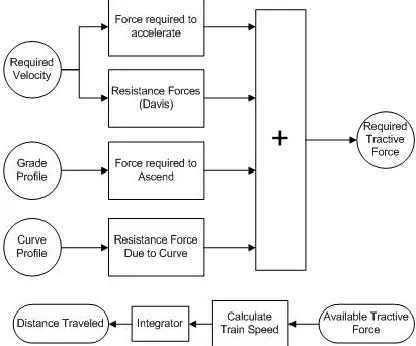
The details of the train dynamic block diagram are illustrated in Figure 5. The input of this block is the desired velocity and the output is the corresponding required traction force and speed of the train. In this block, the required traction force is computed based on the Equations (1)-(5).

In the bottom part of Figure 5, there is another input (Available Tractive Force) that is related to the available speed and traction force at the end of forward facing approach. Here, the available tractive force solves as a quadratic function to calculate the previous velocity, using the equations used in backward facing approach. It means that at the end of each time step, the velocity of the train is obtained and by this the difference between the desired and the available speed can be calculated. By integrating of the speed in the elapsed time the traveled distance can be calculated.

Figure 5. Train dynamics block diagram

2.3.Wheel Modeling

Another important part of the system modeling is the wheels dynamic. The wheels are modeled by using a simple model as mentioned in Figure and by using Equation (6).

T

JT r F (6)

where J and r denote the inertia and the radius of the wheel, respectively. Also, T describes the driving or braking torque and  is the angular velocity of the wheel. The steady state wheel forces and torques are generated as functions of the slip-augmented rotational speed. The longitudinal force FT can be described as a function of the longitudinal slip,sx. The longitudinal slip is defined as in Equation (7) and Figure 6 shows the relation between FT and sx [21]:

(5)

International Journal of Railway Research (IJRARE) 41 x

r

s v

v

 (7)

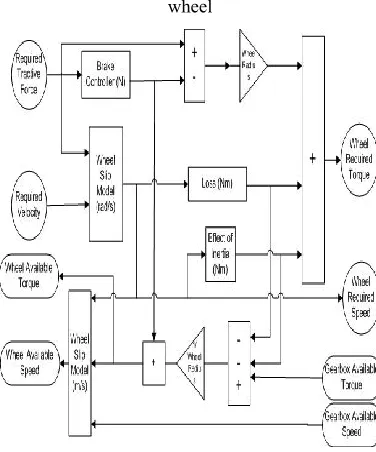
The slip is not directly calculated by using Equation (7). It is just assumed that the slip is controlled between the reasonable values and by dividing tractive force by the force on the wheel the coefficient of friction () will be obtained. Regarding Figure 7, the slip value will be gained and the angular velocity based on Equation (7) is calculated. In the wheel block of Figure 2, the force and the vehicle longitudinal velocity are the input. By using the weight on the wheel and a lookup table the loss of the wheel is attained. The effect of the inertia is calculated by using Equation (8). The wheel loss and the effect of the inertia are added to the required torque in backward facing approach. In forward facing they will be declined.

Effect of Inertia=( previous)

previous r

t t

 

 (8)

Figure 6. Simple chassis/wheel model

Figure 7. Longitudinal slip characteristics of train

The detail of the wheel model Block is shown in Figure 8. A brake controller interface is placed in the block to simulate the friction braking when the vehicle velocity is less than 10 Km/h. As mentioned in [10] in velocities less than 10 km/h, the motor rotational speed is not enough to generate the minimum charging power of the

ultra-capacitor, but based on Tehran metro documents the minimum speed that can be used for the dynamic braking is 30 km/h. In speeds below this value, the friction braking takes over for most of the braking.

wheel

Figure 8. Wheel model block diagram

2.4.Gearbox Modeling

The gearbox is modeled with a simple form. Generally it is described in the equation below:

B F

FB

F B

T G

T

   (9)

where GFB is gear ratio; and indices F and B

denote follower and base, respectively. Also, 

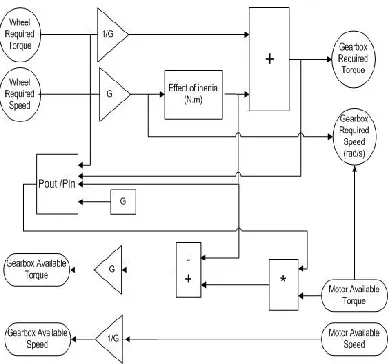
denotes rolling direction of gear and shaft. As mentioned before in each block the inertia and loss of the corresponding block is computed and added to results. The subsystem “Effect of Inertia” in Figure 9 is related to gearbox inertia. Here the loss of gearbox is ignored.

2.5.Traction Motor Modeling

As mentioned in many references like [22] and [23], in large and complex systems such as vehicles, employing the efficiency maps of the motor is an appropriate way to model the traction motor. Using the efficiency maps, motor is modeled as a black box that according to the applied required speed and torque as inputs

(6)

42 International Journal of Railway Research (IJRARE) serves a known output like amount of Kilowatts

that is needed to be supplied. The efficiency map of DC machine which is used in the simulations is shown in Figure 10.

Figure 9. Gearbox model block diagram

Figure 10. Efficiency map of a DC traction machine

Generally, the efficiency map is the torque/speed curve of a certain electric machine that is special for it. The torque/ speed curve is mapped by efficiency map of the machine in each point. Using this map, the power loss of the machine can be calculated and be added to the output power of the machine (PoutT), so the

required input power is easily calculable. The schematic diagram of the traction motor is shown in Figure 11.

2.6.Ultra-capacitor and Bus

2.6.1. Ultra-capacitor specifications and benefits

Heavy transportation vehicles place particular demands on energy storage devices.

They must be very robust and reliable, with a long lifetime and low maintenance requirements. They must be able to operate efficiently under harsh conditions, and they must be able to

Figure 11. Motor and controller model block diagram

deliver high peak currents. They must also be able to work on a high duty cycle and cope with frequent deep discharging. Finally, they must be straightforward to integrate into a vehicle design [3]. Maxwell Technologies has addressed these issues with its HTM BOOSTCAP ultra-capacitor module for ultra-capacitor-based braking energy recuperation and torque assist systems in transportation applications [3]. By operating at 125V, the new module can store more energy per unit volume, deliver more power per unit volume and weight and last longer than any other commercially available ultra-capacitor solution [3]. A key factor in the energy storage system is thermal management. With efficient cooling, higher continuous currents are possible without compromising reliability.

The dimensions and design of the 125V module were chosen for best efficiency and cooling behavior when operated at high currents, up to 150A continuous and 750A peak. This compares to a maximum continuous current of 90A with Maxwell’s 48V ultra-capacitor module, an increase up to 70%. This means that a much higher charge/discharge power can be delivered [3].

The module design ensures that there is only a 3°C temperature rise above ambient temperature at the maximum continuous current. The layout of the module results in a very stable temperature distribution over all cells in the module, which results in greater reliability and longer life [3].

The HTM module is designed to perform reliable work through one million or more charge/discharge cycles, which equates to

(7)

International Journal of Railway Research (IJRARE) 43 150,000 hours or more than 15 years of

operational life. It is undergoing extensive testing against rigorous transportation industry standards [3].

Proprietary material science and packaging technology are reducing manufacturing cost, so that the price of the modules competes favorably with other energy storage designs. The HTM module is sealed from the elements in a rugged, splash-proof, IP 65-compliant, aluminum chassis, and weighs less than 50kg [3].

As well as braking recuperation, energy storage can also be used to help meet peak power demands. Ultra-capacitors offer up to 10 times the power of batteries and in terms of acceleration of a vehicle, this plays an important role [3].

2.6.2. Ultra-capacitor modeling

With this background, in this section, the detail of ultra-capacitor modeling is described. The open-circuit voltage of the ultra-capacitor is given by:

uc oc

uc

q V

C

 (10)

where quc and Cuc are the ratio of charge and capacitance respectively. The charge dynamics of the ultra-capacitor are given by:

uc uc

dq i

dt   (11)

where iuc is the current being drown. Positive

and negative current correspond to discharging and charging, respectively. The state-of-charge is a normalized parameter representing the amount of charge remaining in the ultra-capacitor, defined as:

max

oc V SOC

V

 (12)

where Vmax is the maximum open-circuit voltage and SOC denotes state of charge. The effective voltage provided by the ultra-capacitor is:

0

0

out oc uc uc

dis uc

uc

chg uc

V V i R

R i

R

R i

 

 

  

(13)

chg

R and Rdis are the line resistances for

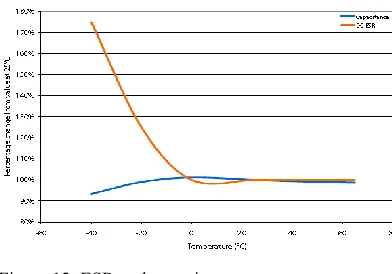
charging and discharging, respectively. The two resistances are assumed to be the same, as is typically the case in an ultra-capacitor [6]. In Figure 12, the ultra-capacitor resistance by ESR is presented.

Figure 12. ESR and capacitance versus temperature of an ultra-capacitor

The current drawn from the ultra-capacitor is determined from the power Puc demanded by

motor, using the simple relation:

uc uc

out

P i

V

(14)

This power is bounded by the line losses in the ultra-capacitor. The maximum charging and discharging power which capacitor can support are given as [4]:

2

max,

4 oc dis

uc V P

R

(15)

max max,

oc

chg oc

uc

V V

P V

R

 (16)

So, iuc can be computed by solving the Equations (12)-(17) as:

(8)

44 International Journal of Railway Research (IJRARE)

2

max ( max) 4

2

uc required

uc uc

SOC V SOC V R P

R i

    

 (17)

Based on the Maxwell information (Figure) there is not much deference in ESR and capacitance of ultra-capacitor in temperatures above 0°C, and based on the Tehran metro information, the temperature in tunnels do not fall behind this value. On the other hand, based on information discussed before, there is only a 3°C temperature rise above ambient temperature at the maximum continuous current. So, in case of simplicity the thermal dynamic of the ultra-capacitor can be ignored [24]. As illustrated in Figure, the required motor power is input of ultra-capacitor block and by the value of required power the corresponding available current of ultra-capacitor based on the available state of charge will be calculated as in Equation (17). After that the next state of charge (SOC) can be calculated and so on. This procedure will be continued until the SOC reaches its minimum or maximum value. Whenever the available power of ultra-capacitor is different with required power, the power should be provided by the supply network – here the third rail – or should be wasted by resistances. Equations (12) to (17) are used to model the ultra-capacitor as it is shown in Figure 13.

Figure 13. Ultra-capacitor model block diagram

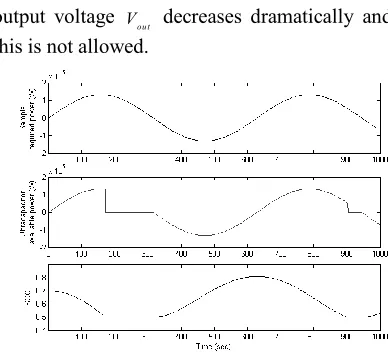
As a test of ultra-capacitor model, a sinusoidal waveform as required power is applied to the presented model of the ultra-capacitor. The results are shown in Figure 14. The top part of the figure shows the hypothetical input power; the middle part shows the available power of the ultra-capacitor regard to the required power. The final part shows state of charge of the ultra-capacitor that should be maintained between 1 and 0.5.

These waveforms show a valid simulation of the ultra-capacitor and SOC varies between 0.5 and 1 since the state of charge of the ultra-capacitor cannot fall below 0.5 because its

output voltage Vou t decreases dramatically and

this is not allowed.

Figure 14. Ultracapacitor test waveforms

The amount of the capacitance that needs to be used in train can be calculated by Maxwell data. By considering the characteristics of the system, a power of about 150kW [24] is needed. So, there can be six modules including two series of three paralleled modules or another arrangement by six series modules. The simulations in both cases are executed. The simulation results show that the six series modules can deliver more power than the first arrangement. Because the ultra-capacitor power potential increases with the square of voltage, and only linearly decreases with resistance. This means that to increase the pack’s discharge power capability, it is much better to string more cells together in series to give a higher operating voltage than to simply add strings in parallel.

2.6.3. Powerbus Modeling

Power-bus represents a simple control algorithm to choose a power source between the third rail and the ultra-capacitor. Simply by four simple if-then commands as in Equation (18) the bus can be modeled, Figure 15.

required Net required

required Net

required Net

required Net

if SOC < 0.5 & P > 0 P =P

if SOC < 0.5 & P < 0 P =0

if SOC > 0.5 & P > 0 P =0

if SOC > 0.5 & P < 0 P =0

      

(18)

This says that when the state of charge is less than 0.5 and the required power (Prequired) is positive the required power should be supplied by the network (PNet) and when the required power is negative there is no need to the network

(9)

International Journal of Railway Research (IJRARE) 45 since the power is used to recharge the

ultra-capacitor and if it reaches its maximum charge the power is wasted by resistances. In a same way if state of charge is bigger than 0.5 there is no need to the network since if the required power is positive the ultra-capacitor supplies it and when it is negative again it charges the ultra-capacitor.

Figure 15. Bus and power control

3.Simulation Results

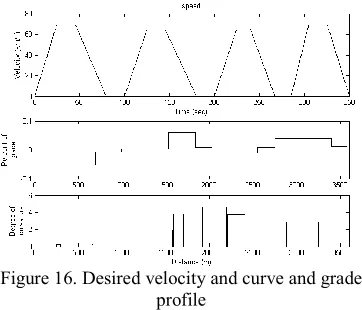
Simulation executed under a 5-station drive cycle and grade and curve profiles of line 2 in Tehran metro, as presented in Figure 16. It is considered that the maximum speed of the corresponding track is up to 70 Km/h.

Figure 16. Desired velocity and curve and grade profile

The power characteristics are shown in Figure 17. The solid line shows the whole power that the train requires and the dashed line is the amount of the power that the ultra-capacitor covered. In negative parts of power the ultra-capacitor recharges and in the positive parts it supplies power till SOC reaches its minimum limit. Also, the ultra-capacitor characteristic is shown in Figure 18. As it is shown in Figures 17&18, with consideration of the initial SOC equal to 0.7, the ultra-capacitor can deliver more than 35% of energy required and absorbs most of

braking energy. As another test, the initial SOC is 0.8, but the route profile is similar to the previous test. The results are shown in Figure 19. Obviously here, the ultra-capacitor can deliver more power. This time the percentage power delivered by the ultra-capacitor is up to 42% and it represents a very good capability of the system.

Figure 17. Power characteristic of system

(Solid line: whole required power; Dashed line: Ultra-capacitor covered power)

Figure 18. Ultracapacitor characteristics

Figure 19. Characteristics of the second test with the initial SOC = 0.8

(10)

46 International Journal of Railway Research (IJRARE)

4.Conclusions

A simple and precise model of a hybrid electric train that is equipped with Maxwell 125V heavy transportation modules is modeled and simulated. The simulation results show that using the ultra-capacitors in heavy transportation like trains have benefits as in reducing the energy consumption and to prevent lack of voltage in case of voltage drops in peak hours. Using the ultra-capacitors also prevents the delay and standing still. Although it seems it that the costs are too much to equip a train with the ultra-capacitor modules but if it is considered, up to 40 percent of reducing energy for fifteen years for a large system like the undergrounds is possible.

List of symbols

A cross sectional area

of vehicle

2

m

a Acceleration 2

/

m s

B Coefficient of

Moving Friction -

C Air Resistant

Coefficient -

uc

C Ultra-capacitor

Capacity F

F Force N

T

F Tractive Force N

G Percentage of Grade %

FB

G Gear Ratio -

uc

i Ultra-capacitor

Current A

J Wheel Inertia 2

Kg m

m Weight per Axle Kg

n Number of Axles -

uc

P Ultra-capacitor

Power Watt

uc

q Ultra-capacitor ratio

of charge coulombs

r Wheel Radius m

C

R Curve Resistance N

D

R Resistance Forces N

g

R Grade Resistance N

uc

R Ultra-capacitor

Resistance 

x

S Longitudinal Slip -

S OC State of Charge -

T Torque N m

oc

V Ultra-capacitor Open

Circuit Voltage volt

max

V Ultra-capacitor

Maximum Voltage

volt

min

V Ultra-capacitor

Minimum Voltage volt

Greek symbols

v Linear Speed m s/

 Angular Velocity rad s/

References

[1] S. Matsumoto, Advancement of hybrid vehicle technology, European Conference on Power Electronics and Applications, (Sept. 2005), Dresden, Germany.

[2] E. LO, Review on the Configurations of Hybrid Electric Vehicles, 3rd International Conference on Power Electronics Systems and Applications, (May 2009).

[3] A. Schneuwly, Energy storage for hybrid power in heavy, White paper,

http://www.maxwell.com.

[4] S.A. Schepmann, Ultracapacitor heavy hybrid vehicle: model predictive control using future information to improve fuel consumption, Master of Science Mechanical Engineering thesis, Clemson University, 2010.

[5] Adrian Schneuwly, Rail Power, White paper,

http://www.maxwell.com.

(11)

International Journal of Railway Research (IJRARE) 47 [6] D. Rotenberg, Ultracapacitor assisted power

trains: Modeling, control, and sizing the impact on fuel economy, Master of Science Mechanical Engineering thesis, Clemson University, 2008.

[7] D.W. Gao, C. Mi, A. Emadi, Modeling and simulation of electric and hybrid vehicles, Proceedings of the IEEE, Vol. 95, No. 4, (April 2007), pp.729-745.

[8] A. Khaligh, Z. Li, Battery, Ultracapacitor, fuel cell, and hybrid energy storage systems for electric, hybrid electric, fuel cell, and plug-in hybrid electric vehicles: State of the Art, IEEE Transactions on Control Systems Technology, Vol. 59, No. 6, (2010), pp.2806-2814.

[9] J. Liu, H. Pen, Modeling and control of a power-split hybrid vehicle, IEEE Transactions on Control Systems Technology, Vol. 16, No. 6, (2008), pp.1242-1251.

[10] D. Hong, H. Lee, J. Kwak, Development of a mathematical model of a train in the energy point of view, International Conference on Control, Automation and Systems (2007), pp.350-355.

[11] MITRAC Datasheet,

http://www.bombardier.com.

[12] S. Zoroofi, Modeling and simulation of vehicular power systems, Master’s thesis in Power Engineering, Department of Energy and Environment Division of Electric Power Engineering Chalmers University of Technology, Goteborg, Sweden, (2008).

[13] A. Hipp, Track and signal plan, Tehran Metro Line 2, E2 To X2, Tehran Metro Archive, Released 2005.

[14] Z. Rahman, K. Bulter, M. Ehsani, Designing parallel hybrid -electric vehicle using V-ELPH, Proceedings of American Control Conference, (1999), pp.2693-2697.

[15] K.B. Wipke, M.R. Cuddy, and Steven D. Burch, ADVISOR 2.1: A user-friendly advanced powertrain simulation using a combined backward/forward approach, IEEE Transactions on Vehicular Technology, Vol. 48, No. 6, (1999), pp.1751-1761.

[16] T. Markel, A. Brooker, T. Hendricks, V. Johnson, K. Kelly, B. Kramer, M. O’Keefe, S. Sprik, K. Wipke, ADVISOR: a systems analysis tool for advanced vehicle modeling, Journal of Power Sources 110, (2002), pp.255-266.

[17] R. Von Hanxleden, Model-based design and distributed real-time systems, Christian-Albrechts Universit¨at Kiel, (2006).

[18] A.J. Horowitz, The vehicle – propulsion and resistance, Internal university paper, University of Wisconsin – Milwaukee, (2000).

[19] S. Iwnicki, Handbook of Railway Vehicle Dynamics, CRC Press Taylor & Francis Group, (2006).

[20] J.B. Calvert, Degree of curvature, Railways: History, Signaling, Engineering, (2004).

[21] G. Rill1, Wheel dynamics, Proceedings of the XII International Symposium on Dynamic Problems of Mechanics, ABCM, Ilhabela, SP, Brazil, (2007).

[22] S.M. Lukic and A. Emadi, Modeling of electric machines for automotive applications using efficiency maps, Illinois Institute of Technology, Proceedings of the IEEE, (2003).

[23] S. Williamson, A. Emadi, K. Rajashekara, Comprehensive efficiency modeling of electric traction motor drives for hybrid electric vehicle propulsion applications, IEEE Transactions on Vehicular Technology, Vol. 56, No. 4, (2007), pp.1561-1572.

[24] Datasheet 125V Heavy transportation modules, http://www.maxwell.com

Figure

Table 1. Characteristics of the simulated system
Figure 2. Block diagram of complete system
Figure 5. Train dynamics block diagram
Figure 8. Wheel model block diagram
+5

References

Related documents

Numbers of leaf canopy, stem diameter, plant height, main root length, numbers of primary lateral roots, root weight, shoot weight and root- shoot ratio of

Additionally, the application of AgNPs from both plants showed a significant increase of optimum quantum yield (Fv/Fm), stomata conductance ( g s ), and the number of lateral roots

Experiments were designed with different ecological conditions like prey density, volume of water, container shape, presence of vegetation, predator density and time of

To the finest of our information, this is the first report of the use of PEG-400 and DMAP, DIPEA catalyst for the protection of secondary amine of pyrazole nucleus using Boc..

Graph-24 Location of the chosen variables (Z-score for Mock vs. HSV1 and Adeno) 35.. Graph-25 Location of the chosen variables (Z-score for

This study help chemistry students understand how to construct a homogenous system of linear equations whose solution provides suitable value to balance a

Transcription of dSREBP target genes in dscap mutant larvae is reduced compared to wild type.. It is greater than in mutants lacking dSREBP and remains responsive to dietary lipids

In the environmentally limited regime, in contrast, the average mutational step size is no longer small relative to the distance to the (moving) optimum, and the distribution