Evaluation of organizational commitment among nurses in intensive care units
Abstract
Background and Purpose: Organizational commitment has been on a downward trend among medical staff in different sections of the health care system. This study aimed to investigate the level of organizational commitment among the nurses engaged in the intensive care units (ICUs) of Mazandaran Heart Center in Sari, Iran.
Methods: This descriptive-analytical study was conducted at the educational hospital of Mazandaran University of Medical Sciences,
affiliated to Mazandaran Heart Centre. Data were collected using Allen and Meyer's organizational commitment questionnaire, which was completed by 90 nurses selected by census sampling from different ICUs. Data analysis was performed using SPSS V.21.
Results: In this study, 17 participants (18.9%) were male, and 73 (81.1%) were female, with the mean age of 7.25±34.4 years. Among
the variables associated with organizational commitment, including age, work experience and working hours, only age and work
experience had significant correlations with the rate of commitment (P=0.001).
Conclusion: According to the results of this study, medical supervisors and managers need to provide nurses with adequate facilities
in order to encourage commitment and motivation among these health professionals.
Keywords: Organizational commitment, Nurse, Intensive care unit
Saeed Jafari1, Tahereh Afshin1, Kaveh Jafari2,*, Maryam Barzegar1
(Received: 7 Apr 2015; Accepted: 9 Aug 2015)
1 Mazandaran Heart Centre, Sari, Iran
2,* Corresponding author: Mazandaran Heart Centre, Sari, Iran. Email: [email protected]
Original article
Introduction
Organizational commitment is defined as the
sense of honor to be associated with an organization, performing job duties correctly and working for
long hours, while finding this process worthwhile (1). Organizational collaboration involves the individual’s commitment to the identification
and acceptance of the goals and values of that organization, as well as the desire to cooperate with the organization in order to achieve the goals and
keep a certain position (2). This type of commitment reflects the attitude and values of individuals, acting
as an incentive allowing them to stay in their position
and focus on the achievement of professional goals and expectations (3).
According to the literature, comparing to
Nurses who working under no obligation , engaged employers have better experience in
long commitments. Vigorous obligation is the
direct result of work experience. Furthermore, highly experienced employers tend to have more
competence, self-confidence and positive attitude towards their organization (4, 5). In this issue,
Turnover intentions are associated with negative feelings, and this is considered as the main
reason behind the importance of organizational commitment. Therefore, in a system attempting to control the rate of job turnover, it is necessary to recognize the factors leading to increased organizational commitment (6).
Abundance of commitment leads to organizational
citizenship behavior (OCB). Commitment could be
associated with a few aspect of OCB; for instance,
engaged employees tend to have more dedication
and conscientiousness. As such, individual
organizational socialization and psychological
contracts largely influence the prevalence of the normative. Psychological contracts signify the
perception of an individual towards the preexisting condition, as well as the mutual exchange between the individual and the associated organization. In this context, the individual becomes aware of what to present to the organization and what to expect in
return (7).
Among health care professionals, organizational
commitment focuses on the preservation, recursion and enrichment of human health (8). In this regard, factors such as intention for the turnover of young nurses, desire to perform non-medical functions or out-of-hospital activities, rate of early retirement among nurses and self-redeeming are known to decline the number of nursing staff in a health care establishment. Therefore, it could be concluded that with increased organizational commitment, it is possible to conserve agile health staff in a medical
organization (9, 10).
Studies conducted in other countries have indicated factors such as low workload, balanced occupational duties and raise of salary to be effective in increasing occupational satisfaction and organizational commitment, while reducing nurse burnouts. In such regard, provision of support and welfare for the nursing staff could remarkably enhance their function and disposition to confront tense conditions at work. Other contributing factors in the improvement of commitment among health care staff include high income, appropriate
retirement plans, adequate holidays and desirable amounts of rewards and job perks (11-14).
According to several studies, if nurses have
abundant commitment to their organizations, the
overall turnover rate is likely to decline in the medical
system (15-17). On the other hand, organizational commitment could be a significant predictor of the
turnover rate, while it cannot determine the rate of
job satisfaction (18).
Organizational commitment and legislation of new codes as to improve the salary in the medical staff play a pivotal role in the development of health
care. Regarding the lack of adequate studies focusing
on this issue among the employees of critical care units, this study aimed to investigate the rate of organizational commitment and its related factors among the nurses engaged at the intensive care units
(ICUs) of Mazandaran Heart Center in 2014.
Materials and Methods
This descriptive-analytical study was performed
on all the nurses (N=130) employed at the ICUs of Mazandaran Heart Center, Iran in 2014. Data were collected using Allen & Meyer’s standard model of organizational commitment. This questionnaire consists of 24 descriptive items, which are replied with the following phrases: Strongly agree, Agree, Do not know, Disagree and Strongly disagree. Score range is from 1 (strongly disagree) to 7 (strongly agree) (12).
Validity of the questionnaire was calculated
using the standard methods. Reliability of the
questionnaire was determined using Cronbach’s
alpha, as Gitter previously calculated the reliability
to be 0.81 (14). In Iran, the reliability of this questionnaire was determined by Nahrir at 0.94, using Cronbach’s alpha (12).
The study protocol was approved by the associated authorities at the ICUs of Mazandaran Heart Center.
Afterwards, subjects were selected by census
sampling, including the staff with associate degree, bachelor and master’s of sciences employed at the cardiac intensive care unit (CICU), coronary care unit (CCU), and angiography and dialysis sections of the hospital.
Inclusion criteria of the study were as follows:
1) overall clinical experience of more than 6 months; 2) clinical experience at ICUs for at least one month
and 3) current employment at ICUs. Subjects were
granted terms of confidentiality, and the results of
the study were provided in closed envelops in each
unit. In this study, scores of 3.5 and above were
indicative of notable organizational commitment in the participants.
We used the CHI 2 test in order to examine the
relationship between organizational commitment and the associated factors. To investigate the prevalence of organizational commitment among nurses, we used descriptive statistics (mean and standard deviation), and for the comparison of differences between the study groups, t-test was used. Moreover, t-test and logistic regression were used to evaluate the rate of organizational
commitment among the subjects. Data analysis was performed in SPSS V.21.
Results
Due to the lack of cooperation and refusal to complete the questionnaires, only 90 out of 130 nurses participated in this study, 17 of whom (18.9%) were male and 73 (81.1%) were female, within the age range of 23-54 years (mean age: 7.25±34.4 years). Only 5.6% of the subjects had a master’s degree, 12.2% had a history of management at the hospital or other wards, and 67.8% were married.
Moreover, 20% of the subjects were in their internship course, 7.8% had working contracts with the hospital, 35.6% were official staff and others had specific contracts. Also, 7.8% of the subjects were head nurses, and 90% were regular staff. Among the studied subjects, 34.4% were employed at the CCU, 46.7% were engaged at the ICU, 8.9% worked at
the dialysis unit, and 10% were engaged at the
angiography section of the hospital. In addition,
37.8% of the nurses were within the age range of 36-45 years, and 84.4% received a monthly salary of less than 1.5 million Toman.
In this study, 24.4% of the nurses had clinical experience of less than 5 years, and 35.6% had professional experience of 5-10 years; these two
groups accounted for the largest proportion of
our sample size. On the other hand, 25.6% of the subjects had clinical experience of 10-15 years, and 14.4% had over 15 years of work experience. Minimum age of the participants was 23 years, and the maximum age was 54 years. The highest income among the studied nurses was 2.5 million Toman
per month.
Among the investigated variables in this study,
including age, work experience and working hours,
only age and experience had significant correlations
with the rate of organizational commitment. Results
of Pearson’s correlation coefficient were non-parallel for age (r= -0.327, P=0.006) and work experience of the subjects (P=0.002), and a significant correlation
was observed between these two variables. This was due to the use of linear correlation analysis only for work experience.
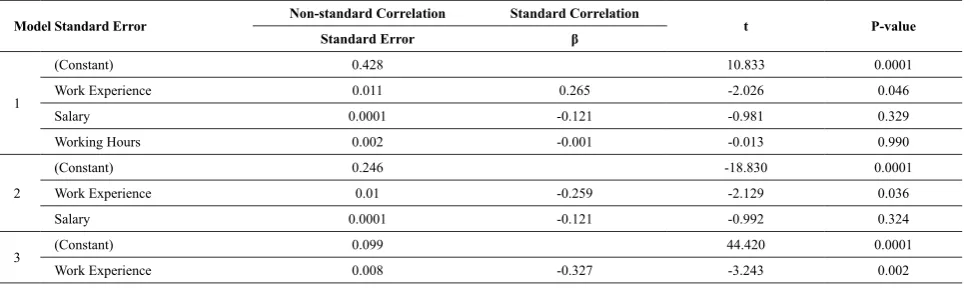
According to the results of logistic (Table 1)
with every one year of work experience, the rate
of organizational commitment reduced by 0.027 (out of 7), which is equivalent to 0.38% (β=-0.327, P=0.002). On the other hand, the correlation
between the employment status of the subjects was
not considered significant; however, changes in the employment status of official and non-official
Table 1. Correlations between Variables of Organizational Commitment
Model Standard Error Non-standard Correlation Standard Correlation t P-value
Standard Error β
1
(Constant) 0.428 10.833 0.0001
Work Experience 0.011 0.265 -2.026 0.046
Salary 0.0001 -0.121 -0.981 0.329
Working Hours 0.002 -0.001 -0.013 0.990
2
(Constant) 0.246 -18.830 0.0001
Work Experience 0.01 -0.259 -2.129 0.036
Salary 0.0001 -0.121 -0.992 0.324
3 (Constant) 0.099 44.420 0.0001
Work Experience 0.008 -0.327 -3.243 0.002
nurses were considered significant. Additionally,
the correlation between employment at corporate sectors and rate of organizational commitment was
significant, while the lowest rate of commitment
was observed among the staff of angiography
section (P=0.017).
In this study, a significant correlation was
observed between direction and the commitment of the nurses, and nurses who followed authority direction had higher organizational commitment
compared to others (P=0.003). Furthermore, a significant correlation was found between
management experience and nurse commitment, and rate of organizational commitment was higher
in the absence of managerial experience (P= 0.033). Finally, there was a significant correlation between
work shifts, and the rate of commitment was higher
in rotating work shifts among nurses (P≤0.0001).
Discussion
According to the results of this study, there is a significant correlation between organizational commitment and work experience; correspondingly,
highly experienced nurses were observed to have more commitment compared to other nurses. In the
present study, 94% of the subjects had a bachelor’s
degree and an average level of organizational
commitment to their job (20). On the other hand, 3% of the nurses had bachelor’s degrees with an average commitment rate of 2.42, which was lower than the total average of the present study (21-22).
According to our findings, nurses with master’s
degree had lower organizational commitment, while previous studies have not reported any correlations between these two variables. This could be due to the lack of proportionality between the salary and
the education level of nurses (23). In one study, Yaghubi et al. (2008) reported no significant
correlation between the level of education and rate of organizational commitment among nurses. maybe this is due to a lack of suitable job and had
been placed in the right (20).
In the current study, no correlations were observed between gender and rate of organizational
commitment, while in another study, Abili et al.
reported a significant relationship between gender and organizational commitment among nurses (24).
In general, the average rate of commitment and its relation to gender has been reported to be below
standard between male and female nurses (22). In the present study, a significant correlation was
observed between organizational commitment and the assigned units of the nurses. Similarly, the results obtained by another study conducted in Jordan
were indicative a significant relationship between
organizational commitment and job satisfaction
among nurses (25).
According to the findings of the present study, there was a significant relationship between age and organizational commitment. As such, nurses over 40 years of age were found to have higher
commitment compared to others. In general,
there was no significant relationship (22). It has a significant relationship between age and organizational commitment (23). Furthermore,
factors such as employment status, responsibility and experience contributed to the improvement
of organizational commitment (26). In the
present study, younger nurses were observed to have remarkable commitment as an incentive for making progress in their career. In contrast to our study, Yaghubi et al. did not elaborate on the relationship between age and organizational
commitment (20).
In the current study, no significant correlations
were found between organizational commitment and factors such as age, gender, education level and
work experience of the subjects (27). Regarding the
rate of organizational commitment, turnover intents
accounted for the lowest score (20.3). According to our findings, organizational commitment and nurse
burnout are among the major contributing factors for turnover intention, and the factors associated with job satisfaction could multiply the impact of
turnover intent among nurses (29).
Job satisfaction and organizational commitment
are considered as the significant determinants of turnover rates among nurses. As such, we observed a significant correlation between the rate of
organizational commitment and turnover intents. Therefore, turnover intentions should be taken
into account in young nurses with low job security,
and medical organizations are required to provide
proper facilities as to motivate and increase the commitment of these professionals to the health
care organization (14).
Organizational commitment is a legal obligation,
and evidence suggests that significant commitment
to job performance and legal obligation of nurses are the most important factors in increasing commitment
(25). Highest rates of organizational commitment
have been reported among nurses with work
experience of 6-10 years, which is mainly due to the
consolidated position of these individuals, as well as the prospect for occupying managerial positions in the future. Furthermore, nurses with work experience
of more than 15 years tend to demonstrate higher commitment to their job (22-30-31).
Conclusion
In conclusion, employment of individuals with
high qualifications in the right positions could
remarkably enhance organizational commitment among different medical staff. Therefore, supervisors and managers need to create facilities and encourage the medical staff in various aspects to increase their commitment and motivation. The
findings of the current study could be applied to
other issues, such as motivation and negligence among nurses, in the evaluation of organizational commitment.
Conflicts of interest
The authors declare that they had no competing interests.
Author’s contributions
Kaveh Jafari and Tahereh Afshin have
contributed to the designing, writing, revising
and approving the final manuscript. Saeed jafari
have performed data collection. Saeed jafari was involved in the study conception, design and material support. Maryam Barzegar was involved in the critical revisions for important intellectual content and review of content.
Acknowledgments
Hereby, we extend our gratitude to all the nurses for their participation in this study. We would also like to thank the authorities and staff of Mazandaran Heart Center and its specialized and sub-specialized clinics for assisting us in this research project.
References
1. Delgoshaei B, Tofighi Sh, Kermani B. The relationship
between organizational climate and organizational commitment in teaching hospitals of Hamedan University
of medical sciences. Horizon Med Sci 2009; 14(4):60-8.
2. Steers RM. Introduction to Organizational Behavior. 3rd
ed. Glenview: Scott, Foresman; 1981.
3. Meyer JP, Herscovitch L. Commitment in the workplace:
toward a general model. Human Resource Manag Rev
2001; 11(3):299-326.
4. Kline CJ, Peters LH. Behavioral commitment and tenure of new employees: A replication and extension. Acad Manag J 1991; 34(1):194-204.
5. Van Dyne L, Graham JW, Dienesch RM. Organizational citizenship behavior: Construct redefinition, measurement, and validation Acad Manag J 1994; 37(4):765-802.
6. Wong C-S, Wong Y-T, Hui Ch, Law KS. The significant
role of Chinese employees’ organizational commitment: Implications for managing employees in Chinese societies.
J World Bus 2001; 36(3):326-40.
7. Coyle-Shapiro JAM, Shore LM. The employee–
organization relationship: Where do we go from here?
Human Resource Manag Rev 2007; 17(2):166-79.
8. Han SS, Moon SJ, Yun EK. Empowerment, job satisfaction, and organizational commitment: comparison of permanent
and temporary nurses in Korea. Appl Nurs Res 2009; 22(4):e15-20.
9. Chang PL, Chou YC, Cheng FC. Career needs, career
development programmes, organizational commitment and
turnover intention of nurses in Taiwan. J Nurs Manag 2007; 15(8):801-10.
10. Gryfe CI, Amies A, Ashley MJ. A longitudinal study of falls in an elderly population: I. Incidence and morbidity. Age Ageing 1977; 6(4):201-10.
11. Mcelroy JC. Managing workplace commitment by putting
people first. Human Resource Manag Rev 2001; 11(3):327-35. 12. Nehrir B, Ebadi A, Tofighi Sh, Karimi Zarchi AA, Honarvar
H. Relationship of job satisfaction and organizational
commitment in hospital nurses. J Mil Med 2010; 12(1):23-6.
13. Mohammadian Y, Eskandari M, Mahdavi M, Hosseini
nejad A. Assessment of job satisfaction and organizational
commitment conditions in one of the military universities
staff’s. Iran J Military Psychol (JMP) 2010; 1(2):25-40. 14. De Gieter S, Hofmans J, Pepermans R. Revisiting the
impact of job satisfaction and organizational commitment on nurse turnover intention: an individual differences
analysis. Int J Nurs Stud 2011; 48(12):1562-9.
15. Beecroft PC, Dorey F, Wenten M. Turnover intention in new graduate nurses: a multivariate analysis. J Adv Nurs 2008; 62(1):41-52.
16. Simon M, Müller BH, Hasselhorn HM. Leaving the organization or the profession–a multilevel analysis of nurses’ intentions. J Adv Nurs 2010; 66(3):616-26. 17. Tourangeau AE, Cranley LA. Nurse intention to remain
employed: understanding and strengthening determinants.
J Adv Nurs 2006; 55(4):497-509.
18. Ingersoll GL, Olsan T, Drew-Cates J, DeVinney BC, Davies
J. Nurses’ job satisfaction, organizational commitment, and
career intent. J Nurs Adm 2002; 32(5):250-63.
19. Han J, Woo H, Ju E, Lim S, Han S. Effects of nurses' social
capital on turnover intention: focused on the mediating effects organizational commitment and organizational
cynicism. J Korean Acad Nurs 2013; 43(4):517-25 (Korean).
20. Yaghoubi M, Yarmohammadian MH, Javadi M.
Organizational commitment and job stress at Isfahan university of Medical Sciences teaching hospitals managers.
Iran J Health Admin 2008; 11(3):63-8.
21. Yang J, Liu Y, Chen Y, Pan X. The effect of structural
empowerment and organizational commitment on Chinese
nurses' job satisfaction. Appl Nurs Res 2014; 27(3):186-91. 22. Bakhshi Sourshejani L. Mental health and organizational
commitment of teachers, nurses and staff. New Findings in
Psychology J 2009:23-33.
23. Rahmanzade E, Parsa Yekta Z, Farahani M, Yekani
Nejad S. Nurses’ organizational commitment in hospitals
affiliated to Tehran University of Medical Sciences. IJN 2014; 26(86):29-38.
24. Abili KH, Nastezaie N. Surveying the relationship
between psychological empowerment and organizational
commitment in nursing staff. Tolooe Behdasht J 2009; 1-2(8):26-38.
25. Saleh AM, Darawad MW, Al-Hussami M. Organizational
commitment and work satisfaction among Jordanian
nurses: A comparative study. Life Sci J 2014; 11(2):31-6. 26. Lee SP, Chitpakdee B, Chontawan R. Factors predicting
organizational commitment among nurses in state hospitals,
Malaysia. Inter Med J Malaysia 2011; 10(2).
27. Kafashpour A, Mortazavi S, Pour S. Impact of psychological
contracts on organizational trust and commitment of nurses in Ghaem hospital - Mashhad province. Iran Hospital J
2012; 11(4):65-74.
28. Tsai Y. Learning organizations, internal marketing, and
organizational commitment in hospitals. BMC Health Serv
Res 2014; 14:152.
29. Moon SJ, Han SS. A predictive model on turnover intention of nurses in Korea. J Korean Acad Nurs 2011; 41(5):633-41(Korean).
30. Riaz Khan M, Ziauddin JF, Ahmed Jam F. The impacts of
organizational commitment on employee job performance.
Euro J Social Sci 2010; 15(3):292-8.
31. Abbas Zadeh A, Borhani F, Seyed Gheybi FS, Shokoohi M. Nurses' organizational commitment in hospitals affiliated to Shiraz University of Medical Sciences. Med Ethic J 2013; 7(23):33-46.