A Data-Driven Decision-Making Model for the Third-Party
Logistics (3PL) Industry
Faith Moyo1, Brenda Scholtz1, Mohammed Alhassan1
1 Nelson Mandela University, Port Elizabeth 6001, South Africa
[email protected], [email protected], [email protected]
Abstract. The evolution of the supply chain has resulted in a growth in the usage of technology and data generated and distributed within the industry. Third-party logistics (3PL) companies operating within the supply chain industry are not maximising the capabilities of data to make well-informed decisions. The purpose of this paper is to address this gap and to develop a prescriptive, theoretical model for data-driven decision-making (DDDM). To address the gap, a literature review of DDDM in 3PL industry and in other contexts was conducted. The proposed model is built based on the consideration of existing DDDM models and frameworks; data and data analytics principles to collect, store, manage and analyse data; and the Cynefin framework. Existing models and frameworks for DDDM do not provide explicit guidelines on how to apply DDDM in a 3PL and supply chain context. The proposed DDDM model constitutes of three phases, namely: (1) the setup phase, that considers data knowledge and decision-making knowledge; (2) execution phase; and (3) the learning phase. The application of the model in 3PL companies can support the decision-making process in these companies, with a consideration of the challenges and opportunities that exist in the supply chain. The decision-makers in 3PLs can thus make better-informed decisions that positively impact their enterprises and the supply chain.
Keywords: Supply Chain Industry, Third-Party Logistics, Data-Driven Decision-Making, Prescriptive Model, Cynefin Framework, Data Analytics.
1
Introduction
operate and manage their respective enterprises [4], and to extract actionable insights that could assist 3PLs and other supply chain players with making well-informed decisions [5]. These insights cannot be extracted solely from the use of technology to analyse the data; the processes of decision-making must be considered as well as the knowledge of the decision-makers [6].
Modern theories of the value of information begin with the seminal work of Blackwell [7]. Blackwell’s theorem states that decision-makers observe signals correlated to the state of their environments prior to their choice of action and hence “update” the probability distribution before the “optimal” action is chosen. Therefore, instead of relying on their instincts, enterprise leaders gather relevant data sets and perform various data analysis activities to make sound decisions that are based on scientific signals and observations [8]. Data provides insights on how to answer key enterprise questions [9]. In making decisions with uncertainty, enterprises should be able to classify the data collected to build a suitable model for mitigating the risk of misinterpreting the data [10]. The collected data must be in accordance with the objectives to be achieved by the enterprise, therefore increasing the reliance that can be placed on the data analytics models derived [11]. The act of basing decisions on the analysis of data rather than purely on intuition is referred to as Data-Driven Decision-Making (DDDM) [12].
The research objectives of this study are: (1) to determine existing frameworks and models for DDDM; and (2) to determine the requirements of decision-making for the 3PL and supply chain domain and the suitability of existing models/frameworks. The purpose of this paper is to develop a model for DDDM to be used by decision-makers in 3PLs and the supply chain industry. The model will contribute towards maximising the usage of data to make better informed decisions on how to manage and transform 3PL and supply chain enterprises. The sections contained in this paper are: Sections 1 and 2 provide the background and problem description. Section 3 explains the research method that was used in the study. In Section 4, the literature review findings and model development are explained. The last section of this paper presents the conclusions of the study.
2
Background to Data Driven Decisions in 3PLs and Supply Chain Industry
Fig. 1. Flow of Data between 3PLs and the rest of the Supply Chain (Adapted from [17])
The latest generation of ISs provides a high level of supply chain process integration through internet-based applications, thus serving as an additional source of integrated data that can be used for analysis [18]. An increase in the supply chain complexity has elevated the degree of uncertainty and risks that supply chain and 3PLs are faced with [19]. The rapid changes experienced by companies in this industry require a rapid analysis of the available data to make sound and rapid decisions [15,16]. For enterprises in the supply chain to benefit from DDDM, it is important for the decision-makers to understand the relationship of data and related data concepts like data quality and data sources and to understand the principles of discovering insights from the data collected [12]. DDDM in a 3PL refers to decision-makers systematically collecting and analysing data to guide a range of decisions that enable and improve the success of providing the outsourced services to their clients [9]. 3PLs using DDDM can therefore differentiate themselves within the supply chain industry and they are twice as likely to be top performers than lower performers [3]. However, in the 3PL and supply chain domain DDDM is rarely evident and DDDM models and frameworks specific to this domain are limited and do not consider all the stages of the DDDM process or process integration of 3PLs [18].
3
Research Method
4
Review Findings
From the review of the literature seven DDDM models/frameworks were identified. The Cynefin Framework (Fig. 2) aids with decision-making [23] and categorises problems into four categories, namely ordered (either simple or complicated), complex and chaotic [24]. There is also a fifth type called ‘disorder’ which represents the situation when you don’t know which of the other four applies to your situation. The Cynefin framework can help decision-makers in identifying the context of the problems they are required to solve so that they can not only make better decisions but also avoid the problems that arise when their preferred decision-making processes results in actions without the desired outcomes.
Fig. 2. Cynefin Framework [24]
Fig. 3. Framework for Simple vs Complex DDDM. Adapted from [25]
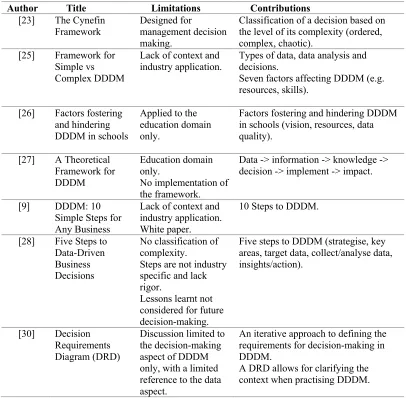
In addition to the framework [25] identified seven factors that affect the success of DDDM, namely: resource capacity and expertise; analytical skills and support; accessibility and timeliness of data; perceived validity of the data; timeframe for the actions from the decisions made; partnerships with external enterprises; tools; and enterprise culture and leadership. Further work by [26] identified the factors promoting and hindering DDDM in an educational context and proposed that data use is influenced by three types of characteristics: organisation, data and user (Fig. 4). The organisational characteristics relate to enhancing data use by having a shared vision, leadership, support and collaboration. Data factors relate to accessibility, usability and quality of data. The user characteristics relate to knowledge and skills in the enterprise for data analysis and dispositions of the user to use the data. A structured method for analysis and interpretation of data on which to draw insights and base actions should also be adopted. The conclusions drawn in the study by [26], although conducted in an educational context, can be applied in a business context.
Fig. 4. Factors promoting or hindering DDDM [26]
Fig. 5. A Theoretical Framework for Data-Driven Decision Making [27]
Both [9] and [28] argue that data lies at the core of an enterprise’s decision-making and propose steps to be followed for DDDM. Whilst [9] proposes 10 steps, [28] provides a more summarised version in five steps (Fig. 6). The first of the five steps is for decision makers to formulate the enterprise’s strategy and to map the direction on how data will be used to derive insights for better-informed decisions [28]. The second step is to identify key areas that are crucial in achieving the overall business strategy. These areas will serve as the domain focus and in the third step the target data sets should be identified, from which insights can be retrieved to solve the identified issues. The fourth step is to collect and analyse the data, from which actionable insights will be derived, thus achieving DDDM. The limitations to Roth’s [28] five steps to DDDM are that the steps are expressed in broad terms and assumed to be applicable to any enterprise across all industries. Thus, the steps are not domain or industry specific. Furthermore, the five-step prescription does not highlight the importance of categorising the business decisions into categories as proposed by the Cynefin Framework [29].
Table 1. Limitations and Contributions of DDDM Models/Frameworks
Author Title Limitations Contributions
[23] The Cynefin
Framework Designed for management decision making.
Classification of a decision based on the level of its complexity (ordered, complex, chaotic).
[25] Framework for Simple vs Complex DDDM
Lack of context and
industry application. Types of data, data analysis and decisions. Seven factors affecting DDDM (e.g. resources, skills).
[26] Factors fostering and hindering DDDM in schools
Applied to the education domain only.
Factors fostering and hindering DDDM in schools (vision, resources, data quality).
[27] A Theoretical Framework for DDDM
Education domain only.
No implementation of the framework.
Data -> information -> knowledge -> decision -> implement -> impact.
[9] DDDM: 10
Simple Steps for Any Business
Lack of context and industry application. White paper.
10 Steps to DDDM.
[28] Five Steps to Data-Driven Business Decisions
No classification of complexity.
Steps are not industry specific and lack rigor.
Lessons learnt not considered for future decision-making.
Five steps to DDDM (strategise, key areas, target data, collect/analyse data, insights/action).
[30] Decision Requirements Diagram (DRD)
Discussion limited to the decision-making aspect of DDDM only, with a limited reference to the data aspect.
An iterative approach to defining the requirements for decision-making in DDDM.
A DRD allows for clarifying the context when practising DDDM.
5
Proposed DDDM Model for 3PLs
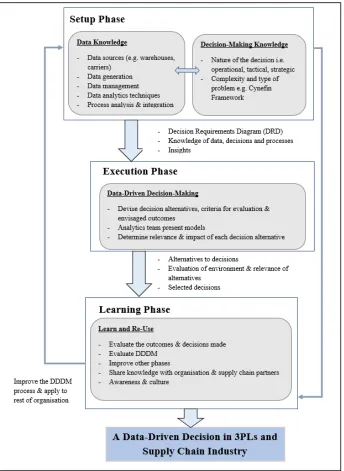
The proposed DDDM model for 3PLs is built based on the guidelines provided by the existing frameworks, guidelines and models for DDDM presented in Section 4 and the requirements for the 3PL and supply chain domain highlighted in Section 3. From the existing DDDM models and frameworks,
it can be argued that the DDDM process constitutes of three primary phases as shown in
Fig. 7: (1) a preparation or setup phase (2) an execution phase and (3) a learning phase.
team of decision-makers identifying the data from which the insights will be drawn from. The data from all possible 3PL sources as specified by [17]) (Fig. 1) should therefore be identified. Next the data should be collected and stored by the Business Intelligence or data analytics team. The management of the data should be enterprise-wide, integrate supply chain processes [18] and adhere to data quality and governance principles [12] such as ISO 25012:2008. Thereafter, the data should be rapidly processed, analysed and visualised to gain a general understanding and description of the data [15, 16]. There are various data analytics techniques that can be applied to build models from the data available in the supply chain [4]. The techniques include machine learning and data mining techniques (clustering, classification, regression and association rules), text analysis, social network analysis and sentiment analytics [31]. The data analytics techniques to be applied are chosen based on the objectives of the model and the type of data available. Subsequently, data sets for testing, training, and production purposes are developed and the model is built and executed [32,33]. Data knowledge incorporates the provisions of the first four steps in [28]’s five Steps to DDDM and the first eight Steps in [9]’s 10 Steps to DDDM.
Decision-makers in a 3PL consider their enterprises and the supply chain industry to identify and to understand the decision to be made and classify the decision into operational, tactical or strategic. Furthermore, the requirements of the decision are identified and in the case of DDDM, the data and the insights required to support the decision will form part of the requirements. There is therefore a two-way relationship between data knowledge and decision-making knowledge. To identify the decisions, their requirements and the complexity of the decisions, a framework such as the Cynefin framework should be considered. By using this framework, the decision is presented in a clear and unambiguous way and is classified into one of five categories. To facilitate the communication between the analytics team and the decision-makers in the 3PL, a Decision Requirements Diagram (DRD) is developed and communicated between these two divisions. The building of a DRD is performed by applying iteratively four steps proposed by [30] which are (1) identify decisions; (2) describe decisions; (3) specify decision requirements; and (4) decompose and refine the model. The four steps are iterated until the decisions are completely specified and the decision-makers have a clear sense of how the decision will be made. The input of the DRD is the data from which the insights will be derived; for example from carriers, warehouses and other sources in the supply chain as shown in Fig. 1. The outputs of the setup phase in DDDM are a DRD and knowledge and insights of the data used. Data knowledge is achieved from the discovery of relationships between the data and relevant insights from the data collected and analysed by the data analytics team [12].
Fig. 7. A Data-Driven Decision-Making Model for 3PLs
6
Discussion
• Assumptions and constraints on which the model depends on more comprehensive, rigorous and relevant to the 3PL and supply chain industry;
• The model incorporates the categories of problems and decisions based on those used in the Cynefin framework to encourage a level of deliberation in the cognitive processes involved in decision-making; and
• The DDDM model will be evaluated for effectiveness and the lessons learnt will be systematically fed back to the rest of the 3PL enterprise and industry.
The model will facilitate the communication between the decision-makers and the analytics team in the decision-making process, which can lead to more efficient and effective use of data analytics and thus benefit from the insights derived from data for decision-making. The documentation of the decision-making process in the format of a DRD will enable 3PLs to reuse knowledge for future decision-making, fostering learning from the decisions made.
7
Conclusions
References
[1] G. Büyüközkan and F. Göçer, “Digital Supply Chain: Literature review and a proposed framework for future research,” Comput. Ind., vol. 97, pp. 157–177, 2018.
[2] M. Long and J. Langley, “2018 22nd Annual Third-Party Logistics Study: The State of Logistics Outsourcing,” 2018.
[3] S. LaValle, M. . Hopkins, E. Lesser, R. Hockley, and N. Kruschwitz, “Analytics : the new path to value. MIT Sloan Management Review,” 2010.
[4] McKinsey & Company, “Big data and the supply chain: The big-supply-chain analytics landscape (Part 1),” 2016. [Online]. Available: https://www.mckinsey.com/business- functions/operations/our-insights/big-data-and-the-supply-chain-the-big-supply-chain-analytics-landscape-part-1. [Accessed: 26-Jun-2019].
[5] V. C. S. Chen, Hsinchun, Roger H. L. Chiang, “Special_Issue_Business_Intelligence_Rese,” Mis Q., vol. 36, no. 4, pp. 1165–1188, 2012.
[6] R. Sharma, S. Mithas, and A. Kankanhalli, “Transforming decision-making processes: a research agenda for understanding the impact of business analytics on organisations,” Eur. J. Inf. Syst., vol. 23, no. 4, pp. 433–441, 2014.
[7] D. Blackwell, “Equivalent Comparisons of Experiments,” Ann. Math. Stat., vol. 24, no. 2, pp. 265–272, 1953.
[8] Q. Long, “Knowle dge-Base d Systems Data-driven decision making for supply chain networks with agent-based computational experiment,” Knowledge-Based Syst., vol. 141, pp. 55–66, 2018.
[9] B. Marr, “Data-Driven Decision Making: 10 Simple Steps For Any Business,” Forbes, 2016. [Online]. Available: https://www.forbes.com/sites/bernardmarr/2016/06/14/data-driven-decision-making-10-simple-steps-for-any-business/#9a420955e1e5. [Accessed: 16-Apr-2019]. [10] L. Angria S, Y. Dwi Sari, M. Zarlis, and Tulus, “Data-driven Modelling for decision making
under uncertainty,” IOP Conf. Ser. Mater. Sci. Eng., vol. 300, no. 1, 2018.
[11] M. Ghasemaghaei, S. Ebrahimi, and K. Hassanein, “Data analytics competency for improving firm decision making performance,” J. Strateg. Inf. Syst., vol. 27, no. 1, pp. 101–113, 2018. [12] F. Provost and T. Fawcett, “Data Science and its Relationship to Big Data and Data-Driven
Decision Making,” Big Data, vol. 1, no. 1, pp. 51–59, 2013.
[13] A. E. Coronado Mondragon, C. S. Lalwani, E. S. Coronado Mondragon, and C. E. Coronado Mondragon, “Facilitating multimodal logistics and enabling information systems connectivity through wireless vehicular networks,” Int. J. Prod. Econ., vol. 122, no. 1, pp. 229–240, 2009. [14] A. Gunasekaran and S. C. Lenny Koh, “Interlocking of information systems for international
supply and demand chains management,” Int. J. Prod. Econ., vol. 122, no. 1, pp. 127–132, 2009.
[16] M. Rouse, “3PL (third-party logistics),” Supply Chain Planning and Execution, 2018. [Online]. Available: https://searcherp.techtarget.com/definition/3PL-third-party-logistics. [Accessed: 25-Jun-2019].
[17] Tigers Global Logistics, “Manage your Supply Chain in One Place,” Tigers Logistics, 2018. [Online]. Available: https://www.go2tigers.com/services/. [Accessed: 15-Apr-2019].
[18] A. Robinson, “How Supply Chain Systems Integration Is a Game Changer,” Industry Week, 2018. [Online]. Available: https://www.industryweek.com/supply-chain/how-supply-chain-systems-integration-game-changer. [Accessed: 25-Jun-2019].
[19] I. Manuj and J. T. Mentzer, “Global supply chain risk management strategies,” Int. J. Phys. Distrib. Logist. Manag., vol. 38, no. 3, pp. 192–223, 2008.
[20] Danah Boyd and K. Crawford, “CRITICAL QUESTIONS FOR BIG DATA,” Information, Commun. Soc., vol. 15, no. 5, pp. 662–679, 2012.
[21] A. McAfee and E. Brynjolfsson, “Big Data: The Management Revolution,” Harv. Bus. Rev., vol. 90, pp. 60-66,68,128, 2012.
[22] K. Peffers, T. Tuunanen, M. Rothenberger, and S. Chatterjee, “A Design Science Research Methodology for Information Systems Research,” J. Manag. Inf. Syst., vol. 24, no. 3, pp. 45– 77, Dec. 2007.
[23] G. Kempermann, “Cynefin as reference framework to facilitate insight and decision-making in complex contexts of biomedical research,” Front. Neurosci., vol. 11, no. NOV, pp. 1–8, 2017. [24] D. J. Snowden and M. E. Boone, “A Leader’s Framework for Decision Making,” Harvard
Business Review- Decision Making, 2007. [Online]. Available: https://hbr.org/2007/11/a-leaders-framework-for-decision-making. [Accessed: 16-Jul-2019].
[25] G. S. Ikemoto and J. A. Marsh, “chapter 5 Cutting Through the ‘Data-Driven’ Mantra: Different Conceptions of Data-Driven Decision Making,” Yearb. Natl. Soc. Study Educ., vol. 106, no. 1, pp. 105–131, 2007.
[26] K. Schildkamp, C. Poortman, H. Luyten, and J. Ebbeler, “Factors promoting and hindering data-based decision making in schools,” Sch. Eff. Sch. Improv., vol. 28, no. 2, pp. 242–258, 2017.
[27] E. B. Mandinach, M. Honey, and D. Light, “Mandinach, E. B., Honey, M., & Light, D. (2006). A Theoretical Framework for Data-Driven Decision Making, 1–18.,” A Theor. Framew. Data-Driven Decis. Mak., pp. 1–18, 2006.
[28] E. Roth, “5 Steps to Data-Driven Business Decisions,” Sisense, 2018. [Online]. Available: https://www.sisense.com/blog/5-steps-to-data-driven-business-decisions/. [Accessed: 16-Apr-2019].
[29] Ö. Göçer and M. S. Derindere, “Cynefin Framework for Decision Makers for Information Systems Security in the face of Information Asymmetry,” Istanbul J. Innov. Educ., vol. 1, no. 1, pp. 1–13, 2015.
[30] Decison Management Solutions, “An Introduction to Decision Modeling with DMN,” p. 13, 2016.
Procedia Comput. Sci., vol. 100, no. June 2017, pp. 1071–1084, 2016.
[32] D. Dietrich, B. Heller, B. Yang, and EMC Education Services, Data science & big data analytics: Discovering, analyzing, visualizing and presenting data. 2015.
[33] F. Chiheb, F. Boumahdi, and H. Bouarfa, “A New Model for Integrating Big Data into Phases of Decision-Making Process,” Procedia Comput. Sci., vol. 151, no. 2018, pp. 636–642, 2019. [34] T. Poleto, V. D. H. de Carvalho, and A. P. C. S. Costa, “The Roles of Big Data in the
Decision-Support Process: An Empirical Investigation,” in ICDSST, 2015.
[35] G. Anadiotis, “Business analytics: The essentials of data-driven decision-making,” ZDNet, 2018. [Online]. Available: https://www.zdnet.com/article/business-analytics-the-essentials-of-data-driven-decision-making/. [Accessed: 16-Apr-2019].
![Fig. 1. Flow of Data between 3PLs and the rest of the Supply Chain (Adapted from [17])](https://thumb-us.123doks.com/thumbv2/123dok_us/8875448.1816591/3.612.206.420.107.244/fig-flow-data-pls-rest-supply-chain-adapted.webp)
![Fig. 2. Cynefin Framework [24]](https://thumb-us.123doks.com/thumbv2/123dok_us/8875448.1816591/4.612.223.401.231.420/fig-cynefin-framework.webp)
![Fig. 3. Framework for Simple vs Complex DDDM. Adapted from [25]](https://thumb-us.123doks.com/thumbv2/123dok_us/8875448.1816591/5.612.151.469.426.608/fig-framework-simple-vs-complex-dddm-adapted.webp)
![Fig. 5. A Theoretical Framework for Data-Driven Decision Making [27]](https://thumb-us.123doks.com/thumbv2/123dok_us/8875448.1816591/6.612.177.449.455.554/fig-theoretical-framework-data-driven-decision-making.webp)