31
Parametric Study For Overcut Using EDM With Tool of
Graphite, Copper & Silver
Priyesh N. Santoki, Prof. Ashwin P. Bhabhor
P.G. Scholar, M.E.[Production], L.D.R.P.-ITR, Gandhinagar, Gujarat Asst. Prof. Mechanical Engineering Department, LDRP-ITR, Gandhinagar, Gujarat
ABSTRACT:
Electric Discharge Machining (EDM), a ‘non-traditional machining process’, is replacing milling, grinding and other traditional machining processes and is now a well-demandable machining option in many manufacturing company
throughout the whole world. EDM machine is useful to machining complex & hard material. A suitable selection of tool
can reduce the cost of machining. This paper reports the results of an experimental investigation of machining parameters such as current, pulse on time, pulse off time on overcut in EDM of AISI 304 Stainless Steel. The tool material are graphite,
copper & silver at positive polarity. Taguchi design of experiments is used to conduct experiments. Finally it is found
that the copper tool is more suitable. In certain characteristics silver tool gives better performance but the cost becomes high for machining so keeping in mind cost and other some characteristics a graphite tool is more suitable than silver tool. The experimental results indicate that the current significantly affects the OC followed by pulse on time & pulse off time.
Keywords: Electrical Discharge Machining, MRR, OC, SR, TWR
I. INTRODUCTION
Electric Discharge Machining (EDM) is a nontraditional machining process in the sense that they do not employ traditional tools for metal removal and instead directly by means of electric spark erosion [A.40]. It is developed in the late 1940s, has been accepted worldwide as a standard process in manufacture of forming tools to produce plastics molding, die castings, forging dies etc. New developments in the field of material science have led to new engineering metallic materials, composite materials, and high tech ceramics, having good mechanical properties and thermal characteristics as well as sufficient electrical conductivity so that they can readily be machined by spark erosion [A.1].
The recent developments in the field of EDM have progresseddue to the growing application of EDM process and the challenges being faced by the modern manufacturing industries, from the development of new materials that are hard and difficult-to-machine such as tool steels, composites, ceramics, super alloys, hastalloy, nitralloy, carbides, stainless steels, heat resistant steel, etc. being widely used in die and mould making industries, aerospace, aeronautics, and nuclear industries. Many of these materials also find applications in other industries owing to their high strength to weight ratio, hardness and heat resisting qualities. EDM has also made its presence felt in the new fields such as sports, medical and surgical instruments, optical, dental and jewellery industries, including automotive R&D areas [A.1].
The adequate selection of manufacturing conditions is one of the most important aspects to take into consideration in the die-sinking electrical discharge machining (EDM) of conductive steel, as these conditions are the ones that are to determine such important characteristics: Overcut(OC), Surface Roughness (SR), Tool Wear Rate (TWR) and Material Removal Rate (MRR) [A.2]. In this paper, a study of Overcut performed on the influence of the factors of Current, Pulse on Time & Pulse off Time.
II. PRINCIPLEOFEDM
Volume 2, Issue 3, 2015
32 Fig 1. Setup of EDM [B.1]
III.EXISTINGRESEARCHEFFORTS
Shankar Singh et. al. [A.1] evaluate that Electric Discharge Machining (EDM), a ‘non-traditional machining process’, has been replacing drilling, milling, grinding and other traditional machining operations and is now a well-established machining option in many manufacturing industries throughout the world. This paper reports the results of an experimental investigation carried out to study the effects of machining parameters such as pulsed current on material removal rate, diameteral overcut, electrode wear, and surface roughness in electric discharge machining of En-31 tool steel (IS designation: T105 Cr 1 Mn 60) hardened and tempered to 55 HRc. The work material was ED machined with copper, copper tungsten, brass and aluminium electrodes by varying the pulsed current at reverse polarity. Investigations indicate that the output parameters of EDM increase with the increase in pulsed current and the best machining rates are achieved with copper and aluminium electrodes. After analysing the results of the experiments on En-31 tool steel with different electrode materials, the following conclusion are arrived at: For the En-31 work material, copper and aluminium electrodes offer higher MRR. Diameteral overcut produced on En-31 is comparatively low when using copper and aluminium electrodes, which may be preferred for En-31 when low diameteral overcut (higher dimensional accuracy) is the requirement. Copper and copper–tungsten electrodes offer comparatively low electrode wear for the tested work material. Aluminium electrode also shows good results while brass wears the most, of all the tested electrodes.Of the four tested electrode materials, Cu and Al electrodes produce comparatively high surface roughness for the tested work material at high values of currents. Copper–tungsten electrode offers comparatively low values of surface roughness at high discharge currents giving good surface finish for tested work material. Copper is comparatively a better electrode materials as it gives better surface finish, low diameteral overcut, high MRR and less electrode wear for En-31 work material, and aluminium is next to copper in performance, and may be preferred where surface finish is not the requirement.
Othman Belgassim et. al. [A.42] used L9 orthogonal array based on Taguchi method to conduct a series of experiments to optimize the EDM parameters. Experimental data were evaluated statistically by analysis of variance (ANOVA). The EDM parameters are Pulse current (Ip), Pulse –on- time (Ton), Pulse –off- time (Toff), and the Gap voltage (Vg) , while the machining responses in concern are the surface roughness of the machined surface and the over-cut. The experimental results have given optimal combination of input parameters which give the optimum surface finish of the EDM surface.
S.H.Tomadi et. al. [A.2] evaluate that the influence of operating parameters of tungsten carbide on the machining characteristics such as surface quality, material removal rate and electrode wear. The effectiveness of EDM process with tungsten carbide, WC-Co is evaluated in terms of the material removal rate, the relative wear ratio and the surface finish quality of the workpiece produced. It is observed that copper tungsten is most suitable for use as the tool electrode in EDM of WC-Co. Better machining performance is obtained generally with the electrode as the cathode and the workpiece as an anode. In this paper, a study was carried out on the influence of the parameters such peak current, power supply voltage, pulse on time and pulse off time. The surface quality that was investigated in this experiment was surface roughness using perthometer machine. Material removal rate (MRR) and electrode wear (EW) in this experiment was calculated by using mathematical method. The result of the experiment then was collected and analyzed using STATISTICA software. This was done by using the design of experiments (DOE) technique and ANOVA analysis.
33 Praveen Kumar Singh et. al. [A.40] focused on the effect of Copper and Brass electrodes on material removal rate (MRR) and tool wear rate (TWR) for AISI D2 tool steel by using Die- Sinker EDM. The current was varied from 4 to 10 amp, the voltage and flushing pressure were constant, the MRR for copper electrode was in the range of 4.8139 -22.6580 mm3/min whereas the range of MRR for brass electrode was 7.2213-9.8203 gm/min. The trend of TWR as shown in results increases with current for both the electrodes. The effect of voltage on MRR and TWR for both the electrodes was analyzed. The MRR for copper electrode was continuously decreasing with voltage whereas MRR for brass don’t follow any specific trend. The TWR for both the electrodes decreases with voltage. It has been observed that copper electrode is the best for machining AISI D2 tool steel by using Die- Sinker EDM.
IV.OBJECTIVES
Encouraging the use of AISI 304 Stainless Steel due to its good weldability, resistance against corrosion & chemicals, good machinability, and good heat resistance. Finding out the best suitable tool material for machining AISI 304 Stainless Steel depending upon requirements such as Overcut which directly affects quality of machining and machining time.
V. EXPERIMENTALSETUP&DOE
The electric discharge machine, model SPARKONIX SN-25 (die-sinking type) with servo-head (constant gap) and positive polarity for electrode was used to conduct the experiments. Spark Erosion EDM oil was used as dielectric fluid. Material to be used as workpiece- AISI 304 Stainless Steel
Electrode to be used- Graphite, Copper, Silver, all of have 10.00 mm diameter. Variable Input Parameters- Current, Pulse on time, Pulse off time.
Constant Input Parameter- Voltage[50 V], Flushing Pressure[0.5 lb/m2] Depth of Cut- 3 mm
Square work piece has to be machined with each side of 25 mm & 20 mm Thickness. Experiment has to be done at Jayvir Engineering, Ahmadabad.
DOE Adopted : Taguchi L9 Orthogonal Array
Overcut is calculated by, Overcut = [Diameter of Hole - Diameter of Tool]
/
2Table 1. Chemical composition of AISI 304 Stainless Steel
Material C Cr Fe Mn Ni P S Si N
AISI304 Wt. %
Max 0.08
18-20 66.345-74
Max 2 8-10.5 Max 0.045
Max 0.03
0.75 0.1
Typical Application of AISI 304 Stainless Steel in : Chemical Equipments, Cooking Equipments, Cooling coil, Evaporators, Food Processing Equipments, Hospital Equipments, Refrigerator Equipments, Paper & Rubber Industry.
Technical Reasons for Selecting Graphite: Graphite is the preferred electrode material for 90% of all sinker EDM applications. Graphite has an extremely high melting point about 5530 ◦C. Graphite has significantly lower mechanical strength properties than metallic electrode materials. Easily available & low in cost [B.2].
Technical Reasons for Selecting Copper: Copper can produce very fine surface finishes. Also Copper has high electrical conductivity [1.04 * 10^7 Siemens/meter], Sufficiently high melting point [1083 ◦C]. Easily available & low in cost [B.2]. Technical Reasons for Selecting Silver: Silver is occasionally used as an electrode material, due to its superior electrical conductivity, purity, and structural integrity. The use of Silver electrodes and fine finish power supplies can produce extraordinary fine finishes in coining dies. Easily available [B.2].
Volume 2, Issue 3, 2015
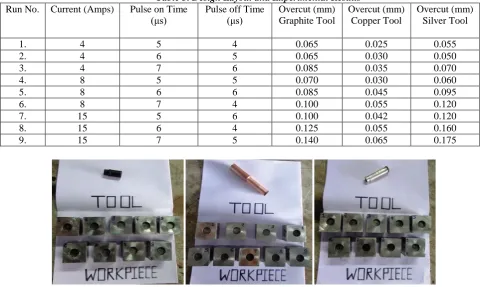
34 Fig 2. Tool Material : Graphite, Silver, Copper
Table 2. Factors with Levels
Factors Notation
1
Levels
2 3
Current (Amps) Ip
4 8 15
Pulse on Time (μs) Ton
5 6 7
Pulse off Time (μs) Toff
4 5 6
VI.EXPERIMENTALRESULT&DISCUSSION
The effect of process parameters on the machining parameter is recorded in the table. The nine experiments done on the electro discharge machine based on the Taguchi method and summarized in the following table.
Table 3. Design Layout and Experimental Results Run No. Current (Amps) Pulse on Time
(μs)
Pulse off Time (μs)
Overcut (mm) Graphite Tool
Overcut (mm) Copper Tool
Overcut (mm) Silver Tool
1. 4 5 4 0.065 0.025 0.055
2. 4 6 5 0.065 0.030 0.050
3. 4 7 6 0.085 0.035 0.070
4. 8 5 5 0.070 0.030 0.060
5. 8 6 6 0.085 0.045 0.095
6. 8 7 4 0.100 0.055 0.120
7. 15 5 6 0.100 0.042 0.120
8. 15 6 4 0.125 0.055 0.160
9. 15 7 5 0.140 0.065 0.175
35
4 5 6
0.12 0.10 0.08 M Poff 0.09 0.06 P on P off 7
Fig 4. Main effect of process parameters on OC Fig 5. Interaction effect of process parameters on OC Fig 4 shows the main effect plot of process parameters on overcut at different parameters like current, pulse on time, pulse off time in EDM process of machining for AISI 304 SS by graphite tool. From the fig, it can be seen that :-
Effect of Current : Overcut is increase with the increase in Current.
Effect of Pulse on Time : Overcut is increase with the increase in Pulse on Time.
Effect of Pulse off Time : Overcut is a slight decrease with the increase in Pulse off Time.
Fig 5 shows the interaction effect plot of process parameters on overcut at different parameters like current, pulse on time, pulse off time in EDM process of machining for AISI 304 SS by graphite tool.
15 8 4 0.054 0.048 0.042 0.036 0.030 7 6 5 6 5 4 0.054 0.048 0.042 0.036 0.030 I M ea n Pon Poff
Main Effect Plot For OC - Copper
7 6
5 4 5 6
0.06 0.04 0.02 0.06 0.04 0.02 I P on P off 4 8 15 I 5 6 7 Pon Interaction Plot For OC - Copper
Fig 6. Main effect of process parameters on OC Fig 7. Interaction effect of process parameters on OC Fig 6 shows the main effect plot of process parameters on overcut at different parameters like current, pulse on time,
pulse off time in EDM process of machining for AISI 304 SS by copper tool. From the fig, it can be seen that :- Effect of Current : Overcut is increase with the increase in Current.
Effect of Pulse on Time : Overcut is increase with the increase in Pulse on Time. Effect of Pulse off Time : Overcut is decrease with the increase in Pulse off Time.
Fig 7 shows the interaction effect plot of process parameters on overcut at different parameters like current, pulse on time, pulse off time in EDM process of machining for AISI 304 SS by copper tool.
15 8 4 0.150 0.125 0.100 0.075 0.050 7 6 5 6 5 4 0.150 0.125 0.100 0.075 0.050 I M e a n Pon Poff
Main Effect Plot For OC - Silver
7 6
5 4 5 6
0.15 0.10 0.05 0.15 0.10 0.05 I P on P off 4 8 15 I 5 6 7 Pon Interaction Plot For OC - Silver
Volume 2, Issue 3, 2015
36 Fig 8 shows the main effect plot of process parameters on overcut at different parameters like current, pulse on time, pulse off time in EDM process of machining for AISI 304 SS by silver tool. From the fig, it can be seen
that :-
Effect of Current : Overcut is increase with the increase in Current.
Effect of Pulse on Time : Overcut is increase with the increase in Pulse on Time.
Effect of Pulse off Time : Overcut is a slight decrease with the increase in Pulse off Time.
Fig 9 shows the interaction effect plot of process parameters on overcut at different parameters like current, pulse on time, pulse off time in EDM process of machining for AISI 304 SS by silver tool.
VII. CONCLUSION
Effect of process parameters on Overcut for Graphite tool was concluded as under :
Effect of Current : Overcut is increase with the increase in Current.
Effect of Pulse on Time : Overcut is increase with the increase in Pulse on Time.
Effect of Pulse off Time : Overcut is a slight decrease with the increase in Pulse off Time. Effect of process parameters on Overcut for Copper tool was concluded as under :
Effect of Current : Overcut is increase with the increase in Current.
Effect of Pulse on Time : Overcut is increase with the increase in Pulse on Time.
Effect of Pulse off Time : Overcut is decrease with the increase in Pulse off Time. Effect of process parameters on Overcut for Silver tool was concluded as under :
Effect of Current : Overcut is increase with the increase in Current.
Effect of Pulse on Time : Overcut is increase with the increase in Pulse on Time.
Effect of Pulse off Time : Overcut is a slight decrease with the increase in Pulse off Time.
Finally it is found that the copper tool is more suitable. In certain characteristics silver tool gives better performance but the cost becomes high for machining so keeping in mind cost and other some characteristics a graphite electrode is more suitable than silver tool. The experimental results indicate that the current significantly affects the OC followed by pulse on time & pulse off time.
VIII. FUTURESCOPE
Various theoretical models describing overcut mechanism have been proposed by the researchers from time to time. Still a lot of in-depth study is required to better understanding and development of the EDM process. Future scope which would express this research is some non-electrical parameters like electrode rotation and work piece rotation while machining improve the flushing conditions and thus may reduce overcut. Performance of water based dielectric is yet to be investigated for machining materials like composites and carbides. Selection of different types of electrode would also change in overcut. It may also be used the hybrid Electric Discharge Machine such as Abrasive and Dielectric mixture EDM, Magnetic EDM, etc.
ACKNOWLEDGEMENT
The author is very grateful to Mr. Ronak Punchal , Owner of Jayvir Engineering, Nikol, Ahmadabad for providing the material and machinery for experimentation.
REFERENCES [A] Journal Papers:
[1] Shankar Singh et. al.,“Some investigations into the electric discharge machining of hardened tool steel using different electrode materials”,Journal of Materials Processing Technology 149 (2004) 272–277.
[2] S.H.Tomadi et. al.,“ Analysis of the Influence of EDM Parameters on Surface Quality, Material Removal Rate and Electrode Wear of Tungsten Carbide”, Proceedings of the International MultiConference of Engineers and Computer Scientists 2009 Vol II IMECS 2009, March 18 - 20, 2009, Hong Kong.
[3] S. Assarzadeh et. al.,“ Statistical modeling and optimization of process parameters in electro-discharge machining of cobalt-bonded tungsten carbide composite (WC/6%Co)”,Procedia CIRP 6 ( 2013 ) 463 – 468 2212-8271 © 2013 The Authors. Published by Elsevier B.V. Selection and/or peer-review under responsibility of Professor Bert Lauwers doi: 10.1016/j.procir.2013.03.099.
[4] S. Gopalakannan et. al.,“Modeling & Optimization of EDM process parameter on machining of AL 7075-B4C MMC using RSM”, Procedia Engineering 38 ( 2012 ) 685 – 690 1877-7058.
[5] T.M.Chenthil Jegan et. al., “Determination of EDM parameters in AISI 202 SS using Gray Relation Analysis”, Procedia Engineering 38 ( 2012 ) 4005 – 4012 1877-7058.
37 Gaurav Raghav et. al.,“Optimization of Material Removal Rate in Electric Discharge Machining Using Mild Steel”, International Journal of Emerging Science and Engineering (IJESE) ISSN: 2319–6378, Volume-1, Issue-7, May 2013.
[10]Singaram Lakshmanan et. al.,“ Optimization of Surface Roughness using Response Surface Methodology for EN31 Tool Steel EDM Machining”,ISSN 2347-6435(Online), Volume 1, Issue 3, December 2013.
[11]Amit Kohli et. al.,“ Optimization of Material Removal Rate in Electrical Discharge Machining Using Fuzzy Logic”, World Academy of Science, Engineering and Technology Vol:6 2012-12-20.
[12]Shashikant et. al.,“Optimization of Machine Process Parameters on Overcut in EDM for EN19 Material using RSM”, International Journal of Current Engineering and Technology ISSN 2277 – 4106.
[13]Shivendra Tiwari,“ Effect of Different Process Parameters on Over Cut in Optimizing of Electrical Discharge Machining (EDM) Process”, International Journal of Engineering Research & Technology (IJERT) Vol. 2 Issue 7, July – 2013, ISSN: 2278-018.
[14]Vishal J Nadpara et. al.,“ Optimization of EDM Process Parameters Using Taguchi Method with Graphite Electrode”, International Journal of Engineering Trends and Technology (IJETT) – Volume 7 Number 2- Jan 2014.
[15]Hitesh B. Prajapati et. al.,“ Parametric Analysis of Material removal rate and surface roughness of Electro Discharge Machining on EN 9”,Vol. 1, Issue:1, February 2013 (IJRMEET) ISSN:2320-6586.
[16]Navdeep Malhotra et. al.,“ Experimental Study of Material Removal Rate in EDM”, IJAEA, Volume 2, Issue 1, pp. 6-10, 2009.
[17]P. Janmanee et. al.,“ Performance of Difference Electrode Materials in Electrical Discharge Machining of Tungsten Carbide”,Energy Research Journal 1 (2): 87-90, 2010 ISSN 1949-0151, 2010 Science Publications. [18]Mr. V.D.Patel et. al.,“ Analysis of Different Tool Material On MRR and Surface Roughness of Mild Steel In
EDM”,International Journal of Engineering Research and Applications (IJERA) ISSN: 2248-9622, Vol. 1, Issue 3, pp. 394-397.
[19]Santanu Dey et. al.,“Experimental Study Using Different Tools/Electrodes E.G. Copper, Graphite on M.R.R of E.D.M Process and Selecting The Best One for Maximum M.R.R in Optimum Condition”, IJMER, Vol.3, Issue.3, May-June. 2013 pp-1263-1267 ISSN: 2249-6645.
[20]S.H.Tomadi et al.,“ Analysis of the Influence of EDM Parameters on Surface Quality, Material Removal Rate and Electrode Wear of Tungsten Carbide”, Proceedings of the International MultiConference of Engineers and Computer Scientists 2009 Vol II IMECS 2009, March 18 - 20, 2009, Hong Kong.
[21]Harpreet Singh et. al.,“Effect of Pulse On/Pulse Off Time On Machining Of AISI D3 Die Steel Using Copper And Brass Electrode In EDM”, International Journal of Engineering and Science ISSN: 2278-4721, Vol. 1, Issue 9 (November 2012), PP 19-22.
[22]Shankar Singh et. al.,“ Some investigations into the electric discharge machining of hardened tool steel using different electrode materials”,Journal of Materials Processing Technology 149 (2004) 272–277.
[23]N.Arunkumar et. al.,“Investigation on the Effect Of Process Parameters For Machining Of EN31 (Air Hardened Steel) By EDM”, IJERA, Vol. 2, Issue4, July-August 2012, pp.1111-1121.
[24]Bhavesh A. Patel et. al.,“Influence of Electrode Material and Process Parameters on Surface Quality and MRR in EDM of AISI H13 using ANN”, International Journal on Recent and Innovation Trends in Computing and Communication ISSN: 2321-8169 Volume: 1, Issue: 12, 858 – 869.
[25]Subramanian Gopalakannan et. al.,“Effect of Electrode Materials on Electric Discharge Machining of 316 L and 17-4 PH Stainless Steels”, Journal of Minerals and Materials Characterization and Engineering, 2012, 11, 685-690 Published Online July 2012.
[26]Harpuneet Singh,“ Investigating the Effect of Copper Chromium and Aluminum Electrodes on EN-31 Die Steel on Electric Discharge Machine Using Positive Polarity”, Proceedings of the World Congress on Engineering 2012 Vol III WCE 2012, July 4 - 6, 2012, London, U.K.
[27]Saeed Daneshmand et. al.,“ Investigation of EDM Parameters on Surface Roughness and Material Removal Rate of NiTi60 Shape Memory Alloys”, Australian Journal of Basic and Applied Sciences, 6(12): 218-225, 2012 ISSN 1991-8178.
[28]Mohan Kumar Pradhan et. al.,“ Modelling of machining parameters for MRR in EDM using response surface methodology”, Proceedings of NCMSTA’08 Conference National Conference on Mechanism Science and Technology: from Theory to Application November 13-14, 2008 National Institute of Technology, Hamirpur. [29]Suraj Choudhary et. al.,“ Analysis of MRR and SR with Different Electrode for SS 316 on Die-Sinking EDM
Volume 2, Issue 3, 2015
38 [30]Periyakgounder Suresh et. al.,“ Optimization of Intervening Variables in MicroEDM of SS 316L using a Genetic
Algorithm and Response-Surface Methodology”, Journal of Mechanical Engineering 60(2014)10, 656-664. [31]V.Balasubramaniam et. al.,“ Optimization of Electrical Discharge Machining Parameters Using Artificial Neural
Network With Different Electrodes”, 5th International & 26th All India Manufacturing Technology, Design and Research Conference (AIMTDR 2014) December 12th–14th, 2014, IIT Guwahati, Assam, India.
[32]S. Dewangan et. al.,“ Optimization of the quality and productivity characteristics of AISI P20 tool steel in EDM process using PCA-based grey relation analysis”, 5th International & 26th All India Manufacturing Technology, Design and Research Conference (AIMTDR 2014) December 12th–14th, 2014, IIT Guwahati, Assam, India. [33]Saeed Daneshmand et. al.,“Influence of Machining Parameters on Electro Discharge Machining of NiTi Shape
Memory Alloys”, Int. J. Electrochem. Sci., 8 (2013) 3095 – 3104.
[34]Nikhil Kumar et. al.,“Comparative Study For Mrr on Die-Sinking EDM Using Electrode of Copper & Graphite”, International Journal of Advanced Technology & Engineering Research (IJATER), VOLUME 2, ISSUE 2, MAY 2012.
[35]Harpreet Singh et. al.,“Examination of Surface Roughness Using Different Machining Parameter in EDM”,IJMER, Vol.2, Issue.6, Nov-Dec. 2012 pp-4478-4479.
[36]S.B.Chikalthankar et. al.,“ Experimental Investigations of EDM Parameters”, International Journal of Engineering Research and Development e-ISSN: 2278-067X, p-ISSN: 2278-800X, Volume 7, Issue 5 (June 2013), PP. 31-34.
[37]Dilshad Ahmad Khan et. al.,“ Effect of Tool Polarity on The Machining Characteristics in Electric Discharge Machining of Silver Steel And Statistical Modelling of The Process”, IJEST, Vol. 3 No. 6 June 2011.
[38]Shivendra Tiwari,“Optimization of Electrical Discharge Machining (EDM) with Respect to Tool Wear Rate”, International Journal of Science, Engineering and Technology Research (IJSETR) Volume 2, Issue 4, April 2013. [39]Mr. Alpesh Nogas et. al.,“Experimental Investigation of MRR of Cold Work Tool Steel Material on EDM for Different Electrode Materials”, IJSRD - International Journal for Scientific Research & Development| Vol. 1, Issue 3, 2013 | ISSN (online): 2321-0613.
[40]Praveen Kumar Singh et. al.,“ Parametric studies for MRR and TWR using die sinking EDM with electrode of Copper and Brass”, Proc. of the Intl. Conf. on Advances In Engineering And Technology - ICAET-2014, ISBN: 978-1-63248-028-6 doi: 10.15224/ 978-1-63248-028-6-03-145.
[41]Priyesh N. Santoki et. al., “A Review - Status of Recent Developments & Effect of Machining Parameters on Performance Parameters in EDM.”, International Journal of Innovative and Emerging Research in Engineering Vol. X, No. X, 2015.
[42]Othman Belgassim et. al., “Optimization of the EDM Parameters on the Surface Roughness of AISI D3 Tool Steel”, Proceedings of the 2012 International Conference on Industrial Engineering and Operations Management [43]Istanbul, Turkey, July 3 – 6, 2012.
[B] Brochures:
[1] Instruction and Maintenance Manual For Spark Erosion Machine by Sparkonix Pvt. Ltd. [2] Techtips by Roger Kern.
[C] Books:
[1] Text book of Machine tool engineering by G.R. Nagpal in 2004 , Khana publication. [2] Text book of production engineering by P.C. Sharma in 1982, S.Chand & Company ltd.
[3] Text book of Manufacturing science by Amitabha Ghose & Asok mallik in 2005 West press private Ltd. [4] Text book of Production Engineering Technology by R.K Jain.
![Fig 1. Setup of EDM [B.1]](https://thumb-us.123doks.com/thumbv2/123dok_us/8873739.1815593/2.595.156.435.67.214/fig-setup-of-edm-b.webp)