Investigation of Liquid–Liquid Two-Phase Flow Pattern in
Microreactors for Biodiesel Production
M. Basiri, M. Rahimi*, F. Mohammadi
CFD Research center, Chemical Engineering Department, Razi University, Kermanshah, Iran
Abstract
In the present study, transesterification of soybean oil to Fatty Acid Methyl Ester (FAME) was carried out in the microreactor. The system performance was investigated in the presence of hexane as a cosolvent. Furthermore, the effect of number of micromixer’s inlets on the mixing was one of the objectives in this work. For the goals mentioned above, three different experiments were done with and without cosolvent in two and three inlet micromixers under optimum conditions. Both flow pattern observations and Gas Chromatgoraphy (GC) characterization of FAME samples demonstrated that cosolvent technique and micromixer application could significantly influence the FAME yield in biodiesel production.
Keywords: Biodiesel, Cosolvent, Flow Pattern, Micromixer, Transesterification
1. Introduction
Biodiesel is an interesting alternative diesel fuel that contributes to reducing the environmental impacts in the transportation sector since emissions of the most regulated pollutants are substantially lower in comparison to fossil diesel [1]. Biodiesel is relatively safe for use in diesel engines and storage in diesel container because of its high flash point. It can be used alone as fuel, or mixed with fossil diesel in diesel engines without major adjustments [2,3].
Transesterification of soybean oil to obtain biodiesel consists of replacing the
Corresponding author: [email protected]
glycerol of triglycerides with a short chain alcohol in the presence of a catalyst. The process is carried out in an alkaline medium, dissolving the catalyst in methanol under low temperature conditions and atmospheric pressure. In this process glycerol and FAME are obtained and separated in two different immiscible phases, distributing amongst them an excess of added methanol and the catalyst [4].
miniaturization for the last two decades [5]. One of the most important fundamental advantages is the decrease of the physical size of a reactor. For a given difference in a physical property, decrease of linear dimensions leads to an increase of the gradient of the processing parameters (such as temperature, concentration, density or pressure) [6]. Accordingly, the mass transfer, heat transfer, and diffusional flux are enhanced. In these small devices, a high specific surface area in the range of 10,000– 50,000 m2/m3 is achieved, which enables an effective mass and heat transfer compared to traditional chemical reactors [7].
Due to the small channel dimensions, in all microreactors a laminar flow regime predominates. By rearrangement of Fick’s law the dependence of the mixing time
(tmixing) on the width of the lamellae (d) is
revealed by the following equation, where the positive effect of miniaturization of characteristic structures on mixing can be seen:
𝑡𝑚𝑖𝑥𝑖𝑛𝑔 ∝𝑑𝑙2
𝐷 (1)
D is the diffusion coefficient and 𝑑𝑙2is lamellae width [6].
Consequently, a rather rapid diffusion mixing is promoted in microreactors compared with the turbulence and chaotic mixing in conventional reactors, i.e. mixing time scale in microseconds in microreactors [8] vs. seconds or longer in classical reactors [6].
Several studies on transesterification reaction using microreactors have recently been published [9,10].
The rate of transesterification reaction decreases as equilibrium is approached. The
main problem for the lower rate of transesterification is that the reaction mixture is not homogeneous because the oils and alcohols are not miscible because of their chemical structures. To overcome this difficulty of the heterogeneous mixing of the reactants, a single phase reaction has been proposed by Boocock et al. [11]. The proposed model includes a solvent introduced into the reaction mixture which makes both the oil and methanol miscible.
Different cosolvents have been used in batch reactors by some researchers [12,13]. In one study, biodiesel production in a microtube reactor in the presence of a diethyl ether was examined [14].
The flows of two immiscible fluids in biodiesel synthesis reaction have been investigated in microchannels by Guan et al. and Sun et al. [9,10,14].
In 2009, Guan et al. [9] investigated flow patterns for transesterification reaction of sunflower oil with methanol using a KOH catalyst which was performed in a transparent microtube reactor under different operating conditions. It was found that at a methanol/oil molar ratio of 23.9 at 60°C, a
quasi-homogeneous phase formed
approximately 300 mm from the reaction inlet where the oil was completely converted to FAMEs.
of fine glycerol droplets.
Sun [10] examined the flow patterns of transesterification of cottonseed oil and methanol with KOH under different conditions in transparent microtubes. The influences of the type of the micromixer, the residence time, the methanol-to-oil molar ratio, the flow rate, and reaction temperatures below and above the boiling point of methanol were examined.
No work has been done in the field of flow behavior in the presence of hexane as a cosolvent in microreactors. So, this work seeks to investigate the liquid–liquid two-phase flow pattern in microreactors in the presence of hexane. Furthermore, other experiments were designed to determine whether it is better to have a three-inlet-micromixer or conduct the transesterification reaction in a two-inlet-micromixer and inject the mixture of oil and cosolvent from an inlet.
The results revealed that in two-inlet-micromixer, cosolvent addition increased the FAME yield 23 wt% and exchanging two-inlet-micromixer with three-two-inlet-micromixer can increase the FAME yield 13 wt%.
2. Materials and methods
2-1. Materials
The soybean oil used in this study was supplied from Nazgol oil company (Kermanshah, Iran) with an average molecular weight, specific gravity and saponification index of 863.47 g/mol, 910 kg/m3 and 191.88 mg of KOH/g oil, respectively. Methanol (purity>99.5%), normal hexane (purity>95%), potassium hydroxide (purities>85%, pellets), sulfuric acid (AR grade) and rhodamine B were purchased from Merck Co. Ltd. Methyl
laurate (methyl dodecanoate, 99.7%) as standard for GC analysis was supplied by Sigma–Aldrich. All materials were employed as received without any further processing.
2-2. Methods and experimental procedure
The transesterification reaction was performed in transparent tube with an inner diameter of 1.5 mm and micromixers with an inner diameter of 0.8 mm.
Combination of micromixers with microtube was applied. The experimental set-up is shown schematically in Fig. 1. The experiments were conducted at room temperature, oil to methanol volumetric ratio 3 and methanol to hexane volumetric ratio 0.4 which were optimized before.
Three syringe pumps were used to inject the soybean oil, solution of KOH in methanol, and hexane at the targeted rates [9,12].
The residence time was controlled by adjusting the flow rates of three pumps, while the molar ratio of oil to methanol was controlled by the flow rate ratio of three pumps.
The system performance was investigated in the presence of hexane in two types of micromixer configurations. Three different experiments were designed under optimum conditions.
Figure 1. Experimental set-up of the transesterification reaction carried out in a microreactor.
Figure 2. Mixer configurations and mixing forms of the reactants in different experiments.
It should be mentioned that the catalyst concentration was kept constant at 1 wt% based on the oil weight [15]. After dissolving the KOH catalyst in methanol, the mixed solution was dyed with inert pink rhodamine B to obtain clear images of the flow patterns in the microtube.
The flow patterns were recorded with an electronic microscope (640*480 pixels, magnification 10x~300x) connected to a personal computer.
The experiments were repeated without dye for GC analysis. For this aim, each experiment’s product was collected at the
outlet of the microtube after termination of the reaction by sulfuric acid addition. After that it was centrifuged to separate FAMEs layer. The layer was washed with water three times and dehydrated in an oven at 100°C for an hour.
2-3. Biodiesel characterization
The samples of biodiesel were analyzed by gas chromatography (Agilent, model 6890N) with a
μm, and internal diameter=0.25 mm). Nitrogen was used as both the carrier gas and FID auxiliary gas. One microliter of the sample was injected using a 6890 agilent Series Injector with a splitless mode. The sample was heated up from 50°C to 230°C at a heating rate of 5°C/min. Methyl laurate (C12:0) was added as an internal standard reference into the samples.
The FAME was calculated using Eq. (1) as follows [16]:
𝐹𝐴𝑀𝐸(𝑤𝑡%) =(∑ 𝐴)
𝐴𝑠 ×
𝑊𝑠
𝑊 × 100 (2)
Where ∑A is the sum of all areas under the curve from C12 to C24, As is the area
under the curve of C12:0, Ws is the Weight of
C12:0 (g) and W is the Weight of product (g).
3. Results and discussion
3-1. Flow pattern results
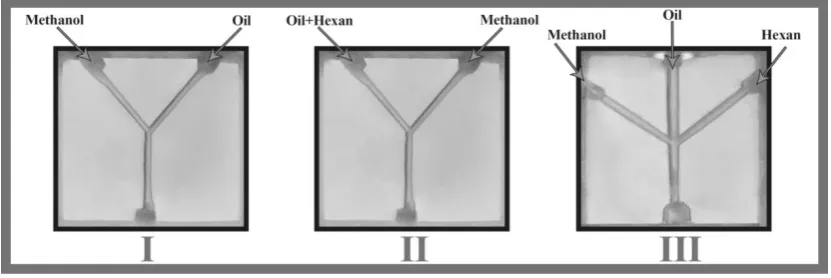
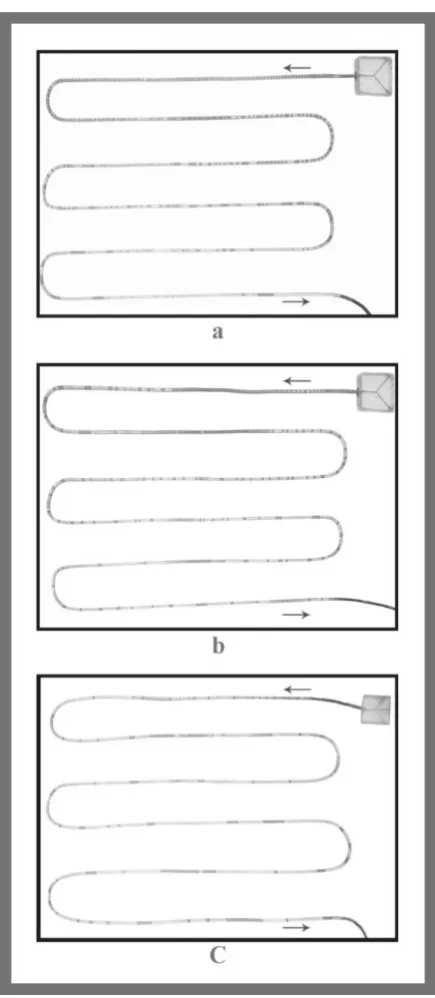
Flow behavior of the experiments which were described before are visualized in this section. Fig. 3 and Fig. 4 show microscopic images of the flow pattern in the micromixers and microtubes respectively.
Figure 3. Microscopic image of the micromixer’s flow pattern in the experiment (a) I, (b) II, (c) III.
Figure 4. Microscopic image of the microtube’s flow pattern in the experiment (a) I, (b) II, (c) III.
As can be seen from the figures, the flow pattern in the micromixers is parallel in all experiments and slug in microtubes.
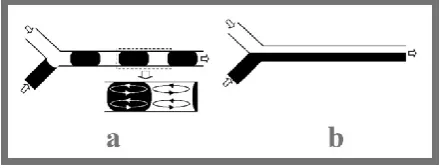
Figure 5. Major stable flow regimes possible for a biphasic mixture in capillary microreactors: (a) slug flow, (b) parallel flow.
In the case of slug flow, two mechanisms are known to be responsible for the mass transfer between two fluids: (a) internal circulation [18-20] takes place within each slug and (b) the concentration gradients between adjacent slugs lead to the diffusion between the phases. In the liquid-liquid slug flow, the stable well-defined flow patterns and uniform interfacial areas permit a precise tuning of the mass transfer processes and make an a priori prediction of mass transfer coefficients feasible [21].
In the case of parallel pattern, the flow is laminar and the transfer of molecules between the two phases is supposed to occur only by diffusion [22]. Due to relatively low interfacial area and mass transfer only by diffusion, the parallel flow requires a longer time for higher throughput compared to slug flow [21].
The flows of the reactants come into contact in the micromixers (Fig. 3) and pass along each other through the parallel flow. Thereby an efficient mixing is achieved due to the small dimensions and large surface area to volume ratio of the mixer. By increasing the number of micromixer’s inlet, mixing can be become more efficient. In the case of using three-inlet-micromixer (Fig. 3c), the interface of the three phases becomes
unclear which implies excellent
micromixing.
The typical images of the flow patterns in the microtube (Fig. 4) show clear stable
segments formed apart from the
micromixer’s outlet.
In experiment I (Fig. 4a) segments in the microtubes were formed around 600 mm apart from the micromixer’s outlet and segments began to aggregate and larger segments were formed near the outlet. When hexane was introduced into the microtube reactor (Fig. 4b), the aggregation of the segments began at 350 mm apart from the micromixer’s outlet. In this case the aggregation of segments occurred at the part closer to the reaction inlet due to the disappearance of mass transfer resistance.
Hexane helps create a pseudo-homogenous reaction mixture, allowing easier transport of methanol into the oil phase. Hexane itself does not participate in the reaction but acts as a dispersal medium for the oil. Since hexane is hydrophobic it can easily slide between oil molecules and weaken oil- to- oil cohesive forces [12]. This leads to decrease the length of the oil segment and increase the length of the methanol segment compared with the results shown in Fig. 3a.
In experiment III (Fig. 4c) where the cosolvent was applied in the three inlet micromixer, aggregation was evident 150 mm from the reaction inlet. Incorporation of a cosolvent to the transesterification reaction in the microtube reactor caused the aggregation of segments to appear at the closer part to the reaction inlet compared to two other experiments.
Guan et al. [9] used a transparent Teflon tube with an inner diameter of 0.8 mm for observation of fluid motion of the transesterification reaction. Using 4.5 wt% amount of KOH, 23.9 methanol/oil molar ratio at 60°C, quasi-homogeneous phase formed approximately 300 mm from the reaction inlet where the oil was completely converted to FAMEs.
Guan et al. [14] also examined the synthesis of BDF in a transparent fluoroethylene polymer microtube reactor (inner diameter=0.96mm) in the presence of diethylether as a cosolvent by using a microscope camera to observe the flow behaviors as the reaction progressed. The operating conditions were 1 wt% amount of KOH, methanol/oil molar ratio of 8, diethyl ether/methanol molar ratio of 0.73 and temperature of 25°C. In the absence of the cosolvent, clear stable segments were observed approximately 60 cm from the reaction inlet, and then red methanol segments began to aggregate, forming larger segments at the exit region. However, in the presence of diethyl ethera homogeneous flow was obtained quickly at the entrance region of the microtube.
3-2. Comparison between experimental measured yields:
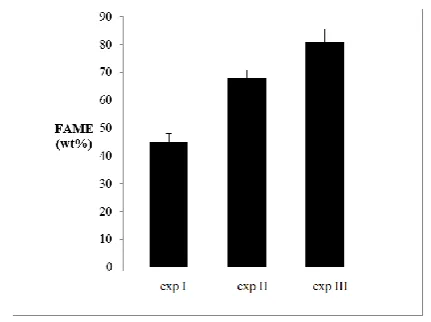
The experiments were done three times and the yields of the FAME samples and the errors are presented in Fig 6. By adding cosolvent in two-inlet-micromixer, the FAME yield increased 23 wt% as a
consequence of disappearance of
heterogeneous mass transfer resistance. Adding hexane to the reaction mixture causes mass transfer enhancement between oil and
alcohol phases and consequently higher FAME yield reaction of experiment II.
When the micromixer was exchanged with the three inlet one, 13 wt% FAME enhancement was observed. The style of contact of reactants in micromixers accelerated mixing in biphasic reactions. Application of microreactor technology for mixing of all materials causes the more efficient contact between molecules so the conversion rate is significantly enhanced and the transesterification reaction process appears to be more efficient. Furthermore, the mass transfer-controlled regime is eliminated due to short diffusion distance in micro reactors.
Figure 6. Yield of the FAME in different experiments.
different points apart from the inlet and determined the oil conversions at these points. Oil conversion reached 63.4% at a microtube length of 12 cm and 92.8% at the point where most of the glycerol drops formed (microtube length=36 cm, residence time=93 s).
4. Conclusions
The transesterification reaction was conducted in two types of micromixer configurations followed by a microtube reactor. In order to investigate the flow pattern behavior, three different experiments were designed under optimum condition to illustrate the effect of hexane and the employed mixer on two-phase flow pattern. Applying a micromixer obviously transforms the parallel flow to slug flow and the segments begin to aggregate along the microtube reactor.
In the best case of this study, in which the combination of hexane as a cosolvent and a three-inlet-micromixer were employed, the aggregation of segments and reaching quasi-homogeneous phase in the microtube was formed around 150 mm apart from the outlet of micromixer. A yield enhancement of 36 percent was obtained in three- inlet case in comparison with that of two- inlet micromixer without hexane as co-solvent. It should be noted that the visual observations were consistent with GC results in all experiments.
References
[1] Ma, F. and Hanna, M. A., "Biodiesel production: a review", Bioresour. Technol.,
70 (1), 1 (1999).
[2] Ashraful, A. Masjuki, H. Kalam, M.
Rizwanul Fattah, I. Imtenan, S. Shahir, S. and Mobarak, H., "Production and comparison of fuel properties, engine performance, and emission characteristics of biodiesel from various non-edible vegetable oils: A review", Energy Convers. Manage.,
80, 202 (2014).
[3] Ong, H. Silitonga, A. Masjuki, H. Mahlia, T. Chong, W. and Boosroh, M., "Production and comparative fuel properties of biodiesel from non-edible oils: Jatropha curcas, Sterculia foetida and Ceiba pentandra", Energy Convers. Manage., 73, 245 (2013).
[4] Antolı́n, G. Tinaut, F. V. Briceño, Y. Castaño, V. Pérez, C. and Ramı́rez, A. I., "Optimisation of biodiesel production by sunflower oil transesterification", Bioresour. Technol., 83 (2), 111 (2002).
[5] Mills, P. L. Quiram, D. J. and Ryley, J. F. "Microreactor technology and process miniaturization for catalytic reactions—A perspective on recent developments and emerging technologies", Chem. Eng. Sci., 62
(24), 6992 (2007).
[6] Erhfeld, W. V. H. and Lowe, H., Microreactors: New Technology for Modern Chemistry, Wiley-VCH, Weinheim, (2005).
[7] Renken, A. Hessel, V. Löb, P. Miszczuk, R, Uerdingen, M. and Kiwi-Minsker, L., "Ionic liquid synthesis in a microstructured reactor for process intensification", Chem. Eng. Process., 46 (9), 840 (2007).
107 (6), 2300 (2007).
[9] Guan, G. Kusakabe, K. Moriyama, K. and Sakurai, N., "Transesterification of sunflower oil with methanol in a microtube reactor", Ind. Eng. Chem. Res., 48 (3), 1357 (2009).
[10] Sun, P. Wang, B. Yao, J. Zhang, L. and Xu, N., "Fast synthesis of biodiesel at high throughput in microstructured reactors",
Ind. Eng. Chem. Res., 49 (3), 1259 (2009).
[11] Boocock, D. G. Konar, S. K. Mao, V. Lee, C. and Buligan, S., "Fast formation of high-purity methyl esters from vegetable oils", J. Am. Oil Chem. Soc., 75 (12), 1167 (1998).
[12] Escobar, E. C. Demafelis, R. B. Pham, L. J. Florece, L. M. and Borines, M. G., "Biodiesel production from Jatropha curcas L. oil by transesterification with hexane as cosolvent", Philipp. J. Crop. Sci.,
33 (3), 1 (2008).
[13] Alhassan, Y. Kumar, N. Bugaje, I. Pali, H. and Kathkar, P., "Co-solvents transesterification of cotton seed oil into biodiesel: Effects of reaction conditions on quality of fatty acids methyl esters", Energy Convers. Manage., 84, 640 (2014).
[14] Guan, G. Sakurai, N. and Kusakabe, K., "Synthesis of biodiesel from sunflower oil at room temperature in the presence of various cosolvents", Chem. Eng. J., 146 (2), 302 (2009).
[15] Freedman, B. Butterfield, RO. and Pryde, EH., "Transesterification kinetics of soybean oil 1", J. Am. Oil Chem. Soc.,
63(10),1357 (1986).
[16] Wang, Y. Ou, S. Liu, P. Xue, F. and
Tang, S. "Comparison of two different processes to synthesize biodiesel by waste cooking oil", J. Mol. Catal. A: Chem., 252
(1), 107 (2006).
[17] Kashid, M. N. and Kiwi-Minsker, L., "Microstructured reactors for multiphase reactions: state of the art", Ind. Eng. Chem. Res., 48 (14), 6465 (2009).
[18] Burns, J. and Ramshaw, C., "The intensification of rapid reactions in multiphase systems using slug flow in capillaries", Lab Chip, 1 (1), 10 (2001).
[19] Dummann, G. Quittmann, U.
Gröschel, L. Agar, D. W. Wörz, O. and Morgenschweis, K., "The capillary-microreactor: a new reactor concept for the intensification of heat and mass transfer in liquid–liquid reactions", Catal. Today, 79, 433 (2003).
[20] Kashid, M. N. Gerlach, I. Goetz, S. Franzke, J. Acker, J. Platte, F. Agar, D. and Turek, S., "Internal circulation within the liquid slugs of a liquid-liquid slug-flow capillary microreactor", Ind. Eng. Chem. Res., 44 (14), 5003 (2005).
[21] Kashid, M. N., "Experimental and modelling studies on liquid-liquid slug flow capillary microreactors", Desertation of PhD, Department of Biochemical and Chemical Engineering at the University of Dortmund (2007).