Classifying Written Corrective Feedback for Research
and Educational Purposes: A Typology Proposal
Clasificación de la retroalimentación correctiva escrita para propósitos
investigativos y educativos: una propuesta de tipología
Benjamín Cárcamo
1
Universidad de las Américas, Viña del Mar, Chile
Although several investigations have been carried out in recent years on written corrective feedback (wcf), there is a lack of agreement about its definition and the effect on students’ writings of different types of feedback. This may be due to the lack of systematicity regarding the characterization of wcf used in those studies. This article seeks to review the concept of wcf in studies in the field and to systematize the various aspects considered in a typology, which includes specification, focus, scope, source, mode of delivery, and notes. The resulting typology should help improve the effectiveness in the comparison of wcf studies and serve as a reference for teachers interested in expanding their practices.
Keywords: assessment, second language acquisition, typology, written corrective feedback
A pesar de la variedad de estudios recientes sobre la retroalimentación correctiva escrita (rce), no existe un acuerdo respecto a su definición ni al efecto que distintos tipos de retroalimentación tienen en la escritura de los estudiantes. Esto puede deberse a la falta de sistematicidad en dichos estudios para caracterizar la rce. Así, en este artículo se hace una revisión de su noción y de los diversos aspectos considerados en los estudios, a fin de sintetizarlos en una tipología que incluya especificación, enfoque, alcance, fuente, modo de entrega y notas. Se espera que la tipología propuesta sea eficaz en la comparación de estudios sobre la rce y sirva de consulta a docentes interesados en expandir sus prácticas.
Palabras clave: adquisición de una segunda lengua, evaluación, retroalimentacióncorrectiva escrita (rce), tipología
Benjamín Cárcamo https://orcid.org/0000-0001-7330-9007 ∙ Instituto de Idiomas, Universidad de las Américas, Viña del Mar, Chile.
Email: [email protected]
How to cite this article (apa, 7th ed.): Cárcamo, B. (2020). Classifying written corrective feedback for research and educational purposes:
A typology proposal. Profile: Issues in Teachers’ Professional Development, 22(2), 211–222. https://doi.org/10.15446/profile.v22n2.79924 This article was received on May 27, 2019 and accepted on January 27, 2020.
Introduction
The importance of feedback in education has gained attention in recent years due to a paradigm shift in the understanding of evaluation. Indeed, the notion of assessment of learning has lost popularity among educators in favor of assessment for learning (Black & William, 1998; Laveault & Allal, 2016). Whereas the former highlights the relevance of external stan-dards, the latter seeks to promote that the student is informed during his or her learning process based on clear goals and evaluative instances, both formal and informal (Everhard, 2015). In order to implement effectively assessment forlearning, one of the funda-mental resources is the timely delivery of feedback. In the education field feedback is usually understood as information that is given by an agent to a person regarding a particular performance in order to guide students’ learning from what is understood to what should be (Hattie & Timperley, 2007). In the area of second language writing in particular, a key research line has focused on the concept of written corrective feedback (wcf). wcf is usually defined as a strategy through which teachers inform students of a linguistic error with the aim of supporting its correction and subsequent elimination in future linguistic production (uptake; Ferreira-Cabrera, 2017).
Today there is a high interest to analyze the effects of the different styles of wcf that can be delivered. For example, Tang and Liu (2018) sought to establish whether or not indirect feedback with affective com-ments was more effective than without comcom-ments. Researchers in this study found that both improve writing; however, affective comments also reinforce a positive mindset and increase motivation for writing. Comparative studies in a similar line have explored different dimensions of wcf, such as whether wcf should include metalinguistic comments (Bitchener & Knoch, 2008, Lillo & Sáez, 2017), the impact of focusing on specific errors (Diab, 2015; Muñoz &
Ferreira, 2017; Salami & Raouf-Moini, 2013), the effect of automated feedback (Dikli & Bleyle, 2014; Milton, 2006) and the differences in perception and impact with respect to the feedback given by teachers, peers, or computers (Chong, 2017; Han & Hyland, 2019; Lai, 2009; Miao et al., 2006; Yu & Hu, 2017), among others.
The multiple studies on the effects of wcf have given rise to two issues. The effectiveness of wcf has been questioned (Fazio, 2001; Truscott, 1996) and its classification has been explored inconsistently (Al-Jarrah, 2016; Ellis, 2009a). A possible cause of the first problem is the definition of wcf which has had different nuances. The most common have priori-tized grammar (Ferreira-Cabrera, 2017, Lillo & Sáez, 2017, Truscott, 1996). However, in other cases, it has been linked with the improvement of global aspects of communication (Al-Jarrah, 2016). This issue of definition has had a negative impact on the typolo-gies developed for classifying wcf, which, although multidimensional, has usually ignored certain aspects that are involved in writing.
The Role of Written Corrective Feedback in Second Language Acquisition
There are two main perspectives of wcf: a classic, mainstream grammatical vision and a holistic one. From the first point of view, wcf has sometimes even been equated with grammatical correctness (Truscott, 1996). This narrowed understanding of wcf can be attributed to the history of the study of the acquisition of second languages. On the other hand, Al-Jarrah (2016) points out a broader vision, which does not give as much importance to errors at the local level but prefers to comment on global problems such as the organization of the writing and its content. This global vision would be more in tune with approaches such as writing through the curriculum and teaching methodologies of foreign languages that integrate skills, such as task-based language teaching.
From the perspective of second language acquisition (sla), the priority given to wcf in the coverage of local errors can be traced in the development of the concept of “error.” In the 1950s and 1960s, errors were perceived as negative, and the aim was to prevent them from becoming an impossible habit to correct (fossilization; Selinker, 1972). The behaviorism of the time channeled its efforts to the immediate correction of errors, the constant practice of correct forms, and initiatives such as contrastive analysis (ca), which would reduce the interference of the student’s mother tongue (Brooks, 1960). With the advent of Chomskian cognitivism, studies of this nature focused on the analysis of errors (ae). This approach consisted of the systematic analysis of the errors of the learners, which revealed that these were not necessarily dependent on the mother tongue. Selinker (1972) proposed that each apprentice forms his own “interlanguage,” consisting of his own rules and whose nature would evolve as time goes by. Both the ca and the ae tend to focus on the analysis of sentences, leaving aside the pragmatic–discursive plane.
In line with this perception of errors, the 1980s gave rise to articulated proposals for acquisition, which are still very influential. Krashen (1982), for example, proposed five hypotheses for the acquisition of a second language: the acquisition/learning hypothesis, the monitor hypothesis, the natural order hypothesis, the input hypothesis, and the affective filter hypothesis. It is beyond the scope of this article to explain each of these, but it is worth noting that, from this perspective, wcf is not important in the case of acquisition (e.g., immersion) since the learner’s l2 would follow a natural order. In other words: independent of the feedback received by the student, the student will learn the grammatical structures in a predetermined order. Nonetheless, in the case of learning (e.g., classrooms) feedback could have a more relevant role.
and even with other sociocognitive models such as Long’s interactionist perspective (1996), in its contemplation of the negative evidences during the negotiation of meanings as instances that promote learning.
With the rise of sociocognitive studies, the development of oral production has received more attention than written production, which has made most researchers interested in the topic work on oral corrective feedback (ocf). This has generated extensive bibliography on precise aspects of oral feedback such as recast studies (Han, 2002, Iwashita, 2003, Long et al., 1998; Lyster, 1998) and classifica-tions (Lyster & Ranta, 1997; Lyster et al., 2013). Both the systematization and the deepening in areas of wcf have not reached the same level of growth. Certainly, the research on writing in an l2 from the sociocognitive perspective seems to be in a stage of childhood (Nishino & Atkinson, 2015).
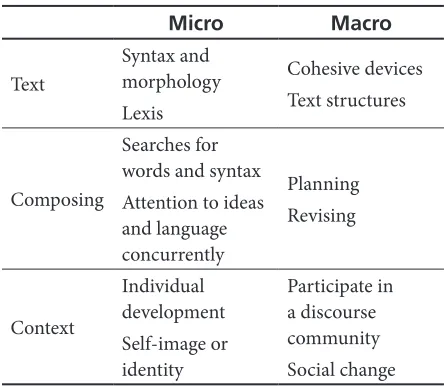
Studies focused on the development of writing rather than the acquisition of a language have broadened the role of the wcf (Al-Jarrah, 2016). From this perspective, the feedback becomes less limited to lexico-grammatical structures in favor of comments regarding the overall structure of the text. This dichotomy is explored by Cumming (2001) through the labels of micro and macro visions of writing, which the author recognizes as axes of three views of writing: the text, the composing, and the context.
Table 1 shows the two perspectives of writing (micro and macro) as well as three dimensions with respect to which writing has been investigated: the text, the composing, and the context. Thus, one could examine a piece of writing at the micro level while focusing on the context. For example, exploring linguistic marks that account for the voice of the writer. On the other hand, at the same level from a macro perspective, it would correspond to study the way in which the writer shows allegiance to a particular discourse community.
Table 1. What is Learned When Writing in a Second Language (Cumming, 2001)
Micro Macro
Text
Syntax and morphology Lexis
Cohesive devices Text structures
Composing
Searches for words and syntax Attention to ideas and language concurrently
Planning Revising
Context
Individual development Self-image or identity
Participate in a discourse community Social change
If one considers the previously discussed under-standings of wcf, it can be noted that both would be associated with the micro and macro levels respectively. In particular, the classic view of wcf as the correction of mainly grammatical and vocabulary errors would be restricted to the micro textual level; on the other hand, the global view of wcf could be associated with both textual and contextual macro levels. This second view can be traced back to works by Emig (1977) and Britton (1970), who emphasized the role of writing not only as an instrument of communication and expression but also of reflection and learning. As a summary, it can be pointed out that the predominant view of wcf at the lexical–syntactic level can be attributed to the importance of structural and cognitive linguistics in studies of sla. The units of analysis of these paradigms rarely go or have gone beyond the sentence level. On the other hand, studies from the subdiscipline of writing in an l2 have had broader research interests, which focus on writing as a communicative skill. This has brought with it an interest in macro aspects of the text. One weakness that has been noted in this journey is the lack of attention to the cognitive components of writing at the time of studying wcf.
Classifications of Written Corrective Feedback
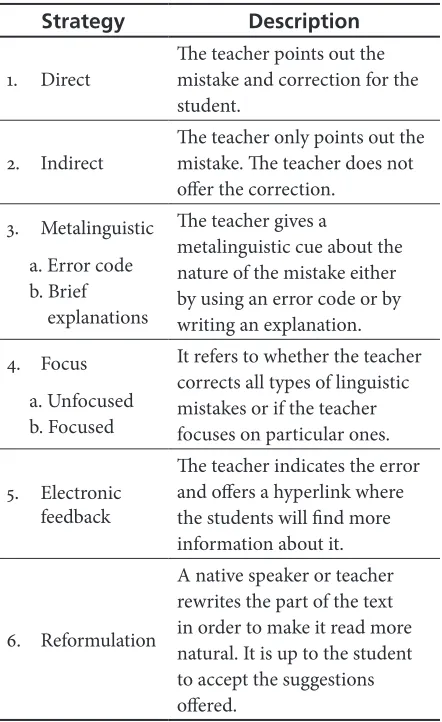
There are several variables that can be taken into account when classifying the different types of feedback that can be delivered. Performing this task is a key challenge in helping increase the degree of comparability of the studies carried out in the investigation of the effects of wcf since one could label the type of wcf offered in a particular study before assuming it can be compared to the type used in another one. One of the most significant efforts in this line is that of Ellis (2009a), who offers the types of wcf shown in Table 2. These were identified by the author based on material delivered by teachers and empirical studies.
Table 2. Typology of Written Corrective Feedback by Ellis (2009a)
Strategy Description
1. Direct The teacher points out the mistake and correction for the student.
2. Indirect The teacher only points out the mistake. The teacher does not offer the correction.
3. Metalinguistic a. Error code b. Brief explanations
The teacher gives a
metalinguistic cue about the nature of the mistake either by using an error code or by writing an explanation. 4. Focus
a. Unfocused b. Focused
It refers to whether the teacher corrects all types of linguistic mistakes or if the teacher focuses on particular ones.
5. Electronic feedback
The teacher indicates the error and offers a hyperlink where the students will find more information about it.
6. Reformulation
A native speaker or teacher rewrites the part of the text in order to make it read more natural. It is up to the student to accept the suggestions offered.
strategy as indirect, metalinguistic, and focused. Clearly, a teacher could focus on a grammatical structure such as the use of past forms, mark errors by noting the amount made at the end of a line, and then deliver grammatical comments about the mistakes made. Therefore, it is important to note the lack of emphasis given to the possibility of overlap between different categories of those mentioned in the typology.
Tang and Liu (2018), on the other hand, use the term iccf to refer to indirect coded corrective feedback and iucf for indirect uncoded corrective feedback. This choice of terminology can be interpreted as another symptom of the lack of scope of Ellis’s typology (2009a), since this type of feedback would blur the border between indirect and metalinguistic feedback. Similarly, Al-Jarrah (2016) has criticized the distinction between direct and indirect corrective feedback and focused and nonfocused. The first distinction would lose validity because only indirect corrective feedback would deliver feedback that motivates the student to review his or her error while the direct one would be a mere correction, not actually feedback. Regarding the distinction by focus, the author distinguishes types of focused feedback. On the one hand, a researcher could study one structure such as the use of the present simple in a comprehensive manner, that is, including all its possible uses. On the other hand, the researcher could investigate feedback specific to a particular use of the structure. In the case of the present simple, wcf could be delivered only when there are simple present errors when expressing routines.
Another weakness of the typology is that it does not make explicit the possibility that other people apart from the teacher give feedback, as would be the case of a classmate or a researcher outside the classroom. In effect, several studies have explored how this variable can affect dimensions as important as the quality of the writing according to the level of the correctors (Chong, 2017) and the differentiation of the impact of a feedback given by a partner with that
of the same student, a teacher, or a computer (Diab, 2011; Lai, 2009; Miao et al., 2006), among others. Even Ellis (2009a) recognizes that it is not only the teacher who can provide feedback, which increases the need to make this factor explicit in a typology that allows a more complete description of the wcf. Finally, electronic wcf, noted by Ellis (2009a), is clearly linked to studies in call (computer assisted language learning), however, its definition does not seem to be sufficiently comprehensive. Research under this view goes beyond the delivery of a hyperlink with informa-tion on the nature of the error as suggested by Ellis (2009a). In fact, one can identify three parallel visions of the role played by technology in the acquisition of a second language through feedback. The first conceives the use of technologies as a replacement or comple-ment to the teacher, through tutorials or intelligent tutor systems (Dai et al., 2011). A second research line highlights the mediating role of technology in the delivery of feedback (Milton, 2006). The third line would be represented by those studies that seek to develop and implement technologies that allow the evaluation of writing automatically (Kyle & Crossley, 2017; Warschauer & Ware, 2006).
A Proposal for Describing Types of Written Corrective Feedback
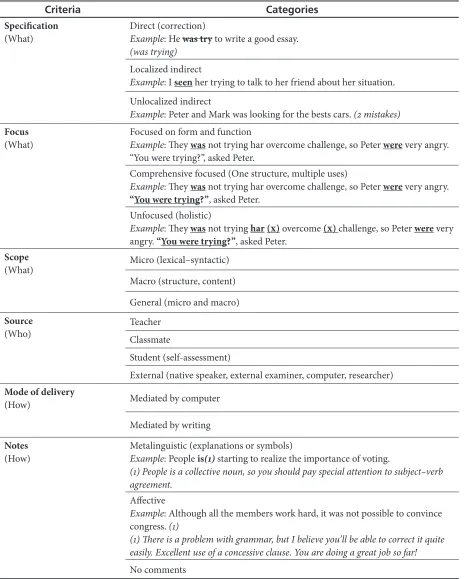
Table 3. A Comprehensive Written Corrective Feedback Typology
Criteria Categories
Specification
(What) Direct (correction)Example: He was try to write a good essay.
(was trying)
Localized indirect
Example: I seen her trying to talk to her friend about her situation. Unlocalized indirect
Example: Peter and Mark was looking for the bests cars. (2 mistakes)
Focus
(What) Focused on form and functionExample: They was not trying har overcome challenge, so Peter were very angry. “You were trying?”, asked Peter.
Comprehensive focused (One structure, multiple uses)
Example: They was not trying har overcome challenge, so Peter were very angry. “You were trying?”, asked Peter.
Unfocused (holistic)
Example: They was not trying har(x) overcome (x) challenge, so Peter were very angry. “You were trying?”, asked Peter.
Scope
(What) Micro (lexical–syntactic) Macro (structure, content) General (micro and macro) Source
(Who) TeacherClassmate
Student (self-assessment)
External (native speaker, external examiner, computer, researcher) Mode of delivery
(How) Mediated by computer Mediated by writing Notes
(How) Metalinguistic (explanations or symbols)Example: People is(1)starting to realize the importance of voting.
(1)People is a collective noun, so you should pay special attention to subject–verb agreement.
Affective
Example: Although all the members work hard, it was not possible to convince congress. (1)
(1) There is a problem with grammar, but I believe you’ll be able to correct it quite easily. Excellent use of a concessive clause. You are doing a great job so far!
Table 3 presents a synthesis of the interests of different researchers when studying the wcf. For example, the specification criterion includes the classic distinction between direct and indirect wcf proposed and used by various authors (Bitchener & Knoch, 2008, Ellis, 2009a, Muñoz & Ferreira, 2017, Tang & Liu, 2018). This distinction is the most widely recognized in this type of studies. Similarly, the focus of wcf has been taken into account in multiple studies (Farrokhi & Sattarpour, 2011, Muñoz & Ferreira, 2017, Salami & Raouf-Moini, 2013), which have sought to contrast the way in which the correction of specific errors differs from the correction that does not distinguish between the nature of the errors and delivers as much information as possible to the student. The third criterion is the scope of the wcf that has been taken from the distinction made by Cumming (2001), which has recently been considered by Al-Jarrah (2016). The criterion of source condenses the concerns of those researchers interested in determining the ways in which the effect of wcf varies, depending on who is the agent that delivers it (Diab, 2011; Miao et al., 2006; Yu & Hu, 2017). These studies may try to establish if the feedback given by a classmate is equally effective to that delivered by a teacher, for example. The fifth criterion identified for a comprehensive typology is the mode of delivery. This criterion has been proposed based on studies focused on the effect of the wcf delivered by means of a computer in contrast to the more usual written method (Ghazi & Zamanian, 2016; Kluger & Adler, 1993; Stevenson & Phakiti, 2014). Finally, with respect to the criterion of notes, it considers the inclusion as a variable of metalinguistic comments in the corrections (Bitchener & Knoch, 2008; Diab, 2015; Ellis, 2009a) and, from more recent studies, the affectivity involved and transmitted in these comments, which also has significant effects on student writing (Tang & Liu, 2018).
This classification allows describing in detail the choices of a teacher or researcher regarding the feed-back that will be given to the students. For example, a teacher could begin by opting for indirect localized
holistic feedback at the micro level. Then, this teacher can decide that this feedback should be given among students who will correct their writings using word processing software. Finally, the teacher could request that the students receive comments of a metalinguistic nature. Clearly, it is not possible to reach this level of specificity with typologies such as Ellis’s (2009a). With the proposed typology of the present article, a researcher who has previously identified a type of feedback as peer feedback could now specify it better as to increase the comparability of their study with others as well as the replicability.
In order to show in more detail the different dimen-sions that have been included in the proposal, each of the criteria incorporated in the typology is explained in the following paragraphs.
(a) Specification: This criterion refers to the clas-sic way in which the student is informed of an error. The proposed typology offers three categories: direct, indirect localized, and indirect unlocalized. The direct specification refers to the delivery of the correct form to the student where the error occurred or another nearby position. The indirect localized notes the occurrence of an error, without offering the correction.
(b) Focus: Regarding the focus, the presented typol-ogy distinguishes among three options. The first is feedback focused on form and function. This implies focusing on a structure, for example, the use of the indefinite or definite article and on only one of its uses. On the other hand, comprehensive wcf involves pro-viding feedback on all the functions of a particular form. Finally, a holistic focus would mean that the teacher gives feedback on all kinds of errors. It is worth mentioning that this distinction has been of interest for much research.
local level. On the other hand, the macro scope points to the feedback that seeks to prioritize the delivery of information regarding linguistic errors associated with the global coherence of the writing, such as the rhetorical organization. The general scope refers in this typology to the balanced combination of both scopes.
(d) Source: The feedback is usually assumed to be provided by the teacher, who may or may not be acting as the researcher. However, this can come from other agents within the classroom as the same student that writes, who can reflect after a while about their own writing or that of their classmates. In a similar fashion, wcf can be delivered by external agents such as the researcher or a native speaker who works as an assistant. Within this last category, the feedback generated by the computer can also be included. This may be delivered through techniques that implement natural language processing (nlp).
(e) Mode of delivery: The proposed typology includes two options. The first is the possibility of using the computer as a mediator. In its simplest material-ization, a teacher could correct a text written on the computer in Microsoft Word and make comments through the option available in the software; these could include hyperlinks to videos or web pages with more error information. The other mode is the most common: the use of the same piece of writing to communicate the student’s mistakes.
(f) Notes: Along with the direct or indirect wcf, more elaborate comments can be submitted. The three possibilities offered in the typology are metalinguistic comments, affective comments, and the absence of comments. In the case of metalinguistic comments these vary from the use of elaborated explanations that refer to particular moments of a class to the use of small descriptions that allude to a key rule. These comments can also allude to a grammatical structure by means of symbols such as wo = word order or inf = mistake with the infinitive. On the other hand, affective comments seek, among other
positive effects, to increase the motivation of the students, their interest in reviewing the feedback, and their confidence in writing in the l2. Finally, the category of no comments takes into account those studies in which the feedback does not include additional information for students.
Conclusion
Through the review of different proposals and empirical studies it has been possible to generate a synthesis of the dimensions involved in the precise characterization of wcf. The proposal generated in this article seems to be a clear advance towards a more comprehensive outlook of the phenomenon.
This proposal contributes to the study area in three significant ways. In the first place, it offers a clarifying resource regarding the factors involved in the in–depth characterization of the types of wcf that can be deliv-ered. This leads to broadening the view of the potential combinations between dimensions. In addition, the typology is useful for teachers who want to expand and deepen their understanding of wcf, which can result in varied formative assessment practices related to writ-ing. Finally, one of the great advantages of a typology of this type is to be able to thoroughly review previous and future studies in order to characterize well the feedback studied and thus improve the comparability of the results.
The provision of wcf is a technique that supports assessment for learning. Therefore, understanding both the factors considered for its delivery and its consequences should be one of the short-term goals for researchers in the area. It is to be hoped that the proposal in this article helps systematize wcf studies, so that the field continues progressing. In this way, teachers will have better tools to nourish the learning process of writing in l2.
References
Al-Jarrah, R. (2016). A suggested model of corrective feedback
provision. Ampersand, 3, 98–107. https://doi.org/10.1016/j.
amper.2016.06.003
Anderson, J. R. (1996). act: A simple theory of complex
cognition. American Psychologist, 51(4), 355–365. https://
doi.org/10.1037/0003-066X.51.4.355
Bitchener, J., & Ferris, D. R. (2012). Written corrective feedback
in second language acquisition and writing. Routledge. https://doi.org/10.4324/9780203832400
Bitchener, J., & Knoch, U. (2008). The value of written cor-rective feedback for migrant and international students.
Language Teaching Research, 12(3), 409–431. https://doi. org/10.1177/1362168808089924
Black, P., & William, D. (1998). Assessment and
class-room learning. Assessment in Education:
Prin-ciples, Policy and Practice, 5(1), 7–74. https://doi. org/10.1080/0969595980050102
Britton, J. (1970). Language and learning. University of
Miami Press.
Brooks, N. H. (1960). Language and language learning: Theory
and practice. Harcourt.
Chong, I. (2017). How students’ ability levels influence the
relevance of their feedback to peers: A case study. Assessing
Writing, 31, 13–23. https://doi.org/10.1016/j.asw.2016.07.002 Cumming, A. (2001). Learning to write in a second language:
Two decades of research. International Journal of English
Studies, 1(2), 1–23.
Dai, J., Raine, R. B., Roscoe, R., Cai, Z., & McNamara, D. S. (2011). The writing-pal tutoring system: Development
and design. Journal of Engineering and Computer
Innovations, 2(1), 1–11.
De Beaugrande, R.-A., & Dressler, W. U. (1997).
Introduc-ción a la lingüística del texto [Introduction to textual linguistics]. Ariel.
Diab, N. M. (2011). Assessing the relationship between different types of student feedback and the quality of revised
writing. Assessing Writing, 16(4), 274–292. https://doi.
org/10.1016/j.asw.2011.08.001
Diab, N. M. (2015). Effectiveness of written corrective feedback: Does type of error and type of correction matter?
Assessing Writing, 24, 16–34. https://doi.org/10.1016/j. asw.2015.02.001
Dikli, S., & Bleyle, S. (2014). Automated essay scoring feedback for second language writers: How does it compare to
instructor feedback? Assessing Writing, 22, 1–17. https://
doi.org/10.1016/j.asw.2014.03.006
Ellis, R. (2009a). A typology of written corrective feedback
types. elt Journal, 63(2), 97–107. https://doi.org/10.1093/
elt/ccn023
Ellis, R. (2009b). Corrective feedback and teacher develop-ment. l2 Journal, 1, 3–18.
Emig, J. (1977). Writing as a mode of learning. College
Composition and Communication, 28(2), 122–128. https:// doi.org/10.2307/356095
Everhard, C. (2015). The assessment–autonomy relationship.
In C. Everhard & L. Murphy (Eds.), Assessment and
autonomy in language learning (pp. 8–34). Palgrave Macmillan. https://doi.org/10.1057/9781137414380_2 Farrokhi, F., & Sattarpour, S. (2011). The effects of focused
and unfocused written corrective feedback on
gram-matical accuracy of Iranian efl learners. Theory and
Practice in Language Studies, 1(12), 1797–1803. https:// doi.org/10.4304/tpls.1.12.1797-1803
Fazio, L. L. (2001). The effect of corrections and commentaries on the journal writing accuracy of minority- and
majority-language students. Journal of Second Language Writing, 10(4),
235–249. https://doi.org/10.1016/S1060-3743(01)00042-X Ferreira-Cabrera, A. (2017). El efecto del feedback correctivo
feedback to improve students’ writing skills in sfl].
Colombian Applied Linguistics Journal, 19(1), 37–50. https://doi.org/10.14483/calj.v19n1.10220
Flower, L., & Hayes, J. R. (1981). A cognitive process theory of
writing. College Composition and Communication, 32(4),
365–387. https://doi.org/10.2307/356600
Ghazi, S., & Zamanian, M. (2016). The influence of asyn-chronous computer-mediated versus conventional corrective feedback on Iranian efl learners’ writing
accuracy. Journal of Studies in Learning and Teaching
English, 5(2), 169–181.
Han, Z. H. (2002). A study of the impact of recasts on tense
consistency in l2 output. tesol Quarterly, 36(4), 543–572.
https://doi.org/10.2307/3588240
Han, Y., & Hyland, F. (2019). Academic emotions in written
corrective feedback situations. Journal of English for
Academic Purposes, 38, 1–13. https://doi.org/10.1016/j. jeap.2018.12.003
Hattie, J., & Timperley, H. (2007). The power of feedback.
Review of Educational Research, 77(1), 81–112. https:// doi.org/10.3102/003465430298487
Iwashita, N. (2003). Negative feedback and positive evidence in task–based interaction: Differential effects on l2
development. Studies in Second Language Acquisition,
25(1), 1–36. https://doi.org/10.1017/S0272263103000019
Kang, E., & Han, Z. (2015). The efficacy of written corrective feedback in improving l2 written accuracy: A
Meta-analysis. The Modern Language Journal, 99(1), 1–17.
https://doi.org/10.1111/modl.12189
Kim, Y., & Emeliyanova, L. (2019). The effects of written corrective feedback on the accuracy of l2 writing: Comparing collaborative and individual revision
behavior. Language Teaching Research. https://doi.
org/10.1177/1362168819831406
Kluger, A. N., & Adler, S. (1993). Person- versus
computer-mediated feedback. Computers in Human Behavior,
9(1), 1–16. https://doi.org/10.1016/0747-5632(93)90017-M
Krashen, S. D. (1982). Principles and practice in second language
acquisition. Pergamon.
Kyle, K., & Crossley, S. (2017). Assessing syntactic sophis-tication in l2 writing: A usage-based approach.
Language Testing, 34(4), 513–535. https://doi. org/10.1177/0265532217712554
Lai, Y.-H. (2009). Which do students prefer to evaluate their
essays: Peers or computer program? British Journal
of Educational Technology, 41(3), 432–454. https://doi. org/10.1111/j.1467-8535.2009.00959.x
Laveault, D., & Allal, D. (Eds.). (2016). Assessment for learning:
Meeting the challenge of implementation. Springer. https:// doi.org/10.1007/978-3-319-39211-0
Lillo, J., & Sáez, K. (2017). La efectividad del feedback correctivo escrito en la adquisición de segundas lenguas [The effect of written corrective feedback in second language
acquisition]. Revista Signos, 50(94), 217–240. https://doi.
org/10.4067/S0718-09342017000200217
Long, M. H. (1996). The role of linguistic environment in second language acquisition. In W. C. Ritchie & T. K.
Bhatia (Eds.), Handbook of second language acquisition
(pp. 413–468). Academic Press.
Long, M. H., Inagaki, S., & Ortega, L. (1998). The role of implicit negative feedback in sla: Models and recasts
in Japanese and Spanish. The Modern Language Journal,
82(3), 357–371. https://doi.org/10.1111/j.1540-4781.1998.
tb01213.x
Lyster, R. (1998). Recasts, repetition and ambiguity in l2
class-room discourse. Studies in Second Language Acquisition,
20(1), 51–81. https://doi.org/10.1017/S027226319800103X
Lyster, R, & Ranta, L. (1997). Corrective feedback and learner uptake: Negotiation of form in communicative classrooms.
Studies in Second Language Acquisition, 19(1), 37–66. https://doi.org/10.1017/S0272263197001034
Lyster, R., Saito, K., & Sato, M. (2013). Oral corrective feedback
in second language classrooms. Language Teaching, 46(1),
1–40. https://doi.org/10.1017/S0261444812000365
McLaughlin, B. (1987). Theories of second language learning.
Edward Arnold.
Selinker, L. (1972). Interlanguage. International Review of Applied Linguistics in Language Teaching, 10(3), 209–231. https://doi.org/10.1515/iral.1972.10.1-4.209
Shang, H.-F. (2019). Exploring online peer feedback and automated corrective feedback on efl writing
perfor-mance. Interactive Learning Environments. https://doi.
org/10.1080/10494820.2019.1629601
Stevenson, M., & Phakiti, A. (2014). The effects of
computer-generated feedback on the quality of writing. Assessing
Writing, 19, 51–65. https://doi.org/10.1016/j.asw.2013.11.007 Tang, C., & Liu, Y.-T. (2018). Effects of indirect coded correc-tive feedback with and without short affeccorrec-tive teacher comments on l2 writing performance, learner uptake
and motivation. Assessing Writing, 35, 26–40. https://doi.
org/10.1016/j.asw.2017.12.002
Truscott, J. (1996). The case against grammar correction in
l2 writing classes. Language Learning, 46(2), 327–369.
https://doi.org/10.1111/j.1467-1770.1996.tb01238.x Warschauer, M., & Ware, P. (2006). Automated writing
evaluation: Defining the classroom research agenda.
Language Teaching Research, 10(2), 157–180. https://doi. org/10.1191/1362168806lr190oa
Yu, S., & Hu, G. (2017). Understanding university students’ peer feedback practices in efl writing: Insights from
a case study. Assessing Writing, 33, 25–35. https://doi.
org/10.1016/j.asw.2017.03.004
class. Journal of Second Language Writing, 15(3), 179–200.
https://doi.org/10.1016/j.jslw.2006.09.004
Milton, J. (2006). Resource-rich web-based feedback: Helping learners become independent writers. In
K. Hyland & F. Hyland (Eds.), Feedback in second
language writing: Contexts and issues (pp. 123–139). Cambridge University Press. https://doi.org/10.1017/ CBO9781139524742.009
Muñoz, B., & Ferreira, A. (2017). El feedback correctivo escrito indirecto en el aprendizaje de la forma compara-tiva de adjetivos en inglés [Indirect written corrective feedback in the learning of English comparatives].
Logos: Revista de Lingüística, Filosofía y Literatura,
27(1), 73–89. https://doi.org/10.15443/RL2706
Nishino, T., & Atkinson, D. (2015). Second language
writing as sociocognitive alignment. Journal of Second
Language Writing, 27, 37–54. https://doi.org/10.1016/j. jslw.2014.11.002
Pienemann, M. (1984). Psychological constraints on the
teachability of languages. Studies in Second Language
Acquisition, 6(2), 186–214. https://doi.org/10.1017/ S0272263100005015
Salami, M., & Raouf-Moini, M. (2013). The impact of focused and unfocused corrective feedback on written accuracy.
International Journal of Foreign Language Teaching and Research, 2(4), 32–41.
About the Author