English Language Teachers’ Oral Corrective Preferences
and Practices Across Proficiency Groups
Preferencias y acciones correctivas de docentes de inglés
entre grupos con competencias diferentes
Sajjad Sepehrinia
1
University of Tehran, Tehran, IranNahid Fallah
University of Kharazmi, Tehran, Iran
Soad Torfi
Islamic Azad University, Qazvin, Iran
Studies on oral error correction in second language acquisition have been tilted towards cognitive aspects ignoring the affective and practical dimensions. This study attempted to fill this gap by investigating the role of students’ proficiency levels in five English language teachers’ corrective behavior. Follow-up interviews were conducted with the observed teachers. The results showed that the teachers provided more corrections to less proficient learners though they preferred more correction for advanced learners and used mainly recast for both groups, avoiding explicit forms of correction. They were mainly concerned with the affective aspects of oral error correction and acted on their own value system and teaching experience. The findings carry important implications for teacher education programs and the studies in this regard.
Keywords: beliefs, emotional reactions, foreign language learning, oral corrective feedback, proficiency level Los estudios sobre la retroalimentación oral correctiva en la adquisición de una segunda lengua se han concentrado en los aspectos cognitivos, en detrimento de las dimensiones afectiva y práctica. Este estudio intenta llenar dicho vacío al explorar el papel que juega el nivel de competencia de los estudiantes en las prácticas correctivas de cinco docentes. Se llevaron a cabo entrevistas de seguimiento con los docentes participantes. Los resultados muestran que los profesores corrigieron más a los estudiantes menos avanzados, aunque prefirieron corregir a los más avanzados y evitar usar formas de corrección explícitas para ambos grupos. Los docentes estaban mayormente preocupados por los aspectos afectivos de la retroalimentación oral y actuaron de acuerdo con su propio sistema de valores y experiencia. Los resultados tienen importantes implicaciones para los programas de formación docente y para otros estudios similares.
Palabras clave: aprendizaje de lenguas extranjeras, creencias, nivel de competencia, reacción emocional, retroalimentación correctiva oral
Sajjad Sepehrinia · Email: [email protected]
Nahid Fallah https://orcid.org/0000-0003-1941-3326 · Email: [email protected] Soad Torfi · Email: [email protected]
How to cite this article (apa, 7th ed.): Sepehrinia, S., Fallah, N., & Torfi, S. (2020). English language teachers’ oral corrective preferences
and practices across proficiency groups. Profile: Issues in Teachers’ Professional Development, 22(2), 163–177. https://doi.org/10.15446/ profile.v22n2.82369
This article was received on September 25, 2019 and accepted on April 11, 2020.
Attribution-NonCommercial-NoDeriva-Introduction
Second language acquisition researchers and prac-titioners agree that teachers’ corrective behavior should be informed by certain factors. For instance, Yoshida (2008) found that teachers considered learners’ age as an important factor, and that they preferred to use recast to avoid embarrassing their adult students. Kai-vanpanah et al. (2012) found that most Iranian English as a foreign language (efl) teachers did not favor peer feedback in the Iranian context because, according to them, it created negative affective reactions, which, some have found (e.g., Sheen, 2008; Rassaei, 2013), is inhibitive to learners’ use of feedback. Therefore, it seems that teachers’ decisions about correction of errors is informed by the factors that have been rarely addressed in empirical studies. In other words, research-ers have been mainly preoccupied with cognitive and theoretical aspects of oral corrective feedback (ocf). Furthermore, few studies have juxtaposed research findings with teachers’ beliefs and practices to find the areas of inconsistency. The present study is an attempt to shed light specifically on the role of one of the factors (i.e., learners’ proficiency level)—which is believed to influence learners’ ability to benefit from feedback—in teachers’ correction preferences.
Background
The present study attempts to probe into teachers’ corrective behavior and examine the role of one of the factors believed to be influential in learners’ success in implementing correction to improve their interlanguage. Considering the purpose of the study, this section presents a review of some studies that have examined teachers’ corrective practice and preferences. Then, the gap existing in these studies, which the present study tries to fill, will be mentioned.
Teachers’ Corrective Preferences
Mackey et al. (2004) considered 18 experienced and inexperienced teachers’ use of incidental
focus-on-form techniques. Each teacher taught for half an hour during which their behavior was examined. Experienced teachers were found to use more preemptive focus on form, recasts, and explicit correction in comparison to the inexperienced teachers.
Using stimulated recall, Polio et al. (2006) also examined the relationship between teaching experience and corrective behavior. After a two-way information exchange activity, the videotaped interaction was played to each native speaker teacher. Each error and the teacher’s correction were marked as recast, negotiation, or ignore. The results showed that experienced teachers used more recasts (35% vs. 29%) but not more negotia-tions (9% vs. 11%). The difference was not significant, however. The cause of this small difference, they found, was that learners are likely to produce more language when talking with an experienced teacher because he or she uses more general statements and questions encouraging learners to speak.
In another study, Zyzik and Polio (2008) examined the occurrence of incidental focus on form using obser-vation, interview, and stimulated recall in the context of advanced-level literature classes. The results of their study were similar to those of Mackey et al. (2004) in that teachers preferred to use recast for correcting their learners’ errors. Their major reason was that it did not embarrass the learners. Accordingly, explicit correction occurred only once because all the three observed teachers believed that it might cause embarrassment. Authors speculated that other types of feedback that involve negotiation, in contrast to recast, might be more time-consuming.
a questionnaire followed by interviews with 20 of the students. The results were almost similar to the previous studies; recast was the most commonly used type of feedback. There was a mismatch between teachers’ and learners’ preferences in this regard; teachers had a high preference for implicit feedback (recast) while students disliked it and preferred explicit forms of correction.
Mori (2011) examined the role of teachers’ beliefs in their correction in more detail by observing and interviewing two English language teachers in Japan. One of the teachers used recast in 92% of the cases and the second teacher only in 5.7%. Learners’ emotional reactions, instructional focus, time constraints, and the frequency of errors were the influential factors in the first teacher’s corrections; his major priority was to avoid hurting learners’ self-confidence and to help them take risks and contribute more to the classroom discussions, which made recast a good choice for him. The second teacher’s students, however, were not willing to express their beliefs because they were very afraid of making mistakes. The larger number of students (35) in comparison with the first class (18) caused further inhibition in the students. Therefore, the teacher needed to “induce” or “coax” them to talk by “prompting” them to express themselves, and, via elicitation, to think of what structures, words, and idioms to use (14.3%). However, as the students were unwilling to risk talking and their proficiency level was quite low, the number of corrections involving the use of recast was limited (5.7%).
In a more recent study, Kamiya (2016) explored, via interviews and a single classroom observation, four native-speaking teachers’ stated beliefs and practices in providing ocf. The author also examined the role of experience in the correspondence between the teachers’ beliefs and actual corrective practices. The results showed that the teachers did not believe in the effectiveness of correction, particularly recast, which they considered as peripheral. They avoided explicit forms of correction in order to create a comfortable
learning environment for the students. The teachers preferred recasts, instead, which are, according to the teachers, not humiliating. A comparison between three teachers’ practices and their views pointed to the existence of a correspondence between the two, particularly in the case of experienced teachers.
Roothooft (2014) included more teachers in his study and tried to compare their beliefs with their practice. He investigated 10 Spanish teachers’ beliefs/ practices of corrective feedback through classroom observation and a following questionnaire for exploring their views. The findings from the study showed that although the teachers considered feedback to be important, they were not willing to interrupt their learners for correction and were concerned about the negative affective reactions that may develop following feedback. Furthermore, the teachers were not aware of how much and even what types of feedback they wanted to provide. The results also attested to the mismatch between belief and practice.
In a different study, Roothooft and Breeze (2016) also found clear mismatches, but this time between teachers’ and learners’ attitudes and preferences for correction. While the teachers believed errors should not be always corrected and showed a mixed attitude to immediate correction, the majority of their learners always expected to be corrected. The teachers believed correction may negatively influence learners’ self-confidence and also their fluency and were less inclined to use explicit forms of correction to ensure positive emotions and a positive reaction to their corrections. Their learners, in contrast, seemed to feel much more positive about explicit feedback forms.
The Focus of the Study
Teacher cognition research and practice have wit-nessed fundamental changes over the years. The field has gradually become concerned with the nature of teacher learning and the factors contributing to teachers’
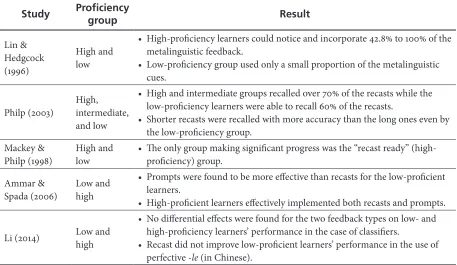
mentalities regarding various dimensions of teaching. Along this line, Borg (2003) reviewed research on teacher cognition and identified four factors feeding teacher cognition: previous learning, professional development initiatives, contextual factors, and experience. This line of inquiry, according to Borg, has been concerned with the way teachers conceptualize their practice. In the field of error correction, teachers’ conceptualization of their practice has received less attention. This might lead to considerable gaps between what researchers recom-mend and what practitioners do. As an instance, there are certain contradictions between teachers’ practices and research findings. For example, teachers use recast although it does not produce much learning particularly for less proficient learners (see Table 1). Besides, pro-ficiency level has been found to be related to learners’ preferences for feedback (Brown, 2009; Yang, 2016), but whether teachers differentiate between less and more proficient learners has not been touched upon.
Table 1. Studies on the Effect of Learners’ Language Proficiency Level and Their Use of Correction
Study Proficiency group Result
Lin & Hedgcock (1996)
High and low
• High-proficiency learners could notice and incorporate 42.8% to 100% of the metalinguistic feedback.
• Low-proficiency group used only a small proportion of the metalinguistic cues.
Philp (2003) High, intermediate, and low
• High and intermediate groups recalled over 70% of the recasts while the low-proficiency learners were able to recall 60% of the recasts.
• Shorter recasts were recalled with more accuracy than the long ones even by the low-proficiency group.
Mackey &
Philp (1998) High and low • The only group making significant progress was the “recast ready” (high-proficiency) group.
Ammar &
Spada (2006) Low and high
• Prompts were found to be more effective than recasts for the low-proficient learners.
• High-proficient learners effectively implemented both recasts and prompts.
Li (2014) Low and high
• No differential effects were found for the two feedback types on low- and high-proficiency learners’ performance in the case of classifiers.
Few studies (e.g., Kennedy, 2010) have considered whether the level of proficiency influences teachers’ corrective behavior. Kennedy used classroom data from the childes database and analyzed them in terms of the type of errors, type of feedback, and rate of learner uptake and repair for each proficiency group. The teacher recorded in the transcripts was an esl teacher whose first language (l1) was English. There were 15 Grade 1 esl learners. Kennedy found that the teacher used recast mainly for the low-proficiency group and elicitation-like types of feedback, which require self-correction, for the Mid/High proficiency groups. Kennedy’s study suffers certain shortcomings such as the use of a limited sample population: She used data from just one teacher.
Considering the importance of informing teachers of the empirical findings (Roothooft, 2014), there is, first, a need to see if teachers’ practice reflects the research findings in this regard. Therefore, the present study attempted to fill this gap by addressing the following research questions:
1. Is there any relationship between learners’ level of proficiency and the amount of ocf preferred by teachers?
2. Is there any relationship between learners’ level of proficiency and the types of ocf preferred by teachers? 3. Is there any correspondence between teachers’
views and practice with regard to the amount and types of correction (to be) used for the two proficiency groups?
Method
Participants
This is an observational and survey-based study evaluating language teachers’ practices and perceptions of oral error correction. This study was carried out in two private language institutes in Tehran, Iran. The participants included five efl teachers and 84 learners. The teacher participants had at least two years of teaching experience in conversation-based classes in private language institutes.
They had either a ba (n = 3) or ma (n = 2) in applied linguistics. The number of students in the classrooms was limited (about 10 in each class) because the courses were all conversation-based. The participants were male (n = 39) and female (n = 45) efl learners ranging in age from 12 to 31. They were pre-intermediate (n = 43) and advanced learners (n = 41) according to the institutes’ classification, which was based on written exams and oral interviews at the beginning of each semester. All the learners had also received formal foreign language instruction either at schools or universities.
Instruments and Procedure
Results and Discussion
The findings will be presented in two parts. The first part reports on the amount of correction used and preferred by the observed teachers for each proficiency group. The second part deals with the types of feedback used and preferred for the two proficiency groups. Finally, the teachers’ beliefs are juxtaposed with their practice.
Amount of Correction
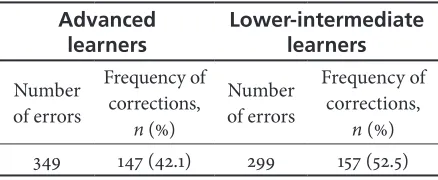
To find the amount of correction used in practice, almost all the utterances made by the students that had at least one error were reported. Since the focus of the present study was on the different ways of error treatment by the teachers, we will report both the number of errors followed by feedback and errors that did not receive any correction (i.e., non-corrections). Table 2 provides a report on the number of errors made by each proficiency group and the frequency of corrections made by the teachers.
Table 2. Frequency of Errors and Corrections Across Proficiency Groups
Advanced
learners Lower-intermediate learners
Number of errors
Frequency of corrections,
n (%)
Number of errors
Frequency of corrections,
n (%) 349 147 (42.1) 299 157 (52.5)
As shown in Table 2, the advanced learners made more errors than the lower-intermediate ones. This was because they had a more active contribution to the raised discussions considering their higher ability to express themselves. However, when the number of words was compared with the number of errors for the lower-intermediate and advanced groups (70 errors in every 1,000 words vs. 111 errors in every 1,000 words, respectively), the proportion of words to errors was higher for the lower-intermediate group meaning that they, in fact, made more errors. Naturally, similar to the studies shown in Table 1,
the teachers made more corrections for the lower-intermediate group.
Overall, although the teachers provided more corrections for the lower proficiency group during the observations, their beliefs were more consistent with the results of empirical studies. The results of these studies (e.g., Ammar & Spada, 2006; Kartchava & Ammar, 2014; Lyster, 2001, 2004; Lyster & Ranta, 1997; Mackey & Philp, 1998; Martoccio, 2017; Sheen, 2006; Trofimovich et al., 2007) confirm the teachers’ claim that lower-intermediate learners have the lowest rate of implementation of feedback. Practice, however, does not necessarily follow exact beliefs. In fact, the teachers seemed to be mainly concerned about the practical aspects of providing feedback and learners’ emotional reaction to their correction which, according to them, influences their use of feedback. In other words, their differentiation between less and more proficient learners was mainly related to the different emotional reactions the teachers believed they show to correction; the more proficient the learners are, the less sensitive they will be to correction. Vásquez and Harvey (2010) and Kartchava et al. (2018) also found that the teachers in their teacher education program
initially emphasized the affective dimension of error correction. Roothooft and Breeze (2016) came up with a similar finding. However, in the present study, concern about creating negative emotions, as well as the context, played a determining role; the reason for using fewer corrections for the advanced learners was that it was not always possible to interrupt the advanced learners due to their higher fluency.
Types of Feedback Preferred
The results related to the types of feedback used by the observed teachers, as presented in Table 4, indicate that the frequency of recasts is much higher in both proficiency groups and the teachers were less inclined to use explicit forms of correction. As one of the teachers noted: “Explicit forms of correction targeted at the individual students might make them feel exposed to others’ judgment.” Rahimi and Zhang (2016) also found that less experienced teachers did not favor explicit correction, elicitation, and metalinguistic feedback. Furthermore, the teachers generally used output-prompting feedback types (i.e., elicitation and
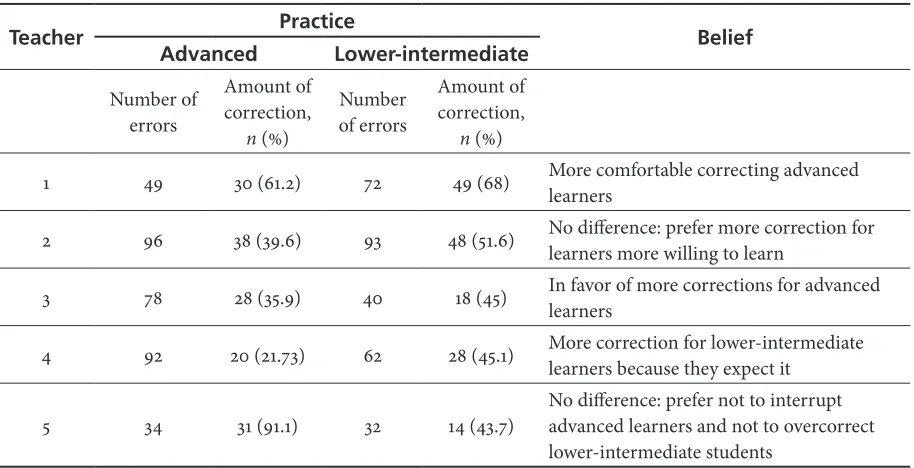
Table 3. Frequency of Errors and Corrections by Each Teacher Across Proficiency Groups
Teacher Practice Belief
Advanced Lower-intermediate
Number of errors
Amount of correction,
n (%)
Number of errors
Amount of correction,
n (%)
1 49 30 (61.2) 72 49 (68) More comfortable correcting advanced learners
2 96 38 (39.6) 93 48 (51.6) No difference: prefer more correction for learners more willing to learn
3 78 28 (35.9) 40 18 (45) In favor of more corrections for advanced learners
4 92 20 (21.73) 62 28 (45.1) More correction for lower-intermediate learners because they expect it
clarification request), though much less frequently, for the advanced learners. This was consistent with the findings of studies (e.g., Ammar & Spada, 2006; Li, 2014; Mackey & Philp, 1998; Philp, 2003); elicitation has been found to be more beneficial to more profi-cient learners and less helpful for the low-proficiency learners; as Long (2007) puts it, elicitation requires
self-correction which requires a level of knowledge that low-proficiency students lack. With regard to input-providing types of feedback (i.e., recast, metalinguistic feedback, and explicit correction), the teachers used recast and metalinguistic feedback almost equally for both groups but used explicit correction more for the lower-intermediates.
Table 4. Distribution of Feedback Types for Advanced and Lower-Intermediate Groups
Group Feedback type
Recast,
n (%) Elicitation,n (%) feedback, Metalinguistic n (%) correction, Explicit n (%) request, Clarification n (%) Advanced 110 (74.8) 12 (8.2) 10 (6.8) 11 (7.5) 4 (2.7)
Lower-intermediate 121 (77.07) 7 (4.45) 12 (7.65) 17 (10.83) 0
Table 5. Distribution of Feedback Types Across Each Proficiency Group
Teacher Group
Feedback type Belief
Recast,
n (%) Elicitation, n (%)
Metalinguistic feedback,
n (%)
Explicit correction,
n (%)
Clarification request,
n (%)
1
Advanced 17 (56.67) 5 (16.67) 7 (23.33) 1 (3.33) 0 Metalinguistic feedback for lower-intermediate group and recast for advanced group
Lower-intermediate 40 (81.64) 4 (8.16) 3 (6.12) 2 (4.08) 0
2
Advanced 36 (94.74) 0 0 0 2 (5.26) Recast particularly for lower-intermediate groups / Generally no difference between proficiency groups Lower–
intermediate 35 (72.92) 3 (6.25) 4 (8.33) 6 (12.50) 0
3
Advanced 22 (68.57) 0 2 (7.14) 4 (14.29) 0 Recast and explicit correction for advanced group Lower–
intermediate 14 (77.78) 0 2 (11.11) 2 (11.11) 0
4
Advanced 16 (80) 2 (20) 0 0 2 (20)
No difference between the two groups Lower–
intermediate 22 (78.57) 0 0 6 (21.43) 0
5
Advanced 19 (61.29) 5 (16.13) 1 (3.23) 6 (19.35) 0 Indirect forms of correction for lower-intermediate group / Generally, no difference between the groups Lower–
Individually, the observed teachers had different practices and beliefs (see Table 5). Out of the corrections Teacher 1 made for the lower-intermediate group, 81% was in the form of recast though she believed “recast is not beneficial to low-proficiency learners and even if they are corrected by recasting, they will not understand what was wrong with their utterance.” She also used metalinguistic feedback more for advanced learners though she preferred metalinguistic feedback (in belief) for the lower-intermediate group.
Teacher 2 used more recasts for the advanced learners; he preferred to use recast particularly for the lower-intermediate learners believing that “correc-tions should be made indirectly [using recast] and the feedback should be delayed no matter at what level of proficiency the learners are.” This was because he pre-ferred “not to interrupt the learners during classroom discussion,” which made him rarely use other types of feedback.
The feedback type highly preferred by Teacher 3 was also recast, which she believed “should be used mainly for higher-proficiency learners because they are better able to benefit from it due to their higher level of knowledge.” She also asserted that explicit correction is also more appropriate for advanced learners and might hurt lower-intermediate learners’ self-confidence. During the observations, however, as shown in Table 5, she used more recasts for the lower-intermediate learners. She used more explicit corrections for her advanced learners (14.29%) though. Teacher 3’s concern about her students’ emotional reaction was also reflected in her avoidance of “challenging” feedback types, that is, elicitation and clarification request (see Table 5).
Teacher 4 used recast for both proficiency groups. She used elicitation and clarification request only for advanced learners, though quite rarely, despite the fact that she mentioned in the interview that she does not differentiate between the two groups. She also used explicit correction very rarely and only for the lower group, because she believed it might make her students
less willing to talk as “direct forms of correction might sound like reproaching to my students.”
Teacher 5’s reluctance to interrupt the learners was reflected in her use of recast due to its unobtrusive nature. This was more so, according to her, in the case of her less proficient students. She pointed out:
Less proficient students normally show a negative reac-tion to feedback. This might be partly because of their little learning experience; they have been less exposed to corrective feedback as compared to advanced learners… I prefer to use less correction and indirect forms of correction.
This was observed in her practice; she used fewer corrections and mainly recast for correcting the lower-intermediate group. She used elicitation and more explicit correction for the advanced group but more metalinguistic feedback for the lower-intermediate learners.
The results were generally indicative of the domi-nance of recast irrespective of the learners’ proficiency level. This result is consistent with the findings of previ-ous studies (Kamiya, 2016; Lee, 2013; Lyster & Ranta, 1997; Roothooft, 2014; Roothooft & Breeze, 2016; Zyzik & Polio, 2008), which also found that recast is the most frequently used feedback type among teachers. According to the results of the present study, there was no convergence between the teachers in this respect; some used it more for the advanced (e.g., Teacher 2) and some for the lower-intermediate group (e.g., Teachers 1, 3, and 5).
The reasons behind the choice of recast were similar to those of the teachers in the previous studies (e.g., Kamiya, 2016; Mori, 2011; Roothooft, 2014; Zyzik & Polio, 2008) but different for the two proficiency groups.
used this feedback type mainly because of its practical advantages and unobtrusive nature; because advanced learners talked more fluently, the teachers preferred to use recast in order not to interrupt them in the middle of conversation. Most of the teachers were also aware of the disadvantages of recast and mentioned, though on the periphery, its ambiguous nature—particularly for the lower-intermediate learners—and believed it does not benefit them because they do not notice it. However, its practical advantages and the teachers’ great concern about the learners’ emotional reaction, as in the previous studies (Kamiya, 2016; Roothooft, 2014; Roothooft & Breeze, 2016), made them ignore its disadvantages. This concern was higher in the case of lower-intermediate students as the teachers used recast even more frequently with them.
Another reason for the overuse of recast for the lower-intermediate learners might be the teachers’ misconception about how learners might negatively react to explicit forms of correction. This, as pointed out by Borg (2003), might have something to do with the teachers’ previous experience as l2 learners. They might avoid using the techniques they would not have favored themselves as language learners. Explicit cor-rection, nevertheless, does not always result in negative emotions. Tavakoli and Zarrinabadi (2016) found that explicit feedback not only does not produce a negative response but promotes learners’ willingness to talk and even decreases their anxiety and increases their communication competence. Yang (2016), as another instance, discovered that learners generally favored explicit correction and metalinguistic feedback on all types of errors.
In the case of the advanced learners, however, as it was already mentioned, the main reason for the overuse of recast and less frequent use of other more explicit forms of correction was the fact that advanced learners were more fluent in speaking and it was not possible to interrupt them as much in the middle of conversation. In fact, the teachers did not favor interrupting the
learners using explicit forms of correction when they were talking, which they believed, would be discouraging and make them lose track of what they were trying to say. Another reason, however, might be the high frequency of errors. According to Mori (2011), the more frequent the errors are, the more implicit the corrections become. Overall, it seemed that the teachers preferred to use this feedback type due to its emotional and practical advantages for lower and higher proficiency groups, not because it produces better learning; it does not challenge or embarrass the learners and it does not interrupt them in the middle of conversation.
The findings were also indicative of a lack of cor-respondence between the teachers’ views and their corrective practice with the teachers preferring more feedback for advanced learners but using more correc-tions for the lower-intermediate group and pointing to the ineffectiveness of recasting less proficient learners’ errors but still using it. This finding is in line with the findings of other studies (e.g., Basturkmen, 2012; Roothooft, 2014). In her review on the congruity/incongruity of teachers’ beliefs and practices, Basturkmen (2012) reported the lack of a direct consonance between beliefs and practice, finding that contextual barriers and curricular constraints impeded the connection between beliefs and practices. This finding seems to support the claim made by Borg (2003, 2010) in the sense that context makes a cardinal contribution to shaping teachers’ thought processes. In the case of the present study, the conversation-based activities and also the indirect nature of recast, which makes it less embarrassing, made it practically an ideal choice for correcting the errors.
Conclusion
The perceptions of the participating teachers were different, however, across the proficiency groups; they used fewer corrections and mainly recast for advanced learners because they were more fluent and it was less possible to interrupt them; they used more corrections, more recasts but fewer explicit forms of correction on fear of causing negative emotional reactions in the less proficient learners. This also caused an inconsistency between their beliefs and practice; too much concern about learners’ emotional reaction led the teachers to use those feedback types that, according to them, less proficient learners have difficulty noticing (i.e., recast) and to avoid using other types of correction. On this basis, it seemed that previous learning experience, context, and experience play a more determining role and professional development programs do not seem to have a prominent place. The teachers’ practice was not particularly informed by research findings thus causing an inconsistency between research findings and teachers’ practice. This finding points to the need for dispelling teachers’ misconceptions about how learners may react to correction and informing them about the results of studies and the benefits of other types of feedback for different proficiency groups in the framework of professional development programs, which, as pointed out by Borg (2003), play a determining role in forming teachers’ cognitive processes. As Kartchava et al. (2018) noted, teachers’ limited knowledge “about how, when, and in what amounts to provide feedback prevents them from reconciling their beliefs with classroom practices” (p. 238).
Researchers, on the other side, seem to have been mainly concerned with the cognitive aspects of learning thereby limiting themselves to empirical and, in most of the cases, laboratory-based studies that examine the effectiveness of certain types of corrective feedback; with regard to proficiency level, as it was mentioned in the review section, empirical studies have compared the efficacy of different feedback types in lower and higher proficiency groups. The results of these studies,
according to Ellis et al. (2006), might not be generaliz-able to the classroom context. In fact, the lower effect size values for classroom-based observational studies on ocf (Lyster et al., 2013) might be an indication of the complexities and the potential intervening variables related to the teachers’ way of correction. Some of these complexities and intervening variables might be related to practical considerations and learners’ reaction to teacher feedback; in the case of the present study, proficiency level had a role to play in teachers’ corrective practice directing the teachers to use more implicit correction due to practical considerations in the case of the advanced learners and emotional considerations in the case of less proficient learners. Accordingly, researchers might do well to draw on teachers’ experiences and take them as initiatives for more qualified research and to examine the role of these aspects of correction in learners’ ability to implement teacher correction. For instance, the researchers could investigate and compare lower and higher proficiency groups’ emotional reaction to correction to find the possible differences between the two proficiency groups in this respect. Furthermore, despite the affective differ-ences between adult and younger learners (Roothooft & Breeze, 2016; Yoshida, 2008), few studies, if any, have compared their use of feedback. Few studies (Rassaei, 2013; Sheen, 2008) have also examined the effect of negative emotions on learners’ use of feedback.
References
Ammar, A., & Spada, N. (2006). One size fits all? Recasts,
prompts, and l2 learning. Studies in Second Language
Acquisition, 28(4), 543–574. https://doi.org/10.1017/ S0272263106060268
Basturkmen, H. (2012). Review of research into the correspondence between language teachers’ stated
beliefs and practices. System, 40(2), 282–295. https://
doi.org/10.1016/j.system.2012.05.001
Borg, S. (2003). Teacher cognition in language teaching: A review of research on what language teachers think,
know, believe, and do. Language Teaching, 36(2), 81–109.
https://doi.org/10.1017/S0261444803001903
Borg, S. (2010). Language teacher research engagement.
Language Teaching, 43(4), 391–429. https://doi. org/10.1017/S0261444810000170
Brown, A. V. (2009). Students’ and teachers’ perceptions of effective foreign language teaching: A comparison
of ideals. The Modern Language Journal, 93(1), 46–60.
https://doi.org/10.1111/j.1540-4781.2009.00827.x Ellis, R., Loewen, S., & Erlam, R. (2006). Implicit and explicit
corrective feedback and the acquisition of l2 grammar.
Studies in Second Language Acquisition, 28(2), 339–368. https://doi.org/10.1017/S0272263106060141
Jean, G., & Simard, D. (2011). Grammar teaching and learning in
l2: Necessary, but boring? Foreign Language Annals, 44(3),
465–492. https://doi.org/10.1111/j.1944-9720.2011.01143.x Kaivanpanah, S., Alavi, S. M., & Sepehrinia, S. (2012).
Preferences for interactional feedback: Differences
between learners and teachers. The Language Learning
Journal, 43(1), 74–93. https://doi.org/10.1080/09571736 .2012.705571
Kamiya, N. (2016). The relationship between stated beliefs and classroom practices of oral corrective feedback.
Innovation in Language Learning and Teaching, 10(3), 206–219. https://doi.org/10.1080/17501229.2014.939656 Kartchava, E., & Ammar, A. (2014). The noticeability and
effectiveness of corrective feedback in relation to target
type. Language Teaching Research, 18(4), 428–452. https://
doi.org/10.1177/1362168813519373
Kartchava, E., Gatbonton, E., Ammar, A., & Trofimovich, P. (2018). Oral corrective feedback: Pre-service English as a second language teachers’ beliefs and practices.
Language Teaching Research, 24(2), 220–249. https:// doi.org/10.1177/1362168818787546
Kennedy, S. (2010). Corrective feedback for learners of
varied proficiency levels: A teacher’s choices. tesl
Canada Journal, 27(2), 31–50. https://doi.org/10.18806/ tesl.v27i2.1054
Lee, I. (2013). Research into practice: Written corrective
feedback. Language Teaching, 46(1), 108–119. https://
doi.org/10.1017/S0261444812000390
Li, S. (2014). The interface between feedback type, l2 proficiency, and the nature of the linguistic target.
Language Teaching Research, 18(3), 373–396. https:// doi.org/10.1177/1362168813510384
Lin, Y.-H., & Hedgcock, J. (1996). Negative feedback incorporation among high-proficiency and low-proficiency Chinese-speaking learners of Spanish.
Language Learning, 46(4), 567–611. https://doi. org/10.1111/j.1467-1770.1996.tb01353.x
Long, M. H. (2007). Problems in sla. Lawrence Erlbaum.
Lyster, R. (2001). Negotiation of form, recasts, and explicit correction in relation to error types and learner repair
in immersion classrooms. Language Learning, 51(s1),
265–301. https://doi.org/10.1111/j.1467-1770.2001. tb00019.x
Lyster, R. (2004). Differential effects of prompts and
recasts in form-focused instruction. Studies in Second
Language Acquisition, 26(3), 399–432. https://doi. org/10.1017/S0272263104263021
Lyster, R., & Ranta, L. (1997). Corrective feedback and learner uptake: Negotiation of form in
commu-nicative classrooms. Studies in Second Language
Acquisition, 19(1), 37–66. https://doi.org/10.1017/ S0272263197001034
Lyster, R., Saito, K., & Sato, M. (2013). Oral
correc-tive feedback in second language classrooms.
Mackey, A., & Philp, J. (1998). Conversational interaction and second language development: Recasts, responses,
and red herrings? Modern Language Journal, 82(3),
338–356. https://doi.org/10.1111/j.1540-4781.1998. tb01211.x
Mackey, A., Polio, C., & McDonough, K. (2004). The relationship between experience, education and teachers’ use of incidental focus-on-form techniques.
Language Teaching Research, 8(3), 301–327. https:// doi.org/10.1191/1362168804lr147oa
Martoccio, A. (2017). How does prior explicit knowledge affect the efficacy of explicit instruction and feedback?
The case of the personal a in l2 Spanish. Language
Teaching Research, 22(4), 379–397. https://doi. org/10.1177/1362168816689802
Mori, R. (2011). Teacher cognition in corrective feedback in
Japan. System, 39(4), 451–467. https://doi.org/10.1016/j.
system.2011.10.014
Philp, J. (2003). Constraints on “noticing the gap”: Nonnative
speakers’ noticing of recasts in ns–nns interaction.
Studies in Second Language Acquisition, 25(1), 99–126. https://doi.org/10.1017/S0272263103000044
Polio, C., Gass, S., & Chapin, L. (2006). Using stimulated recall to investigate native speaker perceptions in
native–nonnative speaker interaction. Studies in
Second Language Acquisition, 28(2),237–267. https:// doi.org/10.1017/S0272263106060116
Rahimi, M., & Zhang, L. J. (2016). The role of incidental unfocused prompts and recasts in improving English
as a foreign language learners’ accuracy. Language
Learning Journal, 44(2), 257–268. https://doi.org/10 .1080/09571736.2013.858368
Rassaei, E. (2013). Corrective feedback, learners’ perceptions, and second language development.
System, 41(2), 472–483. https://doi.org/10.1016/j. system.2013.05.002
Roothooft, H. (2014). The relationship between adult efl teachers’ oral feedback practices and their beliefs.
System, 46(1), 65–79. https://doi.org/10.1016/j. system.2014.07.012
Roothooft, H., & Breeze, R. (2016). A comparison of efl teachers’ and students’ attitudes to oral corrective
feedback. Language Awareness, 25(4),318–335. https://
doi.org/10.1080/09658416.2016.1235580
Sheen, Y. (2006). Exploring the relationship between
characteristics of recasts and learner uptake.
Lan-guage Teaching Research, 10(4), 361–392. https://doi. org/10.1191/1362168806lr203oa
Sheen, Y. (2008). Recasts, language anxiety, modified
output, and l2 learning. Language Learning, 58(4), 835–
874. https://doi.org/10.1111/j.1467-9922.2008.00480.x Tavakoli, M., & Zarrinabadi, N. (2016). Differential effects of explicit and implicit corrective feedback on efl
learners’ willingness to communicate. Innovation
in Language learning and teaching, 12(3), 247–259. https://doi.org/10.1080/17501229.2016.1195391 Trofimovich, P., Ammar, A., & Gatbonton, E. (2007). How
effective are recasts? The role of attention, memory,
and analytical ability. In A. Mackey (Ed.),
Conversa-tional interaction in second language acquisition (pp.
171–195).Oxford University Press.
Vásquez, C., & Harvey, J. (2010). Raising teachers’ awareness about corrective feedback through research
replication. Language Teaching Research, 14(4), 421–
443. https://doi.org/10.1177/1362168810375365 Yang, J. (2016). Learners’ oral corrective feedback
preferences in relation to their cultural background,
proficiency level and types of error. System, 61, 75–86.
https://doi.org/10.1016/j.system.2016.08.004 Yoshida, R. (2008). Teachers’ choice and learners’
preference of corrective feedback types. Language
Awareness, 17(1), 78–93. https://doi.org/10.2167/la429.0 Zyzik, E., & Polio, C. (2008). Incidental focus on
form in university Spanish literature courses. The
About the Authors
Sajjad Sepehrinia is a phd graduate in applied linguistics from University of Tehran. His research interests include foreign language teaching, teachers’ beliefs, focus on form, oral corrective feedback and development of explicit and implicit linguistic knowledge. He has published papers in international and national journals on the mentioned topics.
Nahid Fallah is an assistant lecturer at the University of Kashan. She has published papers on critical discourse analysis, teachers’ beliefs and corrective feedback and has presented papers on discourse and classroom interaction in different national conferences. Her research interests are classroom discourse analysis, corrective feedback, and critical discourse analysis.
Appendix: Guiding Questions for the Interview
With the Participating Teachers
To what extent, do you believe correction is effective in learning? How often do you provide correction? Please explain. Does learners’ proficiency influence the amount of correction you provide?
What is the most important factor you take into account in correction? Is proficiency a determining factor? How do you differentiate between your advanced and lower proficiency learners in the way you correct them? Why?
How do you normally correct your advanced and lower-intermediate learners’ errors? What type(s) of feedback do you prefer? Do you think it is (they are) effective? Is there any difference, you think, between lower-intermediate and advanced learners in their ability to benefit from any of these feedback types you use in your classes?