Development of seeder for mixed planting of corn and soybeans
Seung Min Woo
,
Daniel Dooyum Uyeh
,
Moon Sang Sagong
,
Yu Shin Ha
* (Department of Bio Industrial Machinery Engineering, Kyungpook National University, Daegu 41566, Korea)Abstract: Corn and soybeans should be sown between 5 cm and 10 cm apart in mixed cultivation to increase protein content and improve productivity of the forage. However, existing sowers cannot plant at intervals of less than 20 cm. Consequently, mixed cultivation of corn and soybeans is currently performed by first sowing corn seeds with a tractor and then manually planting soybean seeds. This method results in irregular intervals between the seeds, it is laborious and time consuming. This study aimed at developing a seeder that can simultaneously, precisely and efficiently plant corn and soybean. The geometrical and rheological properties of corn and soybeans were initially measured. The seed conveying equipment were designed using the EDEM software. The sowing interval between seeds, depth of soil over planted seed, and sowing performance were analyzed. The EDEM simulation results indicated that a 6-mm-wide and 3-mm-deep grooved seed-delivering roller had the highest particle mobility of the designs considered, with a 2.5% misplanting rate. A performance test showed that no misplanting occurred in the sections sowed with soybean seeds at a seeding interval that averaged 32 mm (321 seeds sown in 10 m) and that misplanting occurred in one section sowed with corn at a seeding interval that averaged 247 mm (40 seeds sown over 10 m). The sowing efficiency for both corn and soybeans was found to be 0.42 h/hm2. The average depth of soil over seed was 32.7 mm for soybean and 39.7 mm for corn. These average depths are within the stipulated range for the depth of soil over seed, which is 5 to 10 times the seed size. This study developed an efficient seeding machine that can simultaneously plant soybean and corn precisely, consequently improving forage yield and saving man-hours.
Keywords: corn, geometric characteristics, mixed planting, seeder, soybean
DOI: 10.3965/j.ijabe.20171003.2543
Citation: Woo S M, Uyeh D D, Sagong M S, Ha Y S. Development of seeder for mixed planting of corn and soybeans. Int J Agric & Biol Eng, 2017; 10(3): 95–101.
1 Introduction
Various factors, such as increasing bio-energy
production, energy shortages, increasing demand for
Received date: 2016-04-20 Accepted date: 2016-12-11
Biographies: Seung Min Woo, PhD candidate, research interests: processing of agricultural products, machinery and facilities for livestock, bio-energy, Email: [email protected]; Daniel Dooyum Uyeh, PhD candidate, research interests: processing of agricultural products, machinery and facilities for livestock, bio-energy, Email: [email protected]; Moon Sang Sagong, MSc, research interests: processing of agricultural products, machinery and facilities for livestock, bio-energy, Email: [email protected].
*Corresponding Author: Yu Shin Ha, PhD, Professor, research interests: processing of agricultural products, machinery and facilities for livestock, bio-energy. 107, College of Agriculture and Life sciences building 3, Kyungpook National University, 80, Daehakro, Daegu 41566, Korea. Email: [email protected].
grains in Asia (particularly China) and climate change,
have caused the international prices of grains to rise
sharply. This has led to increases in the prices of
assorted feeds[1]. Advancing solutions to the high
production costs of assorted feeds used by livestock farms
involves developing high-quality bulky feed and
expanding the base for its production. Mixed cultivation
of corn, a gramineous crop used in bulky feeds, with
legume crops can correct issues caused by eutrophic
environments[2] and chemical fertilizers used to increase
output[3-5]. This can increase the quantity and protein
content achieved in comparison to single cultivation[6-8].
Mixed cultivation can also increase output by preventing
lodging of corn during the rainy season as a result of the
vine characteristic of soybean plants. It has been
reported that mixed cultivation of corn and soybeans,
produced, achieves high productivity because the soybean
vines can climb easily, wrapping around the corn stalks
when narrowly seeded at intervals of 5-10 cm[8].
However, a mechanized seeder that can sow both types of
seeds simultaneously and control the seeding intervals of
both crops has not been developed. Consequently,
mixed seeding is currently performed by seeding
soybeans after seeding corn, which using the available
single seeders that have been developed [9,10]. This is an
imprecise and laborious procedure that consumes vital
man-hours and produces relatively low yields.
Mechanization is therefore needed to achieve precise
seeding of the grains at appropriate spacing and make
efficient use of time and resources, especially in regions
with limited farm manpower.
In a study related to the development of a seeder for
coarse fodder seed, Rhee et al.[11] calculated the grain size,
a characteristic with units of length that represents the
shade factor, and used the grain size parameter to provide
data on the size and shape of seeds necessary for
designing a seeder. Soybeans were identified as being
round in shape, while corn was identified as being a
semi-oblate shape. Related studies have been conducted
on development of a precision-planting roller-shaped
seed-metering device[10,12-14], a seed metering system[15]
and a planting-furrow roller-type seed-metering
device[9,16,17]. The results of these studies showed that
the roller type is the most common type of seeder and that
seed metering devices of the vacuum suction type,
inclined-plate type, belt type, and vertical rotor type are
also often used. A roller-type seeder has furrows cut
into the surface of a roller at regular intervals, and these
furrows discharge seeds as the roller rotates. This type
of seeder, which can be used with different types of seeds
by changing the roller, is suitable for speedy seeding and
is easy to fabricate because of its simple structure. Use
of a roller-type seeder was judged to be appropriate for
the purposes of this study.
To improve the output achieved by mixed cultivation
of soybeans and corn, the metering rate should be
controlled so that one or two grain(s) can be seeded with
a grain of corn. Above all, the seeding interval should
be maintained within the range of 5-10 cm, and consistent
intra-row spacing must also be maintained. This study
set out to develop a seeding machine by designing a seed
metering device based on an analysis of the geometric
and mechanical characteristics of corn and soybean
materials and the results of particle behavior simulation
conducted using the EDEM software. The results were
used to develop a combined seeder that can plant both
grains simultaneously. Testing was also conducted to
assess the performance of the seeding machine in sowing.
2 Materials and methods
2.1 Test materials assessment
Seed sizes for soybeans (Glycine max) and corn (Zea
mays) vary depending on the species. In general,
soybeans are round in shape, while corn seeds are
irregular semi-oblate shapes[8]. Considering the
suitability of bulky feed seeds used in mixed cultivation,
the soybean type selected for use in this study was
Chookdu 1 (this was developed from a cross between
wild soybean PI483463 and cultivated soybean
Hutcheson). The corn cultivar used was P32P75
(Pioneer, USA). The geometric and mechanical
characteristics of the soybean and corn seeds used in the
study were measured using a Vernier caliper for
measuring width and length of the materials, a
contact-mode microscope (EGVM-35B, EGTech, Rep.
Korea), was used to determine the shape of the materials,
a beaker (500 mL), to determine the bulk density and a
hardness tester (LTCM-100, Ametek Corp, USA), was
used to determine the hardness of the materials.
2.2 Seed metering device simulation
The material conditions were as follows: The hopper
part of the seeder was designed to have a Poisson’s ratio
of 0.29, a shear factor of 7×10⁴ MPa, and a density of
7800 kg/m3, using SM45C elements. The metering
roller part was designed to have a Poisson’s ratio of 0.4, a
shear factor of 1×10⁻⁶ MPa, and a density of 1500 kg/m3.
The metering roller part was designed to be a Nylon
plastic material that would interact with the soybeans in
ways such as repulsion, suspension, and kinetic friction
(Table 1). The driving conditions were as follows: A
seeding speed of 0.26 m/s was selected for a 50-HP
second gear has a 75% of pull at the maximum power.
It has an available power of 31.58-HP compared to the
31.45-HP and 28.58-HP of the first and third gears
respectively that are normally used in working[18]. The
metering roller, which had a diameter of 63.7 mm and
eight furrows, was set up to seed eight times (25 mm) per
rotation (200 mm) and was connected to the drive axle of
the seeder at a deceleration ratio of 4:1. The seeding
ratio and seeding interval were analyzed.
Table 1 Set-up conditions for seeder material
Unit Material Poisson ratio Shear Modulus/MPa Density/kg·m-3
Hopper SM45C 0.29 7×10⁴ 7850 Roller Nylon Plastic 0.40 1×10⁻⁶ 1500
2.3 Design of seeding machine
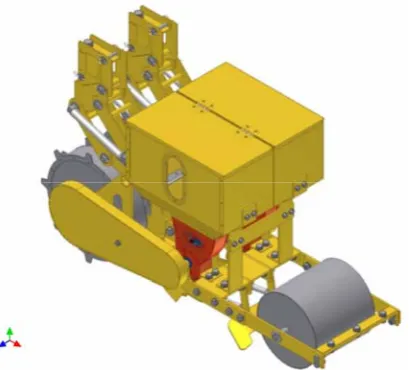
The seeding machine consisted of a seed metering
device, a seed hopper, a seed delivery device, a furrow
opener, a soil covering and compaction device, a seed
depth controller, and tractor couplers (Figure 1).
Figure 1 Three-dimensional modeling of a seeder for mixed cultivation
The machine was designed to allow seeding rates to
be controlled by the size and number of furrows of the
metering roller and for the intra-row spacing to be
controlled by the gear ratio between the driving wheel
and the seed metering device. The transfer of the seeds
in the parallel-type structure and the intra-row and
inter-row spacing between the seeds was controlled
through the seeder.
2.4 Performance evaluation and method of data
analysis
The performance evaluation was carried out in the
testing field of the College of Agriculture of Kyungpook
National University, located in Hyoryeong-myeon,
Gunwi-gun, Gyeongsangbuk-do, Korea. The
experimental procedure was as follows: A seeding
machine was attached to a tractor (NX490, Daedong,
Korea), the work efficiency was measured by conducting
seeding in a test field area of 1 hm2 at work speeds in the
range of 0.26-0.39 m/s. Three zones, 10 m each in
length, were selected and were divided into units of 1 m.
Nine measurement points were set up, excluding the
first and the last unit of each zone (Figure 2). The
average of row Space and soil covering depth at space
between plants of seeding performance and seeding rates
points were measured and calculated using Equations
(1)-(5)[15].
1 ( ) ( ) = =
∑
n i i i A B A B RSn (1)
where, RS is average row space, mm; A is corn row
space, mm; B is soybean row space, mm.
1 = =
∑
n i i C C SCDn (2)
where, SCD is average soil covering depth, mm; C is
seed soil covering depth, mm;
SP= A
T (3)
where, SP is seeding performance, hm2/h; A is seeding
area, hm2; T is seeding time, h.
0 3
0
SR 1 100
=
⎛ ⎞
⎜ ⎟
= − ×
⎜ ⎟
⎝
∑
i i⎠n
n
(4)
where, SR is seeding rate, %.
2 1
1
( )
−
=
∑
N −i i
S x x
N (5)
where, S is standard deviation.
Figure 2 Seeding method for corn and soybean
3 Results and discussion
3.1 Characteristics of test materials
The corn seeds had an average length-to-width (L/W)
an average strength of 93.3 N (SD=33.9) while the
soybean had 1.20, 786.0 kg/m3 and 39.1 N (SD=13.3) for
average-to-width ratio, average bulk density and average
strength respectively as shown in Table 2.
Table 2 Geometric and mechanical characteristics of test materials
Seeds Length/mm Width/mm Thickness/mm L/W ratio Bulk density/kg·m-3 Maximum load/N Corn 8.12 ± 0.92* 7.80 ± 1.05 5.64 ± 1.25 1.04 746.4 93.3 ± 33.9
Soybean 5.70 ± 0.38 4.74 ± 0.37 4.19 ± 0.32 1.20 786.0 39.1 ± 13.3 Note: * Mean±S.D.
3.2 Metering characteristics according to size of holes
Planting performance of a seeder mainly depends on
the seed metering device that discharges the seeds, so
designing a precise seed metering device is important.
A hole roller-type seed-metering device has dented holes
at uniform intervals on the surface of a roller and
discharges the seeds held in the hopper as it rotates. In
this study, the diameter of the roller seeding hole was
6 mm, which is similar to the length of a soybean, and
three depths (2 mm, 3 mm and 4 mm) were considered in
simulations of particle flow conducted using the EDEM
program (Figures 3-4).
Figure 3 Bean shape design using the EDEM program
Figure 4 Simulation of seed metering device using the EDEM program
Results of Simulation conducted using EDEM
software to examine the appropriate roller furrow depth
for the size of the seed used is presented in Table 3.
This shows that the best seed flow was achieved when the
metering roller furrow depth was 3 mm. The seeding
performance achieved was 2.5% misplanting, 92.5%
seeding of one or two grain(s), and 5% seeding of three
grains. Except in the misplanted section, the seeding
interval was 25 mm (SD=22.06), and seeding was
performed eight times in 200 mm, which met the design
conditions.
Table 3 Metering characteristics according to roller hole
depth
Seeding Rate/% Depth of hole
/mm
none 1-2 3 total
Row space /mm
2 48.5 51.5 0 100 3 2.5 92.5 5 100 4 0 17.5 82.5 100
25 ± 12*
Note: * Mean±S.D.
3.3 Manufacturing of a seeding machine and the
result of performance test
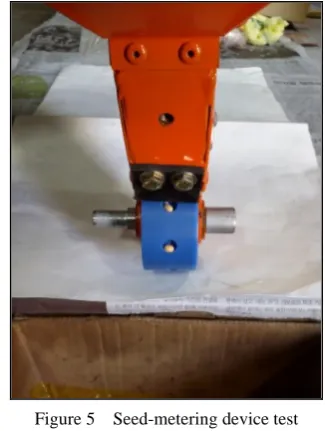
Based on the results of the EDEM simulation, a
metering roller was produced with holes 6 mm wide and
3 mm deep (Figure 5).
Figure 5 Seed-metering device test
One seeding machine (Type A) was manufactured to
at regular intervals, at a ratio of 1:8 for 200 mm, and a
second seeding machine (Type B) was manufactured.
Clogging was prevented by adding a plow (Figure 6) to
the front of the driving wheel, given the parallel-type
structure of the seeder. These results are presented in
Table 4.
Figure 6 Plow used on Type B machine
Table 4 Result of seed metering device tests
Seeding Rate/% Time
none 1-2 3 total
Row space /mm
1 0 94 6 100
2 2 95 3 100
3 1 94 5 100
Ave. 1.00 94.33 4.67 100 26 ± 7*
Note: * Mean±S.D.
3.4 Performance test
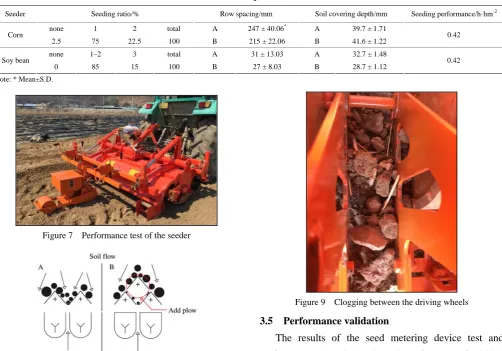
Performance tests (Table 5) for the Type A and Type
B seeding machines (Figure 7), showed that there were no
misplanted sections of soybean seeds and one misplanted
section of corn seeds.
The two seeders maintained excellent seeding
efficiency and soil covering thickness (Figure 8). The
intra-row spacing of corn seeds was 247 mm (SD =
40.06) for the Type A seeder, because of clogging
between the driving wheels (Figure 9), and the space
between plants appeared to be more irregular than that for
the Type B seeder 215 mm, (SD = 22.06), to which a
plow was added.
Table 5 Results of performance tests
Seeder Seeding ratio/% Row spacing/mm Soil covering depth/mm Seeding performance/h·hm-2
none 1 2 total A 247 ± 40.06* A 39.7 ± 1.71
Corn
2.5 75 22.5 100 B 215 ± 22.06 B 41.6 ± 1.22 0.42 none 1–2 3 total A 31 ± 13.03 A 32.7 ± 1.48
Soy bean
0 85 15 100 B 27 ± 8.03 B 28.7 ± 1.12 0.42 Note: * Mean±S.D.
Figure 7 Performance test of the seeder
Figure 8 Seeder direction for Type A and Type B machines
Figure 9 Clogging between the driving wheels 3.5 Performance validation
The results of the seed metering device test and
performance tests above showed seeding rate of 94.33%
The other parameters examined which include seeding
ratio were 75% for 1 seed, 22% for 2 seeds of corn
respectively. The seeding ratio for soybean was 85% for
1-2 seeds and 15% for 3 seeds of soybeans respectively.
Row spacing, seed covering depths and seeding
performance showed to be within the recommended
standards. These tests were done 5 times, and the tests
met all the technical requirements[8,19-22].
However, the Type B seeding machine, which had a
plow installed in front of the driving wheel, exhibited
less slip by clogging between the parallel-type driving
wheels than the Type A seeder. The variation in the
space between plants was stabilized, but ultimately, the
slip was not resolved. Additional research is
necessary to stabilize the variation in the space between
plants by changing the structure of the simultaneous
seeder from the parallel type to the serial type and
vertical type.
4 Conclusions
A simultaneous seeder was designed and
manufactured for use in simultaneous planting of corn
and soybeans at a seeding interval of 5-10 cm. The
performance evaluation results showed that when the
seeding speed was 0.26 m/s, there were no misplanted
sections of soybean seeds for either seeding machine
(Type A or Type B) and there was one misplanted section
of corn seeds. The average soil covering thickness over
the corn seeds was 39.7 mm (SD = 1.71) for the Type A
seeding machine and 41.6 mm (SD = 1.22) for the Type
B seeding machine. These results reflect excellent work
efficiency.
Acknowledgement
This work was supported by Korea Institute of
Planning and Evaluation for Technology in Food,
Agriculture, Forestry and Fisheries (IPET) through
Agri-Bio Industry Technology Development Program,
funded by Ministry of Agriculture, Food and Rural
Affairs(MAFRA) (314024-3) and Basic Science Research
Program through the National Research Foundation of
Korea (NRF) funded by the Ministry of Education
(NRF-2014R1A1A2057491).
[References]
[1] Mafra. Major statics data-roughage and formula feed. 2015. Available from: http://lib.mafra.go.kr.
[2] Hussain I, Olson K R, Ebelhar S A. Long-term tillage effects on soil chemical properties and organic matter fractions, Soil Sci. Soc. Am. J., 1999; 63: 1335–1341.
[3] Rochester I J, Peoples M B, Hulugalle N R, Gault R R, Constable G A. Using legumes to enhance nitrogen fertility and improve soil condition in cotton cropping systems. Field crops research, 2001; 70: 7–41.
[4] Ramesh P, Ghosh P K, Reddy K S, Ajay S, Choudhary R S. Assessment of biomass, productivity and sustainability of soybean based cropping systems at three levels of nitrogen in deep vertisols of semi-arid tropical India. Journal of sustainable agriculture, 2005; 26(2): 43–59.
[5] Sharma R P, Paha S K, Haque M, Raman K R. Diversification of traditional rice (Oryza satua)-based cropping system for sustainable productions in Soutli Bihar alluvial plains. Indian J. Agron, 2004; 49(4): 218–222. [6] Ta T C, Faris M A. Species variation in the fixation and
transfer of nitrogen from legumes to associated grasses. Plant and Soil, 1987; 98: 265–274.
[7] Sovetgul A, Grover S, Jeong-Dong L. The current status of forage soybean, Plant Breed. Biotech., 2014; 2(4): 334–341.
[8] Seo J D, Chae J H, Park J H, Kim M S, Gwon C H, Lee J D. Yield and quality of forage produced by mixed planting of soybean and corn. Korean J. Int Agric., 2014; 32(2): 105–109.
[9] He J, Zhang Z, Li H, Wang Q. Development of small/medium size no-till and minimum-till seeders in Asia: A review. Int J Agric & Biol Eng, 2014; 7(4): 1–12. [10] Yang L, He X, Cui T, Zhang D, Shi S, Zhang R, Wang M.
Development of mechatronic driving system for seed meters equipped on conventional precision corn planter. Int J Agric & Biol Eng, 2015; 8(4): 1–9.
[11] Rhee J Y, Hwang J S, Chung C J, Kim H J. Morphological analysis of seed for seeder design. Proceedings of the KSAM 2000 Winter Conference, 2000; 5(1): 101–106. [12] Ryu I H, Kim K U. Design of roller-type metering device
for precision planting. Journal of the KSAM, 1997; 22(4): 401–410.
[13] Ebrahim A, Hamid R G, Mohammad M, Kyeong U K. Development of a precision seed drill for oilseed rape. Turk J. Agric, 2008; 32: 451–458.
[15] Zhai J, Xia J, Zhou Y, Zhang S. Design and experimental study of the control system for precision seed-metering device. Int J Agric & Biol Eng, 2014; 7(3): 13–18. [16] Zhai G X, Wang Z H, He G, Liu G L, Yang L. Design of
metering device key parts of pneumatic grass seeder. Journal of Earth Science and Engineering, 2015; 5: 289–295. [17] Yoo S N, Choi Y S, Kim D H, Suh S R. Development of a
precision seeder for direct seeding of rice on dry paddy. Journal of Biosystem Eng., 2008; 33(2): 83–93.
[18] Larsen L F. Test 805: Case 310E (Diesel). 2016. Available from http://digitalcommons.unl.edu/cgi/viewcontent.cgi? article=2252&context=tractormuseumlit.
[19] Evandro M B, Paulo F A, Alcir J M, Murilo M B, Adelar J F. Seeder performance under different speeds and its relation to
soybean cultivars yield. Journal of Agronomy, 2015; 14: 139–145.
[20] Soza1 E, Botta G, Tourn M, Hidalgo R. Sowing efficiency of two seeding machines with different metering devices and distribution systems: a comparison using soybean, Glycine max (L) Merr. Spanish Journal of Agricultural Research, 2004; 2(3): 315–321.
[21] Yang L, Zhang R, Gao N, Cui T, Liu Q, Zhang D. Performance of no-till corn precision planter equipped with row cleaners. Int J Agric & Biol Eng, 2015; 8(5): 15–25. [22] Mao X, Yi S J, Tao G X, Yang L, Liu H Y, Ma Y C.