1
EDUCATION AND ENVIRONMENTAL HEALTH RISK
PERCEPTION: HOW SENSE OF CONTROL AND ECONOMY
SHAPE COGNITIVE DISSONANCE IN ACCRA, GHANA
Sarah Q. Ehlinger1, 2, Dr. Emmanuel M. Asiedu1, Professor Alexander B. Asiedu1
1 University of Ghana, Legon, Accra, Ghana 2 Communicating Author: [email protected]
Abstract
Risk perception research on environmental health often looks for spatial and demographic patterns. Because culture can change dramatically between locations, especially in a developing country, research often finds cognitive dissonance among respondents but fails to examine cultural explanations for it. Here we present a study conducted in Accra, Ghana that examined the roles of economic livelihoods and prioritization and sense of control as possible explanations for cognitive dissonance regarding health risks from air pollution.
Key words: Risk perception; Cognitive dissonance, Cultural theory, Air pollution, Ghana
Introduction
Environmental pollution and its detrimental effects on human health present a growing problem in the developing world, particularly in areas with high rates of urbanization such as sub-Saharan Africa. Understanding stakeholder risk perception—or the way in which people evaluate potential harm to themselves or what they value1—is central to effective community engagement, policy, and management. While actual risk is a calculated characterization of the probability of adverse health effects of human exposures to environmental hazards2, perceived risk is largely affected by
socio-economic and cultural factors. As such, perceived risk by stakeholders may not accurately match actual hazards2-4, making management of risk and implementation of potential solutions difficult. Because the way in which people make sense of risks is shaped by numerous factors, risk perception is difficult to generalize between localities. As Bickerstaff and Walker5 describe, this “localisation of risk” forces people to construct and contextualize their understanding and perceptions of personal risk based on where they live and work.
In a rapidly developing country such as Ghana, high income and education disparities combined with drastically different environmental conditions may exist within the same city.
This is the case in Ghana’s capital, Accra. Such varying physical, social, and cultural contexts can not only lead to discrepancies between people’s perceptions of risk, but also
IJCC
S
EC Volum
e 2, Issu
e 2
2 create inconsistencies at the individual level. These inconsistencies are described in the theory of cognitive dissonance, or when an individual’s beliefs are not in accord with his or her actions6. Bickerstaff and Walker5 proposed two explanations for the theory of cognitive dissonance. The first explanation involves what is termed the “perception gap,” in which a person recognizes the presence of danger yet fails to believe consequences will happen to him or her. Using air pollution as an example, this would mean a person knows they are breathing polluted air, knows there are adverse health effects of breathing polluted air, and still regards their personal risk as low. The second explanation describes the idea that a person with health problems related to air pollution—such as a respiratory disease—may attribute it to natural causes, allowing them to justify inaction and refrain from holding anyone (self or others) accountable. In this case, a person fails to recognize personal environmental health risks altogether. Understanding the perception gap is important because it can lead to dangerous personal behaviors7. The idea of cognitive dissonance can be framed within the context of the cultural theory of risk. The cultural theory of risk considers how cultural biases lead to selective attention to risk, which ultimately supports a certain way of life based on a society’s ideologies and values 8,9. In the present study, we explored different types of cognitive dissonance in regards to environmental risk perception in Accra, Ghana, focusing specifically on air pollution as a type of environmental pollution. As culture and lifestyles differ between neighborhoods in Accra, we hypothesized that cognitive dissonance would exist among residents of all backgrounds, but in different forms and for different reasons.
Study Site and Methodology
Located in the south of Ghana, the city of Accra finds its northern border at the University of Ghana and the Gulf of Guinea to the South. With a high population density (1,205 people per square kilometer) and high rate of population growth (34.6%, from 2.91 million in 2000 to 3.91 million in 2010), Accra faces several health risks related to air pollution. Ambient concentrations of air pollutants in urban areas have been well researched in Accra. A study conducted by Dionisio et al. (2010a) monitored PM2.5 and
PM10 in four neighborhoods of Accra, finding PM2.5 and PM10 concentrations well above
the WHO Air Quality Guidelines and significantly higher in neighborhoods of low socio-economic status 10. The study concluded that spatial differences in air quality were a result of greater automobile traffic in those areas, increased density of people using charcoal and wood as cooking fuel in the house and on the street, trash burning, and unpaved roads. Indoor air pollution is common, as 52% of urban households use charcoal as their primary source of cooking fuel 11. A study conducted by Zhou et al. 12 found particulate matter from indoor cooking to be higher in low-income areas, suggesting that risk may differ based on socio-economic status. In Accra, it is inferred that the poor are disproportionately affected by respiratory health problems due to their heavy dependence on solid fuels 13. Childhood morbidity and mortality due to acute respiratory illness are a
serious concern for Accra. In a study of cooking fuel choice in Accra, Boadi and Kuitunen (2006) found that 28.4% of children covered in the study had respiratory health symptoms in the two weeks preceding the study 13. The physical state of air pollution in Accra is well researched and understood. Less known is how the differences in physical state,
IJCC
S
EC Volum
e 2, Issu
e 2
,
3 exposure, demographics, and culture of the city affect residents’ perceptions of risks, and more specifically, how they may contribute to cognitive dissonance.
With a detailed questionnaire, we surveyed four neighborhoods of varying socio-economic status. Each of the four neighborhoods of the study—Nima, Asylum Down, Labone, and East Legon—is located in Ghana’s capital city, Accra (Fig.1).
Located in the south of Ghana, the city of Accra finds its northern border at the University of Ghana and the Gulf of Guinea to the South.
Fig. 1. Greater Accra Metropolitan Area (GAMA) highlighting study areas.
East Legon is a high-income area with a low but increasing population density. With the neighborhood having about five persons per hectare 12, plots are typically large with
self-contained houses. In the past, vehicular traffic has been low, but the area is becoming increasingly commercial. Labone is also considered a high-income area with a low population density, about eighteen persons per hectare 14. Labone has relatively good
access to services and infrastructure such as quality housing, sanitation, waste management, water, and electricity. Situated by a highly trafficked road, Asylum Down is considered a medium to low-income neighborhood with a population density of forty persons per hectare. Many residents in Asylum Down are employed as informal business owners. Lying north of Asylum Down, Nima is a low-income neighborhood comprised largely of migrants. At two hundred fifty persons per hectare, population density is high in Nima, putting large demands on already poor services such as housing, water, and waste collection 14. Biomass cooking fuel use is high in Nima, and is widely used by street food sellers. Nima is considered a slum and one of the poorest neighborhoods in Accra. Past research has shown that levels of particulate matter are much higher in Nima and Asylum Down than in East Legon 10. It has also been found that those of higher IJCC
S
EC Volum
e 2, Issu
e 2
,
4 educational attainment in these four neighborhoods rate risks from air pollution significantly lower for themselves than for their families, neighborhoods, and Accra 15. Ehlinger (2013) also showed significantly lower levels of dread among residents of the two low-income, highly polluted neighborhoods, Nima and Asylum Down. The discrepancy between risk ratings for different risk targets and low levels of dread among residents living in higher pollution levels demonstrate two different forms of cognitive dissonance. It is necessary to understand better the risk denial among the highly educated—who are most likely to form and implement policy—as well as the low amount of dread among those in low-income neighborhoods, whose health is most compromised by air pollution.Multi-stage, cluster sampling was used for this study. Nima, Asylum Down, Labone, and East Legon were chosen due to their variance in socio-economic status and neighborhood environmental conditions. Forty questionnaires were distributed randomly around each neighborhood. Because of several incomplete questionnaires in East Legon and Labone, five additional questionnaires were distributed in those neighborhoods. The structured questionnaire contained mostly close-ended questions, ending with a series of Likert scale prompts that addressed issues like control, responsibility, priority, and economic livelihood. Fieldwork was conducted from October to November 2012. Data analyses were conducted using the Statistical Package for the Social Sciences 16 and JMP 10.1 statistical software 17.
Results and Discussion Education and Control
Previous research has linked a sense of control to risk denial 18. Since risk denial was exhibited among the educated in Accra 15, a sense of control may help explain risk
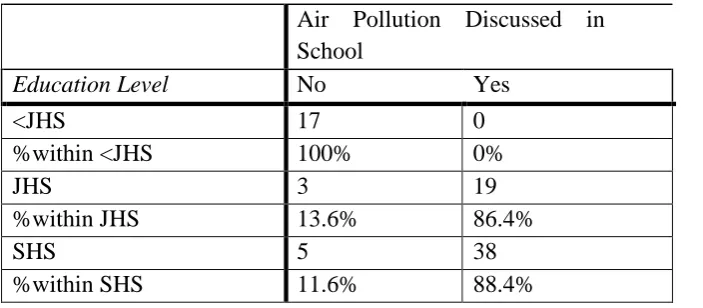
perceptions of residents with high educational attainments. Though formal education may teach a person specifically on environmental pollution, the highly educated are more likely to live in less environmentally polluted neighborhoods, thus having fewer first-hand experiences with pollution. Since the questionnaire revealed that over 85% of respondents who had a Junior High School (JHS), Senior High School (SHS), or tertiary education experienced a discussion of air pollution in school, we know that risk denial among the educated is not just a product of being unaware of the existence of air pollution (Table 1). A possible explanation for the risk denial then, is that education provides a person with a sense of personal control over the risk.
Table 1: Percentages of respondents that experienced a discussion of air pollution in school, by educational attainment.
Air Pollution Discussed in School
Education Level No Yes
<JHS 17 0
%within <JHS 100% 0%
JHS 3 19
%within JHS 13.6% 86.4%
SHS 5 38
%within SHS 11.6% 88.4%
IJCC
S
EC Volum
e 2, Issu
e 2
,
5
Vocational/Technical 9 17
%within Voc/Tech 34.6% 65.4%
Tertiary 7 53
%within Tertiary 11.7% 88.3%
TOTAL 41
(24.4%)
127 (75.6%)
The Likert scale prompt, “People have very little control over risks to their health,” sought to find a difference in the sense of control between respondents, particularly between those with different educational attainments. Fit tests determined that education was indeed significantly related to how much a respondent agreed, while neighborhood of residence was not. As shown in Figure 1, the <JHS and JHS groups had higher percentages in agreement than did the SHS and tertiary groups. Particularly noticeable is the high amount of respondents in JHS that strongly agreed, more than twice the percentage in the other education levels. There was a larger discrepancy in the percentages of people who disagreed with the statement. About 40% of respondents in both the SHS and Tertiary groups disagreed or strongly disagreed with the statement, expressing their belief that people do have control over risks to their health. Less than 24% with <JHS education and only 5% with a JHS education disagreed or strongly disagreed. It is clear that those with the lowest educational attainment do not feel a great sense of control over risks to their health.
Figure 1: Responses to the prompt, “People have very little control over risks to their health” by educational attainment. The issue of control over risks to health may help explain why the highly educated may show patterns of risk denial, but there may be another spatial and cultural reason why those with lower educational attainment do not show the pattern. Field observations and interviews revealed that several residents in Nima and Asylum Down seemed unaware that other people’s environmental situations were different from their own. In Nima, a young woman in SHS was asked which Accra neighborhood had the best air quality. She said she was not sure and could not think of anywhere. Research assistants prompted her by asking if she agreed with several respondents who had previously and independently replied Achimota. The woman commented,
“Achimota?...Hmm…I have never been there so I don’t know…”
IJCC
S
EC Volum
e 2, Issu
e 2
,
6 It seems residents in Nima and Asylum Down have internalized their situations and as such view their lifestyles and environmental conditions as the norm. It is difficult to view something that is the norm as a risky; this will be discussed later in further detail in regards to charcoal cooking fuels and garbage burning—both of which are common in Nima and Asylum Down.
Another reason that residents in Accra may or may not feel a sense of control is the state of their financial or logistical resources to protect themselves from pollution. The issue of economy is discussed in the following section.
Economy Versus Health
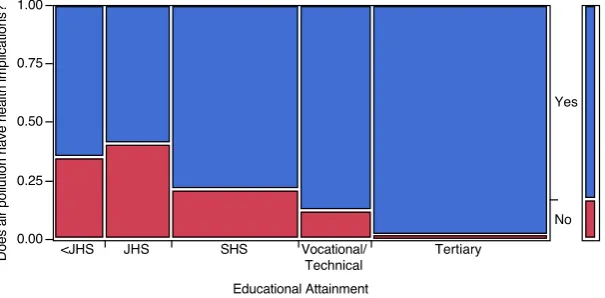
Boadi et al. (2006) found that uneducated residents in Accra were often not aware of environmental health impacts, i.e. that burning charcoal produces smoke and breathing smoke can cause respiratory diseases. However, it is also possible for those of a lower socio-economic status to perceive risks as higher than do those of higher socio-economic status because they live in an environment where less has been done to minimize the risks. This idea was proposed 19 in regards to traffic risk and the safety features that are available to the wealthy but not to the poor, making the poor more concerned about traffic risks. So one question raised is whether the less educated are simply unaware of risks or are aware but do not have the affordability and accessibility to avoid them (by living in less polluted neighborhoods and avoiding sources of air pollution). Head of the Environmental Quality Department at EPA-Ghana, Dr. Sam Adu-Kumi, noted during an interview that low-income people who are exposed to smoke might not fully connect it to health problems for three reasons. First, they have a lack of education on it. Second, they are most concerned with affordability. Third, they may attribute health problems to other causes or superstitions. Figure 2 supports the first claim. When asked to respond yes or no to “Does air pollution have any health implications,” those without a tertiary education were significantly more likely to respond “No” than those with a tertiary education. In fact, about 41% of respondents with a JHS education replied no. This was noteworthy because excluding those with an educational attainment of <JHS, respondents in each level of education overwhelming responded in the affirmative that air pollution was discussed in school (Table 1). So it seems that even if respondents have learned about air pollution during their schooling, they are less aware of its specific health effects. This may result in cognitive dissonance: awareness of pollution but a failure to change personal habits and exposure to it.
Figure 2: Responses to the question, “Does air pollution have any health implications?”
IJCC
S
EC Volum
e 2, Issu
e 2
,
7 As the environmental Kuznets curve describes, at early stages of economic development a state is more concerned with economic growth than environmental protection 20. It is only when awareness and technology improve that pollution begins to decline with further economic development. If this model were applied on a smaller scale to low-income neighborhoods, then it is possible that awareness of the existence of air pollution occurring with minimal behavioral changes is a result of people thinking about livelihoods before the environment and personal health. To see if this was the case in Nima and Asylum Down, questionnaire responses about economy and livelihood were analyzed.
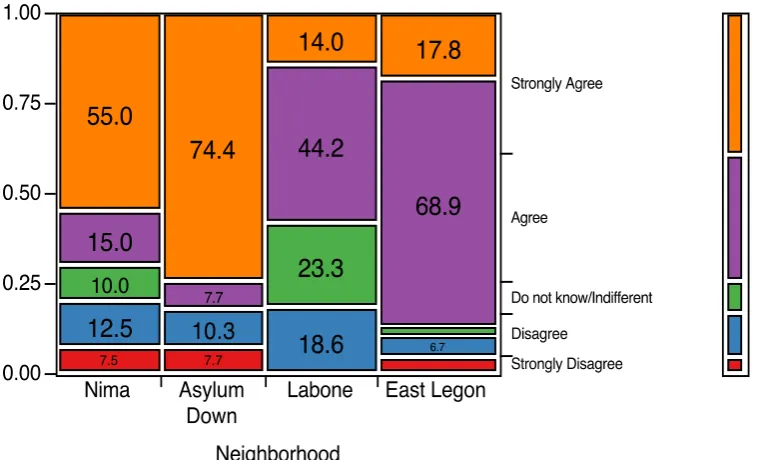
The use of old vehicles for cheap public transportation is one issue tied to economy and health in Accra. Over 90% of residents in all neighborhoods agreed with the statement, “Trotros/taxis contribute to air pollution” (Figure 3). A similarly sized majority agreed that “Emissions from trotros/taxis affect human health” (Figure 4). When it came to vehicular emissions, residents make a link between air pollution and health. However, when asked if “Trotros should be phased out as a means of public transportation,” the majority of residents in Nima, Asylum Down, and East Legon disagreed (Figure 5). Residents recognize health implications from trotros yet realize that trotros provide a necessary and affordable means of transportation for a large amount of residents in Accra. Here, belief does not translate into action because of economy and affordability. This applied to people living in high income-neighborhoods as well as low-income neighborhoods.
Figure 3: Responses to the prompt, “Trotros/taxis contribute to air pollution” by neighborhood.
IJCC
S
EC Volum
e 2, Issu
e 2
,
8
Figure 4: Responses to the prompt, “Emissions from trotros/taxis affect human health” by educational attainment.
Figure 5: Responses to the prompt, “Trotros should be phased out as a means of public transportation” by neighborhood.
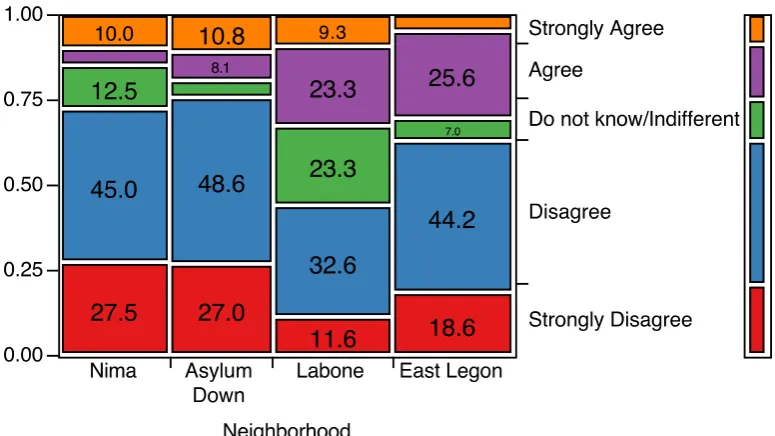
The prompt, “Economic livelihood is more important than clean air” produced clear divides between neighborhoods and between education levels (Figures 6, 7). The two variables were significantly related to responses after accounting for their insignificant interaction term. Unexpectedly, the high-income neighborhoods had a high percentage of their respondents agree while very few agreed in the low-income neighborhoods. Nima and Asylum Down actually had 47.5% and 63.2% disagree with economic livelihood being more important than clean air. This is surprising because the environmental Kuznets curve applied at a smaller scale would predict that low-income neighborhoods sacrifice environmental quality for economic gain. Here, respondents in low-income areas do not support that theory. This is possibly due to the poor environmental conditions in low-income neighborhoods—conditions that residents in Labone and East Legon are less likely to experience first-hand. Therefore, Labone and IJCC
S
EC Volum
e 2, Issu
e 2
,
9 East Legon residents are able to perceive economic gain as more important than environmental quality, without fear of consequences. Even with educational attainment, respondents in the tertiary and vocational groups had higher percentages agree that economic livelihood is more important than clean air than the other education levels. These results show that economy may play a large role in shaping the risk perceptions and cognitive dissonance of highly educated, high-income populations in the developing world. This leaves the question, if economy has minimal influence on low-income and less-educated populations, what are the main factors influencing their perceptions of risk?
Fig 6: Responses to “Economic livelihood is more important than clean air” by neighborhood.
Fig 7: Responses to “Economic livelihood is more important than clean air” by educational attainment.
Choice of cooking fuel is another issue tied to economy in Accra, but it is also tied to issues of availability and culture as well. When asked about their reason for cooking fuel choice, about 43% of respondents who cooked with charcoal reported IJCC
S
EC Volum
e 2, Issu
e 2
,
10 affordability as determining their choice of cooking fuel while about 37% checked availability. For those who use electricity or gas, availability was the most common reason checked, with 39% and 46% respectively. Likert scale questions were used to corroborate these findings. Responses to the prompt, “Prices influence my choice of cooking fuel,” were significantly related to neighborhood of residence. East Legon and Labone had the highest percentage of respondents agree with the statement (Figure 8). It was surprising that under 50% of respondents in Nima and Asylum Down agreed, since these are the low-income neighborhoods that rely largely on charcoal. It seems that in Nima, cooking fuel choice has less to do with economy and more that it is the “norm.” Since charcoal is widely used in the neighborhood, and widely available, there may be an internalization of risk. This means that instead of making a conscious decision on choice of cooking fuel based on affordability or health risks, residents may choose what their parents used for cooking or what is commonly used around them—they may follow the normal lifestyle decisions of their neighborhood. Therefore, it would be incorrect to generalize that all residents who expose themselves to risks do so because of their economic situations. It depends largely on the type of risk being discussed. Affordability depends largely on availability, which depends largely on the culture of a neighborhood.
Fig 8: Responses to the prompt, “Prices influence my cooking fuel choice.”
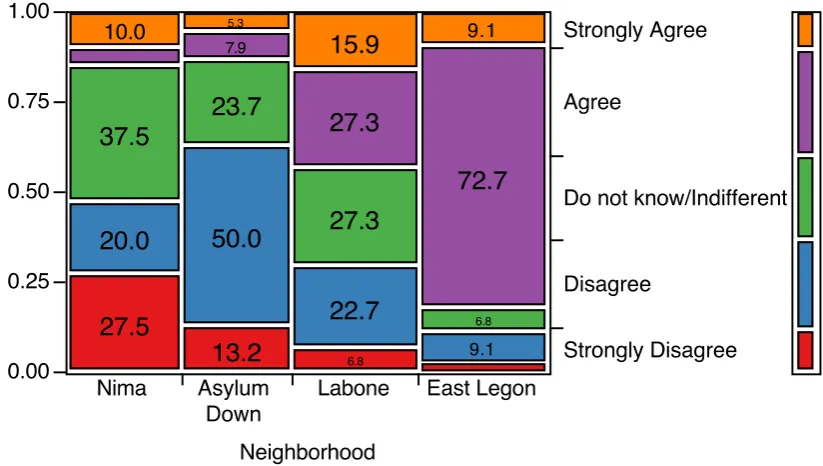
Further investigating the balance between economy, control, and culture, the two prompts, “The backyard burning of household garbage should be allowed because it reduces uncollected solid waste” and “The disposal of solid waste is more important than keeping the air clean” produced results that highlight cognitive dissonance among respondents. For both prompts, neighborhood was significantly related to responses, education was not significantly related, and education and neighborhood were found not to have a significant interaction term. A majority of respondents in all neighborhoods agreed or strongly agreed that backyard burning of household garbage should be allowed because it reduces uncollected solid waste (Figure 9). Based on field observations and interviews, solid waste, clogged gutters, and smells were common complaints about the environment. These complaints are a likely reason people view garbage burning as a necessary task. However, when prompted that disposal of solid waste is more important than clean air, 45% percent of respondents in Nima and 79.5% in Asylum Down
IJCC
S
EC Volum
e 2, Issu
e 2
,
11 responded that they strongly disagreed or disagreed (Figure 10). So it appears they believe garbage burning is necessary but not more important than keeping the air clean. This creates a clear conflict of desire: residents in Nima and Asylum Down want both clean air and to reduce waste via burning. One reason that East Legon residents overwhelmingly agree that disposal of solid waste is more important than keeping the air clean could be their sense of control—that the consequences to air quality will not affect them directly. Since both waste disposal and air quality are important determinants of the state of a person’s environment, both shape perception. Still, there is no easy solution, as maintaining clean air and keeping the ability to burn garbage come in conflict when public utilities and infrastructure are limited.
Fig 9: Responses to “Backyard burning of household garbage should be allowed because it reduces uncollected solid waste” by neighborhood.
Fig 10: Responses to “The disposal of solid waste is more important than keeping the air clean” by neighborhood. IJCC
S
EC Volum
e 2, Issu
e 2
,
12 Responsibility
Understanding perceptions of responsibility is an important part of environmental health risk perception 21. It has been found that in areas where there is a sense of powerlessness and public fatalism—that residents have little control of something as ubiquitous as urban air pollution—individuals will not act to alleviate pollution problems, resulting in cognitive dissonance 22. It is doubtful that residents in Accra would change their interactions with the environment if they do not feel personally responsible. The questionnaire asked respondents to rank who is responsible for keeping the air clean in Accra (Table 2). Even though many residents reported feeling little control over risks to their health (Figure 1), many rated individual residents as having the most responsibility in keeping the air in Accra clean. No significant differences were found in responsibility ratings by educational attainment.
Table 2: Summary Statistics for Responsibility Ratings. Respondents rated responsible parties from 1=most responsible to 6=least responsible for keeping the air clean in Accra.
Indiv idual Resi dents Govern ment Trotro/ Taxi Driver s Waste Comp anies/ Zooml ion Factori es/ Private Busine sses Non-Gove rnme nt Orga nizati ons
n 153 150 147 152 147 149
MEA N
2.53 3.01 3.05 3.82 3.93 4.49
MED IAN
2 3 3 4 4 5
MOD E
1 1, 2 2, 3 5 5 6
Individual residents and the government were rated as having the most responsibility, followed by trotro/taxi drivers. It can be seen as positive that both the government and individual residents were considered responsible, since government regulations would involve individual actions such as requiring and enforcing emissions checks on personal and imported vehicles, restricting garbage burning, rerouting traffic, improving public transportation, etc. What is perhaps most interesting is the apparent conflict between admitting individual responsibility and yet feeling minimal control over risks. This is yet another form of cognitive dissonance. Moreover, residents showed a general willingness to pay for improved air in Accra (Figure 11), but it would be difficult for the air quality to be improved only through government action, since residents agreed that garbage burning is necessary, trotros should not be banned, and charcoal cooking fuel does not produce smoke.
IJCC
S
EC Volum
e 2, Issu
e 2
,
13
Fig. 11 Responses to “I am willing to pay for additional taxes to maintain clean air in the community” by neighborhood.
The cultural theory of risk perception describes the allocation of responsibility as less about a lack of logical reasoning and more about protecting a certain set of values and way of life 8,23. If cultures develop or support fears that in turn support their way of
life, it is understandable that residents of Accra would ignore risks which if acknowledged would force them to change their actions to avoid health consequences. However, this theory cannot fully apply to residents in Accra because many admitted to an individual responsibility in maintaining clean air (Table 2). It seems the conditions of a developing country, with income discrepancies, lack of governmental regulations, minimal choices over housing, transportation, and cooking fuel, only exacerbate the cognitive dissonance that has been researched in other countries (see for example Bronfman and Cifuentes 24). Conclusion
In this study, cognitive dissonance was displayed in several forms. It was displayed among the highly educated who rated higher risks for others. It was displayed in low-income neighborhoods where residents have high exposure but do not relate it to health effects and where residents find affordability important when it comes to public transportation but not when it comes to cooking fuel. It was displayed in residents who think clean air is important but view “trotros” and garbage burning as necessary. Finally, it was displayed by those who believe they have minimal control over risks to their health, but rated individuals as having the most responsibility in keeping the air clean. Since environmental risk perception research is fairly new to Accra, it possible that residents have never been asked to consider such topics as prioritizing health, livelihoods, and the environment. With more research, we can grasp a better understanding as to what factors
IJCC
S
EC Volum
e 2, Issu
e 2
,
14 influence risk perceptions of residents with varying backgrounds. This is important for media outreaches and policy development.
Based on this study, we conclude that a sense of control and concern for economic livelihood may shed light on cognitive dissonance among the highly educated. Availability and culture, which are related to what is considered the “norm,” are more relevant to the perceptions of those with less education and those in low-income neighborhoods.
Acknowledgements
This research was funded in part by a Rotary International Ambassadorial Fellowship to SQE.
Bibliography
1. Adeola, F. O. Nativity and Environmental Risk Perception: An Empirical Study of Native-Born and Foreign-Born Residents of the USA. Research in Human
Ecology 14, 13–25 (2007).
2. USEPA. EPA’s Risk Assessment Process for Air Toxics : History and Overview.
Risk Assessment and Modeling (2004).
3. Renn, O., Burns, W. J., Kasperson, J. X., Kasperson, R. E. & Slovic, P. The Social Amplification of Risk : Theoretical Foundations and Empirical Applications. 48, 137–160 (1992).
4. El-Zein, A., Nasrallah, R., Nuwayhid, I., Kai, L. & Makhoul, J. Why do
neighbors have different environmental priorities? Analysis of environmental risk perception in a Beirut neighborhood. Risk Analysis 26, 423–435 (2006).
5. Bickerstaff, K. & Walker, G. Public understandings of air pollution: the
‘localisation’ of environmental risk. Global Environmental Change 11, 133–145 (2001).
6. Festinger, L. A. A Theory of Cognitive Dissonance. (1957).
7. Ropeik, D. The Perception Gap: Recognizing and managing the risks that arise when we get risk wrong. Food and chemical toxicology : an international journal
published for the British Industrial Biological Research Association 50, 1222–
1225 (2012).
8. Tansey, J. & O'Riordan, T. Cultural theory and risk: A review. Health, Risk &
Society 1, 71–90 (1999).
9. Wildavsky, A. & Dake, K. Theories of Risk Perception: Who Fears What and
Why?Theories of Risk Perception
10. Dionisio, K. L. et al. Air pollution in Accra neighborhoods: spatial,
socioeconomic, and temporal patterns. Environ. Sci. Technol. 44, 2270–2276 (2010).
11. Service, G. S. Ghana Living Standards Survey: Report of the Fifth Round (GLSS 5). in (2008).
12. Zhou, Z. et al. Household and community poverty, biomass use, and air pollution IJCC
S
EC Volum
e 2, Issu
e 2
,
15 in Accra, Ghana. PNAS 108, 11028–11033 (2011).
13. Boadi, K. O. & Kuitunen, M. Factors Affecting the Choice of Cooking Fuel, Cooking Place and Respiratory Health in the Accra Metropolitan Area, Ghana.
Journal of Biosocial Science 38, (2006).
14. Arku, G., Luginaah, I., Mkandawire, P., Baiden, P. & Asiedu, A. B. Housing and health in three contrasting neighbourhoods in Accra, Ghana. Social Science &
Medicine 72, 1864–1872 (2011).
15. Ehlinger, S. Environmental Risk Perception on Air Pollution and Health: The Role of Socio-economic and Residential Status in Accra, Ghana. M.Phil. Thesis, Univ. Ghana, Legon (2013).
16. SPSS, S. version 17. (SPSS Inc., 2009).
17. SAS Institute. Using JMP 10. (SAS Institute, 2012).
18. Sjöberg, L. Factors in Risk Perception. Risk Analysis 20, (2000).
19. Nordfjærn, T. & Rundmo, T. Perceptions of traffic risk in an industrialised and a developing country. Transportation Research Part F: Traffic Psychology and
Behaviour 12, 91–98 (2009).
20. Dasgupta, S., Laplante, B., Wang, H. & Wheeler, D. Confronting the
Environmental Kuznets Curve. Journal of Economic Perspectives 16, 147–168 (2002).
21. Starr, G., Langley, A. & Taylor, A. Environmental Health Risk Perception in Australia. in (2000).
22. Bickerstaff, K. Risk perception research: socio-cultural perspectives on the public experience of air pollution. Environment International 30, 827–840 (2004). 23. Bickerstaff, K. & Walker, G. Risk, responsibility, and blame: an analysis of
vocabularies of motive in air-pollution(ing) discourses. Environment and
Planning 34, 2175–2192 (2002).
24. Bronfman, N. C. & Cifuentes, L. A. Risk Perception in a Developing Country: The Case of Chile. Risk Analysis 23, 1271–1285 (2003).
IJCC
S
EC Volum
e 2, Issu
e 2
,