61
Real Study on Fly Ash Polymer Composite
Sumit
1, Abhishek Arya
21
M. Tech. Student, Matu Ram Institute of Engineering and Management College (M.R.I.E.M), Rohtak 2
HOD of Civil Engineering Department in Matu Ram Institute of Engineering and Management College), (M.R.I.E.M), Rohtak
ABSTRACT
Fly-ash is mixed with Cold setting resin at different| proportions and water treated at different temperatures to search out out an answer to the brick trade. The compressive strength, Hardness, water absorption, Density and thermal physical phenomenon of the Fly ash -resin powder bricks obtained below optimum test conditions are eleven.24 MPa, 47.37HV, 19.09% 1.68 g/cm3, and 0.055 W/mK respectively. The sliding wear behavior is also investigated. The structure-property correlation of those composites are studied using X-ray diffraction, FTIR analysis and scanning electron microscopy.
Keywords: Fly Ash, Strength, Mixing, Resin, Bricks, Polymer, Composite
INDRODUCTION Fly Ash
Fly Ash is an Industrial waste that is accepted as an environmental waste material, generated throughout the combustion of coal for energy production. once the coal is discharged within the grate of a boiler, Carbon and volatiles materials fully burnt off. But still, some inorganic impurities of earth parts (sand, Feldspars etc.) are bonded along and are discharged out through flue gases. once these amalgamated materials are allowed to solidify, it ends up in the formation of fine and spherical particles known as Fly ash
Cold setting resin: -
Cold mounting compound resin is used as a binder material to provide inter particle bond between the Fly ash particles and to increase their strengthening effect. They are good resistance to atmospheric and chemical degradation. Resin powder cannot shows its effect alone until it is mixed with hardener (or accelerator) to provide the mounting compound, and then the polymerization process takes place to form the desired block. This pr ocess sometimes generates heat but this generation can be minimized by the use of cool air or cooling water. These compounds can be ideally chosen for those materials which show sensitivity towards heat or pressure. This cold setting resin offers better properties for Fly ash compacts. Improved mechanical strength and hardness, resistance to atmospheric and chemical degradation, reduced thermal conductivity, eliminates porosities and cavities.
Objective of the Present work
The aim of the present work is to fabricate Fly ash polymer composite at different proportions of polymer and to study physico mechanical, thermal conductivity and wear behavior. In present project an attempt was made to increase the density and hardness of the water cured cylindrical samples. SEM, XRD and FTIR analysis is done to investigate the microstructural changes
Experimental work and methodology
62 Hardness
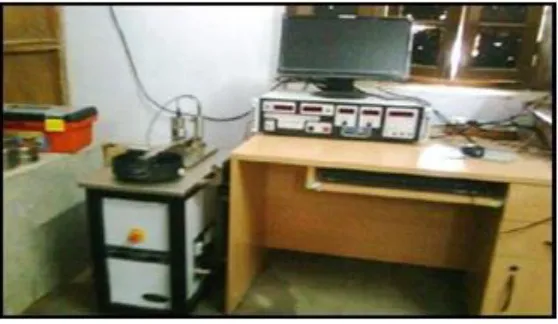
Vickers hardness tester (LECO, LM 248AT) as shown in Figure 1. was used to find the hardness values of all the dry and wet samples using 20 gf Load for a dwell time of 15 seconds. At least eight measurements were taken at different position for each sample in order to get constant results.
Fig 1: Vicker hardness tester Compressive Strength
In order to measure the compressive strength of dry and wet samples INSTRON 1196. Prior to test, gauge length and gauge diameter of the dry and wet specimens were measured individually by the aid of Vernier caliper .The tests were carried out at room temperature (300 K) with a constant crosshead speed of 1mm/min and the full scale range load of 50 kN. This computer integrated machine gives the Load vs displacement signals directly when the specimens were subjected to tests.
Wear resistance and Friction
In this study computerized Ball on Plate Wear Tester (TR-208-M1) as shown in Fig was used to evaluate the wear performance and sliding contact resistance of the Fly ash compacts.
Fig.2: Ball-On-Plate Wear Tester (TR-208 M1)
63 compact with a constant speed of 20 rpm for different time period of 600s. At the end of each test, loss in weight of the samples was noted. Results obtained have been expressed in terms of wear depth, and friction co-efficient.
RESULTS Composition of Fly ash
Fly ash mainly consists Silica (Sio2), Alumina (Al2o3), Calcium Oxide (CaO), and Iron Oxide (Fe2O3).The chemical composition of Fly ash is tabulated in table 1.
Table1: Compositional analysis of Fly ash
Water Absorption Test
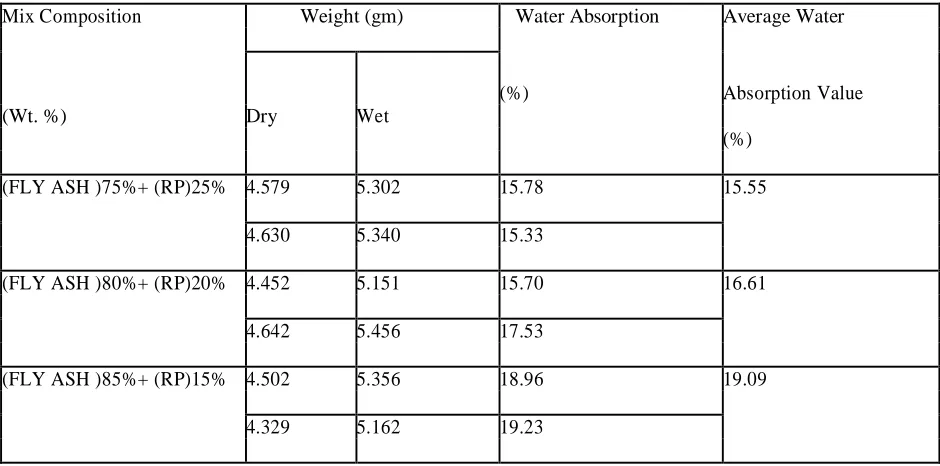
The amount of water absorbed corresponding to different FLY ASH composition. The water absorption values of FLY ASH composites lies in the range of 15.55 % to 19.09%. It can be seen that all the composition met the absorption criteria set by several developing countries. In India maximum of 20 % water absorption permits when compacts are immersed for 24 hours.
Table 2: Percentage (%) water absorbed by various fly ash polymer compacts
Fig.3 shows a relation between the amount of water absorbed and density of dry composite with respect to Fly ash composition. It is evident from the graph that the water absorption increases with increase in Fly ash content. 85wt. % Fly ash absorbs water to a maximum of 19.09%. This indicates that that most of the openings of the compacts are open to outside.
Compounds SiO2 Al2O3 CaO Mgo P2O5 Fe2o3 SO3 K2O LOI
Composition 54.5 26.5 2.1 0.57 0.6 - - - 14.18
(%)
Mix Composition Weight (gm) Water Absorption Average Water
(Wt. %)
(%) Absorption Value
Dry Wet
(%)
(FLY ASH )75%+ (RP)25% 4.579 5.302 15.78 15.55
4.630 5.340 15.33
(FLY ASH )80%+ (RP)20% 4.452 5.151 15.70 16.61
4.642 5.456 17.53
(FLY ASH )85%+ (RP)15% 4.502 5.356 18.96 19.09
64 Figure.3: Water absorption and density as a function of FLY ASH Composition
CONCLUSIONS On the basis of present study following conclusion can be drawn:
1. Thermal conductivity of FLY ASH increases with increase in temperature, whereas in case of resin powder Fly ash mixes, the conductivity of composite decreases with increase in temperature. A lower conductivity value is achieve and thus can be used as a substitute material with respect to clay.
2. Water absorption increases with increase in Fly ash content. Maximum of 19% water is absorbed in case of 85 wt. % Fly ash
3. Density of dry compacts decreases with increase in Fly ash content. While in case of wet compacts, it increases with increase in Fly ash content.
4. SEM analysis revealed the morphology of Fly ash particles that are mostly spherical in shape. With decrease in polymer addition i.e. increase in Fly ash content the interFly ash ce bonding becomes better and less amount of cracks were found at the interFly ash ces.
5. XRD analys is exposed that Fly ash particles mainly consist of Silica and alumina with less percentage of Fe2O3, Cao and others.
REFERENCES
[1]. ASTM C 618-08a (2008) Standard specification for coal Fly ash and raw or calcined natural pozzolan for use in concrete, American Society for Testing and Materials.
[2]. ASTM C 618-08a (2008) Standard specification for coal Fly ash and raw or calcined natural pozzolan for use in concrete, American Society for Testing and Materials.
[3]. Jala S, Goyal D. Fly ash as a soil ameliorant for improving crop production – a review. Bioresour Technol 2006; 97(9):1136–47.
[4]. 4) Sikka R, Kansal BD. Characterization of thermal power-plant Fly ash for agronomicpurposes andidentify pollution hazards. Bioresour Technol 1994; 50:269–73
[5]. Matsi T, Keramidas VZ. Fly ash application on two acid soils and its effect on soil salinity, pH, B, P and on ryegrass growth and composition. Environ Pollut 1999; 104(1):107–12
[6]. Roy WR, Thierry RG, Schuller RM, Suloway JJ. Coal Fly ash : a review of the literature and proposed classification system with emphasis on environmental impacts. Environmental geology notes 96. Champaign, IL: Illinois tate Geological Survey; 1981.
65
[8]. Mattigod SV, Dhanpat R, Eary LE, Ainsworth CC. Geochemical Fly ash ctors controlling the mobilization of inorganic constituents from fossil fuel combustion residues: I. Review of the major elements. Journal of Environmental Quality 1990;19:188–201
[9]. Da Costa JCD, Prasad P, Pagan RJ. Modern environmental improvement pathways for the coal power generation industry in Australia. Process Safe Environ Protect 2004; 82(3B):191–9.
[10]. Matsi T, Keramidas VZ. Fly ash application on two acid soils and its effect on soil salinity, pH, B, P and on ryegrass growth and composition. Environ Pollut 1999; 104(1):107–12.
[11]. Pandey VC, Singh N. Impact of Fly ash incorporation in soil systems. Agric, Ecosys Environ 2010; 136(1 2):16 27. [12]. Pujari GK, Dash PM. Fly ash – problem and management aspect. Envis Newsl Centre Environ Stud 2006; 3(1):1–8. [13]. ASTM Standard D5334-08 – Standard Test Method for Determination of Thermal Conductivity of Soil and Soft
Rock by Thermal Needle Probe Procedure, doi:10.1520/D5334-08. [14]. Chapman TR, Niesz DE, Foxrt, Fly ash wcett T. Wear 1999;236:81.