Hong-Yang Lu
1, a, b, e, f, Zhen-Yi Lu
2, b, c, f, Qiao-Yuan cheng
3, b, d–f, Ju-fen cai
4, b, c, f,
Xiao-Jia Wang
1, b, c, f, Yi-Ping Zhang
1, b, c, f, cai-Jin Lou
4, b, c, f, Xin-min Yu
4, b, c, f,
Jing Qin
4, b, c, f, Wei-Wu Ye
4, b, c, f, Lei Lei
4, b, c, f, Jian Huang
4, b, c, f, Hui-Yi Yang
5, c, d, g,
Wei-Min Mao
1, a, fIdentifying EGFR Mutations from SCLC Patient Plasma
by Mutant-Enriched Liquidchip Technology*
1 Zhejiang Key Laboratory of diagnosis & Treatment Technology on Thoracic Oncology, Zhejiang cancer
Hospital, Hangzhou 310022, PRc
2 department of Oncology, Xiangshan first People’s Hospital, Xiangshan 315700, PRc
3 department of Traditional chinese Medicine, Zhejiang Institute for food and drug control, Hangzhou 310004, PRc 4 department of Medical Oncology, Zhejiang cancer Hospital, Hangzhou 310022, PRc
5 Surexam bio-Tech co. Ltd., guangzhou Technology Innovation base, Science city, guangzhou 510663, PRc
A – research concept and design; B – collection and/or assembly of data; C – data analysis and interpretation;
D – writing the article; E – critical revision of the article; F – final approval of article; G – other
Abstract
Background. epidermal growth factor receptor (egfR) tyrosine kinase inhibitors (TKI) such as erlotinib and gefitinib are targeted drugs for the kinase domain of egfR. They are widely used for the treatment of non-small cell lung cancer (NScLc). The egfR exon 19 deletion mutation and the L858R mutation in exon 21 comprise approximately 90% of the somatic mutations in NScLc patients that respond to egfR TKI. Several recent studies have also reported that small cell lung cancer (ScLc) patients with egfR mutations responded to gefitinib. further study, however, has been limited due to the difficulty obtaining tumor specimens from ScLc patients.
Objectives. The aim of this study was to explore the egfR mutation status in ScLc patients by plasma analysis.
Material and Methods. Plasma samples from ScLc patients were collected for mutant-enriched liquidchip (MeL) analysis to identify the egfR mutations in exon 19 and 21.
Results. The exon 19 deletion mutation was detected in one out of 35 patients (a female non-smoker). No exon 21 mutations were found.
Conclusions. a prevalence of egfR mutations in ScLc is rare, and occurs most frequently in females and non-smokers (Adv Clin Exp Med 2014, 23, 2, 191–195).
Key words: small cell lung cancer, epidermal growth factor receptor, gene.
adv clin exp Med 2014, 23, 2, 191–195 ISSN 1899–5276
ORIgINaL PaPeRS
© copyright by Wroclaw Medical University
It is well known that epidermal growth factor receptor (egfR) tyrosine kinase inhibitors (TKI) such as erlotinib and gefitinib are targeted drugs used in the treatment of non-small cell lung can-cer (NScLc) [1–5]. The presence of egfR mu-tations is a biomarker predicting the response of NScLc patients who will receive egfR TKI treatment. It has been reported that the frequen-cy of egfR mutations in asia is higher than in
europe and North america [6, 7]. Interestingly, several recent studies have reported that small cell lung cancer (ScLc) patients with egfR mu-tations responded to gefitinib [8, 9]. The response of chinese ScLc patients to gefitinib has also been observed with the status of egfR mutations unknown [10].
fewer than 5% of ScLc patients are staged T1-2N0M0, and most ScLc patients do not receive
surgical resection. Therefore very few studies about ScLc patients’ mutation status are available, due to the difficulty in obtaining tumor tissues. The most recent report is a prospective study from Taiwan showing that egfR exon 19 mutations were detected in only 2.6% (2 of 76) ScLc patients [11]. Tatemat-su et al also reported low egfR mutation frequen-cy among Japanese ScLc patients: 5 out of 122 cas-es (4.1%) [12]. The authors of the current study previously reported two combined ScLc patients with egfR exon 19 deletion mutation out of 40 ScLc patients undergoing surgical resection [13]. To further explore the egfR mutation incidence in ScLc patients without surgery, a novel mutant-enriched liquidchip (MeL) technology was used to identify egfR mutation in ScLc patient plasma.
Material and Methods
Patient Characteristics
Thirty-five ScLc patients were recruited in this study between 2011 and 2012. Their clini-cal information is shown in Table 1. Plasma sam-ples were acquired along with the cancer diagno-sis. dNa was extracted by standard means. all the samples were included in a mutant-enriched liq-uidchip polymerase chain reaction (MeL-PcR) analysis. The study was approved by the ethical Review committee of Zhejiang cancer Hospital.
Mutant-Enriched Liquidchip
(MEL)
The MeL-PcR protocol was adapted and mod-ified from asano et al. [14]. It consists of two-step PcR procedures and one restriction enzyme diges-tion. In brief, there was a uniquely designed restric-tion site in each of the wild-type egfR genes of ex-ons 19 and 21: Mse I (TTaa) for exon 19 and Msc
I (Tggcca) for exon 21. after the first PcR am-plification, restriction digestion was performed to selectively remove the wild-type egfR. In the sec-ond PcR, the mutated egfR was then enriched. following PcR amplification, the PcR product was hybridized to a mixture of probe-bearing mi-crosphere populations in a hybridization buffer. The probes were designed against the sequence of wild-type and mutant of egfR exon 19 dele-tions and L858R. The mixtures were then heated to 96°c for 2 min, followed by 15 min incubation at 56°c. Then 25 uL of streptavidin-conjugated phy-coerythrin (Sa-Pe) in hybridization buffer was added to the mixture and incubated for 5 min at 56°c. The reactions were analyzed on a Luminex 200 system.
Statistical Analysis
SPSS 13.0 software was used for the statistical analysis.
Results
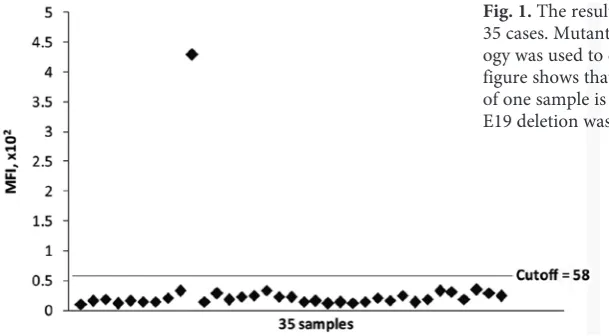
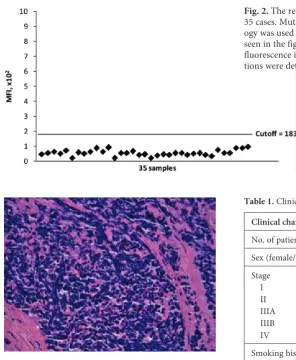
The egfR exon 19 mutation was detected in one out of 35 samples (2.8%) (fig. 1). No pa-tients with the egfR exon 21 mutation were found (fig. 2). The only patient with an egfR mutation is a 57-year-old female non-smoker carrying the c.2236-2250 del 15 (p.e746-a750 del) mutation. chest cT revealed a tumor in the left lower lung with mediastinal lymph node metastasis. bone and brain metastasis occurred before treatment. fig-ure 3 presents the histological type of the tumor, based upon which the patient was diagnosed with ScLc. The stage of this patient was IV according to the TNM classification system. The patient re-ceived 6 cycles of chemotherapy with etoposide plus cisplatin, and a partial response was observed after four cycles of chemotherapy.
Discussion
egfR mutations are rare in ScLc patients. The mutations reported so far include g719a, exon 19 deletions and L858R, which covered most of the mutation sites in NScLc. ScLc patients with egfR mutations most frequently occur in females, nonsmokers and in cases of ScLc com-bined with adenocarcinoma [13]. To avoid the dif-ficulty of obtaining ScLc tumor specimens, the authors of the current study explored the use of MeL-PcR technology to analyze egfR mutations in ScLc patient plasma samples.
analysis of circulating dNa or RNa in plasma requires only a small blood sample, which makes it a promising non-invasive diagnostic method [15]. Many technologies are available for analyzing cir-culating nucleic acid [16, 17]. MeL technology was
developed by Wu [18] to detect KRaS mutations us-ing serum or formalin-fixed and paraffin-embedded samples. The technique is a method of high sensitivity, high reliablity and high throughput [18]. In the cur-rent study, a very low egfR mutation rate was found (1/35, 2.8%), which was consistent with reports in lit-eratures [11–12]. due to the fact that tumor speci-mens of ScLc patients are always obtained from bi-opsy or needle puncture, few specimens are available for further analysis. Plasma can serve as an alternative option for mutation detection and make MeL tech-nology more useful in molecular diagnosis.
It is well known that egfR mutations in NScLc are prevalent in females, nonsmokers, asians and adenocarcinoma [7, 19, 20]. The ScLc patient with egfR mutation in the current study is a female and non-smoker, which is consistent with previous studies [11–13]. This consistence leads to the hypotheses that egfR mutations in ScLc may also be relatively prevalent in females and nonsmokers. as the presence of egfR mutations is the most reliable biomarker to predict tumor
Fig. 2. The results for the egfR e21 mutation in 35 cases. Mutant-enriched liquidchip (MeL) technol-ogy was used to detect the egfR e21 mutation. as seen in the figure, no sample has a value of median fluorescence intensity above the cut-off, so no muta-tions were detected
Fig. 3. The pathology of the ScLc patient with the egfR 19 mutation. The patient was a 57-year-old female non-smoker. The sample was obtained by bronchoscope. The patient’s pathological results were detected using hematoxylin and eosin staining. The tumor cells are dense and of small size, with a lack of cytoplasm, disappearance of nucleolus and finely granular nuclear chromatin
Table 1. clinical characteristics of the study population
Clinical characteristic Cases
No. of patients (total) 35 Sex (female/male) 7/28 Stage
I II IIIa IIIb IV
0 0 2 6 27 Smoking history
Nonsmoker Light smoker Moderate smoker Heavy smoker
responses to egfR TKI in NScLc patients, the authors hypothesize that gefitinib can treat ScLc patients with egfR mutations. a partial response to gefitinib has actually been reported in ScLc pa-tients with egfR mutations before [8, 9]. further study is proposed to investigate the role of egfR mutations in TKI treatments for ScLc patients.
The authors conclude that egfR mutations are rare in ScLc patients, and might be relatively prevalent in females and non-smokers. circulating dNa is an alternative target for mutation analy-sis, especially for those patients who cannot under-go surgery. MeL technology can be used to detect low-frequency mutations in plasma.
References
[1] Douillard JY, Shepherd FA, Hirsh V, Mok T, Socinski MA, Gervais R, Liao ML, Bischoff H, Reck M, Sellers
MV, Watkins CL, Speake G, Armour AA, Kim ES: Molecular predictors of outcome with gefitinib and docetaxel in previously treated non-small-cell lung cancer: data from the randomized phase III INTeReST trial. J clin Oncol 2010, 28, 744–752.
[2] Maemondo M, Inoue A, Kobayashi K, Sugawara S, Oizumi S, Isobe H, Gemma A, Harada M, Yoshizawa H,
Kinoshita I, Fujita Y, Okinaga S, Hirano H, Yoshimori K, Harada T, Ogura T, Ando M, Miyazawa H, Tanaka
T, Saijo Y, Hagiwara K, Morita S, Nukiwa T; North-East Japan Study Group: gefitinib or chemotherapy for
non-small-cell lung cancer with mutated egfR. N engl J Med 2010, 362, 2380–2388.
[3] Mok TS, Wu YL, Thongprasert S, Yang CH, Chu DT, Saijo N, Sunpaweravong P, Han B, Margono B, Ichinose Y, Nishiwaki Y, Ohe Y, Yang JJ, Chewaskulyong B, Jiang H, Duffield EL, Watkins CL, Armour AA, Fukuoka M:
gefitinib or carboplatin – paclitaxel in pulmonary adenocarcinoma. N engl J Med 2009, 361, 947–957.
[4] Mitsudomi T, Morita S, Yatabe Y, Negoro S, Okamoto I, Tsurutani J, Seto T, Satouchi M, Tada H, Hirashima T, Asami K, Katakami N, Takada M, Yoshioka H, Shibata K, Kudoh S, Shimizu E, Saito H, Toyooka S, Nakagawa K, Fukuoka M; West Japan Oncology Group: gefitinib versus cisplatin plus docetaxel in patients with non-small-cell lung cancer harbouring mutations of the epidermal growth factor receptor (WJTOg3405): an open label, randomised phase 3 trial. Lancet Oncol 2010, 11, 121–128.
[5] Zhou C, Wu YL, Chen G, Feng J, Liu XQ, Wang C, Zhang S, Wang J, Zhou S, Ren S, Lu S, Zhang L, Hu C, Hu C, Luo Y, Chen L, Ye M, Huang J, Zhi X, Zhang Y, Xiu Q, Ma J, Zhang L, You C: erlotinib versus chemotherapy as first-line treatment for patients with advanced egfR mutation-positive non-small-cell lung cancer (OPTIMaL, cTONg-0802): a multicentre, open-label, randomised, phase 3 study. Lancet Oncol 2011, 12, 735–742.
[6] Shigematsu H, Lin L, Takahashi T, Nomura M, Suzuki M, Wistuba II, Fong KM, Lee H, Toyooka S, Shimizu N,
Fujisawa T, Feng Z, Roth JA, Herz J, Minna JD, Gazdar AF: clinical and biological features associated with epi-dermal growth factor receptor gene mutations in lung cancers. J Natl cancer Inst 2005, 97, 339–346.
[7] Wu YL, Zhong WZ, Li LY, Zhang XT, Zhang L, Zhou CC, Liu W, Jiang B, Mu XL, Lin JY, Zhou Q, Xu CR,
Wang Z, Zhang GC, Mok T: epidermal growth factor receptor mutations and their correlation with gefitinib therapy in patients with non-small cell lung cancer: a meta-analysis based on updated individual patient data from six medical centers in mainland china. J Thorac Oncol 2007, 2, 430–439.
[8] Okamoto I, Araki J, Suto R, Shimada M, Nakagawa K, Fukuoka M: egfR mutation in gefitinib responsive small-cell lung cancer. ann Oncol 2006, 17, 1028–1029.
[9] Zakowski MF, Ladanyi M, Kris MG: egfR mutations in small-cell lung cancers in patients who have never smoked. N engl J Med 2006, 355, 213–215.
[10] Qian J, Qin SK, Tang QQ, Chen YX, Yang LQ: gefitinib in patients with advanced refractory small cell lung cancer contemporaneous with superior venacava syndrome. chin clin Oncol 2005, 10, 243–244.
[11] Shiao TH, Chang YL, Yu CJ, Chang YC, Hsu YC, Chang SH, Chang SH, Shih JY, Yang PC: epidermal growth
factor receptor mutations in small cell lung cancer: a brief report. J Thorac Oncol 2011, 6, 195–198.
[12] Tatematsu A, Shimizu J, Murakami Y, Horio Y, Nakamura S, Hida T, Mitsudomi T, Yatabe Y: epidermal
growth factor receptor mutations in small cell lung cancer. clin cancer Res 2008, 14, 6092–6096.
[13] Lu HY, Sun WY, Chen B, Zhang YP, Cai JF, Su D, Wang Z, Zheng YQ, Ma SL: epidermal growth factor receptor mutations in small cell lung cancer patients who received surgical resection in china. Neoplasma 2012, 59, 100–104.
[14] Asano H, Toyooka S, Tokumo M, Ichimura K, Aoe K, Ito S, Tsukuda K, Ouchida M, Aoe M, Katayama H,
Hiraki A, Sugi K, Kiura K, Date H, Shimizu N: detection of egfR gene mutation in lung cancer by
mutant-enriched polymerase chain reaction assay. clin cancer Res 2006, 12, 43–48.
[15] Bremnes RM, Sirera R, Camps C: circulating tumor derived dNa and RNa markers in blood: a tool for early detection, diagnostics, and follow up. Lung cancer 2005, 49, 1–12.
[16] Bai H, Mao L, Wang HS, Zhao J, Yang L, An TT, Wang X, Duan CJ, Wu NM, Guo ZQ, Liu YX, Liu HN, Wang YY,
Wang J: epidermal growth factor receptor mutations in plasma dNa samples predict tumor response in chinese patients with stages IIIb to IV non-small-cell lung cancer. J clin Oncol 2009, 27, 2653–2659.
[17] He C, Liu M, Zhou C, Zhang J, Ouyang M, Zhong N, Xu J: detection of epidermal growth factor receptor muta-tions in plasma by mutant-enriched PcR assay for prediction of the response to gefitinib in patients with non-small-cell lung cancer. Int J cancer 2009, 125, 2393–2399.
[19] Zhu JQ, Zhong WZ, Zhang GC, Li R, Zhang XC, Guo AL, Zhang YF, An SJ, Mok TS, Wu YL: better survival with egfR exon 19 than exon 21 mutations in gefitinib-treated non-small cell lung cancer patients is due to dif-ferential inhibition of downstream signals. cancer Lett 2008, 265, 307–317.
[20] Rosell R, Moran T, Queralt C, Porta R, Cardenal F, Camps C, Majem M, Lopez-Vivanco G, Isla D, Provencio M, Insa A, Massuti B, Gonzalez-Larriba JL, Paz-Ares L, Bover I, Garcia-Campelo R, Moreno MA, Catot S, Rolfo C, Reguart N, Palmero R, Sánchez JM, Bastus R, Mayo C, Bertran-Alamillo J, Molina MA, Sanchez JJ, Taron M; Spanish Lung Cancer Group: Screening for epidermal growth factor receptor mutations in lung cancer. N engl J Med 2009, 361, 958–967.
Address for correspondence:
Wei-Min Mao
Zhejiang Key Laboratory of diagnosis & Treatment Technology on Thoracic Oncology Zhejiang cancer Hospital
Hangzhou 310022
The People’s Republic of china Tel.: +86 571 881 223 88 e-mail: [email protected]
conflict of interest: None declared