Analgesic activity of
Cuscuta campestris
Yuncker a parasitic plant grown
on
Nerium indicum
Mill
Ghule R.S1*, Venkatnarayanan R.1, Thakare S.P.2, Jain H.3, Ghule P.R.3
1. R.V.S. College of Pharmaceutical Sciences, Sulur, Coimbatore, Tamil Nadu, India.
2. Sigma Institute of Pharmacy, Bakrol, Baroda, Gujarat, India.
3. Finar Chemical Ltd., Bavla, Sanand, Ahmedabad, Gujarat, India.
*Corresponding author: [email protected]
ABSTRACT:
Cuscuta campestris is the most widespread species in the genus Cuscuta belonging to
family Convolvulaceae throughout the World. Cuscuta campestris possess to have
anthelmintic activity. The ethanol extract of plant also proved to have Analgesic,
anti-pyretic and anti- inflammatory activity (Azza, et al., 1996) on different host. The dried
methanol extract (CC ME) of the whole plant of Cuscuta campestris Yuncker was
studied for its analgesic activity grown on Nerium indicum (Apocyanaceae). Analgesic
activity was carried out using animal models i.e. Acetic acid Induced Writhing Test
(Chemical Stimulation) and Heat conduction method in comparison with Diclofenac
sodium as reference standard (Positive control). The CC ME was given in doses of 100,
200 and 400 mg/kg body weight in which dose 400 mg/kg given significant results in
comparison with reference standard Diclofenac sodium. The study may conclude that
some chemical entities transferred from host Nerium indicum to the parasite Cuscuta
campestris are responsible for analgesia.
Key words: Cuscuta campestris Yuncker, analgesic, whithing, heat conduction.
INTRODUCTION:
The genus Cuscuta L. (dodder) contains 180 species [15, 13], distributed throughout the
World mostly in tropical and subtropical regions of the world. Cuscuta campestris is the
most widespread species in the genus Cuscuta belonging to family Convolvulaceae
throughout the World. This parasitic weed is native from North America which has
spread to the Old World [5]. All the resources required to it is obtains from its host
plants and severely suppressing them which may cause death of host plant [2, 4, 5]. C.
campestris is among the most damaging parasite due to its wide geographical
distribution and host range worldwide causing. C. campestris causesevere damages to
parasites, C.campestris seeds do not require a specific stimulant to induce germination.
Mechanical or chemical scarification of the seed coat is sufficient to facilitate
germination [9, 5]. Cuscuta campestris possess to have anthelmintic activity [10]. The
plant also proved to have Analgesic, anti-pyretic and anti- inflammatory activity [3] on
different host. Due to having adverse side effects, like gastric lesions, caused by NSAIDs
and tolerance and dependence induced by opiates, the use of these drugs as analgesic
agents have not been successful in all the cases. Therefore, analgesic drugs lacking
those effects are being searched all over the world as alternatives to NSAIDs and
opiates. During this process, the investigation of the efficacy of plant-based drugs used
in the traditional medicine have been paid great attention because they are cheap, have
little side effects and according to WHO still about 80% of the world population rely
mainly on plant based drugs [12]. Present study attracts analgesic activity of Cuscuta
campestris due to adverse effect of allopathic analgesics.
MATERIALS AND METHODS:
Plant material:
The plant material of Cuscuta campestris Yuncker (Convolvulaceae) parasitic on Nerium
indicum Mill. (Apocyanaceae) was collected from Baroda- Ahmedabad Express way of
Gujarat (16° 41' 60N Latitude and 74° 13' 0E Longitude and 300m Altitude) in
December 2010. The plant specimen was submitted to museum of Department of
Pharmacognosy, Sigma Institute of Pharmacy, Baroda, Gujarat, India. The voucher
specimen no. is RSG2412.
Preparation of extract:
The shade dried material was coarsely powdered (500 g) and extracted with methanol
(1.5 L) by cold maceration method. The extract (CC ME) was filtered, concentrated on
rotary vacuum evaporator and further dried in vacuum dryer and weighed (11.23%
w/w). Dosages of different concentrations of extract were dispensed from solution
prepared from normal saline. The vehicle alone served as control.
Animals:
Swiss Albino mice (20-25 g) were procured from SPARC, Baroda. The animals were
housed under standard conditions of temperature (22 ± 10C), relative humidity (55 ±
10%), 12 hr light/dark cycles and fed with standard pellet diet (Amrut, Pranav Agro
Grouping of animals:
The animals were divided into six groups each containing six animals. Group I served
as untreated control and received normal saline (3 ml/kg, p.o.), group II served as
positive control and received Diclofenac sodium (5 mg/kg, i.p.) and group III, IV and V
were treated with 100, 200, and 400 mg/kg of CC ME respectively.
Acute toxicity test:
The acute toxicity of Cuscuta campestris methanol extract was determined in Swiss
Albino mice according to the method [7]. with slight modifications. Mices fasted for 16 h
were randomly divided into groups of six rats per group. Graded doses of the extract
(250, 500, 1000 and 2000 mg/kg p.o.) were separately administered to the mices in
each of the groups by means of bulbed steel needle. All the animals were then allowed
free access to food and water and observed over a period of 48 h for signs of acute
toxicity. The number of deaths within this period was recorded.
Analgesic activity:
1. Acetic acid Induced Writhing Test (Chemical Stimulation):
The analgesic activity of the samples was evaluated using acetic acid induced writhing
method in mice [1]. In this method, acetic acid is administered intraperitoneally to the
experimental animals to create pain sensation. As a positive control, any standard
NSAID drug can be used. In the present study Diclofenac sodium was used to serve the
purpose. The CC ME was administered orally in three different doses (100, 200 and
200 mg/kg body weight) to the Swiss Albino mice after an overnight fast. Test samples
and vehicle were administered orally 30 minutes prior to intraperitoneal administration
of 0.7% v/v acetic acid solution (0.1ml/10g) but Diclofenac sodium was administered
15 minutes prior to acetic acid injection. Then the animals were placed on an
observation table. Each mouse of all groups were observed individually for counting the
number of writhing they made in 15 minutes commencing just 5 minutes after the
intraperitoneal administration of acetic acid solution. Full writhing was not always
accomplished by the animal, because sometimes the animals started to give writhing
but they did not complete it. This incomplete writhing was considered as half-writhing.
Accordingly, two half-writhing were taken as one full writhing. The number of writhes in
each treated group was compared to that of a control group while Diclofenac sodium (5
2. Heat conduction method:
The animals were divided into five groups of 6 animals each. Group I served as negative
control. Group II served as positive control and were injected Diclofenac sodium (5
mg/kg) intraperitonially. Group III, IV and V were treated with 100, 200, and 400
mg/kg body weight of CC ME respectively. After half hour, 1 hour, 2 hour and 3 hour,
the tip of tail was dipped up to 5 cm into hot water maintained at 58°C. The response
time was noted as the sudden withdrawal of the tail from the hot water. Cut off time of
10 seconds was maintained to avoid damage to the tail for all groups. The time required
for flicking of the tail, was recorded, to assess response to noxious stimulus [11].
Statistical analysis:
All the values ware statistically analyzed by one-way analysis of variance (ANOVA)
followed by Dunnett’s test. Comparison between control and drug treated groups were
considered to be significant. All values are expressed as mean ± SEM.
RESULTS AND DISCUSSION:
Oral administration of graded doses (250, 500, 1000 and 2000 mg/kg p.o.) of the
methanol extract of Cuscuta campestris to mices produce no significant changes in
behavior. No mortality was however recorded for all the doses after 72 h of
administering the extract to the animal.
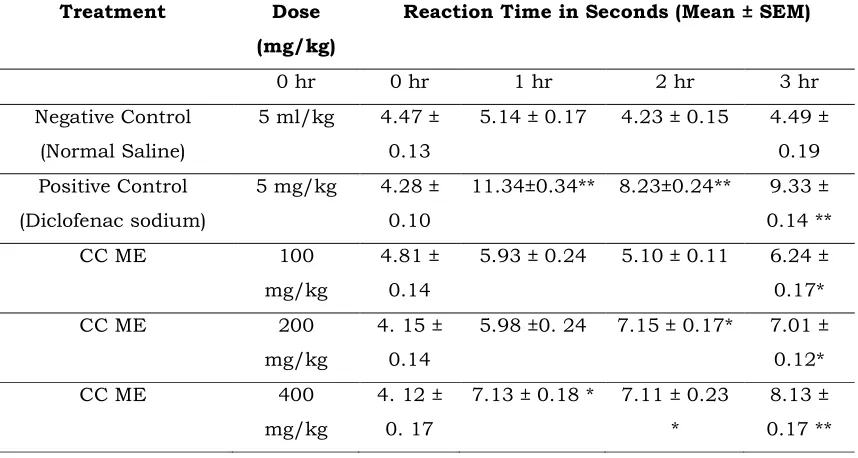
Table 1. Analgesic effect of methanol extract of Cuscuta campestris on Swiss albino
mice’s using Heat conduction method
Treatment Dose
(mg/kg)
Reaction Time in Seconds (Mean ± SEM)
0 hr 0 hr 1 hr 2 hr 3 hr
Negative Control
(Normal Saline)
5 ml/kg 4.47 ±
0.13
5.14 ± 0.17 4.23 ± 0.15 4.49 ±
0.19
Positive Control
(Diclofenac sodium)
5 mg/kg 4.28 ±
0.10
11.34±0.34** 8.23±0.24** 9.33 ±
0.14 **
CC ME 100
mg/kg
4.81 ±
0.14
5.93 ± 0.24 5.10 ± 0.11 6.24 ±
0.17*
CC ME 200
mg/kg
4. 15 ±
0.14
5.98 ±0. 24 7.15 ± 0.17* 7.01 ±
0.12*
CC ME 400
mg/kg
4. 12 ±
0. 17
7.13 ± 0.18 * 7.11 ± 0.23
*
8.13 ±
Values are expressed as Mean ± SEM, n=6, Data analyzed by One-way ANOVA followed
by Dunnette’s test * * P < 0.01, * P < 0.05, CC ME (Cuscuta campestris methanol extract).
Table 2. Analgesic effect of methanol extract of Cuscuta campestris on Swiss albino
mices using Acetic Acid Induced Writhing method.Acetic Acid Induced Writhing
Treatment Dose Number of Writhes
observed
Percentage
Inhibition
Negative Control (Normal
Saline)
5 mL/kg 34.8 ±1.69 --
Positive Control (Diclofenac
sodium)
5 mg/kg 10.7 ± 0.98** 67.38
CC ME 100
mg/kg
29.3 ± 0.94* 15.81
CC ME 200
mg/kg
24.0 ± 0.92* 26.83
CC ME 400
mg/kg
18.2 ± 0.69** 44.51
Values are expressed as Mean ± SEM, n=6, Data analyzed by One-way ANOVA followed
by Dunnette’s test * * P < 0.01, * P < 0.05, CC ME (Cuscuta campestris methanol extract).
Acetic acid induced writhing in mice attributed visceral pain finds much attention of
screening analgesic drugs [6]. The crude extract the plant showed significant analgesic
action compared to the reference drug Diclofenac sodium against acetic acid induced
pain in mice and heat conduction method at three dose levels i.e. 100, 200 and 400
mg/kg b. wt. The results of present study indicate the methanol extract of Cuscuta
campestris possesses analgesic effect. Analgesic effect of the extracts was demonstrated
in the experimental models using Acetic acid Induced Writhing Test (Chemical
Stimulation) and Heat conduction method using thermal stimuli. An increase in
reaction time and decrease in writhing are generally considered an important parameter
of analgesic activity in Heat conduction method and Acetic acid Induced Writhing Test
respectively. Cuscuta campestris is feeding on its host; in the present study Cuscuta
campestris is parasitic on Nerium indicum. So, it may conclude that chemical
constituents of Nerium indicum are responsible for analgesic activity of Cuscuta
CONCLUSION:
The methanol extract of Cuscuta campestris showed significant results for analgesic
activity. As the holo- parasite the plant get feeds on its host plant. Many of the primary
as well as secondary metabolites may transfer from host to parasite. The analgesic
effect of Cuscuta campestris may be due to the metabolites transfer from Nerium
indicum. The present study may conclude that pharmacological activities of parasitic
plants are depending on their hosts. If same parasite grown on different hosts then it
may having different pharmacological actions or same pharmacological action with
varying results.
REFERENCES:
1. Ahmed F., Selim M.S.T., Das A.K., Choudhuri M.S.K. Antiinflammatory and
antinociceptive activities of Lippia nodiflora Linn. Pharmazie. 2004; 59: 329-333.
2. Ashton F.M., Santana D. Cuscuta spp. (dodder): a literature review of its biology and
control. University of California Berkeley: Division of Agricultural Science Cooper.
Ext. Bull. 1976; 1880.
3. Azza M.A., Essam A.S., Ahmed G. Pharmacological Study of Cuscuta
campestris Yuncker. Phytotherapy Research. 1996; 10(2): 117-120.
4. Cooke D.A., Black I.D. Biology and control of Cuscuta campestris and other Cuscuta
spp.: a bibliographic review. Adelaide, South Australia: South Australian
Department of Agriculture Technical. 1987; 18.
5. Dawson J.H., Musselman L.J., Wolswinkel P., Dorr I. Biology and control of
Cuscuta. Rev. Weed Sci. 1994; 6:265–317.
6. Hasan S.M.R., Hossain M.M., Akter R., Jamila M., Mazumder M.E.H., Alam M.A.,
Faruque A., Rana S., Rahman S. Analgesic activity of the different fractions of the
aerial parts of Commelina benghalensis Linn. International Journal of
Pharmacology. 2010; 6 (1): 63-67.
7. Hilaly J.E., Israili Z.H., Lyoussi B. Acute and chronic toxicological studies of Ajuga
iva in experimental animals. J. Ethnopharmacol. 2004; 91: 43-30.
8. Holm L., Doll J., Halm E., Panch J., Harberger J. World Weeds: Natural Histories
and distribution.John Wiley & Sons. NY, USA. 1997.
9. Hutchison J.M., ASTON F.M. Germination of field dodder (Cuscuta campesrris).
Weed Science 1980; 28: 330-333.
10.Jabbar A., Raza M.A., Iqbal Z., Khan N. An inventory of the ethnobotanicals used as
11.Kulkarni S.K. Handbook of Experimental Pharmacology. 3rd rev. ed. New Delhi:
Vallabh Prakashan; 1999; 123-25.
12.Kumara N.K. Identification of strategies to improve research on medicinal plants
used in Sri Lanka. In: WHO Symposium. University of Ruhuna, Galle, Sri Lanka.
2001.
13.Mabberley D.J. The plant-book. Cambridge University press, Cambridge, New York.
3rd edition. 2008; 158-160.
14.Parker C., Riches C.R. Cuscuta species, the dodders and Cassytha filiarmis In:
Parasitic weeds of the world biology and control, CAB International, Wallingford,
UK, 1993; 183-223.
15.Yuncker, T.G. The genus Cuscuta. Memoirs of the Torrey Botanical Club. 1932;
18:109-331.
16.Jadhav R.B, Anarthe S.J, Surana S.J, Gokhale S.B. Host-hemiparasite transfer of
the C-glucosyl xanthone mangiferin between Mangifera indica and Dendrophthoe
falcata. Journal of Plant Interactions. 2005; 1 (3): 171-177.