From LiDAR waveforms to Hyper Point Clouds: a novel data product to
characterize vegetation structure
Tan Zhou*a,b, Sorin Popescub, Lonesome Malambob, Kaiguang Zhaoc, Keith Kraused
a Colaberry Inc.
b LiDAR Applications for the Study of Ecosystems with Remote Sensing (LASERS) Laboratory,
Department of Ecosystem Science and Management, Texas A&M University, College Station, TX
77450, USA
c School of Environment and Natural Resources, Environmental Science Graduate Program, The
Ohio State University, Columbus, OH 43210, USA
d National Ecological Observatory Network, 1685 38th St., Suite 100, Boulder, CO 80301, USA
Abstract
Full waveform (FW) LiDAR holds great potential for retrieving vegetation structure parameters at
a high level of detail, but this prospect is constrained by practical factors such as lack of available
handy processing tools and technical intricacy of waveform processing. This study introduces a
new product, named the Hyper Point Cloud (HPC) derived from FW LiDAR data, and explore its
potential applications such as tree crown delineation using the HPC-based intensity and percentile
height (PH) surfaces, which show a promising solution to the constraints of using FW LiDAR data.
Results of the HPC present a new direction to handle FW LiDAR data and offer prospects for
studying the mid-story and understory of vegetation with high point density (~ 182 points/m2). The
intensity-derived digital surface model (DSM) generated from the HPC shows that the ground
region has larger maximum intensity (MAXI) and mean intensity (MI) than the vegetation region
while having smaller total intensity (TI) and number of intensities (NI) at the given grid cell. Our
analysis of intensity distribution contours at individual tree level exhibit similar patterns, indicating
that the MAXI and MI are decreasing from the tree crown center to tree boundary while a rising
trend is observed for TI and NI. These intensity variable contours provide a theoretical justification
for using HPC-based intensity surfaces to segment tree crowns and exploit their potential for
extracting tree attributes. The HPC-based intensity surfaces and the HPC-based PH Canopy Height
Models (CHM) demonstrate promising tree segmentation results comparable to the LiDAR
derived CHM for estimating tree attributes such as tree locations, crown widths and tree heights.
We envision that products such as the HPC and the HPC-based intensity and height surfaces
introduced in this study can open new perspectives to use FW LiDAR data and alleviate the
technical barrier of exploring FW LiDAR data for detailed vegetation structure characterization.
Keywords: hyper point cloud (HPC); HPC-based intensity surface; percentile height; gridding; full waveform LiDAR; tree segmentation; vegetation structure
1 Introduction
Light Detection and Ranging (LiDAR) remote sensing has demonstrated its advantages over
traditional remote sensing (e.g. multispectral and radar) for forest inventory and vegetation
structure characterization (Dubayah et al., 2010; Falkowski et al., 2009; Lefsky et al., 2002;
Wulder et al., 2008; Zhao et al., 2009). With technological advances, commercial airborne LiDAR
data such as small footprint full waveform (FW) LiDAR data have become available to wider
remote sensing and ecological communities. Compared to conventional LiDAR systems, FW
LiDAR can record the whole echo scattered from intercepted objects to inform their spatial
arrangements (Chauve et al., 2009; Drake et al., 2002; Mallet and Bretar, 2009; Wagner et al.,
2006). Theoretically, such an advantage can enable FW LiDAR systems to better characterize
vegetation structure with fine details. Past experience of FW LiDAR applications has also
demonstrated their superior capacities for measuring vegetation structure (Hancock et al., 2017;
McGlinchy et al., 2014; Reitberger et al., 2008; Zhou and Popescu, 2017). Yet, FW LiDAR remote
sensing of vegetation structure has not reached an as well-established stage as the discrete-return
(DR) LiDAR remote sensing. Developing alternative ways to analyze FW LiDAR data in relevant
applications are critical to facilitating the widespread use of FW LiDAR data, as well as improving
the accuracy of characterizing the three-dimensional structure of vegetation.
Increased availability of FW LiDAR data over the past decades has spurred various applications
targeted at estimating vegetation structural parameters and biomass through decoding the structural
information inherent in waveforms (Allouis et al., 2013; Cao et al., 2014a; McGlinchy et al., 2014;
Reitberger et al., 2009). Early applications of FW LiDAR data mainly focus on estimating
elevation, canopy height, crown depth, canopy cover and biomass at the footprint level over large
scale using large-footprint profilers such as the Laser Vegetation Imaging Sensor (LVIS) and the
Geoscience Laser Altimeter System (GLAS) (Drake et al., 2002; Harding and Carabajal, 2005;
Lefsky et al., 2005). More recent applications of FW LiDAR centered on individual tree analyses
with small-footprint FW LiDAR data such as understory detection (Anderson et al., 2016), stem
advanced statistical methods (Heinzel and Koch, 2011; Zhou et al., 2017a). There are also some
studies that employed FW LiDAR to extract canopy fuel parameters (Hermosilla et al., 2014),
classify land cover (Wang and Glennie, 2015) and predict biomass (Babcock et al., 2016; Cao et
al., 2014a; Finley et al., 2013) with the synthetic use of other remote sensing data. These studies
have accentuated the great potential of FW LiDAR for characterizing vegetation structure and
demonstrate their advantages compared to DR LiDAR data. Despite the envisioned advantages,
fewer practical FW LiDAR applications are available as compared to DR LiDAR applications. A
notable challenge of FW LiDAR data application is related to the technical barrier such as
complicated processing steps or approaches and the lack of available software tools for handling
large data volume (Anderson et al., 2016; Mallet and Bretar, 2009). Moreover, currently available
tools or software for LiDAR data analysis are primarily oriented for processing point cloud data
while the commonly available FW LiDAR data are stored in the wave format. This conflict
essentially makes FW LiDAR data become more difficult to adopt than DR LiDAR data, but it
also leaves us considerable room to further investigate possible approaches for interpreting
information from FW LiDAR data. In addition, directly visualizing complete FW LiDAR data is
still hardly available to the remote sensing and ecological communities.
Current endeavors of FW LiDAR data processing can mainly be categorized into two types. First,
part of waveform signals that represent objects are converted into points through the
decomposition or deconvolution methods using dedicated algorithms and functions (Roncat et al.,
2011; Wu et al., 2011; Zhou et al., 2017b). Simultaneously, these methods could render us
additional information such as echo widths, the number of peaks and amplitudes for corresponding
peaks, which provide valuable insights into vegetation structure characterization and dynamics
(Anderson et al., 2016; Reitberger et al., 2008; Roncat et al., 2008). Essentially, this approach
treats FW LiDAR data as DR LiDAR data to extract useful metrics for the subsequent analysis.
Despite more information with higher density point cloud has been obtained with this approach as
compared to DR LiDAR data, the intensity information embeds in waveforms which is the most
conspicuous advantage of FW LiDAR data is still insufficiently studied. Through this intensity
information, we can gain the unique insight into the energy or intensity distribution of vegetation
and individual trees, but it is rarely being investigated. To make the most use of information raw
waveform contained and enable practitioners to easily adopt FW LiDAR data, we delivered a new
that of DR LiDAR datathrough directly transforming all waveform intensities into points with the
aid of georeferenced data. This process will be detailed later in Section 2.3.1; Second, the other
type of FW LiDAR data processing directly extracts vegetation’s vertical information from
waveforms as waveform signatures or features for possible applications. Their effectiveness has
been demonstrated in previous studies (Drake et al., 2002; Hermosilla et al., 2014; Zhou et al.,
2017a). This second concept was first used in the large-footprint waveform and it was introduced
into the small-footprint waveform recently with the aid of tree crown boundary. The main reason
for the necessity of tree crown boundary is that an individual small-footprint waveform only
captures a small portion of tree crowns intercepted by the laser beam (Zhou et al., 2017a). More
useful and representative vegetation information can be extracted through employing all
waveforms within the tree crown boundary rather than only using an individual waveform as the
large-footprint waveform. Actually, the demand for additional information such as tree crown
boundary gives rises to another concern of directly using small-footprint FW LiDAR data. The
waveform decomposition needs to be done to obtain the Canopy Height Model (CHM) as the input
to tree crown segmentation, which possibly requires users to have a deep understanding of
complicated waveform processing methods and precludes the practitioners’ willingness to explore
FW LiDAR data’s potential. Therefore, we introduced the CHM-like products derived from the
HPC without the aid of dedicated waveform processing algorithms, namely the HPC-based
intensity and percentile height (PH) surfaces, for tree segmentation and further explored their
potential applications.
This study mainly aims to propose a new and convenient way to visualize and process FW LiDAR
data and explore their potential for characterizing vegetation structure. More specifically, we
attempted to: (1) introduce a new concept or product, named the HPC, to relax subsequent FW
LiDAR data analysis through converting all waveforms into points that is easy to reconcile with
existing LiDAR processing tools well known by practitioners; (2) exemplify potential applications
of the HPC such as the HPC-based PH CHMs and the HPC-based intensity surfaces for tree crown
segmentation by exploring height and intensity information inherent in waveforms; and (3)
evaluate the effectiveness of the HPC-based surfaces for estimating fundamental tree dimensional
variables such as tree location, crown width and tree height. The logic of these three objectives is
that we start from proposing a new product, the HPC, and then explore its applications such as the
usefulness for extracting tree attributes from the height and intensity information. Of particular
note, the concepts or products of the HPC and the HPC-based surfaces are new to the remote
sensing and ecological communities. It is anticipated that the novelty of these concepts or products
could alleviate technical impediments for the extensive use of FW LiDAR data and could inspire
more potential and innovative applications of FW LiDAR data.
2 Materials and Methods
2.1 Study area
A 236 ha ecosystem research experimental area, part of San Joaquin Experimental Range with the
center at 256,361.9 Easting, 4,109,518.0 Northing and UTM Zone 11N, was chosen for this study
(Fig. 1). This study area is characterized by mixed patches of vegetation and complex topography
including coarse, large hills and valleys with elevation ranging from 210 to 521m above sea level
with a mean elevation of 366 m. The main vegetation of the study area consists of interior live oak
(Quercus wislizeni), blue oak (Quercus douglasii), gray pine (Pinus sabiniana) and scattered shrubs
Fig.1. An overview of the study area in the San Joaquin Experimental Range with false composite
image and a subset with LiDAR data (right panel).
2.2 Data
2.2.1 LiDAR data
Two airborne LiDAR datasets including DR LiDAR and FW LiDAR data were simultaneously
collected through the National Ecological Observatory Network (NEON) Airborne Observation
Platform (AOP) (Kampe et al., 2010) with an Optech Gemini instrument at a nominal range of
1000 m (the aircraft flew at 1000 m above ground level). FW LiDAR data acquired with this
platform generated a 0.8 m diameter footprint, a spacing of about 0.524 m in the across-track
were also collected with the maximum horizontal accuracy of 0.4 m and maximum vertical
accuracy of 0.36 m (Zhou et al., 2017b) with the average point density approximately 6 points/m2
(ppm2). Both data were acquired in June 2013 during the leaf on season. These data can be
downloaded from NEON data Portal (http://data.neonscience.org/home).
Our study area is covered by two perpendicular direction flight lines, with four and two flight lines
in an east-west direction and north-south direction, respectively. In total, the study region was
covered by 40,000,812 waveforms and each waveform is composed of 500 time bins with 1 ns
temporal resolution. The tail of each waveform is filled with zero values to keep the length of
waveforms constant. In fact, the zero values in the waveform represent non-record values. Besides
the waveform information, the reference geolocation information of these waveforms was also
used in this study. Specifically, seven basic reference geolocation attributes are directly used to
geo-transform the waveform data to the HPC. The seven items are the Easting of first return xr
(m), the Northing of first return yr (m), the height of first return zr (m), dxr (m), dyr (m), dzr (m),
and first return reference bin location tr (leading edge 50% point of the first return).
2.1.3 Reference data
The field data were collected through the NEON AOP and the Terrestrial Instrument System (TIS)
programs (NEON, 2018a). In sum, there were 13 plots and totally 345 individual trees and shrubs
(<=3m) in our study area. These plots were designed for the long-term plant, insect and soil
measurements following the protocol of the NEON Terrestrial Observation System (Meier &
Jones, 2014) and each plot is restricted to a region 20 × 20m. For each field-measured tree, key
vegetation structure variables such as tree locations (Easing and Northing), tree height, and average
crown width were provided (http://data.neonscience.org/prototype-search).
2.3 Methods
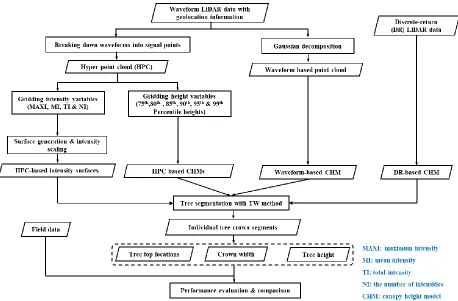
To get a better overview of the HPC generation process and their potential applications, we
summarized the major steps of this study as shown in Fig. 2. A detailed description of these steps
Fig. 2. The flowchart of utilizing the hyper point cloud to extract tree attributes.
2.3.1 From raw waveforms to hyper point cloud
The routine for extracting FW LiDAR information is to convert part of waveform signals to
discrete points with the decomposition or deconvolution methods, which has been proven useful
for tree species identification, forest inventory, and biomass estimation (Allouis et al., 2013; Cao
et al., 2014a; Yao et al., 2012; Zhou et al., 2017a). However, most of the intensity information
inherent in waveforms is being ignored with the conventional methods that undoubtedly degrades
the value of FW LiDAR data. Moreover, the complicated waveform processing steps perplex users
and further hinder the extensive use of FW LiDAR data for vegetation characterization. To tackle
these challenges, we directly convert all raw waveform signals into points to form a point cloud,
named the HPC, for subsequent analysis. A HPC is a set of data points converted from all
waveform signals along the pulse path by combing geo-reference information (black) with raw
Specifically, we geo-transformed every time bin of the waveform into a point Pij = (Xij, Yij, Zij, Iij)
(i = 1,…, nj, j =1, … ,m) through Eq. (1) based on the whole return waveform signals and
corresponding geo-reference data. Here, Iij is the intensity of the ith time bin for the jth waveform.
𝑋𝑖𝑗 = (𝑡𝑖𝑗 − 𝑡𝑟𝑗) ∗ 𝑑𝑥𝑟𝑗+ 𝑋𝑟𝑗
𝑌𝑖𝑗 = (𝑡𝑖𝑗− 𝑡𝑟𝑗) ∗ 𝑑𝑦𝑟𝑗+ 𝑌𝑟𝑗 (1) 𝑍𝑖𝑗 = (𝑡𝑖𝑗 − 𝑡𝑟𝑗) ∗ 𝑑𝑧𝑟𝑗+ 𝑍𝑟𝑗
where 𝑋𝑖𝑗, 𝑌𝑖𝑗, 𝑍𝑖𝑗 is the geolocation of Iij, 𝑡𝑟𝑗 is the first return reference bin location for the jth
waveform, 𝑑𝑥𝑟𝑗, 𝑑𝑦𝑟𝑗, 𝑑𝑧𝑟𝑗 are the position change for every nanosecond for the jth waveform,
Fig. 3. Comparison of the discrete-return LiDAR point cloud and the hyper point cloud (HPC)
over the same subset region. (a) Discrete-return LiDAR point cloud. (b) Illustration of the HPC
generation process by combing raw waveform data (blue) and corresponding geo-reference data
(black).
2.3.2 Gridding of the hyper point cloud
The HPC preserves as much information embed in original waveforms as possible and provides a
convenient way to handle FW LiDAR data for most potential users. However, the large data
volume of the HPC precludes their direct use for measuring vegetation structure. Additionally, not
all signals converted from waveforms are useful for the subsequent analysis. Thus, we propose to
apply a grid-net method for the HPC to reduce the data volume and generalize useful information
it contains on the 3D vegetation structure.
In this study, we first explored the intensity variation in grid cells with different sizes to investigate
the capability of waveform intensity information for segmenting tree objects and the spatial pattern
of waveform intensity across various objects. Specifically, we projected the HPC’ intensities into
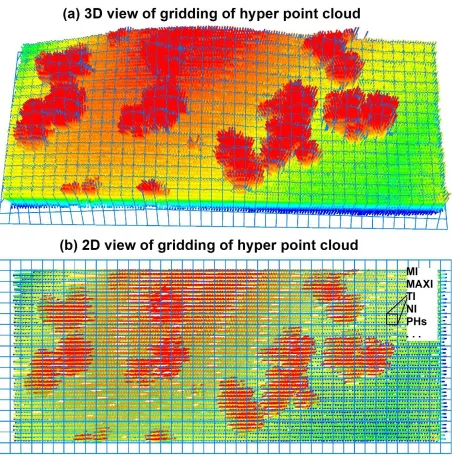
XY planes to obtain the spatial distribution of energy with self-defined grid sizes. As shown in
Fig. 4, we directly applied a gridding process to the HPC and generated multiple grid-level
variables such as the mean location of all intensities (Xc and Yc), the maximum intensity (MAXI),
the mean intensity (MI), the total intensity of waveforms (TI) and the number of intensities (NI)
for each grid. To find the appropriate grid size (based on the HPC density), multiple grid cell sizes
including 0.5 m, 0.8 m, 1 m, 1.5 m, 2 m, 3 m, 4 m and 5 m were used. Besides height information,
PHs such as 75th, 80th, 85th, 90th, 95th and 99th in each grid were also generated. At the current
stage, we reduced the HPC to a manageable degree at grid level with various intensity and height
Fig. 4. The gridding of the hyper point cloud (HPC). (a) 3D view of the HPC with grid-nets. (b)
Derivation of variables such as the mean intensity (MI), the maximum intensity (MAXI), the total
intensity (TI), the number of intensities (NI) and multiple percentile heights (PHs) at the grid cell
level with the gridding procedure from the 2D perspective.
2.3.3 The intensity and height surfaces
To further investigate the intensity distribution of vegetation and ground objects at the local level,
we assumed these variables such as the MI, MAXI and PHs were Z values like the height
information of DR LiDAR data. Subsequently, we converted Xc, Yc and one of these variables to
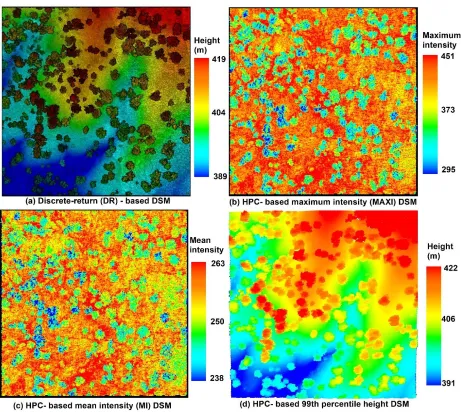
model (DSM) for each point cloud using the lasgrid function from LAStools (Isenburg, 2012). Fig.
5 exhibits an overview of preliminary results of digital surface model (DSM) form DR LiDAR
data and the HPC with representative variables such as the MAXI, MI and 99th PH.
Fig. 5. Preliminary results of (a) the discrete-return (DR)-based digital surface model (DSM) and
(b) the HPC-based MAXI DSM, (c) HPC-based MI DSM and (d) HPC-based 99th percentile height
(PH) DSM from the hyper point cloud (HPC).
It was evident that the HPC-based MAXI DSM, MI DSM and 99th PH DSM shared the similar
spatial pattern with the DR-based DSM, which motivates us to further generate a surface analogous
to the CHM surface. However, the HPC-based TI and NI DSMs did not provide as meaningful
we did not carry out any further exploration of these two products for tree crown segmentation
analysis in this study.
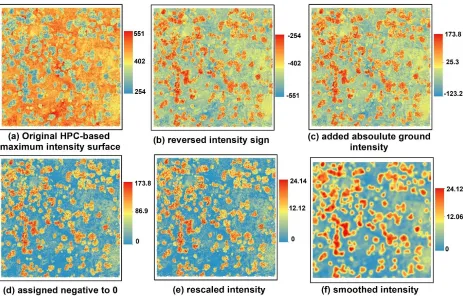
For visual analysis and semantic extraction of canopy information, a multi-level rescaling process
was conducted on intensity-DSMs to generate CHM-like surfaces as shown in Fig. 6. Specifically,
the sign of values for the HPC-based intensity DSMs such as MAXI DSM and MI DSM were
reversed to enable intensities over the vegetation higher than the ground region (Fig. 6(b)).
Subsequently, the absolute mean value of ground samples was added to these reversed intensities
to generate positive intensity values for vegetation regions and negative values for the ground
regions (Fig. 6(c)). These negative values were reassigned to zero (Fig. 6(d)). Further, we rescaled
the intensities to provide a more intuitive CHM-like surface (Fig. 6(e)). To mitigate the effect of
gaps on the surface, a smooth process was conducted to generate the no-gap surface as shown in
Fig. 6(f), named it the HPC-based MAXI surface in the following sections.
For the based PH point clouds, we treated them as DR LiDAR data and generated the
HPC-based PH CHM with the steps we have described in the previous studies (Zhou and Popescu, 2017;
Zhou et al., 2017b). Specifically, we first classified these HPC-based percentile heights point cloud
into ground and non-ground categories using lasground function and then applied las2dem, lasgrid
and lasmerge functions for these non-ground points to obtain the CHM. Simultaneously, the same
procedures were applied to DR LiDAR data and waveform-based point cloud from the Gaussian
Fig. 6. An example of rescaling original HPC-based maximum intensity surface to generate a
CHM-like surface.
2.3.4 Tree crown delineation
Tree crown segmentation is a preliminary and pivotal step for extracting and estimating individual
tree attributes such as crown width and tree volume over large areas. Generally, the tree crown
segmentation was conducted on the CHM derived from DR or FW LiDAR point cloud. In this
study, we mainly aim to directly employ the HPC-based surfaces such as the MAXI intensity
surface and PH CHMs to segment tree crowns and compared their results with the conventional
surfaces such as the DR-based and waveform-based CHMs.
Specifically, the tree crown segmentation was conducted on the DR and waveform-based CHMs,
the HPC-based MAXI surface and HPC-based PH CHMs with the TW (the combination of
TreeVaW and watershed algorithms) method (Zhou et al., 2017a). First, the TW method adopted
adaptive variable window filtering approach (Popescu et al., 2002) to identify tree tops using the
local maxima algorithm. The core of the adaptive window filtering is that the size of the moving
window varied with the height based on an empirical equation of the field-measured crown width
intensity range with the height range of CHMs which enable us to use the same empirical equations
to initiate the tree top identification process. The minimum height (MINH) was the threshold used
to filter ground for both CHMs and HPC-based intensity surface, while the MINH became the
rescaled intensity instead of the height for the HPC-based intensity surface. The MINH was
determined by averaging the heights or rescaled intensities from group samples in terms of visual
inspection. To obtain reasonable tree top results, we refined the parameters with a trial and error
method, with the ultimate parameters we used in this study summarized in Table 1. However, there
is a distinct difference in the MINH between the LiDAR derived CHMs and the HPC-based MAXI
surface. The main reason may be that the HPC-based MAXI surface stored relative intensity
information rather than height information.
As a further step, we followed the procedure described by Zhou et al. (2017a) to tackle the
over-segmentation problem and acquire the adjusted tree top locations for the whole study. For each
adjusted tree top, a tree crown was delineated using the marker-control watershed segmentation
algorithm (Chen et al., 2007). The tree location and tree crown results from the above step were
compared with results from LiDAR derived CHMs and field-measured data to evaluate the
performance of tree crown segmentation using the HPC-based MAXI surface and the HPC-based
PH CHMs.
Table 1. Key parameters for tree crown segmentation using the LiDAR derived CHMs, the
HPC-based MAXI surface and percentile height CHMs (m)
DR & waveform
-based CHMs
HPC-based maximum
intensity surface
HPC based percentile height
CHMs
Resolution 1m 0.5m 0.8m 1m 2m 1m (90th) 1m (95th) 1m (99th)
Function 0.25x +2 0.12x+1 0.24x+0.9 0.28x+0.5 0.28x+0.6 0.18x+2 0.18x+2 0.2x+2
MINH 3 8.5 8.5 8 7.5 2.5 2.5 2.1
*when it came to the intensity surface, the MINH represent the Minimum rescaled intensity;
Function is the linear relationship between the tree height and crown width which is used to control
the size of adaptive variable window; x is the height value from the CHM or rescaled intensity
2.3.5 Individual tree intensity distribution
Besides the exploration of FW LiDAR data at the local level in Section 2.3.4, we also investigated
the intensity distribution of FW LiDAR data at individual tree level. Specifically, we employed
the individual tree crowns obtained from the above step to subset the HPC and obtained individual
trees’ HPCs. Subsequently, we applied a 0.8 m (the footprint diameter is approximately 0.8 m)
grid-net described above to these individual HPCs and obtained corresponding grid statistics or
variables such as the MI, MAXI, TI and NI (Fig. 4). Three representative tree segments were
chosen to demonstrate the intensity or energy distribution of individual trees in the contour line
format.
2.3.6 Individual tree attributes
We next explored potential applications of the HPC-based surfaces for identifying tree top
location, estimating tree crown width, and tree height using the delineated tree crowns and the
HPC. Briefly, the tree top location in each delineated crown was identified as the MAXI’s location
through the local maximal algorithm; the crown width was calculated as the diameter of each
individual delineated tree crown by assuming that the tree crown was circular. To quantitatively
assess the HPC-based MAXI surface and the HPC-based PH CHMs’ capacity for measuring these
tree attributes, we computed the mean difference (MD) between the estimated attributes and the
field-measured data, their corresponding standard deviation (SD) and root mean square error
(RMSE). Additionally, the percentage of estimated tree locations within the 2.5 m buffer of
field-measured tree locations (Pdis<2.5) was also calculated.
For the tree height estimation, we directly derived tree height from the CHMs (the DR-based,
waveform-based and HPC-based PH) by obtaining the maximum value within a 2.5 m circle
around each estimated tree location. However, the HPC-based MAXI surface only stored intensity
information which was not directly relevant to tree height and required additional steps for
estimating tree height from it. We considered two methods to extract tree height from fine
resolution HPC-based MAXI surface alone: (1) building a linear relationship between intensity
variables and heights using the training data (70% of all reference data) and applying this
relationship to the testing data (30% of all reference data) to assess the performance of tree height
estimation. The simple linear relationship used here was mainly to ensure the model’s generality
and transferability. The intensity variables were extracted from 2.5 m circle buffers initiated from
each buffer as variables. (2) combing tree top locations derived from the HPC-based MAXI surface
with the HPC to estimate tree height through filtering procedures using intensity and height
information. The assumption of this approach is that the ground and tree top correspond to the
points whose intensities are around the MAXI of each estimated tree crown. More specifically, we
first selected points within a circle of estimated tree top locations to obtain possible ground and
top of the canopy points. The range of radius for the circle was determined with a trial-and-error
approach that worked efficiently in our study site was 2 - 3 m. Next, these points whose intensity
falling into the intensity range [MAXI - ratio*MAXI, MAXI + ratio*MAXI] were assumed to
contain useful ground and tree height information as the filtered point cloud. Here, the MAXI
represents the maximum intensity in the selected points in each circle. We achieve the robust
estimates when the ratio was in [0.02, 0.06]. Further, the tree height was calculated as the average
of difference between the tree top PH (97th, 98th, 99th) and ground PH (1st, 2nd, 3rd) of the filtered
point cloud. These percentiles were mainly to avoid the negative effect of outliers and were
determined based on the experiment of multiple adjacent ranges of percentiles. Additionally,
multiple percentiles can mitigate the error caused by practical factors such as various terrain
conditions and irregular tree structures. The effectiveness of this method was evaluated by
comparing estimated tree height with corresponding field data.
3 Results
3.1 Hyper point cloud
The comparison between the DR LiDAR point cloud and the HPC over a small subset region is
presented in Fig. 2. Overall, the HPC was consistent with DR point cloud to some extent in terms
of the spatial arrangements of ground and vegetation. However, the HPC of a subset region was
much denser than DR LiDAR point cloud with the point density approximately 177 vs. 10 ppm2,
and the average spacing among points 0.07 vs. 0.32 m. As shown in Fig. 2, more signals were over
the top of the canopy and beneath the ground, which consequently contributed to larger ranges of
height for the HPC. A closer examination revealed that the mid-story of vegetation for the HPC
was also filled with signals. In contrast, most of the mid-story height levels of vegetation were
empty for the DR point cloud. Nevertheless, the HPC did not present as explicit vegetation object
shapes as the DR LiDAR point cloud, which became more evident when we compared them at the
LiDAR data and preserve a wealth of information inherent in FW LiDAR data with promising
potentials for characterizing vegetation structure.
3.2 HPC-based intensity and height surfaces
Fig. 5 illustrates the HPC-based intensity and PH DSMs with the LiDAR derived DSM. Overall,
these DSMs shared similar pattern with consistent spatial arrangements of vegetation and ground.
For the HPC-based intensity DSMs, the vegetation parts (blue) are prone to have lower MAXI and
MI values compared to the ground parts (red). The HPC-based PH DSM was almost identical to
the DR-based DSM except for the height range. More specifically, the HPC-based PH DSM was
consistently higher than DR-based DSM with approximately 3m.
To further demonstrate the potential usefulness of these products, we generated a CHM-like
surface with multi-level rescaling steps. As an example, Fig. 6 showed detailed steps of rescaling
the HPC-based MAXI surface over a subset region to elaborate on the usefulness of these steps.
These steps were mainly intended to generate representative intensity information for
distinguishing the vegetation and ground with the simple linear conversion.
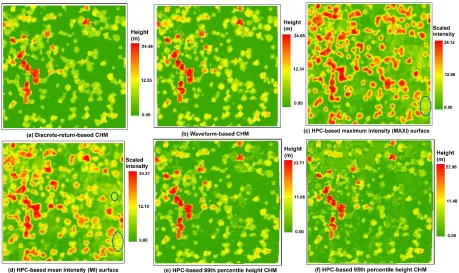
The comparisons between these two HPC-based intensity surfaces (the MAXI and MI) and the
HPC-based 99th PH CHM are shown in Fig. 7. As expected, the HPC-based intensity surfaces
exhibited a spatial pattern similar to CHMs after multi-level rescaling: the higher rescaled
intensities corresponded to vegetation areas with high CHM values and smaller rescaled intensities
were located on the ground with low CHM values. However, the height variance (the CHM) for
vegetation was larger than the corresponding region’s rescaled intensity variance (the HPC-based
intensity surfaces) with more homogenous intensity (red) (Fig. 7(c) & (d)). Regarding the ground
areas, more variations of the rescaled intensity for the HP-based intensity surfaces were observed
compared to these CHMs, especially when the HPC-based MI surface was taken into account (Fig.
7(d)). Interestingly, we found some “mixed” areas that could be classified either as ground or
vegetation in both HPC-based intensity surfaces as depicted with blue circles while they were
deemed as the ground in the CHMs (Fig. 7(a) & (b)) with low heights. Moreover, the HPC-based
MI surface appeared to generate more “mixed” areas than the HPC-based MAXI surface, which
gave rise to the problematic tree crown segmentation in the later stage. Therefore, the HPC-based
MAXI surface might hold greater potential for characterizing vegetation and ground. For the
HPC-based PH surfaces, the 99th PH CHM was prone to better captured the vegetation than 95th PH
Fig. 7. Comparisons of the (a) DR-based CHM, (b) waveform-based CHM, (c) HPC-based
maximum intensity (MAXI) surface, (d) based mean intensity (MAXI) surface, (e)
HPC-based 99th PH CHM and (f) HPC-based 95th PH CHM over a subset region.
3.3 Individual tree intensity distribution
Beyond the local level, the energy (intensity) distributions of FW LiDAR data at the individual
tree level was also examined and three representative individual trees were selected as examples
to demonstrate the spatial energy distribution patterns at the individual tree level. To get an
overview of DR LiDAR point cloud and the HPC at individual tree level, we present them in Fig.
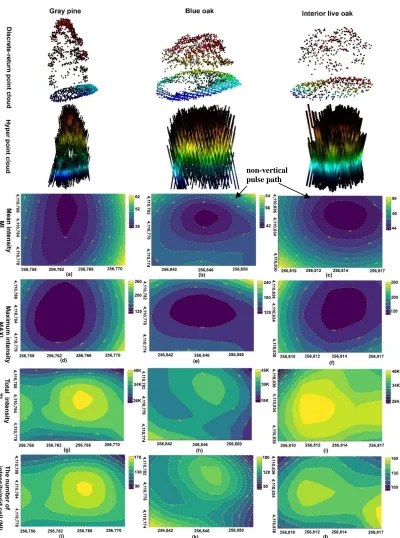
8 with four intensity distributions of these trees in a contour line format. It was evident that the
HPC was denser that DR LiDAR data, especially at the mid-story height levels of trees. Another
significant difference was that the shape of trees can be easily discerned from DR LiDAR data
while these become more obscure for the HPC. However, different trees of the HPC still exhibited
their unique characteristic with different clustering patterns and crown shapes. Moreover, the
non-vertical pulse path of FW LiDAR data was also clearly demonstrated.
Regarding the intensity distribution, these four intensity variables followed the anisotropic
distribution whether within one tree or across different trees (Fig. 8). However, some consistent
MAXI and MI contours demonstrated that the original intensity value was increasing from the
center to the boundary of tree crown with the lowest value in the center of tree crown. Conversely,
the contours of the TI and NI exhibited totally opposite changing pattern that they were decreasing
from the center to the boundary of tree crown with the highest values at the center of tree crown.
These individual tree level contours provided valuable insight into the potential of the HPC-based
intensity surfaces for identifying tree top locations and delineating tree crowns.
3.4 Potential applications
3.4.1 Tree crown delineation
Preliminary results of tree crown segmentation demonstrated that the HPC-based MAXI surface
was superior to the MI surface for delineating tree crowns. Thus, the subsequent tree attributes
analysis was only conducted on the HPC-based MAXI surface. Various grid cell sizes affected
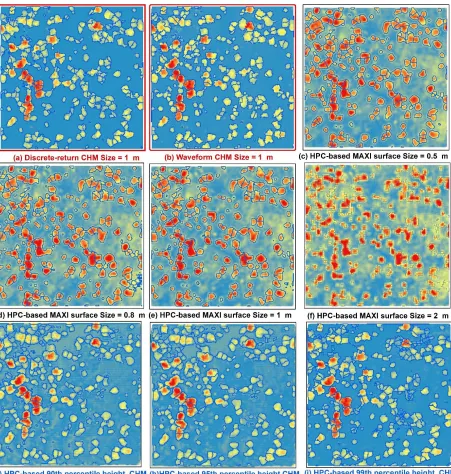
performances of tree crown delineation using the HPC-based MAXI surface. As shown in Fig. 9,
several representative crown delineation results of based MAXI surfaces (black) and
HPC-based PH CHMs’ (blue) are presented as compared to the DR-HPC-based, waveform-HPC-based CHMs (red).
Based on the visual inspection, there is no significant differences among tree crown segmentation
results.
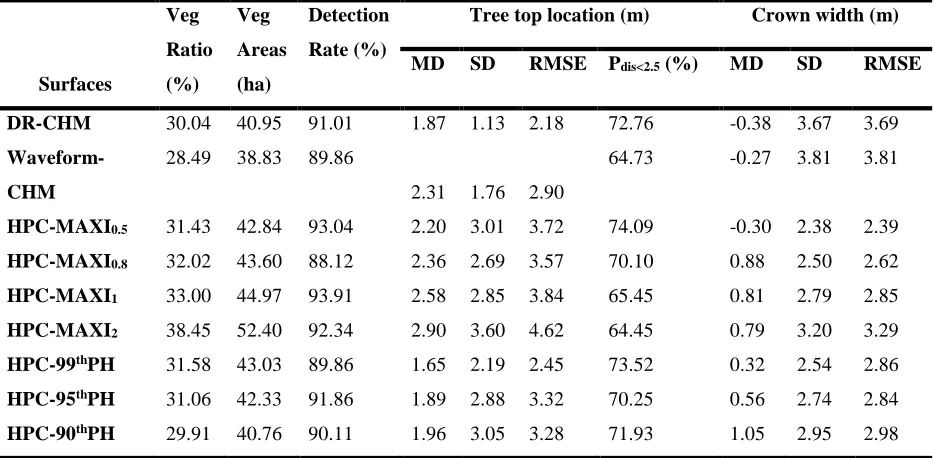
To further quantitatively assess the tree crown delineation results, Table 2 summarizes vegetation
area, ratio of vegetation areas, and tree crown detection rate for both CHMs and WISs after
comparing with reference data. As illustrated in the visual comparisons, the HPC-based MAXI
surfaces with the fine grid cell sizes such as 0.5, 0.8 and 1m can give comparable results as the
LiDAR-derived CHMs with overall tree crown detection rate centering on 90%. However, results
of tree crown detection rate significantly decrease when the grid cell size became larger than 1m.
Overall, visual comparisons of tree crown segmentation results between CHMs and the HPC-based
MAXI surfaces (Fig. 9 (c) - (f)) reveal consistently satisfactory segmentation results, but the
Fig. 8. Discrete-return point cloud, the HPC and the energy distributions of three representative
individual trees including the gray pine, blue oak and interior live oak. (a - l) The contours of mean
intensity (MI), maximum intensity (MAXI), total intensity (TI) and the number of intensity/grid
Table 2. Summary statistics of comparisons among the DR-based CHM (DR-CHM),
waveform-based CHM (waveform-CHM) and the HPC-waveform-based MAXI (HPC-MAXI) and the HPC-waveform-based
percentile height (HPC - PH) surfaces over the study area.
Ssscca
Surfaces
Veg Ratio (%)
Veg Areas (ha)
Detection Rate (%)
Tree top location (m) Crown width (m)
MD SD RMSE Pdis<2.5 (%) MD SD RMSE
DR-CHM 30.04 40.95 91.01 1.87 1.13 2.18 72.76 -0.38 3.67 3.69
Waveform-CHM
28.49 38.83 89.86
2.31 1.76 2.90
64.73 -0.27 3.81 3.81
HPC-MAXI0.5 31.43 42.84 93.04 2.20 3.01 3.72 74.09 -0.30 2.38 2.39
HPC-MAXI0.8 32.02 43.60 88.12 2.36 2.69 3.57 70.10 0.88 2.50 2.62
HPC-MAXI1 33.00 44.97 93.91 2.58 2.85 3.84 65.45 0.81 2.79 2.85
HPC-MAXI2 38.45 52.40 92.34 2.90 3.60 4.62 64.45 0.79 3.20 3.29
HPC-99thPH 31.58 43.03 89.86 1.65 2.19 2.45 73.52 0.32 2.54 2.86
HPC-95thPH 31.06 42.33 91.86 1.89 2.88 3.32 70.25 0.56 2.74 2.84
HPC-90thPH 29.91 40.76 90.11 1.96 3.05 3.28 71.93 1.05 2.95 2.98
*MD: The mean difference between reference and estimated values. SD: Standard deviation of these
differences. RMSE: The root mean square error of these differences. Pdis<2.5: The proportion of distances
Fig. 9. Tree crown segmentation results using discrete-return and waveform based CHMs (red),
HPC-based intensity surfaces with different grid cell sizes (black) and HPC-based PH CHMs
(blue) over the subset region.
3.4.2 Individual tree attributes
We further assessed the accuracy of tree attributes extracted from the HPC-based MAXI surface
and PH CHMs such as the crown width, tree top location and tree height. Overall, the HPC-based
MAXI surface (<= 1m) and PH CHMs generated comparable estimates of the crown width, tree
and Pdis<2.5. Nevertheless, the crown width estimation results demonstrated that the HPC-based
MAXI surfaces with fine resolution (<=1m) yielded more accurate estimates than the LiDAR
derived CHMs (e.g., RMSEHPC-MAXI0.5 = 2.39 vs. RMSEDR =3.69 m) (Table 2). In contrast, tree top
locations were better captured by the LiDAR derived CHMs than the HPC-based MAXI surface
from the perspective of the MD and RMSE. Among the HPC-based MAXI surfaces, coarse
resolution surfaces were prone to give less accurate estimates and the HPC-MAXI0.5 outperformed
other HPC-based intensity surfaces in terms of the crown width and tree location estimation results.
Although the based PH DSMs appeared to be shifted form DR-based DSM, the various
HPC-based PH CHMs demonstrated a promising estimation of crown width and tree location
comparable to the LiDAR-derived CHMs with all RMSE values smaller than 3m.
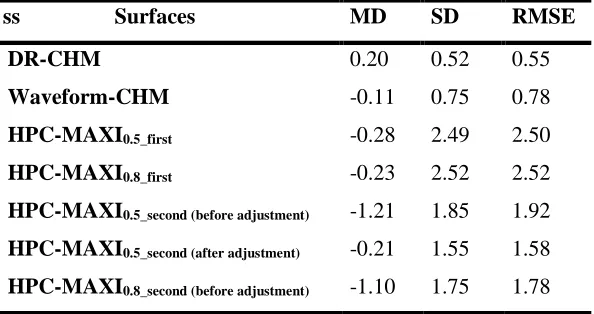
Regarding the tree height estimation, the HPC-based PH CHM almost yielded the same results as
the LiDAR derived CHMs, especially for the 99th PH CHM (Table 3). Given that the HPC-based
MAXI surface did not directly store height information like the CHMs, we proposed two methods
to extract height information. Results of the first method using a linear relationship between height
and rescaled intensity were demonstrated in Fig. 10. A general trend emerged from this figure that
higher heights were more likely to have higher rescaled intensities. However, there is a weak
relationship between rescaled intensities and reference height with low R-square but acceptable
RMSE (~ 2.5m). Moreover, there was no significant difference among using minimum, maximum,
mean and total rescaled intensities of the buffer to estimate tree height.
Table 3. Tree height estimation using DR-based CHM, waveform-based CHM, the HPC-based
MAXI surfaces with the first method (HPC-MAXI0.5_first & HPC-MAXI0.8_first) and the second method
(HPC-MAXI0.5_second (before adjustment), HPC-MAXI0.5_second (after adjustment), HPC-MAXI0.8_second (before adjustment) &
HPC-MAXI0.8_second (after adjustment)) and HPC-based PH (99th, 95th, 90th) CHMs
ss Surfaces MD SD RMSE
DR-CHM 0.20 0.52 0.55
Waveform-CHM -0.11 0.75 0.78
HPC-MAXI0.5_first -0.28 2.49 2.50
HPC-MAXI0.8_first -0.23 2.52 2.52
HPC-MAXI0.5_second (before adjustment) -1.21 1.85 1.92
HPC-MAXI0.5_second (after adjustment) -0.21 1.55 1.58
HPC-MAXI0.8_second (after adjustment) -0.10 1.37 1.40
HPC-99thPH -0.52 0.71 0.75
HPC-95thPH -0.56 0.94 0.98
HPC-90thPH -1.05 1.35 1.41
For the second method, we obtained robust estimates of tree height using various tree top and
ground percentiles with appropriate radius and filtering intensity ranges. Various tree top and
ground percentiles used here were mainly intended to leverage the bias of the estimate. Our
experiment showed that the choice of radius has larger impact than the intensity range for
accurately estimating tree height from the HPC. The suitable range for the radius is [2, 3]m and
for the intensity range or ratio is [0.03 ,0.06] according to our experiment. The preliminary results
(before adjustment) of the second method exhibited that tree height was overestimated consistently
with approximately 1m from the HPC-based MAXI surface (Fig.11 (a)). After subtracting 1m from
original estimated heights, we obtained smaller average bias (-1.10 vs. -0.10 m) and RMSE (1.78
vs. 1.40 m) of differences between the estimated tree height and reference tree height (Fig. 11). In
terms of the MD and RMSE, the second method outperformed the first method for estimating
height information from the HPC-based MAXI surface. However, the height estimation results
from the HPC-based MAXI surface did not generate as good results as the HPC-based PH CHMs.
Among various PHs, the 99th HPC-based PH CHM gives the best height estimation result.
Interestingly, all height estimation from FW LiDAR data including waveform-based and
HPC-based products overestimated the tree height with the MD are less than zero while DR LiDAR data
Fig. 10. The linear relationship between reference tree height and mean rescaled intensity
(minimum, maximum, mean and total rescaled intensities) within the 2.5 m buffer of the waveform
intensity surface (WIS, 0.5m resolution).
Fig. 11. The comparisons between (a) original height estimation from the HPC-based MAXI
surface and (b) adjusted height estimation with simple subtraction refine process using the radius
4 Discussion
The emphasis of this study was expanding potential uses of FW LiDAR data from a new
perspective and enhancing their values for vegetation characterization. We introduced the HPC
and the HPC-based products or concepts through directly using FW LiDAR data without
complicated processing algorithms, and exemplified their uses for characterizing vegetation
structure.
4.1 Hyper point cloud
A plethora of information inherent in FW LiDAR data is stored in the wave format which is not
easily processed by most of the practitioners to extract useful vegetation biophysical parameters.
We proposed an approach to directly converting waveform data into a point cloud with a structure
that is well known to remote sensing and ecological scientists. To some extent, this will alleviate
the difficulty we experienced in understanding and employing sophisticated algorithms for
extracting information from FW LiDAR data (Wu et al., 2011; Zhou et al., 2017b). Moreover, our
approach also provides a competitive alternative way to the conventional method for processing
FW LiDAR data. Previous studies have explored potential uses of FW LiDAR for vegetation
characterization such as tree species identification and global canopy height mapping using
features extracted from waveforms (Lefsky et al., 2005; Zhou et al., 2017a). However, some
amount of raw information will automatically be lost during these existing procedures. With the
advent of the HPC, all original information contained in FW LiDAR data is preserved by
converting every signal of waveforms into a point.
Additionally, how to directly visualize complete FW LiDAR data over a region like DR LiDAR
data is still an open question that challenges the remote sensing community. The HPC provides a
solution to this question and enables users to straightforwardly visualize FW LiDAR data using
available handy tools designed for DR LiDAR data as shown over a subset region (Fig. 2) and
individual trees (Fig. 8). This point cloud is analogous in format to terrestrial LiDAR data to some
extent with detailed information in the mid-story of the canopy. As anticipated, the HPC is
approximately 18 times or more on average (varies on the overlap of flight lines) denser than
corresponding DR LiDAR data by keeping all signal intensities along the pulse path. It is worthy
to note that the vegetation or canopy parts of the HPC are composed of a substantial number of
points instead of sparsely sampling points from the top of the canopy for the DR LiDAR point
provide detailed information in the mid-story of vegetation. Meanwhile, it also leaves us
considerable room and flexibility to exploit their potential applications such as semantic
segmentation and vegetation structure reconstruction.
Overall, the HPC with its point cloud format and rich information it contains gives interpreters or
users more accessibility and flexibility to investigate the potentials of FW LiDAR data for multiple
purposes. Certainly, the HPC requires more storage space and calls for more efforts to exploit and
interpret the ample information inherent in waveforms. However, there is little doubt that the HPC
can render us a new perspective on investigating vegetation structure and facilitate extensive
applications of FW LiDAR data with the continued technological advances.
4.2 HPC-based intensity and height surfaces
To enhance the practical value and use efficiency of the HPC, we exemplify a grid-based statistical
method to generate the thinned version of point cloud for characterizing vegetation structure. The
HPC-based intensity (MAXI and MI) DSMs exhibit promising prospects for distinguishing
vegetation and ground as shown in Fig. 5. Interestingly, higher MAXI and MI are more likely to
present at the ground sections rather than vegetation sections. One possible reason emerges from
this is that more energy loss occurs during the process of the pulse passing through the gaps of
vegetation layers compared to directly interacting with ground given the same amount of pulse
energy. This is also substantiated by the fact that the first peak intensity of the waveform
(amplitude) generally has larger values than the subsequent amplitudes (Zhou et al., 2017b).
However, the vegetation could give rise to more signal returns that result in higher TI and NI for
a given region. Surprisingly, the spatial patterns of the HPC-based TI and NI DSMs are not as
evident as the HPC-based MI and MAXI DSMs (Fig. 5). A closer examination of these HPC-based
intensity DSMs reveals that a different number of overlapping flight lines mainly contributed to
this discrepancy. At this point, the vegetation and ground can be well captured by the HPC-based
intensity products.
LiDAR-derived CHM is deemed as the most fundamental and valuable model to characterize
vegetation parameters such as tree height, crown width and biomass for complementing forest
inventory (Allouis et al., 2013; Cao et al., 2014b; Popescu et al., 2002; Zhao et al., 2018). The
motivation for rescaling the original intensity information is to generate a CHM-like product and
further assess the feasibility of the HPC-based intensity surface for augmenting or substituting
To generalize the rescaling steps and preserve original intensity information inherent in the HPC,
all steps are done with the simple linear conversion. The HPC-based MAXI surface shows a
promising spatial pattern which is anticipated to promote the efficient use of intensity information
from FW LiDAR data for vegetation characterization. Among four representative HPC-based
intensity surfaces, the HPC-based MAXI surface is more likely to give us a better separation of
vegetation and ground. The possible reason is that the MAXIs (amplitude) of waveforms generally
correspond to the objects such as trees and ground that the pulses interact with, and different
objects give different amplitude values. For instance, the waveforms coming from ground sections
yield similar maximum intensities while they differ significantly from the maximum intensities
from vegetation components, which results in the discernible boundary between ground and
vegetation. Of particular note, multiple possible variables or features such as intensity percentiles
can also be extracted from the HPC. We encourage researchers to further exploit other variables
or features from the HPC to further test their utilities and validity over various types of forest.
As expected, the HPC-based PH CHMs demonstrate the promising prospects of the PHs as
surrogates for canopy structure variables from the HPC. These CHMs show consistent or identical
spatial distribution with the DR-based and waveform-based CHMs. Overall, the proposed
approaches for obtaining the HPC-based intensity and height surface not only expand existing
approaches for processing FW LiDAR data, but also provide a new insight into fully using FW
LiDAR data for characterizing canopy structure.
4.3 Individual tree energy distribution
Along with the HPC-based intensity and height surface results, the detailed energy distribution at
the individual tree level is also examined (Fig.8). The waveform intensity contours of three
representative trees provide a theoretical justification for potential applications of the HPC-based
surfaces. For instance, the most inner contour of an individual tree is more prone to be the tree top
locations and the outer contour is similar to the shape of a tree crown boundary.
The intensity contours such as the MAXI, MI, TI and NI at the individual tree level provide insight
into the changing pattern of energy over the vegetation at a high level of details. Both the MAXI
and MI contours reveal that the intensities are increasing from the center of tree crown to the
boundary of the tree. This can be explained by the fact that more energy loss occurred during the
penetration process over the center of tree crown, where more dense vegetation is present
amplitudes or maximum intensities were returned from the region with dense vegetation.
Analogous to the TI and NI WISs, the TI and NI contours at the individual tree level exhibit
decreasing pattern from the center of tree crown to the boundary of the tree. More signal returns
are generated from the center of tree crowns or dense vegetation areas can attribute to this pattern.
Additionally, there is a pronounced difference of contour center and changing patterns between
the MAXI & MI and TI & NI contours. These inconsistencies are possibly due to the TI and NI
contours being obtained from more “noise” in the point clouds resulted from multiple flight lines
compared to the MAXI and MI contours. In addition, the lack of calibration or proper
normalization steps for the TI and NI products also potentially counteract their usefulness for
subsequent tree analysis. Of course, the calibration of the MAXI and MI products is also needed
to enhance their capability for vegetation characterization or extend new potential applications.
However, it is beyond the scope of this study to investigate proper intensity calibration procedures.
Our further research will aim to explore the proper calibration or normalization steps for efficiently
using the HPC or the HPC-based surfaces.
Although we only examine these four variables from the HPC, there is little doubt that other
variables or features extracted from the HPC are useful as competitive alternatives for solving
potential research problems, such as using contour boundaries or intensity percentiles to estimate
fuel loads of forests, crown base height, or to better characterize the horizontal and vertical
vegetation structure. Overall, the contours of intensity distribution at the individual tree level
provide a theoretical justification to extract attributes from the HPC-based surfaces for
characterizing tree structure and ultimately promote the extensive use of FW LiDAR data.
4.4 Potential applications
The HPC-based intensity and height surfaces provides a new perspective for employing intensity
information to characterize vegetation structure and exhibits the HPC’s potential usefulness, which
is expected to spur more efforts to explore these products for practical and scientific applications.
We exemplify the utility of these surfaces for delineating tree crowns, identifying tree top
locations, estimating crown width and tree height in this study. These applications offer an
alternative way to extract information from FW LiDAR data and boost the use of information
inherent in waveforms.
Tree crown segmentation is the fundamental procedure for forest inventory and monitoring, which
Zhou et al., 2017a). Our tree detection comparisons suggest that the fine resolution HPC-based
MAXI surfaces can generate comparable results to the DR and waveform-based CHMs with the
tree detection rates being around 90%. The accurate tree detection and crown segmentation results
render promising prospects for subsequent tree attribute estimation. Our results also suggest that
the HPC-based intensity surfaces with various resolution are prone to detect additional vegetation
areascompared to the CHMs. As noted from the blue circles in Fig. 7, the WISs appear to have
some “noise” compared to CHMs, but a closer examination reveals that these regions are covered
with low vegetation (< 3m) such as California sagebrush. This finding may shed light on detecting
understory layers or studying savanna ecosystems using intensity information of FW LiDAR data
(Zhou et al., 2017b). Overall, the performance of the WIS’s tree crown segmentation is comparable
to the CHM and demonstrate the potential of the HPC-based MAXI surface as an alternative
product to the CHM for vegetation characterization.
Results of individual tree attributes estimated from the HPC-based intensity and height surfaces
further confirmed the promising prospect of the HPC. Interestingly, the crown width is better
captured by the fine resolution HPC-based MAXI surfaces than the CHMs (DR and
waveform-based and HPC-waveform-based PH CHMs) while the HPC-waveform-based PH CHMs outperform the others in terms
of the tree top identification results. Various factors may contribute to this discrepancy, such as
field data’s uncertainties (Zhao et al., 2018) and tree top identification assumption. For instances,
the in-suit tree location directly measured at the tree trunk location while our approach mainly
identified the tree location with the highest height or the MAXI of the estimated tree crown area.
This inconsistency confounds our tree location estimation especially when it comes to the trees
with irregular stand structure in our study site. Undoubtedly, this may also indicate that our method
for identifying tree locations using the HPC-based MAXI surface does not always work
effectively. Although results of the individual tree intensity distribution (Fig. 8) show that the
center of tree crowns can be distinguished from the rest of the areas and support our method
theoretically, a robust, dedicated and accurate tree top identification method using the intensity
information of FW LiDAR data seems not yet established. It is not surprising that the crown width
estimation with the HPC-based MAXI surface is better than the CHMs according to the contours
of individual tree intensity distribution. Because the crown width is calculated based on the crown
area and the bias is more likely to be leveraged compared to when only one location is used for
Compared to the tree location identification and crown width estimation, the tree height estimation
from the HPC-based MAXI surface is less direct and more challenging to derive than the CHMs.
We developed two methods to explore the potential of tree height estimation directly from the
HPC-based MAXI surface. The motivation of the first method was to examine whether a simple
relationship between the height and normalized intensity exists. Despite the fact that the
parsimonious linear relationship does not exist in this study (low R-square), a general trend
between the height and normalized intensity is observed without the field-based intensity
calibration step. Nevertheless, this method holds promise for enhancing the tree height predictive
capability after conducting proper calibrations. Compared to the results of the first method, the
second method can achieve better results through additional processing steps. We integrated the
HPC-based MAXI surface with the HPC to search possible points containing ground and tree top
through the criteria such as the radius around the estimated tree locations and intensity ranges of
these points. Our results demonstrate that the robust tree height estimation can be obtained when
the radius and filtering intensity range are in proper intervals. Despite the original HPC-based
MAXI surface’s height estimation results without the refining process being not as good as the
CHMs, comparable height estimation results can be achieved with a simple bias adjustment as
demonstrated in Fig. 11. Moreover, our results may be improved with other possible tree height
estimation methods such as combing the tree locations identified by the HPC-based MAXI surface
with the height from the HPC-based PH CHM. Ultimately, these potential applications of the WIS
exhibit promising prospects of HPC and provide significant implications for measuring fine-scale
vegetation attributes with intensity information. We strongly encourage researchers to further
explore their utilities and potential applications in various biomes and relevant fields. As
anticipated, the HPC-based PH CHMs outperform the HPC-based MAXI surface for estimating
tree height and generate similar tree height estimation to the DR and waveform-based CHMs in
terms of the MD and RMSE.
To our best knowledge, the concepts or products of the HPC, the HPC-based intensity and height
surfaces are new to remote sensing and ecological communities. It is anticipated that these new
concepts and products can pave a new way to make the most use of waveform intensity
information, facilitate extensive use of FW LiDAR data and expand their promising applications
for characterizing vegetation structure. A wealth of original information is contained in the HPC,
representative and critical variables or features. We hope our potential application examples could
encourage more efforts to recognize and draw out significant information from the HPC for
characterizing vegetation structure. Moreover, there are also opportunities to advance the
understanding the energy or radiative transfer modeling of vegetation through integrating optical
earth observations with these products. Certainly, careful calibration of the intensity is needed to
ensure the consistent performance or accuracy of models. Overall, the HPC and the HPC-based
intensity and height surfaces presented in this study represent a new means for studying vegetation
structure using FW LiDAR data and offer promising prospects for serving different user groups
with a deep understanding of waveform intensity and height information.
5 Conclusion
Conventional ways of extracting FW LiDAR information such as using the decomposition or
waveform signatures requires sophisticated algorithms and deep understanding of waveform data,
which curbs the widespread use of FW LiDAR data and further obstruct their potential and
extensive applications for vegetation characterization. The HPC proposed in this study not only
presents a direct way to visualize FW LiDAR data with available software but also mitigates the
technical barriers for most potential practitioners, and further enables FW LiDAR data processing
to become more accessible to remote sensing and ecological communities. Simultaneously, this
product preserves as much information of raw FW LiDAR data as possible that render users more
flexibility to interpret and decode the information inherent in waveforms. The HPC-based intensity
and height surfaces exemplify the potential applications of the HPC. For example, the HPC-based
MAXI surface gives a snapshot of the intensity distribution of vegetation and ground at the local
level which produces the high level of agreement with the height distribution (the CHM). This
observation not only expands existing ways or products for vegetation characterization but may
also enlighten an exciting new direction for vegetation structure characterization using intensity
information of FW LiDAR data. The intensity distribution of vegetation at the tree level with
contours provide the theoretical justification for subsequent individual tree analysis using the
HPC-based MAXI surfaces. Results of individual tree crown delineation demonstrate encouraging
potential applications of the HPC-based MAXI surface and the HPC-based PH CHMs, which is
further confirmed by individual tree attribute analysis such as tree location identification, crown
width and tree height estimation. These provide initial proofs for the usefulness of the HPC and
conceptual approach. Despite that the HPC-based MAXI surface can achieve comparable or better
results compared to the CHMs in some aspects, we made no attempt to substitute the CHM with
the HPC-based MAXI surface but instead to complement each other for accurately characterizing
vegetation structure using both height and intensity information. Given the high density and
mid-story detection capacity of the HPC, it is feasible to analyze the detailed internal structure of
individual trees or vegetation over a large region. Additionally, the contours of individual tree’s
intensity distribution also provide insights into other potential applications such as estimating the
crown base heights and forest surface fuel load or even identifying tree species. Actually, the
HPC-based intensity and height surfaces provides promising prospects in the 2D perspective, further
research is also needed to develop approaches to obtain vegetation structure or biophysical
attributes with detailed 3D reconstruction models using FW LiDAR data.
Acknowledgment
We gratefully acknowledge the support from NSF Doctoral Dissertation Improvement
Grant (DEB1702008) and NASA’s ICESat-2 SDT (Grant # NNX15AD02G). We also thank the
National Ecological Observatory Network (NEON) for providing waveform LiDAR and field data.
Reference
Allouis, T., Durrieu, S., Véga, C., & Couteron, P. (2013). Stem volume and above-ground biomass estimation of individual pine trees from LiDAR data: Contribution of full-waveform signals.
Selected Topics in Applied Earth Observations and Remote Sensing, IEEE Journal of, 6, 924-934
Anderson, K., Hancock, S., Disney, M., Gaston, K.J., Rocchini, D., & Boyd, D. (2016). Is waveform worth it? A comparison of LiDAR approaches for vegetation and landscape characterization. Remote Sensing in Ecology and Conservation, 2, 5-15
Babcock, C., Finley, A.O., Cook, B.D., Weiskittel, A., & Woodall, C.W. (2016). Modeling forest biomass and growth: Coupling long-term inventory and LiDAR data. Remote Sensing of Environment, 182, 1-12