Address for correspondence
Hubert Kardach
E-mail: [email protected]
Funding sources
None declared
Conflict of interest
None declared
Received on November 15, 2015 Revised on December 19, 2015 Accepted on February 25, 2016
Abstract
Background. The loss of physical properties of orthodontic chains has been a topic of discussion among scientists and clinicians, motivating efforts to improve elastic materials and minimize the decrease of force. Orthodontic companies have introduced memory elastomers, which, according to the manufacturers, have improved mechanical properties.
Objectives. The aim of the study was to evaluate the effects of stretching elastomeric chains submerged in 37°C artificial saliva.
Material and methods. The study assessed 2 types of chains. The first phase of the study evaluated 1) the tensile strength of the chains; and 2) elongation at the time of tearing in an environment outside of the oral cavity (without exposition). The second phase of the study evaluated 1) permanent deformation after stretching; 2) elongation at the time of tearing; and 3) the tensile strength of the chain in conditions similar to those present in the oral cavity.
Results. In the experiments using artificial saliva, pronounced force decay was observed in the plastic chain, in which, after just 7 days, force decreased almost by half compared to the initial value, with a con-tinuous downward trend. The memory chain, however, showed increased elasticity, and after the first week of exposition the force decay at the time of tearing was around 20% of the initial value. Force decay at the time of tearing remained at a steady level between 14.4 and 25.4% throughout the whole period of exposition. In the plastic chain this value oscillated between 50.3 and 55.9%. In the experiments assessing permanent deformation of the chains performed after each week of exposition, the specimens prepared from the memory chain stretched from 8 cm to approximately 9.5 cm after exposition, while the specimens prepared from the plastic chain stretched to approximately 13 cm.
Conclusions. Memory chains are more effective in orthodontic treatment due to diminished loss of me-chanical and elastic capabilities, when compared to plastic chains.
Key words: force decay, initial strain, tearing, stretching, elastic chain DOI
10.17219/acem/61957
Copyright
© 2017 by Wroclaw Medical University This is an article distributed under the terms of the Creative Commons Attribution Non-Commercial License (http://creativecommons.org/licenses/by-nc-nd/4.0/)
The mechanical strength of orthodontic elastomeric
memory chains and plastic chains: An in vitro study
Hubert Kardach
1, A–F, Barbara Biedziak
1, A–F, Aneta Olszewska
1, B–D, Ewelina Golusińska-Kardach
2, B–D, Jerzy Sokalski
2, A–F1 Division of Facial Malformation, Department of Dental Surgery, Poznan University of Medical Sciences, Poland 2 Department of Dental Surgery, Poznan University of Medical Sciences, Poland
A – research concept and design; B – collection and/or assembly of data; C – data analysis and interpretation; D – writing the article; E – critical revision of the article; F – final approval of article
The dynamic development of orthodontic techniques and products is allowing orthodontic therapy to reach new heights in positive treatment results, which in turn is making the use of permanent dental braces much more common.
The benefits of permanent dental braces include full control over dental alignment and precise use of forces, which makes them especially useful in treating dental anomalies and in interdisciplinary orthodontic, surgi-cal and prosthetic treatment. Effective treatment is often not limited to the use of one type of brace; it frequently requires the implementation of precise and coordinated forces through the introduction of orthodontic archwires and supplementary elements.
Among those supplementary elements, elastic orth-odontic elements called elastomers have been used for years. In addition to properties such as pliability and elas-ticity, elastomers are easy to use, reduce the risk of intra-oral trauma, do not require the cooperation of patients and are cheap. They are produced in a wide variety of col-ors, and patients adapt to them easily during orthodon-tic treatment. Disadvantages include a decrease of force that is noticeable over time, difficulties in oral hygiene, increased dental plaque retention compared to metal ele-ments and a loss of color through the absorption of fluid and dye from food.1 There are many types of elastomers,
including, most commonly, separators, ligatures, rotation wedges, elastic threads and chains. They are an indis-pensable type of orthodontic accessory because they sup-ply the force needed to move teeth, e.g. canine retraction and closing interdental spaces. Elastomers are most com-monly made of 2 types of materials: natural or synthetic latex, the latter being increasingly more popular due to better mechanical and elastic properties, as well as the fact that more and more people are allergic to natural la-tex. Chains are produced as colorless or colored polyure-thane elastomers with varying force (closed, short, long chains). Closed chains produce the biggest initial force. Less force is exerted by short chains in which the chain links are separated by short connectors. Even smaller forces are at play in long chains where the spaces between the chain links are longer. Loss of the initially generated force constitutes the biggest clinical problem. Studies have shown a 28–50% loss of initial force as early as 8 h after chain insertion into the oral cavity. After 24 h, the rate of initial force loss decreases significantly but is still observed in the following 2 to 3 weeks.2–4 For
practitio-ners, the correlation between the loss of force of the elas-tic elements and the time lapsed signifies that the chains need to be regularly changed every 5 to 6 weeks.
For years, the loss of physical properties of orthodon-tic chains has been a topic of discussion among scientists and clinicians, motivating efforts to improve elastic ma-terials and minimize the decrease of force. Orthodontic companies have introduced memory elastomers which, according to the manufacturers, have improved
mechani-cal properties. Elastomers used during orthodontic treat-ment are exposed to harsh conditions in the oral cavity, such as high temperature, significant humidity and spicy, highly seasoned food. These factors, apart from influenc-ing the esthetics of the elastomers, significantly decrease their efficacy.
The aim of the study was to evaluate and compare the mechanical strength of elastomeric memory chains and plastic chains in in vitro conditions.
Material and methods
Two types of orthodontic chains – memory chain and plastic chain (American Orthodontics, Sheboygan, USA) – were chosen for the study. The type of factory in which the elastic materials are produced has a significant influ-ence on their force decay. The composition and proper-ties of the chains given by the manufacturers are often similar or nearly identical, but scientific studies show that the differences are very significant. For that reason, the materials chosen for this study were all manufactured by one company.
The study was carried out in 2 phases. The first phase of the study evaluated 1) the tensile strength of the chain and 2) elongation at the moment of tearing, both in an environment outside of the oral cavity (without expo-sition). The second phase of the study evaluated 1) the permanent deformation after stretching, 2) elongation at the moment of tearing and 3) the tensile strength of the chain, all in conditions similar to those present in the oral cavity. The specimens were constantly submerged in artificial saliva at 37°C over periods of up to 4 weeks; the
procedure was repeated at weekly intervals (t = 1 week, 2 weeks, 3 weeks and 4 weeks).
The orthodontic elastic chains were subjected to the study within 2 weeks of delivery from the manufacturer’s warehouse and were stored in a cupboard, at room tem-perature, in order to avoid UV radiation and excessive humidity prior to the experiments. Colorless chains were chosen for the study to eliminate the pigmentation effect in the elastic materials.5–7
A total of 35 specimens, 8 cm each, were taken from each type of chain. In the first phase of the study of the mechanical properties, both types of chain were placed, without exposition, in a Zwick 1445 Universal Testing System machine (Zwick GmbH, Ulm, Germany) and a tear test was performed at a cross-head speed of 50 cm/min. Additionally, an elongation-at-tear test was performed. All the tests were carried out by the same person, at room temperature.
saliva was prepared according to EU regulation PN-EN 12868:2001, paragraph 5.8.
After the exposition time lapsed – i.e. 1, 2, 3 or 4 weeks – the stress on the specimens was lifted. After being taken out of the artificial saliva, the chains were dried, and, after a 30-min rest, each specimen was mea-sured in order to study the permanent deformation. An 8 cm section was then cut from the middle of each of the stretched, submerged and dried specimensand placed in the Universal Testing System machine, where a tear test was performed at a cross-head speed of 50 cm/min. Ad-ditionally, an elongation-at-tear test was performed. All the tests were carried out by the same person, at room temperature.
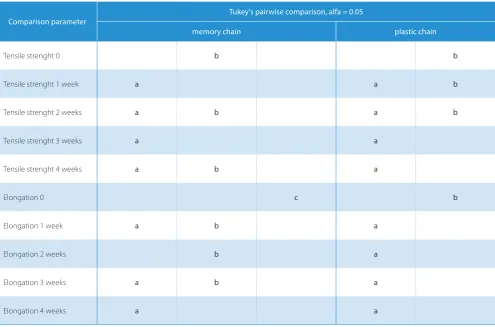
Data analyzed came from an interval scale and were shown as the mean value and standard deviation (mean ± SD). In order to compare the two independent groups (memory chains and plastic chains) Student’s t-test was used. Compliance with normal distribution of data was verified using the Shapiro-Wilk test. Pairwise compari-sons of strength and elongation when exposed to saliva and temperature were carried out using an analysis of variance (ANOVA). The post hoc Tukey’s test was used when the results showed significant differences to deter-mine homogeneous groups (Table 1). The statistical anal-ysis was carried out using STATISTICA v. 10.0 software
(StatSoft Inc., Tulsa, USA). All the tests were analyzed at a significance level of α = 0.05
Results
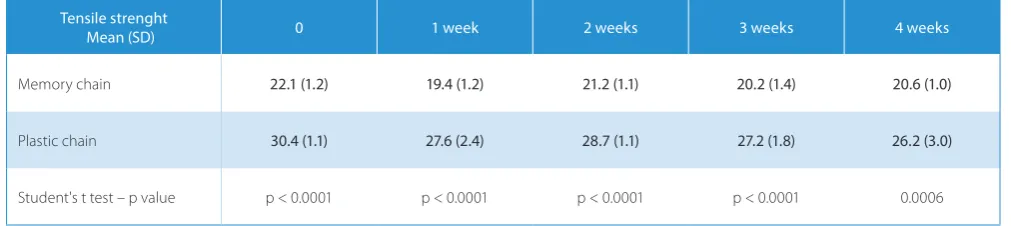
The test results are presented in Tables 2–6. Table 2 shows the results of the tensile strength test for both memory chains and plastic chains, before exposition (time 0) and after submersion in artificial saliva after 1, 2, 3 and 4 weeks. The results show the mean force in new-tons (N) registered at the moment of tearing. The plastic chains exhibited more tensile strength than the memory chains did, and the difference was statistically significant. The force required to tear the plastic chains equaled 30.4 N, which was 37.6% higher than the force needed to tear the memory chains. Time spent submerged in artificial saliva decreased the mechanical strength of both chain types. The biggest decrease in the force value necessary to break the plastic chains was registered after the 4th week, while
in case of the memory chains the biggest decrease was after the 1st week. Furthermore, the difference between
the memory chain’s initial tensile strength and its tensile strength after 4 weeks of exposition decreased by almost 50%. The changes in tensile strength are expressed as percentage values in Table 3.
Comparison parameter
Tukey's pairwise comparison, alfa = 0.05
memory chain plastic chain
Tensile strenght 0 b b
Tensile strenght 1 week a a b
Tensile strenght 2 weeks a b a b
Tensile strenght 3 weeks a a
Tensile strenght 4 weeks a b a
Elongation 0 c b
Elongation 1 week a b a
Elongation 2 weeks b a
Elongation 3 weeks a b a
Elongation 4 weeks a a
Tensile strenght
Mean (SD) 0 1 week 2 weeks 3 weeks 4 weeks
Memory chain 22.1 (1.2) 19.4 (1.2) 21.2 (1.1) 20.2 (1.4) 20.6 (1.0)
Plastic chain 30.4 (1.1) 27.6 (2.4) 28.7 (1.1) 27.2 (1.8) 26.2 (3.0)
Student's t test – p value p < 0.0001 p < 0.0001 p < 0.0001 p < 0.0001 0.0006
Elongation % (SD) 0 1 week 2 weeks 3 weeks 4 weeks
Memory chain 414 (9.1) 337 (21.2) 354.4 (25.5) 333.3 (27.5) 308.9 (37.9)
Plastic chain 400.7 (54.3) 199 (25) 190.9 (25.6) 193 (29.6) 176.7 (34.1)
Student's t test – p-value 0.535002 p < 0.0001 p < 0.0001 p < 0.0001 p < 0.0001
Tensile strenght change % 1 week 2 weeks 3 weeks 4 weeks
Memory chain 19.4 (1.2) 21.2 (1.1) 20.2 (1.4) 20.6 (1.0)
Plastic chain 27.6 (2.4) 28.7 (1.1) 27.2 (1.8) 26.2 (3.0)
Elongation change % 1 week 2 weeks 3 weeks 4 weeks
Memory chain -18.6 -14.4 -19.5 -25.4
Plastic chain -50.3 -52.4 -51.6 -55.9
Permament deformation 1 week 2 weeks 3 weeks 4 weeks Avg
Memory chain 9.3 9.7 9.5 9.4 9.475
Plastic chain 12.7 13.2 13.5 12.9 13.075
Table 2. Tensile strenght
Table 4. Elongation
Table 3. Tensile strenght change
Table 5. Elongation change
Table 6. Permament deformation
Table 4 presents the results of the elongation-at-tear test for both types of chain. In the first phase of the study, without exposition, the memory chains showed better elastic properties than the plastic chains; however, the difference was not statistically significant.
In the tests conducted with artificial saliva a signifi-cant decrease of elongation was observed in the plastic
elongation-at-tear value of the memory chains stayed be-tween 14.4 and 25.5%. In case of the plastic chains, this value oscillated between 50.3 and 55.9% (Table 5). The statistically significant difference between those values points to the higher elasticity of the memory chains.
In the test for permanent deformation carried out af-ter each week of exposition, the length of the specimens was measured 30 min after being removed from the man-drels. The memory chain specimens stretched from 8 cm to approximately 9.5 cm after 7 days of exposure and the plastic chain specimens stretched to approximately 13 cm. Exposition time did not significantly influence the deformation values of either type of chain. The results are presented in Table 6.
Discussion
The hypothesis that elastomers are materials that re-main stable throughout the entire time they are in the oral cavity and that they do not lose strength during treatment can be categorically rejected. The first studies and published results about decreases in the mechanical properties of elastomers appeared in the 1970s. The au-thors’ own research points a gradually decreasing force in both plastic chains and in modified elastomers such as memory chains. It is worth mentioning that the latter exhibit greater elasticity and the decrease in elongation-at-tear value was almost 50% of the decrease noted for the plastic chains. The problem of force decay in elastic orthodontic elements constitutes a significant clinical issue and is of interest to researchers. Different studies have reported force decay ranging from 24 to 85% after 28 days.8–14 Masoud et al. compared the mechanical
prop-erties of thermoplastic and thermoset elastic chains and found significant force decay in thermoplastic chains, on average 20% higher than in thermoset chains.15 Kersey
et al. evaluated the strength of elastics, and showed that the force decay after 24 h equaled 17% and the value of the forces generated was lower than that given by the manufacturer.16 A study by Kanchana et al. found that
the initial force in elastics decreases by 30% in the first hour.17 Mikulewicz et al. demonstrated that the rate of
force relaxation in elastics after 24 h varies between 5.7 and 17.7%, depending on type of elastic.18
Environmental factors such as water, fluids, saliva, food and temperature impact changes in the mechanical prop-erties of elastic elements. Fraunhofer et al. demonstrated that the exposition of elastic chains to saliva and superfi-cial fluoride necessitates an increase in length of elonga-tion to generate 150 g and 300 g force.19
Josell et al. studied chains from several different manu-facturers, and demonstrated that all the chains lose their physical qualities most rapidly on the first day or even the first hour of use. This trend then continues over 2–4 days.20
During orthodontic treatment the elastic elements are stretched to generate force. Stretching a chain stresses the molecular polymer within it. The procedure initially strengthens the durability of the elastic chain and causes it to generate the force necessary for orthodontic treat-ment.21 This is possible because the material “wants” to
return to its initial form and size. It is crucial for the ma-terial not to get stretched to its limits, as that will cause permanent deformation and excessive broadening. Quan-tifying the loss of physical properties depends on the speed and strength with which the material is stretched. With enough force applied it is possible to tear the ma-terial. Rock et al. showed that stretching the elastic ele-ments 300% or more produces an unfavorable response that causes the material to reach its limit of elasticity. Stretching the material 200% is frequent in orthodontic treatment.22 Huget et al. demonstrated that stretching
chains 50% causes less force decay than stretching it 100 or 200%.23
The results obtained in the present study are con-sistent with the published work of authors worldwide. In both chain types, the biggest force decay was observed after the first 7 days. Subsequently it decreased slightly, remaining at a fairly constant level. A significantly lower loss of physical properties was observed in the memory chain. The authors of the study have confirmed, in con-tradiction to studies conducted by Ash et al. and An-dreasen et al., that the loss of elastic properties also oc-curs when artificial saliva is used.24,25
The results of the present study confirm the need to exchange the elastic elements used in orthodontic treat-ment every 4 weeks in order to maintain a moderately constant force value. Memory chains are more effective in orthodontic treatment due to a lower rate of loss of me-chanical and elastic properties when compared to plastic chains.
References
1. Buchamann N, Senn C, Ball J, Brauchli L. Influence of initial strain on the force decay of currently avaiable elastic chains over time. Angle Orthod. 2012;82(3):529–535.
2. Wong A. Orthodontic elastic materials. Angle Orthod. 1976;46:196–205. 3. Eliades T, Eliades G, Watts DC. Structurat conformation of in
vitro and in vivo orthodontic elastomeric modules. Eur J Orthod. 1999;21:649–658.
4. Warych B. Akcesoria, Materiały i techniki ortodontyczne, Komorows-ka A, Polskie Towarzystwo Ortodontyczne. Lublin;2009:141–154. 5. Lu T C, Wang W N, Tarng T H, Chen J W. Force decay of
elastomer-ic chain – a serial study. Part II. Am J Orthod Dentofacial Orthop. 1993;104:373–377.
6. Baty DL, Volz JE, von Fraunhofer JA. Force delivery properties of colored elastomeric modules. Am J Orthod Dentofacial Orthop. 1994;106:40–46.
7. Lew K. Staining of clear elastomeric modules from certain foods. J Clin Orthod. YEAR;24;472-474.
8. De Genowa DC, Mcinnes-Ledous P, Weinberg R Shaye R. Force deg-radation of orthodontic elastomeric chains – a product compari-son study. Am J Orthod. 1985;87: 377–384.
17. Kanchana P, Godfrey K. Calibration of force extension and force degradation characteristics of orthodontic latex elastics. Am J Orthod Dentofacial Orthop. 2000;118:280–287.
18. Mikulewicz M, Szymkowski J, Kossakowska P. Właściwości reolog-iczne ortodontycznych wyciągów elastycznych- doświadczenie in vitro. Dent Med Probl. 2008;445(4):420–424.
19. Fraunhofer JA, Coffelt MTP, Orbell GM. The effects of artificial sali-va and topical fluoride treatments on the degradation of the elastic properties of orthodontic chains. Angle Orthod. 1992;62:265–274. 20. Josell SD, Leiss JB, Rekow ED. Force degradation in elastomeric
chains. Semin Orthod. 1997;3(3):189–197.
21. Wong A. Orthodontic elastic materials. Angle Orthod. 1976;46:196–205. 22. Rock WP, Wilson HJ, Fisher SE. A laboratory investigation of
orth-odontic elastomeric chains. Br J Orthod. 1985;12:202–207.
23. Huget EF, Patrick KS, Nunez LJ. Observation on the elastic behavior of a synthetic orthodontic elastomer. J Dent Res. 1990;69:496–501. 24. Ash J, Nikolai R. Relaxation of orthodontic elastic chain and
mod-ules in vivo and in vitro. J Dent Res. 1978;57:685-690.
25. Andreasen GF, Bishara SE. Relaxation of othodontic elastomeric chains and modules in vitro and in vivo. Angle Orthod. 1970;40:319–328. 10. Andreasen GF, Bishara SE. Comparison of Alastik chains with
elas-tics involved with intra-arch molar to molar forces. Angle Orthod. 1970;40:151–158.
11. Bishara SE, Andreasen GF. A comparison of time related forces between plastic Alastiks and latex elastics. Angle Orthod. 1970; 40:319–328.
12. Stevenson J, Kusy R. Force application and decay characteristics of untreated and treated polyurethane elastomeric chains. Angle Orthod. 1994;64:455–467.
13. Kim KH, Chung CH, Choy K, Lee JS, Vanarsdall RL. Effects of pre-stretching on force degradation of synthetic elastometric chains. Am J Orthod Dentofacial Orthop. 2005;128:477–482.
14. Balhoff DA, Shuldberg M, Hagan JL, Ballard RW, Armbruster PC. Force decay of elastomeric chains – a mechanical design and prod-uct comparison study. J Orthod. 2011;38:40–47.
15. Masoud A, Tsay T, BeGole E, Bedra-Russo A. Force decay evaluation of thermoplastic and thermoset elastomeric chains. A mechanical design comparison. Angle Orthod. 2014;84(6):1026–1033.