• No results found

Dietary patterns and breast or lung cancer risk: A pooled analysis of 2 case-control studies in north-eastern Poland

N/A
N/A
Protected

Academic year: 2020

Share "Dietary patterns and breast or lung cancer risk: A pooled analysis of 2 case-control studies in north-eastern Poland"

Copied!
9
0
0

Loading.... (view fulltext now)

Full text

(1)

DOI

10.17219/acem/65433

Copyright

© 2017 by Wroclaw Medical University This is an article distributed under the terms of the Creative Commons Attribution Non-Commercial License (http://creativecommons.org/licenses/by-nc-nd/4.0/)

Address for correspondence

Beata Krusińska

E-mail: [email protected]

Funding sources

None declared

Conflict of interest

None declared

Acknowledgements

Thanks are expressed to the participants for their contribution to the study.

Received on February 24, 2016 Reviewed on September 16, 2016 Accepted on September 29, 2016

Abstract

Background. Breast cancer in women and lung cancer in men are the most prevalent cancers in Poland

and worldwide. Evidence of the impact of food groups and nutrients on the risk of breast and lung cancer is limited and lacking conclusions. Studies on food consumption and breast or lung cancer are limited.

Objectives. Assessment of the association between dietary patterns and the prevalence of breast and lung

cancers in adult Poles.

Material and methods. The study involved a pooled analysis of 2 case-control studies on 320 subjects

aged 50–70 years from north-eastern Poland (160 women, 160 men). Breast cancer cases in 80 women and lung cancer cases in 80 men were diagnosed. The food consumption frequency for 21 selected foods was collected using the Questionnaire of Eating Behaviors (QEB). Principal component analysis and multiple logistic regression analysis were used. The odds ratio (OR) and 95% confidence interval (95% CI) were calculated.

Results. Three dietary patterns (DPs) were identified: ‘Prudent’, ‘Processed & fast food’, and ‘Traditional

Polish’. In the pooled analysis for both cancers, the ORs were from 0.35 (95% CI: 0.20–0.61; p < 0.05 with adjustment for age) to 0.48 (95% CI: 0.26–0.88; p < 0.05 with adjustment for age, socioeconomic status index, physical activity, smoking, and abuse of alcohol) in the upper tertile of the ‘Prudent’ DP in compari-son to the absence of cancers (OR  =  1.00). The ORs of both cancers were 1.83 (95% CI: 1.06–3.16; p < 0.05 with adjustment for age) in the upper tertile of the ‘Processed & fast food’ DP. The ORs of both cancers for the ‘Traditional Polish’ DP were insignificant.

Conclusions. In the pooled analysis, a strong inverse relation was found between the ‘Prudent’ dietary

pattern, characterized by higher frequency of dairy, fruit, vegetables, wholemeal bread, fish and juices con-sumption, and breast or lung cancer prevalence, irrespective of age, socioeconomic status, physical activity, smoking, alcohol abuse, and type of cancer in Polish adults from north-eastern Poland.

Key words: lung cancer, adults, breast cancer, PCA, dietary patterns

Dietary patterns and breast or lung cancer risk: A pooled

analysis of 2 case-control studies in north-eastern Poland

Beata Krusińska

1, A–D, F

, Iwona Hawrysz

1, A, B, F

, Małgorzata A. Słowińska

1, A, C, E, F

, Lidia Wądołowska

1, A, C, E, F

,

Maciej Biernacki

2, B, F

, Anna Czerwińska

3, B, F

, Janusz J. Gołota

4, B, F

1 Department of Human Nutrition, University of Warmia and Mazury in Olsztyn, Poland 2 Department of Surgery, University of Warmia and Mazury in Olsztyn, Poland 3 Independent Public Complex of Tuberculosis and Lung Diseases in Olsztyn, Poland 4 Clinic of Thoracic Surgery, Ars Medica Medical Center, Olsztyn, Poland

A – research concept and design; B – collection and/or assembly of data; C – data analysis and interpretation; D – writing the article; E – critical revision of the article; F – final approval of the article

(2)

Introduction

In industrialized countries, cancers are the second lead-ing cause of death in humans, just after cardiovascular diseases.1 Breast cancer in women and lung cancer in men

are the most prevalent cancers in Poland and worldwide.1

In Poland, in 2010, breast cancer accounted for 22% of all diagnosed cancers in women and lung cancer accounted for 21% of all cancers in men.2 Out of the 16 regions in Poland,

Warmia and Mazury had the highest incidence of lung can-cer in men and was 6th in terms of the incidence of breast

cancer in women in 2010.2 The highest lung cancer

mor-tality was recorded in men aged over 50 years old, while 50% of cases occurred after 65 years of age.2 The highest

mortality of breast cancer in women was recorded in peri- and postmenopause, at the age of 50–69 years.2 Recently,

an increase has been observed in the incidence of breast cancer in women aged 20–49 years. In Poland, the num-ber of cases of breast cancer per 100,000 women increased from 20 in 1980 to 34 in 2010.2

The development of cancer in the human body depends on the interactions between the immune system, individual genetic predisposition and outside environmental factors.3

From among the modifiable environmental factors, lifestyle is very important, including nutrition and quality of food consumed, as well as the degree of environmental pollution, region of residence and related social and cultural condi-tions.1,4 It is estimated that the role played by diet in cancer

development, depending on the location, may be at the level of 10–70%.3 Convincing evidence has only been obtained for

alcoholic drinks as a factor increasing the risk of breast can-cer and for beta-carotene supplements for smokers as a fac-tor increasing the risk of lung cancer.1,5 Fruit and food

containing carotenoids probably decrease the risk of lung cancer.1 There is limited evidence suggesting that

non-starchy vegetables, foods containing selenium and quer-cetin decrease, while red meat, processed meat, total fat, butter and retinol supplements (for smokers only) increase the risk of lung cancer.1 Evidence of the impact of other food

groups and nutrients on the risk of breast and lung can-cer is limited, and no conclusions have yet been drawn.1,5

Because of the complex character of the daily diet, apart from estimating the impact of the consumption of indi-vidual food groups or nutrients on cancer incidence, it is important to assess food consumption comprehen-sively. One of the generally accepted ways of assessing the type of most commonly consumed foods is by identi-fying dietary patterns.6 Currently, there are no conclusive

results of research on the effects of nutrition and dietary patterns on the prevalence of breast and lung cancers, es-pecially among Polish research in a regional perspective. Knowledge of nutritional factors associated with the risk of cancer growth is very important, both in primary and secondary prevention of cancer diseases. The similar epi-genetic mechanisms of breast and lung cancers indicate common dietary causes.7

To provide a more precise evaluation of the association between dietary patterns and the prevalence of breast and lung cancers in adult Poles, a pooled analysis of 2 case-control studies in north-eastern Poland was performed.

Material and methods

Ethical considerations

These studies were approved by the Bioethics Com-mittee of the Faculty of Medical Sciences, University of Warmia and Mazury in Olsztyn (Poland), on October 2, 2013 (resolution No. 29/2013). All participants gave their voluntary and written consent to take part in the studies and were informed that the information obtained was confidential and used only for scientific purposes.

Study design and sample characteristics

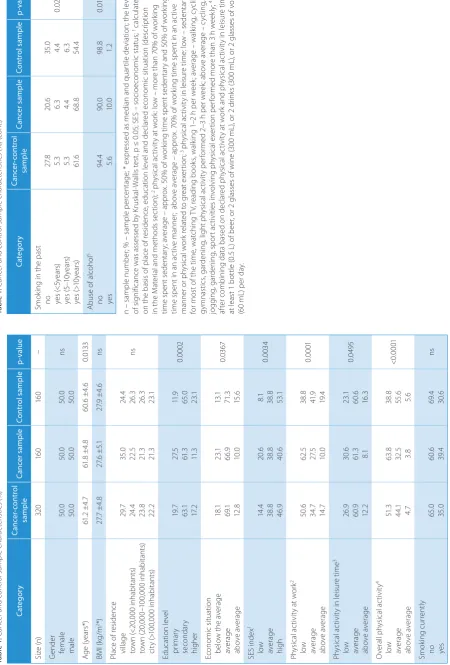
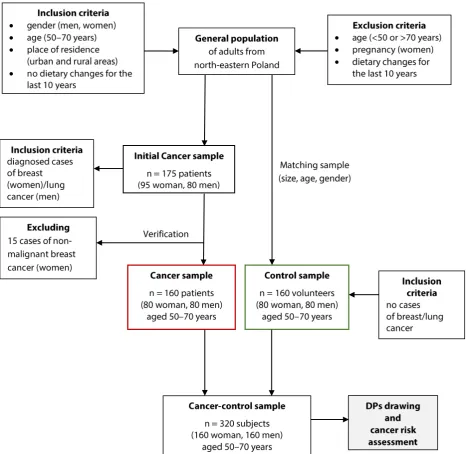
These studies were conducted in years 2013–2015 among adults from the Warmia and Mazury region in north-eastern Poland. The main inclusion and ex-clusion criteria of the sample collection and study de-sign are shown in Fig. 1. All subjects had current results (obtained not earlier than 6 months before inclusion in the study) of ultrasonography (USG) and/or mam-mography of the breast (in women), and of a digital X-ray examination (RTG) and/or a computer tomography and/or bronchoscopy of the chest (in men). Subjects with breast or lung cancer, confirmed by a biopsy and/or histopatho- logy, were included in the cancer sample (160 patients, including 80 women and 80 men, aged 50–70 years), and those without cancer were included in the control sam-ple (160 patients, including 80 women and 80 men, aged 50–70 years). The control sample was matched in size, age and gender to the cancer sample. The 15 cases of non-malignant breast cancer in women were excluded (Fig. 1). In the end, the cancer-control sample involved 320 subjects, aged 50–70 years (61.2 ±4.7). The characteristics of the can-cer and control samples are shown in Table 1.

(3)

Ta bl e 1 . C an cer a nd c on tr ol s amp le c ha ra ct er is tic s ( % ) Ca te gor y Ca nc er -c on tr ol samp le Can ce r s amp le Co nt ro l s amp le p -va lue Si ze (n ) 32 0 16 0 16 0 – G en der fe mal e mal e 50 .0 50 .0 50 .0 50 .0 50 .0 50 .0 ns Ag e (y ea rs*) 61 .2 ± 4. 7 61 .8 ± 4. 8 60 .6 ± 4. 6 0. 013 3 BM I ( kg /m 2*) 27 .7 ± 4. 8 27 .6 ± 5. 1 27 .9 ± 4. 6 ns Pl ac e of  re side nc e vil la ge tow n ( <2 0, 00 0 i nhab ita nt s) to w n ( 20 ,000 –1 00 ,000 in ha bi ta nt s) ci ty (> 10 0, 00 0 i nhab ita nt s) 29 .7 24 .4 23. 8 22. 2 35 .0 22. 5 21. 3 21. 3 24 .4 26 .3 26 .3 23 .1 ns Ed uc at io n l ev el pr im ar y se co nda ry hi gh er 19 .7 63 .1 17. 2 27. 5 61 .3 11 .3 11 .9 65 .0 23 .1 0. 000 2 Ec on om ic si tu at ion be lo w t he a ve ra ge av er age ab ove a ve ra ge 18 .1 69 .1 12 .8 23 .1 66 .9 10 .0 13 .1 71. 3 15 .6 0. 03 67 SE S i nde x 1

low aver

age hi gh 14 .4 38 .8 46 .9 20 .6 38 .8 40. 6

8.1 38.8 53.1

0. 00 34 Ph ys ic al a ct iv ity a t w or k 2

low aver

age ab ove a ve ra ge 50 .6 34 .7 14 .7 62 .5 27. 5 10 .0 38 .8 41 .9 19 .4 0. 000 1 Ph ys ic al a ct iv ity in l ei su re t im e 3

low aver

age ab ove a ve ra ge 26 .9 60 .9 12 .2 30 .6 61 .3 8.1 23 .1 60. 6 16 .3 0. 049 5 O ve ra ll p hy sic al a ct iv ity 4

low aver

age ab ove a ve ra ge 51 .3 44 .1 4.7 63 .8 32 .5 3. 8 38 .8 55 .6 5. 6 <0 .000 1 Sm ok in g cu rr en tly

no yes

65 .0 35 .0 60. 6 39 .4 69 .4 30 .6 ns Ca te gor y Ca nc er -c on tr ol samp le Can ce r s amp le Co nt ro l s amp le p -va lue Sm ok in g in t he p as t

no yes (

< 5ye ar s) ye s ( 5– 10 ye ar s) ye s ( >1 0ye ar s) 27. 8 5. 3 5. 3 61 .6 20 .6 6. 3

4.4 68.8

35

.0

4.4 6.3 54.4

0. 02 14 Abu se o f a lc oho l 5

no yes

94 .4 5. 6 90. 0 10 .0 98 .8 1. 2 0. 01 63

n – s

am

pl

e n

um

be

r; % – s

am pl e p er ce nt ag

e; * e

xp re ss ed a s m ed ia n a nd q ua rt ile d ev ia tio n; t he l eve l of s ig ni fic an ce w as a ss es se d b y K ru sk al -W al lis t es

t, p ≤ 0

.0

5; S

ES – s

oc io ec on om ic s ta tu s;

1 ca

lc ul ate d on t he b as is o f p la ce o f r es id en ce , e du ca tio n l eve l a nd d ec la re d e co no m ic s itu at io n ( de sc rip tio n in t he M at er ia l a nd m et ho ds s ec tio n) ;

2 ph

ys ic al a ct iv ity a t w or k: l

ow – m

or e t ha n 7 0% o f w or ki ng tim e s pe nt s ed en ta ry ; a ve ra

ge – a

pp ro x. 5 0% o f w or kin g t im e s pe nt s ed en ta ry a nd 5 0% o f w or kin g tim e s pe nt in a n a ct ive m an ne

r; a

bove a

ve

ra

ge – a

pp ro x. 7 0% o f w or kin g t im e s pe nt in a n a ct ive m an ne r o r p hy sic al w or k r el at ed t o g re at e xe rt io n;

3 ph

ys ic al a ct iv ity in l ei su re t im e: l

ow – s

ed en ta ry fo r m os t o f t he t im e, w at ch in g T V, r ea din g b oo ks , w al kin g 1

–2 h p

er w

ee

k; a

ve

ra

ge – w

al kin g, c yc lin g, gy m na st ic s, g ar de nin g, li gh t p hy sic al a ct iv ity p er fo rm ed 2

–3 h p

er w ee k; a bove a ve ra

ge – c

yc lin g, jo gg in g, g ar de nin g, s po rt a ct iv iti es in vo lv in g p hy sic al e xe rt io n p er fo rm ed m or e t ha

n 3 h w

ee kl y; 4 af te r c om bin in g d at a b as ed o n d ec la re d p hy sic al a ct iv ity a t w or k a nd p hy sic al a ct iv ity in l ei su re t im e; 5 at l ea

st 1 b

(4)

Food frequency

Information on the consumption of selected 21 food groups (Table 2) in the last 12 months before involve-ment in this study was obtained by the food frequency method, using an interviewer-administrated QEB ques-tionnaire (Quesques-tionnaire of Eating Behaviors) of great internal reliability with Fleiss’ kappa from 0.64 to 0.84.8,9

The frequency of consumption was expressed in 6 cate- gories: never, 1–3 times per month, once per week, seve- ral times per week, daily, several times per day. The fre-quency of consumption was then expressed as times/day and assigned the following values: never = 0; 1–3 times per month = 0.06; once per week = 0.14; several times per week = 0.5; daily = 1; several times per day = 2.

Confounders

Respondents were asked about 3 single factors of their socioeconomic status (SES). Numerical values were as-signed to each response category as follows (in brackets): – place of residence: village (1), town with <20,000 in-habitants (2), town with 20,000–100,000 inin-habitants (3), city with >100,000 inhabitants (4);

– educational level: primary (1), secondary (2), high- er (3);

– economic status (self-declared): below average (1), average (2), above average (3).

The SES index was calculated as the sum of the values assigned to the individual response categories to each SES factor. The SES index values were logarithmized, and then

Figure 1. Flow chart of sample collection and study design

  

  

(5)

the tertiles of the SES were created to identify respondents with low, average, and high SES.

Respondents were asked about their physical activity at work. Numerical values were assigned to each response category as follows (in brackets): low – more than 70% of working time spent sedentary (1); average – approx. 50% of working time spent sedentary and 50% of working time spent in an active manner (2); above average – approx. 70% of working time spent in an active manner or physi-cal work related to great exertion (3).10 Respondents were

also asked about their physical activity in leisure time. Numerical values were assigned to each response cate- gory as follows (in brackets): low – sedentary for most of the time, watching TV, reading books, walking 1–2 h per week (1); average – walking, cycling, gymnastics, garden-ing, light physical activity performed 2–3 h per week (2); above average – cycling, jogging, gardening, sport activi-ties involving physical exertion performed more than 3 h weekly (3).10 The data based on the physical activity

de-clared at work and in leisure time was combined, then 3 categories of overall physical activity were created, with

numerical values assigned as follows (in brackets): low (1); average (2); above average (3).11

Respondents were asked about smoking currently: no (1), yes (2); smoking in the past: no (1), yes <5years (2), yes 5–10years (3), yes >10years (4); and abuse of al-cohol: no (1), yes (2), defined as intake of at least 1 bottle (0.5 L) of beer, or 2 glasses of wine (300 mL), or 2 drinks (300 mL), or 2 glasses of vodka (60 mL) per day.

Statistical analysis

For the cancer-control sample, the consumption fre-quency (times/day) of 21 selected food groups was expressed as a mean value, and then was standardized and included in the Principal Component Analysis (PCA) with varimax rotation.12 Three dietary patterns (DPs) were

identified a posteriori based on the factor loadings for stan-dardized mean values of food consumption frequency and Scree plot for eigenvalues of factors, and the sum of ex-plaining the variance (Fig. 1). The value |0.3| was accepted as the cut-off point of factor loadings, and the tertile

in-tervals were calculated for each of the 3 dietary patterns. We compared the per-centage distribution of the prevalence of breast or lung cancer in tertiles of DPs by Pearson χ2 test with Yates’ correction

as necessary. The prevalence of breast or lung cancer as a categorical indepen-dent dichotomous variable in the up-per and middle tertile in comparison to the bottom tertile of DPs was as-sessed. A logistic regression analysis was performed. The odds ratio (OR) and 95% confidence interval (95% CI) were cal-culated. The reference groups were sub-jects without cancer (OR  =  1.00) and subjects in the bottom tertile of each DPs (OR = 1.00). Five models were cre-ated: model 1 – without adjustment for confounding variables; model 2 – with adjustment for age as a continuous vari-able; model 3 – with adjustment for age and SES index; model 4 – with adjust-ment for age, SES index, overall physical activity, smoking in the past and abuse of alcohol; and model 5 – with adjust-ment for age, SES index, overall physi-cal activity, smoking in the past, abuse of alcohol and type of cancer. The sig-nificance of the odds ratio was assessed by Wald’s statistics.12 The statistical

analysis was performed using STATIS-TICA v. 10.0 PL (StatSoft Inc., USA, Tulsa; StatSoft Polska, Kraków). A p-value <0.05 was considered statistically significant.

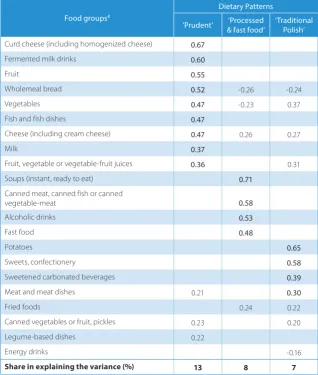
Table 2. The values of factor loadings for selected food groups in dietary patterns – PCA

Food groups#

Dietary Patterns

‘Prudent’ & fast food’‘Processed ‘TraditionalPolish’

Curd cheese (including homogenized cheese) 0.67

Fermented milk drinks 0.60

Fruit 0.55

Wholemeal bread 0.52 -0.26 -0.24

Vegetables 0.47 -0.23 0.37

Fish and fish dishes 0.47

Cheese (including cream cheese) 0.47 0.26 0.27

Milk 0.37

Fruit, vegetable or vegetable-fruit juices 0.36 0.31 Soups (instant, ready to eat) 0.71

Canned meat, canned fish or canned

vegetable-meat 0.58

Alcoholic drinks 0.53

Fast food 0.48

Potatoes 0.65

Sweets, confectionery 0.58

Sweetened carbonated beverages 0.39

Meat and meat dishes 0.21 0.30

Fried foods 0.24 0.22

Canned vegetables or fruit, pickles 0.23 0.20 Legume-based dishes 0.22

Energy drinks -0.16

Share in explaining the variance (%) 13 8 7

(6)

Results

Food consumption frequency

and dietary patterns

These studies found 3 main dietary patterns. The ‘Pru-dent’ DP was positively correlated with the frequency of consumption of: curd cheese (r = 0.67), fermented milk drinks (r = 0.60), fruit (r = 0.55), wholemeal bread (r = 0.52), vegetables, fish and fish dishes, cheese (r = 0.47), milk (r = 0.37), fruit, vegetable or vegetable-fruit juices (r = 0.36) (Table 2). The ‘Processed & fast food’ DP was positively correlated with the consumption frequency of: instant soups, concentrated ready-made soups (r = 0.71), canned meat, fish or canned vegetable-meat (r = 0.58),

alcoholic drinks (r = 0.53), and fast food (r = 0.48) (Ta-ble 2). The ‘Traditional Polish’ DP was positively cor-related with the frequency of consumption of: potatoes (r = 0.65), sweets (r = 0.58), sweetened carbonated beve- rages (r = 0.39), meat and meat dishes (r = 0.30) (Table 2). The shares in explaining the variance for ‘Prudent’, ‘Pro-cessed & fast food’ and ‘Traditional Polish’ DPs were 13%, 8% and 7%, respectively (Table 2).

Dietary patterns and breast

or lung cancer prevalence

There was a statistically significant decrease of the per-centage of breast or lung cancer cases in tertiles of the ‘Pru-dent’ DP (p = 0.0010) (Table 3). In the upper tertile

Table 3. Dietary patterns and the prevalence of breast or lung cancer

Dietary patterns

Cancer (% of the sample)

p-trend tertiles of dietary patterns

p-value

bottom middle upper

1 – ‘Prudent’

(curd cheese, fermented milk drinks, fruit, wholemeal bread, vegetables, fish and fish dishes, cheese, milk, fruit/vegetable/ vegetable-fruit juices)

(n = 106) 41.3a

(n = 108) 34.4

(n = 106)

24.4a 0.0010 ns

2 – ‘Processed&fast food’

(instant soups/concentrated, ready-made soups, canned meat/ fish/vegetable-meat, alcoholic drinks, fast food)

(n = 107) 28.8

(n = 106) 32.5

(n = 107)

38.8 ns ns

3 – ‘Traditional Polish’

(potatoes, sweets, sweetened carbonated beverages, meat and meat dishes)

(n = 106) 33.8

(n = 108) 35.6

(n = 106)

30.6 ns ns

n – sample size; ns – the differences were not statistically significant (the level of significance was assessed by Pearson’s χ2 test, p ≤ 0.05); a statistically

significant differences between the pairs of dietary pattern tertiles, p ≤ 0.05.

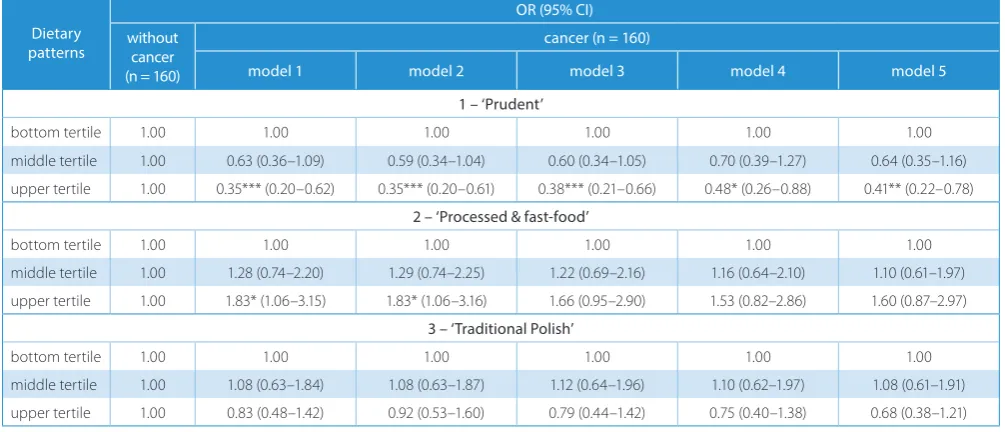
Table 4. Odds ratio (OR) and 95% confidence interval (95% CI) of breast or lung cancer prevalence in relation to dietary patterns

Dietary patterns

OR (95% CI) without

cancer (n = 160)

cancer (n = 160)

model 1 model 2 model 3 model 4 model 5

1 – ‘Prudent’

bottom tertile 1.00 1.00 1.00 1.00 1.00 1.00

middle tertile 1.00 0.63 (0.36–1.09) 0.59 (0.34–1.04) 0.60 (0.34–1.05) 0.70 (0.39–1.27) 0.64 (0.35–1.16) upper tertile 1.00 0.35*** (0.20–0.62) 0.35*** (0.20–0.61) 0.38*** (0.21–0.66) 0.48* (0.26–0.88) 0.41** (0.22–0.78)

2 – ‘Processed & fast-food’

bottom tertile 1.00 1.00 1.00 1.00 1.00 1.00

middle tertile 1.00 1.28 (0.74–2.20) 1.29 (0.74–2.25) 1.22 (0.69–2.16) 1.16 (0.64–2.10) 1.10 (0.61–1.97) upper tertile 1.00 1.83* (1.06–3.15) 1.83* (1.06–3.16) 1.66 (0.95–2.90) 1.53 (0.82–2.86) 1.60 (0.87–2.97)

3 – ‘Traditional Polish’

bottom tertile 1.00 1.00 1.00 1.00 1.00 1.00

(7)

of the ‘Prudent’ DP in comparison to the bottom tertile, there was a significantly lower percentage of breast or lung cancer cases reported (24.4% vs 41.3%) (Table 3). There were no significant differences reported in the percentage of breast or lung cancer cases within the tertiles of the ‘Pro-cessed & fast food’ DP and the ‘Traditional Polish’ DP (Table 3).

Two out of the 3 identified dietary patterns, ‘Prudent’ and ‘Processed & fast food’, showed a significant associa-tion with the prevalence of breast or lung cancers in a lo-gistic regression analysis (Table 4). Subjects in the upper tertile of the ‘Prudent’ DP in comparison to the bottom tertile had a lower risk of breast or lung cancers, from 52% (model 4: OR  =  0.48; 95% CI: 0.26–0.88; p < 0.05) to 65% (model 2: OR  =  0.35; 95% CI: 0.20–0.61; p < 0.001) (Table 4). Subjects in the upper tertile of the ‘Processed & fast food’ DP in comparison to the bottom tertile had almost 2-fold higher risk of breast or lung cancers (mod-el 2: OR  =  1.83; 95% CI: 1.06–3.16; p < 0.05) (Table 4) . There was no significant association reported between the ‘Traditional Polish’ DP and the risk of breast or lung cancers (Table 4).

Discussion

This work presents the results of the first study on die- tary patterns and breast or lung cancer prevalence in Po-land. We found a strong inverse association between the ‘Prudent’ DP and the prevalence of breast or lung can-cer cases, irrespective of age, socioeconomic status, physi-cal activity, smoking, abuse of alcohol, and type of can-cer as confounding variables. Inversely, the ‘Processed & fast food’ DP was weakly associated with an increased risk of breast or lung cancers. There was no evidence of an association between the ‘Traditional Polish’ DP and the prevalence of breast or lung cancer in female and male adults from north-eastern Poland.

In the study, the ‘Prudent’ DP was characterized by a high frequency of consumption of dairy products, fruit, vegetables, wholemeal bread, fish and juices, and significantly reduced risk of breast or lung cancer (from 52% to 65%, depending on confounders incorporated into the model). A similar trend has been observed in studies conducted in many countries around the world. However, not all studies adjusted the results for the many confound-ers such as alcohol consumption, smoking or physical activity, as in our study. The DPs characterized by high consumption of fruit and vegetables, such as ‘Plant-based’, ‘Fruit and salad’ and ‘Antioxidants’, were associated with a 15–56% lower risk of breast cancer in women and with a 39% lower risk of lung cancer in men.13–15

In a sys-tematic review, in 10 out of 26 studies, a significant as-sociation was found between the ‘Mediterranean’ DP, comprised of vegetables, fruit, legumes, fish and olive oil, and a reduced risk of breast cancer in women

on vari-ous continents (from 27% to 86%).16 In a meta-analysis,

in a combination of 8 case-control and 10 cohort studies, it was shown that the ‘Prudent/Healthy’ DP, rich in fruit, vegetables, poultry, fish, low-fat dairy and whole grains, reduced the risk of breast cancer by 11%.17 In the Nether-

lands Cohort Study, the ‘Salad vegetables’ DP, comprised of vegetables, fruit, pasta, rice, poultry, fish and oil, re-duced the risk of lung cancer by 25%.18 This protective

effect probably resulted from a high-quality diet, rich in bioactive compounds including specific peptides, fatty acids, phenolics, vitamins, minerals and fiber. Conversely, in a North American study, the ‘Prudent’ DP, comprised of low-fat dairy products, whole grains, vegetables, fruit, legumes and vegetable or fruit juices, increased the risk of breast cancer 1.42 times.19 This result is contrary

to conventional wisdom and to the results of other stu- dies. In the USA, the ‘Prudent’ DP diet is relatively high-er in carbohydrates and fat than the diet of ‘Prudent/ Healthy’ DPs in European countries. In some studies, there was no association found between breast cancer risk and the ‘Cereals/Milk/Dairy’ DP, ‘Vegetable’ DP and ‘Pru-dent’ DP rich in low-fat dairy products, juices, whole grains, vegetables and fruit.13,20,21 The differences in these

associations could result from differences in the study designs, study populations, secular trends in food sup-ply or different definitions of ‘Prudent/Healthy’ diet and characteristics for their foods.19

In these studies, the ‘Processed & fast food’ DP was characterized by a higher frequency of consumption of al-coholic drinks and processed food such as fast food, in-stant soups and canned goods, which increased the risk of breast or lung cancers almost 2 times, but this rela-tion was weaker and disappeared after the adjustment for many confounders. Many studies performed in dif-ferent countries such as Germany, Italy and Korea, did not report a statistically significant association be-tween the ‘Western’ DP and breast cancer.22–24 However,

the ‘Drinkers’ DPs, including alcoholic beverages such as wines, beers and spirits, were associated with increased risk of breast cancer, from 12% in the California Teach-ers’ Study, through 21% in a meta-analysis of 4 studies and 40% in Uruguayan women, to 2.5 times in French women.13,17,25,26 Alcohol is a proven risk factor for breast

cancer.1 The ‘Western/Unhealthy’ DPs, which were chara-

cterized by a high consumption of processed meat, fast food, canned goods, mayonnaise, butter, high-fat dairy, refined grains, sweets and alcoholic beverages, increased the risk of breast cancer from 20% in the French Cohort Study to 31% in a meta-analysis.17,27 In a Spanish study,

the ‘High-meat’ DP, rich in processed meat, fried red meat and alcoholic beverages, increased the risk of breast can-cer approx. 3.5 times.21 In the Netherlands Cohort Study,

the ‘pork, processed meat and potatoes’ DP increased the risk of lung cancer 2.67 times.18 However, this negative

(8)

load (GL) such as processed food, because of their high fat and sugar content.28 The differences in associations could

result, as mentioned above, from differences in the study designs, study populations, trends in food supply or differ-ent definitions of ‘Western/Unhealthy’ diet and character-istics of their food.19

In our studies, the ‘Traditional Polish’ DP was chara- cterized by a higher frequency of potatoes, sweets, beve- rages, and meat consumption, mainly as fried foods, which are typical foods in the Polish diet. There was no significant effect found for the ‘Traditional Polish’ DP on the prevalence of breast or lung cancers in Polish adults from north-eastern Poland. The ‘Traditional Po- lish’ DP included both food with potentially beneficial ef-fects on health such as potatoes, and food with potentially negatively effects on health such as fried meat, sweets and sweetened carbonated beverages, which may determine its neutral character in relation to the prevalence of can-cer cases. As in our studies, in many studies there was no evidence of an association between ‘Traditional’ DP and risk of breast or lung cancers. Dietary patterns such as the Australian ‘Meat’ (meat, fried dishes, cooked pota-toes and pickled vegetables), the Greek ‘Meat/Potapota-toes’, the Californian ‘High-protein’ (meat, fried foods and fat), and the ‘Ethnic’ (legumes, soy-based foods, rice and leafy vegetables) were not significantly associated with breast cancer risk.13,14,20 To the contrary, in Asian-American

women, the ‘Ethnic meat/starch’ DP, comprised of vege- table soups, pork, dried and salted fish and fried rice, increased the risk of breast cancer almost 1.5 times.29

Among Uruguayan men, the ‘High-meat’ DP, character-ised by high consumption of meat, dairy products, eggs and desserts, increased the risk of lung cancer about 3 times.15 Some of the ‘Traditional’ DPs decreased the risk

of breast cancer, from 22% for the ‘Traditional southern US’ (cooked greens, beans, legumes, mixed vegetables, fried fish and chicken) to 47% for the ‘Uruguayan’ (cooked red meat, cereals, cooked legumes and tubers).30,31

Differ-ences in associations between the ‘Traditional’ DPs and the prevalence of breast or lung cancers could result from the different characteristics of the typical foods in the diet of a given country/region.

The present study provides new and interesting in-sights regarding dietary patterns and breast or lung can-cer risk. It was found that the protective effect of a diet composed of dairy, fruit, vegetables, wholemeal bread, fish and juices was stronger than the negative effects of a diet containing alcoholic drinks and processed food on cancer prevalence. This effect did not depend upon the presence of many confounders, which included age, socioeconomic status, physical activity, abuse of alcohol, smoking, and type of cancer. It may be supposed that a regular diet composed of dairy, fruit, vegetables, whole-meal bread, fish and juices may reduce the negative effects of the socioeconomic and lifestyle risk factors of can-cer. Furthermore, we found this diet composition using

a data-driven approach by drawing dietary patterns from a data-set.12,32 So, there is strong evidence that such dietary

patterns exist in real life and may be found within Polish adults from north-eastern Poland. It is also possible that similar dietary patterns may be found among other people living in central and eastern Europe.33 Thus, our results

may go beyond national significance. Finally, these findings may be helpful in making public dietary recommendations when improving strategies to promote a healthy diet and decrease the risk of breast and lung cancer.

Study strengths and weaknesses

The major weakness of these studies is a lack of quanti-tative data regarding food and nutrient intake. However, current evidence shows the limitations of a single-nutrient component focus.32 We collected data concerning

the fre-quency of food consumption, which reflected the usual intake, and then identified the dietary patterns. Dietary patterns represent the overall combination of foods usually consumed, which together produce synergistic health ef-fects.32 The strength of the study was that we used

the vali-dated, interviewer-administrated FFQ of greater internal repeatability than the self-administrated FFQ.9 Moreover,

the prevalence of cancer incidence was confirmed by his-topathology results. These studies were interdisciplinary studies including 2 scientific areas: human nutrition and medicine – oncology, which is rare in Polish studies. An in-teresting area of these studies was to show the dietary pat-terns and prevalence of breast and lung cancers in a pooled analysis across a wide area of north-eastern Poland.

Conclusions

There was a strong inverse relation between the ‘Pru-dent’ dietary pattern and breast or lung cancer prevalence, irrespective of age, socioeconomic status, physical activity, smoking, alcohol abuse or type of cancer in Polish adults from north-eastern Poland. For cancer prevention, one should start a diet composed of dairy products, fruit, veg-etables, wholemeal bread, fish and juices. Our approach is focused on the foods and overall dietary patterns that exist in the real life of people living in north-eastern Po-land, not on single isolated nutrients. So, this food-based approach is better fitted to making public dietary recom-mendations and individual behavioural counseling.

References

1. World Cancer Research Fund, American Institute for Cancer Research. Food, Nutrition, Physical Activity, and the  Prevention of Cancer: A Global Perspective. Washington, DC: American Institute for Cancer Research; 2007.

2. Wojciechowska U, Didkowska J, Zatoński W. Nowotwory złośliwe w Pol-sce w 2010 roku [Cancer in Poland in 2010]. http://onkologia.org.pl/wp-content/uploads/Nowotwory_2010.pdf. Accessed June 10, 2015. 3. Jarosz M. Nowotwory złośliwe. Jak zmniejszyć ryzyko zachorowania?

(9)

4. Vineis P, Wild CP. Global cancer patterns: Causes and prevention.

Lancet. 2014;383:549–557.

5. World Cancer Research Fund, American Institute for Cancer Research.

Continuous Update Project. Keeping the  science current. Breast Cancer 2010 Report. Food, Nutrition, Physical Activity, and the Prevention of Breast Cancer. Washington, DC: American Institute for Cancer Research; 2010. 6. Wądołowska L. Zasady obliczania i interpretacji wyników. In: Gro-nowska-Senger A, ed. Przewodnik metodyczny badań sposobu żywienia. Warszawa: Komitet Nauki o Żywieniu Człowieka Polskiej Akademii Nauk; 2013:38–65.

7. Xu S, Wang P, You Z, et  al. The  long non-coding RNA EPB41L4A-AS2 inhibits tumor proliferation and is  associated with favorable prognoses in  breast cancer and other solid tumors. Oncotarget. 2016;15:20704–20717.

8. Wądołowska L, Krusińska B. Procedura opracowania danych żywie-niowych z kwestionariusza QEB. http://www.uwm.edu.pl/edu/lidi-awadolowska. Accessed May 5, 2015.

9. Kowalkowska J, Wądołowska L, Czarnocińska J, et al. Analiza zgod-ności wewnętrznej „Kwestionariusza do badania zachowań żywie-niowych i opinii na temat żywności i żywienia” QEB. http://www. uwm.edu.pl/edu/lidiawadolowska. Accessed June 20, 2016. 10. Jarosz M, Taraszewska A. Nadwaga i otyłość oraz wybrane elementy

stylu życia jako czynniki ryzyka GERD. Post Nauk Med. 2011;9:749–759. 11. Wądołowska L, Krusińska B. Procedura opracowania danych żywie-niowych z kwestionariusza KomPAN. In: Gawęcki J, ed. Kwestiona-riusz do badania poglądów i zwyczajów żywieniowych oraz procedu-ra opprocedu-racowania danych. Warszawa: Zespół Behawioralnych Uwa-runkowań Żywienia, Komitet Nauki o Żywieniu Człowieka Polskiej Akademii Nauk; 2014:34–51. http://www.knozc.pan.pl/. Accessed May20, 2016.

12. Wirfält E, Drake I, Wallström P. What do review papers con-clude about food and dietary patterns? Food Nutr Res. 2013;57. doi: 10.3402/fnr.v57i0.20523

13. Link LB, Canchola AJ, Bernstein L, et al. Dietary patterns and breast cancer risk in the California Teachers Study cohort. Am J Clin Nutr.

2013;98:1524–1532.

14. Baglietto L, Krishnan K, Severi G, et  al. Dietary patterns and risk of breast cancer. Br J Cancer 2011;104:524–531.

15. De Stefani E, Boffettab P, Roncoc AL, et al. Nutrient patterns and risk of lung cancer: NA factor analysis in Uruguayan men. Lung Can-cer. 2008;61:283–291.

16. Albuquerque RCR, Baltar VT, Marchioni DML. Breast cancer and dietary patterns: A systematic review. Nutr Rev. 2013;72:1–17. 17. Brennan SF, Cantwell MM, Cardwell CR, Velentzis LS, Woodside JV.

Dietary patterns and breast cancer risk: A  systematic review and meta-analysis. Am J Clin Nutr. 2010;91:1294–1302.

18. Balder HF, Goldbohm RA, van den Brandt PA. Dietary patterns asso-ciated with male lung cancer risk in the Netherlands Cohort Study.

Cancer Epidemiol Biomarkers Prev. 2005;14:483–490.

19. Murtaugh MA, Sweeney C, Giuliano AR, et al. Diet patterns and breast cancer risk in Hispanic and non-Hispanic white women: The  Four-Corners Breast Cancer Study. Am J Clin Nutr. 2008;87:978–984. 20. Demetriou CA, Hadjisavvas A, Loizidou MA, et  al. The 

mediter-ranean dietary pattern and breast cancer risk in  Greek-Cypriot women: A case control study. BMC Cancer. 2012;12:113–124. 21. Castello A, Polla M, Buijsse B, et al. Spanish Mediterranean diet and

other dietary patterns and breast cancer risk: Case-control EpiGEI-CAM study. Br J Cancer. 2014;111:1454–1462.

22. Buck K, Vrieling A, Flesch-Janys D, et  al. Dietary patterns and the risk of postmenopausal breast cancer in a German case-con-trol study. Cancer Causes Control. 2011;22:273–282.

23. Sant M, Allemani C, Sieri S, et al. Salad vegetables dietary patterns protects against HER-2-positive cancer: A prospective Italian study.

Int J Cancer. 2007;121:911–914.

24. Cho YA, Kim J, Shin A, et al. Dietary patterns and breast cancer risk in Korea women. Nutr Cancer. 2010;62:1161–1169.

25. De Stefani E, Deneo-Pellegrini H, Boffetta P, et  al. Dietary pat-terns and risk of cancer: A factor analysis in Uruguay. Int J Cancer. 2009;124:1391–1397.

26. Bessaoud F, Tretarre B, Daures JP, et al. Identification of dietary pat-terns using two statistical approaches and their association with breast cancer risk: A case-control study in southern France. Ann Epi-demiol. 2012;22:499–510.

27. Cottet V, Touvier M, Fournier A, et al. Postmenopausal breast can-cer risk and dietary patterns in  the  E3N-EPIC Prospective Cohort Study. Am J Epidemiol. 2009;170:1257–1267.

28. Woo HD, Park K, Shin A, Ro J, Kim J. Glycemic index and glyce-mic load dietary patterns and the associated risk of breast cancer: A case-control study. Asian Pac J Cancer Prev. 2013;14:5193–5198. 29. Wu AH, Yu MC, Tseng Ch, Stanczyk FZ, Pike MC. Dietary patterns

and breast cancer risk in  Asian American women. Am J Clin Nutr. 2009;89:1145–1154.

30. Velie EM, Schairer C, Flood A, He J, Khattree R, Schatzkin A. Empirically derived dietary patterns and risk of  postmenopausal breast cancer in a large prospective cohort study. Am J Clin Nutr. 2005;82:1308–1319.

31. Ronco AL, De Stefani E, Boffetta P, et  al. Food patterns and risk of  breast cancer: A  factor analysis study in  Uruguay. Int J Cancer. 2006;119:1672–1678.

32. Mozaffarian D. Dietary and policy priorities for cardiovascular dis-ease, diabetes, and obesity: A comprehensive review. Circulation. 2016. doi: 10.1161/CIRCULATIONAHA.115.018585

Figure

Table 1. Cancer and control sample characteristics (%)
Figure 1. Flow chart of sample collection and study design
Table 2. The values of factor loadings for selected food groups in dietary patterns – PCA
Table 3. Dietary patterns and the prevalence of breast or lung cancer

References

Related documents

Then, since there is no absolute frame of reference and each observer can measure the speed of his light to

In a similar way also Eqs. Graph based algorithms for boolean function manipulation. In: Proceedings of the 27th ACM/IEEE design automation conference. A brief introduction to

The data were collected during three longitudinal studies of medical student selection, the first of which began in the autumn of 1980, looking at students who had applied for entry

In summary, short-acting insulin analogues were asso- ciated with fewer nocturnal and severe hypoglycemic events and better glucose control (slightly lower HbA1c and

The interviewees perceived other men ’ s rejection of the wife if she gets breast cancer as a withdrawal strategy to avoid feeling helpless which could undermine the man ’ s role as

Canada No separate body, but effectively regulated by CRA Accounting Standards Board (AcSB) CICA Handbook 4400 for NFP entities Recent adoption (2011) US No separate

For the morphometric comparison part, a total of four spinal indices and Pavlov’s ratio were calculated, based on linear and angular dimensions of the sheep lumbar spine which

If policy-makers were skeptical of citizens’ willingness to buy shares of privatized companies, however, it was not only for the limited size of the stock exchange, but also because