Environmental conditions predict helminth prevalence in red foxes
in Western Australia
q
Narelle A. Dybing
⇑, Patricia A. Fleming, Peter J. Adams
School of Veterinary & Life Sciences, Murdoch University, South Street, Western Australia 6150, Australia
a r t i c l e
i n f o
Article history:
Received 26 February 2013 Revised 24 April 2013 Accepted 26 April 2013
Keywords: Red fox
Helminth parasites Zoonotic
Environmental correlates
a b s t r a c t
Red foxes (Vulpes vulpes) are the most common and widely distributed wild carnivore worldwide. These predators harbour a wide range of parasites, many of which may have important conservation, agricul-tural and zoonotic repercussions. This project investigated the occurrence of helminth parasites from the intestines of 147 red foxes across 14 sampling localities of southwest Western Australia. Helminth parasites were detected in 58% of fox intestines:Dipylidium caninum(27.7% of foxes),Uncinaria stenocep-hala(18.2%),Toxocara canis(14.9%),Spirometra erinaceieuropaei(5.4%),Toxascaris leonina(4.7%),Taenia serialis(1.4%),Taenia hydatigena(0.7%), unidentifiedTaeniaspp. (4.1%),Brachylaima cribbi(0.7%), Plagior-chis maculosus(0.7%) and an Acanthocephalan; family Centrorhynchidae (2.1%). Importantly, two ces-todes of agricultural significance,Echinococcus granulosusand Taenia ovis, were not detected in red foxes in this study, despite the presence of suitable intermediate hosts in the diets of these animals. Par-asite richness varied from 1–3 species per host, with average parPar-asite number varying from 1–39 worms (across all helminth species). Regression analyses indicated that the presence of four helminth parasites was related to various environmental factors. The presence ofS. erinaceieuropaei(p< 0.001),T. leonina (p< 0.01) andU. stenocephala(p< 0.01) was positively associated with average relative humidity which may affect the longevity of infective stages in the environment. The presence ofS. erinaceieuropaeiandU. stenocephala(p< 0.001) was positively associated with 5-y-average minimum temperature which could reflect poor survival of infective stages through cold winter conditions. The presence ofT. canisandU. stenocephala(p< 0.001) was positively associated with the percentage cover of native vegetation at each sampling location, which is likely to reflect transmission from native prey species acting as paratenic hosts. These data identify environmental factors affecting transmission and potential distribution of each parasite taxon, and provide important information increasing our understanding of the potential effects of environmental change on parasite ecology.
Ó2013 The Authors. Published by Elsevier Ltd. All rights reserved.
1. Introduction
The red fox (Vulpes vulpes) is widely distributed and abundant on every major continent throughout the world except Antarctica (Strahan, 1983; Long, 1988; Dickman, 1996). This generalist pred-ator competes with and predates upon a wide range of native and livestock species as well as playing an important role in disease transmission. Red foxes are known to harbour parasites of agricul-tural, conservation and zoonotic importance (Wolfe et al., 2001; Henderson, 2009). Understanding the factors that influence the persistence and spread of these parasites is important in
maintain-ing wildlife community health and may have implications for transmission to livestock and humans.
Many parasite species require relatively specific environmental conditions to complete their lifecycles. Therefore, adverse condi-tions can affect the number of viable parasites in the environment as well as the rate of development of infective stages. Climatic vari-ables such as rainfall, temperature, humidity and barometric pres-sure can therefore influence the geographic distribution of parasites as much as host presence (Stromberg, 1997). Climate change is of increasing importance to determining the occurrence and impacts of infectious diseases. With the expected increase in frequency and severity of extreme climatic events as a result of cli-mate change, geographic distributions of both parasites and their hosts are also expected to change (Morgan and Wall, 2009; Polley and Thompson, 2009). These changing distributions may lead to par-asites switching to newly available and/or naïve host species with deleterious effects (Polley and Thompson, 2009). Host characteris-tics (e.g. age and sex) may also influence an animal’s susceptibility
2213-2244/$ - see front matterÓ2013 The Authors. Published by Elsevier Ltd. All rights reserved.
http://dx.doi.org/10.1016/j.ijppaw.2013.04.004
q
This is an open-access article distributed under the terms of the Creative Commons Attribution-NonCommercial-ShareAlike License, which permits non-commercial use, distribution, and reproduction in any medium, provided the original author and source are credited.
⇑ Corresponding author. Tel.: +61 8 9360 2118.
E-mail addresses:[email protected],[email protected](N.A. Dybing).
Contents lists available atSciVerse ScienceDirect
International Journal for Parasitology:
Parasites and Wildlife
to infection (Mourand and Poulin, 1998; Behnke et al., 1999; Chow-dhury et al., 2001).
Despite the widespread distribution and importance of the red fox as a pest species in Australia, few studies have investigated the helminth parasites they harbour. In particular, little is known regarding the climatic variables that influence the presence and transmission of parasite taxa within Australian environments. Gi-ven the propensity for a changing climate to influence these envi-ronments, information regarding factors that influence parasite occurrence is required. The aim of this study was to investigate the gastrointestinal helminths present in red foxes in southwest Western Australia and the factors influencing parasite presence. We predicted an effect of environmental conditions (temperature, rainfall and humidity) on the presence of parasite species which have an environmental stage, and predicted an effect of the per-centage cover of native vegetation on the presence of parasite spe-cies that rely on native spespe-cies as intermediate hosts.
2. Materials and methods
2.1. Sample collection
Red fox carcasses (n= 124) were sourced from a coordinated culling program across 14 locations within the intensive land use zone of southwest Western Australia (over two designated week-ends in February and March 2010), with additional samples (n= 23) obtained via opportunistic collection i.e. road kill or pri-vate culling operations during the same months (Table 1). Necrop-sies were conducted on red fox carcasses within 12 h of being shot. The animal’s sex was recorded and body mass (kg), head length (cm), head-body length (cm) and pes length (cm) were measured. The entire gastrointestinal (GI) tract (including stomach, duode-num, ileum, caecum and colon) was removed and stored according to means available until examination: on ice for8 h, transferred to a 4°C fridge, or transferred immediately to a 18°C freezer taken into the field. Given the variability in stomach content, the dissected GI tract mass was subtracted from overall body mass for statistical analyses.
Skulls were collected for estimation of age (Forbes-Harper, 2010). In Australia most fox cubs are born in August and Septem-ber (Saunders et al., 1995), and therefore tend to form a tight age cohort. Ages are indicated to the nearest year: at the time we sampled, foxes in their first year were aged between 5 and
10 months old (mo), those in their second year were 17–22 mo, etc. Animals <2 years old (yo) could generally be aged via cranial sutures: foxes with an open basisphenoid–basioccipital suture were considered in their first year and those where this suture was closed but the presphenoid–basisphenoid suture remained open were considered in their second year (Harris, 1978). Animals >2 yo were aged by counting the numbers of dentine layers of the canine teeth following the method of Roulichova and Andera (2007). Age, sex and body mass details for the animals sampled are shown inTable 2.
2.2. Examination of gastrointestinal tracts
Frozen GI tracts were defrosted at room temperature (20–30°C) overnight. Stomach contents were examined for a separate diet analysis; parasites present in the stomach were separated from stomach contents and identified as part of the present study. Intes-tines were laid out on a tray, the small and large intesIntes-tines opened longitudinally and then the entire GI tract was cut into25 cm-long sections. Each section was methodically examined under a dissecting microscope (magnification varying from 1 to 4). Additionally, intestinal walls were scraped with soft forceps to re-move mucous and food items and to enable the detection of para-sites attached to the intestinal mucosa. Parapara-sites imbedded within food particles were gently extracted. Parasites were counted and transferred to 70% ethanol or 10% neutral buffered formalin (ces-todes only). Only scoleces and heads were counted and used for parasite intensity. Some parasites that were found were unable to be unidentified due to poor/degraded specimens. Specimens
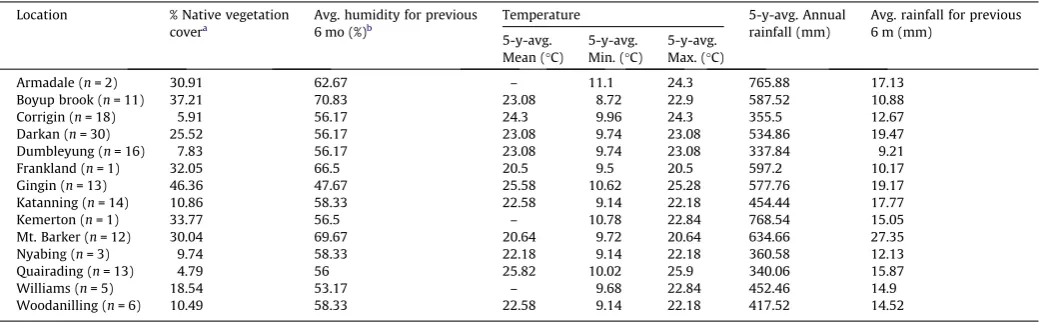
Table 1
Environmental and climatic measures for each sampling location and number of samples collected.
Location % Native vegetation
covera
Avg. humidity for previous 6 mo (%)b
Temperature 5-y-avg. Annual
rainfall (mm)
Avg. rainfall for previous 6 m (mm)
5-y-avg. Mean (°C)
5-y-avg. Min. (°C)
5-y-avg. Max. (°C)
Armadale (n= 2) 30.91 62.67 – 11.1 24.3 765.88 17.13
Boyup brook (n= 11) 37.21 70.83 23.08 8.72 22.9 587.52 10.88
Corrigin (n= 18) 5.91 56.17 24.3 9.96 24.3 355.5 12.67
Darkan (n= 30) 25.52 56.17 23.08 9.74 23.08 534.86 19.47
Dumbleyung (n= 16) 7.83 56.17 23.08 9.74 23.08 337.84 9.21
Frankland (n= 1) 32.05 66.5 20.5 9.5 20.5 597.2 10.17
Gingin (n= 13) 46.36 47.67 25.58 10.62 25.28 577.76 19.17
Katanning (n= 14) 10.86 58.33 22.58 9.14 22.18 454.44 17.77
Kemerton (n= 1) 33.77 56.5 – 10.78 22.84 768.54 15.05
Mt. Barker (n= 12) 30.04 69.67 20.64 9.72 20.64 634.66 27.35
Nyabing (n= 3) 9.74 58.33 22.18 9.14 22.18 360.58 12.13
Quairading (n= 13) 4.79 56 25.82 10.02 25.9 340.06 15.87
Williams (n= 5) 18.54 53.17 – 9.68 22.84 452.46 14.9
Woodanilling (n= 6) 10.49 58.33 22.58 9.14 22.18 417.52 14.52
a
Percentage native vegetation cover was calculated within a 30 km radius of each sampling location (data sourced fromShepherd et al., 2001). b
Climatic measures were sourced from Bureau of Meteorology (Department of Sustainability, 2010). Table 2
Age, weight and sex breakdown of samples collected (n= 147).
Range No. of foxes
Age cohort <2 years 105
2–4 years 26
4–6 years 4
6–8 years 3
Unknown 9
Weight <5 kg 47
5–8 kg 96
>8 kg 2
Sex Male 80
found in only one individual with only a single worm can be put down to artefact from diet.
Parasites were identified based on morphological characteris-tics. Nematodes and acanthocephalans were cleared in lactophenol prior to identification. Identification of nematodes was made based on characteristics outlined in Bowman and Georgi (2009) and Schmidt and Roberts (1985). Hookworms were identified by pres-ence of a cutting plate and ascarids were identified by their tapered tail in males or egg morphology in females. Tapeworms were iden-tified using morphological characteristics pertaining to their pro-glottids, as defined in Cheng (1986). The juvenile acanthocephalans were identified to family according to the key inYamaguti (1963)andAmin (1987). The keys used in the basic identification for trematodes were from Schell (1970). The trematodes were stained with Semichon’s acetocarmine ( Plagior-chis maculosus) and Harris’s haematoxylin (Brachylaima cribbi) respectively. Both of these flukes were identified from the position of the uterus and ventral sucker and measurements for identifica-tion were compared to Krasnolobova (1977) and Butcher and Grove (2001), respectively. Individual Taenia were identified to species based on morphological characters, i.e. anterior rostellar hooks from hook squashes (Beveridge and Gregory, 1976); how-ever there is some overlap in hook lengths between species of Tae-niaand some specimens collected were not whole.
2.3. Statistical analysis
Backwards-stepwise logistic regression analyses (Statistica Ver-sion 9; StatSoft Inc., 2001) were performed to determine factors
correlated with the presence/absence (1/0) of the five most com-mon parasite species (i.e. species that had a prevalence of >4%: Dip-ylidium caninum, Spirometra erinaceieuropaei, Toxocara canis,
Toxascaris leonina, andUncinaria stenocephala) as the dependent variables. Twelve independent variables tested for each dependent variable included seven environmental and climatic measures re-corded for each sampling location (Table 1), and five intrinsic fac-tors (body mass, head-body length, pes length, sex, and age). The analyses were performed on the presence/absence in individual host animals (not prevalence by location), to avoid biassing results due to differences in sample size between locations. Each individ-ual animal was attributed the environmental values for the site of capture (we could not include location as a random factor in these analyses since each location had unique environmental values and would therefore have confounded the results of the analyses).
Correlation between the presence of each parasite species (only parasites that were present in at least three foxes) was examined using a Pearson’s correlation matrix (Excel 2007; Microsoft), based on the presence/absence data for each individual fox examined. A Bonferroni correction was applied.
Mixed-model ANOVA (Statistica Version 9; StatSoft Inc., 2001) was performed to examine whether the load of each of the five most common parasite species had a detrimental effect upon host body condition (i.e. body mass). Body mass of each individual fox was used as the dependent variable. To take into account allome-tric relationships, three measures of body size were included in the analysis (head length, head-body length, and pes length); the inclusion of multiple body size indices improves how allometric change is accounted for (Green, 2001). The age (year; fixed
continuous covariate) and sex (fixed categorical variable) of the host were also included in the analyses; location was included as a random factor to account for repeated samples from each loca-tion. The load of five parasites (D. caninum,S. erinaceieuropaei,T. ca-nis,T. leonina,U. stenocephala)were included as fixed continuous covariates (only parasites species that were present in at least three foxes were included in the analysis).
3. Results
3.1. Helminth species presence, prevalence and infracommunity richness
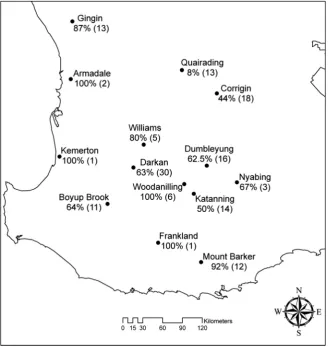
Fifty-eight percent of foxes (n= 85 of 147 total) harboured hel-minth parasites within their GI tract (Fig. 1). Fourteen helminth parasite taxa were recovered from red foxes across all sampling locations; five cestodes, five nematodes, three trematodes and one acanthocephalan (Table 3).
Of the helminth species recovered,D. caninumwas the most pre-valent (present in 27.7% of 147 red foxes examined) and widespread (9 of 14 locations), followed byU. stenocephala(18.2%; 7 locations) andT. canis(14.9%; 5 locations). The three trematode species (B. cribbi, P. maculosusand a uterus of an unidentified fluke) were each found from only a single host. The Acanthocephalan (2.0%; 3 loca-tions), could only be identified to family (Centrorhynchidae) due
to them being juvenile specimens. Of the 86 foxes that harboured parasites, single parasite species infections (53 individuals) were more common than mixed. Mixed infections consisted of either two species (n= 25) or a maximum of three parasite species (n= 7).
3.2. Worm burden
The parasite intensity (burden) of helminths from all foxes was highly variable (Table 3). The parasite species with the highest maximum intensity wasU. stenocephala, with 78 worms detected within a single fox. The maximum helminth intensity forT. serialis,
D. caninumandT. caniswas 74, 51 and 34, respectively. Eleven par-asite species were identified with a minimum parpar-asite intensity of one worm in a host. The mean intensity of each individual parasite species varied from 1 to 39 individuals.
3.3. Factors associated with the presence of parasites
Backward stepwise multiple regression analyses identified a sig-nificant association between environmental measures and the pres-ence of four of the five most prevalent parasite species (Table 4; the presence ofD. caninumwas not attributable to any of the factors tested). The sites whereT. leoninawas present typically had higher average relative humidity than those sites whereT. leoninawas not detected (p< 0.01). The sites whereS. erinaceieuropaeiwas present
Table 3
Prevalence and parasite intensity of helminth species in red foxes. Species within each Family are sorted in decreasing order of prevalence.
Phylum Parasite Prevalence (%) Helminth parasite intensity
Average SD Min Max Median
Nematoda Uncinaria stenocephala 18.2 17.00 17.33 1 78 12
Toxocara canis 14.9 7.00 7.84 1 34 4
Toxascaris leonina 4.7 1.00 – 1 1 1
Unknown roundworm 1.4 1.00 – 1 1 1
Unknown hookworm 0.7 1.00 – 1 1 –
Cestoda Dipylidium caninum 27.7 8.00 12.14 1 51 2
Spirometra erinaceieuropei 5.4 3.00 1.98 1 6 3
Taenia serialis 1.4 39.00 49.50 4 74 39
Taenia hydatigena 0.7 1.00 – 1 1 –
Taeniaspp. 4.1 1.00 – 1 1 1
Trematoda Brachylaima cribbi 0.7 6.00 – 6 6 –
Plagiorchis maculosus 0.7 8.00 – 8 8 –
Unknown fluke 0.7 1.00 – 1 1 –
Acanthocephala Centrorhynchidaea 2.1 2.00 1.73 1 4 1
aIdentified to family only.
Table 4
Summary of five separate backwards stepwise multiple logistic regression analyses carried out to determine factors that were associated with the presence/absence of the five most prevalent parasite species. This table shows beta coefficient values ± standard errors.
Parasite species D. caninum S. erinaceieuropei T. canis T. leonina U. stenocephala
Environmental factors
% Native vegetation cover (30km radius) – – 0.455 ± 0.079*** – 0.493 ± 0.073***
Avg. monthly rainfall- previous 6 mo (mm) – – – – –
5-y-avg. annual rainfall (mm) – – – – –
Avg. humidity- previous 6 mo (%) – 0.574 ± 0.115*** – 0.285 ± 0.085** 0.343 ± 0.10**
5-y-avg. mean temp. (°C) – – – – –
5-y-avg. min temp. (°C) – 0.494 ± 0.115***
– – 0.364 ± 0.103***
5-y-avg. max temp. (°C) – – – – –
Host factors
Sex – – – – –
Head/body length (cm) – – – – –
Pes length (cm) – – – – –
Body mass (minus GI tract mass, kg) – – – – –
Age (years) – – – – –
Factors that were eliminated as part of the backwards stepwise regression are indicated with –; significant factors are indicated with asterisks.
were more humid (p< 0.001) with warmer minimum temperatures (p< 0.001). The sites whereU. stenocephalawas present were more humid (p< 0.01), had warmer minimum temperatures (p< 0.001), and had more native vegetation present (p< 0.001) than other sites. Those sites that had a greater percentage prevalence ofT. canis gen-erally had more native vegetation present (p< 0.001).
3.4. Parasite correlations
A correlation matrix analysis identified correlations between parasite occurrences in foxes (Table 5). A significant correlation was observed with the occurrence of S. erinaceieuropaei and U. stenocephalawithin foxes/across sampling locations (p< 0.001). A strong positive correlation was also observed betweenS. erinacei-europaei and T. leonina; T. canis and U. stenocephala; T. leonina
andU. stenocephala(p< 0.01). A strong negative correlation was observed betweenD. caninumandU. stenocephala(p< 0.01).
3.5. Body condition
Body condition of foxes was not associated with the load of each of five parasite species (Mixed-model ANOVAD. caninum p= 0.283,
S. erinaceieuropaei p= 0.137,T. canis p= 0.282,T. leonina p= 0.537,
U. stenocephala p= 0.383), once allometric relationships (head length p< 0.001, head-body length p< 0.001, pes length
p= 0.360) and age of the foxes (p= 0.019) were taken into account.
4. Discussion
The overall prevalence in this study is considerably lower than that of studies from eastern Australia:Ryan (1976)found an 80.6% prevalence of helminths in foxes (n= 180) andComan (1973) de-tected a prevalence of 71% (n= 1320). Helminth prevalence in red foxes from other countries are also high; (100% for Spain: Gor-tázar et al., 1998; 96% for Ireland;Wolfe et al., 2001; 63% for Bel-gium:Vervaeke et al., 2005; 98% for Denmark:Saeed et al., 2006; 84.5% for Italy:Di Cerbo et al., 2008b). These previous studies all used similar methods of studying the intestinal tract; however spe-cific gastrointestinal methodology did vary; i.e. intestinal scrapings and examination under a microscope was used in some studies or intestinal washes, where only macro parasites were recorded, in the other half. Various factors can explain the lower prevalence found in this study compared to these previous studies. Some fac-tors include intermediate and paratenic host availability, diversity and density, host immunity and nutritional status, previous expo-sure to parasites, and seasonal and/or yearly fluctuations in para-site presence. Other factors include individual host factors, such as age and body size and environmental measures which have been explored in this study.
Red foxes are known to harbour a wide diversity of parasites. Despite the lower overall prevalence of helminth parasites
de-tected in this study, red foxes harboured 14 parasitic species repre-senting four parasitic phyla: Trematoda, Nematoda, Cestoda and Acanthocephala. The common helminth species detected in the present study (i.e.T. canis,T. leonina,U. stenocephala,D. caninum
andTaeniaspp.), have also been identified in previous studies ( Gor-tázar et al., 1998; Wolfe et al., 2001; Vervaeke et al., 2005; Saeed et al., 2006), signifying that red foxes from the southwest Western Australia harbour vulpine helminths commonly found in red foxes elsewhere in the world.
Two species of trematode flukes (P. maculosus and B. cribbi) found in this study have not been previously reported from Wes-tern Australia (Angel, 1959; Butcher and Grove, 2001).P. maculosus
has previously been noted as occurring in South Australia in insec-tivores as definitive hosts (i.e. insectivorous birds such as Willie wagtails, magpies and sparrows and some mammals), but not from red foxes in Australia (Angel, 1959). However, otherPlagiorchisspp. has been found in wild canids, artic foxes and red foxes in previous studies in other countries (Rausch et al., 1983; Kapel and Nansen, 1996; Di Cerbo et al., 2008a,b).B. cribbigenerally occurs in chick-ens, mice and rats as definitive hosts, and has also been noted from South Australia (Butcher and Grove, 2001). Both of these trema-todes are known to be infective to humans. The finding of these two trematodes in foxes from southwest Western Australia ex-pands their known geographical distribution and host range.
Even though the Acanthocephalan found was only in juvenile form, it was able to be identified to family: Centrorhynchidae. This Acanthocephalan family has been described in red foxes as well as other fox species in other parts of the world, including Europe (Eira et al., 2006) and South America (Ruas et al., 2008). The present study has reported an extension of the geographical distribution of this parasite taxon.
Parasite presence varied markedly between the 14 sampling locations. There were no detectable links with host intrinsic factors (i.e. sex, body mass, age) but various environmental factors were associated with presence of the most common parasite species. Environmental factors can strongly influence the larval and/or free living stages of parasites which may be susceptible to suboptimal temperature or humidity conditions (Stromberg, 1997). In addition to these environmental factors influencing parasite larval stages, host availability and behaviour can also be affected by environ-mental factors and therefore influence the occurrence and persis-tence of parasites (Stromberg, 1997; Gortázar et al., 1998; Hegglin et al., 2007).
High humidity levels positively influence parasite survival dur-ing their larval and free livdur-ing stages as it invariably relates to high-er moisture levels in micro-environments, particularly in soils, leading to an increased survival rate as well as dispersion of infec-tive stages (Onorato, 1932; Stromberg, 1997). In dry environments, eggs and larvae are more susceptible to desiccation and eggs are unlikely to embryonate (Ruiz de Ybanez et al., 2001). In the present study, average relative humidity for the previous 6 mo at each
Table 5
Pearson’s correlation matrix with a Bonferroni correction between parasites in red foxes (n= 147) based on presence/absence data. Only parasites present in at least 3 foxes were included in the analysis.
Dipylidium caninum Taeniaspp. Spirometra erinaceieuropaei Toxocara canis Toxascaris leonina Uncinaria stenocephala Dipylidium caninum 1
Taeniaspp. 0.052 1
Spirometra erinaceieuropaei 0.149 0.102 1
Toxocara canis 0.091 0.087 0.067 1
Toxascaris leonina 0.139 0.046 0.228** 0.004 1
Uncinaria stenocephala 0.217** 0.098 0.351*** 0.244** 0.224** 1
Statistically significant correlations are indicated with asterisks.
location had a significant influence on three parasite species (S. eri-naceieuropaei;T. leonina; andU. stenocephala) within red foxes. This correlation has previously been noted forU. stenocephala( Strom-berg, 1997). Although their presence in this study was linked with higher humidity,T. leoninaeggs are able to tolerate greater climatic variation than eggs from parasites such asT. canis, thus increasing their potential distribution and transmission risk (Sprent and Bar-rett, 1964; Okulewicz et al., 2012). Humidity may also correlate with the presence of habitat suitable for paratenic and intermedi-ate hosts thereby increasing parasite numbers (Ryan, 1976). For example,S. erinaceieuropaeihas a complicated life cycle utilising numerous paratenic hosts, including waterborne copepods and arthropods. The increased survival and transmission of this para-site in three locations (Gin Gin, Mount Barker and Perth metropol-itan area) in the southwest is indicative of suitable habitat and conditions for parasite development and transmission.
In addition to humidity, extremes of temperature (high or low) are also important as they can lead to desiccation of eggs and larval stages or arrested development of infective stages in the environ-ment (Onorato, 1932). Extremes of temperature can also determine the presence and density of suitable paratenic hosts and therefore the parasite community present. Higher minimum temperature (averaged over last 5 years) at sampling locations was significantly correlated withU. stenocephalaandS. erinaceieuropaeipresence in red foxes in the present study. Whilst lower minimum tempera-tures may be more conducive to reduced levels of desiccation (exposure of eggs and larvae to high levels of solar radiation in-creases susceptibility to desiccation), it can also potentially depress embryonation (Onorato, 1932) as well as larval activity and motil-ity (Stromberg, 1997). Therefore higher average minimum temper-atures are presumably favourable to the development and transmission of parasite species which involve a free-living or environmental stage.
Vegetation provides vital habitat diversity resulting in micro environments and climates within a landscape as well as refugia for potential host species (Dubinsky´ et al., 1995). Two helminth parasites (U. stenocephalaandT. canis) were positively correlated with a higher native vegetation cover. Life cycle stages forT. canis
andU. stenocephalaare both susceptible to desiccation and there-fore vegetation cover may increase the potential for their persis-tence within the landscape.Dubná et al. (2007) demonstrated a higher incidence and prevalence ofT. canisin parks or areas with a high vegetation cover compared to rural areas. Given the extent of clearing of native vegetation in the wheatbelt region (>90%) for agricultural purposes (DEP, 1997), it is not surprising that remnant vegetation has an important influence on the presence of parasite species (whether it is due to an increased concentration of poten-tial intermediate hosts or more amenable environmental condi-tions) (Stromberg, 1997; Mizgajska, 2001).
Generally, worm intensities in the definitive host are depen-dent on the mode of transmission of a particular parasite (Ryan, 1976), and a high worm burden within a fox is likely to reflect the intensity of infection of the intermediate host. An example of this isD. caninum which was abundant in foxes, most likely due to a high intensity ofD. caninumin the intermediate flea hosts (observed to cause flea bite dermatitis in numerous individuals) or a high infestation of fleas on the fox (Coman, 1973; Nichol et al., 1981). Similarly a high burden of S. erinaceieuropaeimay also represent an individual with an opportunistic feeding prefer-ence as this parasite has a wide range of paratenic hosts including frogs, mice and lizards. The potential for infection is increased by non-specific transmission of the larvalS. erinaceieuropaeito a mul-titude of hosts, and may be further increased by predation of these hosts by foxes. A definitive host with a high parasite burden can also infer a host that has an impaired immune system ( Chan-dra, 1981).
The impact of parasite intensity on red fox body condition has previously been shown to have no effect (Vervaeke et al., 2005). This finding has been further confirmed in the present study with no significant correlation between the load of common parasites and fox condition (once body size and age were taken into ac-count). Foxes in this study were generally in good condition how-ever, it is suggested that larger body sizes and better body conditions convey a greater number and variety of niches in which the parasite can reside (Mourand and Poulin, 1998). It also agrees with the idea that as these parasites are using foxes as a definitive host, they have a minimal effect on the host so that the cycling of this parasite can continue. This result may also reflect the overrid-ing effect of environmental rather than host factors. It may also indicate that there are other factors that may affect parasite pres-ence that need to be explored for example host immunity status and intermediate host availability.
Significant correlations between multiple parasite species were found for red foxes. A negative association was observed between
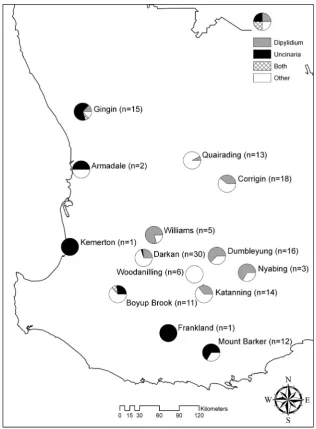
D. caninum and U. stenocephala indicating these two parasites showed minimal geographic overlap (Fig. 2).U. stenocephalawas present in coastal locations and sites typified by higher vegetation cover while D. caninum was present in locations further inland (part of the intensive wheatbelt area), which had lower percentage vegetation cover. The infective life cycle stage ofU. stenocephalais a free living larvae which requires specific environmental condi-tions in order to survive whilstD. caninumeggs, deposited in fae-ces, require ingestion by a flea larva which subsequently infects the definitive host. Other factors could influence the distribution of both these parasites species including the occurrence of fleas and other potential intermediate/paratenic hosts and the foraging behaviour of a definitive host can influence the amount of expo-sure to infective stages. In areas whereD. caninumis present, the few patches of vegetation that are present, act as a vital refuge for definitive hosts. This leads to a higher concentration of fleas, flea eggs and intermediate parasite stages and a higher likelihood of contact of the host with the parasite. Blagburn and Dryden (2009)found that in areas where average relative humidity is less than 50%, flea eggs are more likely to desiccate and this can there-fore lead to the lower transmission ofD. caninumto red foxes in those areas. Only one study location was recorded to have an aver-age relative humidity of less than 50% and nine locations har-bouredD. caninum.
Toxocara canishas been shown to commonly occur in associa-tion with hookworms (U. stenocephalaandAncylostomaspp.) in ca-nids, especially foxes (Newsome and Coman, 1989). Similarly, in the present study significant correlations were observed in the presence ofS. erinaceieuropaei,U. stenocephalaandT. leonina. These relationships may reflect the similar requirements each of these parasites have for their persistence and survival in the environ-ment. All three parasites were significantly associated with aver-age relative humidity andS. erinaceieuropaei andU. stenocephala
were associated with warmer 5-year average minimum tempera-tures. This is most likely related to the sensitivity of the eggs and larval stages of these parasites to desiccation and temperature fluctuations.
Of the parasites recorded in red foxes in this study,S. erinacei-europaei,T. canisare known to be transmissible to wildlife and live-stock species, andD. caninum,S. erinaceieuropaei, T. canis, B. cribbi
and P. maculosus have zoonotic potential. Canids, including red foxes, play an important role in the dissemination of a number of cestode tapeworms. In Australia, the most important of these are
two parasites (body lengths:E. granulosus5mm;T. ovis>5 mm) were detected in red foxes in this study, despite smaller species (P. maculosus1 mm) being detected. A total of 85Taeniaworms were found in nine foxes: based on rostellar hook length 78 were identified as T. serialis, one was identified as T. hydatigena, and one was T. hydatigena/pisiformis(due to overlap in hook length) (Beveridge and Gregory, 1976). The remaining five worms were unidentifiable due to the absence of measurable scoleces. Addi-tionally 69% of the 147 foxes examined had consumed sheep, whether consumed as carrion or freshly predated (Crawford et al., 2010). Despite the presence of T. ovis in sheep in southwest Western Australia and the high frequency of sheep in the red fox diet, neither of these parasites was present. This finding suggests that red foxes do not play an important role in the cycling ofT. ovis
orE. granulosusin south west WA at present. As such, domestic and/or feral dogs may play a more important role in the transmis-sion and persistence of these two parasites in the environment.
This is the first study to have investigated the influence of envi-ronmental and host factors on the presence of helminth parasites in red foxes from southwest Western Australia. Environmental conditions were shown to have a significant effect on the presence
of some species of parasites, which suggest as climatic factors shift so too could the parasite presence and prevalence. This climate change could overtly affect the transmission of larval stages and in turn lead to changing transmission strategies and eventually parasite distributions. Current control programs throughout south-west Western Australia aimed at reducing red fox impacts on envi-ronmental and agricultural resources are also assisting to help minimise disease risks. Due to the wide geographic distribution of the red fox, both in Australia and worldwide, their importance in the transmission of parasitic diseases in a changing climate should not be underestimated.
Acknowledgements
Aileen Elliot and Russell Hobbs for help in identifying hel-minths. Heather Crawford and Jesse Forbes-Harper for access to unpublished data. Red Card for the Red Fox control program including the farmers and volunteers who came out with us for fieldwork.
References
Amin, O.M., 1987. Key to the families and subfamilies of Acanthocephala, with the
erection of a new class (Polyacanthocephala) and a new order
(Polyacanthorhynchida). J. Parasitol. 73, 1216–1219.
Angel, M., 1959. An account ofPlagiorchis maculosus(Rud.), its synonymy and its life history in South Australia. Trans. R. Soc. S. Aust 82, 265–281.
Behnke, J.M., Lewis, J.W., Zain, S.N.M., Gilbert, F.S., 1999. Helminth infections in
Apodemus sylvaticusin southern England: interactive effects of host age, sex and year on the prevalence and abundance of infections. J. Helminthol. 73, 31–44.
Beveridge, I., Gregory, G.G., 1976. The identification of Taenia species from Australian carnivores. Aus. Vet. J. 52, 369–373.
Blagburn, B.L., Dryden, M.W., 2009. Biology, treatment, and control of flea and tick infestations. Vet. Clin. N. Am. Small Anim. Pract. 14, 1173.
Bowman, D.D., Georgi, J.R., 2009. Georgis’ Parasitology for Veterinarians. Saunders.
Butcher, A.R., Grove, D.I., 2001. Description of the life-cycle stages ofBrachylaima cribbin. sp. (Digenea:Brachylaimidae) derived from eggs recovered from human faeces in Australia. Syst. Parasitol. 49, 211–221.
Chandra, R., 1981. Immunocompetence as a functional index of nutritional status. Br. Med. Bull. 37, 89–94.
Cheng, T.C., 1986. General Parasitology. Academic Press College Division.
Chowdhury, N., O’Grady, R.T.O., Sood, M.L., 2001. Evolution, parasitism and host specificity in helminths. In: Chowdhury, N., Tada, I. (Eds.), Perspectives on Helminthology. Science Publishers, Inc., New Hampshire.
Coman, B.J., 1973. Helminth parasites of the fox (Vulpes vulpes) in Victoria. Aus. Vet. J. 49, 378–384.
Crawford, H., Calver, M., Adams, P.J., Fleming, P.A., 2010. The diet of red foxes (Vulpes vulpes) and feral cats (Felis catus) in the south west Western Australia. School of Biological Sciences, Murdoch University.
DEP, 1997. State of the Environment Reference Group draft working papers. Section 4, Land. State of the Environment Reporting Unit. Department of Environmental Protection, Perth, WA.
Di Cerbo, A.R., Manfredi, M.T., Bregoli, M., Milone, N.F., Cova, M., 2008a. Wild carnivores as source of zoonotic helminths in north-eastern Italy. Helminthologia 45, 13–19.
Di Cerbo, A.R., Manfredi, M.T., Trevisiol, K., Bregoli, M., Ferrari, N., Pirinesi, F., Bazzoli, S., 2008b. Intestinal helminth communities of the red fox (Vulpes vulpes
L.) in the Italian Alps. Acta Parasitol. 53, 302–311.
Dickman, C.R., 1996. Impact of exotic generalist predators on the native fauna of Australia. Wildl. Biol. 3, 165–175.
Dubinsky´, P., Havasiová-Reiterová, K., Petˇko, B., Hovorka, I., Tomašovicˇová, O., 1995. Role of small mammals in the epidemiology of toxocariasis. Parasitology 110, 187–193.
Dubná, S., Langrová, I., Jankovská, I., Vadlejch, J., Pekár, S., Nápravník, J., Fechtner, J., 2007. Contamination of soil withToxocaraeggs in urban (Prague) and rural areas in the Czech Republic. Vet. Parasitol. 144, 81–86.
Eira, C., Vingada, J., Torres, J., Miquel, J., 2006. The helminth community of the red fox,Vulpes vulpes, in Dunas de Mira (Portugal) and its effect on host condition. Wildl. Biol. Pract. 2, 26–36.
Forbes-Harper, J., 2010. Ecomorphology of Red Fox (Vulpes vulpes) Skulls from South-West Western Australia (Honours thesis). School of Biology and Biotechnology Sciences, Murdoch University, Perth, WA.
Gortázar, C., Villafuerte, R., Lucientes, J., Fernández-de-Luco, D., 1998. Habitat related differences in helminth parasites of red foxes in the Ebro valley. Vet. Parasitol. 80, 75–81.
Green, A.J., 2001. Mass/length residuals: measures of body condition or generators of spurious results. Ecology 82, 1473–1483.
Harris, S., 1978. Age determination in the Red fox (Vulpes vulpes) – an evaluation of technique efficiency as applied to a sample of suburban foxes. J. Zool. 184, 91– 117.
Hegglin, D., Bontadina, F., Contesse, P., Gloor, S., Deplazes, P., 2007. Plasticity of predation behaviour as a putative driving force for parasite life-cycle dynamics: the case of urban foxes andEchinococcus multilocularistapeworm. Funct. Ecol. 21, 552–560.
Henderson, W., 2009. Pathogens in vertebrate pests in Australia, Invasive Animals Cooperative Research Centre, Canberra.
Kapel, C.M.O., Nansen, P., 1996. Gastrointestinal helminths of Arctic foxes (Alopex lagopus) from different bioclimatological regions in Greenland. J. Parasitol. 82, 17–24.
Krasnolobova, T., 1977. Principles of the systematics of trematodes from the genus
PlagiorchisLühe, 1899. Trudy Gel’mintologicheskoî Lab. 27, 65–110.
Long, J.L., 1988. Introduced Birds and Mammals in Western Australia. Agriculture Protection Board, Forrestfield, WA.
Mizgajska, H., 2001. Eggs ofToxocaraspp. in the environment and their public health implications. J. Helminthol. 75, 147–152.
Morgan, E.R., Wall, R., 2009. Climate change and parasitic disease: farmer mitigation? Trends Parasitol. 25, 308–313.
Mourand, S., Poulin, R., 1998. Density, body mass and parasite richness of terrestrial mammals. Evol. Ecol. 12, 717–727.
Newsome, A.E., Coman, B.J., 1989. Canidae. In: Walton, D.W., Richardson, B.J. (Eds.), Fauna of Australia, Mammalia. Australian Government Publishing Service, Canberra, pp. 993–1005.
Nichol, S., Ball, S.J., Snow, K.R., 1981. Prevalence of intestinal parasites in feral cats in some urban areas of england. Vet. Parasitol. 9, 107–110.
Okulewicz, A., Perec-Matysiak, A., Bun´kowska, K., Hildebrand, J., 2012.Toxocara canis, Toxocara catiandToxascaris leonina in wild and domestic carnivores. Helminthologia 49, 3–10.
Onorato, A.R., 1932. The effects of temperature and humidity on the ova ofToxocara canisandTrichuris vulpis. Am. J. Epidemiol. 16, 266–287.
Palmer, D., Quai, C., Butler, R., 2013. Sheep measles in Western Australia: Foxes are Unlikely to Play a Role, Ovine Observer. Department of Agriculture and Food Western Australia.
Polley, L., Thompson, R.C.A., 2009. Parasite zoonoses and climate change: molecular tools for tracking shifting boundaries. Trends Parasitol. 25, 285–291.
Rausch, R.L., Fay, F.H., Williamson, F.S.L., 1983. Helminths of the arctic fox,Alopex lagopus(L.), in Greenland. Can. J. Zool. 61, 1847–1851.
Roulichova, J., Andera, M., 2007. Simple method of age determination in red fox,
Vulpes vulpes. Folia Zoolog. 56, 440–444.
Ruas, J.L., Muller, G., Farias, N.A., Gallina, T., Lucas, A.S., Pappen, F.G., Sinkoc, A.L., Brum, J.G., 2008. Helminths of Pampas foxPseudalopex gymnocercus(Fischer, 1814) and of Crab-eating foxCerdocyon thous(Linnaeus, 1766) in the Southern of the State of Rio Grande do Sul, Brazil. Rev. Brasil. Parasitol. Vet. 17, 87–92.
Ruiz de Ybanez, M.R., Garijo, M.M., Alonso, F.D., 2001. Prevalence and viability of eggs ofToxocaraspp. andToxascaris leoninain public parks in eastern Spain. J. Helminthol. 75, 169–173.
Ryan, G.E., 1976. Helminth parasites of the fox (Vulpes vulpes) in New South Wales. Aus. Vet. J. 52, 126–131.
Saeed, I., Maddox-Hyttel, C., Monrad, J., Kapel, C.M.O., 2006. Helminths of red foxes (Vulpes vulpes) in Denmark. Vet. Parasitol. 139, 168–179.
Saunders, G., Coman, B., Kinnear, J., Braysher, M., 1995. Managing Vertebrate Pests: Foxes. Australian Government Publishing Service, Canberra.
Schell, S.C., 1970. How to Know the Trematodes. W.C. Brown Co., Dubuque, Iowa.
Schmidt, G., Roberts, L., 1985. Foundations of Parasitology. Times Mirror/Mosby College Publishing, Missouri.
Shepherd, D.P., Beeston, G.R., Hopkins, A.J.M., 2001. Native vegetation in Western Australia. Technical Report 249. Department of Agriculture, Western Australia, South Perth.
Sprent, J.F.A., Barrett, M.G., 1964. Large roundworms of dogs and cats: differentiation ofToxocara canisandToxascaris leonina. Aus. Vet. J. 40, 166–171.
Strahan, R., 1983. The Australian Museum Complete Book of Australian Mammals. Angus and Robertson, Sydney.
Stromberg, B.E., 1997. Environmental factors influencing transmission. Vet. Parasitol. 72, 247–264.
Vervaeke, M., Dorny, P., Bruyn, L.D., Vercammen, F., Jordaens, K., Van Den Berge, K., Verhagen, R., 2005. A survey of intestinal helminths of red foxes (Vulpes vulpes) in Northern Belgium. Acta Parasitol. 50, 221–227.
Wolfe, A., Hogan, S., Maguire, D., Fitzpatrick, C., Vaughan, L., Wall, D., Hayden, T.J., Mulcahy, G., 2001. Red foxes (Vulpes vulpes) in Ireland as hosts for parasites of potential zoonotic and veterinary significance. Vet. Rec. 149, 759–763.