R E V I E W
Open Access
The value of zebrafish as an integrative model in
effect-directed analysis - a review
Carolina Di Paolo
1*, Thomas-Benjamin Seiler
1, Steffen Keiter
1,2, Meng Hu
3, Melis Muz
3, Werner Brack
3and Henner Hollert
1,4,5,6Abstract
Bioassays play a central role in effect-directed analysis (EDA), and their selection and application have to consider rather specific aspects of this approach. Meanwhile, bioassays with zebrafish, an established model organism in different research areas, are increasingly being utilized in EDA. Aiming to contribute for the optimal application of zebrafish bioassays in EDA, this review provides a critical overview of previous EDA investigations that applied zebrafish bioassays, discusses the potential contribution of such methods for EDA and proposes strategies to improve future studies. Over the last 10 years, zebrafish bioassays have guided EDA of natural products and environmental samples. The great majority of studies performed bioassays with embryos and early larvae, which allowed small-scale and low-volume experimental setups, minimized sample use and reduced workload. Biotesting strategies applied zebrafish bioassays as either the only method guiding EDA or instead integrated into multiple bioassay approaches. Furthermore, tiered biotesting applied zebrafish methods in both screening phase as well as for further investigations. For dosing, most of the studies performed solvent exchange of extracts and fractions to dimethyl sulfoxide (DMSO) as carrier. However, high DMSO concentrations were required for the testing of complex matrix extracts, indicating that future studies might benefit from the evaluation of alternative carrier solvents or passive dosing. Surprisingly, only a few studies reported the evaluation of process blanks, indicating a need to improve and standardize methods for blank preparation and biotesting. Regarding evaluated endpoints, while acute toxicity brought limited information, the assessment of specific endpoints was of strong value for bioactivity identification. Therefore, the bioassay specificity and sensitivity to identify the investigated bioactivity are important criteria in EDA. Additionally, it might be necessary to characterize the most adequate exposure windows and assessment setups for bioactivity identification. Finally, a great advantage of zebrafish bioassays in EDA of environmental samples is the availability of mechanism- and endpoint-specific methods for the identification of important classes of contaminants. The evaluation of mechanism-specific endpoints in EDA is considered to be a promising strategy to facilitate the integration of EDA into weight-of-evidence approaches, ultimately contributing for the identification of environmental contaminants causing bioassay and ecological effects.
Keywords:Effect-directed analysis; Bioassay-guided fractionation; Zebrafish; Embryo; Larva; Bioassay;In vitro;In vivo
Review Introduction
Zebrafish is a model vertebrate organism broadly applied in biological sciences, being one of the most important organisms that is used in different research areas as gen-etics, developmental biology and ecotoxicology [1]. More recently, its versatility has also been recognized by
chemists, which provides an opportunity to enhance interdisciplinary studies involving biology and chemistry [2] as in effect-directed analysis (EDA) [3].
Bioassays in EDA
EDA, bioassay-guided fractionation and similar ap-proaches are testing procedures applied to identify the individual bioactive compounds contained in highly complex matrices, such as natural products and environ-mental samples. Bioassays play a central role in EDA since biological activity directs the chemical fraction-ation and analysis steps as well as the testing strategy. * Correspondence:[email protected]
1Department of Ecosystem Analysis, Institute for Environmental Research,
ABBt - Aachen Biology and Biotechnology, RWTH Aachen University, Worringerweg 1, Aachen 52074, Germany
Full list of author information is available at the end of the article
Since fractionation of the sample is required to reduce the complexity of the original mixture, bioassays are needed to identify the active fractions and to guide fur-ther fractionation steps. Target and non-target chemical analyses are applied to select candidates and identify bioactive substances. Bioassays again play an important role in the confirmation phase, for biotesting of the pure substance identified as the bioactive compound [3-5].
Therefore, bioassay selection for EDA studies has to consider aspects that are rather specific to this applica-tion. For accurate identification of bioactive fractions, the bioassays should present high sensitivity and low in-ternal test variability and be able to detect different che-micals that address similar endpoints or modes of action. Furthermore, due to limited sample amounts and large numbers of fractions to be tested, high-throughput low-volume bioassays are required [5].
Thus, in vitro bioassays are often selected for EDA
studies; however, certain bioactivities require the organ or organism level for their proper identification, as for compounds in which metabolism plays an important role by interfering with formation or transformation of bioactive metabolites and bioaccumulation profiles [6]. These are the cases when bioassays with zebrafish early-life stages are considered to be of great value since they combine the organism-level endpoints with advantages of thein vitroformat. Furthermore, biotesting strategies inte-grating organism-based andin vitrobioassays are expected to cover a broad range of bioeffects and related toxicants. The resulting diagnostic power strongly supports the iden-tification of specific toxicants in EDA case studies [7].
Zebrafish model and bioassays in EDA
The zebrafish Danio rerio exhibits characteristics that
make it a very attractive research model, including small size, ease of culture, high fecundity, rapid development, external fertilization and development, and transparency of the embryo. Bioassays with zebrafish embryos and lar-vae have further advantages that fit very well to EDA re-quirements. While these tests are relevant to evaluate acute [8] and chronic [9] effects in later life stages, the ex-perimental setup exhibits several in vitrotest characteris-tics, including a reduced volume of sample for testing and potential for high-throughput applications. Experiments with early life stages often do not require animal test authorization, and no external feeding is needed by em-bryos and larvae [1].
The zebrafish success as a model organism is in great part due to the work of pioneer scientists between the late 1960s and mid-1990s, as George Streisinger, who established the first zebrafish models and performed pi-oneer works on its genetics and developmental biology [10-12]; Charles Kimmel’s descriptions of the cellular fate map [13] and the stages of development [14] in
embryos; and Christiane Nüsslein-Volhard, who per-formed a large-scale mutant screen to identify genes for vertebrate development control [15,16]. Following these ground-breaking studies, there was evident increase in the use of zebrafish in research [17], resulting in the se-quencing of its genome [18], extensive information on its genetics, genomics, phenotypic and developmental biology [19], and the establishment of thousands of wild-type and transgenic zebrafish lines [20,21].
Importantly, zebrafish embryos and early larvae might be used to replace or refine experiments with adult fish, being increasingly applied in ecotoxicology to evaluate the toxicity of chemicals, plant protection products, bio-cides, pharmaceuticals, wastewater effluents and various aqueous environmental samples, and to assess sediment toxicity [1,22-24]. Recently, zebrafish embryo toxicity as-says have been integrated in biotest batteries in environ-mental monitoring programmes, as the Joint Danube Survey [25] and the working group on bioassays of the NORMAN network [26]. Fish bioassays also play an im-portant role in the implementation of the European Water Framework Directive (WFD) since they provide data for the derivation of environmental quality stan-dards (EQS) and might represent a sensitive taxon for substances with specific modes of action [27]. Besides, biotests with fish are also included among recommended bioeffect-based tools for environmental assessment in the context of the WFD and the European Marine Strategy Framework Directive (MSFD) [7]. Consequently, current EU projects are investigating the contribution of zebrafish bioassays for water quality assessment and EDA of envir-onmental samples, with focus on specific modes of action, mechanism-specific endpoints and adverse-outcome path-ways [28,29]. Such initiatives are supported by the pro-posal that EDA contributes as an additional line of evidence in weight-of-evidence frameworks, such as the triad approach, ultimately leading to the identification of the contaminants responsible for the toxic effects ob-served in bioassays and the environment [30,31].
Context and objectives of this review
This review was developed in the context of the Marie
Curie Initial Training Network ‘EDA-EMERGE - Novel
In order to meet these objectives, the literature was searched using the online tools Thomson Reuters Web of Science (WoS), ScienceDirect (SD) and Google Scholar (GS). In WoS, the terms were searched by topic (searching the fields Title, Abstract, Author Keywords and Keywords Plus® per record) in all databases, and in SD and GS, the terms were searched in all fields. The searches were done for publications in all years, except where indicated. The zebrafish terms used for search or filtration were a com-bination of ‘zebrafish’or‘zebra fish’or ‘Danio rerio’. The EDA and life stage search terms are detailed below.
Zebrafish potential for EDA application Zebrafish in EDA-relevant research areas
The application of the zebrafish model in EDA-related research areas was verified by search in WoS for the zebrafish terms as keywords in topic/all databases, followed by classification per research area (Figure 1). The search period was limited to between 2004 and 2014, to be in agreement with the publication years of EDA studies evaluated in this review. Outcomes are in good agreement with a recent review that applied much more sophisticated search strategy [17], indicating the usefulness of WoS for a first evaluation of research areas. Among the research areas strongly related to EDA, toxicology (8.9%) and pharmacology (9.0%) were each referred by circa 9% of the publications, while
environmental sciences and ecology (3.0%) and chemis-try (1.9%) were referred by a lower percentage. The prevalent research fields addressed by more than 20% of publications were mostly those that traditionally apply zebrafish, as genetics and heredity (40.6%), biochemistry and molecular biology (33.9%), developmental biology (30.7%), and zoology (24.6%)
Life stages referred to by research studies
The use of different life stages in studies with zebrafish was estimated by search for the zebrafish terms filtered by the life stage terms ‘embryo*’, ‘larva*’, ‘juvenile*’,
‘adult*’ and combinations of those. Again, the search
period was limited to the publication years of reviewed EDA studies (2004 to 2014). As illustrated in Figure 2, more than half of the studies with zebrafish refer to em-bryos (52.6%) and almost one fourth of these mentioned also either adults or larvae, corresponding to 4.0% and 7.4% of total publications, respectively. The occurrence of studies mentioning adults (13.4%) and larvae (11.9%) was also representative, while circa 1% only referred to juvenile life stages.
EDA studies integrating zebrafish bioassays
Due to the heterogeneous nomenclature found in the lit-erature, different EDA terms as listed in Weller 2012 [4] plus the term ‘fractionation’were searched in quotation
marks, using the different search tools. After filtering by the zebrafish terms mentioned above, resulting publica-tions were screened for confirmation of the searched content. Review papers, or studies that did not include the EDA procedure or zebrafish bioassays, were ex-cluded. Two studies that followed procedures for toxicity identification evaluation (TIE) [32,33] instead of EDA were included since the similarities between both ap-proaches [5] make them relevant for this review. In total, 29 publications were found (Table 1), which were care-fully evaluated for research area, objective, investigated matrix, bioassay endpoint and setup, biotesting strategy, and study outcomes.
Research areas and investigated matrices
Two main fields were prevalent among EDA studies using zebrafish bioassays: drug discovery from natural products and environmental toxicology (Figure 3). Natural product studies aimed to identify bioactive compounds for pharmacological applications, investigating mostly plant extracts [19,34-45] but also extracts of bacteria [46], cyanobacteria and algae [47], seaweed [48] and marine or-ganisms [49]. Environmental toxicology studies aimed to identify the toxic compounds in various environmental samples, including marine and fluvial sediments [50-52], soil [53], cyanobacteria and algae [54,55], industrial efflu-ent [33], rubber tyre leachates [32], oil sand process waters [56,57] and river pore water [58]. Finally, fish skin extracts were investigated in a behavioural sciences study [59].
Prevalent life stages and exposure setups
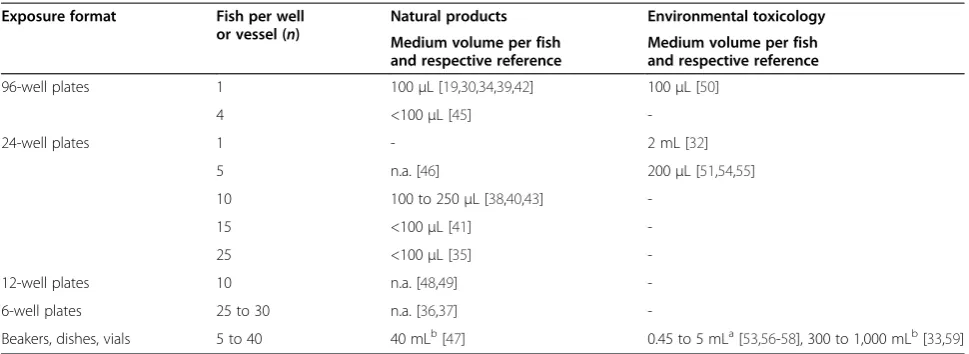
EDA studies applied mostly bioassays with early em-bryos and larvae, following exposure to chemical ex-tracts and fractions in multiwell-plates, often with exposure of several individuals in the same well (Table 2). Zebrafish up to 5 days post fertilization (dpf ) were the life stages mostly applied, except for experiments that extended the assays up to 6 to 7 dpf [34,49,53,56,57] or a few studies with adults [33,47,59]. Environmental toxi-cology studies for the most part performed exposure not
only in 24-well plates (200 μL to 2 mL per embryo or
larva) but also in crystallization dishes, scintillation vials
or beakers (450 μL to 5 mL per embryo or larva, 40 to
300 mL per adult), while natural product studies were performed exclusively in multiwell-plate setup (<100 to 250μL per embryo or larva). The exposure of several in-dividuals in the same well or vessel was observed for most of the studies, reflecting the need to reduce work-load for EDA biotesting.
Biotesting strategy
in parallel. For instance, bioassay batteries evaluated the occurrence of different toxicity mechanisms [50,51] or ef-fects on different trophic levels in the two TIE studies [32,33]. When instead the aim of multiple methods was to analyse different aspects of the same bioactivity or toxicity mechanism, there was the prevalence of tiered approach biotesting [19,39,45]. When applied in screening phase, zebrafish bioassays aimed to identify active fractions by organism-level endpoints, which were later further investi-gated by additional methods with zebrafish [52] or with other experimental models [19,45]. As an example, zeb-rafish bioassays were applied to screen extracts and fractions for anti-angiogenic effects, followed by further
investigations on human cells and transgenic zebrafish embryos [19]. On the other hand, zebrafish bioassays ap-plied only as secondary tests aimed mostly at the confirm-ation of bioeffect occurrence at the organism level [49] or to evaluate the occurrence of acute toxicity in fish [46,47].
Use of solvents in bioassays
In biotesting, solvents were used for transference of sam-ples into exposure vessels or as carriers. The first approach was applied using acetonitrile [55] or ethanol [54], includ-ing also solvent control conditions, and proceedinclud-ing to solv-ent evaporation before adding exposure media. The use of solvents as carriers in bioassays showed the prevalence of
Figure 3EDA studies applying zebrafish bioassays for the investigation of natural products and environmental samples.Number of studies that were evaluated in the literature review identified per main research area and year of publication (Web of Science, ScienceDirect and Google Scholar, October 2014).
Table 1 Records for the EDA terms after filtering and after confirming that studies performed EDA
Search terms WoS, all databases
by topic (n)
WoS, filtered by zebrafish terms (n)
WoS, confirmed content (n) Confirmed papers in
WoS + SD + GS (n)
Bioassay(−)guided fractionation 5,134 14 8 9
Effect(−)directed analysis 189 14 3 5
Bioassay(−)guided isolation 454 9 7 8
Bioassay(−)directed fractionation 464 8 0 1
Toxicity(−)identification evaluation 346 2 1 2
Bioactivity(−)screening 92 3 2 2
Activity(−)guided fractionation 641 2 1 1
Bioactivity(−)guided fractionation 492 1 0 2
Bio(−)guided fractionation 136 1 1 1
Fractionation 232,733 84 15 21
Totala 29
The sum of papers from WoS, ScienceDirect (SD) and Google Scholar (GS) after confirmation of content is also presented. Search done in October 2014.a
dimethyl sulfoxide (DMSO), in concentrations ranging from 0.01% [35], 0.1% [31,45], 0.2% [26], 0.5% [46,47], 1% [33,48-50] up to 2% [51]. In addition, ethanol was also used as a carrier by a few studies, in concentrations of 0.001% for experiments with larvae [40,41] or 0.435% for experi-ments with zebrafish adults [42].
It is relevant to mention that the different procedures for extraction, cleanup, pre-concentration and fraction-ation of samples, already extensively reviewed elsewhere [3,4,60], also involve the use of different solvents and chemicals. Criteria for the use of solvents in EDA studies are the following: low or lack of toxicity in the biotest, the capacity of the solvent to dissolve complex extracts and fractions and the possibility to use the solvent in chemical analysis. The latter is the precondition to make sure that the chemical mixture tested in the bioassay re-sembles the mixture evaluated in chemical analysis. While DMSO excellently meets the first criterion, it is less suitable for dissolving complex mixtures when com-pared to other possible alternatives, and it completely fails the criterion related to the use in chemical analysis. Thus, the investigation of other solvents as possible car-riers for exposure in zebrafish embryo testing might help to reduce possible artefacts during solvent exchange to DMSO. The evaluation of process blanks in order to ex-clude artefact toxicity is crucial for successful EDA and will be discussed below.
Positive/negative controls and biotesting of blanks
Positive control conditions that were specific to the eval-uated endpoints were often described. For that, there was exposure of the zebrafish to compounds known to cause specific effects such as anti-convulsant activity [39], glucose uptake [45], pro-angiogenesis [36,37], anti-angiogenesis [19,44], or estrogenic effects [52,56]. Re-garding negative control conditions, most of the studies
reported the testing of solvent controls in the same concentration as for the respective sample testing [19,32,34,35,38-40,43,44,47,49-51,53,55]. Some studies have additionally evaluated a medium only condition in addition to the solvent control [36,37,42,54,56,57].
The preparation and biotesting of blanks was de-scribed only in few of the evaluated EDA studies and in the two TIE studies. In the EDA studies, there was sub-mission of the respective solvents [51,53,56,57] or of HPLC-grade water [58] through the same or part of the procedures that were applied to samples (i.e. sample preparation, extraction, fractionation). The TIE studies described blank preparation by treatment of milliQ water [32] or 0.1 M KCl solution [33] in the same way as samples for all procedures. In all these studies, the prepared blanks were evaluated in bioassays in the same way as done for samples and fractions. Another strategy was the use of a fraction that showed to be negative for the evaluated effect as a blank condition [45]. The ex-change between elution solvents and DMSO was identi-fied as a critical step since solvent traces might interfere with bioassays; therefore, blank testing was suggested to always be performed [51].
Investigated endpoints and studies outcomes
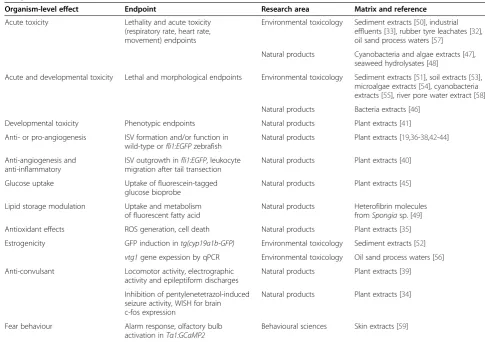
The specificity and sensitivity of bioassays and end-points in identifying the bioactivity or adverse effects in fractions were considered to be a key issue for the rele-vance of zebrafish bioassays in EDA. Therefore, it is rec-ommended to identify the critical aspects for endpoint assessment, to optimize bioassays accordingly and to demonstrate the validity of the bioassay by testing known bioactive compounds [61]. The endpoints and bioassays described in the different studies are summa-rized in Table 3 and discussed in the context of respect-ive study objectrespect-ives and outcomes.
Table 2 Exposure setup for studies on natural products or environmental toxicology
Exposure format Fish per well
or vessel (n)
Natural products Environmental toxicology
Medium volume per fish and respective reference
Medium volume per fish and respective reference
96-well plates 1 100μL [19,30,34,39,42] 100μL [50]
4 <100μL [45]
-24-well plates 1 - 2 mL [32]
5 n.a. [46] 200μL [51,54,55]
10 100 to 250μL [38,40,43]
-15 <100μL [41]
-25 <100μL [35]
-12-well plates 10 n.a. [48,49]
-6-well plates 25 to 30 n.a. [36,37]
-Beakers, dishes, vials 5 to 40 40 mLb[47] 0.45 to 5 mLa[53,56-58], 300 to 1,000 mLb[33,59]
Acute toxicity and lethality
Bioactive sediment fractions [51] and components par-tially responsible for toxicity in oil sand process water fractions [57] have been identified by acute toxicity bio-assays. The two TIE studies reported inconsistent acute toxicity of industrial effluents [33] and rubber tyre leach-ates [32]. One study investigating seaweed hydrolysleach-ates evaluated in vivo toxic potential through acute toxicity testing [48].
It may be summarized that EDA studies that focused on acute toxicity and lethality had only modest success in de-termining active compounds. These are unspecific re-sponses that might occur due to exposure to very broad range of compounds; therefore, fractionation typically re-sults in the distribution of toxicity over many different fractions. However, also other unrelated factors might have been involved, as for example, the high complexity of investigated matrices in the reviewed studies. Neverthe-less, acute toxicity testing might be a powerful tool in TIE,
when applied to evaluate highly contaminated sites with acute toxicity caused by compounds that are well charac-terized [62].
Teratogenesis and developmental toxicity
Assessment of teratogenesis and developmental effects was done in studies that identified the bioactive compounds from microalgae, cyanobacteria and plant [41,54,55], river pore water [58] and developmental toxicants in soil [53]. Most studies evaluated traditionally assessed morpho-logical endpoints, while one investigation of plant fractions focused on ectopic tail formation [41]. One study identified embryotoxicity in sediment extracts but not in respective fractions, which was attributed to losses of active com-pound or of synergistic effect during fractionation [50].
An aspect shared by the successful studies was the me-ticulous experimental characterization of the original matrices and respective fractions regarding their terato-genic effects and developmental toxicity potential. For
Table 3 Organism-level effects and assessed endpoints, according to the research area of studies and the investigated sample matrices
Organism-level effect Endpoint Research area Matrix and reference
Acute toxicity Lethality and acute toxicity (respiratory rate, heart rate, movement) endpoints
Environmental toxicology Sediment extracts [50], industrial effluents [33], rubber tyre leachates [32], oil sand process waters [57]
Natural products Cyanobacteria and algae extracts [47], seaweed hydrolysates [48]
Acute and developmental toxicity Lethal and morphological endpoints Environmental toxicology Sediment extracts [51], soil extracts [53], microalgae extracts [54], cyanobacteria extracts [55], river pore water extract [58]
Natural products Bacteria extracts [46]
Developmental toxicity Phenotypic endpoints Natural products Plant extracts [41]
Anti- or pro-angiogenesis ISV formation and/or function in wild-type orfli1:EGFPzebrafish
Natural products Plant extracts [19,36-38,42-44]
Anti-angiogenesis and anti-inflammatory
ISV outgrowth infli1:EGFP, leukocyte migration after tail transection
Natural products Plant extracts [40]
Glucose uptake Uptake of fluorescein-tagged glucose bioprobe
Natural products Plant extracts [45]
Lipid storage modulation Uptake and metabolism of fluorescent fatty acid
Natural products Heterofibrin molecules fromSpongiasp. [49]
Antioxidant effects ROS generation, cell death Natural products Plant extracts [35]
Estrogenicity GFP induction intg(cyp19a1b-GFP) Environmental toxicology Sediment extracts [52] vtg1gene expession by qPCR Environmental toxicology Oil sand process waters [56]
Anti-convulsant Locomotor activity, electrographic activity and epileptiform discharges
Natural products Plant extracts [39]
Inhibition of pentylenetetrazol-induced seizure activity, WISH for brain c-fos expression
Natural products Plant extracts [34]
Fear behaviour Alarm response, olfactory bulb activation inTα1:GCaMP2
Behavioural sciences Skin extracts [59]
instance, there was the determination of the optimal ex-posure period to identify a phenotype of interest that caused minimal acute toxicity [41]. Characteristic phenotypical effects were identified for specific fractions [53], also on a dose-dependent manner [54,55]. Two studies also investigated if additive or synergistic effects occurred between different fractions [55] or between aryl hydrocarbon receptor (AhR) agonists by co-exposure to a CYP1A inhibitor [58].
Angiogenesis modulation
Bioassays investigating pro- and anti-angiogenesis modu-lation by different bioactive plants were the most frequent studies in natural products. To this end, studies applied wild-type zebrafish [30,42,43] or the transgenicfli1:EGFP [63] zebrafish line [19,36-38,40], in which the zebrafishfli1 promoter drives the expression of enhanced green fluores-cent protein in blood vessels. In wild-type zebrafish, stain-ing of the vessels was applied to facilitate scorstain-ing [30,43], while the transgenic line allowed in vivo observation of the embryonic vasculature. Selected endpoints evaluated specific cellular-morphological phenotypes, as interseg-mental vessel formation. In these assays, the exposure start and duration were set to the most sensitive develop-mental windows related to the assessed endpoints.
All of the evaluated studies were successful in identify-ing at least one bioactive compound causidentify-ing angiogenesis modulation, indicating that the identification of highly specific endpoints on the organism level might be a good requirement for the efficient use of zebrafish bioassays in EDA. The use of transgenic zebrafish lines is also consid-ered to be a great asset for studies that evaluate specific morphological effects since it can facilitate endpoint ob-servation and increase sensitivity of bioassays.
Energy uptake and storage
EDA was successful in identifying known and novel insulin-mimetic compounds in plants [45] with the con-tribution of zebrafish bioassays to characterize glucose uptake modulation. The study applied fluorescein-tagged glucose bioprobes and measured fluorescence by micros-copy imaging and microplate reader, obtaining dose- and time-dependent responses. Another study applied a fluorescent fatty acid analogue to evaluate fatty acid stor-age modulation in zebrafish embryos by extracts from marine sponge [49]. In this case, the characterization of ef-fects was done by extraction of zebrafish lipids followed by thin-layer chromatography. These studies demon-strated that the use of fluorescent bioprobes is a good tool to evaluate effects on the uptake and storage capacity of zebrafish, allowing not only for qualitative but also quanti-tative analysis of effects.
Antioxidant effects
Zebrafish embryos were integrated into an EDA study that identified and purified aloe vera polysaccharide with protective effects against oxidative stress [35]. Tests with zebrafish bioassays provided valuable information on organism-level responses regarding the generation of re-active oxygen species and oxidative stress-induced cell death, which were observed in a dose response manner.
Estrogenicity assessment by gene expression
Estrogenic effects were investigated in extracts and frac-tions of oil sand process waters by vitellogenin gene
ex-pression (vtg1) through quantitative polymerase chain
reaction (qPCR) in zebrafish early larvae [56]. Estrogeni-city was also assessed by the use of transgenic zebrafish embryos that exhibit green fluorescence protein
expres-sion in response to aromatase (cyp19a1b) gene
induc-tion, with confirmation of results by qPCR [52].
Gene expression analysis by qPCR showed to be a use-ful EDA endpoint in zebrafish embryos and larvae when background information allows the selection of specific biomarker genes for the studied effect, as for estrogeni-city. The evaluation of sets of genes by qPCR is consid-ered to be a promising strategy for endocrine disruption investigation, when following optimized experimental de-sign regarding exposure intervals and evaluated zebrafish developmental stages [64]. The transgenic zebrafish em-bryos were also considered to be experimental models compatible with EDA, and their integration in future stud-ies is expected to be facilitated by automated image ana-lysis procedures [52].
Neuroactivity and behaviour
EDA was applied to identify anticonvulsant compounds present in plants, by co-exposure of evaluated samples with a convulsant compound, followed by the analysis of larvae total locomotor activity. Effects were assessed with video-tracking and software analysis and with electro-encephalogram recording analysis [39]. Another EDA study of plant neuroactivity applied similar bioassays, in combination with larvae whole-mountin situhybridization to assess increased brainc-fosgene expression as an indica-tor of seizure onset and brain damage [34]. Both studies identified anticonvulsant compounds, demonstrating the usefulness of the zebrafish model to identify neu-roactivity in EDA. Also for neuneu-roactivity and behaviour, the assessment of specific endpoints and setting the bio-assay accordingly demonstrated to be an effective EDA biotesting approach.
The identification of neuroactive compound extracts of a mixture of red algae and cyanobacteria was investigated by
a biotest battery including in vitro and organism-level
evaluated endpoints were non-specific acute toxicity and mortality, which provided only minor contribution to the overall study outcomes.
The bioactive compounds responsible for fear behaviour response in fish were investigated by the exposure of zeb-rafish adults to fish skin extracts and fractions [59]. Video tracking was used to quantify alarm behaviour by measur-ing swimmmeasur-ing speed and vertical position. The study iden-tified the bioactive compound and proposed a new class of odorants that trigger alarm behaviour in fish. This study required the development of experimental setup and end-point assessment that were specific to the evaluated be-havioural alteration, confirming the importance of this step also for behavioural assessment.
Summary and discussion
Over the last 10 years, EDA studies guided by zebrafish bioassays have successfully identified bioactive or toxic compounds present in diverse biological matrices or en-vironmental samples. Embryos and early larvae were the prevalent zebrafish life stages in these studies, with ex-posure being done in multiwell-plates, often with several individuals in the same well. In consequence, the sample volume for biotesting was minimized and the workload was reduced, which are important aspects in EDA. Zebra-fish bioassays showed also versatility in terms of biotesting strategy, being applied alone or as a part of biotest batter-ies and in both screening phase as well as for further in-vestigation of active fractions in tiered biotesting.
In spite of its limited capacity to dissolve complex matrix extracts, DMSO was the main carrier solvent ap-plied in zebrafish bioassays. As a result, it was used in concentrations up to two orders of magnitude higher than the recommended for single compound biotesting (0.01%) [65]. Additionally, DMSO is not suitable for chemical analysis, which restricts the characterization of samples evaluated in biotesting. Therefore, the inves-tigation of alternative carrier solvents would be an asset for zebrafish bioassays in EDA. Passive dosing methods are also promising options, as recently done in EDA in-vestigation of sediments through the use of silicone rods for dosing of extracts and fractions in algae bioassay [66]. In fact, a loaded polymer silicone cast has success-fully been integrated in zebrafish embryo assay for dos-ing of polycyclic aromatic hydrocarbons [67].
The EDA procedures for sample extraction, cleanup, pre-concentration and fractionation involve the use of different solvents and chemicals. Nevertheless, while most of the studies evaluated solvent and medium con-trol conditions, the investigation of process blanks in bioassays was reported only by a small number of stud-ies. In addition, methods for blank preparation varied considerably between these studies. Since the biotesting of process blanks is crucial for effective EDA, there is a
need to improve and standardize the procedures for their preparation and biotesting in future studies.
Most of the successful EDA studies applied specific and sensitive bioassays evaluating molecular, morpho-logical or behavioural endpoints. Some studies optimized bioassays by identifying the most adequate exposure windows and assessment setups to maximize the specific endpoint response and minimize the interference of acute toxicity [41]. Further improvements might be achieved by advancing methods for the analysis of end-points. For instance, the automated analysis of morpho-logical phenotypes in transgenic or wild-type zebrafish would reduce workload and increase reliability in EDA [52]. Also, EDA of environmental samples would benefit from the analysis of bioassay results in correlation with previously characterized responses to specific classes of pollutants. That is the case of gene expression analysis of biomarker genes for specific mechanisms and modes of action. When analysed in correlation with respective gene modulation by known classes of compounds [68], bio-marker gene responses might indicate the presence of cer-tain classes of chemicals [69]. Similarly, EDA studies evaluating behavioural phenotypes to identify neuroactiv-ity might rely in the near future on databases of behav-ioural profiles for different classes of compounds [70,71].
Such outcomes support the idea that EDA investiga-tions of toxic environmental samples would benefit of the application of endpoint- and mechanism-specific methods with zebrafish. That is in fact a great advantage since mechanism-specific toxicity methods with zebra-fish are broadly developed, as for AhR-mediated toxicity [72], genotoxicity [73] and neurotoxicity [74]. Further-more, EDA guided by such zebrafish bioassays could in-tegrate broader environmental assessment strategies, complementing effect-based approaches [7] and weight-of-evidence frameworks [30]. In this way, EDA would sup-port the identification of contaminants causing bioassay and ecological effects, and the clarification of links be-tween ecosystem functioning and the responses at differ-ent biological levels [30,62]. Finally, the evaluation of toxic aquatic contaminants through EDA guided by zebrafish bioassays might improve the protection of water bodies in the context of the European WFD and MSFD [7,27]. In conclusion, endpoint- and mechanism-specific zebrafish bioassays are considered of great relevance not only for guiding EDA studies but also for integrating EDA into en-vironmental assessment and monitoring, ultimately con-tributing for environmental quality improvement [7,75].
Conclusions
should be standardized. Endpoint- and mechanism-specific bioassays with embryos and larvae are consid-ered to be the most promising zebrafish biotests for fu-ture EDA of environmental samples. When integrated into broader environmental assessment strategies, EDA guided by specific zebrafish bioassays might support the identification of compounds causing bioassay and eco-logical effects, ultimately contributing for environmental quality improvement.
Competing interests
The authors declare that they have no competing interests.
Authors’contributions
CDP was responsible for the general design of the review and wrote the first draft of the manuscript. The other authors - TBS, SK, MH, MM, WB and HH - contributed with specific information concerning their respective expertise. All authors helped revise the draft of the manuscript. All authors read and approved the final manuscript.
Acknowledgements
The EDA-EMERGE project is supported by the EU Seventh Framework Programme (FP7-PEOPLE-2011-ITN) under the grant agreement number 290100.
Author details 1
Department of Ecosystem Analysis, Institute for Environmental Research, ABBt - Aachen Biology and Biotechnology, RWTH Aachen University, Worringerweg 1, Aachen 52074, Germany.2Man-Technology-Environment Research Centre, School of Science and Technology, Örebro University, SE-701 82 Örebro, Sweden.3UFZ-Helmholtz Centre for Environmental Research, Permoserstrasse 15, Leipzig 04318, Germany.4College of Resources and Environmental Science, Chongqing University, 1 Tiansheng Road, Beibei, Chongqing 400715, China.5College of Environmental Science and Engineering and State Key Laboratory of Pollution Control and Resource Reuse, Tongji University, 1239 Siping Road, Shanghai, China.6State Key Laboratory of Pollution Control and Resource Reuse, School of the Environment, Nanjing University, Nanjing, China.
Received: 1 August 2014 Accepted: 24 February 2015
References
1. Strähle U, Scholz S, Geisler R, Greiner P, Hollert H, Rastegar S, et al. Zebrafish embryos as an alternative to animal experiments—a commentary on the definition of the onset of protected life stages in animal welfare regulations. Reprod Toxicol. 2012;33:128–32.
2. Basu S, Sachidanandan C. Zebrafish: a multifaceted tool for chemical biologists. Chem Rev. 2013;113:7952–80.
3. Brack W. Effect-directed analysis: a promising tool for the identification of organic toxicants in complex mixtures? Anal Bioanal Chem. 2003;377:397–407. 4. Weller MG. A unifying review of bioassay-guided fractionation,
effect-directed analysis and related techniques. Sensors. 2012;12:9181–209. 5. Burgess RM, Ho KT, Brack W, Lamoree M. Effects-directed analysis (EDA) and
toxicity identification evaluation (TIE): complementary but different approaches for diagnosing causes of environmental toxicity. Environ Toxicol Chem. 2013;32:1935–45.
6. Di Paolo C, Gandhi N, Bhavsar SP, Van den Heuvel-Greve M, Koelmans AA. Black carbon inclusive multichemical modeling of PBDE and PCB biomagnification and transformation in estuarine food webs. Environ Sci Technol.
2010;44:7548–54.
7. Wernersson A S CM, Maggi C, Tusil P, Soldan P, James A, Sanchez W, et al. Technical report on aquatic effect-based monitoring tools technical report 2014–077 EU Commission. doi:102779/7260. 2014.
8. Knobel M, Busser FJ, Rico-Rico A, Kramer NI, Hermens JL, Hafner C, et al. Predicting adult fish acute lethality with the zebrafish embryo: relevance of test duration, endpoints, compound properties, and exposure concentration analysis. Environ Sci Technol. 2012;46:9690–700.
9. Volz DC, Belanger S, Embry M, Padilla S, Sanderson H, Schirmer K, et al. Adverse outcome pathways during early fish development: a conceptual
framework for identification of chemical screening and prioritization strategies. Toxicol Sci. 2011;123:349–58.
10. George Streisinger. Biographical Memoirs V.68: 353-362. Washington, DC: The National Academies Press; 1995.
11. Streisinger G, Walker C, Dower N, Knauber D, Singer F. Production of clones of homozygous diploid zebra fish (Brachydanio rerio). Nature. 1981;291:293–6. 12. Streisinger G, Coale F, Taggart C, Walker C, Grunwald DJ. Clonal origins of
cells in the pigmented retina of the zebrafish eye. Dev Biol. 1989;131:60–9. 13. Kimmel CB, Warga RM, Schilling TF. Origin and organization of the zebrafish
fate map. Development. 1990;108:581–94.
14. Kimmel CB, Ballard WW, Kimmel SR, Ullmann B, Schilling TF. Stages of embryonic development of the zebrafish. Dev Dyn. 1995;203:253–310. 15. Nüsslein-Volhard C. The zebrafish issue of development. Development.
2012;139:4099–103.
16. Nüsslein-Volhard C. The identification of genes controlling development in flies and fishes (Nobel Lecture). Angewandte Chemie Int Ed Eng. 1996;35:2176–87. 17. Kinth P, Mahesh G, Panwar Y. Mapping of zebrafish research: a global
outlook. Zebrafish. 2013;10:510–7.
18. Howe K, Clark MD, Torroja CF, Torrance J, Berthelot C, Muffato M, et al. The zebrafish reference genome sequence and its relationship to the human genome. Nature. 2013;496:498–503.
19. Bradford Y, Conlin T, Dunn N, Fashena D, Frazer K, Howe DG, et al. ZFIN: enhancements and updates to the zebrafish model organism database. Nucleic Acids Res. 2010;39(1):D822–9.
20. Zebrafish International Resource Center - ZIRC [http://www.zebrafish.org] 21. EZRC - European Zebrafish Resource Center [http://www.ezrc.kit.edu] 22. Braunbeck T, Boettcher M, Hollert H, Kosmehl T, Lammer E, Leist E, et al.
Towards an alternative for the acute fish LC(50) test in chemical assessment: the fish embryo toxicity test goes multi-species–an update. Altex. 2005;22:87–102.
23. Hallare A, Seiler T-B, Hollert H. The versatile, changing, and advancing roles of fish in sediment toxicity assessment—a review. J Soils Sediments. 2011;11:141–73. 24. EURL-ECVAM. Recommendation on the zebrafish embryo acute toxicity test
method (ZFET) for acute aquatic toxicity testing. Report EUR 26710. 35p. In: Recommendation on the zebrafish embryo acute toxicity test method (ZFET) for acute aquatic toxicity testing. Report EUR 26710. 35p. 2014. 25. Joint Danube Survey [http://www.danubesurvey.org]
26. NORMAN Network [http://www.norman-network.net]
27. European Commission. Technical guidance for deriving environmental quality standard. Guidance document n°27, technical report 2011–055, European Communities, 203 p. In: Technical guidance for deriving environmental quality standard. Guidance document n°27, technical report 2011–055, European Communities, 203 p. 2011.
28. Brack W, Govender S, Schulze T, Krauss M, Hu M, Muz M, et al. EDA-EMERGE: an FP7 initial training network to equip the next generation of young scientists with the skills to address the complexity of environmental contamination with emerging pollutants. Environ Sci Eur. 2013;25:18.
29. Brack W, Altenburger R, Schüürmann G, Krauss M, López Herráez D, van Gils J, et al. The SOLUTIONS project: challenges and responses for present and future emerging pollutants in land and water resources management. Sci Total Environ. 2014;503–504:22–31.
30. Hecker M, Hollert H. Effect-directed analysis (EDA) in aquatic ecotoxicology: state of the art and future challenges. Environ Sci Pollut Res. 2009;16:607–13. 31. Chapman PM, Hollert H. Should the sediment quality triad become a tetrad,
a pentad, or possibly even a hexad? J Soils Sediments. 2006;6:4–8. 32. Wik A, Nilsson E, Källqvist T, Tobiesen A, Dave G. Toxicity assessment of
sequential leachates of tire powder using a battery of toxicity tests and toxicity identification evaluations. Chemosphere. 2009;77:922–7. 33. Fang Y-X, Ying G-G, Zhang L-J, Zhao J-L, Su H-C, Yang B, et al. Use of TIE
techniques to characterize industrial effluents in the Pearl River Delta region. Ecotoxicol Environ Saf. 2012;76:143–52.
34. Buenafe OE, Orellana-Paucar A, Maes J, Huang H, Ying X, De Borggraeve W, et al. Tanshinone IIA exhibits anticonvulsant activity in zebrafish and mouse seizure models. ACS Chem Neurosci. 2013;4:1479–87.
35. Kang MC, Kim SY, Kim YT, Kim EA, Lee SH, Ko SC, et al.In vitroandin vivo antioxidant activities of polysaccharide purified from aloe vera (Aloe barbadensis) gel. Carbohydr Polym. 2014;99:365–71.
37. Liu C-L, Kwok H-F, Cheng L, Ko C-H, Wong C-W, Wai Fong Ho T, et al. Molecular mechanisms of angiogenesis effect of active sub-fraction from root of Rehmannia glutinosa by zebrafish sprout angiogenesis-guided fractionation. J Ethnopharmacol. 2014;151:565–75.
38. Crawford AD, Liekens S, Kamuhabwa AR, Maes J, Munck S, Busson R, et al. Zebrafish bioassay-guided natural product discovery: isolation of angiogenesis inhibitors from East African medicinal plants. PLoS One. 2011;6:e14694. 39. Orellana-Paucar AM, Serruys A-SK, Afrikanova T, Maes J, De Borggraeve W,
Alen J, et al. Anticonvulsant activity of bisabolene sesquiterpenoids of Curcuma longa in zebrafish and mouse seizure models. Epilepsy Behav. 2012;24:14–22.
40. Bohni N, Cordero-Maldonado ML, Maes J, Siverio-Mota D, Marcourt L, Munck S, et al. Integration of Microfractionation, qNMR and zebrafish screening for thein vivobioassay-guided isolation and quantitative bioactivity analysis of natural products. PLoS One. 2013;8:e64006.
41. Gebruers E, Cordero-Maldonado ML, Gray AI, Clements C, Harvey AL, Edrada-Ebel R, et al. A phenotypic screen in zebrafish identifies a novel small-molecule inducer of ectopic tail formation suggestive of alterations in non-canonical Wnt/PCP signaling. PLoS One. 2013;8:e83293.
42. Krill D, Madden J, Huncik K, Moeller PD. Induced thyme product prevents VEGF-induced migration in human umbilical vein endothelial cells. Biochem Biophys Res Commun. 2010;403:275–81.
43. Han L, Yuan Y, Zhao L, He Q, Li Y, Chen X, et al. Tracking antiangiogenic components from Glycyrrhiza uralensis Fisch. based on zebrafish assays using high-speed countercurrent chromatography. J Sep Sci. 2012;35:1167–72. 44. He MF, Liu L, Ge W, Shaw PC, Jiang R, Wu LW, et al. Antiangiogenic activity of
Tripterygium wilfordii and its terpenoids. J Ethnopharmacol. 2009;121:61–8. 45. Lee J, Jung D-W, Kim W-H, Um J-I, Yim S-H, Oh WK, et al. Development of a
highly visual, simple, and rapid test for the discovery of novel insulin mimetics in living vertebrates. ACS Chem Biol. 2013;8:1803–14. 46. Dash S, Nogata Y, Zhou X, Zhang Y, Xu Y, Guo X, et al. Poly-ethers from
Winogradskyella poriferorum: antifouling potential, time-course study of production and natural abundance. Bioresour Technol. 2011;102:7532–7. 47. Suyama TL, Cao Z, Murray TF, Gerwick WH. Ichthyotoxic brominated
diphenyl ethers from a mixed assemblage of a red alga and
cyanobacterium: structure clarification and biological properties. Toxicon. 2010;55:204–10.
48. Fitzgerald C, Gallagher E, O'Connor P, Prieto J, Mora-Soler L, Grealy M, et al. Development of a seaweed derived platelet activating factor acetylhydrolase (PAF-AH) inhibitory hydrolysate, synthesis of inhibitory peptides and assessment of their toxicity using the Zebrafish larvae assay. Peptides. 2013;50:119–24.
49. Rae J, Fontaine F, Salim AA, Lo HP, Capon RJ, Parton RG, et al. High-throughput screening of Australian marine organism extracts for bioactive molecules affecting the cellular storage of neutral lipids. PLoS One. 2011;6:e22868.
50. Higley E, Grund S, Jones P, Schulze T, Seiler T, Lubcke-von VU, et al. Endocrine disrupting, mutagenic, and teratogenic effects of upper Danube River sediments using effect-directed analysis. Environ Toxicol Chem/SETAC. 2012;31(5):1053–62. Epub 2012 Mar 2023.
51. Kammann U, Biselli S, Hühnerfuss H, Reineke N, Theobald N, Vobach M, et al. Genotoxic and teratogenic potential of marine sediment extracts investigated with comet assay and zebrafish test. Environ Pollut. 2004;132:279–87.
52. Fetter E, Krauss M, Brion F, Kah O, Scholz S, Brack W. Effect-directed analysis for estrogenic compounds in a fluvial sediment sample using transgenic cyp19a1b-GFP zebrafish embryos. Aquat Toxicol. 2014;154:221–9. 53. Legler J, van Velzen M, Cenijn PH, Houtman CJ, Lamoree MH, Wegener JW.
Effect-directed analysis of municipal landfill soil reveals novel developmental toxicants in the zebrafish Danio rerio. Environ Sci Technol. 2011;45:8552–8. 54. Berry JP, Gantar M, Gibbs PDL, Schmale MC. The zebrafish (Danio rerio)
embryo as a model system for identification and characterization of developmental toxins from marine and freshwater microalgae. Comp Biochem PhysiolPart C Toxicol Pharmacol. 2007;145:61–72.
55. Jaja-Chimedza A, Gantar M, Gibbs PDL, Schmale MC, Berry JP. Polymethoxy-1-alkenes from aphanizomenon ovalisporum inhibit vertebrate development in the zebrafish (Danio rerio) embryo model. Mar Drugs. 2012;10:2322–36. 56. Reinardy HC, Scarlett AG, Henry TB, West CE, Hewitt LM, Frank RA, et al.
Aromatic naphthenic acids in oil sands process-affected water, resolved by GCxGC-MS, only weakly induce the gene for vitellogenin production in zebrafish (Danio rerio) larvae. Environ Sci Technol. 2013;47:6614–20.
57. Scarlett AG, Reinardy HC, Henry TB, West CE, Frank RA, Hewitt LM, et al. Acute toxicity of aromatic and non-aromatic fractions of naphthenic acids extracted from oil sands process-affected water to larval zebrafish. Chemosphere. 2013;93:415–20.
58. Fang M, Getzinger GJ, Cooper EM, Clark BW, Garner LVT, Giulio RTD, et al. Effect-directed analysis of Elizabeth river pore water: developmental toxicity in zebrafish (Danio rerio). Environ Toxicol Chem. 2014:n/a-n/a.
59. Mathuru Ajay S, Kibat C, Cheong Wei F, Shui G, Wenk Markus R, Friedrich Rainer W, et al. Chondroitin fragments are odorants that trigger fear behavior in fish. Curr Biol. 2012;22:538–44.
60. Brack W, editor. Effect-directed analysis of complex environmental contamination, Handbook of environmental chemistry series 15. Berlin, Heidelberg: Springer; 2011. p. 345.
61. Cordero-Maldonado ML, Siverio-Mota D, Vicet-Muro L, Wilches-Arizábala IM, Esguerra CV, de Witte PAM, et al. Optimization and pharmacological validation of a leukocyte migration assay in zebrafish larvae for the rapid In Vivobioactivity analysis of anti-inflammatory secondary metabolites. PLoS One. 2013;8:e75404.
62. Connon RE, Geist J, Werner I. Effect-based tools for monitoring and predicting the ecotoxicological effects of chemicals in the aquatic environment. Sensors. 2012;12:12741–71.
63. Lawson ND, Weinstein BM.In vivoimaging of embryonic vascular development using transgenic zebrafish. Dev Biol. 2002;248:307–18. 64. Schiller V, Wichmann A, Kriehuber R, Muth-Kohne E, Giesy JP, Hecker M,
et al. Studying the effects of genistein on gene expression of fish embryos as an alternative testing approach for endocrine disruption. Comp Biochem Physiol Toxicol Pharmacol. 2013;157:41–53.
65. OECD. Test No. 236: Fish Embryo Acute Toxicity (FET) Test. Paris: OECD Publishing; 2013.
66. Bandow N, Altenburger R, Streck G, Brack W. Effect-directed analysis of contaminated sediments with partition-based dosing using green algae cell multiplication inhibition. Environ Sci Technol. 2009;43:7343–9.
67. Seiler TB, Best N, Fernqvist MM, Hercht H, Smith KE, Braunbeck T, et al. PAH toxicity at aqueous solubility in the fish embryo test with Danio rerio using passive dosing. Chemosphere. 2014;112:77–84.
68. Kosmehl T, Otte JC, Yang L, Legradi J, Bluhm K, Zinsmeister C, et al. A combined DNA-microarray and mechanism-specific toxicity approach with zebrafish embryos to investigate the pollution of river sediments. Reprod Toxicol. 2012;33:245–53.
69. Keiter S, Peddinghaus S, Feiler U, von der Goltz B, Hafner C, Ho N, et al. DanTox—a novel joint research project using zebrafish (Danio rerio) to identify specific toxicity and molecular modes of action of sediment-bound pollutants. J Soils Sediments. 2010;10:714–7.
70. Ali S, Champagne DL, Richardson MK. Behavioral profiling of zebrafish embryos exposed to a panel of 60 water-soluble compounds. Behav Brain Res. 2012;228:272–83.
71. Kokel D, Bryan J, Laggner C, White R, Cheung CY, Mateus R, et al. Rapid behavior-based identification of neuroactive small molecules in the zebrafish. Nat Chem Biol. 2010;6:231–7.
72. Schiwy S, Braunig J, Alert H, Hollert H, Keiter SH. A novel contact assay for testing aryl hydrocarbon receptor (AhR)-mediated toxicity of chemicals and whole sediments in zebrafish (Danio rerio) embryos. Environ Sci Pollut Res Int. 2014.
73. Kosmehl T, Hallare AV, Reifferscheid G, Manz W, Braunbeck T, Hollert H. A novel contact assay for testing genotoxicity of chemicals and whole sediments in zebrafish embryos. Environ Toxicol Chem/SETAC. 2006;25:2097–106.
74. de Esch C, Slieker R, Wolterbeek A, Woutersen R, de Groot D. Zebrafish as potential model for developmental neurotoxicity testing: a mini review. Neurotoxicol Teratol. 2012;34:545–53.