The Thirty-Third AAAI Conference on Artificial Intelligence (AAAI-19)
Anchors Bring Ease: An Embarrassingly Simple Approach
to Partial Multi-View Clustering
Jun Guo,
∗Jiahui Ye
∗Tsinghua-Berkeley Shenzhen Institute, Tsinghua University, Shenzhen 518055, China [email protected], [email protected]
Abstract
Clustering on multi-view data has attracted much more atten-tion in the past decades. Most previous studies assume that each instance appears in all views, or there is at least one view containing all instances. However, real world data often suf-fers from missing some instances in each view, leading to the research problem of partial multi-view clustering. To address this issue, this paper proposes a simple yet effectiveA nchor-basedPartialMulti-viewClustering (APMC) method, which utilizes anchors to reconstruct instance-to-instance relation-ships for clustering. APMC is conceptually simple and easy to implement in practice, besides it has clear intuitions and non-trivial empirical guarantees. Specifically, APMC firstly integrates intra- and inter- view similarities through anchors. Then, spectral clustering is performed on the fused similari-ties to obtain a unified clustering result. Compared with ex-isting partial multi-view clustering methods, APMC has three notable advantages: 1) it can capture more non-linear rela-tions among instances with the help of kernel-based similari-ties; 2) it has a much lower time complexity in virtue of a non-iterative scheme; 3) it can inherently handle data with nega-tive entries as well as be extended to more than two views. Finally, we extensively evaluate the proposed method on five benchmark datasets. Experimental results demonstrate the su-periority of APMC over state-of-the-art approaches.
1
Introduction
Multi-view data has already been widely studied in the past few years (Lahat, Adali, and Jutten 2015; Bai et al. 2016; Bai et al. 2017). Various clustering models have been proposed to solve the problem that grouping unlabeled data from di-verse domains into a unified partition (Kumar and Daume 2011; Kumar, Rai, and Daume 2011; Zhang et al. 2018a; Zhang et al. 2018b). However, real-world data often suffers from incompleteness, which makes traditional multi-view clustering methods inevitably degenerate or even fail.
Incompleteness in multi-view data can be roughly divided into two cases. One is at feature level, in which certain fea-tures are missing from particular data points (Williams and Carin 2005; Williams et al. 2007; Dick, Haider, and Schef-fer 2008). The other case is at instance level, where some instances are not available (Yuan et al. 2012; Shao, Shi, and Yu 2013). Specifically, the ratio of missing instances
Copyright c⃝2019, Association for the Advancement of Artificial Intelligence (www.aaai.org). All rights reserved.
may be approximately 90% in industrial data (Little and Rubin 2014). Besides, each view may suffer from missing some instances (Xiang et al. 2013; Xu, Tao, and Xu 2015; Yang et al. 2018b). This situation typically refers topartial multi-view data, which is common in practical applications (Cai et al. 2018; Zheng et al. 2018).
Previous complete multi-view methods such as Multi-NMF (Liu et al. 2013) cannot work well in this scenario, thus partial multi-view clustering has attracted increasing at-tention recently. Many efforts have been made to solve this problem. Representative works mainly resort to matrix fac-torization to exploit latent spaces for clustering. PVC (Li, Jiang, and Zhou 2014) is a pioneering work using nonnega-tive matrix factorization (NMF) andL1-norm sparse regular-izer to learn common and private latent spaces. IMG (Zhao, Liu, and Fu 2016) integrates PVC and manifold learning to adaptively capture the global structure of all instances. Meanwhile, MIC (Shao, He, and Yu 2015) extends Multi-NMF (Liu et al. 2013) via weighted Multi-NMF withL2,1 regular-ization. DAIMC (Hu and Chen 2018) carries forward MIC through semi-NMF and L2,1-norm regularized regression. However, they have several drawbacks to some extent.
• Few non-linear relations among instances. Almost all of these partial multi-view clustering approaches inherit the limitations of matrix factorization,i.e., involving in linear operations. Therefore, they usually capture various linear correlations among instances, neglecting the potential and valuable non-linear relations.
• Relatively high time cost. There are seldom closed-form solutions for these multi-variable optimization problems. Hence, iterative algorithms are utilized for the optimal re-sults. Most existing works have a quadratic or even cubic time complexity due to matrix eigen decomposition and inverse operation in updating variables. This will harm-fully restrict their efficiency in large-scale datasets.
To address these issues, this paper proposes anA nchor-based Partial Multi-view Clustering (APMC) approach, which utilizes anchors to reconstruct instance-to-instance re-lationships for clustering. We summarize two characteristics in partial multi-view data as follows.
1) The common instances appearing in all views can help bridge the instances with non-overlapping partial views.
2) The instances with missing views cannot be removed since they still provide necessary information for clustering. Then, our proposed APMC method makes full use of the two characteristics and integrates intra- and inter- view sim-ilarities through anchors. More specifically, we regard the common instances as anchors to bridge all the inter-view in-stances. This can solve the dilemma that instances sharing no common views cannot be directly used for computing cross-view similarities. After obtaining the fused similari-ties by anchors, spectral clustering is performed to obtain a unified clustering result. APMC potentially provides a sim-ple yet effective partial multi-view clustering solution which is non-iterative. Experimental results well validate that our proposed APMC method performs remarkably and gener-ally better than state-of-the-art approaches.
Compared with existing partial multi-view clustering ap-proaches, our proposed APMC method is conceptually sim-ple and easy to imsim-plement in practice, besides it has clear intuitions and non-trivial empirical guarantees. The major contributions of our paper are four-fold.
• We develop Gaussian kernel function based instance-to-anchor similarities, which helps bridge all the inter-view instances and capture more non-linear relations.
• We fuse intra- and inter- view similarities in one step. Without iterative steps and complicated matrix opera-tions, APMC has a relatively low time complexity.
• We propose a strategy to directly extend APMC for more than two partial views. Meanwhile, our method can inher-ently handle data with negative entries.
• Experimental results on five benchmark datasets demon-strate the superiority of APMC over state-of-the-art par-tial multi-view clustering methods.
2
Related Work
Our paper is most related topartial multi-view clustering. Here follows a brief review of related methods.
The pioneering work PVC was proposed in (Li, Jiang, and Zhou 2014), which utilized the information of shared in-stances to learn a common latent representation. Meanwhile, it explored private latent spaces for unaligned instances via NMF. IMG (Zhao, Liu, and Fu 2016) extended PVC by adding a graph Laplacian term to learn the global structure over all instances across all views. GPMVC (Rai et al. 2016) also extended PVC to be akpartial-view algorithm with a view specific graph Laplacian regularization. In (Yin, Wu, and Wang 2015; Yin, Wu, and Wang 2017), unified latent representations and projection matrices were learned for in-complete multi-view data. L2,1 regularization was used in MIC (Shao, He, and Yu 2015) together with a weighted NMF framework. After that, (Shao et al. 2016) designed an
online version OMVC to deal with large-scale cases, which utilized a dynamic weight setting and a faster projected gradient descent algorithm. In (Zhao et al. 2016), a partial multi-modal sparse coding framework was proposed to ex-ploit the similarity structure within the same modality and between different modalities. (Qian et al. 2016) developed a double constrained framework called DCNMF by incor-porating the cluster similarity and manifold preserving con-straints. (Gao, Peng, and Jian 2016) gave an IVC algorithm for clustering with more than two incomplete views, which was based on spectral graph theory and kernel alignment principle. Recently, (Xu et al. 2018) sought a latent space and then performed data reconstruction for partial multi-view subspace representation. (Yang et al. 2018b) leveraged the intrinsic and extrinsic information together to yield an in-ductive learner SLIM for semi-supervised scenarios. It can also be readily adopted to either classification or clustering tasks. In (Yang et al. 2018a), partial multi-view clustering problem was mathematically formulated as sparse low-rank representation and jointly measuring inter- and inter- view relations. (Hu and Chen 2018) proposed a DAIMC algo-rithm based on weighted semi-NMF. It combined the advan-tages of PVC and MIC while being able to handle data with negative entries. Moreover, it declared to be capable of more than two views.
3
The Proposed Framework
3.1
Notation and Problem Definition
Except in some specified cases, italic letters but not in bold (k, K,· · ·)represent scalars. Bold lowercase letters(x,· · ·) denote vectors, while bold uppercase letters(X,· · ·)are ma-trices.Iis an identity matrix with an appropriate size and1
is an all-one vector with a compatible length.
For the ease of discussion and without loss of generality, we first take two-view case for illustration. For partial multi-view data, we follow (Li, Jiang, and Zhou 2014) to sepa-rate original data as{
X(1,2),X(1),X(2)}
, whereX(1,2) ∈ Rnc×(d1+d2),X(1) ∈
Rn1×d1 andX(2) ∈
Rn2×d2 denote
the instances present in both views, only view-1 and only view-2, respectively. The feature dimensions of view-1 and view-2 instances ared1andd2, respectively. The number of common instances in two views is nc. The number of in-stances only in view-1 isn1; andn2has a similar meaning. The total number of instances isN =nc+n1+n2.
Partial multi-view clustering aims to group all the above-mentioned instances intoKclusters, whereKis assumed to be predefined by users.
3.2
Motivation and Framework
As stated in §1, partial multi-view data has the following two main characteristics. 1) On one hand, the common in-stances appearing in all views can help bridge the inin-stances with non-overlapping partial views. 2) On the other hand, the instances with missing views cannot be removed since they still provide necessary information for clustering.
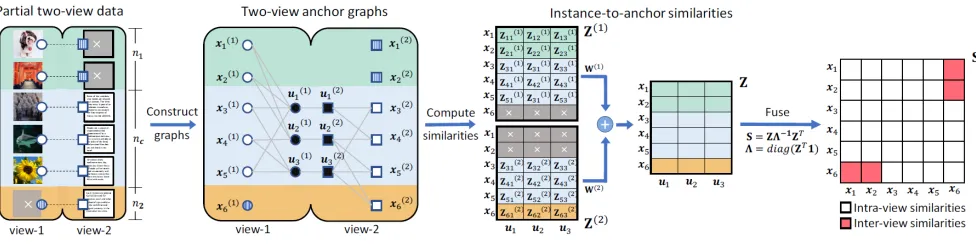
Figure 1: Anchor-based similarity reconstruction in our Anchor-based Partial Multi-view Clustering (APMC) method.
(Sa et al. 2010; Liu et al. 2011) provide us an inspiring per-spective. We can select the common instances as anchors to bridge all the inter-view instances (§3.3). This can solve the dilemma that instances sharing no common views cannot be directly used for computing cross-view similarities. Then, after obtaining the fused similarities by anchors, spectral clustering is performed to obtain a unified clustering result (§3.4). The detailed descriptions of our proposedA nchor-basedPartialMulti-viewClustering (APMC)method are in the following two subsections.
3.3
Anchor-based Similarity Reconstruction
Anchor-based similarity reconstruction is consist of two main steps,i.e., the generation of anchor sets and the con-struction of anchor-based similarity matrix. Figure 1 illus-trates these key modules.
Generation of anchor sets. It is very challenging to di-rectly estimate the instance-to-instance similarities in par-tial multi-view data, as some instances appear in one single view thus pairwise information may be unavailable. Inspired by the idea of anchor graph, we determinelpairs of anchor points by selecting the common instances that appear in both views1,i.e.,l=n
c. As illustrated in the middle figure in Fig-ure 1, the instances in the common area of 1 and view-2 are selected as anchors, which can bridge the instances appearing in non-overlapping partial views.
Construction of anchor-based similarity matrix. After selecting anchor points, we build a bipartite graph to gener-ate instance-to-anchor similarities, which is called truncgener-ated similarities in some works. Then, we construct a unified sim-ilarity matrix by fusing intra- and inter- view similarities.
• Intra-view similarity. Denote the set of all instances in the
v-th view as{x(iv)}nc+nv
i=1 , the anchor points set in thev -th view as{u(iv)}l
i=1. The similarity between the instance
x(iv)and anchor pointu(iv)is defined as
Z(ijv)= ⎧ ⎨
⎩
exp(−D2(x(v)
i ,u
(v)
j )/σ
2)
∑
j∈⟨i⟩vexp(−D2(x(iv),u
(v)
j )/σ2)
,∀j∈ ⟨i⟩v
0 ,otherwise,
(1)
1
We can also utilize other ways such as k-means.
where⟨i⟩v is an index set of m(≪ l) nearest anchors ofx(iv)according to a distance functionD(x,u)such as
l2distance. The truncated similarity is defined based on a kernel functionKσ(·), which is usually a Gaussian kernel
Kσ(x,u) = exp(−D2(x,u)/σ2). The parameterσcan be set to1without loss of generality. Note that the matrix
Z(v) ∈
R(nc+nv)×l is highly sparse. Each row contains onlymnonzero entries summing to 1.
• Inter-view similarity. We can derive the truncated simi-larity matrix Z = [Z˜; ˜Z(1); ˜Z(2)] ∈
RN×l among all instances and anchors, whereZ˜(v) ∈
Rnv×l(v = 1,2) is consist of the last nv rows of Z(v) ∈ R(nc+nv)×l.
˜
Z ∈ Rnc×l indicates the similarities between the com-mon instances and anchors, which could be computed in either view. To leverage the information from both views, we define each element ofZ˜ asZ˜ij = 12(Z
(1) ij +Z
(2) ij ). In Figure 1, matrices W(1) andW(2) help realize this inter-view fusion.W(1)i· = 12 if thei-th instance appears
in both views,W(1)i· = 1if thei-th instance only appears in view-1, andW(1)i· = 0if thei-th instance only appears in view-2. In a similar way,W(2)can be computed.
In (Liu, He, and Chang 2010; Liu et al. 2011), anchor graph is a powerful low-rank approximation of the neigh-borhood graph. To this end, the similarity matrixS∈RN×N among all instances in partial two-view data can be ap-proximated by anchor graph in a low-rank manner asS=
ZΛ−1ZT, whereΛ=diag(ZT1)∈
Rl×lis a diagonal ma-trix. The functiondiag(·)returns a diagonal matrix with the elements of input vector on the main diagonal.
Note thatShas the following critical properties.
1)Sij ≥0,∀i,∀jsinceZis nonnegative. The nonnega-tive similarity matrix is sufficient to make the resulting graph Laplacian matrix positive semi-definite.
2) SparseZleads to a sparse and low-rankS, which has much less spurious connections among dissimilar instances and tends to exhibit high quality (Zhu 2006).
3)Sis a doubly stochastic matrix,i.e., it has unit row and column sums. Thus, the resulting graph Laplacian matrix is
3.4
Spectral Clustering on Fused Similarities
After obtaining the fused similarity matrixS, we can con-duct spectral clustering. We firstly minimize the problem (2) via eigen decomposition onL to derive the correspondingKsmallest eigen vectors2, then perform k-means clustering
to calculate the discrete cluster indicators.
min
FTF=I tr(F TLF),
(2)
wheretr(·)is the matrix trace operator, F ∈ RN×K and
Kis the number of clusters.L=D−Sis called Laplacian matrix in graph theory, andD∈ RN×N is defined as a di-agonal matrix withDii=∑
N j=1Sij.
Remark 1: The computational complexity of eigen decom-position on the Laplacian matrix L ∈ RN×N isO(N3), which is not suitable for large-scale data.
Fortunately, S is nonnegative and doubly stochastic as mentioned in§3.3,i.e.,
diag(S1) =diag(ZΛ−1ZT1) =diag(ZΛ−1Λ1) =diag(Z1) =diag(1) =I.
(3)
Therefore,Sis automatically normalized making the degree matrixD=diag(S1)be an identity matrixI.
Remark 2: With the resulting Laplacian matrixL=I−S, Eq.(2) is equivalent to Eq.(4).
max
FTF=I tr(F
TSF) (4)
Note thatS=ZΛ−1ZT =ZΛ−1/2Λ−1/2ZT =AAT, whereA = ZΛ−1/2. The Singular Value Decomposition (SVD) ofAcan be formulated asA=PΣQT, whereΣ∈
RN×l,P ∈ RN×N, andQ ∈ Rl×l are the singular value matrix, left singular vector matrix, and right singular vector matrix, respectively. It is obvious that
S =AAT
=(PΣQT) (PΣQT)
T
=PΣQTQΣTPT
=P(ΣΣT)PT.
(5)
Recall thatΣ ∈ RN×l is the singular value matrix ofA, thenΣΣT returns anN-by-N diagonal matrix storing all the eigen values ofS=AAT. The column vectors ofPare the eigen vectors ofS. This has been proved in Fast Spectral Clustering (Wang, Nie, and Yu 2017). To reduce the compu-tational complexity, we can perform SVD onAto derive the desiredFrather than eigen decomposition onS.
Alternatively, we can skillfully follow (Liu et al. 2011) to perform eigen decomposition on a small l ×l matrix
2
Some previous works ignore the smallest eigen value 0 of Laplacian matrix, since the corresponding eigen vector is1which is useless for the following k-means clustering.
Algorithm 1:APMC
Input:Partial multi-view data{
X(1,2),X(1),X(2)} ; the number of clustersK; the number of nearest anchorsm;
Output:The cluster indicators; 1 Build anchor graphs and computeZ;
2 Derive the fused similarity matrix byS=ZΛ−1ZT; 3 Obtain the cluster indicators by spectral clustering.
R = Λ−1/2ZTZΛ−1/2 = ATA, resulting in K(< l) eigen vector-value pairs {(bi, θi)}Ki=1 where 1 > θ1 ≥
· · · ≥ θK >0. We denoteΘ ∈ RK×K as a diagonal ma-trix storing the K eigen values on the main diagonal, and
B = [b1,· · ·,bK] ∈Rl×K as a column-orthonormal ma-trix containing theKeigen vectors. The desired solution of
F∈RN×Kis derived asF=ZΛ−1/2BΘ−1/2.
3.5
Computational Complexity Analysis
The whole procedure of APMC is summarized in Algorithm 1. We now analyze the computational cost of our proposed method, which is non-iterative with two main steps. The cor-responding time costs are summarized as follows.
In the first stage of anchor-based similarity reconstruc-tion, the time cost is O(N l∑
vdv) to generate truncated similarity matrixZ, wherelis the total number of anchors anddvis the feature dimension of thev-th view.
In the second stage of spectral clustering on fused simi-larities, the time complexity isO(
N3)
, which involves the eigen decomposition onL∈RN×N. Benefit from the prop-erties of similarity matrixS, the time complexity becomes
O(
min{N l2, N2l})
by performing SVD on A ∈ RN×l, which can be reduced toO(
N K2)
(Holmes, Gray, and Is-bell 2007) if we only need theKlargest singular values. Al-ternatively, the time complexity can beO(
l3)if we follow (Liu et al. 2011) to eigen decomposeR∈Rl×lto obtainF. Finally, we needO(
tN K2)to conduct k-means clustering fortiterations onF∈RN×K.
4
Extension for Multiple Views
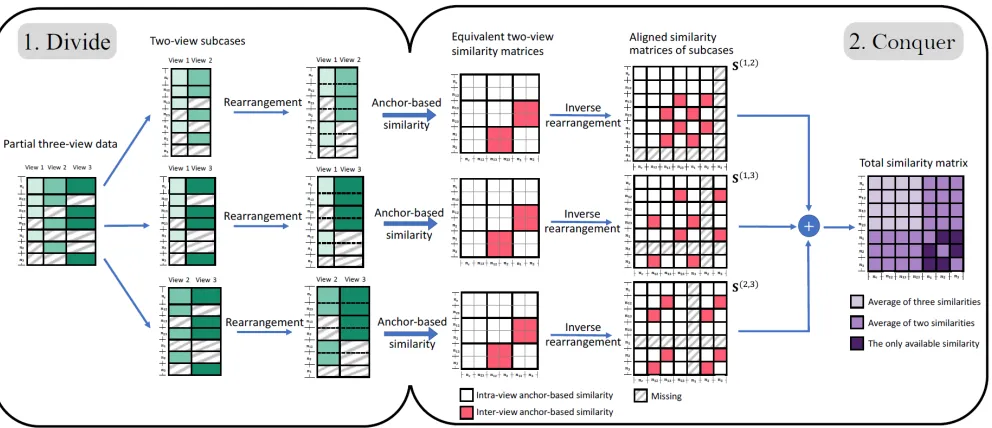
Our proposed APMC method can not only deal with par-tial two-view clustering, but also be easily extended to more than two partial views. We propose a “divide-and-conquer” strategy for multiple partial views. The whole procedure is in Figure 2 taking three views as an example, which verifies that APMC in §3 can be straightforwardly extended to the scenarios of more than two views.
4.1
Divide
Figure 2: Anchor-based similarity reconstruction for partial three-view data.
similar meanings.nv(v = 1,2,3)stands for the number of instances only existing in thev-th view.
We first divide this partial three-view case into three two-view subcases. To adjust each subcase so that we can directly conduct two-view anchor-based similarity construction, we rearrange the instances according to their types. Seen from the third column in Figure 2, each subcase can be repre-sented by an equivalent partial two-view form together with a group of common missing instances. Taking the first sub-case as an example, there arenc+n12instances shown in both views,n23+n2only appear in view-2 whilen13+n1 only appear in view-1. Besides,n3instances misses in this subcase. Similarly, we can analyze the other subcases.
4.2
Conquer
After dividing the partial three-view case, we then construct a similarity matrix for each subcase. The anchor-based sim-ilarity reconstruction method described in§3.3 can be par-allelly applied here. For each partial two-view subcase, we select the common instances present in both views as an-chors. Next, we compute a truncated similarity matrix and the corresponding similarity matrix for each subcase.
To further fuse the above similarity matrices in three par-tial two-view subcases, we rearrange them into aligned sim-ilarity matrices whose rows and columns follow the orig-inal order of instances. To alleviate the impact of missing instances in each subcase, we obtain the final similarity ma-trixS∈RN×N by a weighted combining scheme as Figure 2 shows. The light purple ones indicate that they are average of three aligned similarities, deep purple blocks are average of two aligned similarities, while dark purple stands for the only available aligned similarity.
Following§3.4, performing spectral clustering on the ob-tained total similarity matrix is unhindered as a final step to acquire a unified clustering result.
5
Experiments
In this section, we compare our proposed APMC approach with several state-of-the-art methods on a synthetic dataset and four real-world datasets.
5.1
Datasets
Synthetic Dataset (Guo and Zhu 2018) is composed of two views. For each view, we randomly select 200 data points from a two-component Gaussian mixture model as in-stances. There are two clusters (i.e., cluster1and2). Specifi-cally, the cluster means areµ(1)1 = [1,1]andµ(1)2 = [4,2]in view-1,µ(2)1 = [1,3]andµ(2)2 = [3,1]in view-2. The corre-sponding covariances are
Σ(1)1 = [
0.3 0 0 0.4
]
,Σ(1)2 = [
0.2 0.15 0.15 0.35
] ;
Σ(2)1 = [
0.25 −0.05
−0.05 0.2 ]
,Σ(2)2 = [
0.4 0.1 0.1 0.3
]
.
Real-world datasetsare described as follows.
• USPS-MNIST Datasetmerges two famous handwritten datasets: USPS (Hull 1994) and MNIST (LeCun et al. 1998). USPS includes 9,298 digit images with the size of16×16in ten classes, while MNIST contains70,000 digit images with the size of28×28. The same digits in two datasets can be regarded as described in two differ-ent views. We follow (Guo and Zhu 2018) and randomly select 50 images per digit class from each dataset. Conse-quently, each view comprises 500 instances.
Figure 3: Clustering results of different methods on the synthetic dataset and three real-world datasets under different PDRs.
Table 1: Clustering results (ACC%±STD / NMI%±STD) of different methods on the 3Sources dataset. ‘-’ represents the corresponding result is not available since the method cannot work on three-view scenarios.
BBC-Guardian BBC-Reuters Guardian-Reuters 3Sources (All views) MultiNMF 42.59±1.72 / 37.70±1.44 27.00±1.03 / 13.36±0.71 40.61±3.76 / 32.34±2.59 66.67±2.52 / 52.96±3.59
PVC 61.38±9.28 / 60.64±5.14 61.05±5.03 / 49.75±2.75 59.65±5.30 / 56.96±2.55
-MIC 70.95±4.89 / 55.19±2.69 42.97±2.74 / 29.93±2.60 66.54±3.19 / 57.04±3.01 74.64±6.08 / 58.68±6.75 IMG 54.73±1.05 / 44.97±1.24 44.77±2.85 / 34.42±2.35 54.36±0.65 / 48.96±1.38
-DAIMC 56.63±7.25 / 50.20±6.06 53.25±5.45 / 41.17±3.98 55.42±5.11 / 49.32±4.02 57.98±8.00 / 46.84±5.64 SC[C] 41.51±0.30 / 23.66±0.16 36.89±0.42 / 20.23±0.41 35.68±0.48 / 16.97±0.53 45.37±0.80 / 24.54±0.59 SC[A] 53.48±0.95 / 33.02±0.27 48.29±1.16 / 30.82±0.99 50.86±0.63 / 32.92±0.36 44.78±0.38 / 27.83±0.61 Ours 78.28±1.57 / 63.86±0.61 75.27±1.42 / 65.93±0.68 74.37±1.49 / 66.20±0.59 80.31±1.47 / 68.12±0.65
• Multiple Features Handwritten Dataset (Digit) (Jain, Duin, and Mao 2000) has six feature sets of ten classes of digits and each class holds200instances, summing up to2,000instances. Following (Kumar and Daume 2011) and (Yin, Wu, and Wang 2015), we set view-1 as 76 Fourier coefficients of the character shapes, and view-2 as216profile correlations.
• 3Sources Dataset(Greene and Cunningham 2009) is col-lected from three online news sources: BBC, Reuters, and The Guardian. In total, there are948news articles cover-ing416distinct news stories of six topic classes from the period February to April 2009. Among these distinct sto-ries,169are reported in all three sources,194are in two sources, and53appear in a single news source.
5.2
Comparison Methods
• MultiNMF(Liu et al. 2013) learns a common latent space based on joint NMF.
• PVC(Li, Jiang, and Zhou 2014) seeks a common latent
space for the aligned instances and a private latent space for the unaligned instances.
• MIC (Shao, He, and Yu 2015) extends MultiNMF via weighted NMF withL2,1regularization.
• IMG(Zhao, Liu, and Fu 2016) integrates PVC and man-ifold learning to adaptively capture global structures.
• DAIMC (Hu and Chen 2018) applies weighted semi-NMF with the help ofL2,1-norm regularizer.
We also adopt two simple baselines that perform spectral clustering on different similarity matrices.
• SC[C]. After preprocessing, we concatenate each in-stance’s features from different views into a single feature vector. Then, we obtain an instance-to-instance similarity matrix and perform spectral clustering.
(a) ACC (b) NMI
Figure 4: Influence of the number of nearest anchorsmon the Digit dataset with different PDR settings.
5.3
Settings
3Sources is naturally a partial multi-view dataset, while the other datasets are complete. To simplify the partial multi-view case, we follow (Shao, He, and Yu 2015) to delete the same number of instances for all views in the four complete datasets. We set Partial Data Ratio (PDR) from10%to90% with20%as interval.0%means all views are complete. The missing instances are distributed evenly in all views, and each instance is available in at least one view.
Since MultiNMF cannot directly deal with partial multi-view data, we first fill the missing instances with average feature values in each view. MultiNMF and MIC cannot work over the synthetic, USPS-MNIST and Digit datasets due to a few negative entries. Thus, we rescale the input data into the range of [0,1], then conduct normalization before we run all these clustering methods.
As for evaluation, we adopt two metrics Accuracy (ACC) and Normalized Mutual Information (NMI) to give a com-prehensive analysis. Each experiment is repeated20times for average performance and standard deviation. All results are produced by released codes, some of which may be in-consistent with published information due to different pa-rameter ranges and preprocessing.
5.4
Results and Analysis
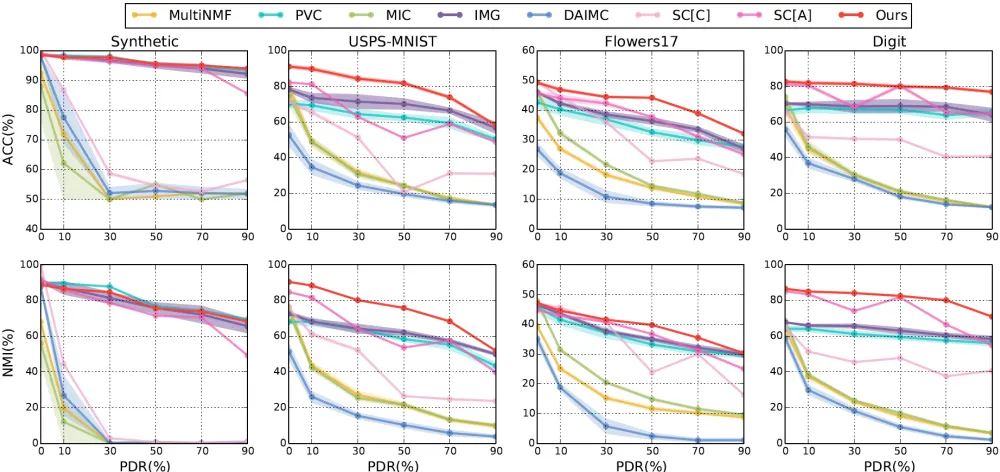
Figure 3 and Table 1 report the results of ACC and NMI val-ues on one synthetic and four real-world datasets with differ-ent PDR settings, respectively. From these data and curves, the following observations and discussion are made.
• The trends of ACC and NMI with varied PDR are sim-ilar for the following groups of methods, {MultiNMF, MIC, DAIMC},{PVC, IMG}, and{SC[C], SC[A]}, re-spectively. This can be explained by the mechanisms of their models. MIC extends MultiNMF by introducing weighted NMF andL2,1-norm. DAIMC carries forward MIC through semi-NMF and L2,1-norm regularized re-gression. IMG integrates PVC by adding manifold learn-ing. SC[C] and SC[A] conduct spectral clustering on two different poor estimations of similarities.
• As PDR increases, the performance of all algorithms drops. The improvement of APMC over SC[C], SC[A], PVC, IMG becomes larger. When the dataset is complete, all methods exhibit a relatively high performance. This
is an evidence that partial multi-view clustering is more challenging than complete multi-view clustering.
• APMC dramatically outperforms two simple baselines SC[C] and SC[A], which further indicates the effective-ness of our method. It is the anchor-based similarity ma-trix reconstruction, rather than simple spectral clustering, that contributes to the performance improvement.
• Over 3Sources dataset, our proposed APMC method per-forms consistently higher than other competitors in three two-view cases and one three-view case. When the num-ber of views increases from two to three, APMC yields even better results, which demonstrates its capability to extend to more than two views.
The superiority of APMC is analyzed as follow. The near-est anchors serve as a set of bases to represent all instances, and the instance-to-anchor similarities computed by kernel function are just like latent representations. This is intrinsi-cally similar to conventional matrix factorization based com-petitors that learn latent representations for all instances. The difference is that APMC captures more non-linear relations while previous works involve in linear correlations.
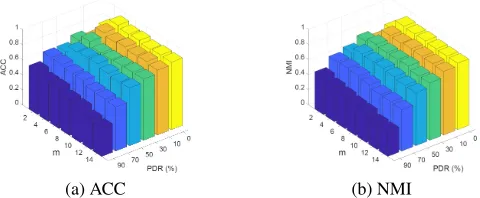
As for parameter study, our proposed APMC method has only one parameter mto be fine-tuned. We set PDR from 0% to90% as aforementioned, and explore the clustering performance of APMC by rangingmwithin{2,4,· · ·,14}. Due to the limit of space, we only report the results on Digit dataset and similar trends can be observed over other datasets. As shown in Figure 4, APMC is not obviously sen-sitive tomin a relatively wide range.
6
Conclusion and Future Work
In this paper, we propose a simple yet effective approach dubbed APMC for partial multi-view clustering. Specifi-cally, APMC utilizes anchors to firstly construct instance-to-anchor similarity matrices. Then, it integrates intra- and inter- view relations into fused similarities and finally per-forms spectral clustering to obtain a unified clustering re-sult. Our proposed APMC method can solve the main draw-backs of existing matrix factorization based methods for par-tial multi-view clustering. Experimental results well validate its superiority over state-of-the-arts.
As for future work, it will be interesting to utilize adaptive graphs (Zhao, Liu, and Fu 2016; Zhang et al. 2018c) to fuse view-specific truncated similarities. We also plan to adjust our model to better handle outliers and noise in partial multi-view data. For example, we can adopt correntropy induced metric (He, Zheng, and Hu 2011; Guo et al. 2016) and self-paced learning (Liang et al. 2016; Fan et al. 2017).
Acknowledgments
J. Guo and J. Ye are listed as co-first authors alphabetized by last name. They are funded by Tsinghua-Berkeley Shenzhen Institute (TBSI) Grant. Guo is partly supported by the 2018 Tencent Rhino-Bird Elite Training Program.
References
Bai, S.; Sun, S.; Bai, X.; Zhang, Z.; and Tian, Q. 2016. Smooth neighborhood structure mining on multiple affinity graphs with ap-plications to context-sensitive similarity. InECCV, 592–608. Bai, S.; Zhou, Z.; Wang, J.; Bai, X.; Latecki, L. J.; and Tian, Q. 2017. Ensemble diffusion for retrieval. InICCV, 774–783. Cai, L.; Wang, Z.; Gao, H.; Shen, D.; and Ji, S. 2018. Deep ad-versarial learning for multi-modality missing data completion. In
SIGKDD, 1158–1166.
Dick, U.; Haider, P.; and Scheffer, T. 2008. Learning from incom-plete data with infinite imputations. InICML, 232–239.
Fan, Y.; He, R.; Liang, J.; and Hu, B. 2017. Self-paced learning: an implicit regularization perspective. InAAAI, 1877–1883. Gao, H.; Peng, Y.; and Jian, S. 2016. Incomplete multi-view clus-tering. InICIIP, 245–255.
Greene, D., and Cunningham, P. 2009. A matrix factorization approach for integrating multiple data views. InECML/PKDD, 423–438.
Guo, J., and Zhu, W. 2018. Partial multi-view outlier detection based on collective learning. InAAAI, 774–783.
Guo, J.; Guo, Y.; Kong, X.; Zhang, M.; and He, R. 2016. Discrim-inative analysis dictionary learning. InAAAI, 1617–1623. He, R.; Zheng, W.; and Hu, B. 2011. Maximum correntropy crite-rion for robust face recognition.TPAMI33(8):1561–1576. Holmes, M.; Gray, A.; and Isbell, C. 2007. Fast svd for large-scale matrices. InNIPS workshop, volume 28, 249–252.
Hu, M., and Chen, S. 2018. Doubly aligned incomplete multi-view clustering. InIJCAI, 2262–2268.
Hull, J. J. 1994. A database for handwritten text recognition re-search.TPAMI16(5):550–554.
Jain, A. K.; Duin, R. P. W.; and Mao, J. 2000. Statistical pattern recognition: a review.TPAMI22(1):4–37.
Kumar, A., and Daume, H. 2011. A co-training approach for multi-view spectral clustering. InICML, 393–400.
Kumar, A.; Rai, P.; and Daume, H. 2011. Co-regularized multi-view spectral clustering. InNIPS, 1413–1421.
Lahat, D.; Adali, T.; and Jutten, C. 2015. Multimodal data fusion: an overview of methods, challenges, and prospects. Proc. IEEE
103(9):1449–1477.
LeCun, Y.; Bottou, L.; Bengio, Y.; and Haaffner, P. 1998. Gradient-based learning applied to document recognition. Proc. IEEE
86(11):2278–2324.
Li, S.; Jiang, Y.; and Zhou, Z. 2014. Partial multi-view clustering. InAAAI, 1968–1974.
Liang, J.; Li, Z.; Cao, D.; He, R.; and Wang, J. 2016. Self-paced cross-modal subspace matching. InSIGIR, 569–578.
Little, R. J. A., and Rubin, D. B. 2014. Statistical analysis with missing data, volume 333. John Wiley & Sons.
Liu, W.; Wang, J.; Kumar, S.; and Chang, S. F. 2011. Hashing with graphs. InICML, 1–8.
Liu, J.; Wang, C.; Gao, J.; and Han, J. 2013. Multi-view clustering via joint nonnegative matrix factorization. InSDM, 252–260. Liu, W.; He, J.; and Chang, S. F. 2010. Large graph construction for scalable semi-supervised learning. InICML, 679–686. Nilsback, M. E., and Zisserman, A. 2006. A visual vocabulary for flower classification. InCVPR, 1447–1454.
Qian, B.; Shen, X.; Gu, Y.; Tang, Z.; and Ding, Y. 2016. Double constrained NMF for partial multi-view clustering. InDICTA, 1–7.
Rai, N.; Negi, S.; Chaudhury, S.; and Deshmukh, O. 2016. Par-tial multi-view clustering using graph regularized NMF. InICPR, 2192–2197.
Sa, V. R. D.; Gallagher, P. W.; Lewis, J. M.; and Malave, V. L. 2010. Multi-view kernel construction.Mach. Learning79(1):47–71. Shao, W.; He, L.; Lu, C. T.; and Yu, P. S. 2016. Online multi-view clustering with incomplete views. InICBD, 1012–1017.
Shao, W.; He, L.; and Yu, P. S. 2015. Multiple incomplete views clustering via weighted NMF withl2,1 regularization. In
ECML/PKDD, 318–334.
Shao, W.; Shi, X.; and Yu, P. S. 2013. Clustering on multiple incomplete datasets via collective kernel learning. InICDM, 1181– 1186.
Wang, R.; Nie, F.; and Yu, W. 2017. Fast spectral clustering with anchor graph for large hyperspectral images.IEEE Geosci. Remote Sensing Lett.14(11):2003–2007.
Williams, D., and Carin, L. 2005. Analytical kernel matrix com-pletion with incomplete multi-view data. InICML Workshop. Williams, D.; Liao, X.; Xue, Y.; Carin, L.; and Krishnapuram, B. 2007. On classification with incomplete data. TPAMI29(3):427– 436.
Xiang, S.; Yuan, L.; Fan, W.; Wang, Y.; Thompson, P. M.; and Ye, J. 2013. Multi-source learning with block-wise missing data for alzheimer’s disease prediction. InSIGKDD, 185–193.
Xu, N.; Guo, Y.; Zheng, X.; Wang, Q.; and Luo, X. 2018. Partial multi-view subspace clustering. InACMMM, 1794–1801. Xu, C.; Tao, D.; and Xu, C. 2015. Multi-view learning with in-complete views.TIP24(12):5812–5825.
Yang, W.; Shi, Y.; Gao, Y.; Wang, L.; and Yang, M. 2018a. Incomplete-data oriented multiview dimension reduction via sparse low-rank representation.TNNLS.
Yang, Y.; Zhan, D.; Sheng, X.; and Jiang, Y. 2018b. Semi-supervised multi-modal learning with incomplete modalities. In
IJCAI, 2998–3004.
Yin, Q.; Wu, S.; and Wang, L. 2015. Incomplete multi-view clus-tering via subspace learning. InCIKM, 383–392.
Yin, Q.; Wu, S.; and Wang, L. 2017. Unified subspace learning for incomplete and unlabeled multi-view data.PR67:313–327. Yuan, L.; Wang, Y.; Thompson, P. M.; Narayan, V. A.; and Ye, J. 2012. Multi-source learning for joint analysis of incomplete multi-modality neuroimaging data. InSIGKDD, 1149–1157.
Zhang, Z.; Liu, L.; Qin, J.; Zhu, F.; Shen, F.; Y. Xu, L. S.; and Shen, H. T. 2018a. Highly-economized multi-view binary compression for scalable image clustering. InECCV, 717–732.
Zhang, Z.; Liu, L.; Shen, F.; Shen, H. T.; and Shao, L. 2018b. Binary multi-view clustering. TPAMI.
Zhang, Z.; Shao, L.; Xu, Y.; Liu, L.; and Yang, J. 2018c. Marginal representation learning with graph structure self-adaptation.
TNNLS29(10):4645–4659.
Zhao, Z.; Lu, H.; Cai, D.; He, X.; and Zhuang, Y. 2016. Partial multi-modal sparse coding via adaptive similarity structure regu-larization. InACMMM, 152–156.
Zhao, H.; Liu, H.; and Fu, Y. 2016. Incomplete multi-modal visual data grouping. InIJCAI, 2392–2398.
Zheng, W.; Zhu, X.; Zhu, Y.; and Zhang, S. 2018. Robust feature selection on incomplete data. InIJCAI, 3191–3197.