www.biogeosciences.net/11/5969/2014/ doi:10.5194/bg-11-5969-2014
© Author(s) 2014. CC Attribution 3.0 License.
Partial coupling and differential regulation of biologically and
photochemically labile dissolved organic carbon across
boreal aquatic networks
J.-F. Lapierre1,*and P. A. del Giorgio1
1Groupe de Recherche Interuniversitaire en Limnologie et en Environnement Aquatique (GRIL), Département des Sciences
Biologiques, Université du Québec à Montréal, Case Postale 8888, succursale Centre-Ville, Montréal, QC, H3C 3P8, Canada *current address: Department of Fisheries and Wildlife, Michigan State University 480 Wilson Rd, Resources Bldg,
East Lansing, MI, 48824, USA
Correspondence to: J.-F. Lapierre ([email protected])
Received: 2 April 2014 – Published in Biogeosciences Discuss.: 8 May 2014
Revised: 2 August 2014 – Accepted: 17 September 2014 – Published: 31 October 2014
Abstract. Despite the rapidly increasing volume of research on the biological and photochemical degradation of DOC (dissolved organic carbon) in aquatic environments, little is known of the large-scale patterns in biologically and pho-tochemically degradable DOC (BDOC and PDOC, respec-tively) in continental watersheds, and on the links that exist between these two key properties that greatly influence the flow of carbon from continents to oceans. Here we explored the patterns in the concentrations and proportions of BDOC and PDOC across hundreds of boreal lakes, rivers and wet-lands spanning a large range of system trophic status and ter-restrial influence, and compared the drivers of these two re-active pools of DOC at the landscape level. Using standard-ized incubations of natural waters, we found that the con-centrations of BDOC and PDOC covaried across all systems studied but were nevertheless related to different pools of dissolved organic matter (DOM; identified by fluorescence analyses) in ambient waters. Concentrations of nutrients and protein-like fluorescent DOM (FDOM) explained nearly half of the variation in BDOC, whereas PDOC was exclusively predicted by DOM optical properties, consistent with the photochemical degradability of specific FDOM pools that we experimentally determined. The concentrations of col-ored DOM (CDOM), which we use here as a proxy of ter-restrial influence, almost entirely accounted for the observed relationship between FDOM and the concentrations of both BDOC and PDOC. The concentrations of CDOM and of the putative biolabile fluorescence component shifted from
com-plete decoupling in clear-water environments to strong cou-pling in darker streams and wetlands. This suggests a base-line autochthonous BDOC pool fueled by internal production that is gradually overwhelmed by land-derived BDOC as ter-restrial influence increases across landscape gradients. The importance of land as a major source of both biologically and photochemically degradable DOC for continental water-sheds resulted in a partial coupling of those carbon pools in natural freshwaters, despite fundamental contrasts in terms of their composition and regulation.
1 Introduction
2003; Jansson et al., 2007), as well as fuel CO2evasion from these systems (Algesten et al., 2004; Lapierre et al., 2013; Berggren et al., 2012), but the relative importance for those processes compared to that of autochthonous sources of or-ganic C (Brett et al., 2009; Wenzel et al., 2012), or terres-trially derived CO2 (Wallin et al., 2013; Butman and Ray-mond, 2011), respectively, is still questioned. This question-ing largely emerges from unresolved issues concernquestion-ing ter-restrial organic carbon degradability in aquatic ecosystems, which then determines the ability of this carbon to enter aquatic food webs and biogeochemical cycles.
Microbial and photochemical degradation are the two main pathways by which terrestrial DOC may influence aquatic metabolism (del Giorgio et al., 1999; Obernosterer and Benner, 2004; Bertilsson and Tranvik, 1998) and gas dynamics (Molot and Dillon, 1997; Jonsson et al., 2001; Lapierre et al., 2013), and both processes operate simultane-ously in ambient waters. Their magnitude and relative con-tribution in natural systems depend on environmental fac-tors, such as light availability, water residence time and dis-solved ions (Soumis et al., 2007), as well as on factors that are intrinsic to DOC (Guillemette and del Giorgio, 2011; Fasching et al., 2014). Microbial degradation is thought to preferentially target freshly produced, low-molecular weight molecules with low aromaticity (Amon and Benner, 1996; Wickland et al., 2007), whereas photochemical degradation mainly acts on colored, photoreactive molecules generally associated with high molecular weight and aromaticity (Ben-ner and Kaiser, 2011; Bertilsson and Tranvik, 1998; Stubbins et al., 2010). These broad chemical properties have thus been associated with distinct pools of DOC with distinct sources (i.e., the process that imported DOC in the environment; e.g., leaching, exudation) and origins (i.e., the environments where these processes take place; e.g., terrestrial, riverine, marine).
Transposing the geochemical evidence described above to natural landscapes would suggest a shift in the relative im-portance of these DOC degradation pathways, from a domi-nance of biological degradation in systems dominated by au-tochthonous carbon sources, to a dominance of photochem-ical degradation in environments with high terrestrial influ-ence. This scenario, which is based on the simplistic as-sumption that biological degradability is mostly linked to autochthonous DOC and that photochemical degradability is mostly associated with terrestrially derived DOC, would lead to a compensatory dynamic wherein the overall (biological+ photochemical) degradability of DOC would be to some ex-tent buffered across different environments and along a gra-dient of terrestrial influence.
Although the above assumption may hold for specific aquatic environments, it is unlikely that it applies at the landscape level, in part because there is increasing evidence that land exports to continental waters not only photochem-ically degradable DOC (Molot and Dillon, 1997; Jonsson et al., 2001; Weyhenmeyer et al., 2012), but also significant
amounts of biologically degradable DOC (Berggren et al., 2010a; Fellman et al., 2008; Guillemette et al., 2013). For example, significant concentrations of protein-like DOC and small organic acids, typically attributed to autochthonous and biolabile material, have been measured in soils and headwa-ter streams (Berggren et al., 2010a; Fellman et al., 2009), and carbon pools that are considered recalcitrant from a geo-chemical perspective (based on their molecular properties and degree of prior processing) may actually be biologically degradable under the right environmental conditions, in soils (Schmidt et al., 2011) or in the water (Marín-Spiotta et al., 2014; Ward et al., 2013; Fasching et al., 2014). This implies that there may be a faster turnover of terrestrially derived DOC in inland waters than what was previously thought, yet there is a large volume of literature documenting the recalci-trance of this carbon in marine or riverine environments with high residence time (see synthesis by Marín-Spiotta et al., 2014). This would suggest that the degradability of terres-trial DOC may be very different in contrasting aquatic envi-ronments and, in particular, that it becomes increasingly sta-ble with time as it circulates through continental watersheds, where the labile portions of the DOC pool imported from up-stream are gradually processed and removed from the bulk.
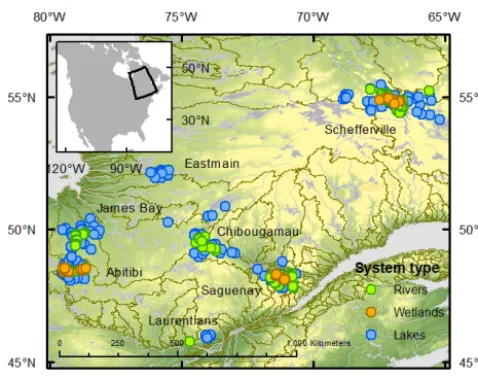
Figure 1. Distribution of the sampling sites across seven boreal re-gions (James Bay, Abitibi, Laurentians, Saguenay, Chibougamau, Schefferville) of Quebec, Canada. Grey lines and areas represent large rivers and lakes; green lines delimit the main watersheds in Quebec.
of terrestrial influence (using CDOM – colored dissolved or-ganic matter – as a proxy; see Lapierre et al., 2013) may un-derlie the patterns in the concentrations of degradable DOC across diverse and complex freshwater networks.
2 Methods
2.1 Study regions and sampling
Over the summer period from 2009 to 2013 we sampled a wide range of lakes (236), streams (204), rivers and wet-lands (83; mostly beaver ponds). Those systems span over a very large geographic range (Fig. 1), which translates into very diverse climate, landscape and limnological proper-ties. In particular, mean annual temperature and precipita-tion ranged from−5.7 to 4.8◦C and from 334 to 1289 mm, respectively, and catchment vegetation ranged from mixed conifer and deciduous in the south to black spruce moss for-est in the north; tundra-type vegetation covered the northern-most, highest altitude sites. Aquatic environmental properties spanned over most of the freshwater gradients reported in the literature, with DOC, CDOM (a440 nm, Naperian units), TN (total nitrogen), TP (total phosphorus) and Chla concentra-tions ranging from 0.4–123.9 mg L−1, 0.05–30.0 m−1, 0.03– 1.90 mg L−1, 2.24–248.2 µg L−1 and 0.1–100.7 µg L−1, re-spectively, across the sampling sites (Lapierre et al., 2013). Hydrology and morphometry were also very different across the systems studied, with rivers ranging from Strahler order 1 to 6, and lakes and wetlands ranging from 0.01 to 2300 km2 (Lapierre et al., 2013), as well as mean depth and discharge ranging over several orders of magnitude (Lapierre and del
Giorgio, 2012; Campeau et al., 2014). The different sites were seldom part of the same catchment except for the largest lakes and rivers that drained vast territories.
Water was sampled at 0.5 m from the surface, at the deep-est measured location of the lakes. Water was also sampled near the shore of streams, rivers and wetlands and, in all cases, it was immediately filtered (0.45 µm) and stored in acid-washed glass vials for DOC, optical analyses and in-organic N. Samples for total nitrogen TN and TP were also stored in acid-washed glass vials but were not filtered. All samples were immediately stored in cold and dark condi-tions. Analyses were typically performed within 1 month; optical measurements and inorganic N were typically per-formed within 2 weeks.
2.2 Biological and chemical analyses
DOC concentration was measured with an OI 1010 TIC-TOC (TX, USA) analyzer following sodium persulfate digestion. We analyzed TP spectrophotometrically after persulfate di-gestion and TN was analyzed as nitrate following alkaline persulfate digestion and measured with an Alpkem Flow So-lution IV autoanalyzer; ambient nitrites and nitrates were measured individually prior to persulfate digestion (APHA, 1998). Ammonium was measured by fluorescence following Holmes et al. (1999). Chl a samples were analyzed spec-trophotometrically after filtration with Whatman (GF/F) fil-ters and hot ethanol (90 %) extraction (Marker and Nusch, 1980). Filters were sonicated prior to extraction. Each of those variables has been collected in duplicates in the field; we present the mean here.
2.2.1 Optical analyses
The absorbance of CDOM was measured on nanopure-corrected samples of filtered ambient water from 230 to 700 nm, using a UV (ultraviolet)–visible Ultrospec 2100 spectrometer (Biochrom, Cambridge, UK) and a 2 cm quartz cuvette. We report CDOM as the absorption coefficient at 440 nm (m−1, Naperian units), calculated by dividing the optical absorbance at 440 nm by the path length in me-ters and multiplying by 2.303 (Cuthbert and del Giorgio, 1992). We also calculated proxies of DOC aromaticity and molecular weight by estimating the DOC specific absorbance at 254 nm (SUVA254) and the ratio of absorbance at 250– 365 nm (Spencer et al., 2009a), respectively. The former was calculated by dividing absorption coefficients at 254 nm by DOC concentration and the latter was directly obtained from the ratio of absorption coefficients at these specified wave-lengths.
Figure 2. Amounts and proportions of biologically and photochem-ically degradable DOC across the three main types of systems stud-ied. Lines represent the 25, 50 and 75 percentiles, points, 5 and 95 percentiles. Different letters denote statistically different (p <0.01) means across groups, based on ANOVA (analysis of variance) and Tukey–Kramer post hoc analyses. BDOC (percent and absolute):
n=201 for lakes,n=71 for rivers,n=53 for wetlands. PDOC (percent and absolute):n=193 for lakes,n=136 for rivers,n=67 for wetlands.
(PARAFAC) model (Stedmon et al., 2003) was developed to identify and quantify groups of DOM that shared similar optical properties and distribution across the sampled sites. Fluorescence data were corrected for inner-filter effect and standardized to Raman units using the FDOMcorr 1.6 tool-box (Murphy et al., 2010) in MATLAB (MathWorks, Nat-ick, MA, USA). The model was based on 1349 samples from ambient waters and from photochemical degradation experi-ments, and was performed on corrected data using the DOM-fluor 1.7 toolbox (Stedmon and Bro, 2008); only part of the data are reported here. The initial data set comprised 1577 samples; samples for which absorbance within the 1 cm cu-vette was higher than 0.6 at 254 nm were excluded due to potential for ineffective inner-filter effect correction (Miller et al., 2010), which could bias the final model. We express the “concentrations” of fluorescence components as the max-imum fluorescence intensity at the peak. These represent rel-ative concentrations that may be used to explore the cross-sample patterns for a given component, but this does not nec-essarily mean that one unit of a given component represents an equal amount of DOM compared to one unit of any other component.
2.3 Biological and photochemical DOC degradation We carried out standardized biological and photochemical degradation experiments in order to derive a concentration of degradable DOC that did not depend on varying incuba-tion condiincuba-tions and would thus be fully comparable across ecosystems and in time (Lapierre et al., 2013). The
experi-Figure 3. Relationship between the proportions (a) and amounts (b) of biologically and photochemically degradable DOC across boreal lakes, rivers and wetlands. (a)n=262, not significant. (b) Lakes: log(BDOC)=0.16log(PDOC) – 1.67, p=0.0003, r2=0.11,
n=161; rivers: log(BDOC)=0.88log(PDOC) – 1.59,p <0.0001,
r2=0.33, n=58; wetlands: log(BDOC)=0.78log(PDOC) – 1.34, p <0.0001, r2=0.23, n=50; overall relationship: log(BDOC)=0.71 log(PDOC) – 1.48,p <0.001,n=268.
ments were started on the same day that the samples were collected. Biological degradation experiments were carried out in water that was filtered through 2.8 µm nominal pore size GF/D filters (Whatman) in order to maintain the in situ bacterial community and thus to avoid re-inoculation. Water samples were incubated in the dark at a fixed incubation time (14 days) and temperature (20◦C). The results presented in Figs. 2 and 3 correspond to the concentrations in BDOC, ex-pressed as the absolute amount of DOC removed over a pe-riod of 14 days, calculated as the difference in concentration before and after degradation. The percentage of degradable DOC was calculated as the fraction represented by the dif-ference between DOC concentration at the start of the exper-iment and BDOC, multiplied by 100.
[image:4.612.323.513.67.301.2](see Appendix A for details). The amount of light energy available in the vial for wavelengths comprised between 300 and 450 nm, responsible for most photochemical processing of DOC (Vähätalo et al., 2000), averaged 130.8 W m−2and did not vary substantially across samples due to self-shading (standard deviation=9.2 W m−2; 10th and 90th percentiles = 118.4 and 140.4 W m−2, respectively) compared to the range of variation measured in the concentrations of PDOC, which spanned several orders of magnitude. Consequently, standardizing the concentrations in PDOC for the corrected light dose in the corresponding tubes could in no way alter the patterns and conclusions of the current study (see Ap-pendix Fig. A2). We therefore report the uncorrected values (in mg C L−1of photochemically degradable DOC). We as-sume that most bacteria could not survive the very strong UV dose and thus significantly contribute to the DOC loss in irra-diation experiments; even if that were not the case, the DOC loss rates (expressed per day) were always at least 1 order of magnitude higher in photochemical degradation experiments compared to biological degradation experiments conducted in the dark (Lapierre et al., 2013).
Photoexposure time (24 h) and temperature (24◦C) were the same for all experiments (Lapierre et al., 2013). The data presented in Figs. 2 and 3 correspond to the amount of DOC removed in 1 day under those conditions; considering diel light cycles and the natural light intensity at the studied lat-itudes, this would roughly correspond to 6 days of natural light exposure in the sampled regions. Irradiated samples were stored in 40 mL glass tubes and directly analyzed for DOC concentration. We also measured DOM optical prop-erties before and after irradiation for a subset (n=187) of the samples. The fluorescence data were included in the PARAFAC model.
2.4 Statistical analyses
Analyses of variance, simple and multiple linear regressions and principal component analyses (PCAs) were performed on log-transformed data in JMP 7.0.1 software. Data were centered and standardized before performing the PCA. The best multiple linear regression (MLR) models were identi-fied using forward step-wise selection based on change in the Akaike information criterion (AIC). Moving window re-gressions (MWRs) of fluorescence component C6 against CDOM concentrations were performed successively on sub-sets of 250 samples (about half of the sample size) sorted by increasing CDOM.
3 Results
3.1 Patterns in the amounts and proportions of degradable DOC
[image:5.612.308.548.64.234.2]The amounts of DOC removed in these standardized incu-bations ranged from 0.05 to 15.2 mg L−1 and from almost
Figure 4. Fluorescence signatures of the components identified by the PARAFAC model. Fluorescence peaks are observed at the fol-lowing wavelengths (nm), for excitation and emission, respectively (secondary peak in parentheses): C1: 275, 424; C2: 275(340), 484; C3: 275(345), 436; C4: 334, 446; C5: 300, 388; C6: 275, 334.
0 to 26.0 mg L−1, for biological and photochemical degra-dation, respectively (Fig. 2). This represented 0.13–54.3%, and 0.04–72.6 % of the ambient DOC pool where those sam-ples were collected, respectively (Fig. 2). These numbers rep-resent potential degradation under standardized conditions and depending on environmental conditions may not be ex-pressed in situ; they should not be considered as representa-tive of ambient rates. They do, however, allow us to isolate DOC degradability while minimizing the influence of site-specific conditions, such as temperature or irradiation, and thus to explore the patterns and drivers of this degradability over a large range of DOC properties.
3.2 The PARAFAC model
The PARAFAC model identified six fluorescence compo-nents (Fig. 4), corresponding to humic-, fulvic- and protein-like materials that are widely reported in freshwaters. In par-ticular, quantitative comparison of our components to pub-lished components (using OpenFluor database; Murphy et al., 2014) revealed that components C1 and C2 reported here matched very well previously reported humic-like, ter-restrially derived material identified in a variety of aquatic environments (Stedmon et al., 2003; Shutova et al., 2014). Components C5 and C6 matched widely reported compo-nents (Cory and McKnight, 2005; Fellman et al., 2008; Kothawala et al., 2013b, among others), which have been associated with microbially derived humic-like and freshly produced protein-like material, respectively. The whole spec-tra of components C3 and C4 did not show a strong match with any fluorescence component published in the Open-Fluor database, but had fluorescence peaks comparable to other published humic- and fulvic-like material (Guillemette and del Giorgio 2012, Lu et al 2013); these components had excitation spectra ranging in the UV-B and UV-A regions (Fig. 4), indicating that they strongly absorb light at those wavelengths.
Although the model was not run with samples with the highest absorbance, as described in the Methods section, it was subsequently used to estimate the concentration of flu-orescence components in highly colored samples for which the inner-effect correction may not be optimal. Hence, for the 43 samples with absorbance ranging from 0.6 to up to 1.2 at 254 nm (cm−1), the concentration of tryptophan-like compo-nent C6 may have been slightly underestimated whereas the concentration of the remaining fulvic- and humic-like com-ponents may have been overestimated by up to 20 % (Miller et al., 2010). Recent findings, however, suggest that the cor-rection that we have performed adequately corrects for inner-filter effect for absorbance up to 1.5 cm−1, such that the bias, if any, would actually be much smaller (Kothawala et al., 2013a) Similar to the range of variation in PDOC, the con-centrations in the different fluorescence components varied by several orders of magnitude across the sampled sites, and thus the small bias that may be present in these 43 highly colored samples is unlikely to influence the patterns reported here.
3.3 Linking patterns in degradable DOC to DOM composition and nutrients
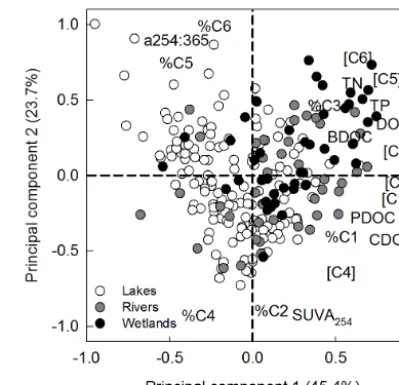
There were significant differences in the amounts and pro-portions of degradable DOC across different types of systems (Fig. 2), and a principal component analysis (PCA) further shows that lakes, rivers and wetlands tend to group not only in terms of concentrations of total and degradable DOC, but also in terms of DOM composition and nutrient concentra-tions (Fig. 5). The concentraconcentra-tions of DOC, CDOM, the
indi-Figure 5. Principal component analysis of concentrations of degradable DOM, DOM optical properties and nutrients across bo-real lakes, rivers and wetlands. Abbreviations are defined in the text. Fluorescence components in square brackets correspond to the ab-solute concentration of the specified component.
vidual fluorescence components identified by the PARAFAC model, and nutrients all tended to covary along a “concen-tration” axis (component 1 of the PCA plot), which ex-plained 45.4 % of the total variability in the measured vari-ables (Fig. 5). Fluorescence components C1, C2 and C3, as well as CDOM had the highest loadings on axis 1, and rivers and wetlands tended to have the highest scores on this axis. The absolute amounts of BDOC and PDOC were also pos-itively associated with this axis, implying that systems with higher amounts of DOM and nutrients tended to have overall more degradable DOC.
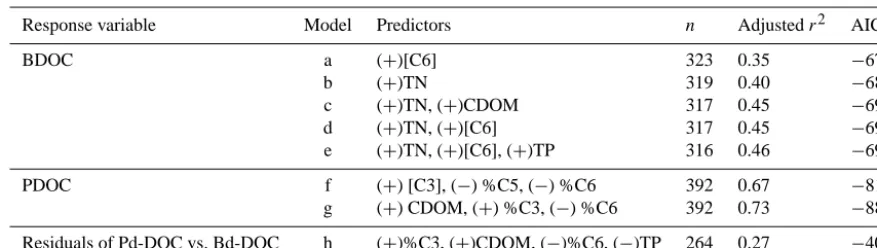
[image:6.612.326.526.65.258.2]Table 1. Multiple linear regression models predicting the concentrations of photochemically and biologically degradable DOC across boreal lakes, rivers and wetlands. Abbreviations are defined in the text. Fluorescence components in square brackets correspond to the absolute concentration of the specified component. The sign in parentheses denotes the sign of the coefficient in the MLR model.
Response variable Model Predictors n Adjustedr2 AIC
BDOC a (+)[C6] 323 0.35 −675
b (+)TN 319 0.40 −683
c (+)TN, (+)CDOM 317 0.45 −696
d (+)TN, (+)[C6] 317 0.45 −693
e (+)TN, (+)[C6], (+)TP 316 0.46 −699
PDOC f (+) [C3], (−) %C5, (−) %C6 392 0.67 −818
g (+) CDOM, (+) %C3, (−) %C6 392 0.73 −887
Residuals of Pd-DOC vs. Bd-DOC h (+)%C3, (+)CDOM, (−)%C6, (−)TP 264 0.27 −406
3.4 The drivers of the concentrations of biologically and photochemically degradable DOC
The differential regulation of BDOC and PDOC is more clearly expressed by their direct relationships with nutrients and the various DOM components (Table 1); pH and the concentration of Chla were not significant predictors when the variables presented in Table 1 were included. Likewise, the inclusion of a categorical variable for system type (lake, river, wetland), or for the sampling region (see Fig. 1) did not improve the fit in multiple regression models predicting either component of degradability. There were thus no sys-tematic ecosystem- or region-specific differences in the rela-tionship between BDOC and its predictors, suggesting that the amount of biologically degradable DOC in the studied systems is mainly a function of DOM composition and nu-trients regardless of the type of aquatic environment and the region where they lie.
BDOC was strongly related to both DOM and nutrient concentrations (Fig. 5, Table 1), and TN was the strongest single predictor (Table 1). Among the fluorescence compo-nents, the concentration of protein-like component C6 was the strongest predictor of BDOC (Table 1, model a); no other component had a significant effect on BDOC once C6 was in-cluded. In contrast to BDOC, DOM optical properties played a greater role as predictors of PDOC. The best MLR mod-els for PDOC included a positive relationship with both the abundance and the relative proportions of component C3, and negative relationships with the proportions of components C5 and C6 (Table 1). The EEMs analysis allowed identifying specific pools of DOM that were particularly linked to ambi-ent DOC biological or photochemical degradability, but the concentration aspect was mostly captured by CDOM (mea-sured as absorbance at 440 nm; see Methods) alone in both cases (Table 1, models c, g). In particular, when concentra-tions of CDOM were included in MLR, no other variable as-sociated with concentration of DOM was significant in pre-dicting PDOC, but qualitative aspects of DOM, such as the
percent contribution of C3 and C6 (the latter negatively re-lated), still significantly improved the model.
3.5 Factors influencing the relationship between the concentrations of biologically and photochemically degradable DOC
The above patterns in nutrients and DOM concentration and composition were reflected in the residuals of the relation-ship between BDOC and PDOC. Sites with higher concentra-tions of CDOM and proporconcentra-tions of the very photochemically degradable fluorescence component C3 (see below) tended to contain more PDOC per unit of BDOC (Table 1, model h). Conversely, sites with higher proportions of protein-like component C6 and higher nutrient concentrations tended to have a DOC pool that was more biologically degradable per unit of PDOC.
3.6 Susceptibility of DOM components to photochemical degradation
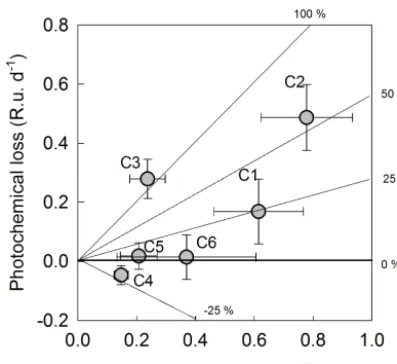
Figure 6. Average loss of specific fluorescence components based on the difference in concentration before and after irradiation for samples originating from boreal lakes, rivers and wetlands. Rates have been reported on a per day basis based on the average of the FDOM (fluorescent DOM) loss measured after 12 and 24 h; this allowed us to better quantify the photochemical susceptibility of C3 which was commonly completely degraded after 24 h, hence the average per day loss of over 100 %.n=121.
3.7 Patterns of biologically and photochemically degradable DOC across gradients of terrestrial influence
Despite the fact that different pools of DOM were linked to the concentrations of PDOC vs. BDOC (Table 1), CDOM itself accounted for as much variability in both PDOC and BDOC as any combination of fluorescence components, in terms of concentration. Coherent with the PCA (Fig. 5), this suggests that environments with high terrestrial influence also have higher concentrations and proportions of specific DOC pools associated with both PDOC and BDOC. Fig-ure 5 shows the very strong relationships that exist between CDOM and the photosensitive fluorescence components C2 and C3. The relationship between CDOM and component C6, which was linked to BDOC, was less obvious in the PCA (Fig. 5). In this regard, there was an overall weak positive re-lationship between CDOM and C6 (Fig. 7a). Interestingly, the shape of this relationship varied greatly over a gradient of terrestrial influence (using CDOM as a proxy; see Lapierre et al., 2013). An analysis of discrete portions of this gradient using moving window regression (MWR) showed that the relationship between C6 and CDOM was not significant in low-CDOM environments (Fig. 7b), but became significant at CDOM (a440) concentrations of approximately 3 m−1. Beyond this point, both ther2and the slope of the relation-ship consistently increased with CDOM concentration until the slope stabilized when the lowest CDOM in the MWR was around 4 m−1. There was thus a strong link between CDOM
and C6 in systems with elevated CDOM concentrations rang-ing from 4 to 30 m−1. These results indicate that the amount of biolabile DOC, as reflected by the C6 component of DOM, is completely uncoupled to CDOM at low levels of water color, but that the two become strongly coupled in systems with stronger terrestrial influence.
4 Discussion
4.1 Origin, age, freshness and degradability of DOC The core result that we report here is that the concentra-tions of biologically and photochemically degradable DOC are uncoupled within any particular site, but that they nev-ertheless tend to positively covary across large geographi-cal and environmental gradients and, in particular, along a gradient of terrestrial influence (Fig. 3b). These two func-tional groups of DOC are associated with composifunc-tionally distinct pools that are subject to differential regulation across the landscape, and their coupling is only apparent when both aspects of DOC degradability are assessed simultaneously over very broad gradients of terrestrial influence and across a wide range of aquatic ecosystems, as we have done in this study. This pattern likely reflects the expression of the differ-ent intrinsic DOC properties as well as environmdiffer-ental con-ditions (Guillemette and del Giorgio, 2011; Marín-Spiotta et al., 2014) that are encountered across the very diverse natural freshwater environments studied here.
Figure 7. Concentrations of protein-like C6 as a function of CDOM in lakes, rivers and wetlands. (a) r2=0.32,p <0.001,n=519. (b) Parameters of moving window regressions performed on discrete portions of the data set based on increasing CDOM. Total sample size was 519, but individual regressions were performed on subsets of 250 samples; a total of 270 regressions were thus performed. “x” signs denote nonsignificant regressions.xaxis shows the lowest CDOM concentration included in the regression for which the parameters are reported. The first regression was thus performed on samples for which CDOM ranged from 0.12 to 3.11 m−1, whereas the last regression was performed on samples for which CDOM ranged from 5.55 to 30.0 m−1. Note that the slope characterizes the log(C6) vs. log(CDOM) relationship.
Marín-Spiotta et al., 2014). Recent work suggests that freshly imported terrestrial organic carbon can be readily degraded in lakes and rivers even if it is extremely old (McCallister and del Giorgio, 2012; Kleber et al., 2011), thus suggesting that age and origin may not be the best predictors of DOC bi-ological degradability across continental and marine waters. Freshness thus appears to be a better common driver than age or origin to place apparently differing patterns of DOC biological degradability on a common gradient that is inde-pendent of the type of aquatic ecosystem studied. In this re-gard, studies in arctic rivers have shown that DOC is typi-cally more labile during the spring freshet (Mann et al., 2012; Holmes et al., 2008), when DOC has been freshly imported into the aquatic environment. Likewise, DOC was more la-bile in temperate streams characterized by low temperatures, presumably because it has been less altered than the DOC found in warmer streams and thus conserved in a “fresher” state (Lu et al., 2013). Our results suggest that the same ba-sic pattern may apply not only seasonally, but also across the whole boreal aquatic network: close to the land–water inter-face, most of the biologically labile DOC appears to be of terrestrial origin, as suggested by the increasingly tight cou-pling between CDOM (measured as absorbance at 440 nm; see Methods) and biolabile component C6 as CDOM in-creases (Fig. 7). Furthermore, the highest concentrations and proportions of both biologically and photochemically labile DOC are found in low-order rivers and wetlands (Fig. 2), supporting the notion that these are major hotspots for bio-geochemical processes in continental waters (Denfeld et al., 2013; Campeau et al., 2014). Systems with greater CDOM content thus tend to contain higher concentrations of
bio-logically and photochemically degradable DOC (Lapierre et al., 2013), because in such environments the DOM pool is fresher and contains high amounts of photosensitive DOM (Fig. 6, Table 1), as well as biolabile, protein-like DOM (Fig. 7, Table 1) which interestingly closely resembles DOM from autochthonous origin (Stedmon et al., 2007; Lapierre and Frenette, 2009; Fig. 7).
4.2 The underlying basis of patterns in degradable DOC
The patterns in the concentrations of biologically and pho-tochemically degradable DOC reported here allow identify-ing DOM pools and environmental factors that are linked to DOC degradability across boreal freshwater networks. In our study the amounts of BDOC and PDOC were measured sep-arately, but there are known synergistic effects between the biological and photochemical processing of DOC in natural environments (Miller and Moran, 1997), wherein biological and photochemical processes may operate on the same DOM pool (Koehler et al., 2012). The overall degradation poten-tial of DOC could thus be different in ambient waters where these processes actually co-occur, as opposed to our exper-imental conditions where no such interaction was possible. The objective of this study, however, was not to estimate the total concentration of degradable DOC, or the realized ex-pression of this potential degradability in situ, but rather to explore the large-scale patterns in BDOC and PDOC and their respective drivers across a wide variety of aquatic en-vironments in the most comparable manner possible.
concentrations and relative proportions of degradable DOC observed in these boreal freshwater environments. BDOC was linked to nutrient concentration, and to DOM concentra-tion and composiconcentra-tion (Fig. 5, Table 1). The influence of TN (and TP) on BDOC may be threefold: (1) it may be related to increased primary production and thus to the production of an autochthonous BDOC component (Descy et al., 2002; Demarty and Prairie, 2009), (2) it may be related to the stim-ulating effect of nutrients on DOC degradation rates (Wick-land et al., 2012; Guillemette et al., 2013), and (3) it may be related to DOM stoichiometry (Sun et al., 1997; Fellman et al., 2009). Chlorophyllaconcentration, however, was unre-lated to BDOC, and although we did not determine organic N, our measurements show that the sum of ammonium, ni-trates and nitrites represented on average 8 % of TN, and never more than 50 %. These results thus suggest that an im-portant fraction of the N in our systems was in the form of DON and contained within the DOM itself along with DOC. The same is probably true for P, although we do not have measurements of inorganic P to support this contention. It would seem that the inclusion of N as a predictor of BDOC is mostly (although not exclusively) reflecting intrinsic DOM properties, i.e., the stoichiometry and therefore quality of the DOM that was originally loaded from land. This potential effect of DOM quality was reflected in absorbance and flu-orescence analyses, as protein-like C6 was the only DOM optical property that was related to BDOC, consistent with previous studies (Guillemette and del Giorgio, 2011; Fell-man et al., 2008). The contribution percentage of C6 to to-tal fluorescence was further strongly and positively related to the a250 : a365 ratio, and negatively to SUVA254(Fig. 5), consistent with previously reported relationships of those ab-sorbance properties with microbial processes such as bacte-rial production and growth efficiency (Berggren et al., 2008). The patterns in PDOC, however, were exclusively ex-plained by DOM optical properties (Table 1). Extrinsic chemical factors are known to drive the photochemical degradation of DOC (Porcal et al., 2014), and PDOC was in-deed significantly correlated with pH (r2=0.13,p <0.001, n=391) and iron concentration (r2=0.35,p <0.001,n= 216). These variables, however, were not significant when in-cluded in multiple linear regression models containing DOM concentration or composition, and CDOM entirely accounted for the concentration effect of FDOM (Table 1), suggesting that water color integrates several key biochemical proper-ties that collectively determine photochemical reactivity. The connection of PDOC with CDOM or terrestrial influence in general is intuitive, as land-derived DOM is typically as-sociated with highly photoreactive material with high hu-mic and lignin contents (Spencer et al., 2009b; Hernes et al., 2009; Stubbins et al., 2010). The average loss of DOC in our incubations was 13 %, whereas on average 41 % of CDOM was lost during the same experiments. This supports the widely accepted notion that colored DOM is preferen-tially removed by photochemical oxidation (Graneli et al.,
1996; Weyhenmeyer et al., 2012) and more importantly sug-gests that specific DOM pools (as shown by fluorescence components) contribute more than others to the photochem-ical losses of DOC (Lu et al., 2013): the degradability of the various fluorescence components (Fig. 6) mostly reflects the degree to which they absorb light in the UV-A region (Fig. 4). These results thus suggest a strong top-down control of DOM composition by photochemical processes, which is reflected in the large-scale patterns of DOM composition across boreal freshwater ecosystems. Certain fluorescence components were extremely photosensitive (Fig. 6); in par-ticular, component C3 was typically completely degraded by light within 24 h (Fig. 6). The ambient waters differ from ex-perimental conditions in terms of the light climate, but these results nonetheless suggest that there are substantial losses of these fluorescence components in natural environments, and clearly indicate that the photochemical loss rates of C3 are much faster than those of other components. This implies that there must be a constant replenishment of this very re-active DOM across continental watersheds in order to main-tain the observed concentrations, such that the contribution of this highly photosensitive DOM (e.g., C3) to aquatic bio-geochemical processes is probably greater than what is sug-gested by its ambient concentrations alone.
4.3 Linking DOM optical properties to degradability patterns
Previous work has shown that the links between the patterns of DOC consumption and the dynamics of specific DOM pools identified on the basis of fluorescence are much more complex than what is generally recognized, because most of these components appear to be both consumed and pro-duced by biotic and abiotic processes across diverse aquatic environments (Guillemette and del Giorgio, 2012; Romera-Castillo et al., 2011; Kothawala et al., 2013b). In this re-gard, Fig. 6 shows a consistent behavior of the various fluo-rescence components in response to irradiation across lakes, rivers and wetlands with very different environmental prop-erties. It also shows that concentrations of humic/fulvic com-ponent C4 systematically increased after exposure to sun-light, yet this component covaries positively and significantly with PDOC (r2=0.30,p <0.001). Photosensitive compo-nent C3 (Fig. 5) also covaries positively with PDOC (Table 1), but clearly the mechanism underlying both relationships is completely different.
may be produced autochthonously in aquatic ecosystems via photochemical processes. Likewise, it has been shown that photoreactive components such as component C3 reported here are also systematically produced by microbial processes during controlled incubations (Guillemette and del Giorgio, 2012). To add complexity to this framework, not only may biologically labile DOC be produced from the photochemi-cal alteration of terrestrially derived DOC (Bertilsson et al., 1999; Cory et al., 2013), but it can also be rendered more re-calcitrant to microbial degradation upon exposure to solar ra-diation (Tranvik and Bertilsson, 2001). It is difficult to quan-tify those interactions, in particular the biotic (Guillemette and del Giorgio, 2012) and abiotic (Fig. 6) production of PDOC, but those different results nonetheless highlight the multiple processes, on land and in the water, which fuel the aquatic pools of both BDOC and PDOC. Linking DOC degradability measurements with DOM optical properties al-lows us to uncover some of those interactions between pro-duction and removal processes, which may not be detected purely based on the characterization of the DOM found in ambient waters.
In the present study we have identified specific fluorescent DOM components associated with either the biological or photochemical degradability of the ambient DOC pool across hundreds of lakes, rivers and wetlands (Table 1, Figs. 3, 5). Our own work in this regard (Stubbins et al., 2014) sug-gests that these fluorescent components involve not only the molecules responsible for the fluorescence properties, but also that they tend to covary with a host of other, nonfluo-rescent compounds. The molecules responsible for the actual fluorescence of these components may be acting both as sub-strates and perhaps more importantly as tracers of a variety of nonfluorescent pools that share similar sources and sinks, and which may themselves be the main substrates of these microbial reactions.
In this regard, the very strong photochemical degradabil-ity of component C3 (Fig. 5), combined with published evi-dence of consistent losses of a comparable component over a gradient of land cover and water retention time in the land-scape (Kothawala et al., 2013b; Lu et al., 2013), suggests that it is indeed acting as a substrate for photochemical degra-dation, and that C3 is a causal driver of PDOC in freshwa-ter environments. Our measurements, however, cannot con-firm whether component C6 is mostly driving BDOC as a substrate for microbial processes or acting as a tracer of co-varying biolabile molecules. Regardless, our results indicate that BDOC and PDOC pools may be adequately tracked by specific DOM properties across a large diversity of freshwa-ter environments, presumably because optical measurements allow targeting meaningful DOM pools comprising differ-ent molecules which share common production, importation, and removal processes.
4.4 Land as a source of both biologically and photochemically degradable DOC
Although it may appear intuitive that both BDOC and PDOC increase with overall DOC, the coupling between the concen-trations of BDOC and PDOC implies that they share at least some basic sinks or, more likely, sources, in boreal water-sheds. The biological and photochemical processes respon-sible for the removal of DOC from those boreal freshwaters are driven by different extrinsic variables and target different DOM pools (Table 1, Fig. 6), and the biological and photo-chemical degradability of DOC, expressed as the fraction of DOC that is biologically or photochemically degradable in standardized conditions, are completely decoupled (Fig. 3a). The collective evidence discussed above thus rather suggests that BDOC and PDOC partly share land as a common origin, and the relatively weak coupling between both DOC pools suggests that the relative contribution of land-derived DOC to BDOC differs greatly across systems.
In this regard, autochthonous processes such as phyto-plankton and macrophyte primary production are known to generate fresh, protein-like DOM in freshwaters (Demarty and Prairie, 2009; Lapierre and Frenette, 2009) and more im-portantly may supply the BDOC pool independently of ter-restrial sources. This appears to be the case in several systems studied here, as the coupling between PDOC and BDOC was weaker in lakes (Fig. 3b), and the amount of biolabile DOM, expressed in the patterns of component C6, was completely independent of CDOM in the lower portion of the CDOM gradient (Fig. 7) where most lakes and some large rivers were found. A comparable pattern has been reported in Swedish lakes (Kothawala et al., 2013b) where the equivalent protein-like FDOM component appeared to be relatively invariable across gradients of lake DOC and water retention time. Con-trary to that study, however, we observed a stronger relation-ship between C6 and CDOM as CDOM increased (Fig. 7), such that highly colored systems (mostly streams and wet-lands) contained much higher concentrations of component C6. The inclusion of rivers ranging from Strahler order 1 to 6, and of a diversity of wetlands, greatly expands the range of terrestrial influence relative to what can be observed based on lakes alone, and may explain the differences between our two studies. This may be a combination of low macrophyte cover and algal biomass in these typically oligotrophic bo-real systems, the inhibition of autochthonous processes by CDOM-induced light limitation (Karlsson et al., 2009) and, perhaps more importantly, the high rate of supply of terres-trial labile DOC in highly colored systems (Berggren et al., 2010a).
intercept of the relationship between BDOC and PDOC (Fig. 3b), which would suggest that in systems with very low terrestrial influence and almost no PDOC, there is still a sig-nificant pool of BDOC that is likely from autochthonous ori-gin. Autochthonous sources may indeed be the main driver of BDOC across narrow CDOM gradients, as previously re-ported (Kritzberg et al., 2004; Guillemette et al., 2013; Mc-Callister and del Giorgio, 2008), but the land-derived BDOC might be the one pool which varies consistently across gra-dients of terrestrial influence and may thus better explain the patterns in DOC degradability across continental water-sheds. These patterns collectively suggest that terrestrially derived BDOC increases proportionately faster than or dependently of autochthonous BDOC along a gradient of in-creasing CDOM, such that land becomes an important and even main source of BDOC as terrestrial influence increases. This in turn may explain why biolabile component C6 (and the molecules it tracks) may actually accumulate and reach high concentrations in wetlands and rivers with very high ter-restrial influence, whereas in lakes it is typically decoupled from CDOM (Fig. 7), as well as from DOC concentrations and water retention time (Kothawala et al., 2013b), since in the latter systems production, importation and removal may be closer to steady state.
Figure A1. Comparing the lamp spectrum to light absorption from the glass and from CDOM. The same scan was used to correct for absorption of light by glass for all the samples, whereas the cor-responding CDOM scan was used for each sample; the illustrated CDOM scan corresponds to a representative river sample.
Appendix A: Standardizing PDOC based on average light dose in the experimental tubes
[image:13.612.311.544.68.188.2]One of the main objectives of this study was to assess the patterns in the concentrations of photochemically degradable DOC, in the most standardized way possible. While the pho-tochemical degradation experiments have been conducted in standardized conditions in terms of incoming light dose, ex-posure time and temperature, the average light dose within the experimental tubes varied depending on CDOM content which attenuated a fraction of the incoming light and re-sulted in self-shading. We tested the potential significance of this self-shading effect on the reported patterns by com-paring the uncorrected PDOC values to light-standardized concentrations, which were obtained by dividing each PDOC concentration by the average light energy available (account-ing for self-shad(account-ing; see below) in the correspond(account-ing tube in which the experiment was conducted. Absorbance scans were obtained for half of an empty glass tube (to account for the energy lost when passing through the glass; see Fig. A1) as well as for the CDOM contained in each sample, as de-scribed in the Methods section. The tubes were round, hor-izontally disposed in the solar simulator and had an inner diameter of 24 mm, so we calculated the proportion of each wavelength that was remaining in 10 different 2.4 mm thick sections of the tube. The solar simulator light had a total light dose of 750 W m−2and a spectrum representative of the sun-light (Fig. A1), which was used to calculate the total amount of light energy (in W m−2)available in each section of the experimental tube by multiplying the incoming light dose by (1-fraction absorbed (by glass and CDOM)). Only the 300– 450 nm range of wavelengths was used. The lamp emitted a
Figure A2. Comparing uncorrected vs. light-standardized concen-trations of PDOC based on CDOM self-shading for wavelengths ranging 300–450 nm.
wide range of longer wavelengths, which were not signifi-cantly absorbed by either the glass or CDOM; thus, although those wavelengths (450–750 nm) contribute a large fraction of the total energy delivered, they typically do not contribute much to photochemical processes (Vähätalo et al., 2000). In-cluding these wavelengths would thus tend to attenuate the cross-sample differences in average light dose.
Acknowledgements. This work is part of the Carbon
Biogeo-chemistry in Boreal Aquatic Systems (CarBBAS) research chair, co-funded by the Natural Science and Engineering Research Council of Canada (NSERC) and Hydro-Québec. We thank A. St-Pierre, A. Parkes and the CarBBAS team for the contribution to the field and laboratory components of this study, and we thank P. Massicotte, T. Rasilo, C. Ruiz-Gonzalez, D. Vachon and F. Guillemette for constructive discussions and comments on early versions of the manuscript.
Edited by: T. J. Battin
References
Algesten, G., Sobek, S., Bergstrom, A. K., Agren, A., Tranvik, L. J., and Jansson, M.: Role of lakes for organic carbon cycling in the boreal zone, Glob. Change Biol., 10, 141–147, 2004. Amon, R. M. W. and Benner, R.: Bacterial utilization of different
size classes of dissolved organic matter, Limnol. Oceanogr., 41, 41–51, 1996.
Anderson, T. R. and Williams, P. J. l. B.: A one-dimensional model of dissolved organic carbon cycling in the water column incorpo-rating combined biological-photochemical decomposition, Glob. Biogeochem. Cycle, 13, 337–349, doi:10.1029/1999gb900013, 1999.
APHA, A.: Standard methods for the examination of water and wastewater, 20, 1998.
Battin, T. J., Kaplan, L. A., Findlay, S., Hopkinson, C. S., Marti, E., Packman, A. I., Newbold, J. D., and Sabater, F.: Biophysical con-trols on organic carbon fluxes in fluvial networks, Nat. Geosci., 1, 95–100, doi:10.1038/ngeo101, 2008.
Benner, R., and Kaiser, K.: Biological and photochemical trans-formations of amino acids and lignin phenols in riverine dissolved organic matter, Biogeochemistry, 102, 209–222, doi:10.1007/s10533-010-9435-4, 2011.
Berggren, M., Laudon, H., and Jansson, M.:Hydrological control of organic carbon support for bacterial growth in boreal headwater streams, Microb. Ecol., 57, 170–178, 2009.
Berggren, M., Laudon, H., Haei, M., Strom, L., and Jansson, M.: Ef-ficient aquatic bacterial metabolism of dissolved low-molecular-weight compounds from terrestrial sources, Isme J., 4, 408–416, doi:10.1038/ismej.2009.120, 2010a.
Berggren, M., Strom, L., Laudon, H., Karlsson, J., Jons-son, A., Giesler, R., Bergstrom, A. K., and JansJons-son, M.: Lake secondary production fueled by rapid transfer of low molecular weight organic carbon from terrestrial sources to aquatic consumers, Ecol. Lett., 13, 870–880, doi:10.1111/j.1461-0248.2010.01483.x, 2010b.
Berggren, M., Lapierre, J.-F., and del Giorgio, P. A.: Magni-tude and regulation of bacterioplankton respiratory quotient across freshwater environmental gradients, ISME J, 6, 984–993, doi:10.1038/ismej.2011.157, 2012.
Bertilsson, S. and Tranvik, L. J.: Photochemically produced car-boxylic acids as substrates for freshwater bacterioplankton, Lim-nol. Oceanogr., 43, 885–895, 1998.
Bertilsson, S., Stepanauskas, R., Cuadros-Hansson, R., Graneli, W., Wikner, J., and Tranvik, L.: Photochemically induced changes
in bioavailable carbon and nitrogen pools in a boreal watershed, Aquat. Microb. Ecol., 19, 47–56, 1999.
Brett, M. T., Kainz, M. J., Taipale, S. J., and Seshan, H.: Phyto-plankton, not allochthonous carbon, sustains herbivorous zoo-plankton production, P. Natl. Acad. Sci., 106, 21197-21201, doi:10.1073/pnas.0904129106, 2009.
Butman, D. and Raymond, P. A.: Significant efflux of carbon diox-ide from streams anr rivers in the United States, Nat. Geosci., 4, 839–842, doi:10.1038/NGE01294, 2011.
Campeau, A., Lapierre, J.-F., Vachon, D., and del Giorgio, P. A.: Regional contribution of CO2and CH4fluxes from the fluvial network in a lowland boreal landscape of Québec, Glob. Bio-geochem. Cycle, 28, 57–69, doi:10.1002/2013gb004685, 2014. Carlson, C. A.: Production and removal processes, in:
Biogeochem-istry of marine dissolved organic matter, edited by: Hansell, D. A., and Carlson, C. A., Elsevier, 2002.
Cole, J. J., Prairie, Y. T., Caraco, N. F., McDowell, W. H., Tranvik, L. J., Striegl, R. G., Duarte, C. M., Kortelainen, P., Downing, J. A., Middelburg, J. J., and Melack, J.: Plumbing the global carbon cycle: Integrating inland waters into the terrestrial carbon bud-get, Ecosystems, 10, 171–184, doi:10.1007/s10021-006-9013-8, 2007.
Cory, R. M. and McKnight, D. M.: Fluorescence spectroscopy re-veals ubiquitous presence of oxidized and reduced quinones in dissolved organic matter, Environ. Sci. Technol., 39, 8142–8149, doi:10.1021/es0506962, 2005.
Cory, R. M., Crump, B. C., Dobkowski, J. A., and Kling, G. W.: Surface exposure to sunlight stimulates CO2 release from per-mafrost soil carbon in the Arctic, P. Natl. Acad. Sci., 110, 3429– 3434, doi:10.1073/pnas.1214104110, 2013.
Cuthbert, I. D. and del Giorgio, P.: Toward a strandard method of measuring color in fresh-water, Limnol. Oceanogr., 37, 1319– 1326, 1992.
del Giorgio, P. A., Cole, J. J., Caraco, N. F., and Peters, R. H.: Link-ing planktonic biomass and metabolism to net gas fluxes in north-ern temperate lakes, Ecology, 80, 1422–1431, 1999.
Demarty, M. and Prairie, Y. T.: In situ dissolved organic carbon (DOC) release by submerged macrophyte-epiphyte communities in southern Quebec lakes, Can. J. Fish. Aquat. Sci., 66, 1522– 1531, doi:10.1139/f09-099, 2009.
Denfeld, B. A., Frey, K. E., Sobczak, W. V., Mann, P. J., and Holmes, R. M.: Summer CO 2 evasion from streams and rivers in the Kolyma River basin, north-east Siberia, Polar Research, 2013.
Descy, J.-P., Leporcq, B., Viroux, L., François, C., and Servais, P.: Phytoplankton production, exudation and bacterial reassimila-tion in the River Meuse (Belgium), J. Plankton Res., 24, 161– 166, doi:10.1093/plankt/24.3.161, 2002.
Dittmar, T. and Kattner, G.: The biogeochemistry of the river and shelf ecosystem of the Arctic Ocean: a review, Mar. Chem., 83, 103–120, doi:10.1016/S0304-4203(03)00105-1, 2003.
Fasching, C., Behounek, B., Singer, G. A., and Battin, T. J.: Micro-bial degradation of terrigenous dissolved organic matter and po-tential consequences for carbon cycling in brown-water streams, Scientific reports, 4, doi:10.1038/srep04981, 2014.
watersheds in southeast Alaska, Biogeochemistry, 88, 169–184, doi:10.1007/s10533-008-9203-x, 2008.
Fellman, J. B., Hood, E., D’Amore, D. V., Edwards, R. T., and White, D.: Seasonal changes in the chemical quality and biodegradability of dissolved organic matter exported from soils to streams in coastal temperate rainforest watersheds, Biogeo-chemistry, 95, 277–293, doi:10.1007/s10533-009-9336-6, 2009. Findlay, S., and Sinsabaugh, R. L.: Aquatic ecosystems: Interactiv-ity of dissolved organic matter Aquatic Ecology, Academic press, San Diego, 2002.
Graneli, W., Lindell, M., and Tranvik, L.: Photo-oxidative produc-tion of dissolved inorganic carbon in lakes of different humic content, Limnol. Oceanogr., 41, 698–706, 1996.
Guillemette, F. and del Giorgio, P. A.: Reconstructing the various facets of dissolved organic carbon bioavailability in freshwa-ter ecosystems, Limnol. Oceanogr., 56, 734–748, doi:10.4319/lo, 2011.
Guillemette, F. and del Giorgio, P. A.: Simultaneous consumption and production of fluorescent dissolved organic matter by lake bacterioplankton, Environmental Microbiology, 14, 1432–1443, doi:10.1111/j.1462-2920.2012.02728.x, 2012.
Guillemette, F., McCallister, S. L., and del Giorgio, P. A.: Dif-ferentiating the degradation dynamics of algal and terres-trial carbon within complex natural dissolved organic carbon in temperate lakes, J. Geophys. Res.-Biogeo., 118, 963–973, doi:10.1002/jgrg.20077, 2013.
Hedges, J. I., Clark, W. A., and Cowie, G. L.: Fluxes and reactivities of organic-matter in a coastal marine bay, Limnol. Oceanogr., 33, 1137–1152, 1988.
Hernes, P. J., Bergamaschi, B. A., Eckard, R. S., and Spencer, R. G. M.: Fluorescence-based proxies for lignin in freshwa-ter dissolved organic matfreshwa-ter, J. Geophys. Res.-Biogeo., 114, doi:10.1029/2009jg000938, 2009.
Holmes, R. M., Aminot, A., Kérouel, R., Hooker, B. A., and Peter-son, B. J.: A simple and precise method for measuring ammo-nium in marine and freshwater ecosystems, Can. J. Fish. Aquat. Sci., 56, 1801–1808, doi:10.1139/f99-128, 1999.
Holmes, R. M., McClelland, J. W., Raymond, P. A., Frazer, B. B., Peterson, B. J., and Stieglitz, M.: Lability of DOC transported by Alaskan rivers to the arctic ocean, Geophys. Res. Lett., 35, 5, L03402, doi:10.1029/2007gl032837, 2008.
Jansson, M., Persson, L., De Roos, A. M., Jones, R. I., and Tran-vik, L. J.: Terrestrial carbon and intraspecific size-variation shape lake ecosystems, Trends Ecol. Evol., 22, 316–322, doi:10.1016/j.tree.2007.02.015, 2007.
Jonsson, A., Meili, M., Bergstrom, A. K., and Jansson, M.: Whole-lake mineralization of allochthonous and autochthonous organic carbon in a large humic lake (Ortrasket, N. Sweden), Limnol. Oceanogr., 46, 1691–1700, 2001.
Karlsson, J., Jonsson, A., Meili, M., and Jansson, M.: Control of zooplankton dependence on allochthonous organic carbon in humic and clear-water lakes in northern Sweden, Limnol. Oceanogr., 48, 269–276, 2003.
Karlsson, J., Bystrom, P., Ask, J., Ask, P., Persson, L., and Jansson, M.: Light limitation of nutrient-poor lake ecosystems, Nature, 460, 506–509, doi:10.1038/nature08179, 2009.
Kleber, M., Nico, P. S., Plante, A., Filley, T., Kramer, M., Swanston, C., and Sollins, P.: Old and stable soil organic matter is not nec-essarily chemically recalcitrant: implications for modeling
con-cepts and temperature sensitivity, Glob. Change Biol., 17, 1097– 1107, 2011.
Koehler, B., Wachenfeldt, E., Kothawala, D., and Tranvik, L. J.: Reactivity continuum of dissolved organic carbon de-composition in lake water, J. Geophys. Res.-Biogeo., 117, doi:10.1029/2011JG001793, 2012.
Kothawala, D. N., Murphy, K. R., Stedmon, C. A., Weyhenmeyer, G. A., and Tranvik, L. J.: Inner filter correction of dissolved organic matter fluorescence, Limnol. Oceanogr.: Methods, 11, 616–630, 2013a.
Kothawala, D. N., Stedmon, C. A., Müller, R. A., Weyhenmeyer, G. A., Köhler, S. J., and Tranvik, L. J.: Controls of dissolved or-ganic matter quality: Evidence from a large-scale boreal lake sur-vey, Glob. Change Biol., 20, 1101–1114, doi:10.1111/gcb.12488, 2013b.
Kritzberg, E. S., Cole, J. J., Pace, M. L., Graneli, W., and Bade, D. L.: Autochthonous versus allochthonous carbon sources of bacte-ria: Results from whole-lake C-13 addition experiments, Limnol. Oceanogr., 49, 588–596, 2004.
Lapierre, J. F., and Frenette, J. J.: Effects of macrophytes and terres-trial inputs on fluorescent dissolved organic matter in a large river system, Aquat. Sci., 71, 15–24, doi:10.1007/s00027-009-9133-2, 2009.
Lapierre, J. F., and del Giorgio, P. A.: Geographic and environ-mental drivers of regional differences in the lakepCO2versus DOC relationship across northern landscapes, J. Geophys. Res.-Biogeo., 117, doi:10.1029/2012JG001945, 2012.
Lapierre, J. F., Guillemette, F., Berggren, M., and del Giorgio, P.: Increases in terrestrially derived carbon stimulate organic carbon processing and CO2emissions in boreal aquatic ecosystems, Na-ture communications, 4, 2972, doi:10.1038/ncomms3972, 2013. Lu, Y., Bauer, J. E., Canuel, E. A., Yamashita, Y., Chambers, R. M., and Jaffé, R.: Photochemical and microbial alteration of dis-solved organic matter in temperate headwater streams associated with different land use, J. Geophys. Res.-Biogeo., 118, 566–580, doi:10.1002/jgrg.20048, 2013.
Mann, P. J., Davydova, A., Zimov, N., Spencer, R. G. M., Davydov, S., Bulygina, E., Zimov, S., and Holmes, R. M.: Controls on the composition and lability of dissolved organic matter in Siberia’s Kolyma River basin, J. Geophys. Res.-Biogeo., 117, 15, G01028, doi:10.1029/2011jg001798, 2012.
Marín-Spiotta, E., Gruley, K. E., Crawford, J., Atkinson, E. E., Miesel, J. R., Greene, S., Cardona-Correa, C., and Spencer, R. G. M.: Paradigm shifts in soil organic matter research affect interpretations of aquatic carbon cycling: transcending disci-plinary and ecosystem boundaries, Biogeochemistry, 117, 279– 297, doi:10.1007/s10533-013-9949-7, 2014.
Marker, A. and Nusch, E.: The measurement of photosynthetic pig-ments in freshwaters and standardization of methods: conclusion and recommendation, edited by: Rai, H. and Riemann, B., Arch. Hydrobiol. Beih. Ergebn. Limnol, 14, 91–106, 1980.
Massicotte, P. and Frenette, J.-J.: Spatial connectivity in a large river system: resolving the sources and fate of dissolved organic mat-ter, Ecol. Appl., 21, 2600–2617, 2011.
McCallister, S. L. and del Giorgio, P. A.: Direct measurement of the delta C-13 signature of carbon respired by bacteria in lakes: Linkages to potential carbon sources, ecosystem baseline metabolism, and CO2fluxes, Limnol. Oceanogr., 53, 1204–1216, 2008.
McCallister, S. L. and del Giorgio, P. A.: Evidence for the res-piration of ancient terrestrial organic C in northern temper-ate lakes and streams, P. Natl. Acad. Sci., 109, 16963–16968, doi:10.1073/pnas.1207305109, 2012.
Miller, M. P., Simone, B. E., McKnight, D. M., Cory, R. M., Williams, M. W., and Boyer, E. W.: New light on a dark sub-ject: comment, Aquat. Sci., 72, 269–275, doi:10.1007/s00027-010-0130-2, 2010.
Miller, W. L. and Moran, M. A.: Interaction of photochemical and microbial processes in the degradation of refractory dis-solved organic matter from a coastal marine environment, Lim-nol. Oceanogr., 42, 1317–1324, 1997.
Molot, L. A. and Dillon, P. J.: Photolytic regulation of dissolved organic carbon in northern lakes, Glob. Biogeochem. Cycle, 11, 357–365, 1997.
Müller, R. A., Futter, M. N., Sobek, S., Nisell, J., Bishop, K., and Weyhenmeyer, G. A.: Water renewal along the aquatic contin-uum offsets cumulative retention by lakes: implications for the character of organic carbon in boreal lakes, Aquat. Sci., 75, 535– 545, doi:10.1007/s00027-013-0298-3, 2013.
Murphy, K. R., Butler, K. D., Spencer, R. G. M., Stedmon, C. A., Boehme, J. R., and Aiken, G. R.: Measurement of Dissolved Or-ganic Matter Fluorescence in Aquatic Environments: An Inter-laboratory Comparison, Environ. Sci. Technol., 44, 9405–9412, doi:10.1021/es102362t, 2010.
Murphy, K. R., Stedmon, C. A., Wenig, P., and Bro, R.: OpenFluor– an online spectral library of auto-fluorescence by organic com-pounds in the environment, Anal. Methods, 6, 658–661, 2014. Obernosterer, I. and Benner, R.: Competition between biological
and photochemical processes in the mineralization of dissolved organic carbon, Limnol. Oceanogr., 49, 117–124, 2004. Porcal, P., Dillon, P. J., and Molot, L. A.: Interaction of extrinsic
chemical factors affecting photodegradation of dissolved organic matter in aquatic ecosystems, Photochem. Photobiol. Sci., 13, 799–812, doi:10.1039/c4pp00011k, 2014.
Raymond, P. A., McClelland, J., Holmes, R., Zhulidov, A., Mull, K., Peterson, B., Striegl, R., Aiken, G., and Gurtovaya, T.: Flux and age of dissolved organic carbon exported to the Arctic Ocean: A carbon isotopic study of the five largest arctic rivers, Glob. Biogeochem. Cycle, 21, doi:10.1029/2007GB002934, 2007. Romera-Castillo, C., Sarmento, H., Álvarez-Salgado, X. A., Gasol,
J. M., and Marrasé, C.: Net production and consumption of flu-orescent colored dissolved organic matter by natural bacterial assemblages growing on marine phytoplankton exudates, Appl. Environ. Microb., 77, 7490–7498, 2011.
Schmidt, M. W., Torn, M. S., Abiven, S., Dittmar, T., Guggenberger, G., Janssens, I. A., Kleber, M., Kögel-Knabner, I., Lehmann, J., and Manning, D. A.: Persistence of soil organic matter as an ecosystem property, Nature, 478, 49–56, 2011.
Shutova, Y., Baker, A., Bridgeman, J., and Henderson, R. K.: Spectroscopic characterisation of dissolved organic matter changes in drinking water treatment: From PARAFAC analy-sis to online monitoring wavelengths, Water Res., 54, 159–169, doi:10.1016/j.watres.2014.01.053, 2014.
Soumis, N., Lucotte, M., Larose, C., Veillette, F., and Canuel, R.: Photomineralization in a boreal hydroelectric reservoir: a com-parison with natural aquatic ecosystems, Biogeochemistry, 86, 123–135, doi:10.1007/s10533-007-9141-z, 2007.
Spencer, R. G. M., Aiken, G. R., Butler, K. D., Dornblaser, M. M., Striegl, R. G., and Hernes, P. J.: Utilizing chromophoric dis-solved organic matter measurements to derive export and reac-tivity of dissolved organic carbon exported to the Arctic Ocean: A case study of the Yukon River, Alaska, Geophys. Res. Lett., 36, doi:10.1029/2008gl036831, 2009a.
Spencer, R. G. M., Stubbins, A., Hernes, P. J., Baker, A., Mopper, K., Aufdenkampe, A. K., Dyda, R. Y., Mwamba, V. L., Man-gangu, A. M., Wabakanghanzi, J. N., and Six, J.: Photochemi-cal degradation of dissolved organic matter and dissolved lignin phenols from the Congo River, J. Geophys. Res.-Biogeo., 114, doi:10.1029/2009jg000968, 2009b.
Stedmon, C. A., Markager, S., and Bro, R.: Tracing dissolved organic matter in aquatic environments using a new ap-proach to fluorescence spectroscopy, Mar. Chem., 82, 239–254, doi:10.1016/s0304-4203(03)00072-0, 2003.
Stedmon, C. A., Markager, S., Tranvik, L., Kronberg, L., Slatis, T., and Martinsen, W.: Photochemical production of ammonium and transformation of dissolved organic matter in the Baltic Sea, Mar. Chem., 104, 227–240, doi:10.1016/j.marchem.2006.11.005, 2007.
Stedmon, C. A., and Bro, R.: Characterizing dissolved organic mat-ter fluorescence with parallel factor analysis: a tutorial, Limnol. Oceanogr. Meth., 6, 572–579, 2008.
Stubbins, A., Spencer, R. G., Chen, H., Hatcher, P. G., Mopper, K., Hernes, P. J., Mwamba, V. L., Mangangu, A. M., Wabakang-hanzi, J. N., and Six, J.: Illuminated darkness: Molecular sig-natures of Congo River dissolved organic matter and its photo-chemical alteration as revealed by ultrahigh precision mass spec-trometry, Limnol. Oceanogr., 55, 1467–1477, 2010.
Stubbins, A., Lapierre, J. F., Berggren, M., Prairie, Y. T., Dittmar, T., and del Giorgio, P. A.: What’s in an EEM? Molecular Signatures Associated with Dissolved Organic Fluorescence in Boreal Canada, Environ. Sci. Technol., 48, 10598–10606, doi:10.1021/es502086e, 2014.
Sun, L., Perdue, E., Meyer, J., and Weis, J.: Use of elemental com-position to predict bioavailability of dissolved organic matter in a Georgia river, Limnol. Oceanogr., 42, 714–721, 1997. Tranvik, L. J. and Bertilsson, S.: Contrasting effects of solar UV
radiation on dissolved organic sources for bacterial growth, Ecol. Lett., 4, 458–463, 2001.
Vähätalo, A. V., Salkinoja-Salonen, M., Taalas, P., and Salonen, K.: Spectrum of the quantum yield for photochemical mineralization of dissolved organic carbon in a humic lake, Limnol. Oceanogr., 45, 664–676, 2000.
Wallin, M. B., Grabs, T., Buffam, I., Laudon, H., Ågren, A., Öquist, M. G., and Bishop, K.: Evasion of CO2 from streams – The dominant component of the carbon export through the aquatic conduit in a boreal landscape, Glob. Change Biol., 19, 785–797, doi:10.1111/gcb.12083, 2013.
Wenzel, A., Bergström, A.-K., Jansson, M., and Vrede, T.: Poor di-rect exploitation of terrestrial particulate organic material from peat layers by Daphnia galeata, Can. J. Fish. Aquat. Sci., 69, 1870–1880, doi:10.1139/f2012-110, 2012.
Weyhenmeyer, G. A., Fröberg, M., Karltun, E., Khalili, M., Kothawala, D., Temnerud, J., and Tranvik, L. J.: Selective de-cay of terrestrial organic carbon during transport from land to sea, Glob. Change Biol., 18, 349–355, doi:10.1111/j.1365-2486.2011.02544.x, 2012.
Wickland, K., Aiken, G., Butler, K., Dornblaser, M., Spencer, R., and Striegl, R.: Biodegradability of dissolved organic car-bon in the Yukon River and its tributaries: Seasonality and im-portance of inorganic nitrogen, Glob. Biogeochem. Cycle, 26, doi:10.1029/2012GB004342, 2012.