Context Aware in Intermittently Connected
Network Routing
Ahmed B. Altamimi1
Assistant Professor, Department of Computer Science and Software Engineering, College of Computer Science and
Engineering, University of Hail, Hail, Saudi Arabia1
ABSTRACT: An intermittently connected network (ICN) is defined as a mobile network that uses cooperation between nodes to facilitate communication. This cooperation consists of nodes carrying messages from other nodes to help deliver them to their destinations. An ICN does not require an infrastructure and routing information is not retained by the nodes. While this may be a useful environment for message dissemination, it creates routing challenges. In particular, providing satisfactory delivery performance is difficult with no network infrastructure or routing information. In this paper, context aware techniques are used to improve the delivery probability in an ICN. The examined context aware techniques are environmental, historical and personal against early and popular ICN routing protocols. It is shown via extensive simulation that context aware employment in ICN routing methods increase the delivery probability by 15%.
KEYWORDS: Intermittently connected network; routing; context aware; delivery probability; environmental context aware; historical context aware; personal context aware.
I. INTRODUCTION
Wireless networks allow mobile users to communicate ubiquitously, and have become widespread in recent years. A wireless network can be organized in three ways. First, a fixed network infrastructure with access points can be employed. With this approach, mobile nodes communicate solely via these points. A drawback of this approach is that when a node moves from one access point to another, delay and packet loss may occur. Further, a node may move outside the range of the access points. The second approach is to form an ad hoc network to allow nodes to communicate. In an ad hoc network, each node has the ability to route a message to the destination without the existence of a fixed infrastructure. Nodes track each other by sending control messages when they move. This allows nodes to forward a message to its destination. However, maintaining node positions and routes can consume significant resources, particularly in dense environments. In addition, an ad hoc network is limited in size by the transmission ranges of the nodes. This size is typically much smaller than with a network based on access points. To overcome the limitation given above, an intermittently connected network (ICN) can be employed. In this case, nodes are able to route a message to the destination without keeping track of the movements of other nodes.
probability is defined as the ratio of the number of packets received by destination nodes to the number of packets sent by source nodes. This probability can be improved by disseminating more message copies in the network [1]. However, nodes in an ICN are rarely connected, and typically only for short durations. Further, they have limited buffer space and battery life. Thus, messages routing method in ICN environment needs to be carefully chosen. In such cases, context aware can improve the delivery probability by improving the routing decision. Based on the encountered node context, an informative decision is made to weather the message is forwarded.
The remainder of the paper is organized as follows. Section 3 presents the context aware in ICN. The message delivery probability with context aware is evaluated in Section 4. Finally, some conclusions are given in Section 5.
II. RELATEDWORK
Epidemic [1], as the opportunistic forwarding method, is a routing protocol that uses opportunistic forwarding to send messages. Epidemic is simple since the messages are flooded.Flooding is defined as forwarding messages to every encountered node that may deliver the messages to the destination. Another opportunistic forwarding method is Spray and Wait [2] routing protocol. Spray and Wait protocol only forward a copy of a carried message to the first L encountered nodes. L can be determined based on many factors including the size of the environment. In order to solve the resource consumption problem with opportunistic forwarding methods, the probabilistic routing protocol (PRoPHET), a predication-based routing protocol, has been proposed [5]. As described in [5], the history of encountered nodes is buffered. To make a forwarding decision, the saved history is used to calculate the probability of meeting a node again. Nodes that are encountered frequently have a higher probability to meet again and older contacts are discarded over time. Messages are only forwarded when the delivery probability of an encountered node is higher than the current node which is the carrier of the message.
Status [8] is a social relationship-based routing protocol. With this protocol, when a node is encountered a message is forwarded based on two factors. First, if the encountered node has a status, it may receive a copy of the message. Having a status means that the encountered node is going to a point of interest (PoI).A PoI is expected to have many nodes located there, such as a shopping mall or a park. Second, a message is forwarded to an encountered node if this node lives in the neighbourhood of the destination node. Status removes the computational complexity that exists in PRoPHET. It also reduces the resource consumption that occurs in Epidemic. However, with no limited resource, epidemic has a higher delivery probability.
Research has focused on the context awareness for its promising performance [14], [15], [16], [17], [18], [19], [20], [21], [22], [23]. The context awareness brings benefits to many application including efficient routing, and secure communication [25]. The implementation of context awareness can be achieved by virtual sensors or physical sensing. In physical sensor, sensors are physically deployed to collect data in the deployed environment. Where virtual sensing deals with the context of data, such as email to reach the targeted awareness in the targeted environment. Both, physical and virtual methods have not been deeply researched in literature. Context awareness benefits for routing has only discussed in [22] and [23]. This research paper is a continuous effort to enrich the field with practical method for context awareness in the ICN routing. The proposed method here employs the physical and virtual data sensing [25] in ICN environment to improve routing based on context awareness. The improvement mainly targets the achievement of successful message routing in ICN environment.
III. CONTEXT AWARE IN ICNROUTING
The impact of three context aware types against network performance is examined, namely, environmental, historical, and personal awareness. The network performance is determined by the successful routing of messages from the source node to the destination. This can be identified by delivery probability. Delivery probability is defined by the number of received messages to the number of sent messages.
The simplest form to improve network performance is to direct message to nodes that are most likely meet the destination shortly. This brings the need of the environmental awareness in its sensed temperature form. The idea is that the sensed temperature can help better route the messages. If the temperature is too low or too high, an encountered node most likely is moving soon from the current location, whereas a normal or good temperature suggests that the encountered node might stay for a while in its current location. Messages copies of a node is forwarded to those nodes that are in the move since their probability of meeting a destination node would increase. Figure 1 highlights the environmental context aware, where messages are only exchanged when the area temperature is abnormal since abnormal temperature indicates a quick movement of nodes from its current location to a new location with an increase of probability of meeting the destination node.
Fig.1: Context aware routing based on environmental condition.
Fig.2: Context aware routing based on historical condition.
IV.SIMULATIONRESULTS
The section starts by explaining the details of the used co-simulator and the simulation settings followed by examining the performance of the proposed methods.
A. Simulation Environment
In this paper, ONE simulator [24] has been chosen and adapted to examine the impact of context aware in ICN environment. ONE is a discrete event simulation package. It combines movement modeling, routing, visualization and reporting. Mobility models determine node movement within the simulation environment. The random waypoint model (RWPM) is widely used and is based on random directions and speeds. However, this random node movement is unrealistic when mobile devices are carried by humans. It is more pragmatic to assume that nodes move towards a specific destination, then another destination, and so on. These destinations are typically particular locations such as malls, restaurants or schools, and so are called points of interest (PoI). The more realistic shortest path movement model (SPMM) has nodes moving towards particular locations, and so is employed here.
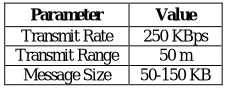
The simulation parameters employed here are carried out based on the realistic environment described in [25] where Helsinki City Scenario (HCS) model is used. The scenario has nodes moving in a part of the downtown Helsinki area. With HCS, node mobility is based on simulating 80 mobile users moving by foot, 30 by car, and 6 by trams in the streets of downtown Helsinki. Each node represents a user moving with realistic speed along the shortest paths between different points of interest (POIs) and random locations. The trams follow real tram routes in Helsinki. The simulation area is designed to be 4500 × 3400 m2 size. The simulation environment parameters are summarized in Table I.
Table I: Simulation Environment Parameters
Parameter Value
Transmit Rate 250 KBps Transmit Range 50 m
Message Size 50-150 KB
B.
Performance Results
In this section, simulation experiments are conducted to examine the performance of the three proposed methods against two early protocols in ICN, namely epidemic and spray and wait routing protocol.
Fig.4: The delivery probability of epidemic routing method with and without envireonmental context aware
Fig.6: The delivery probability of epidemic routing method with and without personal context aware.
Fig.7: The delivery probability of Spray and wait routing method with and without environmental context aware.
Fig.9: The delivery probability of Spray and wait routing method with and without personal context aware.
The above figures prove the positive impact of context awareness in ICN routing protocols. Particularly, the delivery probability of ICN routing protocols increases as context aware technique is employed. The impact of the context aware technique on the delivery probability differs slightly from one technique to other based on the usefulness of the collected data. However, the three context aware techniques all share being able to improve the delivery probability of ICN routing protocols. Note that although spray and wait protocol was reported to have a high delivery probability compared to epidemic [2], context aware techniques were able to benefit both routing protocol despite their original performance.
V. CONCLUSION
This paper presents the impact of context aware in ICN routing protocols. Three techniques of context aware is discussed, namely, environmental, historical and personal context aware. The three techniques show the improvement of ICN routing protocols when they are employed. The improvement of ICN routing protocol when context aware is employed is reported between 8% and 15%.
REFERENCES
1. A. Vahdat and D. Becker, “Epidemic Routing for Partially Connected Ad Hoc Networks,” Duke University, Durham, NC, Tech. Rep. CS-200006, 2000.
2. T. Spyropoulos, K. Psounis, and C. Raghavendra, “Spray and wait: An efficient routing scheme for intermittently connected mobile networks,” Proc. ACM SIGCOMM Workshop on Delay Tolerant Networking, Philadelphia, PA, pp. 252–259 , Aug. 2005.
3. Bhed Bahadur Bista, ”Improving Energy Consumption of Epidemic Routing in Delay Tolerant Networks,” 10th International Conference on Innovative Mobile and Internet Services in Ubiquitous Computing, pp. 278–283, 2016.
4. Li Li, Yang Qin, XiaoxiongZhong, and Hongbin Chen, “An incentive aware routing for selfish opportunistic networks: A game theoretic approach,” 8th International Conference on Wireless Communications and Signal Processing, pp. 1–5, 2016.
5. A. Lindgren, A. Doria, and O. Schelen, “Probabilistic routing in intermittently connected networks,” ACM SIGMOBILE Mobile Computing and Commun. Review, vol. 7, no. 3, pp. 19–20, July 2003.
6. M. W. Kang and Y. W. Chung, ”An energy-efficient opportunistic routing protocol in delay tolerant networks,” International Conference on Information and Communication Technology Convergence, pp. 655–659, 2016.
7. B. B. Bista and D. B. Rawat, ”Enhancement of PRoPHET routing in Delay Tolerant Networks from an energy prospective”, IEEE Region 10 Conference, pp. 1579–1582, 2016.
9. Y. Huo and J. Qi and Z. Li and T. Jing, ”APPOW: An advanced routing protocol based on parameters optimization in the weighted mobile social network”, China Communications, vol.13, pp. 107–115, 2016.
10. P. Hui and J. Crowcroft, “How small LABELS create big improvements,” in Proc. IEEE Int. Conf. on Pervasive Computing and Commun. Workshops, White Plains, NY, pp. 65–70, Mar. 2007.
11. P. Costa, C. Mascolo, M. Musolesi, and G.-P.Picco, “Socially-aware routing for publish-subscribe in delay-tolerant mobile ad hoc networks,” IEEE J. Select. Areas Commun., vol. 26, no. 5, pp. 748–760, June 2008.
12. E. M. Daly and M. Haahr, “Social network analysis for routing in disconnected delay-tolerant MANETs,” in Proc. ACM Int. Symp.on Mobile Ad hoc Networking and Computing, Montreal, QC, pp. 32–40, Sept. 2007.
13. P. Hui, J. Crowcroft, and E. Yoneki, “Bubble rap: Social based forwarding in delay tolerant networks,” in Proc. ACM Int. Symp. on Mobile Ad hoc Networking and Computing, Hong Kong, pp. 1576–1589, May 2008.
14. A. Zaslavsky, C. Perera, and D. Georgakopoulos, “Sensing as a service and big data,” in International Conference on Advances in Cloud Computing (ACC-2012), Bangalore, India, July 2012, pp. 21–29.
15. V. Issarny, M. Caporuscio, and N. Georgantas, “A perspective on the future of middleware-based software engineering,” in 2007 Future of Software Engineering, ser. FOSE ’07. Washington, DC, USA: IEEE Computer Society, 2007, pp. 244–258. [Online]. Available: http://dx.doi.org/10.1109/FOSE.2007.2
16. A. Katasonov, O. Kaykova, O. Khriyenko, S. Nikitin, and V. Y. Terziyan, “Smart semantic middleware for the internet of things.” in ICINCO-ICSO’08, 2008, pp. 169–178. [Online]. Available: http://www.mit.jyu.fi/ai/papers/ICINCO-2008.pdf
17. M. Caporuscio, P.-G.Raverdy, and V. Issarny, “ubisoap: A serviceoriented middleware for ubiquitous networking,” Services Computing, IEEE Transactions on, vol. 5, no. 1, pp. 86 –98, jan.-march 2012. [Online]. Available: http://dx.doi.org/10.1109/TSC.2010.60
18. V. Terziyan, O. Kaykova, and D. Zhovtobryukh, “Ubiroad: Semantic middleware for context-aware smart road environments,” in Internet and Web Applications and Services (ICIW), 2010 Fifth International Conference on, may 2010, pp. 295 –302. [Online]. Available: http://dx.doi.org/10.1109/ICIW.2010.50
19. A. Salehi, “Design and implementation of an efficient data stream processing system.” Ph.D. dissertation, EcolePolytechniqueFederale de Lausanne (EPFL), 2010, http://biblion.epfl.ch/EPFL/theses/2010/ 4611/EPFL TH4611.pdf
20. M. Albano, A. Brogi, R. Popescu, M. Diaz, and J. A. Dianes, “Towards secure middleware for embedded peer-to-peer systems: Objectives and requirements,” in RSPSI ’07: Workshop on Requirements and Solutions for Pervasive Software Infrastructures, 2007, pp. 1– 6. [Online]. Available: http://citeseerx.ist.psu.edu/viewdoc/download? doi=10.1.1.90.5982&rep=rep1&type=pdf
21. A. Cannata, M. Gerosa, and M. Taisch, “Socrades: A framework for developing intelligent systems in manufacturing,” in Industrial Engineering and Engineering Management, 2008. IEEM 2008. , 2008, pp. 1904 –1908. [Online]. Available: http://dx.doi.org/10.1109/IEEM.2008.4738203 22. C Perera, A Zaslavsky, P Christen, D Georgakopoulos, “Context aware computing for the internet of things: A survey,” IEEE Communications Surveys & Tutorials 16 (1), 414-454, [Online]. Available:https://arxiv.org/pdf/1305.0982.pdf
23. A Gendreau, R Barrios, (2014) “Hierarchical-Based Measurement of Situation Awareness in the Internet of Things” International Conference on Wireless Networks, pp. 1-5.
24. A. Kera¨nen, J. Ott, and T. Ka¨rkka¨inen, “The ONE simulator for DTN protocol evaluation,” in Proc. Int. Conf. on Simulation Tools and Techniques, Rome, Italy, pp. 1–10, Mar. 2009.