Volume 3, Issue 4, April 2014
Page 185
Abstract
The three dimensional discrete cosine transform (3-D DCT) is used in many 3-D applications such as video coding and compression. The type-II 3-D DCT is mostly used. The fast algorithms developed for the implementation of I-D DCT are used for the implementation of 3-D DCT using the row-column approach. The 3-D decimation in the frequency vector-radix algorithms (3-D DIF VR) developed involve less arithmetic operations and their implementation is faster than the conventional row-column-frame (RCF) approach. In this paper, we propose a fully pipe lined systolic architecture for efficient implementation of 3-D DCT-II using the 3-D DIF VR algorithm [16] which yields high throughput apart from regularity and simplicity.
Keywords: 3-D DCT, DIF VR algorithm
1. Introduction
Discrete cosine transform (DCT) is used in speech and image processing applications. DCT [1] is the most efficient transform for compression of speech and image data. Performance of the DCT is comparable to the optimal Karhunen-Loeve transform [2] for the purpose of the data compression, feature extraction and filtering applications. So several fast algorithms have been developed for efficient computation of 1-D and 2-D DCT. Development of algorithm for 3-D DCT is usually calculated using the row column frame (RCF) approach or through mapping it to 1-D and using other transforms [12]. 3-D decimation-in-frequency, vector-radix algorithm (3-D DIF VR) is used for fast calculation of 3-D type-II DCT in which the number of multiplication is reduced significantly. Some fast algorithms have been developed to reduce the computational cost of 3-D DCT [12]. Boussakta and Alsibami [16] have developed a 3-D vector-radix decimination–in-frequency (VR DIF) algorithm for fast implementation of 3-D DCT-II. This algorithm is found to be faster and requires substantially fewer multiplications as compare with the familiar RCF approach. It has a regular butterfly structure but they have not proposed an efficient architecture for its implementation. In this paper, we have reviewed the algorithm of [16] and proposed an efficient architecture for implementation of 3-D DCT-II.
The composition of the rest of the paper is as follows: the algorithm of [16] is reviewed in Section-II. Section-III deals with the proposed architecture for implementation of 3-D DCT-II. Throughput and hardware considerations are given in Section-IV. Concluding remarks are given in Section V.
2. A. 3-D DCT-II
The 3-D type-II discrete cosine transform of of size , can be defined as:
= 0, 1, 2…..,Ni
where , i = 1, 2, 3.
and
i = 1, 2, 3.
2. B. 3-D DIF VR algorithm
The 3-D DCT is usually computed using algorithms developed for the 1-D DCT applied over each dimension successively in a row-column style [3-5]. However, multidimensional algorithms involve less arithmetic operations and can be faster [6, 7-9].
In this paper, a 3-D decimation in frequency vector-radix algorithm that calculates the 3-D DCT-II directly is introduced. In this algorithm, the 3-D DCT-II is first decomposed into eight point 3-D DCTs. Each
3-D DCT is then divided further until we get transforms.
Let and assume that the factor is merged into . First, we need to rearrange the input data, as follows:
ARCHITECTURE FOR EFFICIENT
IMPLEMENTATION OF 3 - D DCT – II
S.S. Nayak1 and P.B. Mohapatra2
1&2Department of Physics,Centurion University Of Technology & Management
Volume 3, Issue 4, April 2014
ISSN 2319 - 4847
Volume 3, Issue 4, April 2014
Page 186
If index ni of the element x of input matrix is even then ni is replaced by ni / 2 in the element y of rearranged matrix.
If index ni of the element x of input matrix is odd then is replaced by in the element y of
rearranged matrix.
Replacing each element in Eq. (1) by corresponding element , the 3-D DCT –II can be written as:
where i = 1, 2, 3.
If we consider the even and odd parts of and , the general formula for the calculation of the 3-D DCT-II can be written as
i j l={000, 001, 010, 011, 100, 101, 110, 111}
where
(4) i, j and l equal to zero for even indices and one for odd indices.
Using the trigonometric identity
(6) i = 1, 2, 3.
the following relations can be derived
Using the trigonometric identity
Volume 3, Issue 4, April 2014
Page 187
Using the trigonometric identity(14)
the following relations can be derived
To achieve the rearrangement of the input data, the elements of the 3-D matrix are input as shown in Fig. 1. The elements of plane Y = 3, Y = 0, Y = 1 and Y = 2 are used in succession. The order of flow of the data in each plane of the matrix is shown by arrow mark. The rearrangement of matrix is achieved by ordered flow of the data.
Figure 1 Diagram showing the order of flow of data
3. Proposed architecture for implementation of 3-D DCT
Volume 3, Issue 4, April 2014
ISSN 2319 - 4847
Volume 3, Issue 4, April 2014
Page 188
x(2,2,0), x(3,2,0), x(3,2,1), x(2,2,1), x(1,2,1) and x(0,2,1) fill up R48, R47, R46, R45, R44, R43, R42 and R41 registers of sequentially. The elements x(0,2,2), x(1,2,2), x(2,2,2), x(3,2,2), x(3,2,3), x(2,2,3), x(1,2,3) and x(0,2,3) fill up R57, R58, R59, R60, R61, R62, R63 and R64 registers of sequentially. The order of flow of data is shown in Fig.1.
Data from the shift registers of Rows 1, 2, 3, 4, 9, 10, 11 and 12 shifts sequentially in the order of first C4, then C3, then C1 and then C2. Data from the shift registers of Rows 5,6,7,8,13,14,15 and 16 shifts sequentially in the order of first C3, then C4, then C2 and then C1.
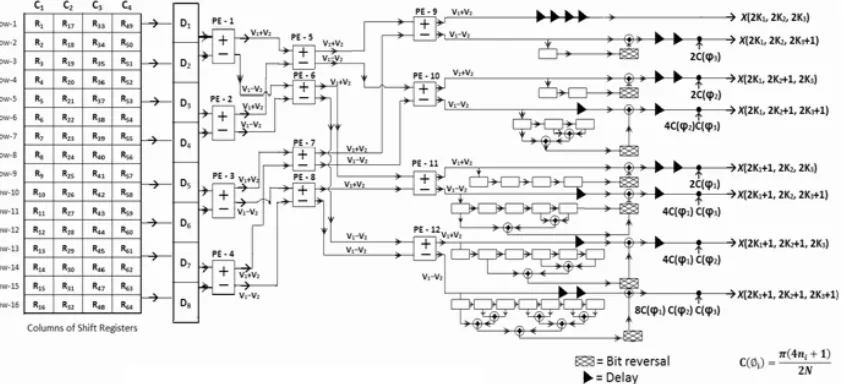
The proposed structure consists of another column of eight cells D1, D2, D3, D4, D5, D6, D7 and D8. In the first time-step, data from Row-1 shifts to D1, D2, D3 and D4 in order and data from Row-4 shifts to D5, D6, D7 and D8 in order, respectively i.e., data from R49 shifts to cell D1, data from R33 shifts to cell D2, data from R1 shifts to cell D3, data from R17 shifts to cell D4, data from R52 shifts to cell D5, data from R36 shifts to cell D6, data from R4 shifts to cell D7 and data from R20 shifts to cell D8. Similarly data from Rows-3 and 2, Rows-8 and 5, Rows-6 and 7, Rows-9 and 12, Rows-11 and 10, Rows-16 and 13 and Rows-14 and 15 shift to cells D1 to D8 in the next time-steps in their respective sequence. The proposed structure consists of three sets of four identical processing elements each. The first set consists of processing elements PE-1, PE-2, PE-3 and PE-4. In the same time-step data from D1 and D2 go to PE-1, data from D3 and D4 go to PE-2, data from D5 and D6 go to PE-3 and data from D7 and D8 go to PE-4. In each time-step one addition and one subtraction are being performed in each PE simultaneously. The structure of each PE is shown in Fig.3. Each PE has two inputs V1 and V2 and two outputs. One output gives the sum of two inputs, and the other output gives the difference of two inputs, .
Figure 2 Function of each PE
The second set of four processing elements consists of PE-5, PE-6, PE-7 and PE-8. The structure and operation of these four processing elements are same as those of previous sets of processing elements. The outputs of 1 and PE-2 are input to PE-5. The output of PE-1 and PE-2 are input to PE-6. The outputs of PE-3 and PE-4 are input to PE-7 and the outputs of PE-3 and PE-4 are input to PE-8. The third set of processing elements consists of PE-9, PE-10, PE-11 and PE-12 which are identical. The outputs of PE-5 and PE-7 are input to PE-9. The outputs of PE-5 and PE-7 are inputs to PE-10. The outputs of PE-6 and PE-8 are input to PE-11. The outputs of PE-6 and PE-8 are input to PE-12.
The output of PE-9 gives the 3-D DCT component directly. The output of PE-9 is added with the bit reversal of the previous output and multiplied by to get component . The output of PE-10 is added recursively with the bit-reversal of the two previous outputs and multiplied by to get the component . The output of PE-10 is added recursively with the
bit-reversal of the just previous, the 2nd previous and the 3rd previous outputs and multiplied by to
get the component . The output of PE-11 is added recursively with the bit reversal of the four previous outputs and multiplied by to get component . The output of PE-11 is added recursively with the bit-reversal of just previous, the 4th previous and the 5th previous outputs and multiplied by to get the component . The output of PE-12 is added recursively with the bit-reversal of the 2nd previous, the 4th previous and the 6th previous outputs and multiplied by to get the component . The output of PE-12 is added
recursively with the bit-reversal of the 1st , 2nd , 3rd , 4th, 5th, 6th and 7th previous outputs and multiplied by to get the component .
4. Throughput and hardware considerations
Volume 3, Issue 4, April 2014
Page 189
number of delays and additional number of shift registers. The same set of N 3 data must be input 2N number of times to get N 3 number of transform components.The implementation of 3-D DCT-II using 3-D VR DIF algorithm [16] consists of four stages. The 1st stage is the 3-D reordering using the index mapping of [6, 15]. The 2nd stage is the butterfly calculation. In the 3rd stage 3-D bits are reversed to get bit reversal data. The 3-D post-addition stage is the 4th stage. Butterfly stages compute equation (3), and computation of equations (5, 7-9, 11-13 and 15) is done in the post addition stage. The total number of real multiplications and additions required for the implementation of 3-D DCT using 3-D VR DIF algorithm [16] are, respectively, and . The total number of real multiplications required for the proposed structure is . The total number of real additions required for the proposed structures .
Table 1: Comparison of number of multiplications and additions of the proposed structure with those of [16].
Structure No. of multiplications No. of additions
[16]
Proposed Architecture
5. Conclusion
In this paper, we have proposed a fully pipe lined systolic architecture for efficient implementation of 3-D DCT-II using 3-D DIF VR algorithm which yields high throughput apart from regularity and simplicity. The hardware complexity of the architecture is less than those of existing architectures. The number of multiplications of the proposed architecture is more than 40% less than the number of multiplications required in RCF approach. Proposed architecture requires 50% less multiplications and 25% less additions compared to the architecture of [16].
References
[1] N.Ahmed, T.Natarajan, K.R.Rao, “Discrete cosine transform”, IEEE Trans. Comput., pp.90-93, January 1974.
[2] R.J.Clark, “Relation between the Karhunen-Loeve and cosine transforms”, IEE Proc. 128(6), pp.359-360, November 1981.
[3] K.R.Rao, P.Yip, Discrete Cosine Transform: Algorithms, Advantages, Applications. New York: Academic, September 1990.
[4] W.Kuo, Digital Image Compression: Algorithms and Standards, Boston, MA: Kluwer, 1995.
[5] G.K.Wallace, The JPEG still picture compression standard, Commun. ACM. 34, pp.30-44, 1991 .
[6] S.C.Chan, K.L.Ho, “Direct methods for computing discrete sinusoidal transforms”, Proc. Inst. Elect. Eng. Radar Signal Process. 137, pp. 433-442, December 1990.
[7] H.S.Hou, “A fast recursive algorithm for computing the discrete cosine transform”, IEEE Trans. Acoustics, Speech, Signal Processing. ASSP-33, pp. 1532-1539, December 1985.
[8] J.Takala, D.Akopain, J.Astola , J.Saarinen, “Constant geometry algorithm for discrete cosine transform”, IEEE Trans. Signal Processing. 48, pp.1840-1843, June 2000.
[9] A.Elnaggar, M.Alnuweiri, “A new multidimensional recursive architecture for computing the discrete cosine transform”, IEEE Trans. Circuit Systems. Video Technology. pp. 113-119, February 2000.
[10]Y.Zeng, G.Bi, A.R.Leyman, “New polynomial transform algorithm for multidimensional type DCT”, IEEE Trans. Signal Processing. 48, pp. 2814-2821, October 2000.
[11]Y.Zeng, G.Bi, A.C.Kot, “New algorithm for multidimensional type-III DCT”, IEEE Trans. Circuits Systems. 47, pp. 1523-1529, Decebmer 2000.
[12]Y.Zeng, G.Bi, Z.Lin, “Combined polynomial transform and radix-q algorithm for multidimensional DCT-III”, Multidimensional System Signal Process. 13, pp. 79-99, 2002 .
[13]S.C.Tai, Y.Gi, C.W.Lin, “An adaptive 3-D discrete cosine transform coder for medical image compression”, IEEE Trans.Inform.Technol.Biomed., 4, pp. 259-263, September 2000 .
[14]S.Boussakta, O.Alshibami, M.Aziz, “Radix-2×2×2 algorithm for the 3-D discrete Hartley transform”, IEEE Trans.Signal Processing. 49, pp. 3145-3156, December 2001.
[15]O.Alshibami, S.Boussakta, “Three-dimensional algorithm for the 3-D DCT-III”, Proc. Sixth Int. Symp.Commun. pp. 104-107, July 2001.
[16]S.Boussakta, O.Alshibami, “Fast Algorithm for the 3-D DCT-II”, IEEE Trans. Signal Processing. 52 , pp. 992-1001, April 2004.
Volume 3, Issue 4, April 2014
ISSN 2319 - 4847
Volume 3, Issue 4, April 2014
Page 190
Figure 1 : Proposed architecture for implementation of 4 x 4 x 4 3-D DCT.