750
Copyright © 2011-15. Vandana Publications. All Rights Reserved.
Volume-5, Issue-2, April-2015
International Journal of Engineering and Management Research
Page Number: 750-754
The WALL: A System Designed to Filter Unwanted Messages from OSN
(Online Social Network) User’s Wall
Ankit Srivastav1, Krishna Gaggad2, Jay Gawande3, Niket Chavan4
1,2,3,4
Computer Engineering, INDIA
ABSTRACT
One most serious issue in today’s Online Social Networks (OSNs) is to give user ability to control the messages posted on their own private wall to avoid that unwanted content/messages is displayed. Till now OSNs provide little support to this requirement. Here in this paper we propose a system allowing OSNs user to have a direct control on the messages posted on their walls. This is achieved through a flexible rule based system, that allows users to modify their filtering criteria and we also implement a Machine Learning-based soft classifier dividing messages in different user specified groups.
Keywords— Online social network, Machine Learning, short text classification, blacklist
I.
INTRODUCTION
These Online Social Networks (OSNs) are today one of the most popular interactive medium to communicate, share, and disseminate a considerable amount of human life information. Daily and continuous communications imply the exchange of several types of content, including free text, image, audio, and video data. In the sharing In OSNs, information filtering can also be used for a different, more sensitive, purpose. This is due to the fact that in OSNs there is the possibility of posting or commenting other posts on particular public/private areas, called in general walls. Information filtering can therefore be used to give users the ability to automatically control the messages written on their own walls, by filtering out unwanted messages. Indeed, today OSNs provide very little support to prevent unwanted messages on user walls. For example, Facebook allows users to state who is allowed to insert messages in their walls (i.e., friends, friends of friends, or defined groups of friends). However,
no content-based preferences are sup-ported and therefore it is not possible to prevent undesired messages, such as political or vulgar ones, no matter of the user who posts them. Providing this service is not only a matter of using previously defined web content mining techniques for a different application, rather it requires to design ad hoc classification strategies. This is because wall messages are constituted by short text for which traditional classification methods have serious limitations since short texts do not provide sufficient word occurrences.
The aim of the present work is therefore to propose and experimentally evaluate an automated system, called Filtered Wall (FW), able to filter unwanted messages from OSN user walls. We exploit Machine Learning (ML) text categorization techniques to automatically assign with each short text message a set of categories based on its content.
Besides classification facilities, the system provides a powerful rule layer exploiting a flexible language to specify Filtering Rules (FRs), by which users can state what contents, should not be displayed on their walls. FRs can support a variety of different filtering criteria that can be combined and customized according to the user needs. More precisely, FRs exploit user profiles, user relationships as well as the output of the ML categorization process to state the filtering criteria to be enforced. In addition, the system provides the support for user-defined Blacklists (BLs), that is, lists of users that are temporarily prevented to post any kind of messages on a user wall.
751
Copyright © 2011-15. Vandana Publications. All Rights Reserved.
Finally, we have provided a prototype implementation of our system by creating a demo social network named “Friendsbook” with similar GUI of facebook, and our system can be easily applied to other OSNs as well.
II.
METHODOLOGY
The main contribution of this paper is the design of a system providing customizable content-based message filtering for OSNs, based on ML techniques. As we have pointed out in the introduction, to the best of our knowl-edge, we are the first proposing such kind of application for OSNs. However, our work has relationships both with the state of the art in content-based filtering, as well as with the field of policy-based personalization for OSNs and, more in general, web contents. Therefore, in what follows, we survey the literature in both these fields.
1. Content-Based Filtering
Information filtering systems are designed to classify a stream of dynamically generated information dispatched asynchronously by an information producer and present to the user those information that are likely to satisfy his/her requirements .
In content-based filtering, each user is assumed to operate independently. As a result, a content-based filtering system selects information items based on the correlation between the content of the items and the user preferences as opposed to a collaborative filtering system that chooses items based on the correlation between people with similar preferences.
Content-based filtering is mainly based on the use of the ML paradigm according to which a classifier is automatically induced by learning from a set of preclassified examples. A remarkable variety of related work has recently appeared which differ for the adopted feature extraction methods, model learning, and collection of samples. The feature extraction procedure maps text into a compact representation of its content and is uniformly applied to training and generalization phases. Several experiments prove that Bag-of-Words (BoW) approaches yield good performance and prevail in general over more sophisticated text representation that may have superior semantics but lower statistical quality. As far as the learning model is concerned, there are a number of major approaches in content-based filtering and text classification in general showing mutual advantages and disadvantages in function of application-dependent issues.
The application of content-based filtering on messages posted on OSN user walls poses additional challenges given the short length of these messages other than the wide range of topics that can be discussed. Short text classification has received up to now few attentions in the scientific community. In our paper we make use of method, named Prediction by Partial Mapping, it produces a language model that is used in probabilistic text classifiers which are hard classifiers in nature and do not
easily integrate soft, multimembership paradigms. In our scenario, we consider gradual membership to classes a key feature for defining flexible policy-based personalization strategies.
2. Policy–Based Personalization of OSN Contents
Recently, there have been some proposals exploiting classification mechanisms for personalizing access in OSNs. For instance, a classification method has been proposed to categorize short text messages in order to avoid overwhelming users of micro blogging services by raw data. The system described in focuses on Twitter and associates a set of categories with each tweet describing its content. The user can then view only certain types of tweets based on his/her interests. In contrast, Golbeck and Kuter propose an application, called Film Trust, which exploits OSN trust relationships and provenance information to personalize access to the website. However, such systems do not provide a filtering policy layer by which the user can exploit the result of the classification process to decide how and to which extent filtering out unwanted information. In contrast, our filtering policy language allows the setting of FRs according to a variety of criteria, which do not consider only the results of the classification process but also the relationships of the wall owner with other OSN users as well as information on the user profile. Moreover, our system is complemented by a flexible mechanism for BL management that provides a further opportunity of customization to the filtering procedure.
The only social networking service we are aware of providing filtering abilities to its users is MyWOT, a social networking service which gives its subscribers the ability to: 1) rate resources with respect to four criteria: trustworthiness, vendor reliability, privacy, and child safety; 2) specify preferences determining whether the browser should block access to a given resource, or should simply return a warning message on the basis of the specified rating. Despite the existence of some similarities, the approach adopted by MyWOT is quite different from ours. In particular, it supports filtering criteria which are far less flexible than the ones of Filtered Wall since they are only based on the four above-mentioned criteria. Moreover, no automatic classification mechanism is provided to the end user.
frame-752
Copyright © 2011-15. Vandana Publications. All Rights Reserved.
works are very powerful and general enough to be customized and/or extended for different application scenarios they have not been specifically conceived to address information filtering in OSNs and therefore to consider the user social graph in the policy specification process. Therefore, we prefer to define our own abstract and more compact policy language, rather than extending one of the above-mentioned ones.
III.
PRIOR APPROACH
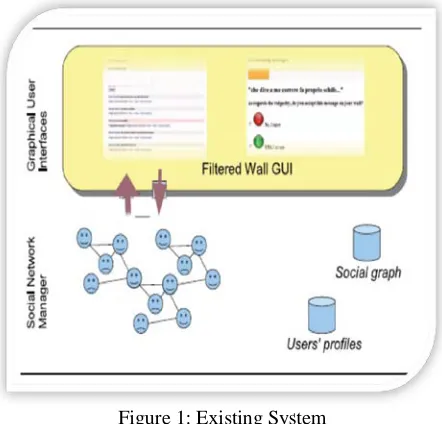
The present OSN architecture is a 2-tier structure. It mainly consists of 2 parts:
1. GUI (Graphical User Interface) 2. Social Network Manager
GUI consists all the basic framework of our demo social network. It includes all the design, page layout and other user related environment.
The second layer, called Social Network Manager (SNM), commonly aims to provide the basic OSN functionalities (i.e., profile and relationship management). The SNM manages the Graphical User Interfaces (GUIs). In particular, users interact with the system by means of a GUI.
Figure 1: Existing System
Here the Users can create a account and add friends based on their interest. They can chat, share pictures, videos, and other activities with other users. But in this system user cannot specify their rules like what kind of messages they want to be posted in their public wall. The role of user is very limited and vulnerable. To overcome this we have proposed a new architecture.
IV.
OUR APPROACH
FILTERED WALL ARCHITECTURE
The architecture in support of OSN services is a three-tier structure (Fig. 1).The first layer, called Social Network Manager (SNM), commonly aims to provide the basic OSN functionalities (i.e. profile and relationship management), whereas the second layer provides the support for external Social Network Applications
(SNAs). The supported SNAs may in turn require an additional layer for their needed Graphical User Interfaces (GUIs). According to this reference architecture, the proposed system is placed in the second and third layers. In particular, users interact with the system by means of a GUI to set up and manage their FRs/ BLs. Moreover, the GUI provides users with a FW, that is, a wall where only messages that are authorized according to their FRs/BLs are published.
The core components of the proposed system are the Content-Based Messages Filtering (CBMF) and the
Short Text Classifier modules. The latter component aims to classifymessages according to a set of categories. In contrast, the first component exploits the message categorization provided by the STC module to enforce the FRs specified by the user. BLs can also be used to enhance the filtering process.
Figure 2: The proposed System, a 3-tier system
As graphically depicted in Fig. 1, the path followed by a message, from its writing to the possible final publication can be summarized as follows:
753
Copyright © 2011-15. Vandana Publications. All Rights Reserved.
contacts, the user tries to post a message, which isintercepted by FW.
2. A ML-based text classifier extracts metadata from the content of the message.
3. FW uses metadata provided by the classifier, together with data extracted from the social graph and users’ profiles, to enforce the filtering and BL rules.
4. Depending on the result of the previous step, the message will be published or filtered by FW.
In what follows, we explain in more detail some of the above-mentioned steps.
SHORT TEXT CLASSIFIER
Present techniques used for text classification work well on data sets with large documents such as newswires corpora, but suffer when the documents in the corpus are short. In this context, critical aspects are the definition of a set of characterizing and discriminant features allowing the representation of underlying concepts and the collection of a complete and consistent set of supervised examples.
Our study is aimed at designing and evaluating various representation techniques in combination with a neural learning strategy to semantically categorize short texts. From a ML point of view, we approach the task by defining a hierarchical two-level strategy assuming that it is better to identify and eliminate “neutral” sentences, then classify “non-neutral” sentences by the class of interest instead of doing everything in one step. This choice is motivated by related work showing advantages in classifying text and/or short texts using a hierarchical strategy. The first-level task is conceived as a hard classification in which short texts are labeled with crisp neutral and non-neutral labels. The second-level soft classifier acts on the crisp set of non-neutral short texts and, for each of them, it “simply” produces estimated appropriateness or “gradual membership” for each of the conceived classes, without taking any “hard” decision on any of them. Such a list of grades is then used by the subsequent phases of the filtering process.
TEXT REPRESENTATION
The extraction of an appropriate set of features by which representing the text of a given document is a crucial task strongly affecting the performance of the overall classification strategy. Different sets of features for text categorization have been proposed in the literature, however, the most appropriate feature set and feature representation for short text messages have not yet been sufficiently investigated. Proceeding from these considerations and on the basis of our experience, we consider three types of features, BoW, Document properties (Dp) and Contextual Features (CF). The first two types of features,already used in, are endogenous, that is, they are entirely derived from the information contained within the text of the message. Text representation using endogenous knowledge has a good general applicability;
however, in operational settings, it is legitimate to use also exogenous knowledge, i.e., any source of information outside the message body but directly or indirectly related to the message itself. We introduce CF modeling information that characterizes the environment where the user is posting. These features play a key role in deterministically under-standing the semantics of the messages. All proposed features have been analyzed in the experimental evaluation phase in order to determine the combination that is most appropriate for short message classification
MACHINE LEARNING-BASED CLASSIFICATION
We address short text categorization as a hierarchical two-level classification process. The first-level classifier performs a binary hard categorization that labels messages as Neutral and Non-neutral. The first-level filtering task facilitates the subsequent second-level task in which a finer-grained classification is performed. The second-level classifier performs a soft-partition of Non-neutral messages assigning a given message a gradual membership to each of the non-neutral classes.
FILTERING RULES AND BLACKLIST MANAGEMENT
In this section, we introduce the rule layer adopted for filtering unwanted messages. We start by describing FRs, then we illustrate the use of BLs.
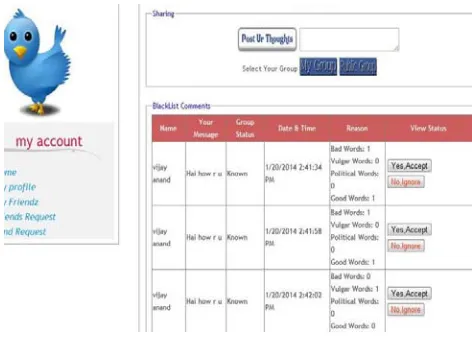
Figure 3: User’s Filtered Wall
754
Copyright © 2011-15. Vandana Publications. All Rights Reserved.
RT and trust value X between two users, if there is an edge connecting them having the labels RT and X. Moreover, two users are in an indirect relationship of a given type RT if there is a path of more than one edge connecting them, such that all the edges in the path have label RT. In this paper, we do not address the problem of trust computation for indirect relationships, since many algorithms have been proposed in the literature that can be used in our scenario as well. Such algorithms mainly differ on the criteria to select the paths on which trust computation should be based, when many paths of the same type exist between two users.
Table 1
Result of our Proposed Model: Recall (R) and F-Measure(F1) Values for Each Class
First Level Second Level
Metric neutral
Non-neutral
Violence vulgar offensive hate sex
81% 77% 82% 62% 82% 65% 88%
R 93% 50% 46% 49% 67% 39% 91%
F1 87% 61% 59% 55% 74% 49% 89%
The set of classes considered in our experiments is:
Neutral, Violence, Vulgar, Offensive, Hate, Sex, where Neutral are the second-level classes. The percentage of elements in set that belongs to the Neutral class is 31 percent.
In order to deal with intrinsic ambiguity in assigning messages to classes, we conceive that a given message belongs to more than one class. After the ground-truth collection phase, the messages have been selected to balance as much as possible second-level class occurrences.
The group of experts has been chosen in an attempt to ensure high heterogeneity concerning sex, age, employment, education, and religion. In order to create a consensus concerning the meaning of the Neutral class and general criteria in assigning multiclass membership we invited experts to participate to a dedicated tuning session.
We are aware of the fact that the extreme diversity of OSNs content and the continuing evolution of communication styles create the need of using several data sets as a reference benchmark. We hope that our data set will pave the way for a quantitative and more precise analysis of OSN short text classification methods.
V.
CONCLUSION
In this paper, we have presented a system to filter undesired messages from OSN walls. The system exploits a ML soft classifier to enforce customizable content-dependent FRs.
The system using the machine language soft
classifier to label the contents is Neutral and Non-neutral. And then applying the Filter Rule based on the creators. Moreover, the flexibility of the system in terms of filtering options is enhanced through the management of BLs.
Moreover, we are aware that a usable GUI could not be enough, representing only the first step. Indeed, the proposed system may suffer of problems similar to those encountered in the specification of OSN privacy settings. In this context, many empirical studies have shown that average OSN users have difficulties in understanding also the simple privacy settings provided by today OSNs. To overcome this problem, a promising trend is to exploit data mining techniques to infer the best privacy preferences to suggest to OSN users, on the basis of the available social network data. As future work, we intend to exploit similar techniques to infer BL rules and FRs.
Additionally, we plan to study strategies and techniques limiting the inferences that a user can do on the enforced filtering rules with the aim of bypassing the filtering system, such as for instance randomly notifying a message that should instead be blocked, or detecting modifications to profile attributes that have been made for the only purpose of defeating the filtering system.
REFERENCES
[1] F. Sebastiani, Machine Learning in Automated Text Categorization, 2002.
[2] R.J. Mooney, L. Roy, Content-Based Book Recommending Using Learning for Text Categorization, 2000.
[3] Marco Vanetti, Elisabetta Binaghi, Elena Ferrari, Barbara Carminati, and Moreno Carullo, A System to Filter Unwanted Messages from OSN User Walls, 2013. [4] M. Vanetti, E. Binaghi, B. Carminati, M. Carullo, and E. Ferrari, Content-Based Filtering in On-Line Social Networks, 2010.
[5] N.J. Belkin and W.B. Croft, Information Filtering and Information Retrieval: Two Sides of the Same Coin? 1992. [6] P.J. Denning, Electronic Junk, 1982.
[7] P.W. Foltz and S.T. Dumais, Personalized Information Delivery: An Analysis of Information Filtering Methods, 1992.