The Thirty-Third AAAI Conference on Artificial Intelligence (AAAI-19)
A Multi-Agent Communication Framework for
Question-Worthy Phrase Extraction and Question Generation
Siyuan Wang,
1Zhongyu Wei,
1∗Zhihao Fan,
1Yang Liu,
2Xuanjing Huang
3 1School of Data Science, Fudan University, China2LAIX Inc., China
3School of Computer Science, Fudan University, China
{18110980001,zywei,18210980005}@fudan.edu.cn, [email protected], [email protected]
Abstract
Question generation aims to produce questions automatically given a piece of text as input. Existing research follows a sequence-to-sequence fashion that constructs a single ques-tion based on the input. Considering each quesques-tion usually focuses on a specific fragment of the input, especially in the scenario of reading comprehension, it is reasonable to iden-tify the corresponding focus before constructing the ques-tion. In this paper, we propose to identifyquestion-worthy phrasesfirst and generate questions with the assistance of these phrases. We introduce a multi-agent communication framework, taking phrase extraction and question genera-tion as two agents, and learn these two tasks simultaneously via message passing mechanism. The results of experiments show the effectiveness of our framework: we can extract question-worthy phrases, which are able to improve the per-formance of question generation. Besides, our system is able to extract more than one question worthy phrases and gener-ate multiple questions accordingly.
Introduction
Question generation has attracted attention from the research area of Natural Language Processing in recent years. Given a piece of text, automatic question generation aims to pro-duce questions according to the input content. It acts as an essential component in some interactive systems, such as di-alogue system (Piwek et al. 2007). It also has various ap-plications in educational area, e.g., generate questions for reading comprehension. Besides, it is helpful for construct-ing question sets for the task of question answerconstruct-ing (QA) to further improve the performance of QA systems.
Most previous studies on question generation are rule-based relying on hand-crafted features. However, these fea-tures are usually hard to design and are difficult to be trans-ferred among different domains. Inspired by the success of the encoder-decoder structure in machine translation (Bah-danau, Cho, and Bengio 2015) and image captioning (Xu et al. 2015), Du et al. (2017) propose to apply sequence-to-sequence model with attention mechanism for question gen-eration without human designed rules, which is called neural
∗
Corresponding author
Copyright c2019, Association for the Advancement of Artificial Intelligence (www.aaai.org). All rights reserved.
Figure 1: An example sentence from SQuAD with multi-ple questions.Phrases of light italic font and underlinedare corresponding focuses (answers in the dataset).
question generation (NQG), and has become the state of the art.
As shown in the example in Figure 1 from the dataset of Stanford Question Answering Dataset (SQuAD) (Rajpurkar et al. 2016) for reading comprehension, a question gener-ated for the input sentence usually focuses on a specific fragment of the input that is deemed to contain significant information. Besides, there are several focuses in an input sentence. Based on these observations, we argue that a ques-tion generaques-tion system should be able to generate quesques-tions according to various focuses in the input content. Zhou et al. (2017) make a move by encoding the position of the ground-truth answer as auxiliary feature for question gen-eration. Although the performance has been improved, it requires pre-identified answers which are not available in the real-environment for question generation. To tackle this problem, we propose to identify focuses from the input con-tent first and generate questions using such information as assistance.
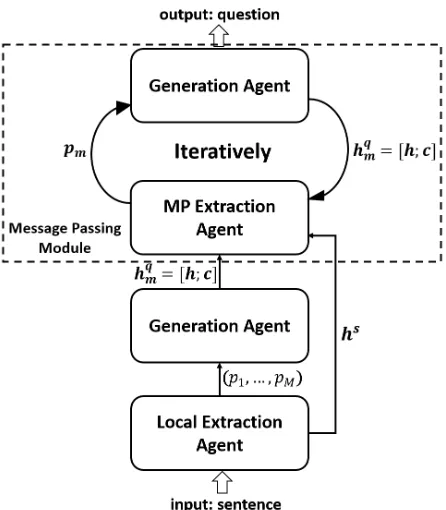
Figure 2: A brief overview of our proposed framework. From bottom to up, a local extraction agent, a generation agent and a iteratively MP module are presented. The gener-ation agent after the local extraction agent is the same as the one in the message passing module. The arrows mean that messages are communicated between different agents.
In this paper, we formulate the task of question generation with an auxiliary task of question-worthy phrase extraction. We expect question-worthy phrases extracted can help to generate better questions, and learning to ask questions can benefit extracting question-worthy phrases, therefore we de-velop a multi-agent communication framework (Sukhbaatar, Fergus, and others 2016; Xu et al. 2017; Celikyilmaz et al. 2018), which constructs two different agents to implement phrase extraction and question generation respectively and learn these two tasks simultaneously via message passing mechanism. We conduct experiments on SQuAD (Rajpurkar et al. 2016) and evaluate our framework from two aspects: phrase extraction and question generation. The results of experiments show the effectiveness of our framework: our phrase extractor with message passing outperforms the state-of-the-art extraction model by a large margin and the per-formance of generation agent can be improved significantly with the assistance of the extraction agent.
Framework
Given an input sentence x = (x1, ..., xn), where xi is a
token, our framework is designed to generate one or more questions(y1, ..., yM), M >1. The overall framework can
be seen in Figure 2. It can be split into three components from bottom to up: a local extraction agent, a generation agent and an iterative Message Passing (MP) module. The
work flow starts from the local extraction agent. It extracts
M phrases from the input sentence and conveys them to the generation agent to help generate M questions. Then the question messages and sentence representations for extrac-tion are fed into the iteratively MP module which consists of an extraction agent and a generation agent. These two agents work iteratively and collaborate via passing messages to each other. Note that the structure of the generation agent in the MP module is the same as the one after the local ex-traction agent.
Local Extraction Agent
The local extraction agent extracts question-worthy phrases given the input sentence. Different from previous rule-based phrase extraction systems, which relies on part-of-speech in-formation to extract phrases, we apply a neural model called Pointer Network (Vinyals, Fortunato, and Jaitly 2015).
Pointer Network (P-N) is proposed to use attention mech-anism and a softmax probability distribution as a pointer to pick the index of tokens from the input sequence as output. Given the number of phrases(M)to be extracted in a sen-tence, P-N detects M pairs of start and end indexes, and tokens between each pair of start and end index are target phrases.
Local extraction agent, denoted asELocal, takes the sen-tencexas input and uses a bi-directional LSTM (Huang, Xu, and Yu 2015) to encodex.
−→
hst =−−−−→LST M(xt, −−→ hst−1)
←− hst =
←−−−−
LST M(xt,←−−hst+1) (1)
The−→hstis the forward hidden state at steptwhile the ←− hst
is the backward one. Then we take the concatenation of the forward and backward hidden states as the output of the en-coder.
hs= [−→hs;←h−s] (2)
Then another LSTM is employed as the decoder. We only take two steps in the decoder, the first step is to point out the start index while the second is to identify the end of the phrase. The hidden states for the decoder are represented as (h1, h2). The attention vector (Bahdanau, Cho, and Bengio
2015) at each output timetis computed as follows:
ui,t=vTtanh W1hsi +W2ht
ai,t=sof tmax(ui,t)
dt= n X
i=1
ai,thsi (3)
ai,t is the probability ofithtoken to be pointed out at time
t, and the attention vectordtwill then be fed into next time
step as input. Then after two steps of decoding, we obtain
asandaeas start and end probabilities over all input tokens.
The loss function is shown as Equation 4, where¯a1anda¯2
are the start and end probabilities of ground truth positions, respectively.
We pick topM start indexes and end indexes respectively according to their probability as and ae and map them intoM (start,end) pairs as our final extraction resultsp = (p1, ..., pM). The mapping is performed to pair each start
index with its closest end index.
p=map[topM i
ai,1;topM
i
ai,2] (5)
Generation Agent
After extracting question-worthy phrases in the local extrac-tion agent, the quesextrac-tion generaextrac-tion agent is responsible for generating questions taking extracted phrases as assistance.
Given the sentence and extracted question-worthy phrases as input, the generation agent processes a phrase at a time. In particular, taking sentencexand one phrasepmas input,
the agent generates a question ym. And our target can be formulated as Equation 6:
ym=argmax y
P(y|x, pm) (6)
With M > 1 extracted phrases, we repeat such pro-cessM times, and finally generate multiple questionsy = (y1, ..., yM).
In this process, we first use the BIO tagging (Zhou et al. 2017) of sentenceb = (b1, ..., bn)to represent the phrase,
wherebiindicates whether theithtoken of sentencexiis in question-worthy phrasepmor not, denoted as Equation 7:
bi =
( B xiis the start of pm
I xiis inside or the end of pm O xiis outside of pm
(7)
Then we concatenate the representation of x and b as the input of the generation process. The generation process follows an encode-decoder structure. We first employ bi-directional LSTM to encode the input and get encoder hid-den states hs = (hs
1, ..., hsn). For the decoder, a LSTM is
applied with the attention mechanism. At each time step t in the decoder, a new statehtis generated:
ht=LST M(yt−1, ht−1) (8)
Furthermore, we take an attention-weighted average (Luong, Pham, and Manning 2015) over hidden states obtained in the encoder.
ati =
exp hTtW hsi
P
jexp hTtW hsj
ct=X
i
atihsi (9)
Then ht and ct are concatenated to calculate the softmax probability distribution over vocabularyP wt|x, w<t, pm),
where wt is the prediction at time t, and ym = (w1, ..., wt, ...). The loss function which needs to be
mini-mized is expressed as Equation 10:
Lg=−
|ym| X
t=1
log P wt|x, w<t, pm) (10)
hqt= [ht;ct]is also treated as the representation of the
ques-tion, and will be passed to MP extraction agent.
Message Passing Module
Here it comes to the MP module which consists of a phrase extraction agent and a generation agent. The MP phrase ex-tractor is an upgrade version of local phrase exex-tractor by taking information from question generator. Note that the generation agent in the MP module is the same as the one introduced in the previous section, so we will skip it here and focus on the MP extraction agent.
MP Extraction Agent Different from local extraction agent,EM Phas an auxiliary inputhq = (hq
1, ..., h
q
M), which
is the question representations passed from generation agent. It doesn’t take the original sentencexas input, but use en-coder hidden stateshsfrom local extraction agentE
Localto
save the computation.
At each time given the sentence representationhsand one
question representationhqm= (h q m,1, ..., h
q
m,l)fromh q, we
extract one corresponding phrase.
We add a Match-LSTM module to help Pointer Net-work (Wang and Jiang 2015; 2017) to incorporate the infor-mation passed by question generator. Match-LSTM usually has two inputs, one is a premise and the other is a hypothesis. It uses the attention mechanism and sequentially combines the attention-weighted premise to each token of the hypoth-esis and uses the aggregated matching result to do the pre-diction.
EM P takes question representationhqmas a premise while takes sentence representation hs as a hypothesis. At each
time step t in the encoder, we compute attention-weighted question representationdtas below:
um,j,t=vTtanh W1hqm,j+W2hst
am,j,t =sof tmax(um,j,t)
dm,t=
l X
j=1
am,j,thqm,j (11)
Then we concatenatehs
tanddm,tas our final inputim,t:
im,t= [hst;dm,t] (12)
For the phrase extraction, we first feed im = (im,1, ..., im,n) into a Bi-LSTM encoder, and then in
de-coder, compute start and end probability over all tokens in the sentence and compute the loss function. We finally pick the start and end indexes with maximum likelihood:
pm= [argmax j
am,j,1;argmax
j
am,j,2] (13)
WhenM > 1, we have multiple question representation
hq = (hq
1, ..., h
q
M), MP extraction agent will runM times to
extract multiple phrasesp= (p1, ..., pM).
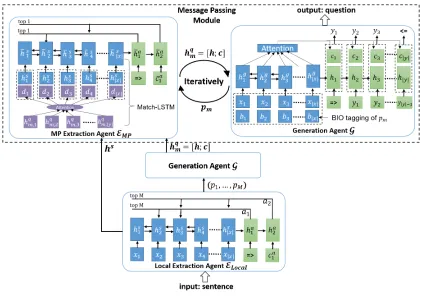
Figure 3: A detailed overview of Multi-agent Communication Framework.
Multi-agent Communication Mechanism
After introducing the local extraction agent, the generation agent and the extractor employed in the MP module, we now describe the communication mechanism and the training de-tail in the following part, referring to Figure 3.
Only the input sentencexis provided toELocal and we extract the first batch of question worthy phrases. A loss function LL
E is utilized for this stage. We then pass these
extracted phrases(pL1, ..., pLM)to the generation agentGto generate M questions (yL
1, ..., yLM). Loss LLG is computed
accordingly. In the MP module, the sentence encoding mes-sagehsfrom the local extraction agent and the question
mes-sages fromGare passed to the MP extraction agent EM P,
aiming to identify better phrases with the assistance of learn-ing to ask questions. A lossLM P
E,1 is computed. And phrases
extracted fromEM P will be passed to the generation agent
Gto continue the process of question generation with a loss
LM P
G,1. Following the same pattern of operations, MP
extrac-tion agent and generaextrac-tion agent work iteratively in the MP module via passing messages to each other. We collect losses
LM P E,2,L
M P G,2,L
M P E,3,L
M P
G,3,..., continually until the given
it-eration number.
To train this framework, we compute a combined loss function for optimization and hyper-parametersλandβ = (β0, β1, β2, ...)are employed to balance these losses:
L=β0LL+β1LM P1 +β2LM P2 +... (14)
where
LL=λLLE+ (1−λ)L L G
LM P
i =λLM PE,i + (1−λ)LM PG,i (15)
Compared to (Sukhbaatar, Fergus, and others 2016; Ce-likyilmaz et al. 2018) which constructs multiple agents of the same function over different contexts, we define two kinds of agents to extract question-worthy phrases and gerate questions respectively. And most existing models en-able the message passing between different layers, while our communication mechanism is more flexible. Messages are passed from local extraction agent to the generation agent, from these two agents to the MP module and between the MP module iteratively. The proposed communication mech-anism is easy to be used for other similar scenarios where agents are designed for different tasks.
Experiments
Datasets
are multiple question-phrase pairs corresponding to a sin-gle sentence. The detailed statistics can be seen in table 1 in terms of the distribution of number of questions to sen-tences. More than30%sentences have multiple questions. The average number of questions per sentence is nearly 1.5. We take a sentence-question-phrase tuple as an instance and it results in 90,682 ones in total. We further split them into 68,704, 10,313 and 11,665 ones as training set, validation set and test set respectively.
# of questions # of sentences percentage
1 41,356 67.11%
2 14,499 23.53%
3 3,921 6.36%
4 1,198 1.95%
>5 649 1.05%
in total 61,623 100%
Table 1: Distribution of number of questions per sentence in our dataset.
Implementation Details
We construct different vocabulary for sentences and ques-tions respectively (40,000 and 30,000) by keeping the most frequent words, while other words are replaced by the sym-bolUNK. We use Glove (Pennington, Socher, and Manning 2014) to initialize word embeddings with dimension of 300. The size of hidden units in LSTM cell in encoder is 300 while that for the decoder is 600. The size of embedding for BIO tag is 100.
We initialize parameters randomly using an uniform dis-tribution with Xavier scheme. We use Adam to optimize our models with learning rate of 0.001, and decay at rate 0.96 per epoch, up to 30 epochs. We use dropout with probability of 0.7 and we take mini-batch of size 32 for training. We also clip the gradient once it exceeds 5. We maintain one MP it-erations in our framework, and the hyper-parameters in loss optimization are set asβ0= 0.2, β1= 0.8,λ= 0in epoch
0-20 andλ= 0.2after tuning.
We evaluate our model on validation set at each epoch and get the best model. During decoding process of testing, we use beam search with 3 as the beam size.
Models for Comparison and Results
Our framework involves question-worthy phrase extraction and question generation. In order to show the effectiveness of our framework, we make comparison for both extraction models and generation models.
Extraction Models We first compare several models of phrase extraction. For all of these models, the number of phrases to be extracted is provided in advance.
• ENERconducts name entity recognition on the input text
and takes extracted entities as question-worthy phrases. We directly use Stanford NER package1 for the imple-mentation.
1
https://nlp.stanford.edu/software/CRF-NER.shtml
• ELocal is the local extraction agent of our Multi-Agent
Communicating Framework, which just uses pointer net-work to point out one or more start-end pairs of question-worthy phrases.
• EMPis our proposed model. It is the extraction agent in
MP module of our framework, which matches question information passed from the generation agent to sentence for the extraction of question-worthy phrases.
Model EM F1 avg. num ENER 13.12% 17.33 0.86
ELocal 24.27% 38.63 1.43
EMP 35.77% 46.71 1.38
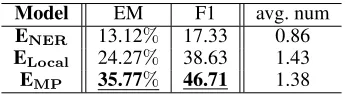
Table 2: Evaluation results of different phrase extraction models. (underline: diff. with both comparison models (ENER,ELocal)p < 0.01;Bold: the best performance in
the column)
Results of Phrase Extraction To evaluate question-worthy phrase extraction, we use ExactMatch score and F1 score, which are widely used for the evaluation of question answering. We also report the average number of extracted phrases to confirm the ability of our framework for multi-ple phrases extraction. Table 2 shows the overall results for phrase extraction. We have several findings:
- ENERis to recognize name entities and take them as
out-put. However, the tagger can only recognize limited types of name entities. This leads to a low average number of phrases extracted. Besides, it also gets low EM and F1 scores because the focuses of some sentences are not en-tities, such as “15-1” in the example shown in Table 4.
- EMP and ELocal use P-N to identify question-worthy
phrases and produce a significantly better performance compared to NER based extractor, indicating that they are able to learn the features of important fragments of the input sentence from training dataset.
- EMPgenerates better EM and F1 scores thanElocal,
indi-cating that messages passed from generation agent is use-ful for extracting better question worthy phrases. The av-erage number of extracted phrases ofEMPis lower than
Elocal. By looking deep into the results, we find that some
mis-extracted phrases are discarded with the assistance of the generation agent.
Following similar decoding structure for phrase extrac-tion, bothEMPandELocalsuffer from the problem of span
overlapping among extracted phrases for a given sentence. The ideal situation is that phrases extracted in the same sen-tence are independent with each other. In order to show how question information passed from generation agent can help extract multiple independent phrases, we calculate the per-centage of sentences with overlapped phrases for the two extraction agents. Results show that 32.37% of sentences have overlapped phrases using ELocal while that ofEMP
Model BLEU 1 BLEU 2 BLEU 3 BLEU 4 METEOR ROUGEL
NQGRule 38.15 21.03 14.15 9.98 13.38 29.00
NQGBase 43.83 23.80 14.46 9.05 14.63 36.50 NQGNER 44.00 23.79 14.52 9.22 14.89 36.32
NQGLocal 44.36 24.58 15.23 9.76 15.15 37.00
NQGMP 45.70∗ 25.87∗ 16.33∗ 10.56∗ 15.76∗ 38.09∗
NQGG−t 47.49 27.81 17.9 11.81 16.84 40.23
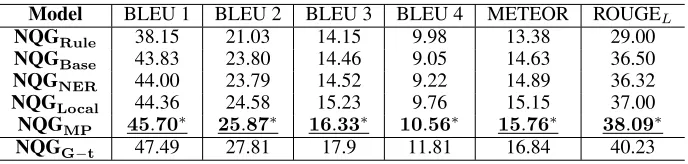
Table 3: Evaluation results of different question generation models in terms of BLEU 1-4, METEOR and ROUGEL. (underline:
diff. with all the comparison models (NQGRule,NQGBase,NQGNER,NQGLocal)p < 0.01; *:p < 0.05;Bold: the best
performance for each column)
Generation Models For question generation, we compare several models.
• NQGRule (Heilman and Smith 2010) is a rule-based
model. It uses manually written rules to perform a se-quence of general purpose syntactic transformations (e.g., subject-auxiliary inversion) to turn declarative sentences into questions, which are then ranked and selected as the final generated questions.
• NQGBase (Du, Shao, and Cardie 2017) is the
state-of-the-art neural-based model for question generation. It takes sentence as input and uses encoder-decoder model with attention mechanism to generate question without modeling focuses in the input.
• NQGNERtakes phrases extracted byENERas additional
information for question generation, and uses the same generation model introduced in our paper.
• NQGLocalis our generation agent that takes phrases
ex-tracted byELocalas additional information for question
generation.
• NQGMP is our proposed generation model in the MP
module that takes phrases extracted byEMPas additional
information for question generation and is trained with EMPsimultaneously.
• NQGG−t (Zhou et al. 2017) takes the ground-truth
an-swers as additional information for question generation and uses the same generation model introduced in our pa-per. This is the upper bound of our generation model.
Results of Question Generation For the evaluation of question generation, we use several metrics including BLEU 1-4 (Papineni et al. 2002), METEOR (Banerjee and Lavie 2005) and ROUGEL (Lin 2004). Without ground-truth
an-swers, we cannot pair the generated questions with ques-tions in reference. For comparison, the most similar question in reference is selected for a generated question to compute evaluation metrics. Table 3 shows the evaluation results of all the generation models. We have several findings:
At first, we note that NQGRule performs poorly as the
sentences in our dataset are quite long and complex, which are not suitable to be analyzed using rule-based methods, for example, sentence parsing is hard to be implemented while the sentence is complicated.
NQGBaseandNQGG−t construct the baseline and up-per bound, respectively. Because the former generates
ques-tions without any extracted phrase information while the lat-ter has the ground truth answers. Between the baseline and the upper bound, the order of different models in terms of all the evaluation metrics areNQGNER < NQGLocal <
NQGMP. This indicates that by taking extracted phrases
with higher quality, the generation model is able to produce better questions. This also shows the effectiveness of our framework of utilizing extracted phrases for better question generation.
In order to show the ability of our framework to generate multiple questions, we calculate the average number of dif-ferent questions generated byNQGMP, which is1.35. (We
identify two questions are different if they have more than 3 different words.) This number is slightly smaller than the average number of extracted phrases from EMP, because
sometimes different phrases may correspond to the same question.
Significance Test We also conduct significance test (inde-pendent two-sample t-test) to compare our model to other comparison models for both phrase extraction and ques-tion generaques-tion. The results are shown in Table 2 and Ta-ble 3 respectively. We can see that our extraction model EMP outperforms ENER andELocal with a large margin
withp-value< 0.01. Compared toNQGRule,NQGBase,
NQGNER, andNQGLocal, our generation modelNQGMP generates a significant improvement.
Case Study
In order to show the effectiveness of our framework more in-tuitively, we present two examples of generated questions in Table 4. In both cases, our model can first extract phrases close to ground-truth answers while ENER can only
ex-tract name entities which sometimes are not the question-worthy phrases. And we can also generate good questions with question-worthy focuses, such as the first question we generated in example1, asking the score of the competition. However, generation based onENERis not able to produce
questions with high quality.
Related Work
Sample 1
Input:the panthers finished the regular season with a 15 – 1 record , and quarterback cam newton was named the nfl most valuable player (mvp) .
Phrases
Ground-truth:15 – 1, quarterback cam newton.
NER:panthers,hblanki.
EMP:15, quarterback cam newton.
Questions
Ground-truth:what was the ratio in 2015 for the carolina panthers during their regular season ? which carolina panthers player was named most valuable player ?
NQGNER:who wons the regular season ?
what was the regular session in the afl ?
NQGMP:how many wins did the panthers
win during the regular season ? who was named the nlf most valuable player?
Sample 2
Input:next to the main building is the basilica of the sacred heart .
Phrases
Answers:main building.
NER:sacred heart
EMP:next to the main building.
Questions
Ground Truth:the basilica of the sacred heart at notre dame is beside to which structure ?
NQGNER:what is next to main building ?
NQGMP:where is the basilica of prayer ?
Table 4: Cases of sentences, phrases extracted and questions generated by different models.
Phrases Extraction
Phrase Extraction is to identify which fragments of sentence are interesting to be asked about, and should be extracted. For this kind of information extraction task, many previous work are rule-based utilizing lexical features such as part-of-speech (POS) and NER tags (Subramanian et al. 2017), then rank these phrases to get final results.
Some other work tries to apply recurrent neural net-work to predict whether a token in sentence should be ex-tracted (Wang and Jiang 2015). However, this method can only take simple relationship between input tokens into ac-count. Then conditional random field (CRF) is applied af-ter RNN layer to consider the sentence-level tag informa-tion (Huang, Xu, and Yu 2015; Lample et al. 2016). Pointer Networks (Vinyals, Fortunato, and Jaitly 2015) also have been employed to this task. Ptr-Net used in machine read-ing comprehension task (Wang and Jiang 2017; Liu et al. 2018) is to predict answer given sentence according to ques-tion which also can be seen as an phrase extracques-tion task.
Question Generation
Rule-based methods are previously applied to the the task of question generation, which usually extract key aspects from the sentences and then insert them into hand-crafted templates to generate interrogative sentences (Heilman and Smith 2010; Heilman 2011; Duan et al. 2017).
Recently, attention-based seq-to-seq model is also devel-oped for question generation (Du, Shao, and Cardie 2017), and performs well. (Zhou et al. 2017) takes the same model and uses the answers as extra information to generate better questions.
(Du and Cardie 2017) proposed that not all sentences in a paragraph are interesting and important and put forward a concept ofquestion-worthysentence. This study also in-spires us to come up a concept: question-worthy phrases. There are also two studies (Subramanian et al. 2017; Kumar et al. 2018) proposing the similar concepts: key phrase and pivotal answer in the sentence to be extracted to aid question question. However, both of them just use a two-stage method which first implement selection and then generate question.
Besides, some studies (Wang, Yuan, and Trischler 2017; Tang et al. 2017) take question generation as a subtask, and learn it with other tasks simultaneously, such as question answering. However none of the previous work combines question generation with phrase extraction to do multi-task learning, and all of them require the ground truth informa-tion for its counter-part task when testing while we just use the input sentence.
Other researchers also work on question generation from images (Fan et al. 2018a; 2018b).
Conclusion and Future Work
In this paper, we propose to extractquestion-worthy phrases
and use such information for better question generation. We propose a multi-agent communication framework to com-bine tasks of phrase extraction and question generation. As a result, we can generate multiple questions given input sen-tence without any ground-truth answers. Experimental re-sults on SQuAD also show the effectiveness of our proposed framework. In the future, there are two research directions as follow-up. First, the performance of phrase extraction in our framework is still limited. Working on the end of phrase extraction, especially for multiple phrases extraction would be really interesting. Second, existing evaluation metrics for question generation is only able to test the perspective of rel-evance. We will explore better evaluation schemes for ques-tion generaques-tion taking other aspects into consideraques-tion.
Acknowledgments
This work is partially supported by China National Key R&D Program (No. 2017YFB1002104), National Natural Science Foundation of China (No. 61702106) and Shanghai Science and Technology Commission (No. 17JC1420200, No. 17YF1427600 and No. 16JC1420401).
References
In Proceedings of the International Conference on Learning Representations.
Banerjee, S., and Lavie, A. 2005. Meteor: An automatic metric for mt evaluation with improved correlation with hu-man judgments. InProceedings of the acl workshop on in-trinsic and exin-trinsic evaluation measures for machine trans-lation and/or summarization, 65–72.
Celikyilmaz, A.; Bosselut, A.; He, X.; and Choi, Y. 2018. Deep communicating agents for abstractive summarization. InProceedings of the 2018 Conference of the North Ameri-can Chapter of the Association for Computational Linguis-tics, 1662–1675.
Du, X., and Cardie, C. 2017. Identifying where to focus in reading comprehension for neural question generation. In
Proceedings of the 2017 Conference on Empirical Methods in Natural Language Processing, 2067–2073.
Du, X.; Shao, J.; and Cardie, C. 2017. Learning to ask: Neural question generation for reading comprehension. In
Proceedings of the 55th Annual Meeting of the Association for Computational Linguistics, 1342–1352.
Duan, N.; Tang, D.; Chen, P.; and Zhou, M. 2017. Question generation for question answering. In Proceedings of the 2017 Conference on EMNLP, 866–874.
Fan, Z.; Wei, Z.; Li, P.; Lan, Y.; and Huang, X. 2018a. A question type driven framework to diversify visual question generation. InIJCAI, 4048–4054.
Fan, Z.; Wei, Z.; Wang, S.; Liu, Y.; and Huang, X. 2018b. A reinforcement learning framework for natural question generation using bi-discriminators. InProceedings of the 27th International Conference on Computational Linguis-tics, 1763–1774.
Heilman, M., and Smith, N. A. 2010. Good question! sta-tistical ranking for question generation. InThe 2010 Annual Conference of the North American Chapter of the Associa-tion for ComputaAssocia-tional Linguistics, 609–617.
Heilman, M. 2011. Automatic factual question generation from text. Language Technologies Institute School of Com-puter Science Carnegie Mellon University195.
Huang, Z.; Xu, W.; and Yu, K. 2015. Bidirectional lstm-crf models for sequence tagging. arXiv preprint arXiv:1508.01991.
Kumar, V.; Boorla, K.; Meena, Y.; Ramakrishnan, G.; and Li, Y.-F. 2018. Automating reading comprehension by gen-erating question and answer pairs. InPacific-Asia Confer-ence on Knowledge Discovery and Data Mining.
Lample, G.; Ballesteros, M.; Subramanian, S.; Kawakami, K.; and Dyer, C. 2016. Neural architectures for named entity recognition. InProceedings of the 2016 Conference of the NAACL, 260–270.
Lin, C.-Y. 2004. Rouge: A package for automatic evaluation of summaries.Text Summarization Branches Out: Proceed-ings of the ACL-04 Workshop74–81.
Liu, X.; Shen, Y.; Duh, K.; and Gao, J. 2018. Stochastic answer networks for machine reading comprehension. In
Proceedings of the 56th Annual Meeting of the Association for Computational Linguistics, 1694–1704.
Luong, M.-T.; Pham, H.; and Manning, C. D. 2015. Ef-fective approaches to attention-based neural machine trans-lation. InProceedings of the 2015 Conference on Empirical Methods in Natural Language Processing, 1412–1421. Papineni, K.; Roukos, S.; Ward, T.; and Zhu, W.-J. 2002. Bleu: a method for automatic evaluation of machine transla-tion. InProceedings of the 40th annual meeting on associa-tion for computaassocia-tional linguistics, 311–318.
Pennington, J.; Socher, R.; and Manning, C. 2014. Glove: Global vectors for word representation. InProceedings of the 2014 conference on EMNLP, 1532–1543.
Piwek, P.; Hernault, H.; Prendinger, H.; and Ishizuka, M. 2007. T2d: Generating dialogues between virtual agents au-tomatically from text. InInternational Workshop on Intelli-gent Virtual AIntelli-gents, 161–174. Springer.
Rajpurkar, P.; Zhang, J.; Lopyrev, K.; and Liang, P. 2016. Squad: 100,000+ questions for machine comprehension of text. InProceedings of the 2016 Conference on Empirical Methods in Natural Language Processing, 2383–2392. Subramanian, S.; Wang, T.; Yuan, X.; Zhang, S.; Bengio, Y.; and Trischler, A. 2017. Neural models for key phrase detection and question generation. In Proceedings of the Workshop on Machine Reading for Question Answering, 78– 88.
Sukhbaatar, S.; Fergus, R.; et al. 2016. Learning multia-gent communication with backpropagation. InAdvances in Neural Information Processing Systems, 2244–2252. Tang, D.; Duan, N.; Qin, T.; and Zhou, M. 2017. Ques-tion answering and quesQues-tion generaQues-tion as dual tasks. arXiv preprint arXiv:1706.02027.
Vinyals, O.; Fortunato, M.; and Jaitly, N. 2015. Pointer networks. In Advances in Neural Information Processing Systems, 2692–2700.
Wang, S., and Jiang, J. 2015. Learning natural language inference with lstm. Proceedings of the 2016 NAACL-HLT
1442–1451.
Wang, S., and Jiang, J. 2017. Machine comprehension using match-lstm and answer pointer.In International Conference on Learning Representations.
Wang, T.; Yuan, X.; and Trischler, A. 2017. A joint model for question answering and question generation. arXiv preprint arXiv:1706.01450.
Xu, K.; Ba, J.; Kiros, R.; Cho, K.; Courville, A.; Salakhudi-nov, R.; Zemel, R.; and Bengio, Y. 2015. Show, attend and tell: Neural image caption generation with visual attention. InICML, 2048–2057.
Xu, D.; Zhu, Y.; Choy, C. B.; and Fei-Fei, L. 2017. Scene graph generation by iterative message passing. In Proceed-ings of the IEEE Conference on CVPR, volume 2.