The Thirty-Third AAAI Conference on Artificial Intelligence (AAAI-19)
Unsupervised Meta-Learning of
Figure-Ground Segmentation via Imitating Visual Effects
Ding-Jie Chen,
†Jui-Ting Chien,
‡Hwann-Tzong Chen,
‡Tyng-Luh Liu
† †Institute of Information Science, Academia Sinica, Taiwan‡Department of Computer Science, National Tsing Hua University, Taiwan
{djchen.tw, ydnaandy123}@gmail.com, [email protected], [email protected]
Abstract
This paper presents a “learning to learn” approach to figure-ground image segmentation. By exploring webly-abundant images of specific visual effects, our method can effectively learn the visual-effect internal representations in an unsuper-vised manner and uses this knowledge to differentiate the fig-ure from the ground in an image. Specifically, we formulate the meta-learning process as a compositional image editing task that learns to imitate a certain visual effect and derive the corresponding internal representation. Such a generative process can help instantiate the underlying figure-ground no-tion and enables the system to accomplish the intended im-age segmentation. Whereas existing generative methods are mostly tailored to image synthesis or style transfer, our ap-proach offers a flexible learning mechanism to model a gen-eral concept of figure-ground segmentation from unorganized images that have no explicit pixel-level annotations. We val-idate our approach via extensive experiments on six datasets to demonstrate that the proposed model can be end-to-end trained without ground-truth pixel labeling yet outperforms the existing methods of unsupervised segmentation tasks.
Introduction
In figure-ground segmentation, the regions of interest are conventionally defined by the provided ground truth, which is usually in the form of pixel-level annotations. Without such supervised information from intensive labeling efforts, it is challenging to teach a system to learn what the figure and the ground should be in each image. To address this issue, we propose an unsupervised meta-learning approach that can simultaneously learn both thefigure-ground concept
and the correspondingimage segmentation.
The proposed formulation explores the inherent but of-ten unnoticeable relatedness between performing image seg-mentation and creating visual effects. In particular, to visu-ally enrich a given image with a special effect often first needs to specify the regions to be emphasized. The proce-dure corresponds to constructing an internal representation that guides the image editing to operate on the target im-age regions. For this reason, we name such an internal guid-ance as theVisual-Effect Representation(VER) of the im-age. We observe that for a majority of visual effects, their
Copyright c2019, Association for the Advancement of Artificial Intelligence (www.aaai.org). All rights reserved.
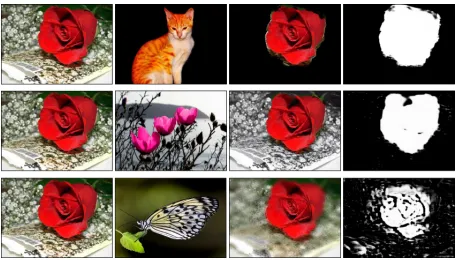
Figure 1: Given the same image (1st column), imitating dif-ferent visual effects (2nd column) can yield distinct interpre-tations of figure-ground segmentation (3rd column), which are derived by our method via referencing the following vi-sual effects (from top to bottom): black background, color selectivo, anddefocus/Bokeh. The learned VERs are shown in the last column, respectively.
resulting VER is closely related to image segmentation. An-other advantage of focusing on visual-effect images is that such data are abundant from the Internet, while pixel-wise annotating large datasets for image segmentation is time-consuming. However, in practice, we only have access to the visual-effect images, but not the VERs as well as the original images. Taking all these factors into account, we reduce the meta-problem of figure-ground segmentation to predicting the proper VER of a given image for the underlying visual effect. Owing to its data richness from the Internet, the latter task is more suitable for our intention to cast the problem within the unsupervised generative framework.
Many compositional image editing tasks have the afore-mentioned properties. For example, to create the color selectivoeffect on an image, as shown in Fig. 2, we can
are decomposed. If a part of the target region is partitioned into the background, the result might look less plausible. Un-like the local operations, to localize the proper regions for editing would require certain understanding and analysis of the global or contextual information in the whole image. In this paper, we design a GAN-based model, called Visual-Effect GAN (VEGAN), that can learn to predict the internal representation (i.e., VER) and incorporate such information into facilitating the resulting figure-ground segmentation.
We are thus motivated to formulate the following prob-lem: Given an unaltered RGB image as the input and an im-age editing task with known compositional process and local operation, we aim to predict the proper VER that guides the editing process to generate the expected visual effect and ac-complishes the underlying figure-ground segmentation. We adopt a data-driven setting in which the image editing task is exemplified by a collection of image samples with the ex-pected visual effect. The task, therefore, is to transform the original RGB input image into an output image that exhibits the same effect of the exemplified samples. To make our ap-proach general, we assume thatno corresponding pairs of input and output images are available in training, and there-fore supervised learning is not applicable. That is, the train-ing data does not include pairs of the original color images and the corresponding edited images with visual effects. The flexibility is in line with the fact that although we could fetch a lot of images with certain visual effects over the Inter-net, we indeed do not know what their original counterpart should look like. Under this problem formulation, several issues are of our interest and need to be addressed.
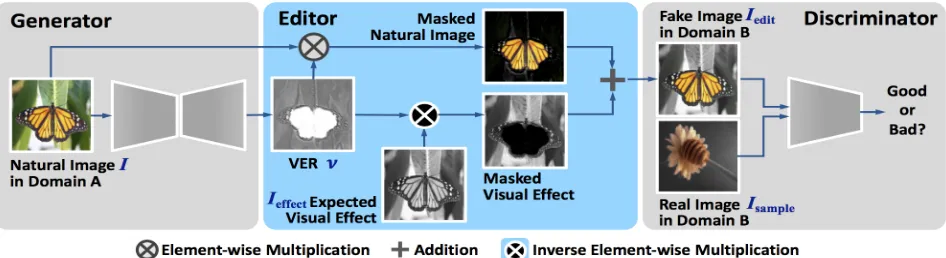
First,how do we solve the problem without paired input and output images?We build on the idea of generative ad-versarial network and develop a new unsupervised learning mechanism (shown in Figs. 2 & 3) to learn the internal rep-resentation for creating the visual effect. Thegeneratoraims to predict the internal VER and theeditoris to convert the input image into the one that has the expected visual ef-fect. The compositional procedure and local operation are generic and can be implemented as parts of the architecture of a ConvNet. Thediscriminatorhas to judge the quality of the edited images with respect to a set of sample images that exhibit the same visual effect. The experimental results show that our model works surprisingly well to learn meaningful representation and segmentation without supervision.
Second, where do we acquire the collection of sample images for illustrating the expected visual effect? Indeed, it would not make sense if we have to manually generate the labor-intensive sample images for demonstrating the ex-pected visual effects. We show that the required sample im-ages can be conveniently collected from the Internet. We provide a couple of scripts to explore the effectiveness of using Internet images for training our model. Notice again that, although the required sample images with visual ef-fects are available on the Internet, their original versions are unknown. Thus supervised learning of pairwise image-to-image translation cannot be applied here.
Third,what can the VER be useful for, in addition to cre-ating visual effects?We show that, if we are able to choose a suitable visual effect, the learned VER can be used to not
only establish the intended figure-ground notion but also de-rive the image segmentation. More precisely, as in our for-mulation the visual-effect representation is characterized by a real-valued response map, the result of figure-ground sep-aration can be obtained via binarizing the VER. Therefore, it is legitimate to take the proposed problem of VER predic-tion as a surrogate for unsupervised image segmentapredic-tion.
We have tested the following visual effects: i) black background, which is often caused by using flashlight;
ii) color selectivo, which imposes color highlight on the subject and keeps the background in grayscale; iii) defocus/Bokeh, which is due to depth of field of cam-era lens. The second column in Fig. 1 shows the three types of visual effects. For these tasks our model can be end-to-end trained from scratch in an unsupervised manner using training data that do not have either the ground-truth pixel labeling or the paired images with/without visual effects. While labor-intensive pixel-level segmentations for images are hard to acquire directly via Internet search, images with those three effects are easy to collect from photo-sharing websites, such as Flickr, using related tags.
Related Work
We discuss below some related work on the topics of gener-ative adversarial networks and image segmentation.
Generative Adversarial Networks
The idea of GAN (Goodfellow et al. 2014) is to generate realistic samples through the adversarial game between gen-eratorGand discriminatorD. GAN becomes popular ow-ing to its ability to achieve unsupervised learnow-ing. However, GAN also encounters many problems such as instability and model collapsing. Hence later methods (Radford, Metz, and Chintala 2016; Arjovsky, Chintala, and Bottou 2017; Gulrajani et al. 2017) try to improve GAN in both the aspects of implementation and theory. DCGAN (Radford, Metz, and Chintala 2016) provides a new framework that is more stable and easier to train. WGAN (Arjovsky, Chintala, and Bottou 2017) suggests to use Wasserstein distance to measure the loss. WGAN-GP (Gulrajani et al. 2017) further improves the way of the Lipschitz constraint being enforced, by replacing weight clipping with gradient penalty.
To reduce the burden of G, Dentonet al. (Denton et al. 2015) use a pyramid structure and Karraset al. (Karras et al. 2018) consider a progressive training methodology. Both of them divide the task into smaller sequential steps. In our case, we alleviate the burden of Gby incorporating some well-defined image processing operations into the network model,e.g., converting background color into grayscale to simulate the visual effect ofcolor selectivo, or blur-ring the background to create theBokeheffect.
Figure 2: Learning and applying our model for the case of “color selectivo” visual effect. The image collection for learning is downloaded using Flickr API. Without explicit ground-truth pixel-level annotations being provided, our method can learn to estimate the visual-effect representations (VERs) fromunpaired sets of natural RGB images and sample images with the expected visual effect. Our generative model is called Visual-Effect GAN (VEGAN), which has an additional componenteditor
between the generator and the discriminator. After the unsupervised learning, the generator is able to predict the VER of an input color image for creating the expected visual effect. The VER can be further transformed into figure-ground segmentation.
unsupervised learning. For the applications of modifying photo styles, some methods (Liu, Breuel, and Kautz 2017; Yi et al. 2017; Zhu et al. 2017) can successfully achieve image-to-image style transfer using unpaired data, but their results are limited to subjective evaluation. Moreover, those style-transfer methods cannot be directly applied to the task of unsupervised segmentation.
Since our model has to identify the category-independent subjects for applying the visual effect without using image-pair relations and ground-truth pixel-level annotations, the problem we aim to address is more general and challenging than those of the aforementioned methods.
Image Segmentation
Most of the existing segmentation methods that are based on deep neural networks (DNNs) to treat the segmentation problem as a pixel-level classification problem (Simonyan and Zisserman 2015; Long, Shelhamer, and Darrell 2015; He et al. 2016). The impressive performance relies on a large number of high-quality annotations. Unfortunately, collect-ing high-quality annotations at a large scale is another chal-lenging task since it is exceedingly labor-intensive. As a re-sult, existing datasets just provide class and limited-annotation data for training DNNs. DNN-based segmenta-tion methods thus can only be applied to a limited subset of category-dependent segmentation tasks.
To reduce the dependency of detailed annotations and to simplify the way of acquiring a sufficient number of training data, a possible solution is to train DNNs in a semi-supervised manner (Hong, Noh, and Han 2015; Souly, Spampinato, and Shah 2017) or a weakly-supervised man-ner (Dai, He, and Sun 2015; Kwak, Hong, and Han 2017; Pinheiro and Collobert 2015) with a small number of pixel-level annotations. In contrast, our model is trained without explicit ground-truth annotations.
Existing GAN-based segmentation methods (Nguyen et al. 2017; Luc et al. 2016) improve their segmentation per-formance using mainly the adversarial mechanism of GANs. The ground-truth annotations are needed in their training process for constructing the adversarial loss, and therefore they are GAN-based but not “unsupervised” from the per-spective of application and problem definition.
We instead adopt a meta-learning viewpoint to address figure-ground segmentation. Depending on the visual effect
to be imitated, the proposed approach interprets the task of image segmentation according to the learned VER. As a re-sult, our model indeed establishes a general setting of figure-ground segmentation, with the additional advantage of gen-erating visual effects or photo-style manipulations.
Our Method
Given a natural RGB imageIand an expected visual effect with known compositional process and local operation, the proposed VEGAN model learns to predict the visual-effect representation (VER) ofI and to generate an edited image
Ieditwith the expected effect. Fig. 2 illustrates the core idea.
The training data are from twounpairedsets: the set{I}of original RGB images and the set{Isample}of images with
the expected visual effect. The learning process is carried out as follows:i)Generatorpredicts the VERν of the im-ageI.ii)Editoruses the known local operation to create an edited imageIeditpossessing the expected visual effect.iii)
Discriminatorjudges the quality of the edited imagesIedit
with respect to a set{Isample}of sample images that exhibit
the same visual effect.iv)Lossis computed for updating the whole model. Fig. 3 illustrates the components of VEGAN. Finally, we performBinarizationon VER for quantitatively assess the outcome of figure-ground segmentation.
Generator: The task of the generator is to predict the VER
ν that can be used to partition the input imageIinto fore-ground and backfore-ground layers. Our network architecture is adapted from the state-of-the-art methods (Johnson, Alahi, and Fei-Fei 2016; Zhu et al. 2017) which show impressive results on image style transfer. The architecture follows the rules suggested by DCGAN (Radford, Metz, and Chintala 2016) such as replacing pooling layer with strided convo-lution. Our base architecture also uses the9-residual-blocks version of (Johnson, Alahi, and Fei-Fei 2016). We have also tried a few slightly modified versions of the generator. The differences and details are described in the experiments.
Discriminator: The discriminator is trained to judge the quality of the edited images Iedit with respect to a set
{Isample}of sample images that exhibit the same effect. We
Figure 3: The proposed Visual-Effect GAN (VEGAN) model. Here we takecolor selectivoas the expected visual effect. The visual-effect representation (VER) produced by the generator indicates the strength of the visual effect at each location. The
editoruses a well-defined trainable procedure (converting RGB to grayscale in this case) to create the expected visual effect. The discriminator receives the edited imageIeditand evaluates how good it is. To train VEGAN, we need unpaired images
from two domains. Domain A comprises real RGB images and Domain B comprises images with the expected visual effect.
2017; Li and Wand 2016; Zhu et al. 2017) as our base dis-criminator network. PatcahGAN brings some benefits with multiple overlapping image patches. Namely, the scores change more smoothly and the training process is more sta-ble. Compared with a full-image discriminator, the receptive field of the70×70patchGAN might not capture the global context. In our work, the foreground objects are sensitive to their position in the whole image and are center-biased. If there are several objects in the image, our method would favor to pick out the object closest to the center. In our ex-periment,70×70patchGAN does produce better segments along the edges, but sometimes the segments tend to be tat-tered. A full-image discriminator (Goodfellow et al. 2014; Radford, Metz, and Chintala 2016; Arjovsky, Chintala, and Bottou 2017; Gulrajani et al. 2017), on the other hand, could give coarser but more compact and structural segments.
Editor: The editor is the core of the proposed model. Given an input image I and its VER ν predicted by the generator, the editor is responsible for creating a composed imageIedit containing the expected visual effect. The first
step is based on the well-defined procedure to perform local operations on the image and generate the expected visual effectIeffect. More specifically, in our experiments we
de-fine three basic local operations:black-background, color-selectivo, and defocus/Bokeh, which involve clamping-to-zero,grayscale conversion, and11×11average pooling, respectively. The next step is to combine the edited back-ground layer with the foreback-ground layer to get the final editing resultIedit. An intuitive way is to use the VERνas an alpha
mapαfor image matting,i.e.,Iedit =α⊗I+ (1−α)⊗ Ieffect, whereα = {αij},αij ∈ (0,1)and⊗denotes the element-wise multiplication. However, in our experiments, we find that it is better to haveν = {νij},νij ∈ (−1,1) with hyperbolic-tangent as the output. Hence we combine the two layers as follows:
Iedit=τ(ν⊗(I−Ieffect) +Ieffect), νij∈(−1,1), (1)
whereτ(·)truncates the values to be within(0,255), which guarantees the Iedit can be properly rendered. Under this
formulation, our model turns to learning the residual.
Loss: We refer to SOTA algorithms (Arjovsky, Chintala, and Bottou 2017; Gulrajani et al. 2017) to design loss func-tionsLGandLDfor generator (G) and discriminator (D):
LG=−Ex∼Pg[D(x))], (2)
LD=Ex∼Pg[D(x))]−Ey∼Pr[D(y)]
+ λgp Eˆx∼Pxˆ[(k∇xˆD(ˆx)k2−1)
2]. (3)
We alternately update the generator by Eq. 2 and the dis-criminator by Eq. 3. In our formulation,xis the edited im-ageIedit,yis an imageIsamplewhich exhibits the expected
visual effect, Pg is the edited image distribution,Pr is the sample image distribution, andPxˆis for sampling uniformly
along straight lines between image pairs from Pg and Pr. We set the learning rate, λgp, and other hyper-parameters the same as the configuration of WGAN-GP (Gulrajani et al. 2017). We keep the history of previously generated im-ages and update the discriminator according to the history. We use the same way as (Zhu et al. 2017) to store 50 pre-viously generated images{Iedit} in a buffer. The training
images are of size224×224, and the batch size is1.
smooth within an object and distinct across object bound-aries. To respect this observation, we describe, in what fol-lows, an optional procedure to obtain a smoothed VER and enable simple thresholding to yield a good binary mask for quantitative evaluation. Notice that all the VER maps visu-alized in this paper are obtained without binarization.
To begin with, we over-segment (Achanta et al. 2012) an input image I into a superpixel set S and construct the corresponding superpixel-level graph G = (S,E, ω)
with the edge set E and weights ω. Each edge eij ∈ E denotes the spatial adjacency between superpixels si and
sj. The weighting function ω : E → [0,1] is defined as
ωij =e−θ1kci−cjk, whereciandcj respectively denote the CIE Lab mean colors of two adjacent superpixels. Then the weight matrix of the graph isW= [ωij]|S|×|S|.
We then smooth the VER via propagating the averaged value of each superpixel to all other superpixels. To this end, we useri to denote the mean VER value of superpixelsi whereri= |s1
i| P
(i,j)∈siνijand|si|is the number of pixels within si. The propagation is carried out according to the feature similarity between every superpixel pair. Given the weight matrixW, the pairwise similarity matrixAcan be constructed asA= (D−θ2W)−1I, whereDis a diagonal
matrix with each diagonal entry equal to the row sum ofW,
θ2 is a parameter in(0,1], and Iis the |S|-by-|S| identity
matrix (Zhou et al. 2003). Finally, the smoothed VER value of each superpixel can be obtained by
[ˆr1,rˆ2, . . . ,rˆ|S|]T =DA−1A·[r1, r2, . . . , r|S|]T, (4)
where DA is a diagonal matrix with each diagonal entry
equal to the corresponding row sum ofA, andD−A1Ayields the row normalized version ofA. From Eq. 4, we see that the smoothed VER valuerˆiis determined by not only neighbor-ing superpixels ofsibut also all other superpixels.
To obtain the binary mask, we set the average value of {rˆ1,ˆr2, . . . ,rˆ|S|} as the threshold for obtaining the corre-sponding figure-ground segmentation for the inputI. We set parametersθ1= 10andθ2= 0.99in all the experiments.
Experiments
We first describe the evaluation metric, the testing datasets, the training data, and the algorithms in comparison. Then, we show the comparison results of the relevant algorithms and our approach. Finally, we present the image segmenta-tion and editing results of our approach. More experimental results can be found in the supplementary material.
Evaluation Metric. We adopt the intersection-over-union (IoU) to evaluate the binary mask derived from the VER. The IoU score, which is defined as|P
T
Q|
|PSQ|, wherePdenotes
the machine segmentation andQdenotes the ground-truth segmentation. All algorithms are tested on Intel i7-47703.40
GHz CPU, 8GB RAM, and NVIDIA Titan X GPU.
Datasets. The six datasets are GC50 (Rother, Kolmogorov, and Blake 2004), MSRA500, ECSSD (Shi et al. 2016), Flower17 (Nilsback and Zisserman 2006), Flower102 (Nils-back and Zisserman 2008), and CUB200 (Wah et al. 2011). MSRA500 is a subset of the MSRA10K dataset (Cheng et al. 2015), which contains 10,000 natural images. We randomly
Table 1: Testing datasets and number of images.
GC50 MSRA500 ECSSD Flower17 Flower102 CUB200
50 500 1,000 1,360 8,189 11,788
partition MSRA10K into two non-overlapping subsets of 500 and 9,500 images to create MSRA500 and MSRA9500 for testing and training, respectively. Their statistics are summarized in Table 1. Since these datasets provide pixel-level ground truths, we can compare the consistency be-tween the ground-truth labeling and the derived segmenta-tion of each image for VER-quality assessment.
Training Data. In training the VEGAN model, we consider using the images from two different sources for compari-son. The first image source is MSRA9500 derived from the MSRA10K dataset (Cheng et al. 2015). The second image source is Flickr, and we acquire unorganized images for each task as the training data. We examine our model on three kinds of visual effects, namely, black background, color selectivo, anddefocus/Bokeh.
• For MSRA9500 images, we randomly select 4,750 im-ages and then apply the three visual effects to yield three groups ofimages with visual effects,i.e.,{Isample}. The
other 4,750 images are hence the input images{I}for the generator to produce theedited images{Iedit}later.
• For Flickr images, we use “black background,” “color se-lectivo,” and “defocus/Bokeh” as the three query tags, and then collect 4,000 images for each query-tag as thereal images with visual effects. We randomly download addi-tional 4,000 images from Flickr as the images to be edited. Algorithms in Comparison. We quantitatively evaluate the learned VER using the standard segmentation assess-ment metric (IoU). Our approach is compared with several well-known algorithms, including two semantic segmenta-tion algorithms, three saliency based algorithms, and two bounding-box based algorithms, listed as follows: ResNet (He et al. 2016), VGG16 (Simonyan and Zisserman 2015), CA (Qin et al. 2015), MST (Tu et al. 2016), GBMR (Yang et al. 2013), MilCutS and MilCutG (Wu et al. 2014), GrabCut (Rother, Kolmogorov, and Blake 2004). The twosupervised
semantic segmentation algorithms, ResNet and VGG16, are pre-trained on ILSVRC-2012-CLS (Russakovsky et al. 2015) and then fine-tuned on MSRA9500 with ground-truth annotations. The bounding boxes of the two bounding-box based algorithms are initialized around the image borders.
Quantitative Evaluation
The first part of experiment aims to evaluate the segmen-tation quality of different methods. We first compare sev-eral variants of the VEGAN model to choose the best model configuration. Then, we analyze the results of the VEGAN model versus the other state-of-the-art algorithms.
Table 2: Comparison of VEGAN variants. All variants are trained with MSRA9500. Each entry shows theversionand themean IoU score(in parentheses) of a VEGAN variant.
Visual Effect Testing Dataset MSRA500 mean IoU Black Background B1 (0.67) B2 (0.73) B3 (0.70) B4 (0.76)
Color Selectivo C1 (0.73) C2 (0.73) C3 (0.74) C4 (0.75) Defocus/Bokeh D1 (0.70) D2 (0.66) D3 (0.70) D4 (0.73)
Testing on Flower17 Testing on Flower102
Figure 4: Comparison of two training sources: MSRA9500 and Flickr. Each sub-figure depicts the sorted IoU scores for the variants. Note that Flickr-B4 is trained from the queried Flickr images and performs as well as other variants.
MSRA500 Flower102
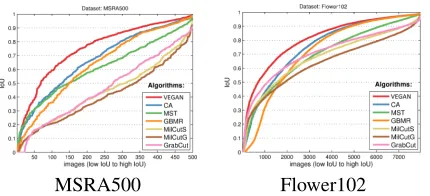
Figure 5: Comparisons among algorithms. Each sub-figure depicts the sorted IoU scores as the segmentation accuracy.
character denotes the type of visual effect: “B” forblack background, “C” forcolor selectivo, and “D” for defocus/Bokeh. The second character is the model con-figuration: “1” refers to the combination of base-generator and base-discriminator described inOur Method; “2” refers to using ResNet as the generator; “3” is the model “1” with additional skip-layers and replacing transpose convolution with bilinear interpolation; “4” is the model “3” yet replac-ing patch-based discriminator with full-image discriminator. We report the results of VEGAN variants in Table 2, and depict the sorted IoU scores for the test images in Flower17 and Flower102 datasets in Fig. 4. It can be seen that all mod-els have similar segmentation qualities no matter what image source is used for training. In Table 2 and Fig. 4, the train-ing configuration “B4” shows relatively better performance underblack background. Hence, our VEGAN model adopts the version of MSRA-B4 as a representative variant for comparing with other state-of-the-art algorithms. Unseen Images. We further analyze the differences of the learned models on dealing with unseen and seen images. We test the variants B4, C4, and D4 on MSRA500
(un-seen) and the subset {I} of MSRA9500 (seen). We find that the performance of VEGAN is quite stable. The IoU score for MSRA500 is only 0.01 lower than the score for MSRA9500 {I}. Note that, even for the seen images, the ground-truth pixel annotations are unknown to the VEGAN model during training. This result indicates that VEGAN has a good generalization ability to predict segmentation for ei-ther seen or unseen images. For comparison, we do the same experiment with the two supervised algorithms, ResNet and VGG16. They are fine-tuned with MSRA9500. The mean IoU scores of ResNet are0.86and0.94for MSRA500 and MSRA9500, respectively. The mean IoU scores of VGG16 are 0.72 and0.88for MSRA500 and MSRA9500, respec-tively. The performance of both supervised techniques sig-nificantly degrades while dealing with unseen images.
From the results just described, the final VEGAN model is implemented with the following setting:i)Generatoruses the9-residual-blocks version of (Johnson, Alahi, and Fei-Fei 2016).ii)Discriminatoruses the full-image discriminator as WGAN-GP (Gulrajani et al. 2017).
Results. The top portion of Table 3 summarizes the mean IoU score of each algorithm evaluated with the six testing datasets. We first compare our method with five well-known segmentation/saliency-detection techniques, including CA (Qin et al. 2015), MST (Tu et al. 2016), GBMR (Yang et al. 2013), MilCutS/MilCutG (Wu et al. 2014), and GrabCut (Rother, Kolmogorov, and Blake 2004). The proposed VE-GAN model outperforms all others on MSRA500, ECSSD, Flower17, and Flower102 datasets, and is only slightly be-hind the best on GC50 and CUB200 datasets.
The bottom portion of Table 3 shows the results of two SOTA supervised learning algorithms on the six testing datasets. Owing to training with the paired images and ground-truths in a “supervised” manner, the two models of ResNet and VGG16 undoubtedly achieve good performance so that we treat them as the oracle models. Surprisingly, our unsupervised learning model is comparable with or even slightly better than the supervised learning algorithms on the MSRA500, Flower17, and Flower102 datasets.
Fig. 5 depicts the sorted IoU scores, where a larger area under curve means better segmentation quality. VEGAN achieves better segmentation accuracy on the two datasets.
Qualitative Evaluation
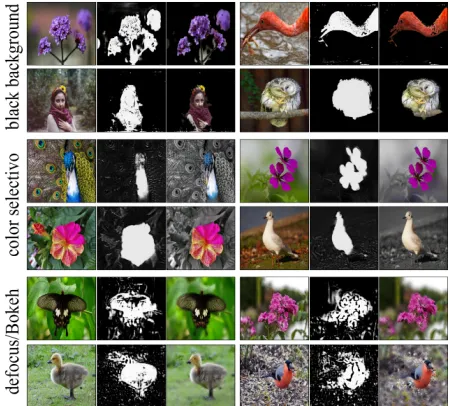
Fig. 6 shows the results generated by our VEGAN model un-der different configurations. Each triplet of images contains the input image, the visual effect representation (VER), and the edited image. The results in Fig. 6 demonstrate that VE-GAN can generate reasonable figure-ground segmentations and plausible edited images with expected visual effects. Visual-Effect Imitation as Style Transfer. Although ex-isting GAN models cannot be directly applied to learn-ing figure-ground segmentation, some of them are applica-ble to learning visual-effect transfer,e.g., CycleGAN (Zhu et al. 2017). We use the two sets {I} and {Isample} of
Table 3: The mean IoU scores of each algorithm on the six datasets. The VEGAN model uses configuration “MSRA-B4” for comparison. Notice that the “supervised learning al-gorithms” ResNet (He et al. 2016) and VGG16 (Simonyan and Zisserman 2015) are pre-trained with ILSVRC-2012-CLS and then fine-tuned with MSRA9500.
Testing Dataset—Mean IoU Score
GC50 MSRA500 ECSSD Flower17 Flower102 CUB200
Algorithm
VEGAN 0.58 0.76 0.58 0.72 0.81 0.52 CA 0.59 0.67 0.50 0.72 0.75 0.51 MST 0.60 0.61 0.53 0.68 0.70 0.54 GBMR 0.52 0.64 0.48 0.68 0.71 0.49 MilCutS 0.54 0.43 0.48 0.67 0.67 0.43 MilCutG 0.50 0.41 0.46 0.64 0.63 0.41 GrabCut 0.51 0.46 0.45 0.68 0.71 0.39
Oracle
ResNet 0.70 0.86 0.67 0.72 0.79 0.60 VGG16 0.68 0.72 0.63 0.73 0.80 0.57
Table 4: Percentage of preferring the VEGAN results. 26 participants mean median Black Background 90.70% 95.00% Color Selectivo 80.30% 80.00% Defocus/Bokeh 75.75% 80.00%
inverse mapping back to{I}. Moreover, CycleGAN focuses more on learning the mapping between local properties such as color or texture rather than learning how to create a glob-ally consistent visual effect. VEGAN instead follows a sys-tematic learning procedure to imitate the visual effect. The generator must produce a meaningful VER so that the editor can compose a plausible visual-effect image that does not contain noticeable artifacts for the discriminator to identify.
Figure 6: The edited images generated by VEGAN with re-spect to specific visual effects. Each image triplet from left to right: the input image, the VER, and the edited image.
Black Background Color Selectivo
Figure 7: The edited images by VEGAN and CycleGAN. CycleGAN is trained with MSRA9500. The task of imitating black backgroundis challenging for CycleGAN.
Figure 8: Testing on Flickr “bird” images using VEGAN model trained with Flickr “flower” images. The first row shows the input images. The second rows shows the VERs.
User Study. Table 4 lists the results from 26 participants. The survey is presented in Google forms, comprising 40 edited image pairs (e.g., as in Fig. 7) for each visual effect. Each user is asked to select the preferred one from an image pair of random order by CycleGAN and VEGAN.
Unseen Figures. To demonstrate that the VEGAN model can learn the general concept of figure-ground segmentation and thus handle unseen foreground “figures.” Fig. 8 shows VERs that testing on Flickr “bird” images using VEGAN models trained merely with Flick “flower” images. The re-sults suggest that the meta-learning mechanism enables VE-GAN to identify unseen foreground figures based on the learned knowledge embodied in the generated VERs.
Conclusion
We characterize the two main contributions of our method as follows. First, we establish a meta-learning framework to learn a general concept of figure-ground application and an effective approach to the segmentation task. Second, we propose to cast the meta-learning as imitating relevant visual effects and develop a novel VEGAN model with following advantages:i) Our model offers a new way to predict mean-ingful figure-ground segmentation from unorganized images that have no explicit pixel-level annotations.ii) The training images are easy to collect from photo-sharing websites us-ing related tags. iii) The editorbetween the generator and the discriminator enables VEGAN to decouple the compo-sitional process of imitating visual effects and hence allows VEGAN to effectively learn the underlying representation (VER) for deriving figure-ground segmentation. We have tested three visual effects, including “black background,” “color selectivo,” and “defocus/Bokeh” with extensive ex-periments on six datasets. For these visual effects, VEGAN can be end-to-end trained from scratch using unpaired train-ing images that have no ground-truth labeltrain-ing.
References
Achanta, R.; Shaji, A.; Smith, K.; Lucchi, A.; Fua, P.; and S¨usstrunk, S. 2012. SLIC superpixels compared to state-of-the-art superpixel methods. IEEE Trans. Pattern Anal. Mach. Intell.34(11):2274–2282.
Arjovsky, M.; Chintala, S.; and Bottou, L. 2017. Wasserstein generative adversarial networks. InICML, 214–223. Cheng, M.; Mitra, N. J.; Huang, X.; Torr, P. H. S.; and Hu, S. 2015. Global contrast based salient region detection. IEEE Trans. Pattern Anal. Mach. Intell.37(3):569–582.
Dai, J.; He, K.; and Sun, J. 2015. Boxsup: Exploiting bound-ing boxes to supervise convolutional networks for semantic segmentation. InICCV, 1635–1643.
Denton, E. L.; Chintala, S.; Szlam, A.; and Fergus, R. 2015. Deep generative image models using a laplacian pyramid of adversarial networks. InNIPS, 1486–1494.
Goodfellow, I. J.; Pouget-Abadie, J.; Mirza, M.; Xu, B.; Warde-Farley, D.; Ozair, S.; Courville, A. C.; and Bengio, Y. 2014. Generative adversarial nets. InNIPS, 2672–2680. Gulrajani, I.; Ahmed, F.; Arjovsky, M.; Dumoulin, V.; and Courville, A. C. 2017. Improved training of wasserstein gans. InNIPS, 5769–5779.
He, K.; Zhang, X.; Ren, S.; and Sun, J. 2016. Deep residual learning for image recognition. InCVPR, 770–778. Hong, S.; Noh, H.; and Han, B. 2015. Decoupled deep neural network for semi-supervised semantic segmentation. InNIPS, 1495–1503.
Isola, P.; Zhu, J.; Zhou, T.; and Efros, A. A. 2017. Image-to-image translation with conditional adversarial networks. In
CVPR, 5967–5976.
Johnson, J.; Alahi, A.; and Fei-Fei, L. 2016. Perceptual losses for real-time style transfer and super-resolution. In
ECCV, 694–711.
Karras, T.; Aila, T.; Laine, S.; and Lehtinen, J. 2018. Pro-gressive growing of gans for improved quality, stability, and variation. InICLR.
Kwak, S.; Hong, S.; and Han, B. 2017. Weakly supervised semantic segmentation using superpixel pooling network. In
AAAI, 4111–4117.
Ledig, C.; Theis, L.; Huszar, F.; Caballero, J.; Cunningham, A.; Acosta, A.; Aitken, A. P.; Tejani, A.; Totz, J.; Wang, Z.; and Shi, W. 2017. Photo-realistic single image super-resolution using a generative adversarial network. InCVPR. Li, C., and Wand, M. 2016. Precomputed real-time texture synthesis with markovian generative adversarial networks. InECCV, 702–716.
Liu, M.; Breuel, T.; and Kautz, J. 2017. Unsupervised image-to-image translation networks. InNIPS, 700–708. Long, J.; Shelhamer, E.; and Darrell, T. 2015. Fully convo-lutional networks for semantic segmentation. InCVPR. Luc, P.; Couprie, C.; Chintala, S.; and Verbeek, J. 2016. Se-mantic segmentation using adversarial networks. InNIPSW. Nguyen, V.; Vicente, T. F. Y.; Zhao, M.; Hoai, M.; and Sama-ras, D. 2017. Shadow detection with conditional generative adversarial networks. InICCV, 4520–4528.
Nilsback, M., and Zisserman, A. 2006. A visual vocabulary for flower classification. InCVPR, 1447–1454.
Nilsback, M., and Zisserman, A. 2008. Automated flower classification over a large number of classes. InICVGIP. Pan, J.; Canton-Ferrer, C.; McGuinness, K.; O’Connor, N. E.; Torres, J.; Sayrol, E.; and Gir´o i Nieto, X. 2017. Sal-gan: Visual saliency prediction with generative adversarial networks. InCVPRW.
Pinheiro, P. H. O., and Collobert, R. 2015. From image-level to pixel-image-level labeling with convolutional networks. In
CVPR, 1713–1721.
Qin, Y.; Lu, H.; Xu, Y.; and Wang, H. 2015. Saliency detec-tion via cellular automata. InCVPR, 110–119.
Radford, A.; Metz, L.; and Chintala, S. 2016. Unsupervised representation learning with deep convolutional generative adversarial networks. InICLR.
Rother, C.; Kolmogorov, V.; and Blake, A. 2004. ”grabcut”: interactive foreground extraction using iterated graph cuts.
ACM Trans. Graph.23(3):309–314.
Russakovsky, O.; Deng, J.; Su, H.; Krause, J.; Satheesh, S.; Ma, S.; Huang, Z.; Karpathy, A.; Khosla, A.; Bernstein, M. S.; Berg, A. C.; and Li, F. 2015. Imagenet large scale visual recognition challenge.International Journal of Com-puter Vision115(3):211–252.
Shi, J.; Yan, Q.; Xu, L.; and Jia, J. 2016. Hierarchical image saliency detection on extended CSSD. IEEE Trans. Pattern Anal. Mach. Intell.38(4):717–729.
Simonyan, K., and Zisserman, A. 2015. Very deep convolu-tional networks for large-scale image recognition. InICLR. Souly, N.; Spampinato, C.; and Shah, M. 2017. Semi su-pervised semantic segmentation using generative adversarial network. InICCV, 5689–5697.
Tu, W.; He, S.; Yang, Q.; and Chien, S. 2016. Real-time salient object detection with a minimum spanning tree. In
CVPR, 2334–2342.
Wah, C.; Branson, S.; Welinder, P.; Perona, P.; and Belongie, S. 2011. The Caltech-UCSD Birds-200-2011 Dataset. Tech-nical Report CNS-TR-2011-001, Caltech.
Wu, J.; Zhao, Y.; Zhu, J.; Luo, S.; and Tu, Z. 2014. Milcut: A sweeping line multiple instance learning paradigm for in-teractive image segmentation. InCVPR, 256–263.
Yang, C.; Zhang, L.; Lu, H.; Ruan, X.; and Yang, M. 2013. Saliency detection via graph-based manifold ranking. In
CVPR, 3166–3173.
Yi, Z.; Zhang, H. R.; Tan, P.; and Gong, M. 2017. Dualgan: Unsupervised dual learning for image-to-image translation. InICCV, 2868–2876.
Zhou, D.; Bousquet, O.; Lal, T. N.; Weston, J.; and Sch¨olkopf, B. 2003. Learning with local and global con-sistency. InNIPS, 321–328.