Seglearn: A Python Package for Learning Sequences and
Time Series
David M. Burns [email protected]
Sunnybrook Research Institute
Cari M. Whyne [email protected]
Sunnybrook Research Institute 2075 Bayview Ave. Room S620. Toronto, ON, Canada. M4N 3M5.
Editor:Alexandre Gramfort
Abstract
seglearnis an open-source Python package for performing machine learning on time se-ries or sequences. The implementation provides a flexible pipeline for tackling classifica-tion, regression, and forecasting problems with multivariate sequence and contextual data. Sequences and series may be learned directly with deep learning models or via feature representation with classical machine learning estimators. This package is compatible with
scikit-learnand is listed underscikit-learn”Related Projects”. The package depends onnumpy,scipy, andscikit-learn. seglearnis distributed under the BSD 3-Clause Li-cense. Documentation includes a detailed API description, user guide, and examples. Unit tests provide a high degree of code coverage. Source code and documentation can be downloaded fromhttps://github.com/dmbee/seglearn.
Keywords: Machine-Learning, Time-Series, Sequences, Python
1. Introduction
Many real-world machine learning problems e.g. voice recognition, human activity recog-nition, power systems fault detection, stock price and temperature prediction, involve data that is captured as sequences over a period of time (Aha, 2018). Sequential data sets do not fit the standard supervised learning framework, where each sample (x, y) within the data set is assumed to be independently and identically distributed (iid) from a joint distribution
P(x, y) (Bishop, 2011). Instead, the data consistsequences of (x, y) pairs, and nearby val-ues of (x, y) within a sequence are likely to be correlated to each other. Sequence learning exploits the sequential relationships in the data to improve algorithm performance.
2. Supported Problem Classes
Sequence data sets have a general formulation (Dietterich, 2002) as sequence pairs{(Xi,yi)}Ni=1, where each Xi is a multivariate sequence with Ti samples hxi,1,xi,2, ...,xi,Tii and each yi
target is a univariate sequence with Ti samples hyi,1, yi,2, ..., yi,Tii. The targets yi can
ei-c
ther be sequences of categorical class labels (for classification problems), or sequences of continuous data (for regression problems). The number of samples Ti varies between the
sequence pairs in the data set. Time series with a regular sampling period may be treated equivalently to sequences. Irregularly sampled time series are formulated with an additional sequence variableti that increases monotonically and indicates the timing of samples in the
data set {(ti,Xi,yi)}Ni=1.
Important sub-classes of the general sequence learning problem are sequence classification and sequence prediction. In sequence classification problems (eg song genre classification), the target for each sequence is a fixed class labelyiand the data takes the form{(Xi, yi)}Ni=1. Sequence prediction involves predicting a future value of the target (yi,t+f) or future
val-ues hyi,t+1, yi,t+2, ..., yi,t+fi, given hxi,1,xi,2, ...,xi,ti, hyi,1, yi,2, ..., yi,ti, and sometimes also
hxi,t+1,xi,t+2, ...,xi,t+fi.
A final important generalization is the case where contextual data associated with each sequence, but not varying within the sequence, exists to support the machine learning algorithm performance. Perhaps the algorithm for reading electrocardiograms will be given access to laboratory data, the patient’s age, or known medical diagnoses to assist with classifying the sequential data recovered from the leads.
seglearn provides a flexible, user-friendly framework for learning time series and se-quences in all of the above contexts. Transforms for sequence padding, truncation, and sliding window segmentation are implemented to fix sample number across all sequences in the data set. This permits utilization of many classical and modern machine learning algorithms that require fixed length inputs. Sliding window segmentation transforms the sequence data into a piecewise representation (segments), which is particularly effective for learning periodized sequences (Bulling et al., 2014). An interpolation transform is imple-mented for resampling irregularly sampled time series. The sequence or time series data can be learned directly with various neural network architectures (Lipton et al., 2015), or via a feature representation which greatly enhances performance of classical algorithms (Bulling et al., 2014).
3. Installation
The seglearn source code is available at: https://github.com/dmbee/seglearn. It is operating system agnostic, and implemented purely in Python. The dependencies arenumpy, scipy, and scikit-learn. The package can be installed using pip:
$ pip install seglearn
Alternatively, seglearn can be installed from the sources: $ git clone https://github.com/dmbee/seglearn $ cd seglearn
$ pip install .
Feature
Representation ProcessingFeature
- scaling - selection
Classical ML Estimator
- SVC - Random Forest
Neural Network Estimator - CNN - RNN Sliding Window Segmentation
{{Wi , j,yi , j}Mj=1i}i=1
N
Inertial Data
Sliding Window Segmentation Inertial Data
b) Direct Segment Learning a) Feature Representation Learning
{{Wi , j,yi , j}j=1
Mi}
i=1
N
{{fi , j,yi , j}jM=1i}i=1
N
{Xi,yi}iN=1
{(Xi,yi)}iN=1
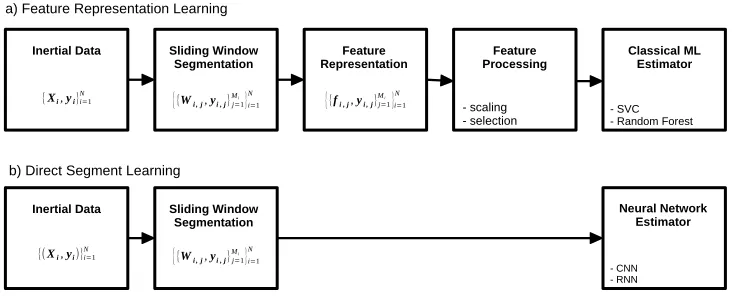
Figure 1: Example seglearn pipelines for a) learning segment feature representations, b) learning segments directly. Xi: time series, yi: time series target,N: number of
time series in the data set,Wi,j: segment (derived fromXi),fi,j: feature vector
(calculated from Wi,j), yi,j: segment target, Mi: number of segments derived
from time seriesXi, SVC: Support Vector Classifier, CNN: Convolution Neural
Network, RNN: Recurrent Neural Network.
4. Implementation
TheseglearnAPI was implemented for compatibility with scikit-learnand its existing framework for model evaluation and selection. The seglearn package provides means for handling sequence data, segmenting it, computing feature representations, calculating train-test splits and cross-validation folds along the temporal axis.1 An iterable, indexable data structure is implemented to represent sequence data with supporting contextual data.
Theseglearnfunctionality is provided within ascikit-learnpipeline allowing the user to leveragescikit-learntransformer and estimator classes, which are particularly helpful in the feature representation approach to segment learning. Direct segment learning with neural networks is implemented in pipeline using thekeraspackage, and itsscikit-learn API. Examples of both approaches are provided in the documentation and example gallery. The integrated learning pipeline, from raw data to final estimator, can be optimized within the scikit-learn model selection framework. This is important because segmentation parameters (eg window size, segment overlap) can have a significant impact on sequence learning performance (Burns et al., 2018; Bulling et al., 2014).
Sliding window segmentation transforms sequence data into a piecewise representation (segments), such that predictions are made and scored for all segments in the data set. Sliding window segmentation can be performed for data sets with a single target value per sequence, in which case that target value is mapped to all segments generated from the parent sequence. If the target for each is sequence is also a sequence, the target is segmented
as well and various methods may be used to select a single target value from the target segment (e.g. mean value, middle value, last value, etc.) or the target segment sequence can be predicted directly if an estimator implementing sequence to sequence prediction is utilized.
A human activity recognition data set (Burns et al., 2018) consisting of inertial sensor data recorded by a smartwatch worn during shoulder rehabilitation exercises is provided with the source code to demonstrate the features and usage of theseglearnpackage.
5. Basic Example
This example demonstrates the use of seglearnfor performing sequence classification with our smartwatch human activity recognition data set.
>>> import seglearn as sgl
>>> from sklearn.model selection import train test split >>> from sklearn.ensemble import RandomForestClassifier >>> from sklearn.preprocessing import StandardScaler >>>
>>> data = sgl.load watch()
>>> X train, X test, y train, y test = train test split(data["X"], data["y"]) >>>
>>> clf = sgl.Pype([("seg", sgl.SegmentX(width=100, overlap=0.5)), ... ("features", sgl.FeatureRep()),
... ("scaler", StandardScaler()), ... ("rf", RandomForestClassifier())]) >>>
>>> clf.fit(X train, y train)
>>> score = clf.score(X test, y test) >>> print("accuracy score:", score)
accuracy score: 0.7805084745762711
6. Comparison to other Software
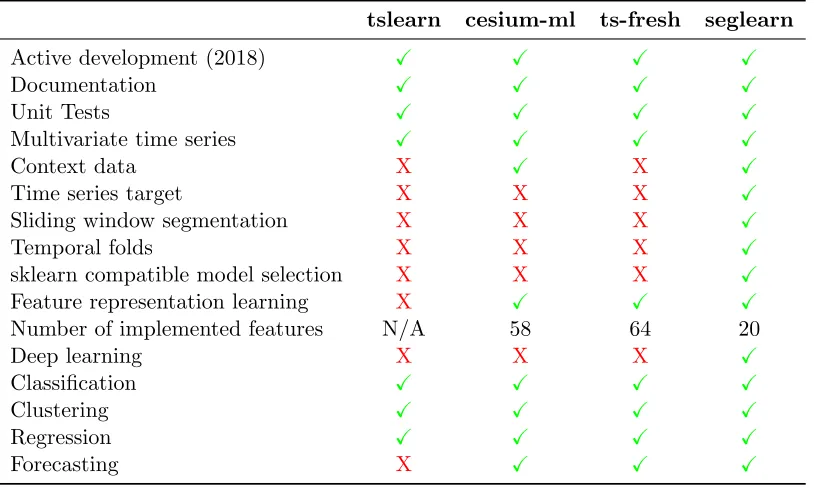
Three other Python packages for performing machine learning on time series and sequences were identified: tslearn (Tavenard, 2017), cesium-ml (Naul et al., 2016), and tsfresh (Christ et al., 2018). These were compared to seglearn based on time series learning capabilities (Table 1), and performance (Table 2).
tslearn cesium-ml ts-fresh seglearn
Active development (2018) X X X X
Documentation X X X X
Unit Tests X X X X
Multivariate time series X X X X
Context data X X X X
Time series target X X X X
Sliding window segmentation X X X X
Temporal folds X X X X
sklearn compatible model selection X X X X
Feature representation learning X X X X
Number of implemented features N/A 58 64 20
Deep learning X X X X
Classification X X X X
Clustering X X X X
Regression X X X X
Forecasting X X X X
Table 1: Comparison of time series learning package features for tslearn v0.1.18.4, cesium-ml v0.9.6,tsfresh v0.11.1 andseglearnv1.0.2.
tslearn (v0.1.18.4) implements time-series specific classical algorithms for clustering, classification, and barycenter computation for time series with varying lengths. There is no support for feature representation learning, learning context data, or deep learning.
The performance comparison was conducted using our human activity recognition data set with 140 multivariate time series with 6 channels sampled uniformly at 50 Hz and 7 activity classes. The series’ were all truncated to 4 seconds (200 samples). Classification ac-curacy was measured on 35 series’ held out for testing, and 105 used for training. seglearn, cesium-ml, andtsfresh were tested using the sklearn implementation of the SVM classi-fier with a radial basis function (RBF) kernel on 5 features (median, minimum, maximum, standard deviation, and skewness) calculated on each channel (total 30 features). tslearn was evaluated with its own SVM classifier implementing a global alignment kernel (Cuturi et al., 2007). The testing was performed using an Intel Core i7-4770 testbed with 16 GB of installed memory, on Linux Mint 18.3 with Python 2.7.12.
tslearn cesium-ml ts-fresh seglearn
Classification accuracy 0.057 0.714 0.714 0.714
Computation time (seconds) 0.79 62.9 0.40 0.088
Table 2: Comparison of time series learning package performance on our human activity recognition dataset.
References
David Aha. UCI Machine Learning Repository, March 2018. URLhttps://archive.ics. uci.edu/ml/index.php.
Christopher M. Bishop. Pattern Recognition and Machine Learning. Springer, New York, 2nd edition, April 2011. ISBN 978-0-387-31073-2.
Andreas Bulling, Ulf Blanke, and Bernt Schiele. A tutorial on human activity recognition using body-worn inertial sensors. ACM Computing Surveys, 46(3):1–33, January 2014. ISSN 03600300. doi: 10.1145/2499621.
David Burns, Nathan Leung, Michael Hardisty, Cari Whyne, Patrick Henry, and Stewart McLachlin. Shoulder Physiotherapy Exercise Recognition: Machine Learning the Inertial Signals from a Smartwatch. arXiv:1802.01489 [cs], February 2018. arXiv: 1802.01489.
Maximilian Christ, Nils Braun, Julius Neuffer, and Andreas W. Kempa-Liehr. Time Series FeatuRe Extraction on basis of Scalable Hypothesis tests (tsfresh A Python package). Neurocomputing, 307:72–77, September 2018. ISSN 0925-2312. doi: 10.1016/j.neucom. 2018.03.067.
Marco Cuturi and Arnaud Doucet. Autoregressive Kernels For Time Series.arXiv:1101.0673 [stat], January 2011. arXiv: 1101.0673.
Marco Cuturi, Jean-Philippe Vert, Oystein Birkenes, and Tomoko Matsui. A Kernel for Time Series Based on Global Alignments. In 2007 IEEE International Conference on Acoustics, Speech and Signal Processing - ICASSP ’07, pages II–413–II–416, Honolulu, HI, April 2007. IEEE. ISBN 978-1-4244-0727-9. doi: 10.1109/ICASSP.2007.366260.
Thomas G. Dietterich. Machine Learning for Sequential Data: A Review. In Structural, Syntactic, and Statistical Pattern Recognition. Springer, Berlin, Heidelberg, 2002. ISBN 978-3-540-44011-6 978-3-540-70659-5. doi: 10.1007/3-540-70659-3 2.
Zachary C. Lipton, John Berkowitz, and Charles Elkan. A critical review of recurrent neural networks for sequence learning. arXiv preprint arXiv:1506.00019, 2015.
Brett Naul, Stfan van der Walt, Arien Crellin-Quick, Joshua S. Bloom, and Fernando Prez. cesium: Open-Source Platform for Time-Series Inference. arXiv:1609.04504 [cs], September 2016. arXiv: 1609.04504.